1. Introduction
The aim of this paper is to review recent accounts of research and practice in initial teacher preparation programmes for second language (L2) teachers – or second language teacher education (SLTE). Despite the centrality of SLTE to L2 teaching, it is a somewhat neglected area in the professional literature compared with the continuing professional development of L2 teachers and this paper is, indeed, the first review of SLTE in this journal since Britten (Reference Britten1985). Its primary focus is a critical examination of the influence on practice of changes and shifts in the SLTE landscape during the 1980s and 1990s, synthesised as a reconceptualised knowledge base for SLTE by Freeman & Johnson (Reference Freeman and Johnson1998), and further developed to the present.
After defining in more detail the starting point and scope of this paper, and clarifying terms, the first part of the article will identify the main trends and influences on SLTE in the period before and after Freeman & Johnson's (Reference Freeman and Johnson1998) paper. Drawing on a series of broad questions relating to the curriculum of SLTE, the two main areas of practice to be covered by the review of publications will be identified. These are respectively SLTE pedagogy – the structured learning experiences provided for student teachers, and supervised practical experience for student teachers undertaking teacher preparation – what might be termed ‘core’ elements of an SLTE curriculum.
The review is presented against the background of a rapidly changing theoretical basis for SLTE. However, what will become clear from the review of a fairly wide selection of accounts of practice, is that the uptake of new conceptualisations of SLTE has not, in the daily reality of SLTE programmes, kept pace with the valuable theoretical consolidation that has been achieved. Innovation in SLTE practice appears to be governed as much by local contextual factors – social, political, economic, institutional, and cultural – as it is by revised conceptualisations of its knowledge base and the ways in which these are activated in teacher education programmes. This is not, however, a phenomenon unique to SLTE. What we encounter, therefore, is an uneven uptake of new ideas in SLTE, and the slow emergence of research procedures in SLTE which reflect the nature of the new knowledge base, and in particular, the process of how teachers learn teaching. The final part of the paper is prospective and to some extent speculative; it identifies issues and examines directions in which research and practice in SLTE might proceed.
The article has been compiled with a wide international readership in mind; it is intended to engage practising teacher educators working in SLTE and educational researchers interested in how language teaching is learned in formal preparation programmes. It is also hoped that it will contribute to debates on L2 teaching together with efforts at reform and renewal in language teaching in many contexts. Initial teacher education is, as I will argue further during the next section, a pivotal activity in SLTE, and of relevance to all of us engaged in the language teaching profession, as it has the potential to shape its future.
2. Defining second language teacher education
Second language teacher education was a term originally coined by Richards (Reference Richards1990) to cover the preparation – training and education – of L2 teachers. As Richards (Reference Richards1990: 15) declares, ‘the intent of second language teacher education must be to provide opportunities for the novice to acquire the skills and competencies of effective teachers and to discover the working rules that effective teachers use’. SLTE has since become an umbrella term for language teacher education in TESOL (or ELT), although the term ‘second language’ remains controversial. This is an issue, but not one within the remit of this paper to tackle. SLTE's acceptance has been consolidated by the publication of Burns & Richards (Reference Burns and Richards2009) Guide to second language teacher education. In this paper I will use the term ‘second language teacher education’ as Richards originally intended it, to cover what in various contexts is known as ‘initial teacher training’, ‘initial teacher education’, ‘pre-service training’ and other local variations. Richards’ definition also provides a useful delimitation of the focal points of this review – how beginning language teachers acquire knowledge and skills and begin to build a working model of effective teaching. These concerns are at the heart of any SLTE programme; programmes themselves are multifarious, varying in length from a matter of hours to years, in intensity – full or part-time, and in content and types of learning experience for the student teachers, to name only some variations. The review will cover different types of programme, as reported in the literature. For the purposes of this paper, the main participants of these programmes are referred to as student teachers (STs) and teacher educators (TEs).
Space does not permit the review of all possible instances of SLTE. This paper focuses primarily on what I shall term ‘Anglo-Saxon SLTE’ – teacher preparation for TESOL/EFL teachers of English in Britain, Australia, and North America (BANA countries) (Holliday Reference Holliday1994) and those contexts whose practice in SLTE has been influenced by Anglo-Saxon SLTE, such as former British colonies and transitional countries on the Pacific Rim like China and Korea, as they adopt practices from BANA contexts. It does not cover content and language integrated learning (CLIL), teaching English for specific purposes (TESP) and other variants of English language teaching. This choice is primarily because there is a thriving research and publications base in and about BANA contexts and secondly, because of my own biography and professional interests.
SLTE thinking and practice in many contexts has been affected by the rapid spread of the English language itself over the past quarter century (Graddol Reference Graddol2006) and its ‘localisation’ and ‘nativisation’ (Canagarajah Reference Canagarajah1999; Holliday Reference Holliday2005). The main consequence in SLTE has been the rise to professional prominence of L2 user teachers who now form the majority of ELT practitioners, and the expansion of SLTE in countries such as China (Boyle Reference Boyle2000; Lin & Xun Reference Lin and Xun2001; Hu Reference Hu2005; Zhan Reference Zhan2008), and Korea (Seongja Reference Seongja2008; Shiga Reference Shiga2008). At the same time, we have experienced the impact of communicative language teaching and its variants on ELT practice, and accompanying reform in SLTE (in the Asia Pacific Region (Nunan Reference Nunan2003); in Turkey (Seferoglu Reference Seferoglu2004, Reference Seferoglu2006); and in Thailand (Prapaisit de Segovia & Hardison Reference Prapaisit de Segovia and Hardison2009)), which has drawn on the new conceptualisation of SLTE that this paper examines. Many of the papers reviewed emanate from transitional contexts, which is a welcome development. It is impossible, however, to examine in depth all the SLTE literature from such contexts.
Other branches of SLTE such as modern foreign language (MFL) teacher education (in BANA and other contexts) and SLTE in mainland Europe (Kelly et al. Reference Kelly, Grenfell, Allan, Kriza and McEvoy2004), where there are deep and thriving traditions of language teacher education, are also simply too important and well-developed to include and treat adequately, despite their clear connections to Anglo-Saxon SLTE (Gray Reference Gray2004, for instance). I would argue, however, that the central concerns of these traditions are broadly the same as those in other traditions of language teacher education, and therefore I hope this review will have some relevance for readers in these spheres of language teaching.
3. Towards a new agenda in SLTE
This section begins by setting out the main questions that are invited by an SLTE curriculum. These questions provide a framework for examining research and accounts of practice in SLTE, in the context of a brief review of the main trends in, and influences on, SLTE in the 1980s and 1990s, which are synthesised by Freeman & Johnson (Reference Freeman and Johnson1998). It also charts the continued influence of these trends on SLTE practice and theory following this landmark paper, and identifies new trends in thinking and practice in SLTE. I contend that this period of activity has seen the emergence of a definable new agenda for SLTE which now permeates a great deal of theoretical discussion in the field.
3.1 Key questions for SLTE
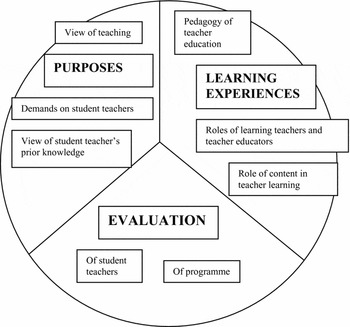
SLTE, through the career-long actions of its language teacher graduates, affects the lives of a large number of people. Like any human activity with such a potentially significant impact, it demands interrogation, and if it is a formal educational activity, the curriculum is the most logical point at which to begin asking questions. The core artefact of a formal SLTE curriculum is the course (or programme), typically a time-bound entity, also institutionalised in most contexts, and has a professional gate-keeping function. An SLTE programme mobilises an amalgam of (a) curriculum aims, (b) a range of learning experiences, affecting decisions about the choice of ‘training materials’ and teacher education pedagogies, and (c) evaluation/assessment procedures. Breen & Candlin's (Reference Breen and Candlin1980) curriculum model proposes central questions of this sort for a communicative language teaching curriculum (see Figure 1). I have adapted this model and reformulated the questions to account for an SLTE programme context and maintain that these questions remain a productive means of analysing any SLTE programme. There are three sets of questions, which are summarised as follows:
1. Questions defining the purposes or goals of any programme.
What sort of teacher should emerge from an SLTE programme?
What learning and developmental demands shall we make on learning teachers? What previous knowledge, values, attitudes and beliefs do learning teachers bring to a programme? Responses will assist in specifying starting points and the content of an SLTE programme. This element of the curriculum specification also contributes to the specification of minimum standards for entry into the profession in any given context, and may also be employed to specify programme exit standards.
2. Questions defining the formal learning experiences in an Initial Teacher Education (ITE) programme.
How can we help student teachers learn to teach? What is the role of the teacher educator? What part does content play in the learning experience? What is content on an SLTE programme? Pedagogies of teacher education are shaped by the responses to these questions. An SLTE curriculum may also consciously ‘build in’ opportunities for informal learning.
3. Questions defining the process of evaluation of programmes.
How do we know we have succeeded in meeting our curriculum goals? Have the learning teachers succeeded in attaining the required standard for entry into the teaching profession? The responses enable ITE programmes to fulfil their gate keeping function. This can require assessment (or evaluation, in the US) of student teachers as teachers at all stages of their programme. It also entails evaluation of the programme itself – whether it has succeeded in meeting its own aims and demands, in the short term, and also, most importantly in the long term, whether the graduates of a programme have the desired impact on the educational contexts where they teach.
Debate on the goals, content, process and evaluation of teacher preparation programmes for L2 teachers over the past 30 years has explicitly (or more commonly, implicitly) addressed these questions. These have changed, in response to various influences and forces operating inside SLTE itself and from the world at large.
The curriculum of second language teacher education (SLTE) (based on Breen & Candlin Reference Breen and Candlin1980: 2).

3.2 The changing face of SLTE: an emerging new agenda for practice
This section traces the emergence of a new agenda for SLTE over the past, approximately, 25 years. Britten (Reference Britten1985) provided the last major review of teacher training in English language teaching, (or ‘TT/EFL’, p. 112) in this journal. The review provides a snapshot of the territory of teacher education for EFL teachers at that point in time, and as such, is a valuable point of reference from which to gauge the extent of the SLTE journey which has occurred. Part 1 covered a range of topics from the goals of pre-service (or initial) teacher training, selection of candidates, subject (content) knowledge (of English) and the ‘methodology’ component, as taught on training courses. The second part concentrated on what Britten termed the ‘teaching skills component’; of special interest was the business of practice teaching and its evaluation. Other topics included were in-service teacher training and teacher trainer training. This review was comprehensive in that it covered virtually every aspect of SLTE practice at the time, and all the curriculum questions posed by the framework, albeit unknowingly. It portrays a version of SLTE which stays very close to its roots in Applied Linguistics, as was the practice at this time, with one or two hints that teacher education pedagogy could be developed beyond its conventional ‘demonstration and delivery’ pattern, but lacking a strong theoretical grounding in professional learning theory. In many ways, the literature he reviewed reflected the (primarily British) interest in practical ways of training teachers; Britten, in fact, laments the lack of research papers and ‘a dearth of book-length publications’ (p. 112) upon which to draw. He presents an activity somewhat limited by its orientation towards language and its feeder fields in Linguistics and Applied Linguistics, in which practice – school-based on one hand – (the learning of theory, methodology and skills) – training institution-based on the other – were separated. In fact, this was a fairly accurate representation of teacher education at the time in almost every discipline. This split of learning experience and location (or practice and theory) has been a difficulty in SLTE since then, and remains in any SLTE curriculum, following what might be termed the ‘Applied Linguistics model’. Changes in thinking about, and practice in, SLTE in the period post-1985 go some way towards addressing this problem by reframing the way in which what student teachers learn is conceptualised, and how and where it is learnt.
Since 1985, there have been significant changes in L2 teaching – in practice, theory and research – and correspondingly in teacher education and the professional development of English language teachers. The main questions posed by the curriculum framework now elicit different answers from many SLTE programmes which have embraced different ideas about the goals, learning experiences and evaluation of SLTE. Contemporary SLTE, as portrayed in the professional literature today, appears considerably more sophisticated and theoretically grounded than in Britten's time. Burns & Richards (Reference Burns and Richards2009) is an excellent collection of position papers which demonstrate the current breadth and depth of activity. It would probably be impossible today to write a review of SLTE with a similar scope as Britten. For example, areas such as ‘in-service training’ (or professional development), which he covered in a relatively short sub-section, now warrant substantial reviews such as Mann (Reference Mann2005) or full-length volumes like James (Reference James2001) and Richards & Farrell (Reference Richards and Farrell2005).
A new agenda for professional practice and research has emerged to challenge the Applied Linguistics SLTE curriculum of language training, language content knowledge and teaching skills reported by Britten. It first began to gain notice and find coherence with the publication of collections such as Richards & Nunan (Reference Richards and Nunan1990), Flowerdew, Brock & Hsia (Reference Flowerdew, Brock and Hsia1992), Freeman & Richards (Reference Freeman and Richards1996), and Johnson (Reference Johnson2000), and longer texts such as Roberts (Reference Roberts1998). These and other publications contributed new ideas about SLTE practice and also provided access to new ways of looking at SLTE, drawn from ‘general education’. Cambridge University Press also launched its Teacher Training and Development series, which covered a variety of SLTE activities – for example, classroom observation (Wajnryb Reference Wajnryb1992), tasks for SLTE (Parrott Reference Parrott1993), teaching young learners (Vale & Fuenteun Reference Vale and Fuenteun1995), and also a full SLTE course (Ur Reference Ur1996). It also went on to feature other SLTE activities such as action research (Wallace Reference Wallace1998), mentoring (Malderez & Bodóczky Reference Malderez and Bodóczky1999), language awareness (Thornbury Reference Thornbury1997; Arndt, Harvey & Nuttall Reference Arndt, Harvey and Nuttall2000), and supervision (Randall with Thornton Reference Randall and Thornton2001). Oxford University Press's Teacher education – a scheme for teacher education also contributed to debate and practice, in particular the series editors’ call for language teaching to become ‘a genuinely professional enterprise’ (Candlin & Widdowson Reference Candlin and Widdowson1987: i) and their belief in teachers’ critical appraisal of ideas and informed application of ideas in their own classrooms.
These publications, typically theorised accounts of practice, also began to draw upon a wider variety of feeder fields from outside SLTE than hitherto, encouraging interest in outside the relatively narrow confines of Applied Linguistics. A number of influential threads found their way into SLTE. The main strands were:
1. A deep concern with reflective practice (after Schön Reference Schön1983, Reference Schön1987), brought initially to the wider SLTE community by Wallace (Reference Wallace1991). This has subsequently become a basic concept in SLTE and signals a fairly radical departure in curriculum design and teacher education practice from the prescriptive to an emphasis on the student teacher's development of autonomous judgement and practical theory (Lockhart & Richards Reference Lockhart and Richards1994).
2. Teacher knowledge (Freeman Reference Freeman1989, Reference Freeman1991), teacher learning (Freeman & Richards Reference Freeman and Richards1996); teacher thinking (Woods Reference Woods1996), and pedagogical content knowledge (Shulman Reference Shulman1986; Roberts Reference Roberts1998).
3. School-based teacher learning, and a renewed interest in mentoring student teachers in the school context (for example, in the UK; Fish Reference Fish1989) captured the attention of SLTE practitioners. With it came new thinking and practice about the role of school cultures in teacher learning, and the importance of learning from experience. An example was the major SLTE initiative for English teachers in Hungary begun in the early 1990s, featuring at its core the notion of school-based teacher learning, supported by a mentoring scheme (Medgyes & Malderez Reference Medgyes and Malderez1996).
These trends emerged at a time when English simultaneously cemented its position as the dominant contemporary international lingua franca. As the demand to learn English has expanded, there has been a corresponding need for more trained teachers. This has led to the expansion of SLTE activity in several transitional countries such as China, Korea, and Vietnam, as well as in former Soviet-bloc states in Central and Eastern Europe and Central Asia. The processes of globalisation (economic and in the field of communications) have had an amplifying effect on the spread of English (Graddol Reference Graddol2006). Learning English is now regarded as a basic educational goal for people in many countries because of its pre-eminence as a global language. Consequently, there has been an increased demand for trained teachers of English. As Richards (Reference Richards2008) notes, SLTE is now a core activity, and central to ensuring the quality of the learning experience of many students of English. The need for large numbers of new English teachers is accompanied by demands for reform in the L2 curriculum, and thus new practices for teachers. Such changes require SLTE to present a more coherent justification for its practices. The following sub-sections discuss what has begun to happen as the strands have begun to knit together into a more coherent body of theory and practice in SLTE.
3.3 A reconceptualised knowledge base for SLTE
Despite the changes outlined in the previous section, Freeman & Johnson (Reference Freeman and Johnson1998: 401) observe that SLTE had ‘lagged behind’ methodological developments and research in ‘general education’. They point out that SLTE had only just begun to ‘recognise that teachers, apart from any method or instructional materials they might have used, are central to understanding and improving English language teaching’ (my emphasis). Freeman & Johnson's paper is intellectually a world away from the relatively simple choice between ‘holistic’ – broad educational goals – and ‘competency-based’ – vocational training – approaches to SLTE presented by Britten (Reference Britten1985: 113). These approaches, macro (educational) and micro (competency-based) have always been in tension in SLTE, as Richards (Reference Richards1990) argued, and Freeman (Reference Freeman2009) has more recently observed. However, it appears that the educational goal has become the dominant influence in the 1990s. While in 1985, SLTE was concerned with teaching and its various methods and techniques, by 1998, it had become more focused on learning to teach. Furthermore, Freeman & Johnson (Reference Freeman and Johnson1998: 402) argue for an approach to SLTE that draws on a ‘constructivist view of how people learn to teach’..As they assert (p. 402):
Learning to teach is a long-term, complex developmental process that operates through participation in the social practices and contexts associated with learning and teaching.
On this basis, Freeman & Johnson argue for a ‘reconceptualised knowledge base’, or what teachers need to learn in SLTE and about the process of learning. It concerns three interdependent domains:
• the teacher as learner of teaching
• schools and schooling as social contexts of teacher learning
• the pedagogical process – of language teaching and learning
These are linked by the processes of learning and socialisation, creating communities of practice in classrooms and schools, and participation in teaching and learning activity. The discussion of these themes creates a heightened awareness of the need for research on learning to teach, teaching, and learning in classrooms. The paper is an outstanding synthesis of ideas on learning-to-teach and the research which informs these ideas, but no claim is made for it as a blueprint for pedagogic practices in SLTE. One of this review's central aims is to examine the impact of the reconceptualised knowledge base on practice in SLTE programmes.
Freeman (Reference Freeman1989, Reference Freeman1991, Reference Freeman1996) consistently espouses the urgency of developing a coherent theory to support SLTE, and he has made a cogent contribution to its shaping and its expression. Central to this enterprise have been the questions of how teachers learn, and the nature and extent of the contribution of formal ‘preparation’ programmes to teacher learning. The relationship between practice and theory in SLTE has been a regular arena for debate (Trappes-Lomax & McGrath Reference Trappes-Lomax and McGrath1999). In the 1990s, the ‘technical rationalist’ (Schön Reference Schön1983, Reference Schön1987) model of ‘theory applied’ has been somewhat discredited, as the idea that teachers construct their own knowledge of teaching through engagement in the classroom – as students in SLTE, and in their subsequent experience as practitioners – has gained credence in SLTE.
Crandall (Reference Crandall2000) also notes the increasing influence of general education on SLTE during the 1990s, and identifies four main trends:
1. A theoretical shift from behaviourism to constructivism, leading to a recasting of the learning teacher from a ‘consumer’ of received knowledge to a thinker, a practitioner who forms their own working theory – in short, a ‘reflective practitioner’ who theorises practice (Richards Reference Richards2004; Farrell Reference Farrell2007a).
2. An understanding that student teachers’ prior learning and beliefs have a powerful influence on their conceptions of teaching and learning. In SLTE programmes, greater emphasis is thus placed on exploring student teachers’ (ST) prior learning experiences and beliefs and the influence of teacher educators in reshaping STs’ beliefs through their modelling of alternative pedagogies.
3. A growing realisation that SLTE programmes did not adequately prepare beginning teachers for the complexities of real classrooms. This has subsequently resulted in a greater emphasis on school-based, experiential practice for the learning teacher, as previously noted (section 3.2).
4. The growth of professionalism among ELT/TESOL practitioners. The accumulation of research and formulation of theory was, in contexts like the US, answering Richards’ (Reference Richards1990) appeal for increased professionalism. In SLTE programmes, the inclusion of research components, and the more developmental approach engendered by reflective practice, has ensured that SLTE is now viewed as the commencement of a long professional journey, rather than the preparation of the finished article.
These trends have continued since the millennium, and have been refined by further research and theorisation, and by innovations in practice on SLTE programmes. For example, a distinctive sociocultural view of SLTE has emerged from the social constructivist view of learning-to-teach in context (Johnson Reference Johnson2006, Reference Johnson2009). It has been a period of innovation and exploration of practice, inspired in no small measure by the directions signalled through the formulation of theory and incorporation of new SLTE pedagogies in the previous decade. Jacobs & Farrell (Reference Jacobs and Farrell2001) identify a ‘paradigm shift’ in language education during the same period (although the nomenclature is a somewhat hyperbolic reaction to the innovation culture which characterises TESOL/ELT). They observe that there is a tendency for practitioners to innovate in isolation, and thus change is implemented piecemeal. This, of course, assumes that change should (or could) be implemented. Perhaps sustainable change is the outcome of individual change – it is likely that change in SLTE practice follows similar patterns, a background issue informing the review to follow.
The new agenda for SLTE, drawn together by the reconceptualised knowledge base, has clear consequences for the SLTE curriculum in the early 21st century in terms of:
Goal – Producing reflective teachers, in a process which involves socio-cognitive demands to introspect and collaborate with others, and which acknowledges previous learning and life experience as a starting point for new learning.
Learning experiences – The provision of a variety of learning experiences in institutionally-based sessions and in real schools and classrooms, with an emphasis on awareness-raising, collaborative learning, reflection and learning from experience.
Evaluation – The creation of means of evaluating personal and professional learning, and long-term, research-based follow-up of successful graduates of SLTE programmes.
Different directions for research and practice are suggested by the reconceptualisation of the knowledge base, and because of this, delineating the coverage of this review has been a challenging task. The most useful function of this review is the opportunity to establish the extent to which these promising new theoretical constructs have had influence on what happens in SLTE programmes, when teacher educators work with student teachers in their learning to teach. This suggests central areas of SLTE practice. Thus I focus on two linked areas, in which there has been a fairly regular output of research and accounts of practice:
1. SLTE pedagogy and practice in formal, institutionally-based programmes, normally translated into learning experiences in the training room (Singh & Richards Reference Singh and Richards2006).
2. Activities in SLTE programmes which focus on practice teaching for student teachers.
In terms of the curriculum framework, these areas represent the core of the learning experience for STs. Furthermore, they reflect broad curriculum goals as well as broad underlying teacher education philosophies; they influence the selection of content, and also have an influence on evaluation practices.
Many important aspects of SLTE have thus been omitted from the review. However, the collection compiled by Burns & Richards (Reference Burns and Richards2009) covers many of these, including recent trends towards the professionalisation of SLTE (Barduhn & Johnson Reference Barduhn and Johnson2009; Katz & Snow Reference Katz and Snow2009; Leung Reference Leung2009). Among other changes, SLTE has responded to the challenges and opportunities presented by ICT technologies – reviewed by Hall & Knox (Reference Hall and Knox2009). Trappes-Lomax & Ferguson (Reference Trappes-Lomax and Ferguson2002), Svalberg (Reference Svalberg2007) and Andrews (Reference Andrews2007) are representative ‘state-of-the-art’ discussions of teachers’ knowledge about language (KAL) of relevance to SLTE. Burns (Reference Burns2005) discusses the role of action research in teachers’ professional learning, while Peacock (Reference Peacock2009) examines the evaluation of SLTE programmes.
3.4 Expanding and refining the knowledge base: recent research on SLTE student teachers’ cognitions
The purpose of this section is to review a selection of recent research on the reconceptualised knowledge base in SLTE, with a focus on the ‘hidden side of the work’ (Freeman Reference Freeman2002), or STs’ mental lives and learning processes. Constructivist and, increasingly, social constructivist theories of learning-to-teach underpin this trend. Freeman (Reference Freeman2002) establishes the research agenda in a comprehensive review and critique of the cognition-focused view of teacher learning. Freeman identifies three components of the research-informed ‘new knowledge base’: how teachers’ mental processes are conceived, the role of prior knowledge, and the role of social and institutional context in learning to teach. S. Borg (Reference Borg2003, Reference Borg2006) provides extensive companion reviews of research on teacher cognitions and formulates a research agenda which relates specifically to different stages in teachers’ learning and career paths. S. Borg (Reference Borg2006) notes, however, that there has been relatively little research on the development of teachers’ cognitions in SLTE – most of the work having been conducted with experienced teachers.
Whether or not SLTE programmes have had an impact on STs’ beliefs (M. Borg Reference Borg2001) about language learning and teaching is a central research theme. The influence of the ‘apprenticeship of observation’ (Lortie Reference Lortie1975; M. Borg Reference Borg2004) on the beliefs of learning teachers is taken axiomatically to be a major impediment to their absorbing alternative models of pedagogy which challenge those that they have already acquired – often portrayed negatively, such as transmission. There is a clear danger in this respect of a new orthodoxy developing in L2 teaching, whereby any pedagogy with non-constructivist leanings is portrayed as inherently ‘bad’. The evidence from general teacher education (for example, Wideen, Mayer-Smith & Moon Reference Wideen, Mayer-Smith and Moon1998; Lewin & Stuart Reference Lewin and Stuart2003) and SLTE (Bigelow & Ranney Reference Bigelow, Ranney and Bartels2005) is, however, that formal teacher preparation courses have relatively little impact on STs’ pre-existing beliefs.
Wideen et al. (Reference Wideen, Mayer-Smith and Moon1998) review over 300 studies on initial teacher education, and demonstrate conclusively that pre-existing beliefs are relatively impervious to change in formal courses. They also argue that Lortie conducted his study of teaching in which he identified the now widely-used concept of the apprenticeship of observation with experienced teachers over 40 years ago, and that its influence on STs is probably more effectively studied in initial teacher education programmes. They posit that the relative lack of success in courses is not necessarily because of a failure to change beliefs per se, but a failure of what they term the ‘traditional’ model of initial teacher education. They identify a clear need for systemic change therein, breaking down the split between ‘theory learning’ in training institutions and ‘practice’ in schools, a binary also noted by Freeman & Johnson (Reference Freeman and Johnson1998: 406). They regard research into social and cultural conditions in schools, the values of teacher educators themselves, and the needs of beginning teachers as more likely to reveal how cognitions change. Lewin & Stuart's (Reference Lewin and Stuart2003) survey of initial teacher education in several developing and transitional countries reaches the same broad conclusions: The learning experience of STs should be the focus of reform in initial teacher education.
However, research on the interactions of STs’ prior knowledge and beliefs about language teaching and learning, and programme goals, course content and teacher educators’ cognitions and pedagogy in ongoing SLTE programmes is almost non-existent. There is also a tendency to examine beliefs in isolation (Donaghue Reference Donaghue2003). S. Borg (Reference Borg2006) also warns that research findings from these types of study are more often than not a product of the means by which data is gathered and analysed. Verbalisations of belief are not entirely reliable, and may be less so when subject to researchers’ interpretations.
A sociocultural view of the learning-to-teach process as it is experienced in SLTE programmes, where STs’ prior knowledge and beliefs interact with programme goals, course content and teacher educators’ cognitions and pedagogy would appear to provide a productive alternative to current research. A sociocultural view of SLTE, Johnson (Reference Johnson2006, Reference Johnson2009) argues, prioritises the role in teacher learning of social and cultural contexts of teacher education. Johnson emphasises the influence of the broad social and political contexts in which SLTE takes place on teacher learning and classroom practice, and presumably teacher educator practice in SLTE. A more contextually-focused research direction in SLTE is suggested, which hopefully will begin to illuminate the effect of daily encounters between STs, TEs and resources in formal SLTE sessions, where, ultimately individual and collective change is mediated.
A sociocultural approach to teacher cognitions concerns the nature of teachers’ knowledge, and its role in SLTE, and the contextual influences on its nature and acquisition. How teachers ‘come to know’ is an issue discussed by Szesztay (Reference Szesztay2004). She argues that teachers are most likely to develop their knowledge of teaching by engaging in teaching – an intuitive and contextually-sensitive process – and that it is difficult for teachers to express tacit knowledge of this type. This view questions how ‘direct’ an approach to influencing STs’ cognitions in SLTE might be. It also creates doubt about the reliability of self-reported beliefs. Xu & Connelly (Reference Xu and Connelly2009) provide a means of reframing this dilemma, distinguishing as they do between knowledge-for-teachers (the traditional knowledge base of SLTE grounded in subject knowledge and teaching skills) and teacher knowledge – ‘the way teachers know themselves and their professional work situations’ (p. 221). As Szesztay also notes, by focusing on the way teachers narrate their self-knowledge and practice, we may gain greater understanding of learning to teach. Further studies on teachers’ beliefs, either at a particular moment in a programme or as they evolve, are reviewed in this light.
Mullock (Reference Mullock2003), a descriptive study of perceptions of ‘good teachers’, is concerned with understanding teachers’ expertise (see also Tsui's (Reference Tsui2003) full-length study of Hong Kong L2 teachers’ expertise), and establishing a connection between language teachers’ and educationalists’ views of ‘expert teaching’. She interviews large numbers of experienced teachers and STs on an Australian SLTE programme as one group. By mixing categories in this way, it is possible that the more experienced teachers could have influenced the STs’ views. She finds only minor variations of belief between the two groups and that beliefs about pedagogic content knowledge, attitudes and behaviours towards students, teachers’ personal characteristics and attitudes, content knowledge and broader educational knowledge and skills were the most significant. No claims are made regarding the ‘ideal products’ of SLTE programmes.
Further research has been conducted on the central question as to whether or not beliefs change during SLTE programmes. Mattheoudakis (Reference Mattheoudakis2007) reports on a longitudinal questionnaire-based study of Greek STs’ beliefs about language teaching and learning over the three-year period of their four-year preparation programme. Despite the limitations of questionnaire-based research, the author identifies important issues in developing belief systems on SLTE programmes. The role of teaching practice is a special focus of this work, as it is believed that encounters with real classrooms can have a transformative effect on STs’ beliefs. However, she finds the experience has a low impact on STs’ existing beliefs. This might have been because STs are required to adhere to the central curriculum, which is based on ideas different from those being taught in the SLTE programme; the relative lack of opportunities for reflection with a coach, supervisor or mentor might also have affected outcomes. Elsewhere the author tracks gradual changes in beliefs, with occasional abrupt shifts on courses which contained declarative and procedural knowledge (e.g. theories of language acquisition). She also finds that the STs’ initial beliefs about the centrality of vocabulary and grammar learning in language learning remained strong throughout the course. In conclusion, she identifies teacher education pedagogy as a key factor in bringing about changes in STs’ beliefs and proposes changes in the programme to include less transmission and more experiential and constructivist learning experiences.
Malderez et al. (Reference Malderez, Hobson, Tracey and Kerr2007), in a long-term UK-based study using both in-depth interviews and questionnaires, explore the motivations, preconceptions and expectations of teaching and learning to teach and the early experiences on their training programmes of a large number of STs (a proportion of whom are language teachers) following a one-year initial training programme. The main findings are (a) the influence of both past and present teachers on the shaping of teacher identity, (b) the relationships with ‘significant others’ in teaching, (c) the relevance of the training programme, and (d) the emotional dimension of the training programme. The authors conclude that pre-service programmes need to find ways of helping STs’ develop ‘the teacher within’ and to satisfy the need to live out interpersonal relationships more explicitly while in training. They further highlight the role of emotional states in the learning and transitional processes of becoming a teacher. They also suggest greater attention be paid to the structure of SLTE programmes, so that theory can be informed by experience in practical teaching experiences.
Cheng et al. (Reference Cheng, Chan, Tang and Cheng2009) report on a study of final year pre-service teachers on a four-year undergraduate programme in Hong Kong, a significant proportion of whom were language specialists. Cheng's team, using a mixture of questionnaire and interview data, discovered that the informant group held strong beliefs about the greater importance of learning effort than innate ability. The group were also inclined to question the authority of knowledge and believed that knowledge changes. The authors note that the spread of constructivist and reflective thinking in all sectors of education in Hong Kong seems to have been influential, particularly in teacher education, and this is reflected in informants’ responses. Constructivist pedagogic strategies in SLTE appear to be successful in bringing about change if the STs have themselves experienced such methods and found them to be helpful in their own learning. However, it is not always easy to experiment with ideas learnt on the course in periods of practice teaching in the schools, where more traditional beliefs linger. The expressed preferences for constructivist methods may also have been affected by a desire to impress the research team, and may fade later after prolonged exposure to school cultures as employees rather than STs. The authors suggest building closer relationships between schools and training institutions but, beyond stronger bonds with mentors, they do not offer specific means of dealing with this barrier to change. Again, like Malderez et al. (Reference Malderez, Hobson, Tracey and Kerr2007), Cheng et al. advocate SLTE learning experiences which model reflective processes and judgements as well as closer TE/ST relationships in training, leading to more sympathetic and supportive learning conditions.
Influencing STs’ beliefs about learning and teaching is today a primary goal of SLTE. Not only are STs in transition to a new teacher identity, but their beliefs may also conflict with contemporary constructivist views of learning – hence the quest in SLTE for changed minds (Hill Reference Hill2000). The research studies reviewed in this section broadly conclude that alterations in the pedagogy and learning experiences of SLTE programmes, through practices such as more explicit engagement with STs’ beliefs in SLTE programmes, under supportive interpersonal and emotional conditions, are likely to have a positive impact on STs’ beliefs and, therefore, their practices as teachers. However, increased knowledge and insight into STs’ beliefs and cognition per se may only indirectly influence SLTE practices. Beliefs do not readily or rapidly change. There is, however, a growing awareness that the learning experiences which SLTE programmes provide, together with the pedagogies that TEs model, the various interactions on an SLTE programme, the relationships between all participants, and the emotional conditions under which SLTE is carried out can all have a positive influence on STs’ cognitions.
Changes in our thinking about the broad goals of SLTE have led to critiques of behaviourally-influenced practices and debate about the relative value of short courses. Murray (Reference Murray2009), for example, provides an extensive critique of CBT (competency-based training) – the archetypal behavioural approach to SLTE – in Australia and New Zealand. She argues that the behavioural origins of CBT make it an unsuitable model for course design and evaluation (assessment) in SLTE in the contemporary ‘post-method’ professional landscape with its central precepts of teacher autonomy and reflection. Murray argues that working in a context less preoccupied with method and more engaged with creating learning opportunity requires a different approach, more akin to exploratory practice (Allwright Reference Allwright2003). Allwright & Hanks (Reference Allwright and Hanks2009) observe, however, that introducing exploratory practice in SLTE programmes is difficult because of the relatively low level of importance these attach to STs gaining a genuine understanding of learners. Murray concludes by noting that SLTE should not be seen in terms of measurable outcomes, but rather as an opportunity to acquire insights which may begin to shape values and dispositions in the long-term, during a teacher's working life.
The new agenda has also led to criticism of, and modifications to, the intensive one-month course SLTE model epitomised by the CELTA (Certificate in English Language Teaching to Adults), probably the most well-known basic SLTE programme. The CELTA has gained a good reputation for providing beginning English language teachers with a sound basic grounding in teaching and content knowledge. However, a number of papers (Ferguson & Donno Reference Ferguson and Donno2003; Horne Reference Horne2003; McPherson Reference McPherson2003), and theses (M. Borg Reference Borg2002; Hobbs Reference Hobbs2007) query whether short courses like the CELTA might inhibit the growth of reflective thinking and changes in beliefs about learning and teaching. M. Borg (Reference Borg2005) describes an individual teacher learner's changed thinking on a CELTA training course in the UK, evidencing a shift in belief from a teacher-focused view of grammar learning to a learner-focused one. The data are drawn directly from the teacher's self-reported changes in perception. Borg speculates on the depth of this change in belief, and how permanent this might be, especially given that the underlying principles of the CELTA are ‘learner-centred’; she argues that it would have advantaged the ST to have made the shift and as a result succeed in the programme. Hobbs (Reference Hobbs2007) reaches similar conclusions about the effect of CELTA courses.
4. Changing SLTE pedagogy
The shift away from behavioural views of SLTE teacher learning has also prompted challenges to transmissive pedagogy, and there is accumulating evidence from accounts of practice of the appropriation of experiential (Dewey Reference Dewey1938) and constructivist and social constructivist (Lantolf Reference Lantolf2000) views of learning, of reflective practice, and action research in SLTE pedagogy. There are three interconnected issues raised by this change.
First, there are dilemmas for the practitioner in such change, which may not be immediately obvious. For example, Hawkins (Reference Hawkins2004b) and Stein (Reference Stein2004) ponder the effect on SLTE discourse of a more participative and process-led pedagogy, and thus the need for participants to acquire new discourses. Freeman (Reference Freeman2004a) examines the implications of shifting what he terms the ‘architecture of instruction’ (the talk generated by pedagogy – based on discourses) from a transmissive (passing on packaged knowledge) to a sociocultural (or, broadly, interactive, and constructed) perspective, which favours dialogue above instruction. He identifies two directions of challenge to SLTE – ‘outside-in’ and ‘inside-out’. The former sees a shift from technical rationalism (Schön Reference Schön1983) to a view of teaching as a moral activity grappling with social justice in different contexts. This view, argues Freeman, is attractive but potentially flawed in today's relativistic world where values conflict is part-and-parcel of educational discourse. The latter, ‘inside-out’ challenge, views the reproduction in SLTE of the social processes of classroom life through the technical rationalism of SLTE programmes as the chief obstacle to change and a more equitable world. It is, therefore, up to teacher educators to adopt a pedagogy which challenges the hegemony of ‘packaged’ knowledge. This dilemma is also implicit in Wright (Reference Wright, Hussain, Ahmed and Zafar2009) in a discussion of how a less didactic teacher education pedagogy might empower STs by enabling them to develop awareness and voice, and take ownership of pedagogies sensitive to the challenges of the contexts in which they will practice.
Secondly, there are dilemmas for STs. Grigoroiu (Reference Grigoroiu2002) analysed at length the effects of introducing a more ‘reflective’ approach to SLTE in her Romanian university in the 1990s. In addition to reorienting the teaching practice procedures to a ‘reflective approach’ wherein observers and student teachers engaged in discussion of observed lessons, Grigoroiu also reports on the experience of introducing a more social constructivist approach to pedagogy in the ‘teaching methodology’ components of the programme. The experience was not without difficulty, and the problems experienced by student teachers in adapting to the new pedagogy are sensitively reported. The study also provides helpful insights into the process of introducing a new SLTE pedagogy into a didactic tradition. She reports conflict between two teacher education ideologies, exacerbated in her context by large classes, the STs’ previous (successful) experience of learning in a transmissive mode, and STs’ idealised constructions of teaching.
Xu & Connelly (Reference Xu and Connelly2009) discuss the importance of a narrative inquiry approach (Johnson & Golombeck Reference Johnson and Golombeck2002) at all levels of the reform process in Chinese SLTE, from broad educational ideologies, to specific practices such as working with STs’ previous learning and life stories in SLTE. Their discussion of the relationship between what they term ‘teacher knowledge’ and ‘knowledge-for-teachers’, or ways of being and ways of knowing, echoes issues raised by Szesztay (Reference Szesztay2004). They note that there is a strong relationship between the two types of knowledge, and that all new ideas are viewed through existing professional and cultural schemata and ways of knowing and doing. Xu & Connelly regard the ‘telling of stories’ as an essential precursor to creating a context for the consideration of new ideas in teaching. This also applies to taking on new professional identities as in SLTE.
The pedagogy that seems to be emerging in SLTE has the following characteristics:
1. An emphasis on the student teacher's learning to teach, and becoming a thinking teacher.
2. This, in turn, means a great deal of reflective activity programmed into learning experiences, often with written records in the form of journals or diaries.
3. This also entails a commitment to student teacher inquiry – into one's own beliefs and narratives, and into the professional contexts of teaching and learning for which STs are being prepared.
4. It has resulted in the appropriation of pedagogies from adult education whose central idea is learning from experience (Kolb Reference Kolb1984; Brookfield Reference Brookfield1988, Reference Brookfield1995; Mezirow Reference Mezirow2000, for example)
4.1 Experiential pedagogy in SLTE
All the new forms of SLTE pedagogy share the primacy of experience (or ‘doing’) as a precursor to conceptualising in formal training sessions. Principles are derived inductively from practice or experience, as might occur in the ‘natural’ learning that a teacher experiences, usually unconsciously, during their career. Learning experiences proceed through different stages of activity and feature talk of different types between and among participants, and an underlying reflective orientation.
Malderez & Wedell (Reference Malderez and Wedell2007) describe a model of SLTE pedagogy with five main steps, grounded in one of three ‘knowledge types’ (or what the ST needs to know and learn):
• ‘knowing about’, information processing and concept development.
• ‘knowing how’, concerned with the development of skills, or ‘being able to do something’ (p. 23), and
• ‘knowing to’, the ability to draw upon and mobilise the other two knowledges appropriately while teaching. This is a combination of what Eraut (Reference Eraut1994) terms ‘people’ and ‘situational’ knowledge and is a strategic knowledge acquired mainly through experience and which tends to be intuitive or tacit.
Step 1 consists of defining the knowledge type and ‘public theory message’ of a training session. This step is typically focused on an experience of some type (past or recent). Step 2 requires STs to interpret and explain the experience. In Step 3, participants read about or listen to others’ ideas about the experience (or similar ones). In Step 4, STs are invited to process the various opinions they encounter in Step 3, with a view to deriving new or revised perceptions and knowledge. In Step 5, STs imagine themselves trying out new ideas in future teaching situations.
The activity sequence described by Malderez & Wedell closely resembles the ‘Learning Cycle’ (Kolb Reference Kolb1984). This is a pattern widely used in SLTE methodology and which also appears in an adapted form in Ur (Reference Ur1996). She proposes an ‘enriched’ model, in which the TE provides strong direction and regular input as the ST progresses through the four stages of experiencing, reviewing, conceptualising and planning. Wright & Bolitho (Reference Wright and Bolitho2007) also present an adapted version of the Kolb Cycle, with an emphasis on the types of activity STs would be invited to engage in at each stage, working from experience (past or present and shared), through review, sense-making (Golombeck Reference Golombeck2000), and finally to real-world application – the problematic ‘transfer of new learning’ stage. This conceptualisation has a strong emphasis on the role of different types of talk, from TE monologue to ST-managed discussion in the learning process.
Woodward's (Reference Woodward2003) ‘loop input’ procedure also begins with STs’ experience of their learning knowledge or skill, which is in effect modelled as a training activity. For example, STs first experience a speaking activity in order to begin to explore the types of speaking activity to be used in the language classroom. Like the three activity sequences reviewed above, it entails considerable amounts of – typically guided – discussion among the STs. DelliCarpini (Reference DelliCarpini2009) reports her positive experience with this approach when introducing collaborative learning to her STs. She establishes that the STs have taken ownership of collaborative learning, but does not report on whether or not this new awareness made the transfer into the STs’ practice.
SLTE pedagogy is a contentious area of SLTE, in which claims for appropriacy and effectiveness are not supported by accounts of training room encounters. Beaumont (Reference Beaumont and Fritz2006) identifies a range of possibilities in SLTE pedagogy and urges judicious choice in their deployment. As Beaumont & Wright (forthcoming) point out, however, there is a danger of constructivist experiential SLTE pedagogy becoming a degraded form of transmission, in which STs ‘discover’ what the TE (or the received wisdom of the ‘book’) already knows; what Britten (Reference Britten1985: 122) terms ‘cat and mouse’. On the other hand, Gray (Reference Gray2004) argues that in language teacher education, the sort of craft knowledge that an experienced teacher accumulates during a career cannot simply be passed on in lectures – it has to be ‘found’. She outlines a series of procedures for raising awareness on a one-year postgraduate SLTE programme in the UK (p. 26) – reading published narrative accounts which explore teacher knowledge; observation and discussion; joint planning, teaching and exploration of teaching dilemmas; student research projects; stimulated recall of video recorded teaching episodes. She also describes a procedure whereby she makes her own teaching available to STs by sharing her lesson planning and then teaching live classes, recording her immediate responses to events as they unfolded in the lesson, in discussion with the STs. She also acknowledges the difficulties of eliciting the craft knowledge which underlies teachers’ practices and points out that these procedures require the contribution of a skilful teacher educator if they are to be successful.
4.2 Modelling new SLTE pedagogies
Changing from a transmission model is a major step for a TE and for STs. One way of introducing the latter to new pedagogy is through modelling. J. Smith (Reference Smith2001), in an extended reflection on her own practice in SLTE with postgraduates in the US, also discusses the nature and purposes of ‘modelling’ and ‘direct experience’ in SLTE. Drawing on Vygotskyan and Deweyan theory, she argues for the inclusion of relational imitation in SLTE, whereby STs can experience alternatives to behaviourist and transmissive pedagogies by directly experiencing constructivist alternatives. Smith advocates the inclusion of regular constructivist activities in an SLTE programme in addition to teaching practice. She claims her STs progressed from experiencing constructivist practice to its adoption in their own practice lessons. A key component of this progression was refection – both ‘live’, following modelled practices, and written, in portfolios.
Hockly (Reference Hockly2000) describes an attempt to improve STs’ capacity to reflect on experience in a one-month CELTA programme in the UK in which ‘knowledge-for-teachers’ was the focus. She uses a process of cognitive apprenticeship – a way of grounding STs in a more reflective approach to their teaching, a cyclical process beginning with observation of ‘expert’ teaching (a form of ‘modelling’ for STs to observe). STs are then invited to analyse the modelled lessons, subsequently undertaking teaching practice (coaching with the assistance of the tutor). This is later followed by ‘fading’, where modelling is replaced by attending to the increasingly autonomous STs’ actual needs in teaching practice. Hockly claims two benefits from this process – STs learn critical skills, and what they further need to learn at their current stage of development.
A small-scale study by da Silva (Reference da Silva2005) established that the perceptions of a group of Brazilian STs regarding the teaching of the four skills were a complex amalgam of experiential (absorbed in their apprenticeship of observation and their lived experience) and theoretical knowledge gained on the SLTE programme. The influence of these two sources of knowledge and how the STs experienced them were identified and interrogated during teaching practice. Da Silva notes that the more vivid the memories of lived experience, the closer the relationship there was with theoretical knowledge, the fewer dilemmas and conflicts STs faced; theoretical knowledge was supported and confirmed by experience and vice versa. However, she leaves the issue of inherent disjuncture between theoretical and practical knowledge in SLTE open.
4.3 Reflective procedures and practices in SLTE pedagogy
This section describes SLTE pedagogy which adapts research techniques as the basis of experiential learning. The accounts are all drawn from their authors’ practices as TEs, and thus also count as action research, in which researcher and TE roles merge.
Farrell (Reference Farrell2006a) regards it as vital for TEs to engage with previous experience and beliefs because of ‘competition’ with received knowledge in an SLTE programme. Drawing on Roberts’ (Reference Roberts1998) claim that, because the beliefs in question are tacit, they limit the STs’ frames of reference, and that teachers should be ‘freed’ from their tacit beliefs, Farrell describes how he uses metaphor to elicit Singaporean STs’ beliefs during a school practicum experience. This is a good example of working directly with STs’ prior knowledge. The longitudinal nature of the metaphor work Farrell describes is offered as a way of helping prepare STs to accept new pedagogic ideas. Images are elicited over a period of time in order to explore any changes through a process of critical reflection (guided by TE) on STs’ journal entries. The awareness gained, Farrell claims, assists decisions on whether or not new models are appropriate for the STs’ teaching situation.
Farrell (Reference Farrell2006b, Reference Farrell2007b) uses case-based teaching (see also Reichelt Reference Reichelt2000) in two ways as a means of promoting reflection among his Singaporean STs. In an investigation of the problematic experience of a novice teacher in their first year of school experience, Farrell (Reference Farrell2006b) concludes that an appropriate way of preparing novices for the transition from course to classroom reality is for STs to work with cases constructed from the narratives of novice teachers (Reference Farrell2007b). He recommends moving away from a concern with language teaching methods on SLTE courses to the development of the skills of anticipatory reflection during the course. This process, he argues, will raise novice teachers’ awareness of what they might experience when they make the transition from SLTE to novice teacher in the first year of teaching. He proposes linking this learning experience to classroom observation, journal writing and group discussions, developing capacities for reflecting on both teaching and the contexts in which it occurs.
Farrell (Reference Farrell2008a) explores the use of critical incidents with undergraduate STs, again on a practicum period in schools in Singapore. A process of ‘formal reflection’ is recommended as the basis for a small-scale research project, in which students describe incidents in writing and then, in a cooperative process, exchange interpretations of the incidents. Farrell observes that the STs focused almost exclusively on ‘negative’ incidents and suggests that they might also benefit from examining ‘teaching highs’ (i.e., when they have been successful). Farrell observes that the awareness raising process enabled the STs to be more realistic about teaching and to recognise some of its uncertainties and complexity.
Farrell (Reference Farrell2009) describes how, by using concept mapping, he was able to assist graduate students in Canada to become more aware of their beliefs, and how these develop during a programme. He sees the process of concept mapping as a way of revealing beliefs and concepts formed in previous learning and life experiences, among these being SLTE programmes. The exercise elicits STs’ expectations about the coming course, and thus provides the tutor with valuable insights into the assumptions and beliefs they bring to the programme. The increasing sophistication of STs’ thinking as the course progresses is visible in their maps, and it is significant that the early representations are, to some extent, residues of previous SLTE courses followed by participants. Farrell claims that the mapping process helps to evaluate both what STs know and how they conceptualise it – a representation of cognitive processing, which includes critical reflection. He sees group discussion – reflecting aloud – as a vital part of the process of clarifying concepts. It is debateable, however, whether the process is always one of critical reflection.
Similar techniques have been employed by Tan (Reference Tan2006). By asking her postgraduate STs in Thailand to take different roles (learner and teacher), and therefore perspectives on teaching, she encouraged them to view the experience of lessons from different standpoints. A significant by-product of the experience was the development of a learning community among the STs, bound together by common experience and convergent beliefs about teaching. This encouraged them to try out new pedagogy and to discuss openly their reflections on the demonstration lessons they had experienced. The resultant professional gain in skills such as evaluation and self-evaluation, Tan argues, is a means of initiating a development ‘culture’ in STs.
Damron (Reference Damron2005) reports a scheme whereby she introduces STs on a US postgraduate SLTE programme to professional development by encouraging and supporting them in conference attendance. She includes an activity in her programme which involves all aspects of organising, delivering and disseminating ideas in a ‘mini-conference’. It also includes writing a paper or preparing a poster presentation. As well as setting up and managing the conference, students also present and evaluate each other's contributions. A review follows the conference in which presenting students prepare a ‘report’ which they share with the tutor for feedback and comment. This also doubles as an element of the assessment for the programme.
While there has a been a fair amount of innovation drawing on the new agenda in SLTE, such as developing reflection and exploring prior knowledge among STs, relatively little has been published which examines what actually happens in formal institution-based training sessions. Without this perspective, it is difficult to evaluate the claims they make for the effectiveness or appropriateness of the new activities or any difficulties encountered in the process. Singh & Richards (Reference Singh and Richards2006), however, provide an invaluable insight into SLTE contexts, or ‘cultures’ as they term them, working from a sociocultural viewpoint. Their central argument is that the essentially transmissive ways in which STs are exposed to ‘knowledge-for-teachers’ on training courses does not adequately prepare them for work in the uncertain world of classrooms. Such experiences ignore the emergent nature of learning, mediated by identity and the context. Singh & Richards assert that knowledge and understanding emerge from the multiple interactive events in a training room which operates as a community of practice. Citing a range of pedagogic practices in teacher education, Singh & Richards contend that practices of dialogue (Johnston Reference Johnston2000), discovery, inquiry and collaboration in SLTE sessions effectively model the types of pedagogy which might also be suitable for the language classroom. In other words, teacher educators model practices which challenge a transmission model of teaching and learning. In theory, this should more effectively enable transfer from the SLTE programme to the teaching context, because STs absorb new methodologies and practices experientially during their SLTE programme. This process does not occur without dissonance, however: Any new pedagogy is open to question by STs.
The focus on process in SLTE programmes marks a departure from established concerns with standards and content. However, the practices of transmission also submit to a sociocultural analysis – the central issue is what happens when transmission is superseded by a concern with dialogic process. Two contrasting ecologies emerge in an SLTE course room from two different pedagogies, both of which STs might learn. However, the evidence suggests that, unless the culture of transmission is challenged (with inevitable difficulties), it will continue to be absorbed by successive generations of STs.
4.4 Developing reflective writing
The practices of ‘reflection’ and the notion of a teacher learning to become a ‘reflective practitioner’ have become established elements of SLTE programmes worldwide as part of the process of lifelong professional development. One of the most visible realisations of this trend is the practice of reflective writing in the form of journals (diaries) and portfolios. Over the past decade issues involved with reflective writing are emerging from accounts of practice, especially as the activity spreads into contexts where it is a fairly radical innovation.
Early instances of publication include reports on the ST experience of writing journals reflecting on key issues in their teaching contexts. The value of a journal as a conduit between the SLTE programme and the realities in schools and classrooms in the US is illustrated by Dong (Reference Dong2000) and Orem (Reference Orem2001), the latter using a web forum. STs are encouraged to stand back from their experience in these practices. Increased awareness of the issues, although not so significantly of their own learning-to-teach process, is a demonstrable gain from this activity. As journaling has spread as a reflective practice, the latter, more introspective, aspect has become a more obvious goal.
Tanner et al. (Reference Tanner, Longayroux, Beijaard and Verloop2000) describe the introduction of portfolio assessment in an undergraduate SLTE programme in Holland. The scheme encourages STs to experience a learning spiral of reflective action in their practice teaching similar to the cyclical activity employed in formal institution-based sessions described in section 3.1 – looking back on practice, using insights gained to plan for future action, trying out new ideas in practice, then reflecting on this experience and drawing conclusions, before planning for new activity. The authors conclude that building portfolios helps prepare student teachers for the complex realities of teaching and induct them into the practices of review and reflection on teaching during their SLTE programme. It also appears to foster individual development although more collaboration would enrich the process. Portfolios are also assessed. This aspect of their practice is reported somewhat uncritically, however, probably because problems had not arisen at this early stage of development. The difficulties of assessing reflective writing – for example, depth – are now well documented, however (Moon Reference Moon2004, Reference Moon2008).
Banfi (Reference Banfi2003) uses portfolios with her Argentine STs to integrate advanced writing practice and study skills among her trainees to compensate for the lack of teaching materials for language improvement. STs produce complex compilations of writing on literature in English, followed by reflective activity on completion of the portfolios. While not directly addressing pedagogic skills development, or content knowledge per se, Banfi believes this activity helped increase STs’ independence and capacities for reflection.
Later experience with reflective writing appears to reveal difficulties with the activity. Lee (Reference Lee2007) discusses a one-year journal writing programme for a group of her STs in Hong Kong. The cohort was divided – one group engaged in a journal dialogue with Lee, and another kept a journal on their experiences in a methodology course. Lee analyses the journals using three criteria. She found the STs were able to generate ‘additional perspectives’ on their experience beyond the descriptive, to explore their own values and beliefs, and to relate programme issues to the wider educational context of Hong Kong. While noting that journal writing is beneficial in the development of reflective thinking, Lee also recommends more explicit instruction in journal writing and problematises her own role in the process. By sharing her diaries with her STs, Lee is modelling reflective practice and collaborative activity. She is also risking her authority and status as a trainer by opening her practice up to scrutiny. She warns against journal writing becoming a chore and, despite the problems raised, advocates encouraging students to read each other's journals, to further develop their reflective capacities.
A portfolio learning activity for Dutch STs on a one-year programme attempting to make strong connections between practice teaching and institutional learning activity is analysed by Mansvelder-Longayroux, Beijaard & Verloop (Reference Mansvelder-Longayroux, Biejaard and Verloop2007). STs produce two portfolios of reflection on their learning experiences in the two main activities on the course. The analysis shows that the STs became more aware of their immediate performance as teachers in the practicum, but less able to think more deeply about theoretical issues and to make connections between these and their practice. The authors suggest that the individual nature of the activity may have limited deeper theorising and that more discussion and cooperation between learners might lead to greater engagement with the rationale underlying STs’ choice of pedagogy.
Reporting on the experience of introducing reflective practice to Malaysian undergraduate STs through collaborative journal writing and reading, Kabilan (Reference Kabilan2007) argues that the practice enables both STs and tutors to assess gains in knowledge and understanding. It also creates heightened awareness of meaningful and effective classroom practices, together with improvement in linguistic proficiency. A further gain is a more positive attitude towards teaching and learning, as well as an increased student capacity for self evaluation of their teaching performance. From these findings, Kabilan derives a model of the mutual effects of sharing knowledge and perceptions on practice, contending that, given an atmosphere of honesty, this enables the reconstruction and enhancement of knowledge among STs. He maintains that reflection should be taught in an atmosphere of collaboration as a core component of courses and that a ‘higher level of reflection’ (p. 700) – reflecting on reflection – should be incorporated into a programme. However, Kabilan does not state how the programme might accommodate the inclusion of new practices on the scale suggested. The account is very positive in tone and mentions few of the difficulties encountered in other contexts. The data quoted from STs is very positive, and there is thus a possible danger that STs are telling their tutor what he wants to hear, or are working to excessively prescriptive guidelines.
The difficulties of written reflective activity are increasingly highlighted. Akbari (Reference Akbari2007), working from an Iranian perspective, provides a refreshing critique of ‘reflective practice’. This polemical paper maintains that ‘effective reflection . . . would be impossible unless a sound grasp of its basic principles is established and a mastery of the discourse norms and features of the community established’ (p. 204). This is a welcome antidote to some of the unquestioningly positive responses to reflective writing that have emanated from other contexts. Luk (Reference Luk2008), in a problem-posing study from Hong Kong, establishes a wide range of proficiency in her undergraduate STs’ reflective writing. Having established some of the discoursal norms of this genre, and located it in reflective practice, he proceeds, through a linguistic analysis of STs reflective journals, to identify considerable disparities between STs’ skills in reflective writing. Luk perceives the ‘emergence . . .[in embryonic form] . . . of the discourse of reflections’ (p. 637) in the adept STs’ writing, but argues that STs need systematic preparation for reflective discourse, which he regards as a prerequisite for entering the community of practice of language teachers. Notwithstanding potential problems with the descriptive discoursal model employed for analysis, this research is a salient addition to the discussion of written reflection, and raises further questions about the difficulty of assessing this type of writing.
4.5 Research skills and practices in SLTE
While many practitioners recommend a research component as a means of developing inquiry skills in SLTE (Wallace Reference Wallace1998), there are not yet many accounts of experience. This section reviews a small selection. Matei (Reference Matei2002) analyses the experience of introducing her Romanian undergraduate STs to classroom research as an optional and experimental part of their programme. Participants report that the experience of doing research with students and in classrooms has made them both reflective and realistic. The process ends with Matei and her students giving joint presentations of their research at an international conference. This final stage demonstrates how this particular activity enables STs to engage with the professional community, and to begin the long process of becoming a member of the international community of English language teachers.
Jones (Reference Jones2004) reports on his experience in an Australian undergraduate SLTE programme course in which STs engaged with the ‘teacher-as-researcher’ role. They came to realise through the process that there were many benefits from engaging in teacher research, such as engagement in developing cultures of group work, from which they develop new skills. Issues hitherto regarded as theoretical become relevant through working in classrooms with learners, who can also engage the STs in critical reflection about their projects. STs also have the opportunity to display the results of their research and, by so doing, realise the impact they may have made on the context through their work. These outcomes are in many ways similar in effect to Matei's groundbreaking work.
El-Dib (Reference El-Dib2007) combines action research and reflective thinking during a period of teaching practice on an Egyptian SLTE undergraduate programme. The main source of data is the STs’ journals, written during their school experience. The research attempts to establish ‘levels of reflective thinking’ (p. 25) engendered by participating in research. Drawing on recent knowledge of reflection, El-Dib constructs a three-part procedure of action research and reflective-planning (problem statement and plan of action), acting, and reviewing. The data shows 50 per cent of his STs were only capable of ‘low-level reflection’. He ascribes this to lack of awareness of the complexity of classroom problems and ‘lack of vision of their work as prospective educators’ (p. 32). He speculates these are due to the inadequacies of the taught elements of the SLTE programme, which were content-heavy, with too much focus on, for example, ‘foundations of education’ and teaching methods, strategies and techniques. This left little time for reflective thinking, despite the reportedly low status of this element of the programme. His major conclusion is that reflective thinking needs to be developed through scaffolding and mentoring, and does not develop naturally. The ‘deficiencies’ he discovers among his STs may also have been due to difficulties in writing. As we have seen in other work on written reflection, writing in this genre may have to be learnt (Bolton Reference Bolton2005).
4.6 Summary
The research and accounts of practice in taught components of SLTE programmes reported in this section provide a cross-section of some of the experimentation and innovation being attempted in a number of contexts. However, this does not necessarily represent the reality in many SLTE programmes. The research comes from a small and possibly unrepresentative number of practitioners. Reading their reports, we generally learn little about the circumstances in which they innovate and experiment, or the institutional and contextual difficulties they may have faced, with notable exceptions (Grigoroiu Reference Grigoroiu2002 and Matei Reference Matei2002, for example). There is evidence to suggest that, in many contexts, change in SLTE pedagogy has been either very slow or negligible. For example, the MUSTER Project (Lewin & Stuart Reference Lewin and Stuart2003; also cited in Stuart, Akyeampong & Croft Reference Stuart, Akyeampong and Croft2009), a large-scale survey of ITE in several African, Caribbean and Asian countries, established that programmes (including SLTE) were highly prescriptive and dominated by transmission pedagogy. Despite efforts at reform, initial teacher education had not embraced a new pedagogy. This apparent failure at reform suggests the need for more research inside innovative SLTE practitioners’ training room contexts, of the type suggested by Singh & Richards (Reference Singh and Richards2006), and research in the wider institutional and professional contexts in which they work, in particular the classrooms in which graduates eventually teach. More studies on large institutional capacity-building projects, for example, in Malaysian SLTE programmes (Ministry of Education, Malaysia 2005), are also urgently required. In this way, we may understand better the obstacles and processes of change, and thus gauge more realistically the true impact of the new SLTE agenda on practice, and ultimately student learning.
5. Teaching practice
Teaching practice (TP or practicum) has long been a core learning experience for STs, and has thrived in the recent transition to a more experiential and reflective approach to SLTE. As SLTE has migrated increasingly into schools, with often extended TP periods, the scope of TP has widened to embrace new forms of school experience and engagement with the profession. Recent accounts of practice have shown that
• practice lessons can be nested within longer reflective conversations; participation in reflective practices in TP can also be extended to supporting teachers in schools and STs’ peers with positive results;
• practical experience for STs can be extended to other forms of school attachment, and in more privileged cases, internationally; opportunities for learning are enhanced by the widening of the range of potential experience and contacts with administrators, teachers and students, contributing to learning about school and practitioner cultures.
The spread of mentoring programmes for STs on TP (Malderez & Bodóczky Reference Malderez and Bodóczky1999; Malderez Reference Malderez2009) has provided a more secure grounding of SLTE in schools. At the same time, publications, such as Randall with Thornton (Reference Randall and Thornton2001) and K. M. Bailey (Reference Bailey2006), have contributed to the consolidation of current theory and practice on the observation and supervision of STs. Recent absorption of the notions of community of practice (Wenger Reference Wenger1998) and professional learning community (Stoll & Louis Reference Stoll and Louis2007) into theorisation of school-based learning has, at the same time, enriched understanding of learning-to-teach in school and classroom contexts.
5.1 Enhancing the experience of micro teaching
Microteaching is a set of practices which has become somewhat unfashionable in recent years, probably due to its behaviourist roots. However, by adjusting the procedures to accommodate the new knowledge base on teacher learning, practitioners have demonstrated its value to STs preparing for school experience. Farrell (Reference Farrell2008b) describes the experience of reflective microteaching with a group of eight Singaporean graduate STs undertaken prior to full practicum experience in the classroom. Microteaching episodes were clearly defined, time-bounded and intensively reflected upon, and supported by both peer and instructor feedback. Farrell evaluates the experience positively and notes that the STs were able to link them directly to the practicum by later taking the teaching ideas to the classroom setting. Microteaching, Farrell claims, helps the STs shed some of the early idealism that tends to be invested in early teaching experiences and to confront some of the realities of classroom practice.
The drawbacks of an approach to TP which tutors view as a means of assessing student teachers are highlighted in a survey by Brandt (Reference Brandt2006). She analyses her Argentine undergraduate STs’ responses to the practicum experience on a wide range of courses, typically short intensive SLTE programmes like the CELTA. She establishes that opportunities for in-depth learning from reflection are lost in instrumental and judgemental tutor-led post-lesson feedback and debriefing. She establishes that practice is subjugated by performance, and feedback is mainly non-developmental. Brandt proposes alternative ‘transformative’ rather than transmissive procedures, which focus on learning, rather than outcomes. These entail a more reflective approach to teaching practice (with an emphasis on practice rather than performance), questioning of assumptions, inquiry and problem-solving.
Leshem & Bar-Hama (Reference Leshem and Bar-Hama2008) examine the troublesome issue of assessing ‘teaching practice lessons’ in their SLTE undergraduate programme in Israel. Working in a context where numerical grades for such activities are the norm, they examine different ways of encouraging more discussion during feedback sessions in order to provide more learning opportunities for STs. They elicit different ways of working with the STs on the evaluation criteria to be used in post-lesson encounters, including choice of numerical grades or more global ‘pass/fail’ grading. The investigation confirms their perception that students in the early stages of learning to teach need very explicit criteria against which to evaluate their emerging practices.
Chiang's (Reference Chiang2008) work challenges traditional teacher preparation methods in Taiwan. She initiates periods of ‘fieldwork’ during her lecture-based methods course, so giving STs the opportunity to trial what they have learned, and also become more accustomed to classroom realities. She discovers that, although STs’ expectations of classrooms are at odds with the realities, the experience sees them becoming more reflective, confident, and independent, in addition to having a positive impact of their efficacy as teachers. These positive outcomes lead her to speculate that increased contact between serving teachers and novice teachers – in schools and training institutions – can be of mutual benefit in learning to teach and perhaps overcoming some of the difficulties of the transfer of learning from the training room to the classroom.
Many teacher educators have examined ways of improving the post-lesson experience for STs by providing the time for reflection on lessons, and generating opportunities for learning. Williams & Watson (Reference Williams and Watson2004) examine the effects of delaying post-lesson debriefing for practicum students. Using transcripts of tutor/ST encounters, they establish that delayed debriefing assists deeper ST reflection, especially when combined with activities like maintaining a reflective diary. The process could be further enhanced by study of lesson transcripts. Harfitt (Reference Harfitt2007) also argues for the inclusion of lesson transcripts in the process of learning to teach and developing ways of thinking reflectively (see also Tsui & Law Reference Tsui and Law2007, below).
Pennycook (Reference Pennycook, Norton and Toohey2004) draws on his personal experience of employing critical approaches to Freeman's (Reference Freeman1982) supervisory styles – directive, alternatives and non-directive – when observing teachers. Working from the precept that learning to teach draws on life histories and learned cultural behaviour (Hoban Reference Hoban2002), Pennycook explores the notion that the post-lesson encounter might be the nexus of real change in both observer and ST perspectives. He sees the practicum not as an opportunity to trial what a formal course has taught, but an opportunity for STs to consolidate and reconcile previous knowledge and personal history, new knowledge gained on their training programme, and the realities of a particular teaching context. The importance of critical moments emerging from dialogue between observer and student teacher is emphasised within the framework (and constraints) of a critical approach, in which there is a clear confluence with the idea of inquiry and questioning of assumptions. Its potential would be further augmented by joint analysis of transcripts of lessons and supervisory encounters by STs and tutors, as in Williams & Watson (Reference Williams and Watson2004). Such analysis would not only raise awareness of classroom complexity, but also serve to enhance the interpersonal relationship between ST and tutor, a key factor in successful SLTE, as research is beginning to show.
Tsui & Law (Reference Tsui and Law2007) take a sociocultural view of learning to teach during the practicum, and focus on the process of STs becoming accepted as members of school learning communities through the activity of TP supervision. The study charts the mutual engagement of participants in a school–university TP partnership in Hong Kong. Participants in the practicum experience (mentor teachers, student teachers and university tutors) engage in a collective practice of studying lessons, often involving several parties who take different roles in the learning process. Because of the differing perspectives, roles and perceived status of the participants, the planning, execution and evaluation of lessons generated contradictions. Through this process the participants invariably cross existing boundaries of status and role between school and university. The resolution of difficulties and dilemmas encountered in joint lesson study leads to a recasting of this practice, enabling participants to move from a supervisory to a more developmental approach to teaching. Tsui & Law point out that the experience has raised awareness of the need to move beyond the issue of transfer of learning from an SLTE programme to development of STs capacities to participate in new professional learning communities, in a collaborative effort to address the ill-defined and complex problems that exist in classrooms.
The study of boundary crossing also touches on issues regarding STs’ identity formation processes, particularly when STs attempt to enter new professional communities. Tsui's (Reference Tsui2007) in-depth study of a Chinese teacher's identity development highlights the interplay between the teacher's own language learning experience and his subsequent life as an English teacher. Identity formation is portrayed as a complex and problematic process, and it is noted that participation in new communities of practice (CoP) is a central aspect of the learning process for new teachers. Tsui points out that beginning teachers need legitimate ‘access to practice’ (p. 678) as well as means of developing professional competence and being recognised as competent in the new community. The issues of engagement with existing power structures in the CoP raised by Tsui & Law (Reference Tsui and Law2007) are again identified as central to the process of identity formation for beginning teachers. The process of narrative inquiry itself, during research, can also lead to further adjustment of identities and may prove to be a valuable means of engaging beginning teachers in ‘theorising’ their formative experience in the SLTE.
Research on teacher identity and its evolution through a teacher's career, beginning in SLTE, is an important aspect of the emerging new agenda in SLTE. Using an ethnographic and discoursal approach, Ouyang (Reference Ouyang2000, Reference Ouyang2004) has studied the impact on teachers of changes in ELT in China and traces the biographies of individuals through the era in which communicative language teaching was adopted. He analyses the origins of individuals’ inner conflicts, group responses to perceived threats to identity, and also the ways a university community deals with both change and foreign influence. At stake in these narratives are individuals’ personal and professional identities. In order to enable teachers to cope with such changes and to lead reforms which connect with Chinese cultures, Ouyang suggests that SLTE should embrace components on the micro-politics of change. For example, STs need awareness and knowledge about the change process and need to develop skills and strategies for entering dialogue with new pedagogical ideas and practices, and for engaging with existing teacher communities. These studies remind us that the effects of new pedagogies are felt far beyond the confines of training rooms and SLTE programmes.
5.2 Alternative learning experiences in SLTE
As Tsui & Law (Reference Tsui and Law2007) conclude, there is more to learning to teach than teaching practice in the living classroom. Beginning the journey of participation in a professional community is now recognised as a key aspect of learning to teach, and several practitioners have seen the possibilities of enhancing the practicum experience by engaging in this aspect of professional learning. On many SLTE programmes, there has been a tendency to plunge STs into practice teaching experiences without much preparation for participation in a real school environment. To overcome the drawbacks of this approach, Williams et al. (Reference Williams, Shibanuma, Matsuzaki, Kanayama and Ito2008) describe how, on an undergraduate SLTE programme in Japan, they set up various encounters between student teachers, learners, and community members prior to the practicum experience. By making the connections between beginning and serving teachers, and the various institutions, they create a feedback cycle of mutual benefit to all involved. In their view, these serve to integrate STs more thoroughly into their working context.
Williams (Reference Williams2009) describes how she enhances a US postgraduate SLTE learning opportunity through a service encounter collaborative project before a practicum. The project involves STs working closely with language learners as they negotiate real service encounters which are enacted later when the STs are teaching. STs then build teaching materials from the bottom up. A key outcome is STs’ raised awareness of the struggles faced by learners in genuine communicative situations. This type of partnership activity creates a productive connection between the institutional aspects of the SLTE programme, schools, and students. All parties appear to benefit from this arrangement.
In privileged contexts, international experience can be provided for STs as part of their preparation. Barkhuizen & Feryok (Reference Barkhuizen and Feryok2006) analyse a scheme which provides Hong Kong undergraduate SLTE students with an international experience as part of their preparation for teaching. This takes the form of a programme of study and experience at a New Zealand university. The authors analyse the participants’ written reflections on their experience as a means of evaluating it, and make recommendations regarding future experiences as a result. Genuine learning opportunities can be generated if reflection on STs’ experiences of taught sessions, school visits and conversations with professionals can be arranged. Such an approach can provide real meaning to journaling activity, often seen as an unnecessary chore in SLTE.
Tomas, Farrelly & Haslam (Reference Tomas, Farrelly and Haslam2008) report on the international practicum experience of some US-based student teachers in the Czech Republic. They found that the student teachers were able to participate fruitfully in a range of interactions with mentors, students, members of the local community and each other in ways which would have been impossible had they done their practicum in the US. They recommend an adjustment to the campus-based model of SLTE in which course tutors and teacher mentors forge closer relationships as they negotiate ST roles and expectations of the practicum experience, similar to the Czech experience. This would enable course tutors to transform their obligatory one-shot assessments of STs into a longer-term dialogue with schools, and a more productive practicum experience for STs.
5.3 Supporting learning in practice teaching: peer coaching and mentoring
The gradual migration of TP into schools has also entailed widening the circle of support for the often isolated ST beyond the customary tutor/supervisor who typically visits the ST from their base in a training institution. The opportunity to provide more long-term and locally available support in practice contexts has been exploited in a number of ways.
The peer coaching procedures adopted by Vacilotto & Cummings (Reference Vacilotto and Cummings2007) on a US-based postgraduate SLTE programme involve the STs sharing lesson plans and observational data gathered in peer observation sessions. In addition, they keep reflective journals during the practicum. The data reveal productive collaborative participation in joint decision-making on the planning and teaching of lessons. The authors conclude that peer coaching provides a good platform for exchanging teaching ideas, developing teaching materials, rethinking long-held beliefs and practices, and providing emotional support during the practicum period. They also note that, although peer coaching appears to be time-consuming, by practising the articulation of their rationale for teaching activity, it can provide a useful preparation for STs to deal with supervisory encounters on practicum experiences.
Goker (Reference Goker2006) assesses the quality of the practicum experience for undergraduate STs in Northern Cyprus when peers create reflective conversations based on mutual observation of teaching. This process is aided by the use of video recordings of classroom teaching. The research was organised with one group of trainees engaging in reflective conversations with peers and others receiving a more ‘traditional’, authority-based supervisory approach. Goker provides evidence that STs working in the experimental peer coaching group develop greater degrees of independence and confidence in their teaching. The peer coaching activity seemed also to enable the uptake and integration of new strategies into STs’ repertoires. Goker also notes that the experience in SLTE can assist teachers in becoming more effective collaborators when they begin to work in schools.
These initiatives are not without difficulty, however. Vanci Osam & Balbay (Reference Vanci Osam and Balbay2004) have examined the differing decision-making patterns and responses to difficulties of STs and cooperating teachers in Turkey. They suspect a mismatch between the two groups’ needs and ways of dealing with difficulties. The STs were concerned with issues of classroom management, while the cooperating teachers were more concerned with matters in the here-and-now of classroom activity, such as teaching particular parts of the coursebook. Interestingly, cooperating teachers were advised to make decisions on the spur of the moment by their more experienced counterparts, a practice which tended to lead them into difficulties. What the study demonstrates is that cooperating teachers need to be sensitised as to the difficulties faced by STs if they are to provide assistance of value. Another difficulty raised is that the cooperating teachers were seen as too entrenched in a transmission approach to teaching, reinforced by the school setting, which did not match closely enough with the teaching ideas the student teachers had gathered from their formal preparation sessions.
6. Teacher educator learning
Practising teacher educators are the authors of a large proportion of the research featured in this review. Their pivotal role in SLTE pedagogy and practice is, however, largely unexplored or even acknowledged. Trials and explorations of new pedagogies are almost entirely within their remit, and their role in the process is central. In the same way that classroom innovation is in the hands of teachers, so it is for teacher educators in SLTE programmes. However, whereas teachers teach language and embody particular pedagogies, the latter is not the reason for their teaching. For teacher educators, who teach teaching, what they do when they are working with STs is a vital aspect of their function. As Russell (Reference Russell, Loughran and Russell1997: 32) says: ‘How I teach is the message’. In section 4.2 we have seen discussion of their modelling role, and in practice teaching encounters, their important role as observers and providers of feedback on teaching, again where they are modelling particular practices. Crandall (Reference Crandall2000) also advocates conscious reflection by TEs on their teacher education practice in order to avoid replicating teacher education pedagogy which they themselves experienced. Two issues for teacher educators are (i) the extent to which they explicitly open their practices to scrutiny by STs and their teacher educator colleagues, both by inviting observation of their practice and through dialogue (Hawkins & Ijuro Reference Hawkins and Ijuro2004), and (ii) whether or not they need to learn how new SLTE pedagogies work, and if so, in what ways and where. When teachers become mentors, some element of formal training is required in order to fulfil the role. Only in a few contexts, such as the Netherlands, is this the case (Lunenberg Reference Lunenberg2002).
Britten (Reference Britten1985: 238) remarks that embracing ‘the twin functions of teaching and of research’ is a good way of continually upgrading quality in SLTE. The practitioners whose work has been reviewed here continue to work in this spirit. It is, however, somewhat surprising that, given the volume of research and theory produced since 1985, there has been so little discussion and debate about how teacher educators learn and develop (McGrath Reference McGrath1997 and Thomas & Wright Reference Thomas, Wright and Budd1999 are exceptions). Teacher educators can nowadays draw on a fairly reasonable range of published teacher education activities and procedures. These include Woodward (Reference Woodward2004) or Malderez & Wedell (Reference Malderez and Wedell2007) in SLTE, and Stuart et al. (Reference Stuart, Akyeampong and Croft2009), straddling both SLTE and other subject disciplines. They also have access to a vast professional teacher education literature far greater than was available in 1985 when Britten (Reference Britten1985: 237–238) discussed ‘the trainers’. Teacher educators have access to a good selection of pedagogically-based handbooks. The Cambridge University Press and Oxford University Press series (section 3.2) are good examples of what is now available. However, there is relatively little discussion of teacher education pedagogy in practice, and its relationship to ST learning. Accounts of teacher educator practices which identify areas of conflict and difficulty are provided by Malderez & Wedell (Reference Malderez and Wedell2007) and Wright & Bolitho (Reference Wright and Bolitho2007), in addition to discussion of the idiosyncrasies of ‘what works for them’ as teacher educators.
As behaviourist SLTE pedagogies are challenged and supplanted by constructivist pedagogies, the role of the teacher educator in modelling new practices becomes more central, but published debate and research is hard to come by. Work by Loughran (Reference Loughran2006), Russell & Loughran (Reference Russell and Loughran2007), K. Smith (Reference Smith2005) and Lunenberg, Korthagen & Swennen (Reference Lunenberg, Korthagen and Swennen2007) in general education reflects an active engagement by teacher educators with pedagogic and professional issues. K. Smith & Sela (Reference Smith and Sela2005) contribute another dimension to the debate by introducing action research into ITE not only as a means of helping STs make connections between their initial training and continuing professional development but also as a vehicle for professional development among teacher educators themselves. In SLTE, however, research and reflection on the work of teacher educators themselves is relatively rare. Perhaps it is another instance of ELT in general ‘lagging behind’ developments in general education. What is clear, however, is that this debate is quite urgently needed in SLTE as it grapples with the new pedagogic agenda.
The collaborative dialogues between teacher educators reported in Hawkins & Ijuro (Reference Hawkins and Ijuro2004) are still a fresh and timely reminder of the challenges faced by teacher educators in dealing with the new agenda, and the shift from transmission to constructivism. The dilemmas and difficulties of working with STs who have been schooled in transmission and with colleagues who are grappling with the new agenda in SLTE make for a significant reading experience. One example, from the dialogue between F. Bailey & Willett (Reference Bailey and Willett2004), captures the essence of the central debate about teacher educators’ roles – the view is expressed that teachers cannot learn teaching from formal training room (‘classroom’) sessions. This raises the spectre of a completely school or classroom-based SLTE experience, without the cognitive distancing that an institution-based programme can provide – an experience potentially untheorised and possibly unreflective too. The dilemma can only be resolved by considering the possibility of a very different form of SLTE formal experience, in which a new type of socialisation and learning is possible. But the rules of how to behave in the ‘new SLTE classroom’ still have to be learned by both teacher educator and ST. As Freeman (Reference Freeman2004b: 132–133) notes in a meditation on knowledge in teacher education that ‘the maps of teacher learning are relatively new and incomplete at best’. For teacher educators, the same holds true – perhaps the maps are even more rudimentary. Much more needs to be said, written and researched before these dilemmas start to unwind.
7. Further research – priorities and directions
The research reviewed in this paper has captured SLTE as an enterprise in transition, and one which is establishing a new identity as it draws on new knowledge and employs new pedagogic practices. Although these papers cannot pretend to speak for practitioners in every context, they do provide a fairly consistent picture of activity in SLTE in two main ways. Firstly, they report on practice – there is a growing and healthy ‘practitioner research’ culture in SLTE, in which teacher educators are examining the effect of the learning experiences they initiate. Secondly, there is continuing research in ‘feeder fields’ such as teacher cognition and teacher cultures. Rather than inform readers about practice in SLTE, this research, although often grounded in SLTE practice, is more concerned with contributing to the knowledge base of SLTE. There is, therefore, a symbiotic relationship between these two branches of research: One explores practice and the other informs practice. It is hoped that this relationship continues to grow. I close with some suggestions for future directions of such research.
• Generate issues and identify puzzles from practice, particularly where reform and innovation are being attempted, and refine theories of learning and changing identity from the study of these. Narrative and life history studies such as Hayes (Reference Hayes2005, Reference Hayes2006, Reference Hayes2008, Reference Hayes2009) and ethnographies like Ouyang (Reference Ouyang2004) of STs’ and teacher educators’ experience promise deeper understanding of the processes of SLTE without being trapped by a perceived need to identify direct outcomes and learning gains from SLTE programmes.
• Study in depth the encounters experienced by participants in SLTE programmes. Singh & Richards (Reference Singh and Richards2006) offer us a glimpse of what is possible when studying the cultures of SLTE training rooms. Similarly, studies of supervisory encounters may lead to greater understanding of how these might contribute to teacher learning. The socioculturally-oriented papers in Hawkins (Reference Hawkins2004a) provide an insight into the type of research and theorising which might provide a starting point.
• Embark on long-term studies of the impact of SLTE programmes on teacher thinking and classroom practice. Farrell (Reference Farrell2008c), a collection of studies of novice teachers’ experiences in the first year of teaching, is a potential precursor to volumes which cover periods in teachers’ lives such as their SLTE experience.
• Encourage more studies of SLTE practices from less well-documented contexts. Contexts such as India do not feature strongly in the research literature on SLTE, for example. The rapid growth in demand for English has prompted a huge demand for English teachers, and this in turn has created a need for SLTE programmes. Many programmes in contexts such as China are prompted to reform by contact with the Anglo-Saxon tradition explored in this article. A review of SLTE practice in these contexts would be most welcome, as it would address the needs of the majority of English teachers who are L2 users.
Similar reviews of research and practice in teacher education of teachers of other languages (in the UK, Modern Languages), and teachers of English for Special Purposes and those who teach content through second languages (CLIL) would broaden our knowledge of practice. It might also facilitate some sharing of practice across disciplines and languages among teacher educators as Gray (Reference Gray2004), Stuart et al. (Reference Stuart, Akyeampong and Croft2009), and McRory & McLachlan (Reference McRory and McLachlan2009) are already doing.
SLTE has a vibrant research base, but one which can expand. Our knowledge of what actually happens in SLTE is only partial, and, given the large number of contexts in which SLTE happens, may always be so. We need to learn more about the effects of our practice in SLTE. Research and accounts of practice provide us with inspiration for our own teacher education practice and lead us to question those practices and the assumptions behind them. In this way we can develop a perspective on our work, which reminds us that second language teacher education is but a contributing factor to quality in language education, albeit a vital one.
Acknowledgements
I would like to thank the reviewers who provided me with insightful and helpful feedback on an earlier draft of this paper.
Tony Wright is Emeritus Professor of Language Education at University College Plymouth St Mark & St John, where he was formerly Head of Postgraduate Programmes in the Centre for International Language Teacher Education. He has been involved in second language teacher education and professional development in the UK, Africa, Asia, Latin America and Europe, where he has actively participated in teacher education and professional development programmes and projects. He has published extensively on second language teacher education, the professional development of language teachers and teacher educators, and English language teaching. He is author of Classroom management in language education (Palgrave, 2005), and joint editor (with Marion Williams) of the Teacher Training and Development series (Cambridge University Press).