Introduction
Early detection of endophenotypes is valuable because of its potential to parse statistical high risk as well as provide insight into the underlying pathophysiology of a disorder. An endophenotype must be heritable, relatively specific to the disorder in question, and independent of clinical status (Gottesman & Gould, Reference Gottesman and Gould2003). The endophenotype would be maximally useful if capable of predicting who among those at risk to schizophrenia are most likely to develop the disorder. However, not all variables differing between high-risk individuals and controls function as predictors of later clinical outcome (Erlenmeyer-Kimling et al. Reference Erlenmeyer-Kimling, Rock, Roberts, Janal, Kestenbaum, Cornblatt, Adamo and Gottesman2000). To be a useful predictor, the expression of an endophenotype must be identifiable sufficiently early to enable intervention strategies to be introduced during the brain's maximum period of plasticity, prior to clinical symptoms or prodromal signs appearing.
The New York High-Risk Project (NYHRP) has emphasized the need to simultaneously consider numerous plausible, easily accessible, and comparatively low-cost measurable candidates for endophenotypes (Erlenmeyer-Kimling, Reference Erlenmeyer-Kimling, Helmchen and Henn1987; Erlenmeyer-Kimling et al. Reference Erlenmeyer-Kimling, Rock, Roberts, Janal, Kestenbaum, Cornblatt, Adamo and Gottesman2000). For instance, in the NYHRP, not only were childhood deficits in sustained attention, short-term memory and gross motor skills greater in offspring of schizophrenic parents than in the two offspring comparison groups, but also these deficits cumulatively act as a predictor of adulthood schizophrenia (Erlenmeyer-Kimling et al. Reference Erlenmeyer-Kimling, Rock, Roberts, Janal, Kestenbaum, Cornblatt, Adamo and Gottesman2000). The databank contains additional candidate endophenotypes, such as thought disorder (TD), which we reported on previously (Ott et al. Reference Ott, Roberts, Rock, Allen and Erlenmeyer-Kimling2002; Gooding et al. Reference Gooding, Coleman, Roberts, Shenton, Levy and Erlenmeyer-Kimling2012), and which we continue to explore, mainly because of its importance to the understanding of cognitive processes in schizophrenia.
Thought disorder
Formal TDFootnote 1Footnote † has been considered one of the cardinal features of schizophrenia since Emil Kraepelin's and Eugen Bleuler's time (Kraepelin, Reference Kraepelin1896/Reference Kraepelin1919; Bleuler, Reference Bleuler1911/Reference Bleuler1950). Paul Meehl (Reference Meehl1962, Reference Meehl1989) proposed TD as an indicator of schizotypy, the latent personality organization necessary but not sufficient for the development of schizophrenia.
We consider TD a viable endophenotype of schizophrenia liability. TD is found in non-affected family members at a higher rate than in the general population (Harvey et al. Reference Harvey, Weintraub and Neale1982; Shenton et al. Reference Shenton, Solovay, Holzman, Coleman and Gale1989; Hain et al. Reference Hain, Maier, Hoechst-Janneck and Franke1995; Docherty & Gordinier, Reference Docherty and Gordinier1999) and has a heritable component (Berenbaum et al. Reference Berenbaum, Oltmanns and Gottesman1985; Kendler et al. Reference Kendler, McGuire, Gruenberg and Walsh1995; Gambini et al. Reference Gambini, Campana, Macciardi and Scarone1997; Docherty & Gottesman, Reference Docherty and Gottesman2000; Bashak et al. Reference Bashak, Ozel, Atbasoglu and Baskak2008). Prior research (Spohn et al. Reference Spohn, Coyne, Larson, Mittleman, Spray and Hayes1986; Marengo & Harrow, Reference Marengo and Harrow1987; Levy et al. Reference Levy, Coleman, Sung, Ji, Matthysse, Mendell and Titone2010) shows that TD is state independent, i.e. it manifests in an individual whether or not illness is active. Further, within families, TD and schizophrenia-spectrum disorders appear to co-segregate.
Although factor analytic studies support the multidimensional nature of TD (Cuesta & Peralta, Reference Cuesta and Peralta2011), there is no clear consensus regarding the exact type and number of interpretable factors that comprise TD.Footnote 2 Nonetheless, much research shows that while the quantity of TD does not distinguish among the psychoses, the quality of TD differs (Marengo & Harrow, Reference Marengo and Harrow1985, Reference Marengo and Harrow1987; Andreasen, Reference Andreasen1986; Holzman et al. Reference Holzman, Shenton and Solovay1986; Shenton et al. Reference Shenton, Solovay and Holzman1987; Solovay et al. Reference Solovay, Shenton and Holzman1987). Despite the non-specificity of TD per se, certain aspects of TD tend to be more distinctive of one psychotic disorder than others (Levy et al. Reference Levy, Coleman, Sung, Ji, Matthysse, Mendell and Titone2010). Generally, schizophrenic TD is characterized by combinatory thinking, confusion and idiosyncratic verbalizations (Holzman et al. Reference Holzman, Shenton and Solovay1986), or a prominent negative formal TD described as poverty of speech and poverty of content (Andreasen & Grove, Reference Andreasen and Grove1986). In contrast, manic TD is characterized by inappropriate flippancy and elaborate, playful confabulations (Holzman et al. Reference Holzman, Shenton and Solovay1986), or a prominent positive formal TD described as pressure of speech, distractibility and loss of goal (Andreasen & Grove, Reference Andreasen and Grove1986). One unresolved research question is whether these differences can be used in the early detection and prediction of later development of specific forms of psychosis.
Prior TD findings from the NYHRP
Earlier analyses in the NYHRP demonstrated that TD could be observed at mid-childhood in children at genetic risk for psychosis, years before the onset of any illness (Ott et al. Reference Ott, Roberts, Rock, Allen and Erlenmeyer-Kimling2002). These preliminary data, based on a subset of the first sample of NYHRP's two samples of high-risk and comparison children, are consistent with data from independent family studies (Shenton et al. Reference Shenton, Solovay, Holzman, Coleman and Gale1989; Hain et al. Reference Hain, Maier, Hoechst-Janneck and Franke1995; Docherty & Gordinier, Reference Docherty and Gordinier1999) in showing that relatives of schizophrenia patients display TD. The findings of Ott et al. (Reference Ott, Roberts, Rock, Allen and Erlenmeyer-Kimling2002) based on ratings of Andreasen's Scale for the Assessment of Thought, Language, and Communication (TLC; Andreasen, Reference Andreasen1979) demonstrated that negative TD was associated with an outcome of schizophrenia-related psychosis (SRP), independent of parental risk. The analyses also revealed that TD was elevated in participants who developed schizo-affective disorder or affective disorder in adulthood. Nevertheless, questions regarding the relationship between positive and negative TD with affective disorder versus SRP, and psychotic versus non-psychotic disorders, were not examined, because the earlier (Ott et al. Reference Ott, Roberts, Rock, Allen and Erlenmeyer-Kimling2002) analyses did not include an affective psychosis comparison group.
More recent analyses (Gooding et al. Reference Gooding, Coleman, Roberts, Shenton, Levy and Erlenmeyer-Kimling2012), based on responses to Rorschach stimuli scored with Johnston and Holzman's Thought Disorder Index (Johnston & Holzman, Reference Johnston and Holzman1979), indicated that offspring of schizophrenia parents displayed more TD than offspring of either affective or normal parents. We also showed that the presence of TD during late adolescence (mean=19.6 years) is associated with a heightened likelihood of the emergence of psychosis in adulthood. These analyses provide further support for considering TD as an indicator of a psychosis diathesis. We could not rule out the possibility that the offspring later diagnosed as psychotic were in the prodromal stages of the illness at the time of their Rorschach assessment. Clearly, ratings of TD obtained in mid-childhood are especially informative in this regard. The earlier in the developmental trajectory that one can identify deficits and aberrations with predictive utility, presumably the greater the window of opportunity in which to intervene, prior to the prodrome.Footnote 3
The present study
This report presents an extension and further analysis of the childhood ratings of language and TD examined by Ott et al. (Reference Ott, Roberts, Rock, Allen and Erlenmeyer-Kimling2002) . The study aims are three-fold: (1) to further examine, with a substantially larger number of participants, the suitability of TD as an indicator of a schizophrenia diathesis; (2) to compare the specificity of different aspects of TD to SRP; and (3) to evaluate the predictive validity of TD to SRP and more broadly to psychosis. To date, few investigations have examined the predictive validity of TD in individuals prior to the typical age of risk.
Method
Participants
Participants were members of the two independent samples of the NYHRP, each sample consisting of offspring of schizophrenic, affectively ill and psychiatrically normal parents [high risk for schizophrenia (HRSz), high risk for affective disorders (HRAff) and normal control (NC) offspring groups, respectively]. All offspring were Caucasian, English speaking, and free of mental retardation, major psychiatric disorders or treatment for emotional problems at recruitment in 1971–72 (sample A) or 1977–79 (sample B) at ages 9.5 (s.d.=1.7) and 9.0 (s.d.=1.8) years, respectively. Follow-up of both samples has included seven rounds of examinations, approximately 3 years apart. Details of the recruitment procedures, parental diagnoses, and longitudinal follow-up have been presented elsewhere (Erlenmeyer-Kimling et al. Reference Erlenmeyer-Kimling, Squires-Wheeler, Adamo, Bassett, Cornblatt, Kestenbaum, Rock, Roberts and Gottesman1995, Reference Erlenmeyer-Kimling, Adamo, Rock, Roberts, Bassett, Squires-Wheeler, Cornblatt, Endicott, Pape and Gottesman1997, Reference Erlenmeyer-Kimling, Rock, Roberts, Janal, Kestenbaum, Cornblatt, Adamo and Gottesman2000). After complete description of the study, written informed consent was obtained from the parents for themselves and their children starting at round 1 and individually from the children who had reached age 18 years in subsequent rounds.
Assessment of TD
Speech samples for the TD ratings were obtained from a videotaped semi-structured interview, which questioned the children about their family, friends, school and leisure activities. The offspring interviews were videotaped at regular intervals, beginning with round 1.Footnote 4 The duration of the interviews ranged from 8 to 10 min.
TD was rated based on the Scale for TLC (Andreasen, Reference Andreasen1986), which can be used to quantitatively rate manifestations of aberrant thought, language and communication as they appear in spoken language. This instrument provides a sufficiently broad range of detailed symptom descriptions to permit rating of subtle signs in individuals without overt symptoms, as well as symptoms of TD frequently displayed by individuals in the acute state of schizophrenia. The 18 TLC categories of aberrant communication can be scored from 0 (no disorder) to 4 (extreme disorder); see Andreasen (Reference Andreasen1986) for a complete description. Higher scores indicate greater deviance.
Items from the TLC were combined to form three subscales: global, negative and positive. The negative TLC subscale score was the sum of the poverty of speech and poverty of content of speech scores. The positive TLC subscale score was the sum of the tangentiality and the derailment scores. To calculate the global subscale, scores for the more pathological TLC symptoms (e.g. poverty of content of speech, distractible speech, neologisms, incoherence) were weighted prior to summing them with scores for the less pathological TLC symptoms.
To investigate the factorial structure of the TLC ratings, we performed principal components analyses with orthogonal rotation. A two-factor solution distinguished positive and negative TD and explained 55% of the variance. From these factors, scales for positive and negative TD were assembled and tested for item-scale reliability. The resultant α reliabilities for positive and negative TD were 0.85 and 0.65, respectively.
Data reduction and derivation of TD factors
In this report, all available sample A data and sample B data are pooled. A description of the training and inter-rater agreement for sample A has been given previously (Ott et al. Reference Ott, Roberts, Rock, Allen and Erlenmeyer-Kimling2002). The same two raters, who remained naive as to parental diagnostic group and adulthood diagnosis of the offspring, rated sample B data. Estimation of inter-rater agreement for the total sample was computed on a scale level, using the inter-rater reliability of the mean (Winer et al. Reference Winer, Brown and Michels1991). Agreement was good for positive TD (0.83) and acceptable for negative TD (0.65).Footnote 5
Assessment of outcome psychiatric diagnoses
In rounds 4 to 6, the Schedule for Affective Disorders and Schizophrenia Lifetime Version (SADS-L; Endicott & Spitzer, Reference Endicott and Spitzer1978) was administered to all participants aged 18 years and older by trained clinical psychologists and psychiatric social workers naive to parental diagnostic group and offspring outcome diagnoses to assess Axis I disorders based on the Research Diagnostic Criteria (RDC; Spitzer et al. Reference Spitzer, Endicott and Robins1978). Final diagnostic evaluations were conducted in 2002, at mean ages 39.4 (s.d.=1.8) years (sample A) and 34.1 (s.d.=2.3) years (sample B). Detailed descriptions of the diagnostic evaluations have been given previously (Erlenmeyer-Kimling et al. Reference Erlenmeyer-Kimling, Squires-Wheeler, Adamo, Bassett, Cornblatt, Kestenbaum, Rock, Roberts and Gottesman1995, Reference Erlenmeyer-Kimling, Adamo, Rock, Roberts, Bassett, Squires-Wheeler, Cornblatt, Endicott, Pape and Gottesman1997, Reference Erlenmeyer-Kimling, Rock, Roberts, Janal, Kestenbaum, Cornblatt, Adamo and Gottesman2000). Briefly, besides the SADS-L, the diagnostic evaluation included all other clinical data: research interviews, psychiatric hospital records, and when relevant, therapists’ notes and comments.
Adulthood Axis I disorders were categorized according to the following hierarchy: (a) SRPs (including schizophrenia, unspecified functional psychosis, and schizo-affective disorder, mainly schizophrenia, as defined in the RDC); (b) affective psychosis (psychotic major depression, bipolar I with psychosis, bipolar II with psychosis, manic psychosis, and schizo-affective disorder, mainly affective, as defined in the RDC); (c) non-psychotic affective disorders; (d) other major Axis I disorders (e.g. anxiety disorders, substance-abuse disorders); (e) drug-related psychosis; and (f) no disorder. Participants were also evaluated for the presence of schizotypal features using the Personality Disorders Examination (PDE; Loranger et al. Reference Loranger, Susman, Oldham and Russakoff1987), a semi-structured clinical interview designed to assess all Diagnostic and Statistical Manual of Mental Disorders, Third Edition, Revised (DSM-III-R) Axis II disorders. The diagnostic algorithm provided in the PDE was used (Squires-Wheeler et al. Reference Squires-Wheeler, Skodol, Hilldoff Adamo, Bassett, Gewirtz, Honer, Cornblatt, Roberts and Erlenmeyer-Kimling1993).
Statistical analysis and study hypotheses
One of the goals was to determine whether subjects with adulthood diagnoses of SRP or affective psychoses displayed specific aspects of elevated thought, language and communication disturbances in childhood. General linear model multivariate analyses of variance (MANOVA; SPSS version 19, SPSS Inc., USA) were used to conduct the group comparisons with parental risk and adulthood outcome diagnosis as the independent variables. The main dependent variables were the scales for TD (namely, positive, negative and global TD). As the TLC data were non-normally distributed, they were transformed to z scores to normalize the skewness of the scale scores. MANOVA and univariate analyses of variance were performed on the transformed scores. Group means for the TLC variables are reported here using the untransformed scores for ease of interpretation. To rule out the possibility of increased TD being attributable to an already incipient psychosis, a correlation was computed between level of TD and length of time elapsed between the interview and the onset of psychosis in the 23 subjects who later had a psychotic episode.
Logistic regression was used to determine whether the presence of TD in mid-childhood was predictive of an adulthood diagnostic outcome of SRP and psychosis generally, including affective psychoses.Footnote 6 Based on the literature on schizophrenia symptoms, we hypothesized that certain aspects of TLC disorder – namely, negative TD – represented the expression of an underlying schizophrenia diathesis, i.e. schizotypy. The relationship between schizotypal features (derived from the PDE) and TD was assessed with Pearson product moment correlations. Because of the directional a priori hypotheses regarding the relationship between schizotypal features and TD, one-tailed tests were applied.
Results
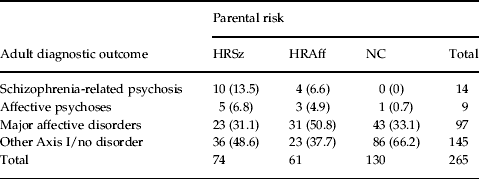
Both usable videotaped interviews in mid-childhood and diagnostic interviews in late adolescence/early adulthood were available for 265 offspring: 74 individuals were genetically high risk for schizophrenia (HRSz), 61 individuals were genetically high risk for affective disorder (HRAff), and 130 were normal controls (NC).Footnote 7 The mean age of all participants at the time of videotaping was 9.4 (s.d.=2.0) years. Of these subjects, 23 developed psychotic illness, either SRP or affective psychoses at a mean age of 18.4 (s.d.=4.2) years. Table 1 provides the distribution of participants by parental risk and adulthood outcome diagnosis.
Frequency of participants by parental risk and adulthood diagnostic outcome
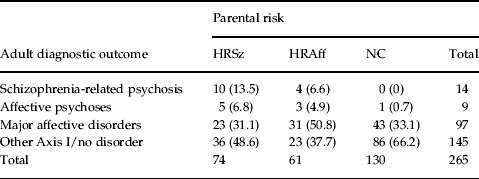
HRSz, High risk for schizophrenia; HRAff, high risk for affective disorders; NC, normal controls.
Data are given as frequency of participants by parental risk group and adulthood diagnostic outcome (percentage of parental group).
TD as a function of parental risk and adulthood outcome diagnosis
A MANOVA was run with dependent and independent variables previously described, with full-scale intelligence quotient (IQ) and socio-economic status included to rule out possible confounding effects on TD. The Wilks' lambda multivariate test of overall differences among groups was statistically significant (p<0.01). The multivariate F was significant for the main effect of IQ (F 3,243=4.72, p=0.003) and adulthood outcome diagnosis (F 9,592=9.23, p<0.001), but not significant for the main effect of parental risk (F 6,488=1.45, p=0.19). Notably, the main interaction between parental risk and adulthood outcome diagnosis was significant (F 15,671=3.32, p<0.001), highlighting that having a psychiatrically ill parent confers genetic risk for a related psychiatric disorder.
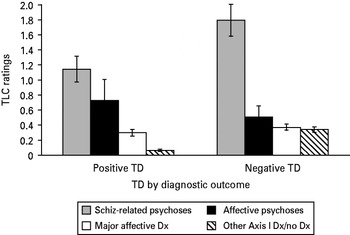
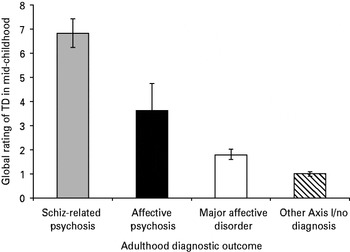
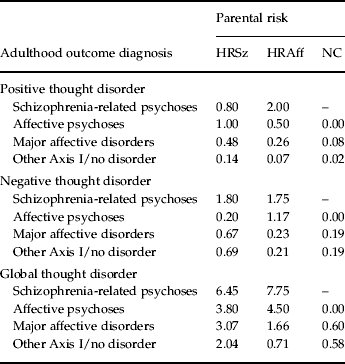
Univariate between-subjects tests revealed that adulthood diagnostic outcome was significantly, but moderately, related to ratings of positive, negative and global TD (all p's <0.001; partial η2=0.12, 0.08 and 0.09, respectively). There was also a significant interaction effect between parental risk and adulthood outcome diagnosis for positive TD (p=0.002; partial η2=0.07). Means of TD ratings by parental risk and adulthood diagnosis are presented in Table 2 and also depicted in Figs. 1 and 2.Footnote 8
Group comparison of ratings by the Scale for the Assessment of Thought, Language, and Communication (TLC; Andreasen, Reference Andreasen1979) for positive thought disorder (TD) and negative TD by adulthood outcome diagnosis. Values are means, with standard errors represented by vertical bars. See the Methods section for a description of symptoms that defined each subtype of TD. Schiz, Schizophrenia; Dx, disorder.

Group comparison of ratings for global thought disorder (TD) by adulthood outcome diagnosis. Values are means, with standard errors represented by vertical bars. For the calculation of the global TD rating, scores for the more pathological Scale for the Assessment of Thought, Language, and Communication (TLC; Andreasen, Reference Andreasen1979) symptoms were weighted prior to summing them with the scores for the less pathological symptoms. See the Methods section for further description. Schiz, Schizophrenia.

Means of thought disorder by parental risk and adulthood diagnosis
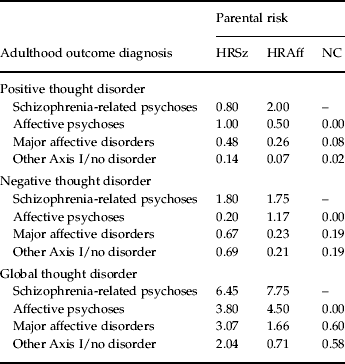
HRSz, High risk for schizophrenia; HRAff, high risk for affective disorders; NC, normal controls.
Planned follow-up comparisons showed that subjects with a psychotic diagnostic outcome (either SRP or affective psychoses) were significantly higher in positive TD than either of the two groups without psychosis (p<0.01). However, the two psychotic groups did not differ in terms of the positive TD ratings (p=0.49). Overall, nearly 25% (65 of 265) of the subjects showed any negative TD during mid-childhood, with 45.9%, 23% and 13.1% in the HRSz, HRAff and NC groups, respectively. A comparison of the groups showed significantly higher negative TD ratings in the SRP group than any of the other diagnostic outcome groups (p<0.001). Subjects with SRP also displayed significantly higher levels of global TD than the other three groups (p=0.001). Follow-up comparisons of the interaction between parental risk and the adulthood psychiatric classification of the offspring showed higher TD levels in SRP subjects than the HRAff group overall, although this was significant only for positive TD (see Table 2).
Tests of between-subjects effects indicated that full-scale IQ was significant though weak for the positive and negative TD scales, as demonstrated by their partial η2 (0.017 and 0.016, respectively). The effect size for the relationship between IQ and global TD was somewhat stronger, with partial η2=0.046.
The appearance of TD before onset of psychosis
The 23 participants who developed psychosis had a mean age of 10 (s.d.=2.2) years when their interviews were taped. Their mean age at psychosis onset was 18.5 (s.d.=4.3) years. Therefore, the average length of elapsed time was 8.23 years (range 4–19 years). A Pearson product-moment correlation was computed for the amount of time elapsed and the TD subscale scores. These correlations with negative, positive and global TD scales were low (r's ranged from −0.03 to 0.14) and not significant (p's ranged from 0.52 to 0.88). Thus, high levels of TD in mid-childhood cannot be attributed to imminent psychosis.
The association between schizotypal features and formal TDFootnote 9
Personality disorder symptom ratings for individuals in the subsample ranged from 0 to 8; a minimum rating of 5 was required to meet diagnostic criteria for schizotypal personality disorder. Zero-order Pearson product-moment correlation coefficients were computed between the PDE-derived ratings of schizotypal features and the TD measures,Footnote 10 yielding significant values for all three scores: negative TD scores=0.12 (p=0.030), positive TD=0.18 (p=0.003) and global TD=0.17 (p=0.005) (all p-values one-tailed). Thus, increased schizotypal features were associated with increased TD.
Prediction of SRP outcome
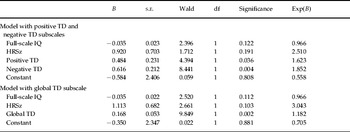
Logistic regressions were conducted to test a model that predicted the presence or absence of a SRP outcome. These analyses revealed that being a member of the HRSz group, i.e. having a parent with schizophrenia, rendered an individual's risk 2.08 times greater than other NYHRP subjects for developing SRP in adulthood. An expanded model that took positive TD ratings into account improved prediction; consideration of negative TD over and above the other variables resulted in still better prediction. The model including all three variables appears in the upper half of Table 3. With a 0.5 cut-off probability (i.e. a 50% likelihood of developing a schizophrenia-related disorder), the model correctly predicted 94% of the sample. However, this probability value was unrealistic, given the nature of the disorders we were trying to predict and their low population base rates.
Logistic regression equations predicting presence or absence of schizophrenia-related psychoses outcome in adulthood

s.e., Standard error; df, degrees of freedom; IQ, intelligence quotient; HRSz, high risk for schizophrenia; TD, thought disorder.
Based on a predicted cut-off probability value of 0.01, the model showed moderately high sensitivity, with 64.3% (nine of 14) subjects being correctly predicted to develop SRP in adulthood; this group of nine true positives included seven HRSz and two HRAff subjects. However, the relatively high number of false-negative cases who were missed by the model (i.e. those who developed SRP but were not predicted to do so) resulted in a lowered positive predictive value (PPV; 40.9%). This group of five false negatives included three HRSz and two HRAff subjects. Specificity was high, with 94.8% of the subjects not at risk for the later development of SRP being accurately predicted by the model, as was the negative predictive value (NPV) for the model, with an 89.8% probability that a subject would not develop SRP in adulthood if they were not in the HRSz group and did not display high ratings of positive and negative TD.
A model is presented in the lower half of Table 3, which used global TD ratings as an alternative means of predicting the later development of SRP. According to this model, having a schizophrenic parent rendered an individual at 3.04 times greater risk than other NYHRP subjects for developing SRP in adulthood. With a predicted cut-off probability value of 0.01, the model based upon global TD ratings accurately predicted 12 of the 14 subjects (85.7%) who later developed SRP; the two subjects missed by this model were both from the HRAff group. The model accurately predicted 80.9% (203 of 251) of the subjects who did not develop SRP. This model, therefore, showed high sensitivity (86%) and relatively high specificity (81%). Although the PPV for this model was low (20%), this cut-off yielded a very high NPV (99%).
Discussion
One goal of this investigation was to evaluate TD as an endophenotype of schizophrenia in confirmation of the preliminary report by Ott et al. (Reference Ott, Roberts, Rock, Allen and Erlenmeyer-Kimling2002). A second goal was to evaluate TD as a potential predictor of adulthood SRP. Previous work using a subset of NYHRP sample A (n=123; Ott et al. Reference Ott, Roberts, Rock, Allen and Erlenmeyer-Kimling2002) had shown that negative TD was related to SRP, independent of parental risk. However, those analyses did not indicate whether the relationship with negative TD reflected a specific association with schizotypy, rather than a more general association with psychosis. With the larger sample (n=265), we were able to analyse the data such that comparisons could be made between SRP and affective psychoses.
Numerous observations of positive TD in both affective psychoses and SRP have been reported for adolescents (Makowski et al. Reference Makowski, Waternaux, Lajonchere, Dicker, Smoke, Koplewicz, Min, Mendell and Levy1997) and adults (Andreasen, Reference Andreasen1979; Andreasen & Grove, Reference Andreasen and Grove1986; Holzman et al. Reference Holzman, Shenton and Solovay1986; Shenton et al. Reference Shenton, Solovay and Holzman1987; Solovay et al. Reference Solovay, Shenton and Holzman1987; Cuesta & Peralta, Reference Cuesta and Peralta2011). Consistent with those findings, no difference was seen between the SRP and affective psychoses subgroups with respect to positive TD. Both subgroups displayed significantly greater positive TD than participants without a psychotic diagnostic outcome.
Negative TD, including poverty of content of speech and verbal underproductivity, is associated with schizophrenia in the general population (Andreasen, Reference Andreasen1979; Levy et al. Reference Levy, Coleman, Sung, Ji, Matthysse, Mendell and Titone2010). As noted earlier, negative TD is state independent, i.e. it manifests in an individual whether or not illness is active. Importantly, our research shows that negative TD is a trait-like risk factor that presents by mid-childhood, long before onset of psychosis in individuals who will develop psychosis.
In contrast to positive TD, negative TD significantly differentiated between diagnostic outcomes of SRP and affective psychoses, with negative aspects of TD being especially associated with risk to the development of SRP. Additionally, we observed a small but significant association of childhood TD ratings with schizotypal features, which are perhaps a more proximal indicator of the underlying schizophrenia diathesis (Meehl, Reference Meehl1962, Reference Meehl1989). Our research thus adds to the amassing support for considering negative TD as an endophenotypic indicator of that diathesis. Because the interview-based assessments of TD were carried out when the NYHRP participants were in mid-childhood, on average 8 years prior to illness onset, our findings point to TD as a long-standing, enduring characteristic that precedes the manifestation of clinical illness and, perhaps, even the prodrome.Footnote 11
Our second goal was to determine whether TD in mid-childhood has predictive validity for SRP in adulthood. Logistic regression analysis confirmed that parental risk predicts future SRP in combination with mid-childhood TD and lowered IQ. These findings are largely consistent with other investigations of individuals who later developed schizophrenia (Jones & Done, Reference Jones, Done, Keshavan and Murray1997; Cannon et al. Reference Cannon, Bearden, Hollister, Rosso, Sanchez and Hadley2000) and/or schizophrenia-spectrum disorders (Parnas et al. Reference Parnas, Schulsinger, Schulsinger, Mednick and Teasdale1982).
Negative TD added to the prediction of SRP outcomes over and above positive TD. Recently, prodromal researchers have begun to consider the presence of positive TD in their prediction of conversion to psychosis. For example, Bearden et al. (Reference Bearden, Wu, Caplan and Cannon2011) observed that illogical thinking, one aspect of positive TD, predicted conversion to psychosis among prodromal adolescents. To our knowledge, however, there are no reports of any group attempting to apply ratings of negative TD in their consideration of risk for psychosis or SRP.
Both logistic regression models had high NPV. Given the personal and societal costs of SRP, the more important goal is to maximize the PPV to initiate therapeutic intervention as early and as vigorously as ethically possible. While the model with negative TD considered separately from positive TD appears to achieve this goal better than the model in which TD is rated globally, neither model reached the generally accepted cut-off of 80% PPV considered adequate for clinical screening. Therefore, it may be premature to consider either prediction model as adequate for clinical application. Future directions include examination of these models combined with other potential endophenotypes identified in the NYHRP.
A limitation of the investigation is that the sample is entirely Caucasian. A sample more representative of the general population would be desirable to enhance the generalizability of the results. Additionally a larger total sample overall with a greater yield of SRP and psychotic affective outcomes would have been useful for statistical power.
In summary, data from the NYHRP further elucidate the role of TD in relation to schizotypy. These findings support consideration of TD as an endophenotypic indicator of a schizophrenia diathesis. The results demonstrate the predictive validity of positive TD identified in childhood in relation to the later development of psychosis. Most importantly, they also demonstrate the specificity of negative TD to predicting schizophrenia-related, but not affective, psychoses.
Acknowledgements
The authors thank the participants in the study as well as Ulla Hilldoff Adamo, M.A., for her work on the project. The National Institute of Mental Health at the National Institutes of Health (grant no. MH 19560-01-3 to L.E.-K.) and a University Sabbatical Research Fellowship to D.C.G. supported the study.
Declaration of Interest
None.