Introduction
A significant concern in modern administrative states is agency capture, in which industries influence regulation to cater to their interests at the expense of the public interest (Carpenter and Moss Reference Carpenter and Moss2014). Studies about capture date back decades, with Huntington (Reference Huntington1952) and Bernstein (Reference Bernstein1955) as classic works in political science and Stigler (Reference Stigler1971) as the seminal work in economics. Game-theoretic models of capture have focussed on two key mechanisms of influence: first are transfer payments by the industry to regulators, which incentivise them to skew policy towards the industry’s interests (e.g. Laffont and Tirole Reference Laffont and Tirole1991; Grossman and Helpman Reference Grossman and Helpman1994), and second is the selective provision of information, the content of which causes a rational, optimising agent to select policy that implicitly favours the industry (e.g. Baron and Myerson Reference Baron and Myerson1982; Gailmard and Patty Reference Gailmard and Patty2013, Chapter 7). Implicit in these models and the broader scholarship of capture that they represent is the notion that regulators have fixed mindsets about policymaking, so that their policies are conditional only on the compensation and information they receive from interest groups.
This prevalent understanding of relationships between agencies and industrial interest groups is incomplete in two respects. First, industries seek to shift not only agency policies but also agency attitudes in their favour. A previous study observed that “it is the daily machine-gun-like impact on both agency and its staff of industry representation that makes for industry orientation on the part of many honest and capable agency members as well as agency staffs” (Landis Reference Landis1960, 71). However, this notion seems to have regained prominence only in recent scholarship (see Kwak Reference Kwak2014, 77).
Second, industry information may contribute to capture in addition to increasing regulators’ knowledge. Scholarship has long recognised that “contacts with the industry are frequent and generally productive of intelligent ideas” (Landis Reference Landis1960, 71). A more recent study has described “information capture”, according to which an industry overwhelms the rule-making process with comments, forcing an agency to amend its rule to reduce the likelihood of judicial override (Wagner Reference Wagner2010). More generally, it is only in theoretical models that players transmit pure information (see e.g. Crawford and Sobel Reference Crawford and Sobel1982). In policy-making settings, industry representatives communicate information in a manner or context that can change how agency officials think about policy, such as at a face-to-face meeting (see Kwak Reference Kwak2014, 89).
Accounts of capture in which an industry tries to change regulators’ mindsets call for a matching game-theoretic model. This article develops a model of two general industry influence activities – rentseekingFootnote 1 and information production. Both activities shift a policy-making agent’s preferences towards the industry’s preferences, but information production also improves regulatory quality,Footnote 2 which benefits all stakeholders. Although the notion of preference shifting conflicts with the assumption of fixed preferences in economics (see Stigler and Becker Reference Stigler and Becker1977), it fits well in political science, which allows individuals to change each other’s views (see Wilson Reference Wilson1980; Gerber and Jackson Reference Gerber and Jackson1993, 363). As shifted preferences imply shifted policies in this model, it encompasses not only capture mechanisms in which a regulator’s attitude towards industry actually changes but also those in which she merely acts “as if” her attitude is changing as she selects biased policy, such as those based on transfer payments or comments in rulemaking discussed above.
A key result is that the political principal does not maximise her policy payoff with an agent who shares her preferences and is invulnerable to capture. The reason is that a group that cannot shift the agent’s preferences has less incentive to engage in the sort of influence activities that improve regulatory quality. Instead, the principal can align policy with her preferences, but achieve greater quality, if the agent’s preferences start further away from the group’s than the principal’s, and then the quality-enhancing form of capture shifts the agent’s preferences (possibly along with rentseeking) until they match the principal’s.
This insight contrasts with the conclusions of previous studies on capture. The majority of studies favour mitigating capture as much as possible (see e.g. Ayres and Braithwaite Reference Ayres and Braithwaite1992, 57–58; Barkow Reference Barkow2010; Kwak Reference Kwak2014, 97–98). Although they do not deny the value of industry information, they do not suggest that the ability to succeed at influencing regulators might be necessary to incentivise more information production. Owing to its unique setup, the model here also departs from models that indicate a trade-off between conformity with the principal’s preferences and quality of information (Gailmard and Patty Reference Gailmard and Patty2013; McCarty Reference McCarty2014). These studies posit that more initial distance between an agent and an industry causes information losses. However, examples of rulemaking by the Securities and Exchange Commission (SEC), presented below, suggest the opposite.
As a major mechanism for setting an agent’s initial preferences more in opposition to the group’s than her own is the appointment of agency leaders; this model also points to an alternative understanding of the relationship between appointments and the policy process. In the United States, presidents have been commonly understood to strive to select agency leaders with views like their own (Lewis Reference Lewis2008; Aberbach and Rockman Reference Aberbach and Rockman2009), as well as to direct agency policy decisions (Kagan Reference Kagan2001). This model suggests that the president would want to control agency appointments by selecting ideology, but then would step away and have industries partially capture the agency, so that the policy process yields alignment with the president’s views, producing superior information along the way.
The rest of the article proceeds as follows: the second section presents the model and solves the equilibrium. The third section uses comparative statics to assess general methods for addressing capture. The fourth section discusses the combination of these methods. The fifth section presents the examples of SEC rulemaking. The final section concludes with suggestions for further empirical research.
Model
Capture is analysed in a unidimensional spatial policy game involving three players: a political principal (P, her), her agent (A, him) and an interest group representing industry (G, it). This phenomenon is represented as a shift in preferences of the agent by the group’s activities.Footnote 3
Game setup
The three players are concerned about a policy decision, which has content
 $y\in{\Bbb R}$
. The agent will set the policy and may be thought of either as an individual regulator or as an agency. The principal is assumed to have delegated this authority to him, but she will be provided with various ways of constraining him before the game begins in order to increase her payoff. As the public interest is a highly contested concept (Carpenter and Moss Reference Carpenter and Moss2014), the model leaves open what policy is “best” given any information and does not assume that the principal’s payoff reflects the public interest.
The first component of the players’ policy payoffs reflects how the policy decision y corresponds to an unknown state of the world,
 $w\in{\Bbb R}$
. The state has a probability distribution function with a finite variance,
 $\sigma _{0}^{2} $
. Players have quadratic loss functions stemming from policy. Preferences are normalised so that the principal has an ideal point of 0, and her payoff from policy content is −(y−w)2. The group has an ideal point g<0, so that it always prefers a lower policy than the principal and has a payoff from matching the policy to the state of −(y−g−w)2. This difference in ideal points ensures that, all other things equal, selecting what the group prefers is never as much in the principal’s interest as selecting what she prefers. Finally, the agent has an initial ideal point, a>g, but he also has an extra component to his utility that represents a bias or shift in his ideal point due to capture, discussed in more detail below. The initial ideal point dictates what he would select apart from any capture activities from the group and could derive from any number of sources such as his sense of the public good or a desire to follow statutory dictates.
Although the agent will set policy, the interest group can undertake two activities to influence his decision: regulatory quality improvements and rentseeking. Resources dedicated to regulatory quality improvements, also called simply “quality”, are denoted by
 $q\in{\Bbb R}_{{\plus}}\!$
. Quality works by increasing the agent’s information. It produces a report consisting of randomly generated information about the state of the world,
 ${\bf x}\in{\Bbb R}^{n} $
(
 $n\in{\Bbb N}$
), which is observable. The distribution from which x is realised will depend both on the state of the world and on the quality. Specifically, the degree to which x reduces uncertainty about the state of the world is given by
 $\sigma _{{\bf x}}^{2} \left( q \right)\,\equiv\,{\rm Var}[{\rm E}(W\!\mid\!{\bf X})\!\mid\!q]$
. Then, by the law of total variance, the expected variance of the posterior distribution becomes
 $\bar{\sigma }_{w}^{2} \left( q \right)\,\equiv\,{\rm E}\left[ {{\rm Var}\left( {w{\rm \:\mid\:}{\bf x}} \right){\rm \:\mid\, }q} \right]\,{\equals}\,\sigma _{0}^{2} {\minus}\sigma _{{\bf x}}^{2} (q)$
. Meanwhile, resources dedicated to rentseeking,
 $r\in{\Bbb R}_{{\plus}}\! $
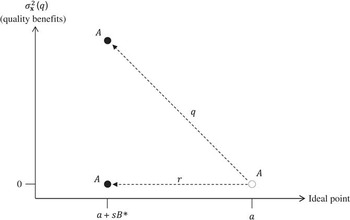
, yield no information for the policy question. Instead, this variable, along with quality, results in capture by shifting the agent’s ideal point. Figure 1 depicts the difference between rentseeking and quality: the former only moves the agent away from his initial ideal point, whereas the latter also yields quality benefits.
Two capture activities, rentseeking (r) and quality (q). Note: The horizontal axis shows the agent’s ideal point, and the vertical axis shows quality benefits, given by
 $\sigma _{{\bf x}}^{2} \left( q \right)$
, which is the reduction in variance, with 0 as the baseline. For any ideal point on the horizontal axis, higher on the vertical axis is better for all players. Rentseeking (r) yields only a shift in agent A’s ideal point, whereas quality (q) yields quality benefits in addition to the ideal point shift. In this case, the effects of each activity are depicted separately. In all figures, open circles represent agents without the group’s capture activities, whereas filled circles represent agents influenced through these activities. As depicted in this figure, both activities yield the same amount of capture, represented by the leftward shift of the agent from a, his initial ideal point, to a+sB*, his final ideal point.

The cost of each capture activity is simply the level of resources devoted to it (q and r, respectively). The result of capture is that the agent is biased by having his ideal point shifted in the amount B(q, r)⩽0, with B=0 only when q=r=0. Given the agent’s bias B, his final ideal point is a+sB, where s⩾0 is a parameter that measures the strength of the effect of the group’s activities. Then, −sB is the amount of capture. This shift is labelled on the horizontal axis of Figure 1, in which the group’s quality improvement and rentseeking are such that each yields the same amount of capture (although this equality need not occur in general).
Although not necessary for an equilibrium, a few regularity assumptions allow analysis of how an interest group plausibly strategises in selecting levels of the two activities. First, the functions B(q, r) and
 $\sigma _{{\bf x}}^{2} \left( q \right)$
are twice continuously differentiable on their domains. Second, B(q, r) is strictly decreasing in its arguments, whereas
 $\sigma _{{\bf x}}^{2} \left( q \right)$
is strictly increasing. Next, B(q, r) is strictly convex, whereas
 $\sigma _{{\bf x}}^{2} \left( q \right)$
is strictly concave. Moreover, the following boundary conditions will apply:
 $B(0{\rm,}\,0)\,{\equals}\,\sigma _{x}^{2} (q)\,{\equals}\,0$
, B
q
(0, r) < 0, ∀r, and B
r
(q, 0) < 0, ∀q,
 $\lim _{{q\to\infty}} B_{q} (q{\rm ,}\,r)\,{\equals}\,0$
, ∀r, and
 $\lim _{{r\to\infty}} B_{r} (q{\rm ,}\,r)\,{\equals}\,0$
, ∀q. Finally, the possibilities for a and s will be limited so that the agent’s final ideal point is always at least the group’s ideal point. This restriction implies plausibly that the agent will not set policy beyond what the group prefers, and that the group will not treat capture as an undesirable side effect of quality improvements.
Combining all the above features yields the following utility functions for the three players after the agent selects a policy and the state of the world is realised:
 $$\eqalignno{ & U^{P} \,{\equals}\,{\minus}(y{\minus}w)^{2} \cr & U^{A} (y)\,{\equals}\,{\minus}(y{\minus}a{\minus}sB{\minus}w)^{2} \cr & {\rm and}\ U^{G} (q,r)\,{\equals}\,{\minus}(y{\minus}g{\minus}w^{2} ){\minus}q{\minus}r $$
The listing of choice variables in these functions implies that the principal has no formal steps within the game. Instead, she may choose to structure the game before it begins through potential remedies described in the next section. After any structuring, the game proceeds as follows:
-
1. Nature determines the state of the world w.
-
2. The interest group chooses levels of quality q, which generates a report with information x, and of rentseeking r.
-
3. Having observed q and x, the agent sets the policy y, and players realise their payoffs.
Information is symmetric throughout the game.
With the model laid out, it is worth highlighting two critical assumptions. First, these capture activities are costly to industry. For rent-seeking activities, this assumption is probably not controversial, given the prominence of corporate campaign contributions (Milyo et al. Reference Milyo, Primo and Groseclose2000). That firms incur costs for quality-improving activities is only somewhat less obvious, as a significant amount of lobbying activity, which requires expenditures, consists of information provision (Nownes Reference Nownes2013, 91–96). Even if firms automatically know more about their production processes than agencies (Coglianese et al. Reference Coglianese, Zeckhauser and Parson2004, 285–287), credible participation in the policy-making process requires costly effort for research that processes raw data into useful knowledge for decisionmakers. The assumption of costly information gathering does not appear in all other models (e.g. Laffont and Tirole Reference Laffont and Tirole1991; Gailmard and Patty Reference Gailmard and Patty2013), but this model attaches importance to the idea that industries have incentives that drive their strategic choice of how much information to generate.
Second, the group’s information is observable to the agent. Thus, although the group can strategise as to what quality of information it will gather, the model is not designed to generate new insights into biases in policymaking that stem from strategic information transmission (cf. Gailmard and Patty Reference Gailmard and Patty2013). Substantively, how much firms and their lobbyists can gain through obfuscation may be limited (Wright Reference Wright1996, 109–113): research suggests that lobbyists believe that successful members in their profession are honest, including in presenting both sides of an issue (McGrath Reference McGrath2006, 75–76), and that, even if biased, lobbyists tend to be truthful enough not to be considered lying (Nownes Reference Nownes2013, 93). In addition, there is a partial correspondence between the result in cheap-talk settings that more information is transmitted the closer the sender and the receiver are (Crawford and Sobel Reference Crawford and Sobel1982) and the result in this model that, up to a point, the group is willing to generate more precise information when it can bring the agent’s preferences closer to its own. Moreover, the examples of SEC rulemakings in the fifth section, which suggest that an increase in the initial distance between industry and an agency increases, rather than decreases, the information transmitted as a result of capture, lend support to the idea that information can be treated as if it were observable.
Equilibrium
As information is symmetric and the agent observes the group’s actions before taking his own, the equilibrium concept is subgame perfection. Backward induction will reveal any equilibria.
In the last stage, an uncaptured agent with ideal point a would prefer that his policy selection be shifted by a compared with the state of the world. As there remains uncertainty about the state even with the group’s information, an uncaptured agent minimises his loss by selecting a policy shifted by a compared with the expected state or a+E(w|x). A captured agent has his ideal point shifted by sB, so that his preferred policy reflects this shift and becomes y*(B, x)=a+sB+E(w|x). This fact does not depend on any of the regularity conditions described above but only on standard statistical decision theory (DeGroot Reference DeGroot1970, 228).
The fact that the agent chooses policy according to his biased ideal point implies two ways in which capture in this model operates in reduced-form fashion. First, more capture activities of either the quality-improving or rent-seeking sort will yield policy choices that are closer to what the group prefers. Second, it makes no difference whether the agent’s biased policy choice comes from an actual change in his preferences or from an “as if” change. The model can incorporate any mechanism in which the resultant degree of regulatory capture increases with the level of influence activities. Previous models that fit this pattern include capture based on transfer payments in Laffont and Tirole (Reference Laffont and Tirole1991) and capture through campaign contributions to congressional overseers in Gordon and Hafer (Reference Gordon and Hafer2005). The narratives of information capture (Wagner Reference Wagner2010) and cultural capture (Kwak Reference Kwak2014) also appear to match the present model’s results, as more information and more interactions between industry representatives and regulators would seem to produce more capture.
On the basis of the agent’s choice, the group’s expected payoff after its capture activities but before the information is generated becomes:
 $$EU^{G} \left( {q,r} \right)\,\,{\equals}\,\,{\minus}\left( {a{\plus}sB\left( {q,r} \right){\minus}g} \right)^{2} {\minus}\,\bar{\sigma }_{w}^{2} \left( q \right)\,{\minus}\,q\,{\minus}\,r$$
With the regularity conditions described above, the group’s optimal choices of rentseeking and quality improvements satisfy the first-order conditions for these variables derived from Equation 1:
 $$\,{\minus}2s\left( {a{\plus}sB^{{\asterisk}} \,{\minus}\,g} \right)B_{q}^{{\asterisk}} {\plus}\sigma _{{\bf x}}^{{2'}} \,\,{\equals}\,\,1$$
 $$\,{\minus}2s\left( {a{\plus}sB^{{\asterisk}} \,{\minus}\,g} \right)B_{r}^{{\asterisk}} \,\,{\equals}\,\,1$$
Equations 2 and 3 express the idea that the respective marginal benefits of quality and rentseeking are equal to these activities’ unit costs. Each activity’s marginal benefit can be further explained. The marginal benefit of quality is the marginal value of biasing the agent, 2s(a+sB−g), times the marginal effectiveness of this activity at inducing more bias, −B
q
, plus the marginal informational benefit of quality,
 $\sigma _{{\bf x}}^{{2'}} $
. As rentseeking produces no information, its marginal benefit is simply the marginal value of biasing the agent times the corresponding marginal effectiveness of this activity at biasing the agent, −B
r
.
As one of the tools for the principal in the next section is placing a maximum on rentseeking,
 $\bar{r}$
, it is worth noting how the group selects its levels of influence activities differently with a binding cap. As a practical matter, binding caps seem to work, as illegal lobbying activities are uncommon (Nownes Reference Nownes2013, 120). Intuition suggests that the group will engage in rentseeking up to the limit and also engage in quality improvement until the marginal benefit equals the marginal cost according to Equation 2, with
 $r\,\,{\equals}\,\,\bar{r}$
. This intuition can be formally proven.
Overall, the game’s equilibrium can be summarised as follows:
Proposition 1: Given any amount of capture activities by the group yielding bias B(q, r) and information from the group x, the agent will select policy y*(B, x)=a+sB+E(w|x). The group, in turn, selects its levels of activities according to Equations 2 and 3 if it does not face a rent-seeking cap. Alternatively, given a binding rent-seeking cap
 $$r\leq \bar{r}$$
, where
 $\bar{r}$
is less than the equilibrium solution r* from Equations 2 and 3, it sets
 $r\,\,{\equals}\,\,\bar{r}$
and quality according to Equation 2 with
 $r\,\,{\equals}\,\,\bar{r}$
.
Proof. Proofs of all propositions are given in the Supplementary Information.
Individual techniques for addressing capture
The principal seeks to increase her expected utility, which, based on the group’s choices of q*and r*, is given by
 $$EU^{P} \left( {q^{{\tf="Sabon-R" \asterisk}} ,r^{{\asterisk}} } \right)\,\,{\equals}\,\,\,{\minus}\,\left( {a{\plus}sB\left( {q^{{\asterisk}} ,r^{{\asterisk}} } \right)} \right)^{2} \,{\minus}\,\bar{\sigma }_{w}^{2} (q^{{\asterisk}} )$$
For greater utility, the principal will want to increase the agent’s final ideal point, a+sB*, until it equals her ideal point of 0, and she will want more quality, q*. This section analyses the effects of three institutional responses to capture on these two features of the equilibrium: limiting rentseeking, increasing the agent’s initial ideal point and reducing the strength of capture.
As the remaining propositions depend on them, it is worth concretely interpreting the cross-derivatives B qr . In terms of preference shifting, B qr >0 makes the two activities substitutes as increasing one capture activity causes the bias term to decrease more slowly with the other. For example, this situation might obtain if additional information from quality improvements cause decisionmaking to depend more on the facts than on leanings of the agent towards the group, making rentseeking less effective. On the other hand, B qr <0 makes the two activities bias complements: perhaps preference shifting from rentseeking works better when the group is credible and provides better information (cf. Nownes Reference Nownes2013, 136–137).
Limiting rentseeking
One attractive response to capture is to set a maximum level for rentseeking,
 $\bar{r}$
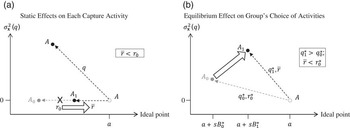
. Figure 2a portrays the effect of a binding rent-seeking cap: if the group was inclined to engage in rentseeking at level r
0, it must instead limit itself to
 $\bar{r}\,\lt\,r_{0} $
. This tool is appealing because it reduces the type of bias that comes with no informational benefit. One might expect that a binding rent-seeking cap will always have a first-order effect of reducing bias overall, along with a second-order effect of incentivising the group to divert some resources towards quality, but not enough to produce more bias. However, the effects are more complex and depend to some degree on whether the two activities are substitutes or complements.
Effects of a binding rent-seeking cap. (a) Static effects on each capture activity. (b) Equilibrium effect on the group’s choice of activities. Note: (a) With a binding rent-seeking cap
 $\bar{r}$
, the group cannot engage in rentseeking at r
0 if
 $r_{0} \,\gt\,\bar{r}$
, and therefore agent A moves only as far as A
1 instead of A
0 from rentseeking. However, the group retains full freedom to capture the agent through quality q. (b) If the activities are not too strong complements, a binding rent-seeking cap causes the group to change its capture activities from
 $q_{0}^{{\asterisk}} $
and
 $r_{0}^{{\asterisk}} $
to
 $q_{1}^{{\asterisk}} \,\gt\,q_{0}^{{\asterisk}} $
and
 $\bar{r}\,\lt\,r_{0} $
. Agent A moves to A
1 instead of A
0, where A
1 entails more quality benefits and, when the activities are not strong substitutes, a higher final ideal point.

The intuition can be understood by analysing Equation 2, the first-order condition for quality. Suppose the group starts from an equilibrium selection of activities, but then a binding rent-seeking cap is suddenly imposed or lowered. There is less bias than before, and the marginal value of bias increases because the distance between the agent’s and group’s ideal points has an increasing marginal cost to the group. Accordingly, the marginal benefit of quality will exceed the marginal cost unless the marginal effectiveness of quality has fallen quite a bit because of the rent-seeking restriction. Such a fall corresponds to scenarios in which the two activities are quite strong complements. Apart from such scenarios, the group will choose to increase quality.
If the group increases quality to achieve the same magnitude of bias as before, the marginal value of bias will be the same as before the rent-seeking restriction, but the marginal effectiveness will have fallen with the increase in quality. As a result, the marginal benefit of quality will be less than the marginal cost unless the rent-seeking restriction came with a sufficiently large initial increase in the marginal effect of quality in biasing the agent. This exception encompasses cases in which the influence activities are strong substitutes. Therefore, unless the activities are strong substitutes, a rent-seeking restriction will lead to a smaller shift in the agent’s preferences.
The next proposition formalises the above qualitative discussion:
Proposition 2: If a binding rent-seeking cap is imposed or lowered, the group engages in rentseeking up to the new limit, and
-
a. quality increases, if and only if rentseeking and quality are not too strong complements;Footnote 4
-
b. the agent’s final ideal point increases, if and only if he does not substitute too strongly towards quality.
The exceptions to the general expectations in parts (a) and (b) are mutually exclusive, and thus the principal will always improve her payoff through increased quality or by less agent bias. Still, Proposition 2 does require two conditions for a rent-seeking cap, on its own, to improve the principal’s payoff along both dimensions. Figure 2b depicts the case in which both conditions hold.
Increasing the agent’s initial ideal point
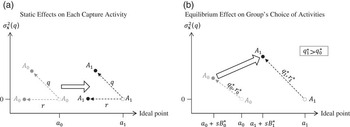
The next institutional response is to increase the agent’s initial ideal point, a, so that there is a greater initial distance between him and the group. As Figure 3a illustrates, rentseeking and quality are as effective as before, but the agent starts out at a higher initial ideal point, and thus also ends up at a higher initial final ideal point.
Effects of increasing the agent’s initial ideal point. (a) Static effects on each capture activity. (b) Equilibrium effect on the group’s choice of activities. Note: (a) Increasing the agent’s initial ideal point moves him from A
0 to A
1. The effects of any given level of rentseeking (r) and quality (q) are the same, but he ends up at a higher final ideal point than before. (b) If the agent is not inclined too strongly to substitute towards rentseeking, increasing his initial ideal point from a
0 to a
1 causes the group to change its capture activities from
 $q_{0}^{{\asterisk}} $
and
 $r_{0}^{{\asterisk}} $
to
 $q_{1}^{{\asterisk}} \,\gt\,q_{0}^{{\asterisk}} $
and
 $r_{1}^{{\asterisk}} $
. The amount of capture increases with
 $\left| {sB_{1}^{{\asterisk}} } \right|\,\gt\!\mid\!sB_{0}^{{\asterisk}} \:\mid\,$
, but the final ideal point is higher than before,
 $a_{1} {\plus}sB_{1}^{{\asterisk}} \,\gt\,a_{0} {\plus}sB_{0}^{{\asterisk}} $
.

In equilibrium, the agent ends up at a higher final ideal point, even accounting for the group’s incentive to respond by increasing its influence activities. Starting from equilibrium, if the agent’s final ideal point suddenly increases, the marginal value of bias will be greater because the distance between the group’s and the agent’s positions has an increasing marginal cost. The influence activities will have the same marginal effect of biasing the agent as before. Thus, the marginal benefit of activities will exceed their cost, and the group will choose to increase one or both activities. However, the group will not engage in enough activities to yield the same final ideal point as before. To return to the original final ideal point requires more influence activities with a lower marginal effectiveness while the marginal value of bias is the same as before. Accordingly, the marginal cost of influence would exceed its marginal benefits, so the group will not fully compensate for the increase in the agent’s initial ideal point.
The only question that remains is which activities the group will increase. If they are complements or weak substitutes, then the group will increase both rentseeking and quality. If they are very strong substitutes, the group may substitute towards quality at the expense of rentseeking or vice versa. Overall, quality increases unless the activities are strong substitutes in a way that favours rentseeking.
These qualitative results can be mathematically proven to yield the following proposition:
Proposition 3: Suppose there is no rent-seeking cap. As the agent’s initial ideal point increases,
-
a. quality increases, if and only if the agent does not substitute too strongly towards rentseeking;
-
b. the agent’s final ideal point unambiguously increases, even though the amount of capture also increases.
Unlike a rent-seeking restriction, only one condition is necessary for an increase in the agent’s initial ideal point to increase both quality and the agent’s final point, which is that the group is not incentivised to substitute towards rentseeking. Figure 3b depicts the case in which this condition holds. Proposition 3 suggests that, if possible, the principal should prefer an agent with an initial ideal point higher than hers.
Reducing the strength of capture
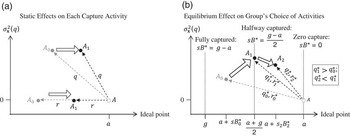
Finally, mitigating the effectiveness of industry influence activities in capturing regulators entails reducing the strength of bias s, so that any effect that a particular combination of rentseeking and quality would have had on the agent’s preferences is lessened. Interest groups are legally as free to try to influence regulators as before, but their efforts are less successful. Figure 4a shows this effect on the two activities when considered separately: the agent ends up to the right of where he would have been with the original strength of capture.
Effects of reducing the strength of capture. (a) Static effects on each capture activity. (b) Equilibrium effect on the group’s choice of activities. Note: (a) Reducing the strength of capture causes the leftward shift from rentseeking (r) and quality (q) to decrease. If the group engages in the activities separately, the agent’s final ideal points move from A
0 to A
1, farther to the right. The quality benefits from q remain the same, however. (b) Reducing the strength of capture causes the group to change its capture activities. In this case, the first reduction causes it to change from
 $q_{0}^{{\asterisk}} $
and
 $r_{0}^{{\asterisk}} $
to
 $q_{1}^{{\asterisk}} \,\gt\,q_{0}^{{\asterisk}} $
and
 $r_{1}^{{\asterisk}} $
and the second reduction from
 $q_{1}^{{\asterisk}} $
and
 $r_{1}^{{\asterisk}} $
to
 $q_{2}^{{\asterisk}} \,\lt\,q_{1}^{{\asterisk}} $
and
 $r_{2}^{{\asterisk}} $
. The agent’s final ideal point moves to the right: one moves rightward from A
0 to A
1 to A
2. If the agent is not inclined too strongly to substitute towards rentseeking, quality benefits increase only if he moves towards being halfway captured, so that he is halfway between his initial ideal point a and the group’s ideal point g, and they decrease if he moves away from being halfway captured.

In contrast with increasing the agent’s ideal point, the equilibrium effect on quality from reducing the strength of capture is not monotonic and depends on the degree to which the agent is captured to begin with. It will be helpful to denote “halfway captured” to mean that the agent’s final ideal point is halfway between his initial ideal point and the group’s ideal point. Mathematically, sB*=(g−a)/2 makes him halfway captured, whereas sB*<(>)(g−a)/2 makes him more (less) than halfway captured.
It should be no surprise that making both activities less effective at biasing the agent makes the group less willing to act to bias the agent than before, so that the agent ends up less biased than before. However, greater bias does not always entail more activity. It turns out that a moderate strength of capture, rather than a very high strength, incentivises the greatest levels of influence activities. If biasing the agent becomes exceedingly hard, the marginal benefit of these activities becomes negligible, and the group will not bother to engage in much capture. At the other extreme, if the strength of capture is very high, little influence is needed to bring the agent’s ideal point close to the group. After this small amount of activity, the marginal benefit of bias would have decreased rapidly, and again the group will not want to engage in more capture. As an intermediate strength of capture yields more activity, it follows that moving towards the intermediate strength that yields the most activity increases quality as long as this activity and rentseeking are not strong substitutes in such a way that favours rentseeking. The condition for an increase in quality in moving to an intermediate strength of capture is the same as for increasing the agent’s initial ideal point.
These intuitions can be formally proven and stated in terms of reducing the strength of capture as follows:
Proposition 4: Suppose there is no rent-seeking cap. If the strength of capture decreases,
-
a. quality increases (decreases) when the agent is more (less) than halfway captured under the same conditions as in Proposition 3(a);
-
b. the agent’s final ideal point increases, and the amount of capture decreases.
Figure 4b depicts the nonmonotonic effect of reducing the strength of capture when the activities are not strong substitutes in favour of rentseeking. Although the turning point at halfway captured is particular to the model’s functional specifications, the more general notion that reducing the strength of capture is more helpful when the agent is strongly captured than only mildly captured is quite plausible.
Overall, Proposition 4 suggests that reducing the strength of capture can be useful to some extent, but doing so comes at the cost of regulatory quality as this strength approaches 0. Given reasonable claims of capture through both industry meetings with agency officials (Kwak Reference Kwak2014, 89) and comments in the rule-making process (Wagner Reference Wagner2010), instances in which influence activities become nearly ineffective at capturing regulators may be hard to find. However, a good candidate example of capture’s strength falling towards 0 is negotiated rulemaking, in which an agency convenes a balanced set of representatives of relevant stakeholders to reach consensus on a proposed rule [5 U.S.C. § 563(a) (2012)]. Although originally designed to make litigation after promulgation less likely (Harter Reference Harter1982), negotiated rulemaking has more recently been understood as a capture-mitigation technique (Kwak Reference Kwak2014, 96).
Accompanying this reduction in the strength of capture is information loss, both in theory and in practice. One of the early exponents of negotiated rulemaking posited that decisions would be based on consensus rather than on large quantities of information (Harter Reference Harter1982, 106). More recently, an analyst of this process has observed that stakeholders may stifle discussion of relevant issues and of specific details for a rule (Coglianese Reference Coglianese2001, 439–441) and offers examples of poorly designed regulations that arose from this process (Coglianese Reference Coglianese2003, 74–75). This assessment is consistent with the intuition that regulated firms have less incentive to produce quality-enhancing information when they cannot substantially move policy in their direction.
Combined techniques for addressing capture
Individually, the effects of three institutional designs depend on the how the marginal effectiveness of one activity at capture changes with the level of the other activity. However, two of the three conditions in Propositions 2–4 become irrelevant with the application of more than one tool. If the activities are substitutes such that a rent-seeking cap would decrease the agent’s final ideal point, the principal can counter this effect by increasing his initial ideal point or decreasing the strength of capture. Conversely, if the activities are substitutes such that these other two tools would cause the group to substitute away from quality towards rentseeking, the principal can prevent this substitution by capping and even eliminating rentseeking.
The only remaining question is whether the activities are such strong complements that a rent-seeking cap will discourage quality improvements. If the activities are consistently strong complements, it makes sense to encourage quality by freely allowing rentseeking and then increasing the agent’s final ideal point and quality with the other two designs. If, instead, the activities are never such strong complements, then rentseeking provides no indirect benefit through its interaction with quality, and the principal is better off banning it altogether and then likewise increasing the agent’s final ideal point and quality with the other two designs. Either way, the fact that a halfway captured agent maximises quality given any agent initial ideal point, combined with the fact that quality increases with the initial ideal point, implies that the principal does quite well with the designs described in the final proposition, in which the agent’s final ideal point is the same as hers and the quality is very high.
Proposition 5: Suppose the principal is free to use all three institutional designs. If the condition in Proposition 2(a) is met (fails) at the group’s choice of activity levels for all combinations of designs, an institutional structure in which rentseeking is prohibited (unrestricted), the principal’s ideal point is midway between the agent’s initial ideal point and the group’s ideal point, and the strength of capture is such that the agent that is halfway captured yields her a higher expected utility than any other combination with the same or a lower initial ideal point for the agent.
This proposition indicates that the combinations of designs that the principal desires depends on whether and when the activities are such strong complements that restricting rentseeking leads to less quality. However, it also suggests that this condition affects only the principal’s preferred cap on rentseeking. Regardless of how the activities interact, some capture is useful, and the principal improves her payoff if she offsets it by moving the agent’s initial ideal point farther away from the group.
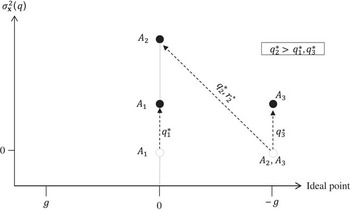
Figure 5 provides a representation of different agents with their equilibrium levels of capture activities. Agent A 1 is aligned with the principal and is immune to capture. Facing this agent, the group invests in relatively little quality. Agent A 2 is the agent featured in Proposition 5. He ends up aligned with the principal but starts out exactly opposite to the group. As he can be influenced through quality improvements, the group has an extra incentive to invest in quality. The result is greater benefits from quality with A 2 than with A 1, although both agents have the same final ideal point. It is important that such an extreme agent be capturable, as an immovable agent such as A 3 would yield policy away from the principal’s ideal point with no additional information.
Preferred institutional designs and agents. Note: Agent A
1, who has been made invulnerable to capture and whose initial ideal point is the principal’s ideal point of 0, yields only modest quality benefits from the group. Agent A
2, whose initial ideal point −g is exactly the opposite of the group’s at g, can yield more quality benefits and can also yield policymaking fully aligned with the principal if he is made to be halfway captured. With the same final ideal point and greater quality (
 $q_{2}^{{\asterisk}} \,\gt\,q_{1}^{{\asterisk}} $
), the principal receives a higher payoff with A
2 than with A
1. An agent farther away from the group than the principal does not help, however, if he is immune to capture, similar to agent A
3.

Theoretical distinctions
Proposition 5 is theoretically significant because it implies that two appealing designs are not close to optimal. First, eliminating capture does not always help the principal, as it does in some other models (see Dal Bó Reference Dal Bó2006, 207–210). In this case, it can be desirable for the agent to move towards the group’s position for reasons independent of the substance of the policy question. In contrast, a fully “ethical”, immovable agent, one who selects policy based solely “on the merits” (cf. Thompson Reference Thompson1995, 20), would reduce the group’s incentives to gather information in the first place.
Second, the agent, apart from the group’s influence, should not share the principal’s preferences. In general, agents with different preferences from the principal have been justified on the grounds of incentivising costly agent effort (Stephenson Reference Stephenson2011), eliciting more candid communication from third parties (Dessein Reference Dessein2002), and serving as a counterweight in policy negotiations (Bertelli and Feldmann Reference Bertelli and Feldmann2007). The last of these logics is closest in spirit to Proposition 5; however, instead of pulling policy towards its preferences through a bargaining protocol, the model here has the group pulling policy directly through its influence activities.
Moreover, this proposition’s call for an agent with preferences on the opposite side of the principal’s, compared with industry’s, contrasts with other models that call for an agent with intermediate preferences falling between the other two players’ (Gailmard and Patty Reference Gailmard and Patty2013; McCarty Reference McCarty2014). Two of the present model’s features explain this contrast. First, this model, unlike the others, assumes that the agent can fully access and use information from industry.Footnote 5 In Gailmard and Patty (Reference Gailmard and Patty2013), however, the group can obfuscate and provide less than complete information about the state of the world, and it obfuscates more with a more opposed agent, as such an agent will act more adversely towards the group.Footnote 6 In McCarty (Reference McCarty2014), the group provides accurate information; however, the agent can use it fully to implement the group’s preferred policy but can only partially use it to implement a policy closer to the agent’s ideal point.
The other relevant feature unique to the present model is the preference shifting notion of capture. Without preference shifting, the group would simply decide how much information to produce and give that to the agent for his full use, regardless of his preferences. With preference shifting, the quality of the information that the group produces depends on the agent’s initial preferences. Consistent with Propositions 3 and 5, the group wants to engage in more information-based capture as the agent’s initial ideal point moves farther away from its own, because the cost of adverse agency action increases in both absolute and marginal terms.
Because of these two features, the other two models predict a negative relationship between regulatory quality and the distance between agent and group preferences, whereas this model posits a positive relationship. The next section discusses examples of SEC policymaking to suggest that a positive relationship holds.
Policy significance
Proposition 5 also has policy significance because most current proposals for addressing capture come in the form of rent-seeking restrictions or reductions in the strength of capture. Proposals for rent-seeking restrictions include additional limitations on the revolving door and eliminating gifts of free attendance to industry-sponsored events of relevance to an agency (Painter Reference Painter2009), as well as reducing policy meetings with and rule-making comments from industry (Wagner Reference Wagner2010). Besides negotiated rulemaking, as discussed above, proposals that would reduce the strength of capture include paying civil servants much higher salaries (Shapiro Reference Shapiro2012), subjecting industry information to public scrutiny (Barkow Reference Barkow2010, 59–60), designating contrarians within an agency as institutionalised dissenters (McDonnell and Schwarcz Reference McDonnell and Schwarcz2010), making judicial review to challenge agency rulemakings less favourable to industry (Wagner Reference Wagner2010) and strengthening regulatory review by the central administration (Livermore and Revesz Reference Livermore and Revesz2014).
In contrast, an intuitive implementation of increasing the agent’s ideal point, appointing regulators more opposed to industry than the principal, has received little attention as a response to capture. The study by Bertelli and Feldmann (Reference Bertelli and Feldmann2007) seems to be the only one that analyses an agency head with such preferences as a counterweight to industry influence in a bargaining framework. It is not clear why appointments have received comparatively little scholarly attention, but one possibility is that it entails the discretion of the principal rather than the formulation of an institutional rule. Thus, Proposition 5 supports a shift in focus towards appointments and the development of other techniques that would move an agency’s initial position farther away from industry.
As appointments are a natural method of increasing the agent’s initial ideal point, whether this method could work in practice is an important question. One concern is political will: can a principal select an agency head with preferences different from her own, or will she inevitably select someone who shares her preferences? Previous studies on appointments suggest that there have been agency leaders more opposed to industry than their appointers. In his classic study of industry influence in regulation, Quirk finds that more officials were anti-industry than pro-industry before their service and rejects appointments as an important channel of influence (Reference Quirk1981, 49, 61). Other scholars have identified chairmen of the Federal Trade Commission during the 1970s and Environmental Protection Agency administrators Ruckelshaus and Lisa Jackson as more opposed to industry than their appointing president (Bubb and Warren Reference Bubb and Warren2014). Thus, even though regulated firms do lobby to influence bureaucratic appointments (see Nownes Reference Nownes2013, 110–113), these examples suggest that a political principal can prevail against such lobbying.
A second issue is whether the principal can commit not to interfere with the policy-making process after the appointment. This issue arises because a group anticipating that the principal would intervene to set policy according to her preferences has less reason to sway the agent with quality-enhancing influence activities. Although presidents have sought to increase their control over policy, such efforts do not imply total control, and their lack of expertise limits their ability to influence decisionmaking and even willingness to do so (Kagan Reference Kagan2001, 2355). Moreover, the president lacks the time and attention necessary to exert anywhere near full control over all appointees (cf. Aghion and Tirole Reference Aghion and Tirole1997, 19–20). Furthermore, as the level of presidential control has varied over time, a president might allow her appointees more freedom to choose policy than her predecessors.
Overall, there is no reason that the president cannot both exert control in appointing agency heads and allow them to determine the content of regulatory policy. This model of partial control over the policy process through appointments is plausible: although a president must at least nominate leaders, she has more discretion as to which regulatory initiatives, if any, to pursue.
Suggestive evidence from SEC rulemakings
Empirically validating the entire model exceeds the scope of this article. However, a comparison of contrasting rulemakings by the SEC provides some support for the foundational idea that a greater initial distance in preferences between the group and the agent leads to more, not less, information production. The SEC is the same agency that serves as a case study in Gailmard and Patty (Reference Gailmard and Patty2013), although the policies considered there are from the 1930s following its inception. As financial regulation is an area for which information is thought to be soft (Gailmard and Patty Reference Gailmard and Patty2013, 265–266), evidence consistent with this model would provide significant support for the notions that regulators can verify firms’ claims and that the ability to capture incentivises information production.
Two rules that support the model’s predicted effect of an increase in the initial distance between the agent and an interest group are the SEC’s April 2004 net capital rule and its July 2014 rule on money market funds. The first rule allowed the largest broker-dealers (securities trading firms) to use mathematical models to help calculate the amount of capital they should hold as a percentage of total indebtedness for protecting their customers in the event of liquidation, among other purposes [69 Fed. Reg. 34,428 (2004)]. The commissioners’ initial position seems to have been close to that of the broker-dealers, given the deregulatory climate of the Bush Administration and their interest in facilitating these firms’ competitiveness in European markets (see Labaton 2008).
Perhaps because of this closeness, it appears that the broker-dealers generated relatively little information about the rule’s potential consequences, as the SEC’s brief discussion, lasting less than an hour, revealed an awareness that the rule might cause problems for broker-dealers but not much of a willingness to inquire into these problems (see Labaton 2008). The preamble to the final rule was 33 pages, which is not trivial, but also not very long for a financial regulation. The quick turnaround after the proposed rule in October 2003 suggests that not much influence was necessary for the broker-dealers to obtain a policy close to their liking.
Compared with the net capital rule, the 2014 money market fund rule involved more initial distance between the SEC and regulated firms, a policy less to these firms’ liking, and more information and more capture (compared with the Commission’s initial policy position). A greater initial distance can be inferred from former Chairman Mary Schapiro’s intention to enact additional regulations shortly after the 2010 money market fund regulations, as well as by a commissioner’s dissenting vote on the final rule (under current Chairman Mary Jo White) for its alleged weakness (Alden 2014). The final rule required institutional money market funds to list a floating net asset value rather than a fixed share price of one dollar, while also allowing all funds to restrict redemptions under certain conditions [79 Fed. Reg. 47,736 (2014)]. The rule’s content is rather further from the status quo that this industry would have preferred than the provisions of the net capital rule were from what the broker-dealers were seeking. Specifically, the money market fund industry was described as having “expressed qualified support” (emphasis added) (Alden 2014).
In addition, the SEC obtained significantly more information, including from firms, about the likely effects of regulatory alternatives. Although rules in different areas can be difficult to compare, the money market fund rule preamble runs 221 pages, more than six times the net capital rule preamble. Moreover, the SEC received 20 comment letters for the net capital rule, but over 230 for the money market fund rule. Besides quantity, the sort of information that firms provided about the two rules is qualitatively different. For the net capital rule, broker-dealers provided suggestions for modifications to the proposed rule, but “no comments that addressed the costs and benefits of the proposal” (69 Fed. Reg. 34,455). Instead, the SEC simply revised its calculation of benefits and costs based on the modifications to which it acceded. For the money market fund rule, a number of comments from industry players discussed the economic consequences, as reflected in the SEC’s citations to some of these comments. Partially because of the differences in industry participation, the SEC’s analysis of the effects of the money market rule is much more extensive than for the net capital rule.
The additional information was accompanied by significant capture: a shift in the SEC’s “as if” preferences can be seen in the nearly two-year delay in regulations and arguably also in the limited application of the floating net asset value requirement to institutional funds, rather than to all categories of funds. The combination of capture and greater information allows the inference that the former incentivises the latter.
Overall, although the above analysis does not consider the full model, including the principal’s choice of agent, the depth of analysis for the SEC’s money market rule compared with the net capital rule does indicate that a more initially opposed agency does not cause industries to become silent or provide unusable information. If anything, industries seem to provide more information when facing the threat of adverse regulation.
Meanwhile, the narrative in Gailmard and Patty (Reference Gailmard and Patty2013) does not quite support the claim that the closeness between regulators and regulated firms yields more information provision. In particular, the SEC’s adoption of a less aggressive stance towards securities issuers and traders stems in part from the possibility that firms would challenge the Commission’s authority in court (Gailmard and Patty Reference Gailmard and Patty2013, 257). Thus, the New Deal-era SEC does not clearly test whether regulators with undisputed power to enact unfavourable policies can induce greater information production. Moreover, this study quotes one of the early SEC chairmen’s reference to the Commission’s rule-making power as the “shotgun behind the door” (Gailmard and Patty Reference Gailmard and Patty2013, 250). This stated logic seems to comport with the notion of incentivising information production through opposition.
Conclusion
The unifying theme of the model results is that the ability to shift a regulator’s preferences (real or “as if”) incentivises industry to generate information. This strategic consideration implies that allowing capture of an agent with a starting point farther from industry than a political principal can produce better-informed policy than an uncapturable agent. The examples in financial regulation mentioned above, along with the analysis of negotiated rulemaking, lend plausibility to the model, but more empirical study is needed to understand how different activities capture policy and improve regulatory quality.
The model suggests four avenues for further research. First, it would be useful to know how different sorts of activities in both the rent-seeking and the quality-improvement categories influence regulatory policy. Although there are studies analysing interest groups’ lobbying activities in general (Boehmke et al. Reference Boehmke, Gailmard and Patty2013) or their repertoire of activities (Nownes Reference Nownes2013), and others focussing on the effect of a single activity (written comments) on a rule’s content (Golden Reference Golden1998; Yackee and Yackee Reference Yackee and Yackee2006; Yackee Reference Yackee2012), there do not seem to have been any studies analysing the effects of multiple activities on agency decisionmaking.Footnote 7 Of particular importance is the interaction between rent-seeking activities such as the revolving door and information-producing activities. Calls to restrict the revolving door are popular (Painter Reference Painter2009), but the utility of such restrictions depends on whether they (do not) strongly complement quality-enhancing forms of capture.
Second is to derive additional measures of policy change to represent capture besides amendments to a proposed rule. The agent’s initial ideal point represents his preferences apart from industry influence targeted at a given policy, but a proposed rule may already reflect influence from industry (West Reference West2009). Survey techniques may be useful in identifying regulators’ true preferences as distinct from the preferences reflected by the policies they propose based on institutional constraints (see Clinton et al. Reference Clinton, Bertelli, Grose, Lewis and Nixon2012).
The third challenge is measuring the quality of industry information. Overall quality has been scored for major regulations (Ellig et al. Reference Ellig, McLaughlin and Morrall2013), but this measure is distinct from how much information industry contributes to policymaking. Although one study observed that comments from business do not on average seem to contain better information than nonbusiness comments (Yackee and Yackee Reference Yackee and Yackee2006), how much information industry contributes in aggregate remains an open question. Just as expert opinion has been used to augment objective measures of agency ideology (Clinton and Lewis Reference Clinton and Lewis2008), it could help assess the usefulness of information from industry.
Progress on these fronts would allow clearer testing of two of the model’s key predictions: that a greater initial distance between regulators and regulated firms produces more information and more capture and that reducing the strength of capture towards 0 eventually leads to less information. To the extent that these predictions are borne out, the model implies that, in addition to or instead of striving to limit or weaken industry influence, offsetting this influence by moving regulators’ starting point away from industry can yield better results for stakeholders seeking to realise their conception of public interest in administrative policymaking.
Acknowledgements
The author gratefully acknowledges helpful early conversations with Charles Borden, Suzanne Day, Mark Fagan, Maggie McKinley, Richard Painter and Bob Rizzi as well as valuable feedback from Jennifer Arlen, Tony Bertelli, Dan Carpenter, Adam Cox, John Ferejohn, Sandy Gordon, Rick Hills, Mike Levine, Alex Stremitzer, Yuki Takagi, Ian Turner, Richard Van Weelden and participants at the 2014 SPSA, MPSA, ALEA and APSA conferences, as well as from three anonymous referees. In addition, the author is thankful for support from the Edmond J. Safra Center for Ethics at Harvard University. All views expressed in this article are solely those of the author.
Financial Support
This project was funded as part of a Lab Fellowship at Harvard University’s Edmond J. Safra Center for Ethics.
Supplementary Material
To view supplementary material for this article, please visit http://dx.doi.org/doi:10.1017/S0143814X16000131