I. INTRODUCTION
Concerns over the protection of the environment and the improvement of thermal efficiency prompted the development of ultra-supercritical (USC) power plants that can operate at much higher steam pressures and temperatures than the conventional plants. Reference Yuan, Zhong, Yu, Yin, Dang, Zhao, Yang, Lu, Yan and Gu1 Due to further increases in steam parameters in the USC generator sets, the heat-resistant materials with excellent long-term high temperature strength, superior oxidation resistance, good weld-ability as well as acceptable fabricability are searched. Austenitic heat-resistant steels are potential materials and widely used for superheater or reheater tubes in the USC power plants, owing to the lower cost and capability of operations at the designed steam pressure (35 MPa or higher) and temperatures (650–760 °C) conditions. Reference Yuan, Zhong, Yu, Yin, Dang, Zhao, Yang, Lu, Yan and Gu1–Reference Ha and Jung3
Austenitic heat-resistant steel such as type 347H austenitic steel is widely accepted for using in important construction components designed for high temperature applications like boilers, nuclear reactors, superheater tubes, and reheater tubes due to its high temperature mechanical stability. 4–Reference Hong, Kim, Min, Lee, Shim, Kim, Suh, Jung and Choi7 Type 347H austenite steel is a kind of niobium-stabilized steel and its Nb content is generally 8–10 times the total amount of C and N present in the alloy. Because the Nb atoms are stronger carbide former elements compared with Cr, the purpose of additions of niobium is the formation of Nb(C,N) carbonitrides during aging. Reference Chandra, Kain and Tewari6 The Nb(C,N) precipitates stabilize the austenite steel against the precipitation of M23C6 carbides, which would lead to intergranular corrosion. Meanwhile, the dissolved Nb(C,N) carbonitrides during solution heat treatment are capable of providing excellent creep resistance in the steel. Reference Erneman, Schwind, Andren, Nilsson, Wilson and Agren8
It is well known that the precipitation behavior of the steel during long-term service at elevated temperature leads to the change of mechanical properties of the materials. Therefore, it is necessary to clarify the evolution of secondary phases in the steels. Previous investigations show that MX carbonitrides, M23C6 carbides, Z-phase, laves phase, and sigma phase are the probable phases that existed in type 347H austenitic steel during long-time isothermal aging. As discussed above, MX carbonitrides provide superior thermal strength because of pinning of dislocation during aging. Reference Prat, Garcia, Rojas, Carrasco and Kaysser-Pyzalla9 The M23C6 carbide is commonly found after isothermal treatment in austenite steel. When type 347H austenitic steel is exposed at the temperature range of 700–900 °C, the laves phase (Fe2Nb) precipitates at the grain boundaries in the matrix. However, the precipitation of the Laves phase results in the reduction of ductility, toughness, and corrosion resistance. Reference Padilha, Machado and Plaut10 The Z phase (NbCrN) can strengthen austenite steel due to its stability and is usually observed in nitrogen and niobium containing heat resistant steels during their service at high temperatures. The sigma phase is an intermetallic phase with a Fe–Cr type, which is known as sigma phase embrittlement. Reference Wang, Liu, Bao and Cheng11
This work is focused on the research of microstructural evolution that may occur in type 347H heat-resistant austenite steel after isothermal treatment at elevated temperature. The type of carbides and phases during aging at 700 °C were identified. The existence of the Z phase (NbCrN) at the grain boundaries was observed. Meanwhile, the typical micrographs of MX carbonitrides, M23C6 carbides, and Z phases were presented. Moreover, the possible precipitation sequence of phases during aging at 700 °C was confirmed. The effects of isothermal holding temperature and annealing time after hot deformation on the precipitate of MX carbonitrides and M23C6 carbides were investigated.
II. EXPERIMENTAL DETAILS
The material analyzed in this investigation was a niobium bearing austenitic steel, type 347H heat-resistant austenitic steel, whose chemical composition is listed in Table I. The experimental samples with a size of 10 mm × 10 mm × 10 mm were machined from as-received steels and homogenized at 1150 °C for 30 min. The specimens for microstructural characterization were aged from 700 to 900 °C in the range of 1–100 h then quenched in water. To analyze the precipitation behavior during long-term aging, the samples were isothermally aged at 700 °C for 1–2200 h then quenched in water. Compression experiments were conducted by using a Gleeble-3500 thermal mechanical simulator (DSI Company, St. Paul, Minnesota) at 1100 °C and 0.01 s−1. All of the samples were prepared by mechanical grinding and polishing and then etched with a mixed solution (CuCl2:HCl:CH3CH2OH = 1:20:20, in volume).
Chemical composition of the explored type 347H austenitic steel (in wt%).

The carbon replicas method was used to observe MX carbonitrides. After a thin carbon layer was jetted on the surface of the specimens, the carbon foils consisting of precipitates were extracted by etching and supported on a 600-mesh Cu grid. The phase identification analysis by x-ray diffraction (XRD) was done by an extraction method. The samples were cut into slice-like specimens with a size of 10 mm × 10 mm × 2 mm and etched in a solution of hydrochloric acid for several days. Then, the pulverous specimens are extracted by using a centrifugal machine.
Phases in microstructures were identified using a scanning electron microscope (SEM) equipped with an x-ray energy dispersive spectroscope (EDS), a transmission electron microscope (TEM) operating with a voltage of 200 kV, and an x-ray diffractometer.
III. RESULTS AND DISCUSSIONS
A. SEM observations
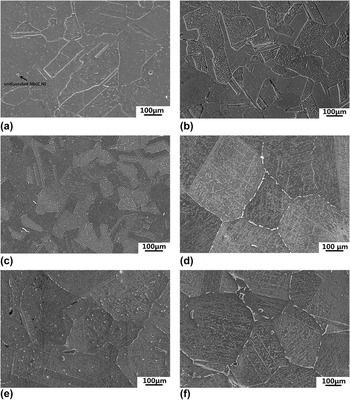
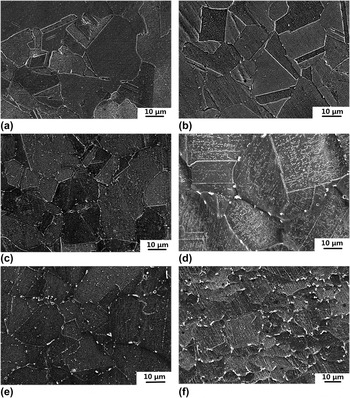
Figure 1 shows the microstructure observed by SEM of type 347H austenitic steel after aging at 700 °C for different holding periods. The typical microstructure of austenitic with some twins is shown in Fig. 1(a) and high density of twins was always randomly presented in the matrix during aging as evident in Fig. 1. A few of particles were observed to be undissolved Nb(C,N) carbonitrides survived from the as-cast microstructure in the specimen which was solution-treated at 1150 °C for 30 min. The microstructure exhibits rather a homogeneous grain structure with an average grain size of about 45 μm. As is shown in Fig. 1, the grain size of the austenite matrix increased inconspicuously with the aging time prolonged. Because the aging temperature is rather low of 700 °C, the grain growth may be neglected. For the specimens of the steel annealed for longer times, a large number of the particles in the form of a chain were found and the coarsening of precipitates was apparent.
SEM micrographs of type 347H austenitic steel after isothermal annealing at 700 °C for different periods: (a) 0 h, (b) 1 h, (c) 100 h, (d) 500 h, (e) 1000 h, and (f) 1500 h.

B. The identification of carbides and phases
The identification of different types of phases that precipitate in type 347H austenitic steel during aging at 700 °C was analyzed by TEM examination. In the investigation, three types of secondary phases (MX, M23C6, Z-phase) were identified.
1. MX carbonitrides
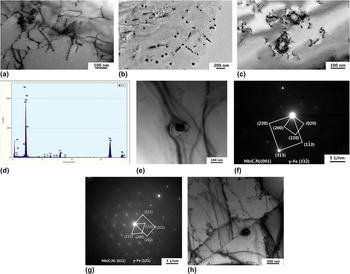
Figure 2(a) exhibits the original morphology of MX-type nanoprecipitates with M = Nb and X = C/N (it will be confirmed later that these are Nb(C,N) carbonitrides). Actually, a large amount of very fine Nb(C,N) carbonitrides nucleated densely along dislocations formed by quenching, and their size increased with the increase of isothermal holding time. Reference Ha and Jung12 The typical microstructures of MX particles are shown in Fig. 2(c). During aging at 700 °C for 2200 h, the size of MX precipitates is about 20–150 nm. The highly fine Nb(C,N) carbonitrides were randomly distributed at crystal defects such as subgrain boundaries and dislocations, and even most of them were surrounded by dislocations. The formation of these leads to the retardation of dislocation movements and improves the creep resistance of the steels at high temperature. Reference Jung, Park, Kim and Lee13 The types of carbonitrides were determined by TEM, EDS, and XRD analysis. The content of powerful carbide-former component Nb in type 347H austenitic steel is about 0.54%. The stabilizing component has as a function higher affinity to carbon than chromium, and they form MX carbides. These carbides combine carbon within the grains and reduce the possibility of intergranular corrosion. Reference Vach, Kunikova, Domankova, Sevc, Caplovic, Gogola and Janovec14 MX carbonitrides in type 347H austenitic steel were classified as intragranular carbide though a few of precipitates of MX were also observed at the grain boundaries. Figure 2(e) illustrates the presence of Nb(C,N) particles at the grain boundaries. It is probably not a detrimental tendency for steels due to the thermal stability of MX carbonitrides. Above all, MX carbonitrides are the predominant strengthening precipitates in type 347H austenitic steel during isothermal annealing at 700 °C.
TEM micrographs of MX carbonitrides in type 347H austenitic steel: (a) the original Nb(C,N) carbonitrides nucleated at dislocations, (b) the fine Nb(C,N) carbonitrides distributed in the matrix, (c) the Nb(C,N) carbonitrides surrounded by dislocations, (d) the EDS analysis of MX carbonitrides, (e) the Nb(C,N) particles within the grain, (f) the TEM analysis of MX precipitates within the grain, (g) the Nb(C,N) particles along the grain boundaries, and (h) the TEM analysis of MX precipitates along the grain boundaries.

2. M23C6 carbides
As is known to all, a critical aspect of microstructural stability in the precipitation strengthened steels for heat-resistant applications is the problem of formation of detrimental particles in the matrix during long-term high temperatures exposure. Reference Sobral, Mei and Kestenbach15–Reference Tan, Byun, Katoh and Snead17 The extremely coarse detrimental precipitates can result in the embrittlement and disappearance of strengthening particles. M23C6 carbides are present at the grain boundaries and they can result in susceptibility to intergranular corrosion. However, the fine discontinuous grain boundary M23C6 precipitates likely improved resistance against grain boundary sliding of type 347H austenitic steel and as well as contributed to improving the creep strength. Rojas et al. found that the formation of nanosized Cr-rich M23C6 carbides can provide good creep resistant due to the pinning effects of grain boundaries. Reference Prat, Garcia, Rojas, Carrasco and Kaysser-Pyzalla9 While, the coarsening rate of M23C6 carbides is much faster than that of MX carbonitrides. The presence of M23C6 precipitates and undissolved primary Nb(C,N) particles plays the key role in decreasing the creep strength of the explored steels. Therefore, the evolution of M23C6 particles has to be well known and understood.
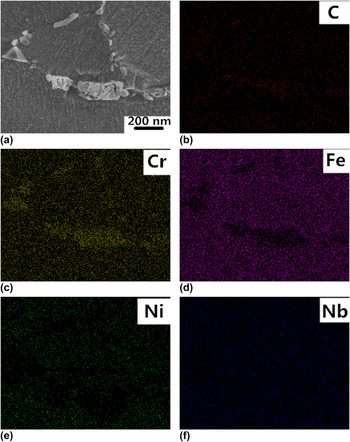
The precipitation behavior of M23C6 carbides has been observed upon long-time holding at 700 °C (see Fig. 3). The M23C6 carbides were identified through energy dispersive spectra and x-ray analysis results [see Figs. 3(e) and 3(f)]. Figure 4 shows the distribution of elements in the form of elemental energy-dispersive X-ray detector (EDX) maps. The results described that the M23C6 particles consist of much more chromium and a little more carbon, and less nickel and iron as compared to that distributed in the matrix. In the steel specimens annealed at 700 °C for 500 h, the existence of discontinuous short rod-like M23C6 particles distributed at the grain boundaries can be seen. By increasing the annealing time, the number of M23C6 carbides increases. It is also apparent that the size of M23C6 increased with the increase of the isothermal holding time. The growth of the M23C6 carbide is faster than that of MX particles. Actually, in the isothermal aged steels, M23C6 carbides precipitate successively on grain boundaries, incoherent twin boundaries, coherent twin boundaries, and finally intragranular. Reference Weiss and Stickler18 When the isothermal holding time is increased up to 2200 h, the M23C6 carbides only precipitated at the grain boundaries [see Fig. 3(d)]. There are no M23C6 particles that can be found within the grains because of the short holding period. As shown in Fig. 4, M23C6 carbides first formed with the shape of short rod-like particles then grew into long bar-like carbides and finally became chain-like precipitates along the grain boundaries. Furthermore, bulk M23C6 particles are easily formed at triple points of grains. The coarsening of M23C6 particles is very harmful to the properties of materials. Reference Sobral, Mei and Kestenbach15–Reference Tan, Byun, Katoh and Snead17,Reference Yoo, Oh, Lee and Nam19 To decrease the number of continuous chain-like M23C6 carbides at the grain boundaries, increasing the content of niobium and boron in the austenitic steels is an effective method to reduce the detrimental to properties at high temperature. Reference Chen, Zhang, Xia, Ishikawa and Yang20
SEM micrographs of M23C6 carbides aged at 700 °C for different holding periods: (a) 500 h, (b) 1000 h, (c) 1500 h, (d) 2200 h, (e) EDS analysis of M23C6 carbides, and (f) XRD profiles.

The SEM micrographs and EDS maps showing distribution of alloying components in M23C6 carbides forming intergranular in type 347H austenitic steel: (a) the SEM image, (b) C, (c) Cr, (d) Fe, (e) Ni, and (f) Nb.

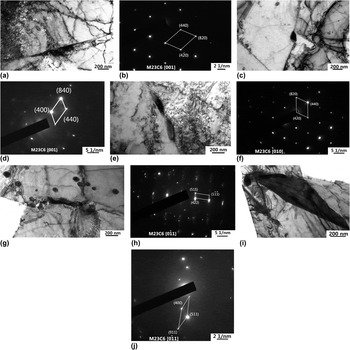
The typical TEM morphologies of M23C6 precipitated at different nucleation sites are shown in Fig. 5. It was observed that M23C6 precipitates at the grain boundaries and agglomerates with a diameter or length of about 0.2–0.8 μm. Since the carbon atom diffuses fast at grain boundaries via dislocation and vacancies, M23C6 particles nucleate and grow firstly along grain boundaries. Reference Wang, Liu, Bao and Cheng11 Figure 5(a) illustrates the micrograph of the steel samples after aging at 700 °C for 500 h, the misty granular particle is the initial microstructure of M23C6 carbide. The M23C6 carbide with the size of 1 μm is present at triple junctions of grain boundaries [see Fig. 5(b)]. Figures 5(e) and 5(g) exhibit the discontinuous rod-like M23C6 carbides. After aging for 2200 h, lots of triangular M23C6 carbides are observed along the grain boundaries [see Fig. 5(k)]. The rod-like M23C6 carbides are more beneficial to the effect of creep-fatigue of the steel compared with triangular M23C6 carbides. Reference Hong and Naw21 There are not enough credible results to verify that the sigma phase precipitates after aging at 700 °C for 2200 h in this work, though M23C6 carbides can facilitate the formation of the sigma phase at the grain boundaries during aging. Reference Viherkoski, Huttunen-Saarivirta, Isotahdon, Uusitalo, Tianinen and Kuokkala22
The various TEM micrographs of M23C6 carbides: (a) the original micrograph and its diffraction pattern (b); (c) bulk M23C6 carbides at triple grain boundaries and its diffraction pattern (d); (e) short rod-like M23C6 carbides and its diffraction pattern (f); (g) chain-like M23C6 carbides and its diffraction pattern (h); (i) triangular M23C6 carbides and its diffraction pattern (j).

3. Z phases
The Z phase (NbCrN) is a kind of very fine nanoprecipitate, which is of tetragonal or cubic structure. The Z phase is capable of strengthening S31042 austenitic steel due to its stability. After long-term exposure under high temperature, a number of cirriform Z phases may occur inside the grains of S31042 austenitic steel. With the increase of holding time, Z phases may also precipitate along the grain boundaries. Reference Sourmail23 A large amount of Z phases were observed in type 347H austenitic steel after aging at 700 °C for 2200 h (see Fig. 6), the size of them is about 100–200 nm. However, it was found that all Z phases were formed at the grain boundaries or twin boundaries, as shown in Figs. 6(a) and 6(c), respectively. Furthermore, as can be seen from Figs. 6(b)–6(e), the results of TEM and EDS analyses indicate that the granular and triangular Z phases are NbCrN particles. The coherent relationships between the Z phase with a size of 200 nm and the matrix cannot be found in Fig. 6(b). As shown in Fig. 6(f), these XRD results indicate the formation of Nb(C,N) carbonitrides and NbCrN particles in the type 347H austenitic steel at 700 °C for 1000 h. Unfortunately, the size and nucleation sites of the Z phase do not conform to the previous observations. The possible reason is the transformation of Nb(C,N) carbonitrides to Z phases with the increase of aging time. The presence of Nb(C,N) at the grain boundaries provides the possibility of transformation. The diffusion rate of atoms at grain boundaries is extremely fast, making it possible to transformation. Danielsen et al. found that MX precipitate particles transform directly into the Z phase by interdiffusion of Cr from the matrix in 12% CrTaN steel. Reference Hilmar, John and Somers24 Though the Z phase is formed at the grain boundaries, the Z phase is more stable than that of Nb(C,N) carbonitrides: the growth of the former is slower than that of the latter. Reference Ha and Jung12 Z phases with the size of 200 nm may strengthen the grain boundaries and increase the creep resistant of the steels.
The TEM analysis of Z phases (NbCrN): (a) Z phases at the grain boundaries and its diffraction pattern (b); (c) Z phases at the twin boundaries and its diffraction pattern (d); (e) EDS analysis of Z phases and its XRD profiles (f).

Based on the above investigation, the possible precipitation sequence of type 347H austenitic steel during aging at 700 °C could be described as: a few of undissolved Nb(C,N) particles exist after solution treatment. A large number of fine Nb(C,N) precipitates are formed at the beginning of aging. With the increase of isothermal holding time, lots of M23C6 carbides precipitate along the grain boundaries. Finally, Nb(C,N) nanoprecipitates transform to the Z phase (NbCrN).
C. Effect of aging temperature on precipitation
Figure 7 apparently indicates that the aging temperature has a strong effect on the number of precipitates in type 347H austenitic steel. During aging from 700 to 900 °C for 100 h, the size of grain swiftly increases. However, when aging temperature increases up to 900 °C, the austenite grain size decreases because the M23C6 carbides occupy the grain boundaries and hinder the increase in grain size. Obviously, the increasing temperature (below the melting point) results in the number density and size of the M23C6 carbides increasing at the grain boundaries. Moreover, hot deformation accelerates the formation of M23C6 precipitates around grain boundaries and deformation bands [see Fig. 7(f)]. The experimental results suggest that the strain induces the precipitation of M23C6 carbides. After hot deformation at 1100 °C and 0.01 s−1, the occurrence of recrystallization and the formation of deformation twinning lead to the earlier precipitation of M23C6 carbides. Reference Ahmedabadi, Kain, Gupta, Samajdar, Sharma, Bhagwat and Chowdhury25,Reference Guan, Xu, Xu and Wang26 Compared with the sample at 900 °C for 100 h, type 347H austenitic steel precipitated more M23C6 particles after thermal deformation. It suggests that the precipitation of M23C6 carbides in steels is more greatly affected by hot deformation at temperatures above aging treatment.
The SEM images of samples being aged for 100 h at different temperatures: (a) 700 °C, (b) 750 °C, (c) 800 °C, (d) 850 °C, and (e) 900 °C, (f) samples deformed at 1100 °C and 0.01 s−1.

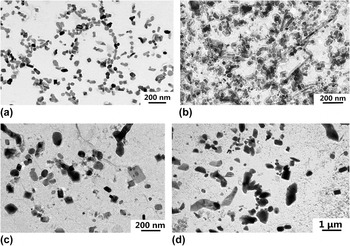
Microstructural examples of the aged Nb(C,N) nanoprecipitates at 700, 800, 850, and 900 °C for 100 h are shown in Fig. 8. Both the amount and the size of MX carbonitrides increase with the aging temperatures ascended. Furthermore, when the temperature rose up to 900 °C, the secondary MX carbonitrides precipitated more easily as compared to the cases annealed in the temperature range of 700–800 °C. Therefore, the increase of isothermal holding temperature facilitates the precipitation of secondary MX carbonitrides.
The TEM images of MX carbonitrides in the steel specimen being aged for 100 h at various isothermal temperatures: (a) 700 °C, (b) 800 °C, (c) 850 °C, and (d) 900 °C.

IV. CONCLUSIONS
The microstructural evolution of type 347H heat-resistant austenitic steel during aging at 700–900 °C was investigated. It can be summarized as:
-
(1) Various precipitates, MX, M23C6, and Z phase, were identified during the long-time high-temperature aging. The size and the amount of these phases increase with the increase of the isothermal temperatures and holding time.
-
(2) MX carbonitrides are the most predominant strengthening phase in 347H austenitic steel. The particles uniformly distributed within the grain as well as at the grain boundaries and tangled with dislocations.
-
(3) M23C6 carbide is a primary harmful precipitate during aging at 700 °C. The size of M23C6 carbides is about 0.2–1 μm, some of them even grow up to 2 μm with the increase of the holding time.
-
(4) Z phases (NbCrN) are observed with the size of 200 nm at the grain boundaries during aging at 700 °C. In type 347H austenitic steel, NbCrN transformed from Nb(C,N) at the grain boundaries.
-
(5) The possible precipitation sequence during aging: fine Nb(C,N) precipitates first, then, M23C6 carbides precipitate along the grain boundaries. Finally, nano Nb(C,N) transforms to the Z phase at the grain boundaries.
ACKNOWLEDGMENTS
The authors are grateful to the China National Funds for Distinguished Young Scientists (Grant No. 51325401), the National High Technology Research and Development Program of China (Grant No. 2015AA042504), and the National Natural Science Foundation of China (Grant No. 51474156) for grant and financial support.