Introduction
Reintroduction, defined as the intentional movement and release of an organism within its indigenous range from which it has disappeared (IUCN/SSC 2013), is an increasingly popular tool for the conservation of threatened species and an innovative measure for rewilding and expanding species distributions (Taylor et al. Reference Taylor, Canessa, Clarke, Ingwersen, Armstrong and Seddon2017). Reintroduction aims not only at re-establishing a viable population in the wild (Scott and Carpenter Reference Scott and Carpenter1987), involving fidelity to the release area, long-term survival and breeding success (Armstrong et al. Reference Armstrong, Castro, Alley, Feenstra and Perrott1999), but also to promote public awareness and international cooperation. Since the release of 15 American Bison Bison bison in Oklahoma in 1907 (Beck Reference Beck2001), more than 700 reintroduction projects (approximately 500 species) have been carried out all over the world. Along with the increased sophistication in planning and implementing reintroduction projects, the development of reintroduction biology in a scientific and systematic way, is the premise for documenting and monitoring reintroduction projects of the Asian Crested Ibis.
The first release of captive-bred Asian Crested Ibis in the world was carried out in 2007 in Ningshan County, Shaanxi Province, China (Yu et al. Reference Yu, Chang, Li, Chen and Shi2009). Analyses of long-term survival rates (Li et al. Reference Li, Ye, Wang, Li, Dong and Huo2018) and population growth rate (Wang et al. Reference Wang, Ye, Li, Huo, Li and Yu2017) of the reintroduced population indicated that there would be a self-sustaining population over the next 25 years. To restore the wild population of the Asian Crested Ibis within their former range, further releases were subsequently conducted in Tongchuan City (Wang Reference Wang2016) and Qianhu National Wetland Park (the present study) of Shaanxi Province, Dongzhai Nature Reserve of Henan Province (Huang et al. Reference Huang, Zhu, Wang, Cai and Huang2016) and Deqing County of Zhejiang Province, China (Shao et al. Reference Shao, He and Lin2016). In August 2008, 10 captive-reared ibises were also released on Sado Island in Japan (Nagata and Yamagishi Reference Nagata, Yamagish and Soorae2013). In 2019, subsequent releases of the Asian Crested Ibis were also carried out in Korea and in Zhouzhi County, Shaanxi Province,China. To date, a total of 414 captive-bred ibises have been reintroduced to the wild in China, Japan and Korea.
Interactions among released individuals are conducive to expanding the distribution and enhancing genetic biodiversity (Glen et al. Reference Glen, Pech and Byrom2013) and may facilitate long-term survival of the Asian Crested Ibis. On the other hand, any translocation may involve at least a simple metapopulation consisting of the source population and several recipient populations (Armstrong and Seddon Reference Armstrong and Seddon2007). This means that species recovery programmes often include multiple reintroductions and many potential reintroduction sites. The ibis population released in Ningshan has become a semi-isolated population where some wild ibises have paired with the released individuals through natural dispersal (Yu et al. Reference Yu, Li and Huo2015). It was observed that one wild ibis from the wild population crossed over the Qinling Mountains to forage in the Weihe River Basin (Dong et al. Reference Dong, Ye, Zhong, Li, Li and Wang2018). Each reintroduced population would be expected to become a recipient population once wild individuals had dispersed to release areas. For this purpose, the experimental reintroduction of the Asian Crested Ibis into Qianhu National Wetland Park, Qianyang County, was conducted on the northern slope of the Qinling Mountains in 2014. All released individuals and wild-born fledglings were monitored over a five-year period to (i) estimate the post-release fate of the reintroduced population through survival rates and reproductive status; (ii) demonstrate potential factors leading to lower outcomes for the newly established population; and (iii) make proposals for subsequent releases of the Asian Crested Ibis and other reintroduction programmes.
Methods
Study area
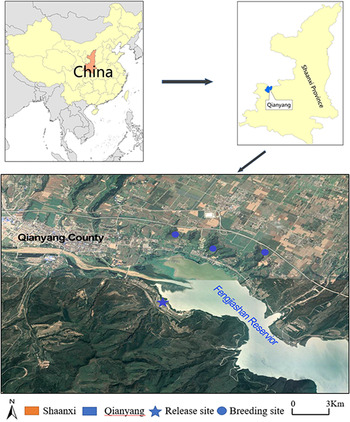
Our study area, Qianhu National Wetland Park, is located in Qianyang County (34°34′–34°56′N, 106°56′–107°22′E), Shaanxi Province in the southern part of the Loess Plateau (Figure 1). The area is characterized by a temperate sub-humid, continental monsoon climate. The annual temperature averages 10.3°C, with a minimum (-19.9°C) in January and a maximum (40.5°C) in July. The average annual precipitation is 627.4 mm and there is a frost-free period of 197 days. The patches of secondary deciduous broadleaf forests were used by all individuals for nest sites, and the shallow margins of the Qianhe River, upstream of the Fengjiashan Reservoir, were used for foraging. The vegetation in these patches is mainly warm temperate deciduous broadleaf forest where the dominant species include Quercus wutaishansea, Q. variabilis and Populus davidiana.
Map of release area showing the location of release site (pentagram) and breeding sites (blue circle) for the reintroduced population.

Study birds and field observations
Until the present study, the individuals we refer to included 30 captive-bred ibises (15 females and 15 males) released on 17 September 2014, and juveniles that successfully fledged over three years (2016–2018). All released individuals were derived from the Asian Crested Ibis Rescue and Research Centre in Yangxian, Hanzhong City. Prior to release, the candidates for release were trained for six months to ensure that they were capable of flying, foraging, and socializing. The training facility was a circular nylon cage 20 m in height and 50 m in diameter, in which roosting trees were planted and foraging grounds were built.
For post-release monitoring, all individuals were uniquely marked with numeric metal rings and colored alphanumeric plastic bands (provided by the National Bird Banding Center of China) on their legs for field identification. We equipped six of the released birds with a neck-mounted lightweight radio transmitter weighing 13–15 g, which is approximately 1% of their body weight (model RI-2D; frequency 216.368-216.691 MHz; battery life approximately 18 months; Holohil Systems, Carp, Ontario, Canada). In the breeding season, all wild-born fledglings were marked at 24–25 days of age when their wings had not developed enough to fly freely, but their tarsi were developed enough for ringing. In the winter following release, the birds were provided with supplementary food (mainly loach Misgurnus anguillicaudatus) at the foraging sites.
The annual resighting data were obtained using banding and radio tracking from 2014 to 2018. All breeding pairs in the study area were monitored during four breeding seasons from January to July, and reproduction rates in terms of the number of fledglings produced were measured. All ibises, as well as the radio-marked individuals, generally formed wandering flocks in autumn and winter for approximately five months. We observed the different groups in the dark (17h40–18h40) when all members of a wandering flock perched in a night-roosting site, and the individuals were observed in a fledgling group between 07h00 and 12h00 on a rotational basis at one-week intervals.
Estimation of the survival probabilities of the reintroduced population
The capture-recapture data were processed and analyzed by the Cormack-Jolly-Seber (CJS) model in the program MARK 9.1 for the annual survival of all individuals combined and released individuals alone. The classic CJS model provides unbiased estimates of survival if all individuals have the same recapture probability (Lebreton et al. Reference Lebreton, Burnham, Clobert and Anderson1992), which can also be modified by dividing animals into groups, introducing age structure, or creating relationships along intervals (Armstrong and Ewen Reference Armstrong and Ewen2002). The Asian Crested Ibis generally forages and roosts in pairs or flocks, and radio-tagged individuals can be a resighting cue for other birds. Hence, we assumed that all individuals had the same probabilities of resighting and survival. We prepared two detailed encounter histories for different cohorts at the beginning of the year of release. The encounter history files were matrices of ones and zeros, showing which individuals were encountered on each survey.
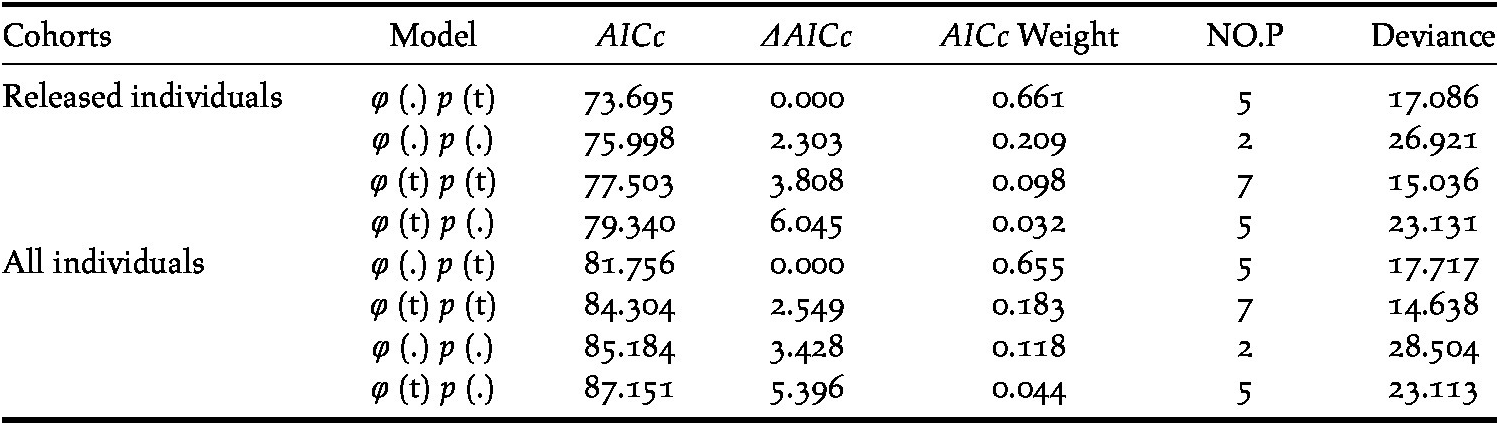
We compared two different subsets of models: models where either survival or recapture (or both) varied with time and models where either survival or recapture (or both) were constant with respect to time. The models are presented in Table 1, using the notation suggested in Lebreton et al. (Reference Lebreton, Burnham, Clobert and Anderson1992). We went through the steps for fitting each of these four models to the data and selected the most parsimonious model based on AICc weights, which represent the weight of the evidence in support of each model (Alisauskas and Lindberg Reference Alisauskas and Lindberg2002). Generally, the model with the highest AICc weight was considered the best-supported model (Anderson et al. Reference Anderson, Burnham and Thompson2000, Burnham and Anderson Reference Burnham and Anderson2002). We also calculated Akaike’s Information Criterion corrected for small sample sizes (AICc) for each candidate model (Buckland et al. Reference Buckland, Burnham and Augustin1997). The most general model was tested with a bootstrap goodness-of-fit test in MARK. The variance inflation factor (ĉ) was also estimated for detecting multicollinearity (Burnham and Anderson Reference Burnham and Anderson1998).
Model selection for the survival (φ) and resighting probability (p) of released individuals and all individuals in the reintroduced Asian Crested Ibis population in Qianyang County.

* Survival rates (φ) and the probability of recapture (p) were modeled as constant over time (.) or as an annual function of time (t). The number of estimated parameters is given by (NO. P).
Results
Survival rates
During our study, 30 captive-bred ibises and 10 wild-born fledglings were included in the survival analysis. The models with no temporal variation in the survival rates or in the recapture (φ (.) p (t)) were more parsimonious both for released individuals and all individuals together based on the highest AICc weights (Table 1). As shown in Table 2, the survival rates of all individuals averaged 0.643 (95% CI: 0.038–0.987), which were slightly higher than those of released individuals (0.569 with 95% CI: 0.353–0.762).
Survival estimates (φ), SE, 95% confidence intervals and relative important value for the best model of released and all individuals.

Thus far, of the 30 released ibises, 13 (43.3%) have been observed to settle in the release area, five (16.7%) were captured and taken back into the prerelease training aviary owing to foraging failure during the following winter, five (16.7%) disappeared due to loss of transmitter signal, and may have dispersed outside the study area, and seven (23.3%) were confirmed to have died. Of the seven mortalities, four (57.1%) died from predation, two (28.6%) from food shortages in winter, and one (14.3%) from unknown reasons.
Reproductive status
The breeding season of the Asian Crested Ibis usually spans four months (from March to June) each year. Since the formation of one breeding pair in 2015 immediately after release, a total of 14 breeding pairs have produced 28 eggs and fledged 10 young birds. Furthermore, the first wild-born female (B181) paired with a released male (Q25) and fledged one young bird successfully in 2018. The mean clutch size was 2.07 ± 0.25 (n = 14), and breeding success was 34.5%. As shown in Table 3, of these clutches (four in 2016, six in 2017 and four in 2018), six were successful (at least one nestling fledged), and eight failed (six during the incubation period and two during the chick-rearing period). During the incubation period, 33.3% and 66.7% of the failures accounted for egg infertility and abnormal behavior of the parent birds (long-term absence from incubation), respectively. During the Table 3 chick-rearing period, one nestling died from predation and another from unknown causes.
Reproductive status of the focal population of the Asian Crested Ibis released in the Qianyang during 2014–2018.

Based on our field observations, the released birds depend to a great extent on food supplementation, especially in winter, indicating that they cannot get enough food in the wild for survival and breeding. The preferred trees used for nesting by the Asian Crested Ibis are Chinese red pine Pinus massoniana and Chinese pine P. tabulaeformis, whereas the forest patches in Qianyang County are primarily mixed plantations where the preferred tree for nesting is aspen Populus davidiana. The released birds therefore tend to select a tree species for nesting that may not be fully suitable. We conclude that food shortage and low availability of suitable nest sites may be the primary reasons for poor breeding success.
Discussion
There is increasing evidence that the exchange of individuals between populations has a strong effect on local population dynamics and persistence (Schaub et al. Reference Schaub, Ullrich, Knotzsch, Albrecht and Meisser2010) and enhances metapopulation functionality (Macdonald and Johnson Reference Macdonald, Johnson, Clobert, Danchin, Dhondt and Nichols2001, Kenward et al. Reference Kenward, Clarke, Hodder and Walls2001). The present population of Asian Crested Ibis would be semi-isolated once individuals from released and wild populations mated with each other through long-distance dispersal. If so, it would be a vital part of the reintroduction plan across the Qinling Mountains. Generally, it is considered that a successful reintroduction programme is composed of three phases: the establishment phase, persistence phase and regulation phase (Robert et al. Reference Robert, Colas, Guigon, Kerbiriou, Mihou and SaintJalme2015). Most released populations fail to establish in the first stage due to high post-release dispersal, low survival, or reproduction rates (Seddon Reference Seddon1999, Seddon et al. Reference Seddon, Armstrong and Maloney2007, Schaub et al. Reference Schaub, Zink, Beissmann, Sarrazin and Arlettaz2009). Moreover, a release site should enable the released organisms to exploit the surrounding area quickly and be adequate for all seasonal needs of the focal species (IUCN/SSC 2013). However, for our reintroduced population, some of the habitat conditions, like low food availability and single vegetation coverage, are likely to have been less suitable for the released ibises and their offspring. Therefore, we speculate that the release project might have failed in the establishment stage without human interventions such as food supplementation, further release, and habitat improvement.
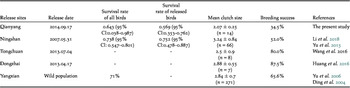
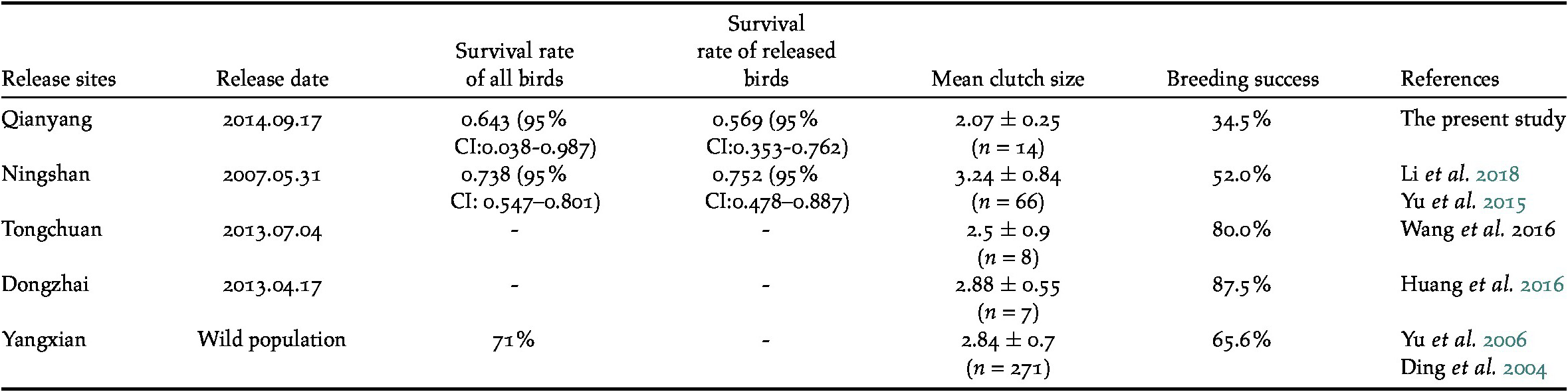
Habitat quality has been identified as an important influence on the survival and establishment of reintroduced individuals (Armstrong and Seddon Reference Armstrong and Seddon2007, Sheean et al. Reference Sheean, Manning and Lindenmayer2012). To a large extent, survival rate and reproductive outcomes of the population might partially reflect the habitat quality of the release area. The present population has been monitored extensively, with particular attention being paid to the survival of the released and wild-born birds over a five-year period. Compared with the survival rate of the Ningshan reintroduction population (Li et al. Reference Li, Ye, Wang, Li, Dong and Huo2018), the survival rate of the released birds in the present study was relatively low (Table 2), indicating that it was difficult for the released individuals to settle down at the release site in the establishment phase. Additionally, the mean clutch size (2.07 ± 0.25, n=14) and reproductive success (34.5%) were much lower than those of the wild population and other reintroduced populations (Table 4). In addition to the immediate unfamiliarity with the release site (Sarrazin and Legendre 2000, Armstrong and Reynolds Reference Armstrong, Reynolds, Ewen, Armstrong, Parker and Seddon2012), the food availability resulting from seasonal changes in the water level upstream of the Fengjiashan Reservoir (Figure 1) could also be associated with lower population outcomes. The released and wild-born ibises mainly foraged in shallow rivers, paddyfields and wet grasslands on the southern slope of the Qinling Mountains (Shi and Cao Reference Shi and Cao2001, Huo et al. Reference Huo, Guo, Li and Yu2014). However, the paddyfields in the vast areas along the Qianhe River almost disappeared due to changes in farming practices over the past four decades. Additionally, we found that most individuals remained close to the release site due to food supplementation in winter instead of moving to a large area in the upper reaches of the Qianhe River (Figure 1). Similar to the Ningshan reintroduced population (Li et al. Reference Li, Huo and Yu2013) and the wild population (Yu et al. Reference Yu, Liu, Xi and Lu2006), predation was the main threat resulting in mortality during the establishment stage of our study population. Dickens et al. (Reference Dickens, Delehanty and Romero2010) suggested that translocated birds are more vulnerable to predators than residents because of the physiological or psychological stresses associated with translocation. Unfamiliarity with the release area and an effort to explore surrounding habitat could also elevate predation mortality in translocated birds (Brown et al. Reference Brown2006, Tavecchia et al. Reference Tavecchia, Viedma, Martinez-Abrain, Bartolome, Gomez and Oro2009). According to previous studies on the southern slope of the Qinling Mountains, the main predators of the Asian Crested Ibis include the king rat snake Elaphe carinata, which usually attacks eggs and chicks, the yellow-throated marten Martes flavigula and Siberian weasel Mustela sibirica, which may also prey on adults as well as their eggs and nestlings (Cao et al. Reference Cao, Yu and Zhai1995, Xi et al. Reference Xi, Lu, Geng, Zhai and Zhang1997, Zhang et al. Reference Zhang, Lu, Zhai, Xi and Wang2000). Moreover, the incubation failure of the released Asian Crested Ibis population on Sado Island, Japan, was attributed to egg predation by crows (Corvus spp.) Nagata and Yamagishi 2013). However, the Eurasian Eagle-owl Bubo bubo, a common resident nocturnal raptor, whose brooding period partially overlaps with that of the Asian Crested Ibis, was recorded to prey on ibis fledglings and adults for the first time. One adult and three yearlings born in the breeding season of 2018 died due to predation by this species. Hence, there is an urgent need for a cost-effective protection measure to be applied in response to this situation.
Survival rate and reproductive success comparison of wild population and reintroduced populations of the Asian Crested Ibis.
In consideration of the crisis that the population faced, the following suggestions are proposed. First, further releases in the upper part of the Qianhe River should be conducted to attract the released individuals to expand their distribution. Based on the sex ratio of the current population (Yu et al. unpubl. data), more female captive-bred individuals should be soft-released to balance the extreme male-skewed population structure. Second, a blocking dam should be constructed on the reservoir to increase the area of shallow shore (foraging grounds). This simple, inflatable rubber dam should be built by the Qianhu National Wetland Park in conjunction with the reservoir management office in the upper reaches of the reservoir as soon as possible. In this way, the water level can be controlled according to the seasonal variation of river runoff to ensure a sufficient area of foraging grounds upstream of the dam. Finally, on the basis of extensive studies on the breeding ecology of the Eurasian Eagle-owl, necessary measures should be taken to deter the owl from the nest sites of the Asian Crested Ibis. Specifically, management interventions should be considered to deter owls from their preferred breeding area in caves on soil cliffs in the vicinity of the breeding territory of the Asian Crested Ibis during the main ibis breeding season.
Acknowledgements
We are very grateful to the management center of the Asian Crested Ibis in Qianhu National Wetland Park for providing logistical help and research aid. We thank Wei Da for obtaining the survival data and Xue Ruihui for drawing the maps. We are also grateful to the anonymous reviewers for their constructive comments. This work was completely supported by the National Nature Science Foundation of China under grant numbers 31572282, 31872245.