

Introduction
In the last two decades, privatization has become a defining feature of the modern political economy. In Latin America, where some of the largest and most aggressive programs of state retrenchment occurred, privatization was a central component of structural economic reforms. However, despite the pervasive trend towards state retrenchment in the region, significant variation in the extent and timing of privatization among Latin American states over the last three decades can still be observed. In Chile, privatization began with the bureaucratic authoritarianism of the Pinochet regime in the early 1970s. In countries such as Peru, Argentina and Mexico, the majority of privatizations occurred in a short period in the early 1990s with the election of neo-populist leaders. In Brazil, although privatization began with Collor de Mello, it was not until the election of the social democrat, Fernando Henrique Cardoso, that privatization began in earnest. In Uruguay, repeated attempts to initiate privatization during the 1990s failed.Footnote 1 Privatization continues to remain a divisive political issue in the region today. The recent electoral success of a diverse group of politicians that are part of a general resurgence of left-of-center political forces across Latin America,Footnote 2 has reignited debates over state ownership, and many of these ‘new left’ leaders have engaged in fiery rhetoric denigrating the widespread privatization of state assets. Leaders, such as Néstor Kirchner in Argentina and Hugo Chávez in Venezuela, have even renationalized previously privatized state entities (see Chavez Reference Chavez2007).
However, while the potential efficiency gains from privatization have received considerable attention from economists (see Chong and López-de-Silanes Reference Chong and López-de-Silanes2003), and the sequencing and timing of privatization has received attention from political scientists (see Manzetti Reference Manzetti1999; Glade Reference Glade1991; Schamis Reference Schamis2002; Bortolotti and Siniscalco Reference Bortolotti and Siniscalco2004), quantitative analyses of the determinants of privatization remain very rare. Of the few studies that do exist, most are concerned with the advanced industrial democracies, and nearly all offer competing explanations for variation in levels of privatization, the most prominent of which include partisanship (Boix Reference Boix1997), globalization (Schneider, Fink and Tenbücken, Reference Schneider, Fink and Tenbücken2005), diffusion (Meseguer Reference Meseguer2004), domestic economic conditions (Brune and Garrett Reference Brune and Garrett2000; Zohlnhöfer, Obinger and Wolf Reference Zohlnhöfer, Obinger and Wolf2008) and legal institutions (Bortolotti, Fantini, and Siniscalco Reference Bortolotti, Fantini and Siniscalco2003). What is more, for Latin America, only one cross-national study, focusing exclusively on the domestic determinants of privatization, exists (Biglaiser and Brown Reference Biglaiser and Brown2003). So what explains privatization among Latin American states?
An extensive literature exists on the politics of stabilization and structural adjustment (see Rodrik Reference Rodrik1996). This literature offers two broadly competing explanations for market-orientated reforms, the first concerned with domestic-level variables and the second focused upon the role of exogenous pressures in the international political economy. Studies, concerned with domestic political and economic conditions, have highlighted the importance of powerful executives, insulated from veto players (Haggard and Kaufman Reference Haggard, Kaufman, Diamond and Plattner1995), the necessity of building broad political coalitions (Frieden Reference Frieden1988), and the role of economic crises (Krueger Reference Krueger1993: Weyland Reference Weyland2002) in driving reform processes. Alternatively, other authors have argued that international pressures have primarily been responsible for structural adjustment. The threat of capital flight (Haggard and Maxfield Reference Haggard, Maxfield, Milner and Keohane1996) and the conditionalities of the international financial institutions (Stallings Reference Stallings, Haggard and Kaufman1992) induced governments to implement liberalizing reforms.Footnote 3
I contend that in order to understand privatization in Latin America, we cannot simply dichotomize between exogenous and endogenous variables. Rather, privatization is best conceptualized as a two-stage process, involving an initial decision to privatize, followed by a subsequent decision regarding the extent and intensity of privatization. Both international and domestic-level variables will have an impact on privatization across the region, but this impact will vary according to the two-stage nature of the privatization process.
I test this argument on a panel of 14 Latin American states over the period 1975 to 2003. This is the first such analysis that models privatization in Latin America as a two-stage process and tests partisan, domestic economic, institutional and exogenous explanations. The results yield two important insights. Firstly, the initial decision to privatize is primarily shaped by international factors, in particular, international diffusion, while variation in the level of state divestiture across the region can primarily be explained by domestic economic and political conditions. Levels of privatization have been higher in wealthier, macroeconomically stable, Latin American states. Domestic politics also matters.
The paper is structured as follows. The first section discusses the determinants of privatization, and draws a number of testable hypotheses from this discussion. The second section presents both the dependent and independent variables and the model utilized to test the competing explanations for privatization. The third section discusses the results of these estimations while the fourth section presents the conclusion and the wider implications for this research.
The Determinants of Divestiture: Exogenous Pressures or Domestic Incentives?
While there exists a large economics literature on the efficiency gains to be accrued from privatization (see Dewenter and Malatesta Reference Dewenter and Malatesta2001; Chong and López-de-Silanes Reference Chong and López-de-Silanes2003)Footnote 4 and a number of qualitative studies on privatization in political science (Manzetti Reference Manzetti1999; Schamis Reference Schamis2002; Feigenbaum, Henig and Hamnett Reference Feigenbaum, Henig and Hamnett1998), very few cross-national quantitative studies exist that attempt to uncover the main determinants of privatization. From those few empirical studies that do exist however, and from the wider qualitative literature on state reform in general, a number of prominent competing theories concerned with the determinants of privatization can be deciphered. These theories can be grouped into two broad categories: explanations that highlight the role of international variables in placing downward exogenous pressures on states to privatize, and explanations that focus on the role that domestic political and economic variables play in shaping reform processes and privatization across Latin America.
International explanations for policy reform begin with the role of exogenous forces in the international political economy that limit the policy autonomy of domestic political actors. Heightened economic interdependence, manifest in rising levels of trade integration and capital mobility since the end of the Bretton Woods system in 1971, is thought to have significantly constrained distinct partisan supply-side polices. The central contention of this ‘globalization thesis’ is simple. The importance of hyper-mobile capital in today's globalized markets has forced states to aggressively compete for mobile asset holders, increasing the power of capital relative to labor, and in so doing, significantly constraining the policy options of national governments (Przeworski and Wallerstein Reference Przeworski and Wallerstein1988; Gill and Law Reference Gill and Law1989; Andrews Reference Andrews1994; Ruggie Reference Ruggie1994; Cerny Reference Cerny and Gummett1996). It is assumed that capital prefers certain government policies over others, such as little regulation, privatization, reduced social welfare spending, flexible labor markets, low corporate tax rates etc. and if governments do not adopt these policies, then mobile asset holders will simply exercise their exit option, resulting in deleterious economic consequences for the state in question.
The pressures of increasing trade competition compound this. Government spending to compensate those affected by the dislocating impacts of trade integration is thought to reduce the competitiveness of a country's exports by distorting prices and wages (Burgoon Reference Burgoon2001; Kaufman and Segura-Ubiergo Reference Kaufman and Segura-Ubiergo2001). National governments are forced to reduce the size of the public economy in order to ensure that their state remains internationally competitive. The end result: a retreat of the state from the national economy, manifest in widespread privatization. This argument has been labeled the ‘efficiency hypothesis’ (see Garrett Reference Garrett1998a), and also the ‘race to the bottom’ thesis (see Drezner Reference Drezner2001).
For the developing world, the constraining effects of exogenous forces are generally presumed to be magnified. Increased dependence on foreign capital and the disorganization of interest groups demanding compensatory spending have resulted in regressive taxation (Wibbels and Arce Reference Wibbels and Arce2003) and reduced social spending (Kaufman and Segura-Ubiergo Reference Kaufman and Segura-Ubiergo2001; Rudra Reference Rudra2002). In Latin America, the debt crisis of the early 1980s and the liberalizing structural reform programs supported by the international financial institutions as part of this debt restructuring further exacerbated the constraints facing national governments (Wibbels and Arce Reference Wibbels and Arce2003).Footnote 5 Schneider, Fink and Tenbücken (Reference Schneider, Fink and Tenbücken2005), in their study of privatization in the advanced industrial democracies, found that domestic political actors were severely constrained by exogenous forces. In fact, their evidence suggests that the main driver of infrastructure privatization in these states was the liberalization of capital markets (2005: 718–719). The prediction of the globalization theorists is therefore relatively straightforward. The exit threat of hyper-mobile capital and the pressures of trade integration have placed pressure on all states to privatize.
Consequently, the more exposed a country is to economic globalization, the more privatization we should observe (Hypothesis 1).
The second major explanation associated with international variables is concerned with processes of international diffusion. There are two main ways to conceive of diffusion in Latin America: as a product of rational learning due to Bayesian updating concerning the efficacy of different policy options, and as a result of various emulative processes. Rational learning assumes that governments have prior beliefs about the effectiveness of a particular policy, in this case privatization, and observe the outcomes in countries that privatize and countries that do not (see Meseguer Reference Meseguer2006: 159–160; Baturo and Grey Reference Baturo and Grey2009). With this new information, governments will revise their beliefs and will switch to privatization as long as the expected outcomes of privatizing are superior to not doing so. This posterior belief, according to Bayes' rule, will then become the prior belief in the following period (see Meseguer Reference Meseguer2004: 301; 2006: 160).
Emulation on the other hand, occurs as a result of a variety of different processes. The first of these is bounded learning, or cognitive heuristics. In this scenario, governments place exaggerated stock in a measure's superiority and simply adopt it wholesale, regardless of its relevance for their own context (Baturo and Grey Reference Baturo and Grey2009: 14; Weyland Reference Weyland2005). Thus, policymakers follow trends blindly, without any form of prior evaluation (Rose Reference Rose1991). Emulation can also be social, whereby states herd simply on the behavior of their peers (Meseguer Reference Meseguer2004: 312), or as a consequence of the diffusion of causal beliefs concerning market reform among neighboring states (see Chwieroth. Reference Chwieroth and Abdelal2009: Reference Chwieroth2007), or as a signal of commitment to sound economic reform (Baturo and Grey Reference Baturo and Grey2009). However, it is difficult to untangle which causal process is ultimately responsible for emulative diffusion. The causal processes associated with herding, social emulation, bounded learning and the spread of neoliberal ideas are very similar and do in fact, overlap in a number ways. Brune and Garrett (Reference Brune, Garrett and Kogut2004) found evidence to suggest that emulative diffusion had a large impact on privatization in the developing world, while in Latin America, Meseguer (Reference Meseguer2004) has argued that the initial decision to privatize was heavily shaped by both processes of rational learning and emulation.
Therefore, rational learning and emulation should increase the probability of privatizing in Latin America (Hypothesis 2).
In contrast, other scholars reject the inevitable policy convergence of the globalization theorists and instead contend that domestic political and economic conditions primarily shape policy choices. These explanations begin with actor preferences. For these scholars, the partisan orientation of the government in power continues to have important implications for the design of policy (see Hibbs Reference Hibbs1977, Reference Hibbs1992), despite increasing exogenous constraints. However, as Karen Remmer (Reference Remmer2002: 40) has noted, the relative fluidity of party political identities in Latin America make it difficult to specify hypotheses regarding electoral strategies and outcomes based on class composition or ideology. Nonetheless, it is possible to generate predictions for the impact of different parties on levels of privatization, based upon the assumption that governments will pursue policies that are favorable to their core clientele (Remmer Reference Remmer2002: 40). So, for example, a right-wing party will have electoral incentives to privatize. A simple rationale for this choice may be the ‘forward looking behavior of market orientated politicians aiming at gaining future support from the constituencies and shareholders of newly privatized firms’ (Botolotti, Fantini and Siniscalco, 2003: 308). In contrast, parties of the left face electoral incentives to resist privatization. Unionized employees in state firms form one of the core constituencies of parties of the left, and this group would most likely lose many of their privileges should privatizations occur (Zohlnhöfer, Obinger and Wolf Reference Zohlnhöfer, Obinger and Wolf2008: 102).
Scholars have long argued that partisanship exerts an impact on policy. Cameron (Reference Cameron1978: 1256) and Hicks and Swank (Reference Hicks and Swank1992: 669–670) contended that the positive effects of trade openness on social spending were directly related to the ideology of the government in power. More recent analyses have indicated that left-leaning governments are consistently able to maintain social-welfare spending (Garrett: Reference Garrett1998a; Allan and Scruggs Reference Allan and Scruggs2004), progressive taxation and macroeconomic policy autonomy (Oately Reference Oatley1999).Footnote 6 In Latin America, recent evidence suggests that governments of the left exert a distinct partisan influence on levels of social spending (Kaufman and Sergura-Ubiergo Reference Kaufman and Segura-Ubiergo2001), patterns of expenditure (Huber, Mustillo and Stephens Reference Huber, Mustillo and Stephens2008) and taxation (Wibbels and Arce Reference Wibbels and Arce2003).
In his study of privatization in the OECD states, Carles Boix (Reference Boix1997) demonstrated that policy towards the public business sector was directly shaped by the partisan composition of those in office. Botolotti, Fantini and Siniscalco (2003) found tentative evidence to suggest that privatization proceeds increased with governing parties of the right, while Zohlnhöfer, Obinger and Wolf (Reference Zohlnhöfer, Obinger and Wolf2008), argued that, when economic problems are moderate, partisan differences do matter for privatization proceeds in the OECD states.
Therefore, we should expect left-leaning governments to be associated with lower levels of privatization (Hypothesis 3).
In addition to those theories concerned with the ideology of domestic actors, are approaches that relate the ability of these actors to impact upon policy to the institutional limitations that they face. Every political actor must operate within a specific institutional configuration that will either impede or accentuate his or her impact on policy. In attempts to explain economic restructuring, particularly in Latin America but also in other parts of the world, the new institutionalism contended that sub-regime variables, such as the degree of presidential power (Mainwaring and Shugart Reference Mainwaring and Shugart1997), the volume of presidential support in the legislature (Shugart and Carey Reference Shugart and Carey1992; Morgenstern and Nacif Reference Morgenstern and Nacif2002) and the effective number of parties in the legislature (Foweraker Reference Foweraker1998; Ames Reference Ames2001; Mainwaring and Shugart Reference Mainwaring and Shugart1997) explained a government's ability to implement, or alternatively resist, economic reforms. In a similar vein, veto-player theory highlights the institutional restrictions that political actors face when pursuing their preferences. The probability of policy change is dependent upon the number of veto players, that is, actors whose agreement is necessary for policy change in a political system, and the similarity of their preferences (Tsebelis Reference Tsebelis1995, Reference Tsebelis2002).
Scholars concerned with this institutionalist tradition, also reject the determinism of the globalization thesis. They object to the notion of an inevitable, exogenously driven policy convergence across states. Rather, they highlight the role and importance of labor market institutions in resisting the pressures of globalization (Garrett Reference Garrett1998a); the path-dependent effects of previous policies and national institutional structures in channeling certain policy outcomes (Pierson Reference Pierson2004); how national varieties of capitalism actually result in the divergence of policy across governments (Streeck Reference Streeck, Crouch and Streeck1997; Hall and Soskice Reference Hall and Soskice2001); and how political institutions ‘provide or restrict opportunities for representation for those that are adversely affected by globalization and for those ideologically opposed to – or materially harmed by – the common neoliberal responses to globalization’ (Swank Reference Swank2002: 6).
In fact, Boix (Reference Boix1997) provides empirical support for the institutionalist argument. His study indicates that multi-party coalitions and minority government status inhibit privatizations.Footnote 7 So, executives with a high level of power, who are not constrained by the necessity to construct multi-party coalitions due to the fragmentation of the legislature, should be able to bypass most opposition to economic reform and privatization.
Therefore, we can expect higher levels of executive power and lower levels of legislative fragmentation to be associated with higher levels of privatization (Hypothesis 4).
Finally, privatization may also be the product of domestic economic conditions. When a government is in severe financial distress, with large deficits and high levels of external debt, the pressure to privatize may increase significantly (Haggard and Kaufman Reference Haggard, Kaufman, Diamond and Plattner1995). Proceeds raised from the divestiture of state assets may be utilized to pay creditors and also to finance current expenditure and reduce deficits (Botolotti, Fantini and Siniscalco, 2003: 309). Reduced levels of external debt will send signals of credibility to the market, improving a country's credit rating and generating lower interest payments (Biglaiser and Brown Reference Biglaiser and Brown2003: 80). Likewise, economic malaise manifest in stagnant or negative growth rates and high levels of inflation may induce a state to adopt measures such as privatization. The deficits of state enterprises may increase inflation, so governments can automatically reduce their expenditure by offloading loss-making entities (Biglaiser and Danis Reference Biglaiser and Danis2002: 91). Poorer states should have a greater incentive to privatize, not only because such transactions will generate much-needed revenue for the state, but also because privatization is often seen as a growth stimulating measure (Zohlnhöfer, Obinger and Wolf Reference Zohlnhöfer, Obinger and Wolf2008: 103).
However, on the other hand, macroeconomic problems, in the form of spiraling inflation, large deficits and high levels of debt, may impose significant political and economic constraints on a government's ability to privatize, as they will be fearful of the political and social dislocation associated with the sale of state assets (Brune and Garrett Reference Brune and Garrett2000: 13; Biglaiser and Danis Reference Biglaiser and Danis2002). Likewise, wealthier countries may be more likely to privatize than poorer countries because they ‘are likely better positioned to offset dislocations by compensating those adversely affected by privatization programs’ (Brune and Garrett Reference Brune and Garrett2000: 12–13). So, the direction of the causal relationship between domestic economic conditions and the decision to privatize is unclear.
In reality, both international and domestic-level variables will shape privatization, but they will do so in different ways. I contend that in order to understand privatization in Latin America, we cannot simply dichotomize between exogenous and endogenous variables. Privatization is best envisioned as a two-stage process, involving an initial decision to privatize, followed by a subsequent decision regarding the extent and intensity of privatization, and at each stage of this process, international and domestic variables will have different impacts.
I expect the first stage of this process, that is, the initial decision to privatize, to be primarily shaped by international-level variables. The primary focus of the globalization literature, and the literature on international diffusion, has been to provide us with an explanation as to why states converge upon similar policies. The initial decision to select privatization as a policy is ultimately about explaining convergence. Domestic economic and political variables, while they may impede or assist the adoption of policy, may not prove as useful in explaining why so many states adopted a similar policy at the same juncture in history. Economic conditions change frequently in Latin America, and levels of political power and fragmentation have remained remarkably constant, at least during democratic periods, across the region. However, while international variables may be able to explain convergence upon privatization, I expect them to have less explanatory power with regards to variation in the level of privatization across Latin America. Indeed, as Meseguer (Reference Meseguer2004: 312) has noted, international diffusion ‘is a strong predictor of the decision to privatize,’ but ‘loses much of its explanatory power when it comes to predicting a government's decision to sustain privatization.’ I expect varying levels of privatization to be primarily explained by domestic-level variables. Exogenous pressures may place downward pressure on a state to privatize, but once a state has chosen to privatize, decisions regarding how much to privatize and what, will ultimately be a product of economic necessity, political ideologies and institutional battles.
Data and Methods
In order to test the two-stage nature of my argument, I utilize a Heckman selection model. I also estimate and report time-series cross-sectional models of privatization. All the econometric models are based on a sample of 14 Latin American states over the period 1975 to 2003.Footnote 8
The Dependent and Independent Variables
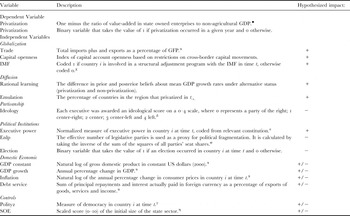
I argue that the decision to privatize occurs in two stages. The first stage concerns the initial decision to approve privatization, while the second stage concerns decisions related to the size and intensity of these privatizations. To model this process, I employ a Heckman selection model. This model requires two dependent variables in order to capture both the selection and outcome stage. Both of these dependent variables are based on the privatization index developed by Morley, Machado and Pettinato (Reference Morley, Machado and Pettinato1999). The first dependent variable is simply the index itself, which captures the level of privatization in each state. According to Morely, Machado and Pettinato (Reference Morley, Machado and Pettinato1999: 10) the index ‘is one minus the ratio of value-added in state owned enterprises to non-agricultural GDP.’ This privatization index is part of a larger project that developed five separate indices and one composite index to measure varying levels of market reform in Latin America. These indices include a measure of trade liberalization, capital liberalization, tax reform, financial liberalization and, of course, privatization. Each index is a continuous measure ranging from 0 to 1 and the country with the highest level of privatization at time t is coded as 1 and all other scores are relative to this maximum.Footnote 9 The values for this index stop at 1999. An updated version that encompasses values from 1975–2003 is taken from Kingstone and Young (Reference Kingstone and Young2009). According to this index, the level of privatization in Latin America has been steadily rising since 1975.
The second dependent variable, which captures a country's decision to select privatization in a given year, is a binary variable that takes the value of 1 when there is a positive increase in the Morley index from the previous year, signaling privatization transactions have occurred in that period, and 0 otherwise. This measure takes into account the first stage of the decision-making process, that is, the decision to approve or ‘select’ privatization. The second stage, concerning the intensity and extent of these privatizations, is captured by the index itself.
However, this index does have some problems. The most serious is that it is sensitive to inflation and to exogenous trends in primary product prices. For example, during periods of severe inflation, governments may have attempted to freeze the prices for public services provided by state companies. Consequently, the companies may have run at a loss and this could be portrayed, erroneously, as a reduction in the size of the state owned sector (Morley, Machado and Pettinato Reference Morley, Machado and Pettinato1999: 11). Despite these problems, the Morley et al. indices have been widely utilized in quantitative studies to compare varying levels of market reform (see for example, Kingstone and Young Reference Kingstone and Young2009; Nielson Reference Nielson2003; Biglaiser and DeRouen Reference Biglaiser and DeRouen2004). The index also represents the longest uninterrupted data on privatization in the region, and although relative to the leading country, the indices are still considered the best available cross-country comparable data for reform across Latin America (see Huber Reference Huber, Bland and Arnson2009: 68). Nonetheless, for the sake of robustness, I also estimate all the statistical models with alternative measures of the dependent variables. The results remain very similar.
I follow Brune and Garrett (Reference Brune and Garrett2000) and acknowledge that there may be some lapse in time between the causal determinant and the resulting privatization and so all independent variables are lagged one year.
In order to test the pressures of the international economic system on privatization, I utilize two standard measures of globalization. The first, Trade, captures the openness of an economy to international trade. It is the sum of imports plus exports as a percentage of a country's GDP. This data was taken from the World Development Indicators (World Bank 2008). The second measure, Capital openness, represents the extent of a state's financial integration, and is taken from Chinn and Ito's (Reference David and Ito2008) index of capital account openess. Based on information from the IMF's Annual Report on Exchange Arrangements and Exchange Restrictions (AREAER), the data relfects the degree of restrictions on cross-border capital movements in a given country. The index takes on higher values the more open a country is to cross-border financial transactions. Finally, the international financial institutions, particularly in Latin America, have traditionally been vocal supporters of privatization. These institutions, at various times, may have been able to exert some pressure on Latin American states to privatize. So, IMF describes whether a country is involved in a structural adjustment program with the Fund. A country that has signed an IMF stand-by agreement in year t is coded as 1. If the country is not involved in such program, this variable is coded as 0.Footnote 10
International diffusion is represented by two variables. Emulation replicates the variable utilized by Meseguer (Reference Meseguer2004: 313), and is simply the sheer number of countries engaged in privatization at t-1. The second diffusion variable, learning, also replicates Meseguer (Reference Meseguer2004: 309–310), and represents a country's capacity for rational learning.Footnote 11 Governments have prior beliefs about the relationship between privatization and growth, X. I have taken this prior belief to be the average rate of growth in the second year of the database, 1976. In each year, governments observe the growth achieved by countries that do privatize, and countries that do not privatize. As a consequence of Bayesian updating, governments use this information to update their prior beliefs. These posterior beliefs then become prior beliefs in the next period, and so on (Meseguer Reference Meseguer2006: 160). Learning is therefore the ‘difference in posterior beliefs about average results under alternative status (privatization and non-privatization)’ (Meseguer Reference Meseguer2004: 311).Footnote 12
In order to test the impact of partisanship on levels of privatization, I construct a variable that captures the ideology of the executive in country i at time t. Each executive was awarded an ideological score on a 0–4 scale, where 0 represents a party of the right; 1 center-right; 2 center; 3 center-left and 4 left. This coding was based on Coppedege's (Reference Coppedge1997) coding from his expert survey on Latin American party positions. An updated and temporal version of this data (1990–2003) was provided by Grigore Pop-Eleches (Reference Pop-Eleches2009).
To examine the role that political institutional structures play in determining levels of privatization, I employ three variables. The level of centralized executive power will reduce the influence of veto players and increase the autonomy of the president. In order to measure the power of the executive in each Latin American state, each country's constitution was coded in order to create Executive power, a variable that measures the executive's control over legislation. The executive's veto and decree power, the executive's ability to exclusively initiate legislation and to call a referendum and the control of the executive over cabinet formation and dismissal were all coded, normalized and then added together.Footnote 13 This total score was then divided by 5 to provide the score for Executive power, for each state, for each year in question. The coding scheme was taken from the United Nations Development Program (2005: 80–81)Footnote 14 and Carey, Amorim Neto and Shugart (Reference Carey, Neto, Shugart, Mainwaring and Shugart1997). The requisite constitutions were downloaded from Georgetown's Political Database of the Americas.Footnote 15
The second institutional variable concerns the fragmentation of the party system. The more parties that exist in a political system, the more difficult it will be to implement policy and the greater the likelihood that the governing party will be forced to forge some type of coalition to govern (Haggard and Kaufman Reference Haggard, Kaufman, Diamond and Plattner1995; Mainwaring and Shugart Reference Mainwaring and Shugart1997). Here, the effective number of legislative parties (Enlp) is used as a proxy for political fragmentation. It is calculated by taking the inverse of the sum of the squares of all parties' seat shares. This data is taken from Kingstone and Young (Reference Kingstone and Young2009). Finally, election is an election-timing variable that captures the potential honeymoon effect for new administrations. It is a dummy variable that takes the value of 1 when an election occurs in country i during a particular year, and 0 otherwise.
I include a standard set of variables to capture a country's domestic economic condition. Gross domestic product (GDP constant) in constant US dollars (2000), reflects the income level of a state, while Inflation and GDP growth reflect short-term macroeconomic conditions. A country's pressing financial obligations is captured by its capability of servicing its debt, debt service. This variable attempts to capture country i's immediate debt obligations at time t. It is all short-term debt as a percentage of exports of goods, services and income. All economic data is taken from the World Development Indicators (World Bank 2008).
Finally, I also include two control variables. The first is in keeping with other political economy literature and represents a measure of democracy. This measure, Polity2, is taken from the Polity IV database (Marshall and Jaggers Reference Marshall and Jaggers2007).Footnote 16 The second control represents the initial size of the state-owned sector (SOE) before privatizations began. Clearly, the initial size of the state-owned sector will have some impact on subsequent levels of privatization. It is plausible to assume that a country with a larger state sector before privatizations begin is likely to privatize more in comparison to a state with a small state sector. However, to capture the initial size of the state sector is far from easy. Very little data exists for the size of the state sector for the advanced industrial democracies, let alone Latin America. So, in order to provide some control for the initial size of the state-owned sector, I utilize a measure from the Economic Freedom of the World Report (Gwartney and Lawson Reference Gwartney, Lawson and Norton2008). This variable consists of the number, composition, and share of output supplied by state-owned enterprises and government investment as a share of total investment. This data is then utilized to construct a rating between 0 and 10.Footnote 17 Aside from the obvious problems with this measurement, this data is only available for every five-year period between 1970 and 2000. Consequently, this variable is treated only as a control for the sake of robustness in the panel estimations.
Variable Descriptions, Data Sources and Hypothesized Impacts on Levels of Privatization in Latin America

• Morley, Machado and Pettinato (Reference Morley, Machado and Pettinato1999);
∝ World Bank Development Indicators (2008);
∂ Chinn and Ito (Reference David and Ito2008);
χ IMF (2009);
δ Coppedge (Reference Coppedge1997), Pop-Eleches (Reference Pop-Eleches2009);
ε UNDP (2005: 80–81), Carey, Amorim Neto and Shugart (Reference Carey, Neto, Shugart, Mainwaring and Shugart1997), Georgetown's Political Database of the Americas;
φ Kingstone and Young (Reference Kingstone and Young2009);
γ Marshall and Jaggers (Reference Marshall and Jaggers2007);
η Gwartney and Lawson (Reference Gwartney, Lawson and Norton2008)
The Models
In order to empirically examine the determinants of privatization, I utilize an unbalanced time-series, cross-sectional dataset for 14 Latin American countries, spanning the period 1975 to 2003. However, errors from regression equations estimated from models of this sort using ordinary least square regression (OLS) procedures tend to suffer from autocorrelation, serial correlation and heteroscedasticity. What is more, I argue that the decision to privatize is best represented as a two-stage process. There is the initial decision facing governments whether to privatize or not, followed by a subsequent decision concerning the extent and size of these privatizations. In addition, variation in levels of privatization, the outcome of interest in this study, is shaped by the initial decision to privatize. Therefore, I utilize a Heckman selection model (Heckman Reference Brooks1976) in order to capture the two-stage nature of this process. This estimation procedure models a process that begins with selection (privatization or not), followed by a decision over a continuous outcome (size and extent of privatization). This model allows me to control for selection bias, thus avoiding misinterpretation of the substantive causal effects of particular variables due to correlation between exogenous variables and the disturbance term. The Heckman model assumes that the procedure through which the observations of Y (y1i) are derived cannot be understood as a single linear function but depends on a second latent variable (Y2). As Brooks (Reference Brooks2002: 508) notes, the dependent variable (y1i*) therefore, is only observed if a second linear model exceeds zero: Y2i = δ'Zi + u2i > 0.
However, the Heckman model performs poorly without an exclusion restriction, a variable that enters the selection equation but does not enter the outcome equation (see Sartori Reference Sartori2003). Without such a variable, the results, as Sartori (Reference Sartori2003: 112) argues, ‘are then based only upon the assumptions about distributional assumptions about the residuals rather than upon variation in the explanatory variables.’ The exclusion restriction utilized here is debt crisis, a variable that captures a systemic transition in Latin America. The debt crisis of the early 1980s sounded the death knell of import substitution industrialization in Latin America and a systemic event of this nature should have had an impact on the decision to select privatization. Debt crisis takes the value of 1 for the years between 1982–83, and 0 otherwise.
I also report a number of alternative econometric estimations that model variation in levels of privatization across Latin American. In order to address the problems of autocorrelation, serial correlation and heteroscedasticity, I follow Beck and Katz's (Reference Beck and Katz1995) recommended procedure and utilize ordinary least squares with panel-corrected standard errors (PCSE) to correct for panel heteroscedasticity and spatial correlation. I also include a lagged dependent variable to deal with temporal dependence and correct for serial correlation (Beck Reference Beck2001). However, as Achen (Reference Achen2000) has demonstrated, the use of a lagged dependent variable can suppress the power of other independent variables. Achen recommends correcting for first-order autoregression in order to avoid the problems associated with a lagged dependent variable. I estimate and report both models, further lending credence to the results. Country dummies are also included in order to control for fixed effects. The basic form of the equation is as follows:

In the equation above, α represents country dummies, b is the parameter estimate for the independent variables, while μ represents the error term.
Results
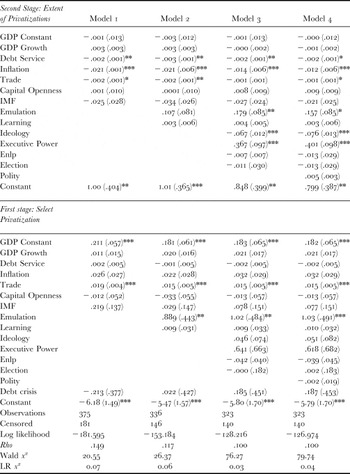
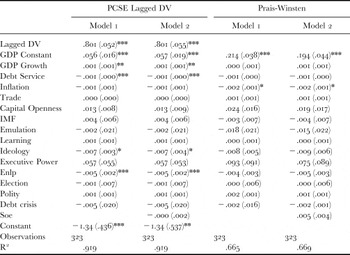
The results of the Heckman selection model are reported in Table 2, while the results of the PCSE models are reported in Table 3. Model 1 in Table 2 comprises the domestic and international economic variables. Model 2 adds the diffusion variables, while Model 3 includes the domestic political variables. Model 4 controls for regime type. The first column in Table 3 reports the estimations with PCSE and a lagged dependent variable, while the second column controls for the initial size of the state-owned sector. The third column replicates the first column but controls for first-order autoregression. The final column once again includes the control for the size of the state sector
Heckman Selection Model Estimates of Privatization Implementation and Extent in Latin America

Standard errors in parentheses
*** p<0.01
** p<0.05
* p<0.1
Time Series Cross Sectional Estimates of Privatization in Latin America

Panel Corrected standard errors in parentheses. Estimated with country fixed effects.
*** p<0.01
** p<0.05
* p<0.1
The results in Tables 2 and 3 above yield a number of important findings. Firstly, there are clearly different dynamics at work during the initial decision to privatize and subsequent decisions regarding the size and extent of privatizations. The decision to select privatization is driven by international factors, namely diffusion together with international trade. In contrast, variation in levels of state divestiture across Latin America is primarily driven by domestic economic and political conditions.
Firstly, let us consider the first stage of the Heckman model, the selection equation. As can be seen from the bottom panel in Table 2 above, in addition to GDP, emulation is statistically significant and positively signed. The substantive effect of this variable is notable. When only 20 per cent of Latin American states have initiated privatization, then the probability of selecting privatization as a policy is roughly 43 per cent. However, when over 85 per cent of states in the region have engaged in privatization, this probability jumps to 69 per cent. The results for trade are similar. Trade is positively correlated with the decision to privatize and statistically significant. What is more, the results for trade are most likely indicative of diffusion rather than the pressures of trade competition. Privatization was implemented as part of a broader package of market-orientated reform and consequently, the positive and statistically significant result for trade, is representative of privatization occurring in conjunction with increasing trade liberalization as part of this wider reform process (see Chwieroth Reference Chwieroth2007). Rational learning, while correctly signed, just fails to reach levels of statistical significance.
However, variations in levels of privatization across Latin America are clearly shaped by different dynamics. As can be seen from Tables 2 and 3 above, the results of both the second stage of the Heckman model (top panel), and the PCSE estimations are quite similar. Varying levels of privatization across the region are primarily explained by domestic economic and political conditions. In the Heckman model, privatizations were negatively correlated with debt servicing requirements, inflation and the ideology of the government, and positively correlated with the level of executive power. In the PCSE estimations, again, privatization is negatively associated with debt servicing requirements, inflation and the ideology of the government. In addition, privatization is negatively correlated with the number of legislative parties, and positively correlated with total levels of GDP and GDP growth. These results suggest that privatizations are facilitated by healthy and stable macroeconomic conditions, combined with low levels of inflation and debt-servicing requirements. For example, a shift from the 10th to the 90th percentile in the level of debt servicing requirements (model 3) will reduce the privatization index by 0.081 points. According to the PCSE model (column 1), a shift from the 10th to the 90th percentile in the level of total GDP will result in an increase in the privatization index of 0.229.
Political conditions also exert a substantive effect on levels of privatization. A left-wing government is associated with lower levels of privatization. For example, the difference between a right-wing government (0) and a left-wing government (4) in power is 0.2718 index points (from model 3 of the Heckman model), a very large effect given the standard deviation of 0.184. Levels of political fragmentation and executive power, and thus the ability to negate potential veto points, also matter. A move from the 10th to the 90th percentile in the level of executive power increases the privatization index by 0.114 points. According to column 1 of the PCSE estimations, the difference between the 10th and the 90th percentile in the number of legislative parties is 0.027 index points.
In both the Heckman and panel estimations, the conventional measures of globalization, trade integration and capital openness, had little or no impact on privatization. Nor did IMF structural adjustment programs. The sign for capital openness was as hypothesized in both estimations, but it failed to reach statistical significance, while the sign for IMF adjustment changed across models. In the Heckman model, trade did reach levels of statistical significance at the 0.1 level in three of the models, but the substantive impact of this variable proved minimal.
The results for international diffusion are interesting. In both the panel and Heckman estimations, learning is correctly signed but it fails to reach levels of statistical significance. In the panel estimations, emulation is incorrectly signed and never reaches levels of significance. However, in the Heckman model, emulation is not only correctly signed, but it also reaches levels of significance in two of the three models. Clearly, emulation continues to have some role in explaining some of the variation in the intensity of privatization across the region.
We must also consider the robustness of these results. For that end, a number of alternative specifications were tested. Firstly, the selection model was re-estimated as a random effects panel probit model, a tobit model and a panel logit model. Both the lagged dependent variable and the AR(1) panel models were re-estimated with year dummy variables along with the country dummies in order to capture specific year effects. The Heckman model was also re-estimated with varying combinations of country and year dummies. The results remained very similar. I re-estimated the Heckman models using the two-step estimator, together with varying combinations of country and year dummies. Again, the results remained effectively the same. Next, I replaced the executive power variable with the xconst variable from the Polity IV dataset (Marshall and Jaggers Reference Marshall and Jaggers2007), replaced my measure of capital openness with the measure from the dataset of Lane and Milesi-Ferretti (Reference Lane and Milesi-Ferretti2007), and I substituted my measure of partisanship for that of Kaufman and Segura-Ubiergo (Reference Kaufman and Segura-Ubiergo2001: 563), where presidents are coded 1 if they had historical links with labor unions and 0 otherwise. Popular presidents are also negatively correlated with privatization and statistically significant in the Heckman model. All other results remain the same. In addition, all the models were re-estimated to take into account any possible interactive effects between ideology and institutions. I interacted the ideology variable with all the institutional variables, but the interactions were insignificant and the results of the basic models were confirmed.
Finally, I re-ran all estimations with two alternative measures for the dependent variable. The first of these was taken from the World Bank Privatization Database (1988–2003) and comprises all revenue from privatization transactions in a given year as a percentage of GDP.Footnote 18 The results proved very similar to those discussed above. In the Heckman model, emulation, trade and GDP were all correctly signed and significant in the selection equation. In addition, learning was correctly signed and significant at the 0.1 level. In the outcome equation, debt servicing, inflation and ideology were all negatively signed, while emulation was positively signed, although these variables just failed to reach robust levels of significance. In the PCSE models, again inflation and debt servicing were negatively signed while executive power was positively signed, but again, levels of significance did not prove robust across all models.
The second alternative measure of the dependent variable, based upon Lora's (Reference Lora2001) index of privatisation reform (1986–1999), captures the cumulative value of the sales and transfers of companies as a proportion of GDP for country i at time t, and once again, the results were remarkably congruent with those above. In the Heckman model, emulation, GDP and GDP growth were all positively signed and statistically significant in the selection equation. In the outcome equation, inflation was negatively signed, while GDP was positively signed and both were statistically significant.Footnote 19 In the PSCE models, the signs for executive power, GDP, and ideology were all in the expected direction and statistically significant. Inflation and debt servicing were negatively signed, but they failed to achieve statistical significance.
Conclusion/Discussion
Privatization is an incredibly important phenomenon that has reshaped the contemporary political economy, not only in Latin America, but in the rest of the world also. However, while aspects of privatization have received considerable attention from economists and political scientists, there remains a dearth of research on the determinants of privatization. This paper has attempted to address this lacuna. It contended that privatization could not be reduced to either the product of international or domestic variables, but was best conceptualized as a two-stage process involving an initial decision to privatize, followed by a subsequent decision concerning the extent and intensity of privatization, where exogenous and endogenous variables had different impacts at different stages of this process. The results of the statistical tests generated some interesting insights.
The decision to choose privatization as a policy instrument is primarily shaped by international diffusion. Governments in Latin America choose to privatize as a consequence of various emulative processes, and as part of the wider diffusion of neoliberal ideas throughout the region (see Chwieroth Reference Chwieroth and Abdelal2009). This provides us with an explanation as to why states have converged upon market reforms in the last two decades and it also finds resonance with previous studies that uncovered a strong relationship between emulation and privatization (see Brune and Garrett Reference Brune and Garrett2000; Meseguer Reference Meseguer2004). However, while diffusion may explain convergence upon privatization, it has less explanatory power with regards to variation in the level of privatization across Latin America.
Variation in the level of privatization across the region appears primarily to be the result of domestic political and economic factors. Left-wing governments, despite the lack of programmatic parties in Latin America (see Kitschelt Reference Kitschelt2000), are associated with lower-levels of privatization. The smaller the number of legislative parties and the greater the level of executive power, the higher the level of privatization, a finding that lends support to neoinstitutionalist approaches that stress the role of institutions in constraining behaviour and shaping economic policy-making (see North Reference North1990). The greater the number of parties in a political system, the greater the uncertainty and consequently, inter-temporal agreements on contentious issues such as privatization will prove very difficult (Nielson Reference Nielson2003: 475). Initial attempts at privatization in Brazil during the presidency of José Sarney floundered for this very reason. High levels of executive power simply allow the executive to ameliorate the influence of potential veto players and implement reform unilaterally. Executive power was centrifugal to the dizzying volume of state enterprises divested in Argentina by Carlos Menem in the early 1990s (see Llanos Reference Llanos2001). Finally, levels of privatization are higher in wealthier, macroeconomically stable states, with low levels of inflation and debt servicing requirements, a finding that initially appears somewhat counter-intuitive. While the results for the political variables are hardly surprising, intuitively, we may expect poorer countries with severe debt problems to gain most from privatization as the proceeds from the divestiture of state assets can be utilized to address fiscal deficits and reduce debt burdens.
So what explains these results? From the perspective of the seller, wealthier states will most likely be in a better position to compensate those adversely affected by privatization programs (Brune and Garrett Reference Brune and Garrett2000) and in addition, privatization in Latin America generally occurred after an extensive stabilization phase. The literature on political risk can provide us with an insight into the perspective of the buyer. This literature has emphasized the importance of stable political environments, the protection of property rights and good economic governance for the attraction of FDI (see Jensen Reference Jensen2003, Reference Jensen2009; Li and Resnick Reference Li and Resnick2003; Biglaiser and DeRouen Reference Biglaiser and DeRouen2006; Biglaiser and Staats Reference Biglaiser and Staats2009). Buyers of divested state assets in Latin America fear expropriation (Biglaiser and DeRouen Reference Biglaiser and DeRouen2006: 53) and seek political stability that creates a hospitable investment climate (Biglaiser and Staats Reference Brune, Garrett and Kogut2009: 12). While functioning democratic institutions strengthen property rights, high levels of executive power enable the host government to offer generous financial and fiscal incentives to potential investors (Li and Resnick Reference Li and Resnick2003: 177). Investors will also fear expropriation from the more extreme left leaders in Latin America (Biglaiser and Staats Reference Biglaiser and Staats2009: 12). Simply put, wealthier, more macroeconomically stable states, with low levels of political fragmentation and pro-reform right governments, lower the political risk for the purchasers of divested state assets. Therefore, these states will attract large volumes of investment, and will ensure that governments can obtain the highest price for divested assets, further encouraging the sale of state enterprises. One area of future research could involve further untangling the relationship between political risk and privatization.
Appendix
Privatization Index
In formal terms (Morley, Machado and Pettinato Reference Morley, Machado and Pettinato1999: 9), the index value for country i at time t is:
Iit = (Max – IRit )/(Max – Min)
Iit = index value for country i, year t.
IRit = raw value of reform measure, country i, year t.
MAX=maximum value of reform measure for all countries, all years.
MIN=minimum value of reform measure for all countries, all years.
The country with the highest level of privatization at time t is coded as 1 and all other scores are relative to this maximum.
Coding Scheme for executive power
In order to measure the power of the executive in each Latin American state for each year between 1975 and 2003, each state's constitution was coded in order to create a measure that attempts to capture the executive's control over legislation. This includes the executive's full and partial veto power; the executive's decree power; the right of the executive to exclusively initiate legislation; the power of the executive to call public referenda; and finally the power of the executive over the formation and dismissal of the cabinet in the context of the assembly. The coding scheme was based on the UNDP's (2005: 80–81) coding scheme for executive power in Latin America in 2002 and Carey, Amorim Neto and Shugart (Reference Carey, Neto, Shugart, Mainwaring and Shugart1997). The constitutions for each state were taken from Georgetown's Political Database of the Americas, comparative constitutions project available at: http://pdba.georgetown.edu/Constitutions/constudies.html.
The veto power (full and partial) of each executive was coded on a scale of 0–13. The score for full and partial veto is then normalized, added together and divided by 2 to give a normalized veto power score. The scale is as follows:
• 0 = no veto power, 1 = veto overridden with majority vote of members present in single chamber or both chambers acting together, 2 = veto overridden with majority vote of total members in single chamber or both chambers acting together, 3 = veto overridden with majority vote of members present in each chamber, 4 = veto overridden with majority vote of total members in each chamber, 5 = veto overridden with 3/5 majority vote of members present in single chamber or both chambers acting jointly, 6 = veto overridden with 3/5 majority vote of total members in single chamber or both chambers acting jointly, 7 = veto overridden with 3/5 majority vote of members present in each chamber, 8 = veto overridden with 3/5 majority vote of total members in each chamber, 9 = veto overridden with 2/3 majority vote of total members present in single chamber or both chambers acting jointly, 10 = veto overridden with 2/3 majority vote of total members in single chamber or both chambers acting jointly, 11 = veto overridden with 2/3 majority vote of members present in each chamber, 12 = veto overridden with 2/3 majority vote of total members in each chamber, 13 = no veto override.
The executive's decree power was coded as:
• 0 = the executive lacks decree power and the constitution either forbids or does not allow for the delegation of decree power to the President; 1 = the constitution allows for the delegation of legislative powers to the President, and the executive has restricted decree authority; 2 = the executive can issue non-delegated decrees although they only remain in force for a short period; 3 = the executive can issue non-delegated decrees, they are not easily rescinded and they have long-term effects.
The executive's ability to exclusively initiate legislation is coded as follows:
• 0 = typical forms such as budget and international treaties; 1 = the executive has exclusive initiative power beyond those that are typical, however, the legislature retains the power to amend this legislation; 2 = the executive has broad exclusive initiative power, but the legislature can amend this legislation; 3 = the executive has broad exclusive initiative power, and the legislature has only limited power to amend this legislation.
The executive's referenda power is coded as follows:
• 0 = the executive is unable to call a plebiscite; 1 = the executive can call a non-binding plebiscite; 2 = the executive can call a binding plebiscite.
The executive's control over cabinet formation and dismissal is coded as follows:
• 0 = President can approve or appoint ministers but with limitations; 1 = President alone can approve or appoint ministers although the assembly can dismiss ministers with a simple majority; 2 = President alone can approve or appoint ministers although the assembly can dismiss ministers with a 2/3 majority; 3 = President alone can approve or appoint ministers and there are no provisions for the assembly to dismiss ministers.
The score for decree power, exclusive initiation, referenda power and control over cabinet were then normalized, and then all were added to the normalized veto power score. This total score was then divided by 5 in order to provide the score for executive power for each state for each year in question.