

Close, dyadic relationships form the foundation of the majority of human social networks. At the centre of our social networks sit the four or five individuals to whom we confide our closest thoughts and feelings and on whom we rely for emotional support and opportunities for intimate disclosure (Roberts, Wilson, Fedurek, & Dunbar, Reference Roberts, Wilson, Fedurek and Dunbar2008; Zhou, Sornette, Hill, & Dunbar, Reference Zhou, Sornette, Hill and Dunbar2005). This exclusive group is typically a mix of kin and non-kin in roughly equal proportions (Dunbar, Lehmann, Korstjens, & Gowlett, in press), with the latter in the majority of cases consisting of a romantic partner and a best friend. While we may not choose our relatives, we are in a position to exercise varying degrees of choice in selecting our romantic partner and best friend.
A key stage in this selection procedure is the stage of attraction. Much has been written regarding the key drivers of attraction in romantic partnerships (similarity: Burleson, Kunkel, & Szolwinski, Reference Burleson, Kunkel and Szolwinski1997; Figueredo, Sefcek, & Jones, Reference Figueredo, Sefcek and Jones2006; Luo & Zhang, Reference Luo and Xhang2009; proximity: Foster, Reference Foster2005; Sprecher, Reference Sprecher1998; sex differences: Pines, Reference Pines2001; Riela, Rodriguez, Aron, Xu, & Acevedo, Reference Riela, Rodriguez, Aron, Xu and Acevedo2010; influence of culture: Pines, Reference Pines2001; Riela et al., Reference Riela, Rodriguez, Aron, Xu and Acevedo2010; effect of attachment style: Holmes & Johnson, Reference Holmes and Johnson2009) and a body of literature concerning attraction in friendship is slowly building (e.g., Burleson & Samter, Reference Burleson and Samter1996; Burleson et al., Reference Burleson, Kunkel and Szolwinski1997; Curry & Dunbar, in press; Foster, Reference Foster2005; Gore, Cross, & Morris, Reference Gore, Cross and Morris2006; McPherson, Smith-Lovin, & Cook, Reference McPherson, Smith-Lovin and Cook2001; Parker & de Vries, Reference Parker and de Vries1993; Sprecher, Reference Sprecher1998). However, much of the discussion in respect of friendships has focused on homophily (shared similarity) in attitudinal and cultural traits (Curry & Dunbar, in press; McPherson et al., Reference McPherson, Smith-Lovin and Cook2001).
The potential for cross-sex friendships to develop into romantic or sexual relationships has rarely been considered. The fact that humans are embedded in extended networks containing many adults of both sexes inevitably means that they are part of a mating market in which both those who are romantically engaged and those who are not are open to ‘bids’ from many other individuals (Deacon, Reference Deacon1997; Dunbar, Reference Dunbar, Dunbar, Gamble and Gowlett2009). Not only may romantic relationships be placed at risk by one of their members being attracted elsewhere, but both cross-sex and same-sex friendships offer potential threats to existing romantic relationships: same-sex best friends are potential rivals, and cross-sex best friends are potential lovers. This implies that best friendships may be at the mercy of the mechanisms of the biological market, and specifically the mating market, to a similar extent to romantic partnerships.
The mating market describes the fact that no individual makes decisions regarding the selection of a mate in a vacuum, but rather does so within a competitive market where supply and demand, self-valuation and relative partner value are all of significance in predicting behaviour (Noë & Hammerstein, Reference Noë and Hammerstein1994, Reference Noë and Hammerstein1995; Pawlowski & Dunbar, Reference Pawłowski and Dunbar1999; Stirrat, Gumert, & Perrett, Reference Stirrat, Gumert and Perrett2011). Successful operation within the mating market requires the ability to assess one's own value and that of those around one, an ability which is arguably adaptive as it reduces time spent on wasted mating attempts (Montoya, Reference Montoya2008). As such, individuals make decisions in the knowledge that they may not attract everyone to whom they are attracted. Evidence for the existence of such a market has been widely documented in humans (e.g., Pawłowski & Dunbar, Reference Pawłowski and Dunbar1999), but its study within best friendships has been largely neglected.
Pawłowski and Dunbar (Reference Pawłowski and Dunbar1999) found that advertisers in personal columns calibrated their demands to their market value: individuals of low market value — be it low income in males or age in females — were significantly less demanding than those of high quality. Such behaviour has been termed ‘condition dependent mate-choice’: mate preferences are influenced by one's own market worth (Little, Burt, Penton-Voak, & Perrett, Reference Little, Burt, Penton-Voak and Perrett2001) while ‘market value’ is the value placed upon an individual and is of flexible magnitude dependent upon the nature of the marketplace (i.e., the number and quality of those with whom the individual is competing: Pawłowski & Dunbar, Reference Pawłowski and Dunbar1999).
There is a growing body of evidence for condition dependent mate choice: Female subjects who are subjectively and objectively more physically attractive and psychologically healthy show a greater preference for attractive and healthy males (represented by high degrees of facial symmetry and masculinity) than female subjects of lower levels of attractiveness and mental health (Jones et al., Reference Jones, Little, Boothroyd, Feinberg, Cornwell, De Bruine and Perrett2005; Little et al., Reference Little, Burt, Penton-Voak and Perrett2001; Penton-Voak et al., Reference Penton-Voak, Little, Jones, Burt, Tiddeman and Perrett2003). Further, in a recent study Vukoivic et al. (Reference Vukovic, Jones, DeBruine, Feinberg, Smith, Little, Welling and Main2010) found that a woman's voice pitch, an objective measure of both attractiveness and health and fecundity, is predictive of her preference for masculinity (i.e., low pitch) in male voices. Women with more feminised voices had a preference for more attractive men, as represented by individuals with low voice pitch, when they listened to recordings with positive valence. However, while evidence for self-valuation and the assessment of others has now been widely documented (e.g., Montoya, Reference Montoya2008; Pawłowski & Dunbar, Reference Pawłowski and Dunbar1999; Stirrat et al., Reference Stirrat, Gumert and Perrett2011; Vukovic et al., Reference Vukovic, Jones, DeBruine, Feinberg, Smith, Little, Welling and Main2010), much of this work focuses upon physical attractiveness and ignores the considerable importance that other aspects of human character (such as personality or, particularly for women, resource potential) have within human mate selection.
Many of these studies suggest that individuals mate assortatively based upon perceived or actual mate quality. Assortative mating describes the phenomenon of individuals selecting mates of similar market value to themselves: males of high value (i.e., of high social standing with resources to offer and/or high levels of symmetry/attractiveness) will select females of equal value (i.e., young with strong signs of fecundity) and vice versa. However, while analysis of objective measures of attractiveness in established mating couples reflect this practice, an individual's perception of their own value and that of their partner varies, depending upon the stage of the relationship. Montoya (Reference Montoya2008) found that while the objective evidence supports the idea of matching (i.e., there is a positive linear relationship between a person's objective attractiveness and that of their chosen potential mate), individuals who are objectively more attractive tend to downgrade the attractiveness of potential mates, possibly to enhance their position within the mating market. Further, attractive individuals believe that a relationship with a partner of similar attractiveness is more likely to be satisfactory than one with someone of inferior attractiveness, and vice versa. However, once a relationship is established, rather than downgrading the value of their partner, subjects are inclined to exaggerate their partners’ qualities (positive illusion), possibly as a mechanism to protect the relationship against external challenges (Eastwick, Finkel, & Eagly, Reference Eastwick, Finkel and Eagly2011; Murray & Holmes, Reference Murray and Holmes1997; Rusbult, Van Lange, Wildschut, Yovetich, & Verette, Reference Rusbult, Lange, Wildschut, Yovetich and Verette2000). As a result, less attractive subjects tend not to regard their pairing with a partner of a similar level of attractiveness as ‘settling’, but genuinely believe the members of their dating pool to be attractive and able to deliver satisfactory relationships (Montoya, Reference Montoya2008).
The Present Study
This study uses participants’ assessments of their own attributes (personality, resource potential, and physical and psychological qualities) and those of their best friend and romantic partner to consider how male and female subjects view their own value in relation to that of their real best friend and their romantic partner, and whether the sex of the best friend has an impact on this. We further aim to determine whether there is any evidence that best friendships have an underlying sexual component, or whether, instead, they offer different kinds of benefits for those who have them. The range of attributes, given in more detail below, has been selected to reflect both those attributes of relevance within the reproductive mating market (e.g., physical attractiveness, financial potential), and those that may be more generally attractive in a companion (e.g., gregariousness or social connections). We focus upon real as opposed to ideal best friendships and romantic partnerships, as previous research has shown that there can be a considerable gulf between the outcome of an individual's actual mate choice and their idealistic mate choice. In the former case, choice is influenced by the objective desirability of the potential mate but is constrained by the likelihood of success linked to the individual's own market value. In the latter case, the choice is influenced simply by the objective desirability of the date, with no reference to the individual's own quality (Montoya, Reference Montoya2008).
The main motivation behind our study is theoretical. The body of literature relating to the biological market within human populations, and particularly within non-romantic relationships, is woefully thin despite the evident benefit of these relationships to us and the limitations based upon the human social network that do not allow for limitless close relationships but require the individual to be selective (Zhou et al., Reference Zhou, Sornette, Hill and Dunbar2005). While some mechanisms of selection (such as homophily) have been explored (Curry & Dunbar, in press; McPherson et al., Reference McPherson, Smith-Lovin and Cook2001) the possible influence of the mating market, despite its role as a powerful driver in many aspects of human behaviour, has not been considered thus far.
It is clear from our own and previous studies that individuals gain different benefits from their romantic and best friend relationships and that this difference is, to an extent, influenced by sex of both the individual and their best friend (Demir, Reference Demir2010; Fuhrman, Flannagan, & Matamoros, Reference Fuhrman, Flannagan and Matamoros2009). Individuals in search of a long-term romantic partner look for cues of fertility, genetic health, resource potential and loyalty, the relative importance of which to the choosing individual is influenced by their sex. In contrast, best friends appear to be a source of stability, advice, intimacy and contentment, although the relative importance of these attributes is influenced not only by the sex of the participant but also whether the best friendship is cross-sex or same-sex (e.g., Davis & Todd, 1985; Elkins & Peterson, Reference Elkins and Peterson1993). This knowledge generates our first hypothesis:
H1: Attribute scores awarded to the romantic partner will be significantly higher than those awarded to the best friend. The preferred traits will be significantly affected by the sex of both the participant and their best friend.
There is some evidence that individuals in established romantic relationships tend to hold positive illusions regarding the quality of their partner as a form of relationship protection (e.g., Murray & Holmes, Reference Murray and Holmes1997). However, it remains unclear whether a similar phenomenon exists within established best friendships. A recent study by Morry et al. (Reference Morry, Kito, Mann and Hill2013), using a measure of relationship-interdependent self-construal (RISC: a measure of the degree to which an individual defines themselves in terms of their relationships with others), found that female participants did not ‘mark up’ their same-sex friends in relation to themselves but projected their own RISC grade onto their friends, implying that a different mechanism, related to similarity, may be operating within this category of friendship. However, this study focused exclusively on female same-sex friendships. We need to explore whether male participants would exhibit similar behaviour and whether the sex of the best friend relative to the participant has an impact upon this behaviour. Indeed, the sex of the best friend may have a major impact upon whether we observe positive illusion (a possibility in cross-sex relationships where the potential for a romantic relationship may exist), projection (is this purely a female phenomenon or do males also exhibit this behaviour in same-sex friendships?) or underplay (members of same-sex friendship dyads remain competitors within the biological market and may underplay their friend's attributes to highlight their own strengths). These possibilities generate a number of further hypotheses.
H2: Participants will exhibit positive illusion by scoring their romantic partners as significantly higher than themselves.
We can test between the three alternative explanations for attitudes towards best friends in the following way:
H3a: Participants will award higher attribute scores to themselves than to their same sex best friend for those attributes which are most important within the mating market (e.g., attractiveness for both sexes, financial potential for male participants) — Biological Market Hypothesis.
H3b: Participants will award significantly higher attribute scores to their opposite sex best friend than to themselves — Potential Mate Hypothesis.
H3c: There will be no significant difference between the attribute scores participants award to themselves and to their best friend — Projection Hypothesis.
Finally, if we believe that best friendships operate within a biological market akin to that encountered by those seeking a romantic partner, then we must ask whether best friendships also show evidence for assortative mating. Does the nature of the best friendship, cross-sex or same-sex, affect the strength of any correlation due to the potential impact of competition upon same-sex relationships and the potential for future romantic relations on cross-sex ones? Hence:
H4: There will be a significant positive correlation between self-attribute scores and (a) romantic partner scores and (b) best friend scores. The nature of the correlation between self and best friend scores will be influenced by the sex of the best friend.
Method
Participants and Procedure
Cross-sectional data were collected as part of a larger online study aimed at understanding the nature of the best friend and romantic relationships and the interaction between them. The participants in this study were all recruited via online psychological research forums such as Online Psychology Research UK (http://www.onlinepsychresearch.co.uk/) and Psychological Research on the Net (http://psych.hanover.edu/Research/exponnet.html). Participants were asked to indicate their consent to their inclusion in the study before being allowed to proceed to the questionnaire. When identifying their best friend, we asked them to refer to the non-kin person who ‘. . . you would turn to first, after your romantic partner, during a time of extreme difficulty or emotional distress’. Overall, 293 heterosexual participants were recruited, 198 females and 95 males; 239 best friendships were same sex, 54 cross-sex. The average age of participants was 29.25 years (SD = 12.197, min. = 18, max. = 70). The average length of a romantic partnership was 7.13 years (SD = 8.384, min. = less than 1 year, max. = 41) and of a best friendship 11.06 years (SD = 9.507, min. = less than 1 year, max. = 49); 43% of participants resided in Europe and 51% within North America, with the remainder of participants residing in South America, Australia, Asia and Africa.
Materials
Participants were asked to provide information regarding the age, sex, number of children, sexuality, relationship status and place of residence for themselves, their romantic partner, if present, and their best friend. In addition, they were asked to complete a measure of personal attributes adapted from Vigil's (2007) Peer Relations questionnaire. This consists of 13 attributes: physical attractiveness, creativity, intelligence, education, financial potential, sense of humour, outgoingness, athleticism, dependability, cooperativeness, social connections, kindness and optimism. Participants were asked to mark themselves, their best friend and their romantic partner on a Likert-type 5-point scale — where 1 would indicate no or low attainment and 5 very high attainment – for each attribute. They were asked to mark themselves, their best friend and romantic partner as they were today, rather than as they used to be or how they would like them to be in the future.
Analyses
The research question of interest to this study centres upon participants’ perceptions of their own market value and that of their romantic partner and best friend and whether we can see evidence for (a) assortative mating and (b) positive illusion or projection in established partnerships. As a result, pairwise and independent t tests and Pearson and partial correlational analysis were carried out on the attribute data, with a particular focus upon the impact of sex, both of self and best friend, on results. Due to the number of t tests, Bonferroni correction was applied to each comparison (resulting in an adjusted critical significance value of .004).
Results
Relationship Market
H1: Romantic partner vs. best friend
When comparing the attributes of a subject's romantic partner with their best friend for female participants, there were no significant differences, with the exception of athleticism, in favour of the romantic partner, t(183) = 5.084, p < .001, r = .351. Male participants scored their best friend significantly higher than their romantic partner for sense of humour, t(80) = −3.078, p = .003, r = .431, outgoing nature, t(97) = −3.751, p < .001, r = .408, and social connections, t(97) = −4.151, p < .001, r = .535, but did not score their romantic partner higher than their best friend in any category of attribute.
However, if we consider the sex of the best friend in our analysis, significant differences between the romantic partner and best friend are only found, for both male and female participants, when the best friend is of the same sex as the subject. If the best friend is cross-sex (i.e., of the same sex as the partner), there are no significant differences between the attributes of a best friend or romantic partner. When the best friend is the same sex as the subject, the results for male participants overall are replicated with respect to sense of humour, outgoing nature and social connections in favour of the male best friend. For female participants with female best friends, again, results mirror those for the overall data with the addition of outgoing nature, t(158) = −3.392, p = .001, r = .382, and social connections, t(157) = −2.963, p = .004, r = .438, in favour of the female best friend.
H2: Positive illusion in romantic partners
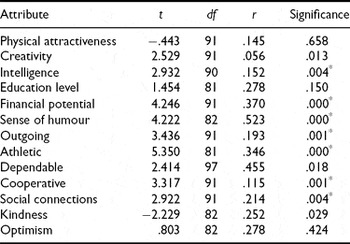
When scoring themselves against their romantic partner on a range of 13 attributes, female participants showed a significant difference in scoring for three categories: they scored their romantic partner higher than themselves on attractiveness, t(185) = −3.946, p < .001, r = .335, and athleticism, t(182) = −5.385, p < .001, r = .279, but themselves higher on cooperativeness, t(185) = 3.445, p = .001, r = .419. Male participants scored themselves significantly higher on seven of the thirteen categories, did not score their romantic partner higher on any categories and reported no significant difference for attractiveness, education, creativity, dependability, kindness and optimism (see Table 1).
Results for Paired Sample t Tests of the Attributes for Male Participants and Their Female Romantic Partners

H3: Attitudes towards best friends
When scoring themselves against their best friend on the 13 attributes, female participants scored their best friend as significantly higher than themselves on attractiveness, t(215) = −3.655, p < .001, r = .416, and outgoingness, t(216) = −3.175, p = .002, r = .213, and scored themselves significantly higher than their best friend on education level, t(215) = 2.985, p = .003, r = .489. At no point did male participants score their best friend significantly higher than themselves, but they did score themselves as significantly better educated, t(100) = 3.038, p = .003, r = .346, more athletic, t(99) = 3.658, p < .001, r = .477, and with greater financial potential, t(101) = 2.916, p = .004, r = .175, than their best friend.
However, as before, the sex of the best friend has a significant effect. For female participants with a female best friend, the results mirror those detailed above for overall female participants, aside from a significant difference between the two for social connections, t(177) = −3.051, p = .003, r = .511, in favour of the best friend and the fact that the difference in education level is no longer significant. When we consider female participants with male best friends, most of the significant results obtained previously disappear, with the exception of dependability, where female subjects score themselves as significantly more dependable than a male best friend, t(35) = 3.168, p = .003, r = .541. When we consider male participants with male best friends, no significant results remained, although results for education level, t(81) = 2.834, p = .006, r = .355, and athleticism, t(80) = 2.786, p = .007, r = .484, were close to significance. When considering those with female best friends there were no significant results for any attributes.
Assortative Mating
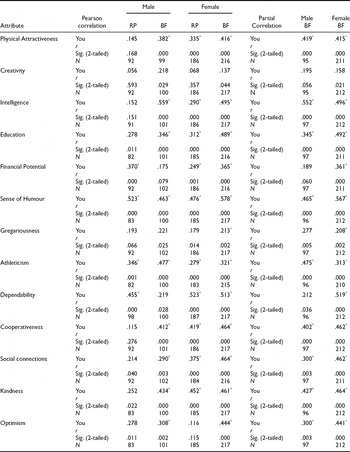
H4: Assortative mating
Table 2 summarises the results of the Pearson correlation analyses between male and female participant self-scores and (a) romantic partner scores and (b) best friend scores across the 13 attribute categories, as well as the partial correlations between male and female participant self-scores and best friend scores controlling for sex of best friend. All the correlations were positive, without exception. For female participants, 10 of these were significant for romantic partner (the three strongest relationships being sense of humour, kindness and dependability), while all bar one of the correlations for best friend were significant (the top three correlations being cooperativeness and social connections, dependability and sense of humour). For 12 of the 13 attributes (the exception being athleticism), the correlation between self and best friend was stronger than the correlation between self and romantic partner. Controlling for sex of best friend did not have a significant effect on the correlation results for self versus best friend. For male participants, only four of the thirteen correlations were significant for romantic partner (the three strongest being financial potential, dependability and sense of humour), and nine of the thirteen were significant for best friend (the three strongest being sense of humour, athleticism and intelligence). For 10 of the 13 attributes (the exceptions being dependability, sense of humour and financial potential), the correlation between self and best friend was stronger than that for self and romantic partner. Again, sex of best friend did not affect the results.
Discussion
This study aimed to understand how the sex of the participant and their best friend influence the scores participants award to themselves, their best friend and their romantic partner on a range of attributes related to physical and mental quality, personality and resource potential. Further, it aimed to explore whether there is evidence for assortative mating, mate competition, positive illusions and/or projection within the best friend data. Our results provided partial support for Hypothesis 1. Although overall there were no significant differences for the majority of attributes, there were significant differences when the best friend was of the same sex as the individual. This suggests that the best friend and romantic partner provide different benefits to the participant and that these benefits are dependent on the sex of the best friend: same-sex best friends appear to have a key function in relation to social connections and behaviour and, for males, they appear to embody ease of interaction and humour.
Results for the Pearson Correlation of Self Versus Romantic Partner (RP) and Best Friend (BF) for Each Sex and the Partial Correlation (controlling for sex of best friend) of Self Versus Best Friend (BF) for Each Sex of Participant

Note: * indicates a significant result.
The fact that the sex of the best friend had such a significant impact upon the scores reinforces the importance of taking the sex of best friend into account when drawing conclusions concerning the characteristics and function of this special relationship.
Our second hypothesis focused on a comparison of the scores awarded to self and romantic partner. Here we argued that if positive illusion is a mechanism within established relationships to maintain satisfaction and promote security, we would expect the self to score their romantic partner higher than themselves. However, we did not find broad support for this in our data. Female participants did score their partners higher than themselves on attributes that are traditionally linked to the male mating role (attractiveness and athleticism). However, they scored themselves as higher on cooperativeness, reflecting the traditional view that females are more relationship-centred (i.e., have higher relationship-interdependent self-construal [RISC]; Morry et al., Reference Morry, Kito, Mann and Hill2013). Rather than being party to positive illusion concerning their partner, female participants seemed to reflect what, we could argue, is the reality in most romantic relationships: a degree of similarity or homophily (10 of the 13 attributes showed no significant difference), with those differences that were significant reflecting conventional sex roles within the relationship. In contrast, the male data showed less evidence for projection than the female data and no evidence for positive illusion: male participants scored themselves higher on seven of the thirteen attributes, were similar in six categories and did not score their romantic partner higher than themselves on any of the categories.
What are we to make of this result? One possibility is that as men have been repeatedly found to be more distanced from their relationships than women, men do not feel the need to secure their relationship using positive illusion or projection (Becker, Reference Becker1987; Gore et al., Reference Gore, Cross and Morris2006; Tschann, Reference Tscahnn1988). Alternatively, while men may consciously commit to a single relationship, the fact that they continue to score themselves higher than their female partner (a practice observed in unattached men within the mating market; Montoya, Reference Montoya2008) this may suggest that unconsciously they remain ‘on the market’ for potential mates — a possibility which is arguably more open to men than to their female partners. We would require considerably more data, including that related to self-esteem, as a control for self-scores to unravel the causes behind this.
Our third hypothesis focused on attitudes towards cross-sex best friends. Here we predicted three possible outcomes based upon the influence of the sex of the best friend: the Biological Market Hypothesis, the Potential Mate Hypothesis and the Projection Hypothesis. The data support H3c, the Projection Hypothesis, as there were no significant differences between cross-sex best friend and self-scores for any of the 13 categories, with the exception of dependability for female participants (in favour of self). The lack of a significant result for physical attractiveness for either sex in respect to their cross-sex best friend suggests that future mating potential plays no significant role within cross-sex best friendships. This result is in line with Morry et al.'s (Reference Morry, Kito, Mann and Hill2013) study on female friendships, where projection was found as a key maintenance mechanism, but our results now extend this to male participants as well. These results support the notion, expressed by many who have studied cross-sex friendship, that these relationships are not a waiting room for a future romantic relationship but have a strongly defined friendship function, which is reflected in the fact that projection/similarity is a key mechanism of relationship maintenance rather than positive illusion (e.g., Messman et al., Reference Messman, Canary and Hause2000; Morry et al., Reference Morry, Kito, Mann and Hill2013). When considering the data relating to same-sex best friends, we again see support from both sexes for H3c, with the notable exception that female participants scored their female best friends significantly higher on social connections and outgoing nature (implying, again, that for female subjects their female best friends serve a function linked to social interaction). This is not the case for males. Male subjects scored their male best friends as similar to themselves in all categories, contrary to our prediction in H3a (the Biological Market Hypothesis) and in support of H3c (the Projection Hypothesis). This result is surprising for two reasons. First, the results comparing male participants with their romantic partner imply that they remain active within the mating market, albeit possibly unconsciously. This being so, it seems logical to suggest that they would view their same-sex best friend as a potential competitor within this market, but this does not appear to be the case. Second, experimental and phenomenological studies have suggested that competition is exhibited and reported at significantly higher levels in male same-sex friendships than in either cross-sex or female same-sex relationships (Becker, Reference Becker1987; Singleton & Vacca, Reference Singleton and Vacca2007). However, our results would appear to contradict this finding. It may be that the benefits of the same-sex best friendship to male participants within the context of the social environment and the ease of interaction within this relationship outweigh the threats to the individual within the mating market. As a result the male participant exhibits a mechanism of maintenance, promoting similarity rather than competition when scoring their best friend's attributes.
Finally, do we have evidence to support hypothesis 4 (Assortative Mating)? It must be stressed that our data are subjective, that is, built from the subjective scorings of the participants, rather than objective and focus on established rather than potential matings, in contrast to Montoya's (Reference Montoya2008) study. Nonetheless, for the majority of the categories, the correlational results show a positive, low to medium strength, relationship between participants and their romantic partners and best friends, respectively, for most categories. However, what is striking is that these correlations tend to be stronger, and for male participants more significant, between the subject and their best friend, implying that similarity is a more powerful predictor of best friend relationships than romantic partnerships. Further, this difference holds even when controlling for the sex of the best friend. It may be that, as men and women are required to bring different attributes to a romantic relationship as a consequence of their reproductive biology, there is less correlation between their attributes than within a best friendship whose key functions appear to be related to social connections, advice and stability (Davis & Todd, 1985). Perhaps the foundation of this stability rests in the greater degree of similarity within best friendships than romantic partnerships which require the integration of different attributes related to the differing priorities of male and female members.
Conclusion
The aim of this study was to assess the extent to which the mating market acts upon established romantic partnerships and best friendships, with a particular focus upon the impact of the sex of the participant and the best friend. When considering the attribute scores, participants awarded to themselves and their romantic partners, the results for male participants imply that they keep one eye on the mating market despite being in committed relationships, while those for female participants suggest an acknowledgment of the different attributes and requirements the different sexes bring to long term romantic partnerships. In contrast, the results for best friendships imply that, despite the potential for competition between same-sex best friends and for future matings between cross-sex best friends, the best friendship is little affected by the mating market. Indeed, results for both sexes suggest a key role for the best friend in relation to the social environment and a degree of homophily between participants and their best friend which far outstrips that within romantic partnerships, regardless of the sex of the best friend. Perhaps these two factors in combination make the best friendship too valuable to jeopardise within the competitive environment of a biological market.
Implications and Future Directions
The implications of this study are several. First, the results show that it is important to consider the sex of the best friend when drawing conclusions regarding the characteristics and function of this type of friendship. Second, the fact that best friendships are immune from the influence of the mating market provides further evidence, in addition to that relating to reciprocity, intimacy and affect, that this form of friendship is rather different from other less close forms of friendship (Carlson-Jones & Vaughan, Reference Carlson Jones and Vaughan1990; Weisz & Woods, Reference Weisz and Wood2005). Third, the fact that male participants may keep one eye upon the mating market, as evidenced by their self-scores as compared to their romantic partners, that they fail to score their romantic partner higher than their best friend on any attribute, and that they are significantly more similar to their best friend than their romantic partner, provides further evidence that men keep themselves at a greater distance from their romantic relationships than women. Such a conclusion does not imply that men consciously act within the market or display lower levels of commitment to their romantic relationships than women, but it does have implications for those involved in couples counselling: such differences may need to be understood and aligned to allow resolution of any conflict.
Our study focused on the way heterosexual participants subjectively scored themselves relative to their best friend and romantic partner on a number of key attribute dimensions. While our recruitment of participants did not exclude individuals of any sexuality, we did not recruit adequate numbers of homosexual and bisexual participants to enable robust analysis of their data. It would be interesting within a future study to explore how sexuality might influence the impact that the mating market has upon these two close non-kin relationships. We might ask how the absence of the possibility of biological reproduction within the couple would affect attribute scores and whether the influence of sex of best friend might differ between heterosexual and homosexual/bisexual participants. Finally, while the mating market appears to have little impact upon best friendships, it would be of interest to explore whether more distant friendships are under the influence of this mechanism. Here, we might ask where the tipping point exists for the benefits of friendship/risks of competition to be outweighed by the benefit of a successful mating.
Acknowledgments
Data collection was funded by the British Academy Centenary Project. AM and RD are funded by a European Research Council Advanced grant to RD.