Changes in cropping systems of intensive farming to mechanized farming and occurrence of resistant weeds owing to frequent application of single herbicides have led to shifts in weed flora, resulting in greater weed diversity (Ahmed et al. Reference Ahmed, Salim and Chauhan2014; Chauhan and Johnson Reference Chauhan and Johnson2010; Singh et al. Reference Singh, Bharadwaj, Thakur, Pachauri, Singh and Mishra2009; Tomita et al. Reference Tomita, Nawata, Kono, Nagata, Noichana, Sributta and Inamura2003). This is true for Japanese foxtail, a troublesome annual grass weed that has become an increasing problem in winter wheat fields in China, Japan, Turkey, and other Asian countries (Yang et al. Reference Yang, Dong, Li and Moss2007). Japanese foxtail has been considered one of the worst grass weeds in China because it causes serious harm to wheat, reducing yield by more than 30% (Shen et al. Reference Shen, Guan, Shi and Lu2000). In addition, Japanese foxtail is also a host of various crop pests such as small brown planthopper [Laodelphax striatellus (Fallén)] and rice thrip [Chloethrips oryzae (Wil.)] which have negative effects on crop growth and production.
Many environmental factors can influence seed germination and seedling emergence of a weed species, such as light, temperature, soil salinity, soil moisture, soil pH, seed burial depth in the soil through tillage, the amount of crop residue in the field, and heat shock. For example, although weed seeds that require light for germination cannot germinate when buried deeply, they are dominant in no-till or reduced-tillage systems that lead to seeds being close to soil surface (Chauhan and Johnson Reference Chauhan and Johnson2010). Temperature affects the occurrence and rate of seed germination (Evert et al. Reference Evert, Staggenborg and Olson2009). Seeds of some weed species can germinate over a broad soil pH range (Chauhan et al. Reference Chauhan, Gill and Preston2006), but some others can only germinate between pH 6 and 7 (Wilson Reference Wilson1979). While soil moisture is needed for seeds to germinate, the amount of soil water needed for germination varies by species (Atia et al. 2011; Wu et al. Reference Wu, Li, Xu and Dong2016a). The ability of some weed seeds to germinate under high soil salinity conditions enables certain weed species to have advantage over crops in areas with high salinity (Geissler et al. Reference Geissler, Hussin and Koyro2009). In some dry rice–wheat rotation systems, farmers seldom practice tillage following dry rice harvest and wheat is sown after burning rice residue (Johnson and Kent Reference Johnson and Kent2002). The heat and exposure time generated by this burning may stimulate or inhibit weed seedling emergence (White and Boyd Reference White and Boyd2016). Presence of crop residue has also been shown to suppress emergence of several weed species (Teasdale and Mohler Reference Teasdale and Mohler1993).
Herbicides are widely used in modern agriculture for their high efficiency in killing weeds, becoming the fastest and most reliable method of farmland weed control. Generally, Japanese foxtail emerges later than wheat, and POST herbicides are used for the control of Japanese foxtail in China. Pinoxaden, fenoxaprop-P-ethyl, and mesosulfuron-methyl are the most commonly used herbicides for Japanese foxtail control in China, introduced in the 1970s, the 1990s, and 2003, respectively (Bi et al. Reference Bi, Liu and Guo2016). The efficacy of POST herbicides varies according to the growth stage of the weed species (Chauhan and Abugho Reference Chauhan and Abugho2012; Singh and Singh Reference Singh and Singh2004). In general, herbicide works less effectively when applied on bigger weeds due to faster herbicide degradation (Singh and Singh Reference Singh and Singh2004). Consequently, farmers have to increase herbicide rates to achieve the same control effect (Chauhan and Abugho Reference Chauhan and Abugho2012). Therefore, the time of herbicide application is a very important factor in effectively controlling weeds. Although herbicides are an effective means to control weeds, it is unwise to have an overreliance on herbicides. The intensive use of herbicides not only causes harm to human health and the environment but also results in weeds evolving resistance to herbicides (Bi et al. Reference Bi, Liu and Guo2016). For example, Japanese foxtail has evolved resistance to haloxyfop, fenoxaprop, pinoxaden, and mesosulfuron-methyl (Bi et al. Reference Bi, Liu and Guo2016; White and Boyd Reference White and Boyd2016; Yang et al. Reference Yang, Dong, Li and Moss2007). Therefore, there is an urgent need for an integrated approach to weed management. Among the weed management tools, knowledge of weed seed biology is one of the most important. What is more, better understanding of the factors influencing Japanese foxtail seed germination and emergence help us to predict potential new areas where this species may spread to due to the changes of crop systems and climate. Meanwhile, chemical control is absolutely necessary in integrated management.
A previous study (Wu et al. Reference Wu, Zhang, Pan, Wang, Xu and Dong2016b) focused on the germination requirements for Japanese foxtail, including light, temperature, osmotic potential, salt stress, pH, and seed burial depth, comparing fenoxaprop-P-ethyl resistant and susceptible biotypes. However, seed dormancy, along with other factors affecting the germination and emergence of Japanese foxtail, such as heat shock and the amount of crop residue, and the response to other POST applied herbicides, have not been studied. Furthermore, some weed populations in different areas may respond differently to environmental factors, and using only one population in a study may lead to a bigger evaluation error. Therefore, the objectives of this study were to a) determine seed dormancy characteristics in Japanese foxtail and study the effects of temperature, light, osmotic potential, salt stress, pH, soil burial depth, heat shock, and rice residue mulch on seed germination or seedling emergence, and b) evaluate the influence of application timing on the efficacy of seven selected POST herbicides.
Materials and Methods
Seed Sources
Even when populations experience similar climatic conditions, germination can vary within a species (Mulligan and Bailey Reference Mulligan and Bailey1975; Leon and Owen Reference Leon and Owen2006; Leon et al. Reference Leon, Bassham and Owen2006). To decrease evaluation error, we selected seeds from three Japanese foxtail populations, ‘1544’, ‘1532’, and ‘1513’ (Table 1), from three remote wheat fields in different provinces where Japanese foxtail has caused significant yield losses. Seeds from each population were collected from more than 500 randomly selected plants in May, 2015. After collection, seeds were cleaned, sun-dried in open trays, and stored in paper bags at room temperature (20±5 C). Except for seeds used for the dormancy test, all seeds had been stored in paper bags for at least five months before use.
Geographical information for the cities where the seeds of Japanese foxtail were collected.

a Data from the China Soil Database (http://gis.soil.csdb.cn/)
b Data from the National Meteorological Information Center (http://www.nmic.cn/)
Germination Testing
For all germination tests, the following procedures were used with exceptions for specific environmental conditions required by experiments that will be described further. Germination was evaluated by placing 20 seeds evenly in a 9-cm-diam petri dish containing two pieces of filter paper (Whatman No. 1, Maidstone, UK) moistened with 5 ml distilled water or solutions having different salt concentrations or osmotic potentials. The dishes were sealed with flexible, self-sealing film to prevent evaporation and were maintained in controlled-environment growth chambers at 20 C under a 12-h photoperiod. The photosynthetic photon flux density produced by fluorescent lamps was 200 μmol m−2 s−1. The number of germinated seeds was counted daily unless otherwise stated. Final germination was calculated after 21 d. Seeds were considered germinated if the radicle was visible (Chauhan and Johnson Reference Chauhan and Johnson2008). Germination values were counted as the total number of seeds germinated divided by the total number of seeds in the petri dish.
To test for Japanese foxtail dormancy, a germination test was started every other day from 3 to 99 d after collection as previously described.
To determine the effect of temperature on germination, Japanese foxtail seeds were subjected to seven constant temperatures (5, 10, 15, 20, 25, 30, and 35 C) and five fluctuating temperatures (35/25, 30/20, 25/15, 20/10, and 15/5 C). These ranges of fluctuating temperatures reflect the temperature differences between day and night in the seed collection regions.
To determine the effect of light on the germination of Japanese foxtail seeds, seeds were exposed to different periods of light and dark conditions as follows: dark (24/0 h dark/light), light (0/24 h dark/light), or alternating light and dark conditions (12/12 h dark/light). The dark treatment was accomplished by wrapping the dishes in two layers of aluminum foil immediately after sowing.
The effect of osmotic stress on seed germination was assessed by placing 20 seeds in solutions with osmotic potentials of 0, −0.1, −0.3, −0.5, −0.7, −0.9, −1.1, −1.3, and −1.5 MPa. The solution concentrations were prepared by dissolving polyethylene glycol 6000 in distilled water (Michel and Kaufmann Reference Michel and Kaufmann1973). The effect of salt stress on the germination of Japanese foxtail was determined by placing 20 seeds in petri dishes containing 5-ml solutions of 0-, 20-, 40-, 80-, 120-, 60-, 200-, 240-, 280-, 320-, 360-, and 400-mM sodium chloride. The solutions were prepared by dissolving NaCl in distilled water (Michel Reference Michel1983).
To examine the effect of pH on germination, buffer solutions with pH values of 4, 5, 6, 7, 8, 9, and 10 were prepared as described by Chachalis and Reddy (Reference Chachalis and Reddy2000). Deionized water (pH 6.8) was used as the control.
Effect of Seed Burial Depth on Emergence
Twenty seeds were sown at depths of 0, 1, 2, 3, 4, 5, 6, and 7 cm below the soil surface in plastic pots with a 16-cm diameter and 13-cm height to assess the effect of burial depth on seedling emergence. Pots without seeds deliberately sown confirmed that there was no background seed bank of Japanese foxtail in the soil used in the experiments. The loam soil (clay, 38%; silt, 26%; sand, 36%; pH, 7.1; organic matter, 1.7%) was autoclaved and passed through a 3-mm sieve. The soil bulk density after seed burial was 1.1 to 1.4 g cm−3. The experiment was conducted in controlled environment growth chambers at 20 C under a 12-h photoperiod. The pots were watered as needed to maintain moisture. Seedlings were considered emerged when the coleoptiles were visible, and seedling emergence was counted 21 d after planting. At the end of the test, the soil in pots with nonemerged plants was poured out to examine whether seeds failed to germinate or the coleoptile failed to emerge.
Effect of Residue Amount on Seedling Emergence
Twenty seeds were broadcast on the soil surface inside plastic pots, and finely chopped rice straw (leaves and stems) was spread on the soil surface at rates equivalent to 0, 1, 2, 4, 6, 8, and 10 t ha−1. The pots and soil used in this experiment were the same as those described in the seed burial depth experiment. Seedlings were considered as having emerged when the coleoptiles were visible, and seedling emergence was counted 21 d after planting. The experiment was conducted in controlled-environment growth chambers at 20 C under a 12-h photoperiod. After 21 days, seedling emergence was counted. At the end of test, the residue in pots with nonemerged plants was poured out to examine whether seeds failed to germinate or the coleoptile failed to emerge.
Effect of Heat Shock on Germination
The effect of heat shock on seed germination was tested in a factorial experimental design with six heat shock levels and two seed treatments. The seeds were either dry or submerged in sterilized water for 24 h (presoaked) before being used for the experiment. Twenty seeds were placed in each mesh bag, and the bag was placed into a container and covered with preheated soil at 20, 40, 70, 100, 130, and 160 C (Fernando et al. Reference Fernando, Humphries, Florentine and Chauhan2016). Then, the containers with seeds were placed in heat chambers with relevant temperatures mentioned above for 5 min, and seed bags were removed from the soil. Seeds were then placed in petri dishes with filter papers dampened with sterilized water and placed into controlled-environment growth chambers at 20 C under a 12-h photoperiod.
Effect of POST Herbicides on Weed Growth at Different Leaf Stages
Twenty seeds from populations ‘1544’, ‘1532’, and ‘1513’ were broadcast on the soil surface in small plastic pots that were filled with the same soil as described above. Seedlings were thinned to nine plants per pot on the eighth day. POST herbicides were sprayed at the three-, five-, and seven-leaf stages using a research track sprayer that delivered a 450 L ha−1 spray solution at a spray pressure of 275 kPa; flat-fan nozzles (TeeJet 903EVS, Greenman Machinery Company, Beijing, China) were used in the sprayer. The seven POST herbicides most commonly used in wheat fields in China were tested at different leaf stages in the experiment (Table 2). A nontreated control was included for comparison. The pots were placed in a greenhouse with day/night temperatures set at 25±5/20±5 C with natural illumination. At 21 d after the herbicide application, shoots were harvested and oven-dried at 70 C for 72 h and biomass was recorded.
Details of the POST herbicides used in the efficacy test.

Statistical Analysis
Except for the heat shock experiment, all the other experiments were arranged in a randomized complete block design and were conducted at least two times with four replicates. Each replication was considered as a block and arranged on different benches or shelves in the incubators or greenhouse. The effect of heat shock on seed germination was tested in a factorial experimental design with two fixed factors (six heat shock levels and two seed treatments). Replicates were considered as a random factor in both analysis of variance (ANOVA) analyses. According to Bartlett’s test, homogeneity of variance was not improved by arcsine square transformation, thus ANOVA was performed on nontransformed percent germination values (SPSS 19.0, IBM Corporation, Armonk, NY); because of the nonsignificant interaction with two repeated experiments, the data were pooled for analysis. Mean comparison was performed using Tukey’s HSD test at P≤0.05. All regression analysis was conducted using SigmaPlot (version 12.5, Systat Software, Inc., Point Richmond, CA). To better understand the germination or emergence response of each population, three seed populations were evaluated separately rather than pooled together, even though nonsignificant interaction was observed with three populations in some tests.
Days required to reach 80% germination (t 80 ) under different temperature and germination rates (V) were estimated as shown:
 $$t_{{\it 80}}{\, \equals\, } \left( {Hp{\minus}Lp} \right)^{{{\minus}1}} {\plus}L,\,{\rm and}$$
 $${\rm V{\, \equals\, }1\,/\,}t_{{\it 80}} $$
where L is the last day before 80% germination was reached, Lp is the observed germination percentage on day L, and Hp is the observed germination percentage on the day when germination reached or exceeded 80% (Li et al. Reference Li, Zhang, Wei and Cui2012).
Percent germination values at different osmotic potentials, salt concentrations, and heat shock treatments (dried seeds exposed to heat shock and presoaked seeds exposed to heat shock) were fitted to a functional three-parameter logistic model using SigmaPlot version 12.5. The model fitted was
 $$G\left( \% \right){\, \equals\, }G_{{max}} \,/\,[{\rm 1}{\plus}(x\,/\,x_{{50}} )G_{{rate}} ]$$
In this equation, G represents the total percentage of germination (%) at NaCl concentration, osmotic potential, or temperature x, G max is the maximum germination (%), x 50 is the NaCl concentration, osmotic potential, or heat shock treatments for 50% inhibition of the maximum germination, and G rate indicates the slope of the equation. The seedling emergence (%) rates obtained at different burial depths were fitted using SigmaPlot sigmoidal decay curve as follows:
 $$E\left( \% \right){\rm }{\, \equals\, }E_{{max}} \,/\,\{ {\rm 1}{\plus}{\rm exp}[{\minus}E_{{rate}} (x{\minus}x_{{\it 50}} )]\} ,$$
where E is the total seedling emergence (%) at burial depth x, E max is the maximum seedling emergence (%), x 50 is the depth to reach 50% of maximum seedling emergence, and E rate indicates the slope of the equation. A linear model of the form
 $$E\left( \% \right){\, \equals\, }E_{{max}} {\minus}bx$$
was fitted to seedling emergence (%) obtained at different residue amounts, where E represents emergence (%) at residue amount x, E max is the maximum seedling emergence and b represents the constant. r2 values were used to determine the goodness of fit to all selected models.
Results and Discussion
Dormancy
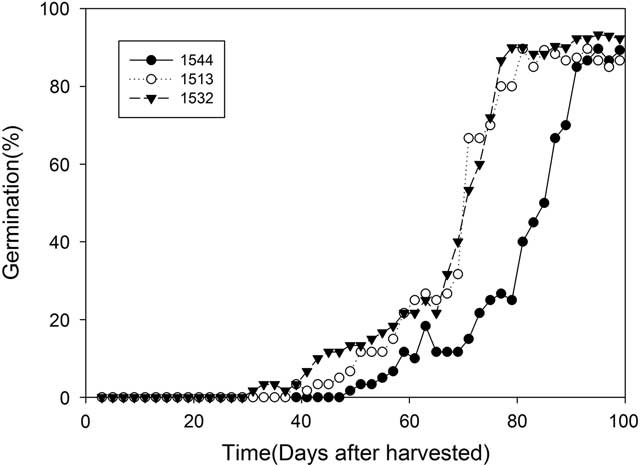
Seed germination response in days was consistent among the three Japanese foxtail populations. For the first 29 d, the germination rate was 0% and there was a slow increase between 29 and 61 d. Subsequently, a rapid increase in germination rates occurred, with approximately 90% germination at 85 d and thereafter (Figure 1). It is generally recognized that seed dormancy results from 1) endogenic factors, such as embryo dormancy, a germination-inhibiting substance, and phytohormone imbalance, and 2) extrinsic factors, such as a seed coat barrier or pericarp (Wu Reference Wu, Li, Xu and Dong2016a). The dormancy of Japanese foxtail seed may result from endogenic factors because the Japanese foxtail seed coat is very thin. These results indicated that Japanese foxtail seed has a dormancy period of approximately 80 d. However, it is possible that this dormancy period of 80 d is an overestimation, because the germination test was conducted under stable temperature conditions, unlike those seen in nature. The results from temperature tests indicated that fluctuating temperatures were more suitable for seed germination of Japanese foxtail.
Germination of three Japanese foxtail populations (‘1544’, ‘1513’, and ‘1532’) in days. The values (mean) are calculated to four replicates.

Impact of Temperature on Germination
When exposed to a constant temperature, Japanese foxtail germinated over a wide temperature range, from 10 to 25 C, with germination always exceeding 85% with the exception of population ‘1532’ at 25 C (13%) (Table 3). The low germination rate observed in population ‘1532’ at 25 C may be because population ‘1532’ was collected from an area with a cooler climate. A sharp decrease in germination occurred when the temperature was greater than 25 C, with almost no germination at 30 C or 35 C. Japanese foxtail also failed to germinate at 5C. Overall, considering germination rate, optimum germination occurred at 20 C. When temperature increased from 10 to 20 C, it did not influence the germination value; however, it reduced the time to the onset of germination and T80 (Table 3). Haferkamp (Reference Haferkamp, Karl and MacNeil1994) and Li (Reference Li, Tan, Li, Yuan, Du and Wang2015) reported that a low-temperature environment did not affect the total germination but did reduce the time to onset of germination of Japanese brome (Bromus japonicus Thunb. ex Murr.) seeds.
Germination percentageFootnote a and days required to reach 80% germination (t80) for Japanese foxtail seeds exposed to 12 temperature treatments.

a The values (mean±SE) are calculated from eight replicates. Three populations were evaluated separately. Different letters indicate significant difference at the P<0.05 level according to Tukey’s HSD test.
b Temperature was either 24 h or alternating 12/12 h.
c Calculated as described in formula: t 80 =(Hp−Lp)−1 + L, where L is the last day before 80% germination was reached, Lp is the observed germination percentage on day L, and Hp is the observed germination percentage on the day when germination reached or exceeded 80%.
d Abbreviation: NE, not estimated because germination did not reach 80% in all replications.
Compared with constant temperature, alternating between the same two mean temperatures significantly improved the germination values. For instance, the germination value of population ‘1532’ under alternating temperatures of 30/20 C was 90%, whereas, at the constant temperature of 25 C, germination was only 13%. These results suggest that the alternating temperature may be more suitable for seed germination of Japanese foxtail, possibly because alternating temperature can simulate the temperature changes between day and night in the natural environment (Leon et al. Reference Leon, Knapp and Owen2004; Thompson et al. Reference Thompson, Grime and Mason1977).
In China, over 70% of land area has tropical, subtropical, or temperate climate, where the annual average temperature is about 8 to 10 C. Japanese foxtail has the ability to spread into most areas of China due to its ability to germinate at 10 C. However, the areas where the average temperature in early autumn is 15 to 16 C, at 27° to 33° N (Ding et al. Reference Ding, Gu and Miao2006), are most favorable for germination of Japanese foxtail seeds. In the future, Japanese foxtail is likely to be a troublesome weed in wheat fields of these areas, such as Yun-Gui plateau and Sichuan Basin, where it has not yet become a serious problem.
Impact of Light on Germination
Light was not a limiting factor for Japanese foxtail germination. When exposed to continuous light, alternating light and dark (12/12 h), and completely dark conditions, the germination rates of Japanese foxtail populations were all greater than 87% (data not shown). Japanese foxtail seed will germinate below the soil surface, even if early-planted wheat has already shaded the ground.
Effect of Osmotic Potential on Seed Germination
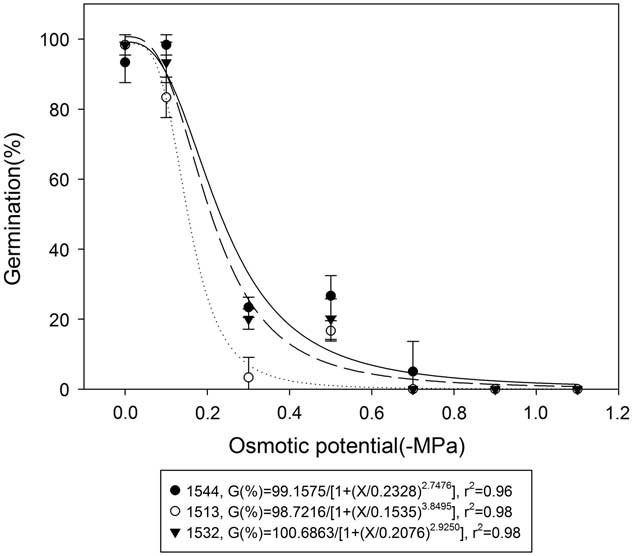
As shown in Figure 2, the germination values of each population’s seeds exposed to 0 (no-stress) and −0.1 MPa osmotic potentials all exceeded 83%, and seed germination declined sharply with a further reduction in osmotic potential. When exposed to −0.3 MPa, seed germination values fell below 25%. Almost no germination occurred when water potential was less than −0.7 MPa. From the fitted model, estimates show that an osmotic potential of −0.2 MPa would reduce germinations to 50% in all populations. Annual rabbitsfoot grass (Polypogon maritimus Willd.) had a high germination rate even at an osmotic potential of −1.6 MPa (Atia et al. 2011). Compared with annual rabbitsfoot grass, Japanese foxtail is highly sensitive to osmotic stress. However, the appropriate soil water potential for seedling emergence of wheat is from −0.05 to −0.02 MPa (Liu and Chen Reference Liu and Chen1988). Therefore, the soil will provide sufficient moisture for germination of Japanese foxtail when wheat seedlings are able to emerge. In our study, germination values were over 90% when seeds were exposed to −1.5 MPa, rinsed, and placed in distilled water (data not shown). The results above indicate that Japanese foxtail seeds will germinate in moist conditions, whereas seeds in dry conditions may remain dormant until moisture conditions are favorable.
Effect of osmotic potential on germination of three populations (‘1544’, ‘1513’, and ‘1532’) of Japanese foxtail seed incubated at 20 C for 21 d in an incubator. Data represent the mean plus or minus standard error of the mean (n=8).

Rice–wheat rotation systems account for a large proportion of fields in the Yangtze Delta region, where the annual precipitation is 1,000 to 1,500 mm (Rao et al. Reference Rao, Dong, Li and Zhang2008). The fields that previously supported rice crops have high soil moisture, which provides high soil moisture for germination of Japanese foxtail seeds. Therefore, it is not surprising that Japanese foxtail has become a troublesome weed in this area.
Effect of Salt Stress on Germination
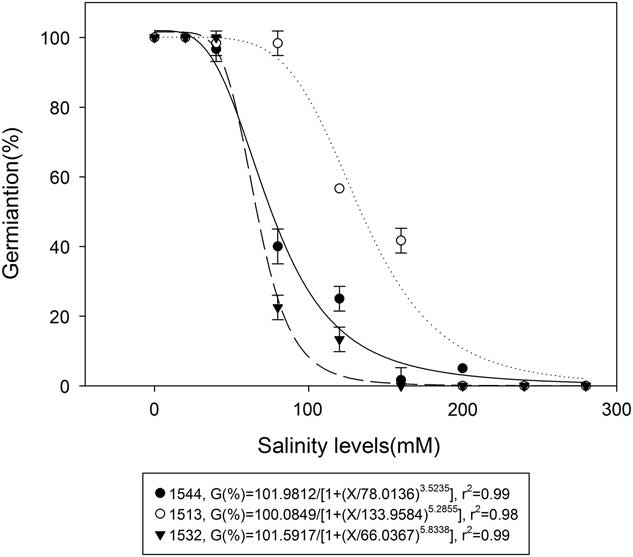
Germination response to salt concentration was different among the three populations. The germination rate of population ‘1513’ at 80 mM was 98%; however, populations ‘1544’ and ‘1532’ had germination rates of 40% and 25% (P=0.0001), respectively. Meanwhile, the germination of population ‘1513’ at 160 mM was 41%, with no germination in populations ‘1544’ and ‘1532’ at this level.
Response of all three populations was inversely related to salt concentration, and the maximum germination (100%) occurred between 0 and 20 mM. Some seeds germinated at 160 mM NaCl (1,513, 41%) and 200 mM NaCl (1,544, 4.5%), but germination was completely inhibited at 240 mM NaCl (Figure 3). In our study, germination values were over 90% when seeds were exposed to 240 mM NaCl, rinsed, and placed in distilled water (data not shown). In China, the Yellow River and Yangtze River estuaries have salt contents of 1.0% (the NaCl concentration is 173.8 mM) and 0.8%, respectively. Water from these rivers is used to irrigate rice, wheat, or other crops in the regions, which may explain why population ‘1513’ (located in the Yellow River Basin) has a higher tolerance to salt stress than populations ‘1532’ and ‘1544’ (located in the Yangtze River Basin) (Ba and Zhao Reference Ba and Zhao1997). These results suggest that some ecotypes of Japanese foxtail have a high tolerance to salt stress, and such soil types are common in many parts of China.
Effect of salt concentration on germination of three populations (‘1544’, ‘1513’, and ‘1532’) of Japanese foxtail seed incubated at 20 C for 21 d in an incubator. Data represent the mean plus or minus standard error of the mean (n=8).

Effect of pH on Germination
Compared to deionized water, germination of Japanese foxtail seed was not significantly influenced by pHs ranging from 5 to 10, and the germination rate of each population was over 90%. When exposed to solutions with pH values of 3 and 4, seed germination was completely inhibited (data not shown). In China, the pH of most soils range from 4.5 to 9.0 (Dai et al. Reference Dai, Huang, Wu and Yu2009). Hence, soil pH may not be a limiting factor for Japanese foxtail germination.
Effect of Seed Burial Depth on Emergence
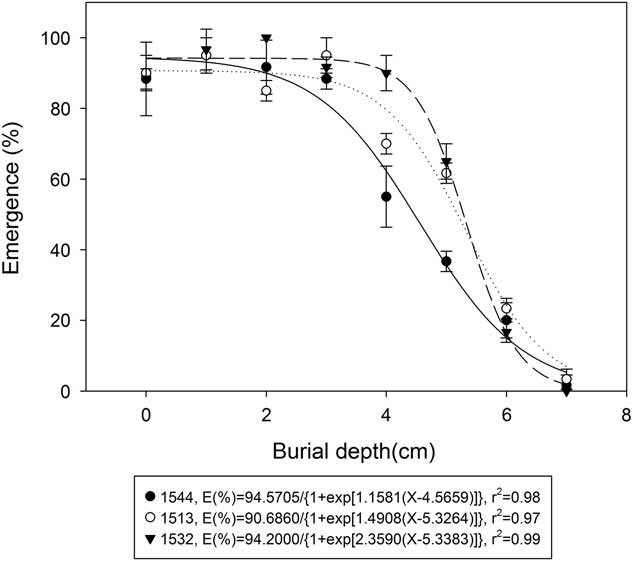
Estimates from the three-parameter sigmoid model indicate that 50% seedling emergence inhibition was achieved at 4.6 cm for population ‘1544’, and 5.3 cm for populations ‘1513’ and ‘1532’ (Figure 4). Benvenuti (Reference Benvenuti1995) reported that very little light could reach a depth greater than 4 mm under the soil surface. Japanese foxtail seeds buried from 0 to 3 cm in soil have a high germination rate (over 90%), which is consistent with the concept that light is not a limiting factor for germination. Emergence values for the three populations rapidly declined when burial depth was more than 4 cm. Almost no emergence occurred when seeds were buried at a depth of 7 cm. This study found that failed emergence of Japanese foxtail seeds mainly resulted from fatal germination. The Japanese foxtail seeds could germinate at the depth of 7 cm because light is not a limiting factor. However, seedlings failed to emerge because seeds planted at deep depths could not provide enough nutrition for the coleoptiles to reach the soil surface (Baskin and Baskin Reference Baskin and Baskin1998). Generally, larger seeds have more energy reserves and can emerge from deeper burial depths (Baskin and Baskin Reference Baskin and Baskin1998); however, small-seeded species, such as smallflower umbrella sedge (Cyperus difformis L.) and globe fringerush [Fimbristylis miliacea (L.) Vahl], do not have sufficient nutrient reserves to support seedling emergence from deep depths (Chauhan and Johnson Reference Chauhan and Johnson2010). There is less temperature fluctuation at deeper soil layers, which also decreased germination. Further, hypoxia and low rates of gaseous diffusion at deeper depths may also be reasons that seed emergence was reduced with increasing soil depth (Benvenuti Reference Benvenuti2003).
Effect of burial depth on seedling emergence of three populations (‘1544’, ‘1513’, and ‘1532’) of Japanese foxtail seeds incubated in a greenhouse for 21 d. Data represent the mean plus or minus standard error of the mean (n=8).

Therefore, burying Japanese foxtail seeds at a depth below 7 cm by deep plowing could be an effective method for managing Japanese foxtail. However, farmers tend to sow wheat without plowing in the south of China, especially in areas of rice–wheat rotation, which may cause weed seed bank accumulation on the surface of the soil and aggravate the occurrence of Japanese foxtail.
Effect of Rice Residue Amount on Seedling Emergence
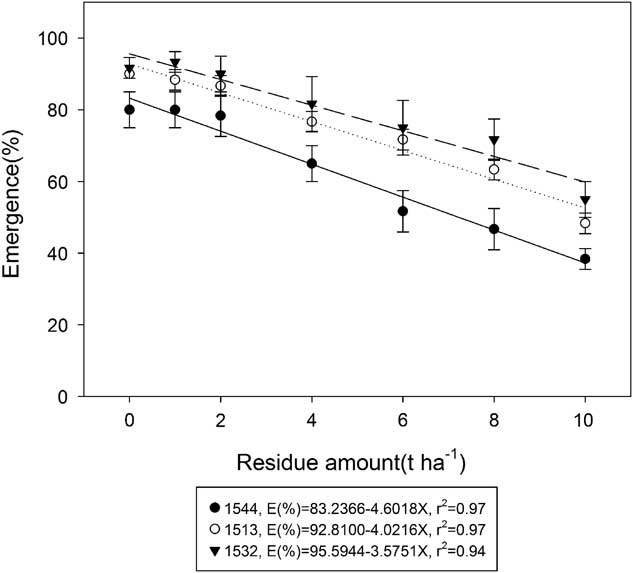
Seedling emergence in all populations decreased with an increasing rate of residues (Figure 5). Seedling emergence was 80% in population ‘1544’, 90% in population ‘1513’, and 91% in population ‘1532’ when no residues were applied, while the application of 10 t ha−1 of residue reduced emergence in ‘1544’ by 38%, in ‘1513’ by 48%, and in ‘1532’ by 55%. This study found that failed emergence of Japanese foxtail seeds also mainly resulted from fatal germination.
Emergence of three populations (1544, 1513, and 1532) of Japanese foxtail seeds, in response to residue amount (t ha−1) when grown in greenhouse for 21 d. Data represent the mean plus or minus standard error of the mean (n=8).

Weed suppression with the addition of surface residue could be attributed to lower soil temperatures, shading, and physical obstruction provided by the mulch itself (Crutchfield et al. Reference Crutchfield, Wicks and Burnside1986; Facelli et al. Reference Facelli and Pickett1991). Similar reductions in seedling emergence have been reported for several other weed species such as feather lovegrass [Eragrostis tenella (L.) Beauv. ex Roemer & J.A. Schultes] (Chauhan Reference Chauhan2013), Echinochloa glabrescens (Opeña et al. Reference Opeña, Chauhan and Baltazar2014), and itchgrass [Rottboellia cochinchinensis (Lour.) W.D. Clayton] (Bolfrey-Arku et al. Reference Bolfrey-Arku, Chauhan and Johnson2011). While high amounts of residue may suppress Japanese foxtail emergence, using this as a management strategy may be difficult if straw is used as fodder or where there is a shortage in the farm labor force. However, in areas with depleted soil organic matter, or where rice hull burning is banned because of air pollution concerns, such as India and the north of China, the addition of high amounts of rice residue mulch may be considered.
Effect of Heat Shock on Germination
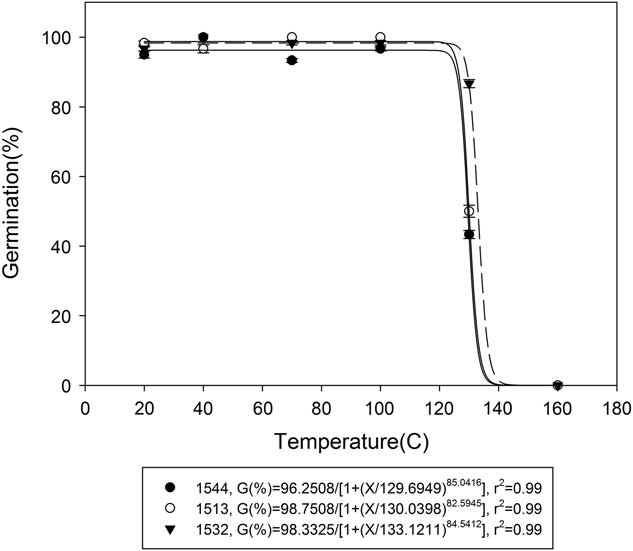
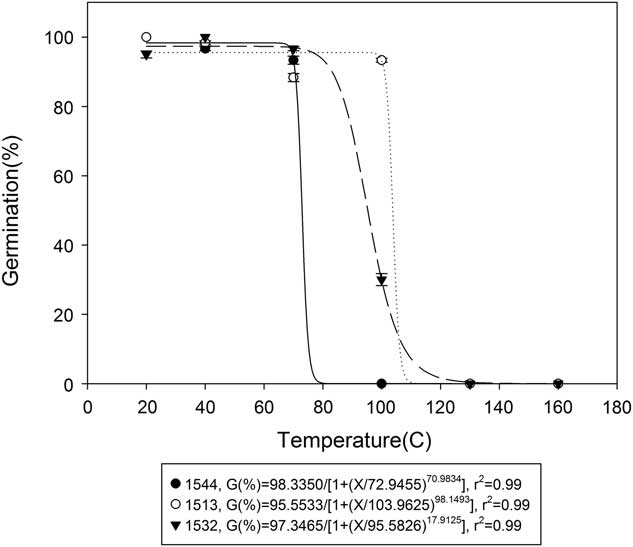
Seed germination was reduced when dry seeds were exposed to heat shock (Figure 6). Maximum germination of the three populations was over 90% when exposed to 20, 40, 70, and 100 C. However, seed germination of populations ‘1544’ and ‘1513’ sharply declined to 43% and 50%, respectively, when the temperature was increased to 130 C, though that of population ‘1532’ did not decline (86%). Germination was inhibited in all populations at 160 C (Figure 6). Seed germination was also reduced when presoaked seeds were exposed to heat shock (Figure 7). However, population ‘1513’ was able to withstand heat shock better than the other two populations. For instance, the germination value of seeds in population ‘1513’ was 93% at 100 C, while the germination values of seeds in populations ‘1544’ and ‘1532’ were 0% and 12%, respectively (Figure 7). The temperature where germination was inhibited by 50% was estimated from the fitted models. For dry seeds, this temperature was approximately 130 C for all three populations (Figure 6). For presoaked seeds, this temperature was 72 C for population ‘1544’, 104 C for population ‘1513’, and 95 C for population ‘1532’ (Figure 7). These results demonstrate that the heat shock temperature required to reduce viability of dry Japanese foxtail seed is relatively consistent in the different populations tested.
Effect of heat shock of dry seeds on the germination of three populations (‘1544’, ‘1513’, and ‘1532’) of Japanese foxtail at 20 C for 21 d. Data represent the mean plus or minus standard error of the mean (n=8).

Effect of heat shock of presoaked seeds on the germination of three populations (‘1544’, ‘1513’, and ‘1532’) of Japanese foxtail at 20 C for 21 d. Data represent the mean plus or minus standard error of the mean (n=8).

Previous studies have shown that to guarantee the death of itchgrass seeds (a weed of many crops throughout the tropics and one of the most important grass weeds of rice), temperatures are required to be in excess of 160 C for 5 min (Bolfrey-Arku et al. Reference Bolfrey-Arku, Chauhan and Johnson2011). In the Philippines, the majority (95%) of farmers burn rice straw after the harvest (Gadde et al. Reference Gadde, Bonnet, Menke and Garivait2009). In Australia, a narrow windrow burning technique is currently the most widely adopted harvest weed seed control system, as it is a simple and effective mechanism (Walsh et al. Reference Walsh, Newman and Powles2013). In experimental weed control fires, soil surface temperatures reached above 500 C (Bebawi and Campbell Reference Bebawi and Campbell2003). Our study showed that germination of Japanese foxtail seeds is completely inhibited at 160 C, and thus seeds on or close to soil surface should be easily destroyed by either burning straw or narrow windrow burning. Therefore, burning should be considered as a tool for managing the soil surface seed bank. However, studies have shown that soil temperatures decrease at a rate of 100 C cm−1 within 5 cm below soil surface (Sanchez Reference Sanchez1976). Considering these values, Japanese foxtail seeds buried below 4 cm may not be destroyed by burning straw.
Effect of POST Herbicides on Weed Growth at Different Leaf Stages
Efficacy of Japanese foxtail control, presented as inhibition rate, was 80% or more for mesosulfuron-methyl, clodinafop-propargyl, pyroxsulam, pinoxaden, and isoproturon. Control with these herbicides was greater than that with fenoxaprop-P-ethyl and flucarbazone-sodium at all growth stages tested (Table 4). The inhibition rate for fenoxaprop-P-ethyl was less than 70% when applied at all leaf stages, except in population ‘1513’ at the three- and five-leaf stages (84.6% and 80.3%, respectively) (Table 4). The efficacy of flucarbazone-sodium was the least, and its dry weight inhibition rate was approximately 60% when applied at the three- and five-leaf stages. Furthermore, the dry weight inhibition rate of flucarbazone-sodium was only approximately 45% when applied at the seven-leaf stage (Table 4). The efficacy of almost all herbicides was reduced with the increased growth stage of Japanese foxtail, thus the herbicides should be used early in wheat fields.
Inhibition rates of Japanese foxtail when herbicide was applied at the three-, five-, and seven-leaf growth stages.Footnote a

a The values (mean±SE) are calculated from eight replicates. Three populations were evaluated separately. Different letters indicate significant difference at the P<0.05 level according to Tukey’s HSD test.
The seeds from the three populations used in our study should have been grown in a common garden with controlled conditions to minimize environmental effects. This was not done, so we cannot know for sure whether the similarities or differences are due to genetic components or just differences in environmental conditions of the maternal plant.
In summary, Japanese foxtail seed was shown to have a dormancy period of approximately 80 days. The seeds can germinate under a wide range of environmental conditions commonly found in the Yangtze Delta region, which may partially explain why it is a serious problem in this region. As Japanese foxtail seeds did not remain viable at temperatures over 160 C, fire and/or narrow windrow burning, with enough stubble to increase the top soil temperature higher than 160 C, may be an effective mechanism for destruction of seeds on the soil surface. Seeds buried between 0 and 4 cm in the soil are suitable for seedling emergence, and emergence is greatly reduced with an increase in burial depth. Therefore, tillage operations that bury seeds deeper than 6 cm may be possible management options. High amounts of rice residue (over 10 t ha−1), used as mulch, suppressed seedling emergence of Japanese foxtail and may be combined with deep ploughing to discourage emergence of Japanese foxtail. The herbicides mesosulfuron-methyl, clodinafop-propargyl, pyroxsulam, pinoxaden, and isoproturon provided excellent control of this weed when applied at the three- and five-leaf stages.
Acknowledgments
This work was financially supported by the Special Fund for Agroscientific Research in the Public Interest of China (201303022), the Ph.D Programs Foundation of Ministry of Education of China (20133702110017), and the National Natural Science Foundation of China (31171866, 31601653). The authors thank all the workers for assistance in conducting this research.