





Medical assistance in dying (MAID) has been legal in the Netherlands since 2002 (Appendix A available in the Supplementary Material at https://doi.org/10.1192/bjp.2026.10815). In the practice of MAID, a distinction is sometimes made between euthanasia and assisted suicide. We use MAID as an umbrella term encompassing both euthanasia and assisted suicide, as regulated under Dutch law. 1 Recently the number of people receiving MAID has increased in the Netherlands, from 5516 in 2015 to 10 341 in 2025, with somatic illness, primarily cancer, being the most common reason. 2,3 The Dutch MAID legislation does not distinguish between irremediable somatic illness and psychiatric disorders (hereafter referred to as somatic and psychiatric MAID, respectively). Psychiatric MAID, although less common, has also increased in frequency in the Netherlands, from 56 cases in 2015 to 174 in 2025, representing 1.7% of all MAID cases in 2025. 2,3 Several other countries, including Belgium, Spain and Switzerland, also allow psychiatric MAID, and Canada has plans to expand their current MAID legislation to include psychiatric cases. 4,5 Somatic MAID is decriminalised or legalised in a number of jurisdictions, including Uruguay, Ecuador, Colombia, Cuba, parts of the USA, Australia, New Zealand and several European countries. 4
Regardless of the underlying condition, Dutch law requires that a MAID request is made voluntarily and without undue influence of others, which causes tension with relative involvement: that is, although relatives may provide essential support, their participation must be carefully managed to ensure that the request is made without external pressure. 1
Relatives’ involvement in MAID
In practice, relatives are frequently involved in MAID on both psychiatric Reference Helinck, Verhofstadt, Chambaere and Pardon6–Reference Snijdewind, de Keijser, Casteelen, Boelen and Smid8 and somatic grounds. Reference Renckens, Onwuteaka-Philipsen, van der Heide and Pasman9–Reference Goldberg, Nissim, An and Hales12 This is in line with the Dutch Euthanasia Code 2026, which deems inclusion of relatives desirable and self-evident. 1 In regard to psychiatric MAID, the Dutch psychiatric association recommends the involvement of relatives because they are an important source of information. Family should be excluded only in exceptional cases, e.g. when the relationship has been damaged irreparably. 13
Beyond their potential influence on the patient’s voluntariness, involving relatives can be complex because their expectations may differ from those of physicians. In psychiatric MAID, as opposed to somatic MAID, physicians often exercise greater caution, questioning fulfilment of the legal criteria. Reference Bolt, Snijdewind, Willems, van der Heide and Onwuteaka-Philipsen14,Reference Pronk, Sindram, van de Vathorst and Willems15 This caution mirrors the debate on psychiatric MAID, which prominently features the assessment of decisional capacity and the irremediability of suffering. Reference Churchill, Gastmans, Kim and Nicolini16 However, relatives do not always share these concerns because non-physicians appear to be more accepting of psychiatric MAID. Reference Evenblij, Pasman, van der Heide, van Delden and Onwuteaka-Philipsen17
Despite these challenges, relatives provide support, offer information to physicians and support the request. Nonetheless, relatives may also experience conflicting emotions, caregiver exhaustion and feel overlooked by professionals. Reference Roest, Trappenburg and Leget18 Two qualitative studies of relatives of people who received psychiatric MAID discovered that some found the trajectory difficult and lonely, and needed more involvement and support. 5,Reference Pronk, Willems and van de Vathorst7
Research directly examining relatives’ experiences remains limited. Studies focused on people requesting MAID as subjects, and those that did include relatives were often qualitative; therefore, these studies were unable to quantify the diversity of relatives’ experiences. 5–Reference Snijdewind, de Keijser, Casteelen, Boelen and Smid8,Reference Boven, Dillen, Dierickx, Van den Block, Piers and Van Den Noortgate11,Reference Goldberg, Nissim, An and Hales12,Reference Snijdewind, van Tol, Onwuteaka-Philipsen and Willems19,Reference Snijdewind, de Keijser, Casteelen, Boelen and Smid20 Furthermore, few compared psychiatric and somatic MAID, thus being unable to elucidate which characteristics are unique to the former. Addressing this gap could provide valuable insight into the experiences and needs of the relatives of people who requested MAID, and may help physicians in providing support.
Research questions
This study includes the following research questions:
-
(a) How do relatives of patients who received MAID on psychiatric grounds score on measures of emotional responses, opinions regarding the MAID trajectory, involvement in the MAID trajectory and judgement of the due care criteria?
-
(b) How do these scores differ from those of relatives of patients who received MAID on somatic grounds?
Methods
Study design
As part of a larger study, we conducted an online cross-sectional survey to explore opinions and quantify experiences regarding MAID in the Netherlands (Appendix B). Eligible for participation were Dutch people aged 18 years and over, of which we selected for analysis in the current study those who had experienced MAID of a relative (defined as a loved one, not limited to family). In both this section and Results, below, we will refer to the participants as ‘respondents’ and to the relatives who received MAID as ‘relatives’.
Data collection occurred between 1 April 2023 and 5 February 2025. To include participants, we used convenience sampling via social media, pamphlets in public locations, via the Dutch association of mental health and addiction care 21 and in 16 local newspapers with broad coverage across the Netherlands. Participation was anonymous, although respondents could provide their email address if they wished to be contacted for potential follow-up studies. The authors assert that all procedures contributing to this work comply with the ethical standards of the relevant national and institutional committees on human experimentation, and with the Helsinki Declaration of 1975 as revised in 2013. The Medical Ethics Committee of the University Medical Centre Groningen confirmed that this survey did not fall within the scope of the Medical Research Involving Human Subjects Act and therefore did not require formal review. At the end of the questionnaire, respondents were asked whether they consented to the use of their anonymised data for research purposes. Only data from respondents who provided informed consent were included in the analyses.
Survey instrument and measures
This study was based on a broad survey addressing the opinions and experiences regarding MAID in the Dutch population. The survey first assessed respondents’ opinions on MAID (1), followed by their experiences with MAID involving a relative (2). Subsequently, respondents’ grief experiences and their personal characteristics were assessed (3). Finally, respondents were asked about their opinions on organ donation following MAID (4). Parts 1 and 4 of the survey were beyond the scope of the current study. We estimated that the survey would take approximately 25 min to complete.
In the absence of validated instruments, questions about respondents’ opinions on MAID 1 were developed by the research team based on clinical experience. Although not strictly pretested, the questionnaire was piloted with a patient representative panel. Given the study’s focus, panel recruitment prioritised experience with psychiatric MAID. Two panel members had lost a relative to psychiatric MAID, and another had experience with both psychiatric and somatic MAID.
In the second section of the survey, which concerned respondents’ experiences with MAID, respondents were asked about the relative who had received MAID: the type of relationship, closeness of the relationship (continuous, on a scale of 1 to 7), age and the disease underlying MAID. Subsequently, the survey asked about the duration of the MAID trajectory, and respondents’ experiences and evaluations of that trajectory. This included respondents’ involvement in the trajectory and their judgement of the due care criteria, given previous findings that physicians tend to hold more restrictive views on MAID. Reference Evenblij, Pasman, van der Heide, van Delden and Onwuteaka-Philipsen17
Respondents’ involvement in the MAID trajectory and their judgements regarding the due care criteria were assessed using five-point Likert scales, from ‘not at all’ (1) to ‘certainly’ or ‘very extensively’ (5). Items on involvement were derived from a physician checklist containing recommendations for relative involvement, developed through focus groups. Reference Ettema, Hulst and Hiddershoven22 Items assessing fulfilment of the due care criteria were developed by the researchers. To ensure accessibility, some items were formulated in lay language rather than clinical terminology (e.g. ‘mental state good enough to make a decision’ referred to decisional capacity). Respondents who had experienced both psychiatric and somatic MAID were asked to report their experiences with MAID for each trajectory separately. If respondents had experienced more than one case within either category (i.e. two or more relatives who received psychiatric MAID, or two or more relatives who received somatic MAID), they were instructed to record their experiences with the MAID of the relative who was closest to them within that category.
In the third part of the survey, respondents’ grief experiences and their personal characteristics were assessed, including age, gender, educational level, rural versus urban residence, nationality, religion, whether they had a partner or children and their empathy. Respondents’ empathy was assessed through the Empathy Quotient (Dutch version), Reference Baron-Cohen and Wheelwright23,Reference Baron-Cohen and Berkhuizen24 because we hypothesised that higher empathy might influence experiences and opinions regarding MAID. The Empathy Quotient is a 40-item self-report questionnaire assessing empathy. Originally validated in individuals with autism, Reference Baron-Cohen and Wheelwright23 it has since been validated for use in other populations, including healthy adults. Reference Lawrence, Shaw, Baker, Baron-Cohen and David25 Items are rated on a 4-point Likert scale from 1 (strongly agree) to 4 (strongly disagree). Responses are recorded as either 1 (slightly (dis)agree) or 2 (strongly (dis)agree), resulting in a score between 0 and 80, with higher scores signifying greater empathy.
The final part of the survey consisted of questions about organ donation following MAID.
Participant selection
For the present study, we included all survey respondents who had experienced MAID of a relative. For this study, the term ‘relative’ refers to a loved one who has received MAID, including but not limited to partners, family members and close friends. Our primary aim was to describe respondents with experience of psychiatric MAID and to compare them with respondents who had experience exclusively of somatic MAID. Respondents whose relative had received MAID due to dementia were excluded, because dementia cannot be unequivocally categorised as somatic or psychiatric and involves distinct MAID trajectories. Respondents who had experience with both psychiatric and somatic MAID were placed in the psychiatric MAID group, and this categorisation was evaluated through sensitivity analyses (Appendix C).
Analysis
Characteristics of the respondents and their relatives, the nature of their relationship, the duration of the MAID trajectory and the understandability of the request were compared between the two groups using Student’s t-test, Mann–Whitney U-test and chi-square test as appropriate. Respondents were excluded from analysis when they had missing values on one of the personal characteristics: age, gender, rural versus urban residence, whether they had a partner or children, educational level and age of the relative who received MAID. For these variables, the missing values amounted to less than 10%. We did not exclude respondents with missing data on their experiences with MAID of a loved one, because we judged that these questions would be completed only by respondents who were able to recall these experiences.
Emotions experienced following MAID were compared by univariate analysis of variance, adjusted for potential confounders: the respondent’s age, the relative’s age, gender, educational level, relationship with the relative and the closeness of the respondent to the relative.
Finally, linear regressions were conducted to examine whether the condition underlying MAID (somatic versus psychiatric, independent variable) was associated with the respondent’s involvement in the MAID process and their judgement of the due care criteria (dependent variables). Potential confounders, each independently of interest, were entered simultaneously into the models: respondent’s age, educational level, Empathy Quotient total score, closeness of the relationship with the relative, nature of their relationship with the relative and the relative’s age. Relationship with the relative was included as a five-level categorical variable, using dummy coding (partner, parent, child, sibling and grandparent/other). Grandparent was combined with ‘other’ because both categories were small and did not differ markedly in closeness of the relationship. The relative’s age was entered into only those models examining associations with the due care criteria judgement, because we hypothesised that this variable would influence judgement of, for example, the irremediability of suffering. Considering the explorative nature of our survey, we did not adjust for multiple comparisons but present all individual p-values. Reference Rothman26
Because the assumption of normally distributed residuals was violated, we applied bootstrapping in all regression models. Bias-corrected and accelerated bootstrapping with 3000 replications was used, because repeating the analysis indicated that this number of replications produced negligible variation in the estimates. Reference Wilcox27,Reference Puth, Neuhäuser, Ruxton and Childs28 All analyses were conducted in SPSS (IBM SPSS Statistics for Windows, version 28.0 (IBM Corp., Armonk, New York, USA), available via: https://www.ibm.com/docs/en/spss-statistics/cd?topic=overview-download-installation-instructions). Results are reported according to the Checklist for Reporting Of Survey Studies. Reference Sharma, Minh Duc, Luu Lam Thang, Nam, Ng and Abbas29
Results
Characteristics of the participants
In total, 3859 people viewed or partially filled in the survey and 2329 respondents completed the survey, of whom 753 of 2329 (32.3%) reported experience with MAID of a relative. Of these 753 respondents, we excluded those who had incomplete data on demographic characteristics (n = 65, 8.6%), did not indicate whether the MAID was psychiatric or somatic (n = 72, 9.6%) or had experience solely with MAID due to dementia (n = 13, 1.7%). This resulted in a final study sample of 616 participants, of whom a minority had experience with psychiatric MAID (n = 110, 17.9%). Sensitivity analyses revealed no meaningful differences when respondents who experienced both psychiatric and somatic MAID were excluded (Appendix C).
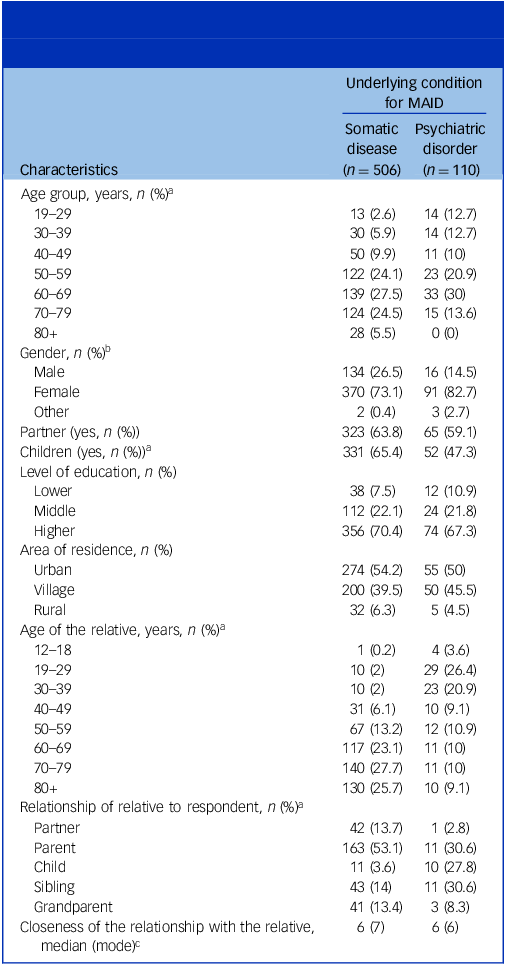
Respondents who had experienced psychiatric MAID differed significantly on several sociodemographic characteristics from those who had experienced somatic MAID (Table 1): they were less likely to have children (p < 0.001) and more often were female (82.7 v. 73.1%, p < 0.05). Although respondents aged 60–69 years represented the largest group in both samples (∼30%), the psychiatric MAID group was significantly younger (p < 0.001). In both groups, most respondents had a partner (63%), were highly educated (69.8%) and lived in an urban area (53.4%). More than 90% of all respondents were of Dutch origin.
Basic characteristics of respondents and their relatives who received medical assistance in dying (MAID; n = 616), stratified by the underlying condition

Table 1 Long description
The table presents basic characteristics of respondents who experienced psychiatric and somatic medical assistance in dying (MAID), with 110 respondents for psychiatric MAID and 506 for somatic MAID. The table has 18 rows and 6 columns. The columns are labeled ‘Characteristics’, ‘Somatic disease (n = 506)’, and ‘Psychiatric disorder (n = 110)’, with sub-columns ‘n (%)’ for each. The rows are labeled with various characteristics such as age group, gender, partner status, children status, level of education, area of residence, age of the relative, relationship of relative to respondent, and closeness of the relationship with the relative. Each row provides the count and percentage of respondents for each characteristic under both psychiatric and somatic conditions. Notable trends include a higher percentage of females in the psychiatric MAID group (82.7%) compared to the somatic MAID group (73.1%), and a younger age distribution in the psychiatric MAID group. Most respondents in both groups had a partner, were highly educated, and lived in urban areas.
a. Significant difference between somatic and psychiatric underlying condition (p < 0.001).
b. Significant difference between somatic and psychiatric underlying condition (p < 0.05).
c. On a scale from 1 (very distant) to 7 (very close).
According to the respondents, for psychiatric MAID, depression was the most common underlying condition (n = 36, 32.7%) followed by post-traumatic stress disorder (n = 17, 15.5%), bipolar disorder (n = 16, 14.5%), personality disorder (n = 10, 9.1%), autism spectrum disorder (n = 8, 7.3%), eating disorder (n = 6, 5.5%) and obsessive–compulsive disorder (n = 6, 5.5%). Less than 5% of cases involved anxiety disorder, psychotic disorder, addiction or other psychiatric conditions.
Respondents declared that, among somatic MAID, nearly two-thirds had cancer (n = 332, 65.6%), followed by multiple geriatric syndromes (n = 96, 19%) and neurological disease (excluding dementia) (n = 33, 6.5%). Less than 5% of cases involved pulmonary, cardiovascular or another somatic disease.
Characteristics of relatives who received MAID
Relatives who received psychiatric MAID were significantly younger than those who received somatic MAID (Table 1), the most common age groups being 19–29 and 70–79 years, respectively (p < 0.001). In the somatic MAID group, most respondents were partners of the deceased whereas, for psychiatric MAID, respondents were more evenly distributed across partners, children or siblings (p < 0.001). Respondents generally reported feeling close to the deceased (median 6, on a 1–7 scale), with no significant difference between groups (p = 0.057).
Opinions and emotions regarding the MAID trajectory
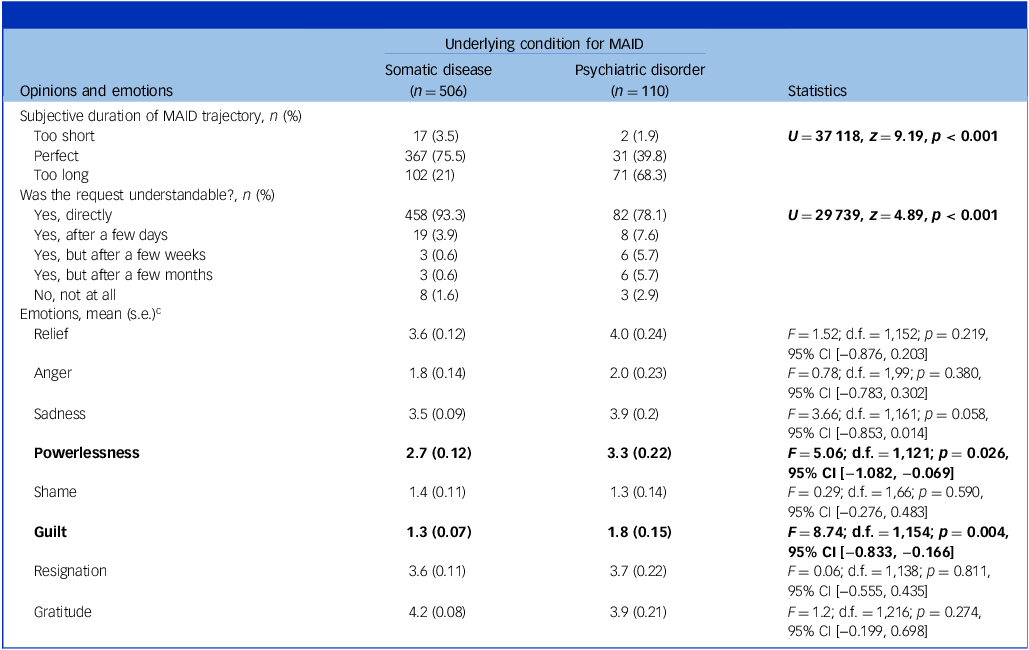
Although a large majority of respondents in both groups immediately understood their relative’s MAID request, this proportion was significantly lower for psychiatric MAID (78.1 v. 93.3%; p < 0.001) (Table 2). Respondents with experience of psychiatric MAID were more likely to consider the MAID trajectory too long (68.3 v. 21.0%; p < 0.001) and less likely to perceive its duration as perfect (39.8 v. 75.5%; p < 0.001).
Opinions and emotions regarding the medical assistance in dying (MAID) trajectory of a relative, stratified by underlying conditiona,b

Table 2 Long description
A Table comparing subjective duration of the MAID trajectory, understandability of the request, and emotional responses between people who experienced a relative’s MAID on somatic grounds and those who experienced a relative’s MAID on psychiatric grounds. The somatic disease group includes 506 participants and the psychiatric disorder group includes 110 participants.
The first section is titled ‘Subjective duration of MAID trajectory.’ In the somatic disease group, 17 participants (3.5%) considered the trajectory too short, 367 (75.5%) considered it perfect, and 102 (21%) considered it too long. In the psychiatric disorder group, 2 participants (1.9%) considered it too short, 31 (39.8%) considered it perfect, and 71 (68.3%) considered it too long. The statistical comparison is U = 37,118, z = 9.19, p < 0.001, which is statistically significant.
The next section asks, ‘Was the request understandable?’ In the somatic disease group, 458 participants (93.3%) answered ‘Yes, directly’; 19 (3.9%) answered ‘Yes, after a few days’; 3 (0.6%) answered ‘Yes, but after a few weeks’; 3 (0.6%) answered ‘Yes, but after a few months’; and 8 (1.6%) answered ‘No, not at all.’ In the psychiatric disorder group, 82 participants (78.1%) answered ‘Yes, directly’; 8 (7.6%) answered ‘Yes, after a few days’; 6 (5.7%) answered ‘Yes, but after a few weeks’; 6 (5.7%) answered ‘Yes, but after a few months’; and 3 (2.9%) answered ‘No, not at all.’ The statistical comparison is U = 29,739, z = 4.89, p < 0.001, which is statistically significant.
The final section is titled ‘Emotions’ and reports mean scores with standard errors for relief, anger, sadness, powerlessness, shame, guilt, resignation, and gratitude. Relief has a mean of 3.6 (0.12) in the somatic disease group and 4.0 (0.24) in the psychiatric disorder group; F = 1.52, d.f. = 1,152, p = 0.219, with 95% CI from -0.876 to 0.203. Anger has a mean of 1.8 (0.14) versus 2.0 (0.23); F = 0.78, d.f. = 1,99; p = 0.380, with 95% CI from -0.783 to 0.302. Sadness has a mean of 3.5 (0.09) versus 3.9 (0.2); F = 3.66, d.f. = 1,161; p = 0.058, with 95% CI from -0.853 to 0.014.
Powerlessness is shown in bold because the results are statistically significant: the mean is 2.7 (0.12) for somatic disease and 3.3 (0.22) for psychiatric disorder; F = 5.06, d.f. = 1,121; p = 0.026, with 95% CI from -1.082 to -0.069. Shame has a mean of 1.4 (0.11) versus 1.3 (0.14); F = 0.29, d.f. = 1,66; p = 0.590, with 95% CI from -0.276 to 0.483.
Guilt is also shown in bold because the results are statistically significant: the mean is 1.3 (0.07) for somatic disease and 1.8 (0.15) for psychiatric disorder; F = 8.74, d.f. = 1,154; p = 0.004, with 95% CI from -0.833 to -0.166. Resignation has a mean of 3.6 (0.11) versus 3.7 (0.22); F = 0.06; d.f. = 1,138; p = 0.811, with 95% CI from -0.555 to 0.435. Gratitude has a mean of 4.2 (0.08) versus 3.9 (0.21); F = 1.2; d.f. = 1,216; p = 0.274, with 95% CI from -0.199 to 0.698.
a. Between 74 and 224 respondents had no missing values on the emotion and covariates, and were included in the analysis.
b. With the following covariates: age of respondent, age of relative, gender, level of education, relationship with relative and closeness to relative.
c. On a scale of 1 (not at all) to 5 (very strongly).
95% CI, 95% confidence interval of the difference in means.
Significant results (p < 0.05) are displayed in bold type.
Gratitude, resignation, relief and sadness were the most strongly felt emotional responses, with no significant differences noted (see Table 2). Adjusting for confounders, those who had experienced psychiatric MAID reported significantly stronger feelings of powerlessness and guilt than those who had lost a relative through somatic MAID.
Involvement in the MAID trajectory
Figure 1 presents responses to five questions assessing involvement in the psychiatric MAID trajectory (see also Appendix D, Table D1). Approximately 55–75% of respondents felt at least moderately positively about their involvement in the psychiatric MAID trajectory. Nonetheless, approximately 30% of respondents reported that their viewpoint (question 2), story (question 3) or emotions (question 4) were not heard at all, and that they received insufficient attention (question 1). More than 40% felt insufficiently supported by the professionals involved (question 5) (Appendix D, Table D1).
Involvement in the medical assistance in dying trajectory of a relative.

For psychiatric MAID trajectories, in unadjusted analyses, respondents were significantly more negative about their involvement (question 1–4) compared with somatic MAID (p < 0.05) (Fig. 1 and Appendix D, Table D1). However, no group differences were identified after adjusting for confounders using linear regression analyses (Appendix D, Table D2). These analyses showed that respondents with a higher level of education, greater empathy and a closer relationship to the relative (i.e. characteristics entered as independent variables into the regression models) generally reported feeling more involved and supported. Partners of those relatives who received MAID generally reported higher levels of involvement than other respondents (questions 1–3 and 5). However, the overall models explained only 10–16% of the variation in involvement (R 2 from 0.099 to 0.160).
Judgement of due care criteria
Seven questions assessed how respondents judged the due care criteria for their relative who had received MAID (questions 6–12) (Fig. 2 and Appendix D, Table D3). Most respondents who experienced psychiatric MAID judged the due care criteria positively; over 90% agreed that their relative had suffered unbearably (question 6), had made a well-considered choice for MAID (question 11) and possessed adequate mental capacity to make a decision regarding MAID (i.e. were decisionally competent (question 12)). Over 80% thought their loved one was sufficiently informed (question 9). Additionally, approximately 10% of respondents were of the opinion that their relative’s suffering could have been alleviated (question 7), that they wrongly refused a potentially effective treatment (question 8) or that they had been influenced by others in their choice for MAID (question 10) (Appendix D, Table D3). In unadjusted analyses, there were no significant differences in the judgement of due care criteria between those who experienced psychiatric versus somatic MAID.
Judgement of due care criteria for the medical assistance in dying (MAID) trajectory of a relative.

Fig. 2 Long description
Panel A: A horizontal bar graph comparing the extent of suffering of relatives with psychiatric disorders and somatic diseases. The x-axis ranges from 0 percent to 100 percent. The y-axis lists two categories: Psychiatric disorder and Somatic disease. The bars are color-coded to indicate different levels of suffering: red for Not at all, pink for Somewhat, light green for Neutral, green for Certainly, and dark green for Most certainly. Panel B: A horizontal bar graph showing whether the suffering of relatives could have been alleviated. The x-axis ranges from 0 percent to 100 percent. The y-axis lists two categories: Psychiatric disorder and Somatic disease. The bars are color-coded similarly to Panel A. Panel C: A horizontal bar graph indicating whether relatives wrongly refused potentially effective treatment. The x-axis ranges from 0 percent to 100 percent. The y-axis lists two categories: Psychiatric disorder and Somatic disease. The bars are color-coded similarly to Panel A. Panel D: A horizontal bar graph showing whether relatives were sufficiently informed about their disease and treatment options. The x-axis ranges from 0 percent to 100 percent. The y-axis lists two categories: Psychiatric disorder and Somatic disease. The bars are color-coded similarly to Panel A. Panel E: A horizontal bar graph indicating whether relatives were influenced by others in their choice for MAID. The x-axis ranges from 0 percent to 100 percent. The y-axis lists two categories: Psychiatric disorder and Somatic disease. The bars are color-coded similarly to Panel A. Panel F: A horizontal bar graph showing whether the choice for MAID was well-considered. The x-axis ranges from 0 percent to 100 percent. The y-axis lists two categories: Psychiatric disorder and Somatic disease. The bars are color-coded similarly to Panel A. Panel G: A horizontal bar graph indicating whether the mental state of relatives was good enough to make a decision about MAID. The x-axis ranges from 0 percent to 100 percent. The y-axis lists two categories: Psychiatric disorder and Somatic disease. The bars are color-coded similarly to Panel A.
None of these judgements of the due care criteria differed significantly between psychiatric and somatic MAID in the regression analyses (Appendix D, Table D4). In these analyses, the respondent’s age was associated with their judgement of some of the due care criteria. Older respondents were more critical about whether their relative had refused a potentially effective treatment (question 8), had made a well-considered choice for MAID (question 11) and was mentally capable of making a good decision about MAID (question 12). However, the overall models explained less than 7% of the variation in respondents’ judgement of the due care criteria (R 2 from 0.01 to 0.065), and were significant for only 4 questions.
Discussion
Principal findings
Relatives of patients who received psychiatric MAID most prominently reported positive emotions (gratitude, relief, resignation), alongside sadness and powerlessness. Although most judged the due care criteria to have been fulfilled, and this did not differ significantly from the relatives of somatic MAID patients, over a quarter felt insufficiently involved and many found the trajectory excessively long. Respondents whose partner received MAID, or who had a close relationship to the relative who received it, felt generally more involved in the MAID trajectory. Compared with somatic MAID, relatives of patients who received psychiatric MAID reported significantly greater feelings of powerlessness and guilt, and were more likely to deem the MAID trajectory too long.
Our finding that many respondents found the psychiatric MAID trajectory too long is consistent with a qualitative study of people whose partners received psychiatric MAID, in which participants reported prolonged suffering preceding MAID and physicians’ repeated refusal to consider a MAID request. Reference Snijdewind, de Keijser, Casteelen, Boelen and Smid8 In contrast, studies also including somatic MAID have reported that relatives sometimes deemed the MAID trajectory too short. Reference Gamondi, Fusi-Schmidhauser, Oriani, Payne and Preston10,Reference Yan, Bytautas, Isenberg, Kaplan, Hashemi and Kornberg30,Reference Dees, Vernooij-Dassen, Dekkers, Elwyn, Vissers and van Weel31 The emotional responses observed in our cohort align with findings from previous studies on psychiatric MAID, which found that relatives often experience relief and gratitude alongside distressing emotions, including sadness and powerlessness. 5,Reference Pronk, Willems and van de Vathorst7
Although most relatives viewed as positive their involvement in the psychiatric MAID trajectory and the due care criteria, a substantial minority expressed doubts or dissatisfaction. Previous qualitative studies similarly describe both sides. A Belgian study found that some relatives desired more guidance in the trajectory’s emotional aspects, particularly when they felt powerless or ambiguous. Some also disagreed with the physician’s judgement of treatment resistance. 5 In one Dutch study, some relatives felt excluded from the psychiatric MAID trajectory and believed that additional treatment would have reinvigorated their relative’s desire to live. Reference Pronk, Willems and van de Vathorst7 In contrast, other studies found that some relatives considered psychiatric MAID the only viable option Reference Snijdewind, de Keijser, Casteelen, Boelen and Smid20 whereas others felt that professionals did not adequately acknowledge the unbearableness of the patient’s suffering. Reference Snijdewind, de Keijser, Casteelen, Boelen and Smid8 These studies contextualise our finding that distressing emotions among relatives 5,Reference Pronk, Willems and van de Vathorst7 can coexist with positive evaluations of the fulfilment of the due care criteria in psychiatric MAID. Reference Dees, Vernooij-Dassen, Dekkers, Elwyn, Vissers and van Weel31,Reference Snijdewind, van Tol, Onwuteaka-Philipsen and Willems32 Our study extends prior qualitative work by providing proportional estimates of the identified perspectives. Three reviews incorporating both somatic and psychiatric MAID provided prevalence data and similarly concluded that most relatives reflected positively on the MAID trajectory, consistent with our cohort’s experiences. Reference Gamondi, Fusi-Schmidhauser, Oriani, Payne and Preston10,Reference Roest, Trappenburg and Leget18,Reference Yan, Bytautas, Isenberg, Kaplan, Hashemi and Kornberg30
Our finding that judgements of the due care criteria did not differ between psychiatric and somatic MAID contrasts with earlier qualitative observations. To our knowledge, this is the first study to quantitatively compare relatives’ experiences of psychiatric versus somatic MAID. One qualitative study including both groups reported that relatives sometimes struggled to recognise the severity of the patient’s suffering, which could hinder accepting and empathising with the MAID request and subsequent death, particularly in psychiatric MAID. Reference Snijdewind, van Tol, Onwuteaka-Philipsen and Willems32 This apparent discrepancy most likely reflects methodological differences: qualitative studies aim to explore the range and depth of experiences whereas our quantitative approach allowed for estimation of their prevalence. Overall the findings suggest that, although difficulties in acknowledging psychiatric suffering occur, they do not appear to predominate.
Strengths and limitations
A major strength of this study is the large nationwide sample, enabling direct comparison of psychiatric versus somatic MAID. Additionally, our study quantitatively assessed themes identified in qualitative research, providing complementary evidence. However, it should be noted that, although adjusted analyses were performed, residual confounding cannot be excluded due to differences between the psychiatric and somatic MAID groups. The two groups were unequal in size, which reflects the lower prevalence of psychiatric compared with somatic MAID. Although the sample size of the psychiatric MAID group was sufficient for the analyses, statistical power to detect more subtle between-group differences may have been reduced. Moreover, a study limitation is the number of missing responses for the experienced emotions, possibly reflecting varying time intervals following MAID. Because relatives could skip these items if MAID felt too distant, this approach may have reduced bias. The convenience sampling method entails a considerable risk of bias and, compared with the overall Dutch population, native Dutch and highly educated people were overrepresented in our sample. 33,34 Whether this constitutes a selection bias remains unclear, because the demographic characteristics of the relatives of patients who received MAID in the Netherlands are largely unknown. It is noteworthy that MAID recipients generally have a higher socioeconomic status. Reference Groenewoud, Atsma, Arvin, Westert and Boer35,Reference Redelmeier, Ng, Thiruchelvam and Shafir36 Finally, it should be noted that the assessed due care criteria reflect respondents’ perceptions rather than evaluations. Therefore, these findings should not be interpreted as a validation of the legal framework in psychiatric MAID.
Implications
Overall, our findings suggest that relatives’ experience of their involvement in the MAID trajectory and their judgement of the due care criteria were broadly comparable between psychiatric and somatic MAID. This adds some nuance to ongoing debates about the complexity of psychiatric MAID, in which the unique challenges of psychiatric MAID are often emphasised. Reference Churchill, Gastmans, Kim and Nicolini16 The differences that did emerge – greater powerlessness and guilt, and perceptions of lengthy procedures – indicate a need for additional support during psychiatric MAID, including proactive communication, emotional guidance and reassurance throughout the trajectory. Particular attention should be paid to the potentially conflicting co-occurrence of distressing feelings (powerlessness and guilt) with retrospective endorsement of the due care criteria, which may warrant ongoing psychosocial support. Future studies should be performed to investigate whether the results of the comparative analysis can be replicated in different populations. Active involvement of relatives appears important because a notable minority felt excluded or questioned the due care criteria. Given that higher education, greater empathy and closer relationships were associated with increased perceived involvement, whereas the condition underlying MAID was not, clinicians should consider family dynamics when determining how to involve relatives. Attention to relational context and communication may support emotional processing, such as grief, guilt or powerlessness, and facilitate acceptance of MAID. Overall, these findings emphasise that meaningful, tailored engagement with relatives is a critical component of psychiatric MAID, potentially mitigating distress and promoting understanding and acceptance in relatives. Future research should investigate how involvement can be optimised, and which forms of support best address negative emotional experiences.
Supplementary material
The supplementary material is available online at https://doi.org/10.1192/bjp.2026.10815
Data availability
The data and analytic code associated with this study are not available. The research material, i.e. the questionnaire used for data collection, can be found in Appendix B.
Acknowledgements
Artificial Intelligence use: No artificial intelligence tools have been used in the research or writing process.
Author contributions
A.v.d.B.: methodology, formal analysis, investigation, writing – original draft, review and editing. R.C.O.V.: conceptualisation, methodology, formal analysis, writing – review and editing, supervision. K.C.: formal analysis, writing – review and editing. L.F.: formal analysis, writing – review and editing. D.J.C.H.: formal analysis, writing – review and editing, supervision. R.M.M.: conceptualisation, methodology, formal analysis, writing – review and editing, supervision, project administration.
Declaration of interest
R.C.O.V. is a board member (unpaid) of the International Association on Assisted Dying and Mental Disorders (IAADM) and licensed SCEN-physician (Support and Consultation for Euthanasia in the Netherlands) by the Dutch Royal Dutch Medical Association (RDMA). R.M.M. is a board member (unpaid) of the IAADM; a board member (unpaid) of ThaNet (network for persistent death wishes and requests for MAID on psychiatric grounds); a member of the committee on MAID of the Dutch Psychiatric Association (unpaid); and licensed SCEN-physician by RDMA. The remaining authors have no conflicts of interest to declare.


 Open access


eLetters
No eLetters have been published for this article.