INTRODUCTION
Fonio millet (Digitaria exilis) plays an important role in food security in West Africa. This crop is a small-grained, C4-metabolism cereal with a short life cycle, and is one of the first cereal crops to have been domesticated by West African farmers (Adoukonou-Sagbadja, Reference Adoukonou-Sagbadja, Wagner, Dansi, Ahlmeyer, Daïnou, Akpagana, Ordon and Friedt2007). It played a central role in the emergence of traditional agriculture in the West African savanna, where it is now a staple food or an important part of the diet for several million people (Adoukonou-Sagbadja et al., Reference Adoukonou-Sagbadja, Dansi, Vodouhè and Akpagana2006), especially the short-cycle varieties harvested at the end of the rainy season when granaries are empty. It is richer in methionine (a sulphur-containing amino acid) than rice (Oryza sativa), corn (Zea mays subsp. mays) or pearl millet (Pennisetum glaucum) (Fliedel et al., Reference Fliedel, Ouattara, Grabulos, Dramé and Cruz2003).
The cultivation of fonio millet in Guinea, Mali and Burkina Faso is indicative of its wide ecological adaptability (Vall et al., Reference Vall, Kanwé, Daho, Béavogui, Diallo, Sogodogo and Cruz2008). As a rainfed crop with low nutrient needs, it is usually grown on poorer soils at the end of a rotation (Adoukonou-Sagbadja, Reference Adoukonou-Sagbadja, Dansi, Vodouhè and Akpagana2006). It is often also grown on acid soils with high aluminium content in monocultural systems after a fallow period. Cultivation tends to stop when the yields become too low or when weeds, particularly Striga hermonthica, become difficult to control. The pressure of this weed explains some of the large variations in fonio grain yields (300–1000 kg ha−1) between different fields in the same village (Vall et al., Reference Vall, Kanwé, Daho, Béavogui, Diallo, Sogodogo and Cruz2008). To control Striga, Ahonsi et al. (Reference Ahonsi, Berner, Emechebea and Lagoke2004) suggested fertilizing the crop with N sources. In this context, it would be interesting to plant it after a legume crop (Abunyewa and Padi, Reference Abunyewa and Padi2003).
The fertilizer response depends upon the production potential of a particular area. Fonio is grown in areas with high production potential, such as in Guinea, as well as in areas with a low production potential, such as the Ségou area in Mali. Indeed, Ségou is characterized by short rainy seasons, with high mean temperatures and sandy soils with low fertility.
As in the case of other cereal species, it would be expected that local varieties with a low but stable grain yield and a cycle length adapted to water availability would respond mainly to nitrogen (N) fertilizer with a marked increase in straw production (Gigou, Reference Gigou1986), making improved fertilization questionable. Nevertheless, various trials with other cereals have reported increase in grain yields following fertilizer applications (Rockström and de Rouw, Reference Rockström and de Rouw1997; Traoré, Reference Traoré1974). In addition, fonio straw is important as forage during the dry season (Vall et al., Reference Vall, Kanwé, Daho, Béavogui, Diallo, Sogodogo and Cruz2008), especially in Sahelian farming systems.
The aim of this work was to study the impact of varying but moderate levels of N, phosphorus (P) and potash (K) fertilizers on straw and grain yields of a local early-maturing cultivar of fonio millet, under varying soil and climatic conditions in West Africa.
MATERIALS AND METHODS
Trial locations
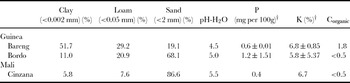
Trials were set up at three experimental stations representing different climatic conditions. Bareng experimental station is in northwestern Guinea, near Labé, in the Fouta Djalon massif (11°19′N and 12°18′W; 1000 m asl). Total annual rainfall reaches 1700 mm, all falling during the rainy season from April/May until October. Fonio millet is sown in July and harvested at the beginning of the dry season. The soil is a ferrasol, based on the FAO classification. It is acid with clay to loamy clay granulometry, and is deep and well drained. It has an organic carbon content of 2%, and poor P and K content (Table 1).
Soil characteristics for the three locations where fonio fertilizer trials were conducted. Mean ±, when available, s.d. observed between the three blocks set-up within each site.

†Nutrients extracted with the acetate of ammonium-EDTA at a pH of 4.65 (Lakanen and Ervio, Reference Lakanen and Ervio1971).
Bordo experimental station is in northeastern Guinea, near Kankan, in the high Niger basin (10°24′N and 9°18′W; 400 m asl). The mean annual rainfall is 1500 mm, all falling during the rainy season from May to October. Fonio millet is sown from May to July and sometimes in August. The first harvest occurs in August during the rainy season. The soil is a cambisol, a loamy-sandy acid soil with an organic carbon content of less than 0.5%. The trial field has a low P and K content (Table 1), with better fertility in the third block than in the others.
Cinzana experimental station is in Mali, near Ségou (13°22′N and 5°16′W; 300 m asl). The Sahelian climate here is characterized by total annual rainfall of 600 mm, all falling during a short rainy season from June/July to September. Fonio millet is sown as early as possible to take advantage of the short rainy season. The trial field soil is an arenosol, a slightly acid sandy-loamy soil with an organic carbon content of only 0.5%. This field was also characterized by low P and K content (Table 1).
The soil structure is stable at all three study locations.
Experimental protocol
The treatments consisted of combinations of these applications: 0, 15.0 and 30.0 kg N ha−1; 0, 15 and 30 kg P2O5 ha−1, equivalent to 0, 6.6 and 13.2 kg P ha−1; and 0, 15 and 30 kg K2O ha−1, equivalent to 0, 12.5 and 25.0 kg K ha−1. In all, there were 27 treatments.
These relatively low levels of fertilizer were chosen because the fonio cultivars available were selected by farmers with poor soils with limited yield potential. The poor and erratic precipitation can also limit the effect of a large quantity of fertilizer.
The fertilizers were applied before sowing in the form of urea (46% N), triple superphosphate (45% P2O5, equivalent to 19.7% P) and potassium chloride (60% K2O, equivalent to 50% K). At each site the trial was set up as a completely randomized block with three repetitions. The elementary plots measured 15 m2 and were separated by 1-m-wide paths.
Uniformity trial (2006)
In order to limit intra-block variation, the fertility of the trial fields had been assessed in the preceding year, 2006. This involved setting up trials (Dagnelie, Reference Dagnelie1981) based on a uniform cropping of the fields that were harvested in adjacent, inter-connected and geo-referenced sub-plots. These sub-plots measured 50 m2 at Bareng and Bordo in Guinea and 100 m2 at Cinzana in Mali. The grain yields were recorded from these different sub-plots.
In these uniformity trials, 46 kg N ha−1 was applied as urea in order to stimulate crop development and reveal variations in soil fertility. By stimulating crop growth and consequently the removal of a maximum amount of soil nutrients, these trials led also to soil fertility homogenization.
The fields were sown with fonio millet at a density of 30 kg ha−1 at the Guinea sites (cultivar Fonibagbé in Bordo and Siragué in Bareng) and with pearl millet (variety CzSyn 00 02) at 5 kg ha−1 at the Mali site.
The results of the uniformity trials allowed the areas in each field with homogeneous soil fertility to be identified in order to set up the blocks for the fonio trials, in the following year, in iso-potential areas.
Fonio fertilization trial (2007)
The same fonio cultivar, locale de Niatia, from Mali was used at all three trial sites. This cultivar was obtained from the Ségou area and had given good results in the preliminary trials (Stilmant et al., Reference Stilmant, Dupuis, Diallo, Cissé, Camara, Gigou, Sanogo, Vaksmann, Guindo, Vall, Kanwe, Andrieu and Cruz2008). Its early heading characteristic enabled it to reach maturity at all the trial sites.
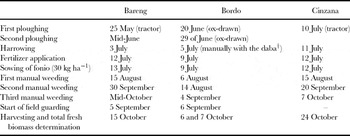
The activities carried out at the sites are recorded in Table 2. The trial fields were ploughed to a depth of 15–20 cm, once or twice, at intervals of 10–20 days, depending upon the site, in order to reduce weed pressure. This was followed by harrowing and fertilizer application just before sowing the crop at a density of 30 kg ha−1. The seeds were thereafter covered with a thin layer of soil. Three hand weedings were carried out during the trials. Guarding against bird damage lasted from grain formation to harvest.
Technical itineraries performed in the fonio fertilization trial set up in Bareng and Bordo (Guinea) and Cinzana (Mali).

†Local traditional hand tool.
The trials were harvested by hand. The straw was cut as low as possible. If residual straw biomass remained on a field, it was harvested in a second run. The fresh weight of sheaved fonio was measured and the sheaves were then air dried for one week before threshing. The grain was then winnowed and weighed.
At Bordo, one grain sample from each plot was analysed in order to assess the impact of the fertilizer treatments on grain quality. The parameters measured were starch, protein, fibre (cellulose, hemicellulose and lignin) (Van Soest and Wine, Reference Van Soest and Wine1967) content and the 1000-grain-weight (TGW) for fonio paddy grains.
Statistical analysis
The grain yield analysis in 2006, to map the distribution of soil fertility in the trial fields, was done using the Contour Plot procedure with MINITAB 13.31 software (Minitab 13.31, 2000).
The results of the fertilization trials in 2007 were analysed using a mixed analysis of variance (ANOVA), with four factors (N level, fixed, three levels; P level, fixed, three levels; K level, fixed, three levels; and block, random, three levels). Each trial was analysed independently using SAS 9.1 software (SAS Institute, 2002). All the interactions, including the block factor, were pooled as an error term. Pair-wise comparisons of treatments were done using the Student-Newman-Keuls multiple means test while interactions effects were analysed using the LSMEANS function from GLM procedure in SAS 9.1 software (SAS Institute, 2002).
RESULTS
Uniformity trials
The grain yields in the individual sub-plots ranged from 142 to 916 kg ha−1, 230 to 1030 kg ha−1 and 370 to 1700 kg ha−1, with means of 398, 563 and 899 kg ha−1 and standard errors of 171.8, 146.1 and 298.6 kg ha−1 at Bareng, Bordo and Cinzana, respectively. Yield maps are presented in Figure 1, with the position of the three blocks included in the 2007 trials at the different sites.
Localization of the three blocks taken into account in the fertilization trials at the trial sites are based on the yields recorded in the uniformity trials performed in 2006; a) Bareng, Guinea; b) Bordo, Guinea; c) Cinzana, Mali.

Fonio response to fertilizers: level of production
The year 2007 was characterized by good rains, with 1515, 1393 and 909 mm recorded at Bareng, Bordo and Cinzana, respectively. The rainy season started late in Cinzana, with significant rainfall only from mid-July to the end of September (Figure 2). Heavy rains, with more than 100 mm per day, were also recorded during the beginning of the rainy season at this site.
Rainfall distributions per decade from April to November 2007 at trials sites.

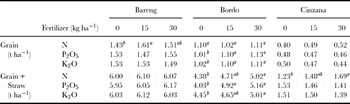
On average, the recorded grain yields were 1.51 ± 0.229, 1.08 ± 0.141 and 0.47 ± 0.182 t ha−1 in Bareng, Bordo and Cinzana, respectively. The total aerial biomass production was 6.06 ± 1.115, 4.70 ± 0.758 and 1.91 ± 0.674 t ha−1, respectively.
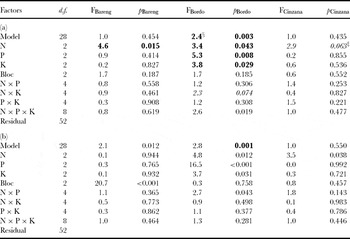
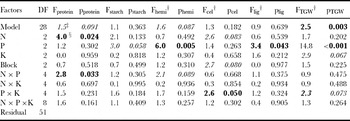
Table 3 summarizes the results of the ANOVA performed for grain and total aerial biomass. In Bareng, there was a significant effect of the N application only on grain yield. The application of 15 kg N ha−1 led to a 13% increase in grain yield (average production of 1.61 t ha−1) compared with the control without N fertilization. The application of 30 kg N ha−1 led to no significant increase in grain yield (6%) compared with the control (Table 3).
Results of analysis of variance performed (a) on grain yield and (b) on the total aerial biomass production for each site.

‡Values in italic are marginally significant results (0.10 > p > 0.05).
§Values in bold are significant (p < or = 0.05).
At Bareng, there was no significant impact of the fertilizer treatments on total aerial biomass production. This variable was impacted only by the block factor. This could be linked to the manual harvesting process, whereby each block was cut and harvested by a different person who had his/her own way of cutting. This could lead to different residual straw biomass on the plot, as illustrated by a high parallel significant impact of the block factor on the grain ratio (Fbareng (2,52) = 13.7; p < 0.001). This ratio ranged between 28% in the first and second blocks and 22% in the third block.
At Bordo, there was a significant impact of the N, P and K treatments on grain yield and total aerial biomass production. For grain yield, there was a significant interaction between N, P and K factors, but for total aerial biomass production there was a significant interaction only between N and P.
The three-way interaction for grain yield, illustrated in Figure 3, clearly showed that to be effective, an N application of 30 kg ha−1 needed to be applied with a certain amount of P and K. The highest yields were observed when 30 kg ha−1of N was applied with 15–30 kg of K2O ha−1and 15–30 kg of P2O5 ha−1. These fertilizer treatments resulted in a production of 1.26 t ha−1 (a 22% increase in grain yield) in comparison with 1.03 t ha−1 in the absence of fertilizers or where only one nutrient was applied.
Illustration of the N, P2O5 and K2O interaction, with doses ranged from 0 to 30 kg ha−1, observed in Bordo (Conakry Guinea), on grain yield (kg ha−1). Means quoted with different letters are significantly different (SAS - Proc GLM - LSMEANS comparison −α = 0.10).

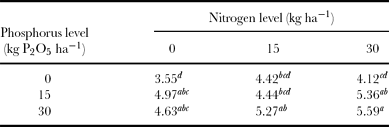
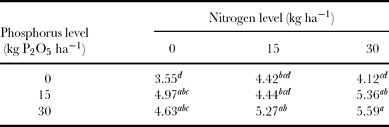
Similarly, the two-way interaction observed between N and P in terms of total aerial biomass production showed that there had to be a certain amount of P in the soil for the N to be effective, and vice versa (Table 4). The supply of one of the two nutrients at the rate of 30 units per hectare with at least 15 units of the other nutrient led to a production of 5.40 t ha−1 (an increase of 52% in the total aerial biomass), compared with 3.55 t ha−1 in the absence of N and P fertilizers. The supply of one or both of these nutrients at the rate of 15 units per hectare led to a 27% increase in total aerial biomass production (4.52 t ha−1).
N × P interaction was illustrated in Bordo trial (Guinea) for total biomass production (T ha−1). The values quoted with the same letter are not significantly different (Student-Newman-Keuls test, α = 0.05).
The analysis of the main effects of the three nutrients illustrated the significant and proportional impact of K fertilizer on total aerial biomass production at the Bordo site (Table 5).
Illustrations of the main effects for different nutrients at Bareng and Bordo (Guinea) and Cinzana (Mali) different sites respectively and grain yield with total aerial biomass production. Within each site for each parameter, the values quoted with the same letter are not significantly different (Student-Newman-Keuls test, α = 0.05).

At Bordo, the fertilizer treatments seemed to have a proportionally more significant impact on total aerial biomass production than on grain yield. This was supported by the negative correlation between grain ratio and total aerial biomass production (r = – 0.881; n = 9; p < 0.001).
At Cinzana, both grain yield and total aerial biomass production were affected by the N applications (Table 5). This explained the marginally significant (p = 0.063) and significant (p = 0.038) impact of these treatments on these two variables, respectively. The application of 30 kg N ha−1 led to a 29% increase in grain yield and total aerial biomass. An increase from 15 to 30 kg N ha−1, however, led to little (7%) and no significant increase in these yields, which indicated the presence of other limiting factors.
Fonio response to fertilizers: grain composition
As the fertilizer treatments had a significant impact on fonio production at the Bordo site, we investigated their impact on fonio grain composition and size at this site. The results showed a marginal effect (p < 0.10) of the fertilization treatment on the protein and hemicellulose content and a highly significant (p < 0.01) effect on TGW (Table 6).
Results of analyis of variance performed on grain composition and size in Bordo (Guinea).

†hemi: hemicellulose; cel: cellulose; lig: lignin; TGW: 1000-grain weight.
‡Values in italic are marginally significant results (0.10 > p > 0.05).
§Values in bold are significant (p < or = 0.05).
There was a significant, albeit small, increase from 4% in the grain protein content, moving from 7.48 to 7.75% of the dry matter (DM), with an increase in N fertilizer from 0 to 30 kg N ha−1 (Table 7). There was also a significant N × P interaction due to the low protein content observed with the combination of 15 kg N ha−1 and 15 kg P2O5 ha−1.
Illustrations of the significant effects of the different nutrients on the fonio grain quality parameters. For each parameter, the values quoted with the same letter are not significantly different (Student-Newman-Keuls test, α = 0.05).

TGW: 1000-grain weight.
Hemicellulose, accounting for 3.4% of the DM, was significantly influenced by P fertilization (Table 6). An increase in the level of P fertilizer reduced this fibre fraction by 4% after an application of 15 kg P2O5 ha−1 (Table 7).
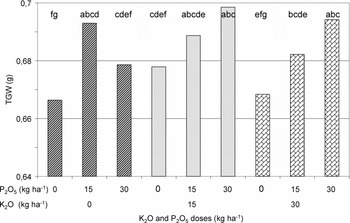
A highly significant impact of P and a slightly significant impact of K were recorded on TGW, with a marginally significant interaction between these two nutrients (Table 6). This interaction was linked to the high TGW associated with the combination of 0 kg K2O ha−1 and 15 kg P2O5 ha−1 (Figure 4). Without taking into account the applications without K2O, there was a clear and significant increase in TGW with P applications (Figure 4). Indeed, TGW increased by 1.8 and 3.4% after applications of 15 and 30 kg P2O5 ha−1, respectively.
K2O × P2O5 interaction, with doses of 0–30 kg ha−1, at Bordo, on TGW (1000-grain weight). Means quoted with different letters are significantly different (SAS – Proc GLM – LSMEANS comparison − α = 0.10).

Starch, cellulose and lignin content were not affected by the fertilizer treatments (Table 6). Their average concentration was 66.4, 8.4 and 3.3% of the DM, respectively.
DISCUSSION
We observed significant differences in the fonio millet response to fertilizer treatments from one site to another, with a marginal to significant impact of N fertilization on grain yield at all three sites and on aerial biomass production at Bordo and Cinzana, coupled with a significant interaction with the P and/or K response at Bordo. The presence of limiting nutrients at Bordo led to the limited response to N application without P or K, or with only either P or K. Of these two nutrients, P is often the most limiting, especially in the semi-arid soils of the Sahel (Knewtson et al. Reference Knewtson, Hons, Juo and Hossner2008). It was at Bordo, however, where the soil had the highest P content (Table 1), that the impact of the P and K treatments was the clearest.
One explanation could be that the higher soil organic matter content at Bareng meant better soil fertility, as illustrated by the highest yields recorded in the study (more than 41% greater than from Bordo where the amount of rainfall was similar but where temperatures and, so, potential evapotranspiration were higher). Indeed, as demonstrated by various studies, extractable soil P content is not always a good indicator of the P fraction available for a crop. This fraction is often more accurately reflected by plant nutrition indices (Duru and Thelier-Huche, 1995).
The lack of an NPK interaction at the Cinzana site could be linked to the presence of a more limiting factor: low and unreliable rainfall, limiting the effect of these nutrients. The significant fluctuation in rainfall in 2007, some days having almost 100 mm but many others with no rainfall at all, limited the efficient use of the nutrients. Under these conditions, the low levels of P and K, however, did not seem to be limiting for the fonio millet and there was a significant impact only of the N fertilizer on grain and total biomass production (more than 37%).
At Bareng, the highest yield was produced after the application of 15 kg N ha−1. One explanation for this could be that, with 1.6 t of grain ha−1, the limit of the production potential of unselected fonio ecotypes was reached at this site. The levels of production were among the highest recorded for small-scale farmers’ fields in the region (Vall et al., Reference Vall, Kanwé, Daho, Béavogui, Diallo, Sogodogo and Cruz2008).
The positive impact of N fertilization on fonio straw production could be of interest, especially in the Sahel, where fodder resources are scarce during the dry season (Vall et al., Reference Vall, Kanwé, Daho, Béavogui, Diallo, Sogodogo and Cruz2008). When the straw fraction increases faster than the grain fraction, however, as at Bordo, the effect of applying more fertilizer is questionable, as is the case for some other African cereals (Gigou, Reference Gigou1986).
Apart from their impact on biomass production, fertilizer treatments can also affect biomass quality. As reported for other cereals species (Salo et al., Reference Salo, Eskelinen, Jauhiainen and Kartio2007; Wang et al., Reference Wang, Li and Malhi2008), N fertilization significantly, albeit slightly, increased the protein content of fonio grain by 3.5% and, as for wheat (Salo et al., Reference Salo, Eskelinen, Jauhiainen and Kartio2007), P fertilization led to a 3% increase in fonio grain weight, coupled with a significant 4% fall in hemicellulose content. As fonio grain size is a key factor for the women who have to process it, the application of a low level of P could be of interest in improving its harvest value.
Apart from the Bordo site, where both P and K were limiting, a low level of N application (15 kg N ha−1) led to a 12–22% increase in production. This level of N can be achieved by integrating legume or forage crops in the rotation (Ghosh et al., Reference Ghosh, Bandyopadhyay, Wanjari, Manna, Misra, Mahanty and Rao2007). Legumes need a good level of P in the soil, however, to express their potential, but they can also help in solubilizing insoluble P fractions in the soil (Ghosh et al., Reference Ghosh, Bandyopadhyay, Wanjari, Manna, Misra, Mahanty and Rao2007). Their integration in the rotation may lead to an increase not only in N, but also in soil organic matter, one of the key parameters of soil fertility and yield stability (Subbarao et al., Reference Subbarao, Renard, Payne and Bationo2000). The N supplied by legumes, or under other forms, also limits the Striga populations (Abunyewa and Padi, Reference Abunyewa and Padi2003) that are a severe constraint to fonio millet production (Vall et al., Reference Vall, Kanwé, Daho, Béavogui, Diallo, Sogodogo and Cruz2008).
As shown at Bordo, P and K can adversely affect the effect of N on the crop. With the shortening of fallow periods because of demographic pressure, K and especially P (Knewtson et al., Reference Knewtson, Hons, Juo and Hossner2008) are becoming more limiting in the Sahel soils. To restore soil fertility and increase the nutrient and soil organic matter content, farmers could use animal manure (Kihanda et al., Reference Kihanda, Warren and Micheni2005) or apply mulches, but the sources of manure are limited, and there are significant nutrient losses during collection and storage (Schlecht et al., Reference Schlecht, Hiernaux, Achard and Turner2004). Thus, without fertilizer application, there would be a fall in the global production of fonio millet (Knewtson et al., Reference Knewtson, Hons, Juo and Hossner2008). In many Sahelian countries, however, investment in these fertilizers is constrained by the low market prices for staple foods, and by land tenure and property rights issues.
Apart from major nutrient shortages, erratic climatic conditions and varying rainfall distribution and intensity explain much of the inter-annual yield variations (Subbarao et al., Reference Subbarao, Renard, Payne and Bationo2000). The climatic conditions can result in a significant water deficit, which has a negative impact on cereal yields by limiting their ability to use available nutrients (Pandey et al., Reference Pandey, Maranville and Admou2001). This could explain the poor yields at the Cinzana site, where there was less than 600 mm of rainfall and a potential evapotranspiration deficit for most of the growing season. In these climatic conditions it is not worth applying higher levels of fertilizers than the amount exported by the crop (about 15 kg N, 2 kg P and 15 kg K ha−1 in the traditional pearl millet systems in the southern Sahel (Burkett and Hyrax, Reference Buerkert and Hiernaux1998)). In fact, excess fertilizer applications may lead to more unstable yields (albeit higher, on average) from year to year and thus would not be adopted by farmers who are unable to cope with such risks (de Rouw, Reference Rouw de2004). In addition, the excess nutrients would be lost through wind or water erosion if the organic matter content was too low, which is often the case in this region (Burkett and Hyrax, Reference Buerkert and Hiernaux1998).
The results of our study show that applying low levels of N (15 kg ha−1) can increase production by 12–22 % if P and K supplies are not limiting. For better control of the risks associated with poor soil fertility and erratic rainfall, the results support the application of moderate levels of N, P and K fertilizers instead of a high level of only one of these nutrients.
In order to be sustainable, these moderate levels of fertilization can come from N fixation by legume species in appropriate rotation systems, with some manure application. When the climatic conditions favour higher levels of production, however, an additional mineral supply of P and K is often necessary, but this is feasible only if there are stable and profitable markets for the cereal crop and/or if commercial crops are integrated into the rotation. Another topic of the INCO FONIO project, funded in the FP6 programme, was the improvement of the commercial potential of this minor cereal so that it can play an important role in improving food security in West Africa.
Acknowledgements
The authors wish to thank the referee for his useful suggestions. The project ‘Upgrading quality and competitiveness of fonio for improved livelihoods in West Africa’ (FONIO) was funded by the FP6 INCO programme (STREP project no. 015403).