Introduction
Cannabis is the most popular used drug worldwide, with an estimated 2.8–4.5% cannabis users in the general population and 7.1% cannabis users in western and central Europe (Degenhardt & Hall, Reference Degenhardt and Hall2012). Use of this drug has been associated with a range of adverse effects on adolescent psychosocial development and mental health (Hall & Degenhardt, Reference Hall and Degenhardt2009). In particular, the association between cannabis use and the occurrence of psychotic disorders has been well established (Arendt et al. Reference Arendt, Rosenberg, Foldager, Perto and Munk-Jørgensen2005; Large et al. Reference Large, Sharma, Compton, Slade and Nielssen2011).
Recent reviews on the association between cannabis use and psychosis risk show that cannabis use is associated with roughly a two-fold increased risk of developing psychosis (Casadio et al. Reference Casadio, Fernandes, Murray and Di Forti2011; Burns, Reference Burns2013). This risk increases to almost three-fold when individuals use high-potency cannabis (skunk) (Di Forti et al. Reference Di Forti, Marconi, Carra, Fraietta, Trotta, Bonomo, Bianconi, Gardner-Sood, O'Connor and Russo2015), which is suggestive of a dose–response effect. Further evidence for a dose–response effect stems from studies of the same research group indicating that while the age of psychosis onset is 3 years younger for individuals who use cannabis than for those without such a history, the age of onset drops to 6 years earlier in those who use cannabis daily or those who use skunk (Di Forti et al. Reference Di Forti, Sallis, Allegri, Trotta, Ferraro, Stilo, Marconi, La Cascia, Marques and Pariante2014).
Although one review on predictors of psychosis in individuals at ‘ultra-high risk’ (UHR) for psychosis (Yung et al. Reference Yung, Yuen, McGorry, Phillips, Kelly, Dell'Olio, Francey, Cosgrave, Killackey and Stanford2005) showed that a history of substance abuse was one of the risk factors associated with an increased risk of developing psychosis (Fusar-Poli et al. Reference Fusar-Poli, Borgwardt, Bechdolf, Addington, Riecher-Rössler, Schultze-Lutter, Keshavan, Wood, Ruhrmann and Seidman2013), there is less evidence of a dose–response relationship in the UHR population. To date, studies investigating the association between cannabis use and transition to psychosis in UHR patients have reported inconsistent results (Korver et al. Reference Korver, Nieman, Becker, van de Fliert, Dingemans, de Haan, Spiering, Schmitz and Linszen2010; Dragt et al. Reference Dragt, Nieman, Schultze-Lutter, Van Der Meer, Becker, De Haan, Dingemans, Birchwood, Patterson and Salokangas2012; Buchy et al. Reference Buchy, Perkins, Woods, Liu and Addington2014; Auther et al. Reference Auther, Cadenhead, Carrión, Addington, Bearden, Cannon, McGlashan, Perkins, Seidman, Tsuang, Walker, Woods and Cornblatt2015). The studies that did find an association included a measurement of severity of cannabis use (i.e. lifetime history of cannabis use or cannabis abuse/dependence disorder in remission) and showed that UHR individuals who met Diagnostic and Statistical Manual of Mental Disorders, fourth edition (DSM-IV) criteria (American Psychiatric Association, 1994) for cannabis abuse or dependence showed a greater risk of transitioning to psychosis compared with UHR individuals who did not meet these criteria (lifetime users or non-users) (Kristensen & Cadenhead, Reference Kristensen and Cadenhead2007). This finding suggests that there might also be a dose–response relationship between cannabis use and transition to psychosis in the UHR population.
Considering the inconsistent results in former reviews (van der Meer et al. Reference van der Meer, Velthorst, Meijer, Machielsen and de Haan2012; Addington et al. Reference Addington, Case, Saleem, Auther, Cornblatt and Cadenhead2014), a more extensive synthesis of the existing data in the form of a meta-analysis is warranted in order to understand the role of cannabis use on transition to psychosis in UHR individuals. The present review and meta-analysis aimed to bring together all results on cannabis use and transition to a first episode of psychosis in UHR populations. Following evidence from previous research (Kristensen & Cadenhead, Reference Kristensen and Cadenhead2007; Auther et al. Reference Auther, Cadenhead, Carrión, Addington, Bearden, Cannon, McGlashan, Perkins, Seidman, Tsuang, Walker, Woods and Cornblatt2015) we hypothesized that (i) lifetime cannabis use is associated with transition to psychosis in UHR individuals, and that (ii) current cannabis abuse or dependence is associated with an increased risk of transition to psychosis.
Method
Data collection
Following the PRISMA database search guidelines (www.prisma-statement.org), relevant articles on cannabis use in UHR patients were identified using the search databases ‘EMBASE’, ‘MEDLINE’ and ‘PsychINFO’ from 1996 to August 2015. We combined the following sets of keywords:
-
(1) ‘clinicalhigh risk’ OR ‘attenuated positive symptoms’ OR ‘brief limited intermittent psychotic symptoms’ OR ‘genetic risk and deterioration’ OR ‘basic symptoms’ OR ‘familial high risk’ OR ‘prodrom*’ OR ‘at risk mental state’ OR ‘ultra high risk’ OR ‘attenuated psychotic symptoms’ OR ‘high risk’
-
(2) ‘substance abuse’ OR ‘substance use’ OR ‘substance use disorder’ OR ‘cannabis’ OR ‘marijuana’ OR ‘tobacco’ OR ‘hallucinogens’ OR ‘cannabis misuse’
-
(3) ‘risk factors’ OR ‘psychosis’ OR ‘schizophrenia’ OR ‘schizo*’ OR ‘psychoti*’
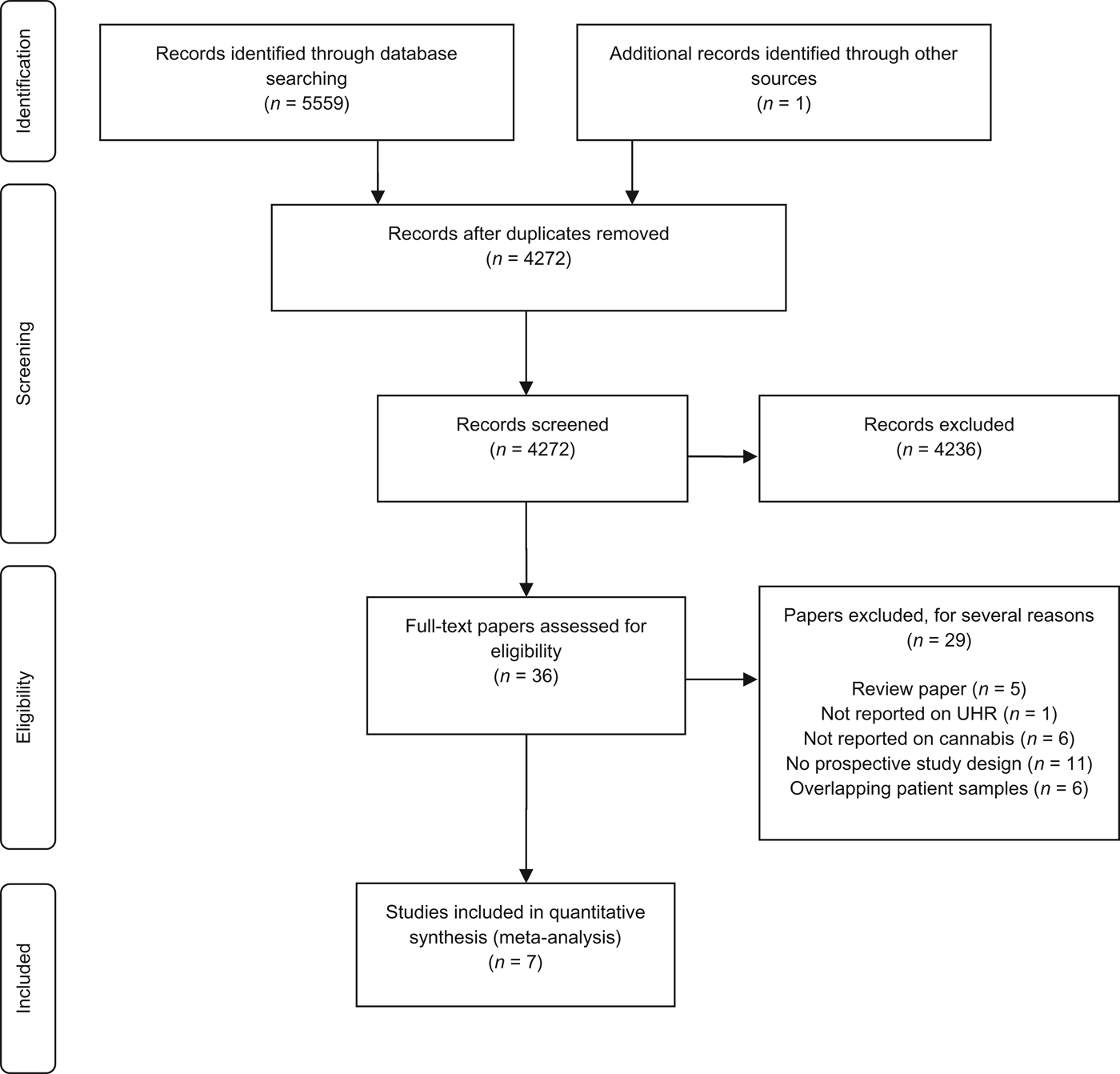
The search resulted in 5559 potentially relevant articles. One study was added after manual searches in PubMed (Dragt et al. Reference Dragt, Nieman, Veltman, Becker, van de Fliert, de Haan and Linszen2011). First, articles were screened on title. Second, abstracts were scrutinized on relevance. Third, a final screening of the full text was conducted. Eligibility was independently assessed by two researchers (K.Z. and T.K). In case of disagreement, a third researcher (M.vd.G) was consulted.
Data extraction (Fig. 1)
Flowchart of selected studies. UHR, Ultra high risk.

Articles were considered eligible if they:
-
(a) included data on individuals meeting UHR criteria as defined by the Comprehensive Assessment of the At-Risk Mental State (Yung et al. Reference Yung, Yuen, McGorry, Phillips, Kelly, Dell'Olio, Francey, Cosgrave, Killackey and Stanford2005), or the Structured Interview for Prodromal Syndromes (T McGlashan et al. unpublished observations), or the Schizophrenia Proneness Instrument, Adult Version (Schultze-Lutter et al. Reference Schultze-Lutter, Addington, Ruhrmann and Klosterkötter2007), or the Schizophrenia Proneness Instrument, Child and Youth Version (Schultze-Lutter et al. Reference Schultze-Lutter, Marshall and Koch2012) or the Basel Screening Instrument for Psychosis (Riecher-Rössler et al. Reference Riecher-Rössler, Aston, Ventura, Merlo, Borgwardt, Gschwandtner and Stieglitz2008)
-
(b) reported on the effect of cannabis use on transition to psychosis. Lifetime cannabis use was defined as having used cannabis at least once previously or recently but not severe enough to meet criteria for DSM-IV abuse or dependence disorder. Current cannabis abuse or dependence was defined according to DSM-IV criteria for cannabis abuse or dependence disorder (within the previous 12 months)
-
(c) made use of prospective designs
-
(d) were published in English.
Articles were excluded when cannabis use was not assessed separately from overall substance use, leaving a total of 12 publications. If publications reported findings from overlapping study samples, the study with the largest sample size was selected for the meta-analysis. For example, of the four studies from the North American Prodrome Longitudinal Study (Addington et al. Reference Addington, Cadenhead, Cannon, Cornblatt, McGlashan, Perkins, Seidman, Tsuang, Walker and Woods2007), the largest cohort (Auther et al. Reference Auther, Cadenhead, Carrión, Addington, Bearden, Cannon, McGlashan, Perkins, Seidman, Tsuang, Walker, Woods and Cornblatt2015) was selected instead of two previous reports (Kristensen & Cadenhead, Reference Kristensen and Cadenhead2007; Cannon et al. Reference Cannon, Cadenhead, Cornblatt, Woods, Addington, Walker, Seidman, Perkins, Tsuang and McGlashan2008). In addition, the cohort of Auther et al. (Reference Auther, Cadenhead, Carrión, Addington, Bearden, Cannon, McGlashan, Perkins, Seidman, Tsuang, Walker, Woods and Cornblatt2015) was selected over Buchy et al. (Reference Buchy, Cadenhead, Cannon, Cornblatt, McGlashan, Perkins, Seidman, Tsuang, Walker and Woods2015) because of the more extensive statistical analysis that was used in the first study. Last, the Dutch Prediction of Psychosis Study (DUPS) was part of the larger European Prediction of Psychosis Study (EPOS) cohort, and we therefore selected the study reporting on the larger EPOS cohort (Dragt et al. Reference Dragt, Nieman, Schultze-Lutter, Van Der Meer, Becker, De Haan, Dingemans, Birchwood, Patterson and Salokangas2012) instead of the three papers that reported on the DUPS cohort (Dragt et al. Reference Dragt, Nieman, Becker, van de Fliert, Dingemans, de Haan, van Amelsvoort and Linszen2010, Reference Dragt, Nieman, Veltman, Becker, van de Fliert, de Haan and Linszen2011; Korver et al. Reference Korver, Nieman, Becker, van de Fliert, Dingemans, de Haan, Spiering, Schmitz and Linszen2010).
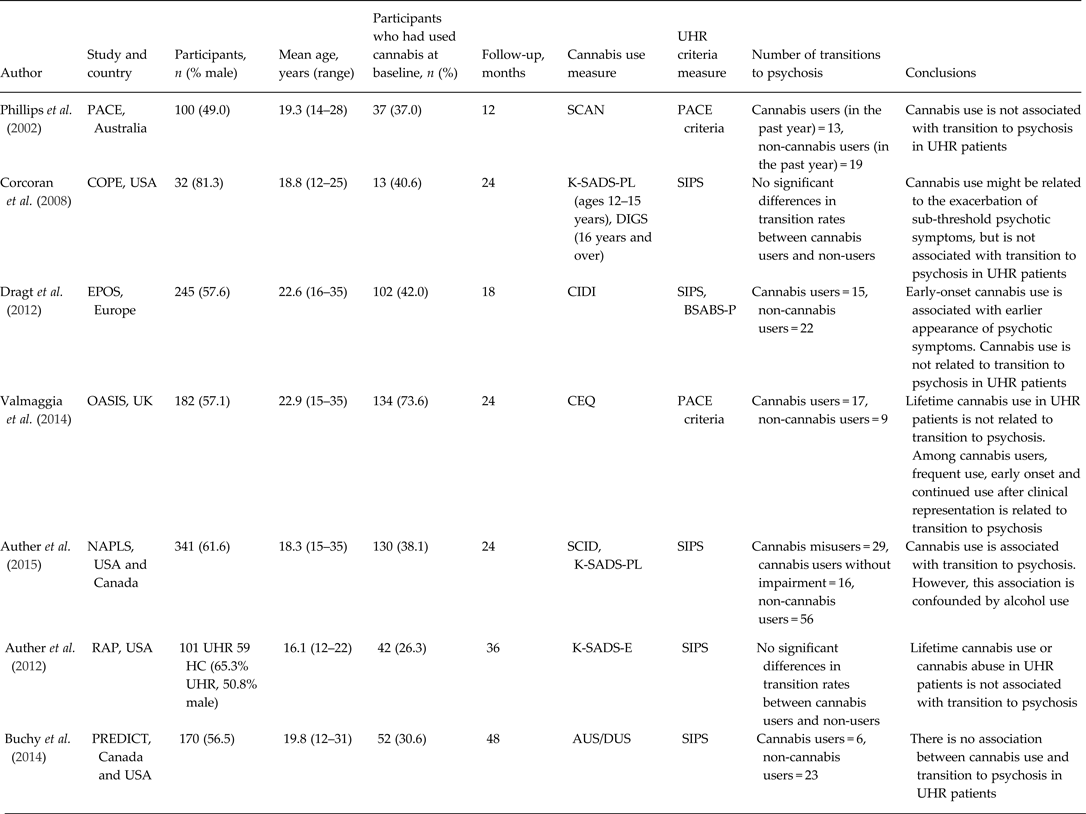
After exclusion of studies with overlapping cohorts, seven publications were left including data of 1171 UHR patients, which were used for the quantitative syntheses (see Table 1 for characteristics of the studies). Additional data were requested and have been provided by Dr A. Auther and Dr L. Buchy.
Overview of studies on cannabis use in UHR subjects

UHR, Ultra-high risk; PACE, Personal Assessment and Crisis Evaluation; SCAN, Schedules for Clinical Assessment in Neuropsychiatry; COPE, Center of Prevention and Evaluation; K-SADS-PL, Kiddie Schedule for Affective Disorders and Schizophrenia for School-Age Children-Present And Lifetime Version; DIGS, Diagnostic interview for genetic studies; SIPS, Structured Interview for Prodromal Syndromes; EPOS, European Prediction of Psychosis Study; CIDI, Composite International Diagnostic Interview; BSABS-P, Bonn Scale for the Assessment of Basic Symptoms – Prediction List; OASIS, Outreach and Support in South London; CEQ, Cannabis Experiences Questionnaire; NAPLS, North American Prodrome Longitudinal Study; SCID, Structured Clinical Interview for DSM; RAP, Recognition and Prevention Program; HC, healthy controls; K-SADS-E, Kiddie Schedule for Affective Disorders and Schizophrenia for School-Age Children-Epidemiological Version; PREDICT, Enhancing the Prospective Prediction of Psychosis Study; AUS/DUS, Alcohol and Drug Use Scale.
Data analysis
We conducted two random-effects meta-analyses with Comprehensive Meta-Analysis (CMA; version 1.0.25; Biostat, USA). The first meta-analysis examined differences in transition rates between UHR individuals with lifetime cannabis use compared with those who had never used cannabis. The second meta-analysis compared transition rates between UHR individuals with cannabis abuse or dependence compared with lifetime cannabis users and non-users.
Heterogeneity of study designs and protocols was tested by χ 2, reporting the I 2 statistic. I 2 could be 0%, 25%, 50% or 75%, indicating no, low, moderate or high heterogeneity (Higgins et al. Reference Higgins, Thompson, Deeks and Altman2003).
Publication bias is the result of selective publishing, i.e. small studies with positive outcomes are more often published than studies with negative outcomes. Publication bias of positive outcome studies was corrected using Duval and Tweedie's trim-and-fill procedure (Duval & Tweedie, Reference Duval and Tweedie2000a , Reference Duval and Tweedie b ), which generates an estimated pooled effect size after the potential influence of publication bias is adjusted for.
Results
Effect of lifetime cannabis use on transition to psychosis
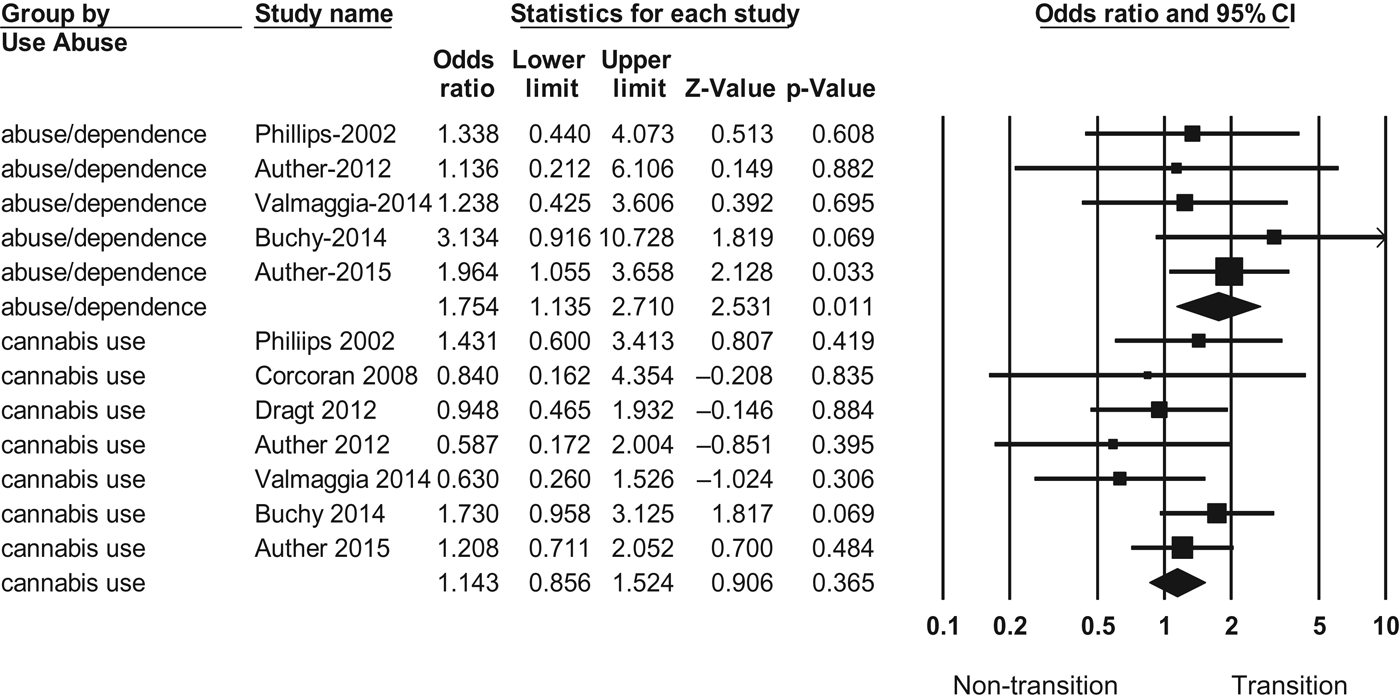
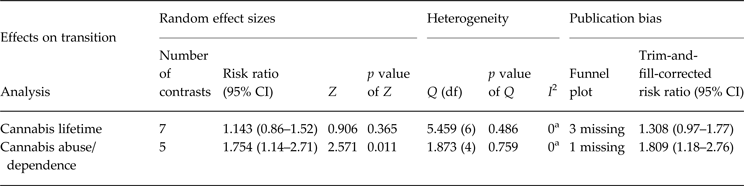
Seven studies reported on lifetime cannabis use and were used for the first meta-analysis examining the relationship between lifetime cannabis use and transition to psychosis in UHR individuals (Phillips et al. Reference Phillips, Curry, Yung, Yuen, Adlard and McGorry2002; Corcoran et al. Reference Corcoran, Kimhy, Stanford, Khan, Walsh, Thompson, Schobel, Harkavy-Friedman, Goetz and Colibazzi2008; Auther et al. Reference Auther, McLaughlin, Carrión, Nagachandran, Correll and Cornblatt2012, Reference Auther, Cadenhead, Carrión, Addington, Bearden, Cannon, McGlashan, Perkins, Seidman, Tsuang, Walker, Woods and Cornblatt2015; Dragt et al. Reference Dragt, Nieman, Schultze-Lutter, Van Der Meer, Becker, De Haan, Dingemans, Birchwood, Patterson and Salokangas2012; Buchy et al. Reference Buchy, Perkins, Woods, Liu and Addington2014; Valmaggia et al. Reference Valmaggia, Day, Jones, Bissoli, Pugh, Hall, Bhattacharyya, Howes, Stone and Fusar-Poli2014). Overall, cannabis use was not significantly associated with an increased risk of transition to psychosis with an odds ratio (OR) of 1.14 [95% confidence interval (CI) 0.856–1.524, p = 0.37, see Fig. 2]. The Q test and I 2 indicated that the study design and protocol of the included studies were not heterogeneous (see Table 2). Although Egger's regression test was not significant (p = 0.16), there was an indication of publication bias in the funnel plot (three studies missing). A trim-and-fill procedure showed a slightly higher OR of 1.31, but this remained statistically insignificant (see Table 2).
Overview of studies that investigated cannabis use and transition to psychosis. CI, Confidence interval.

Random effect sizes, heterogeneity and publication bias in the main and sensitivity analyses

CI, Confidence interval; Q, value for heterogeneity tested by χ 2; df, degrees of freedom; I 2, degree of heterogeneity.
a No heterogeneity.
Effect of current cannabis abuse or dependence on transition to psychosis
Of the seven studies included in the first meta-analysis, five studies determined cannabis abuse or dependence according to DSM-IV criteria. These five studies were examined separately in a second meta-analysis in which we investigated whether current cannabis abuse or dependence was associated with an increased risk of transition to psychosis in UHR individuals (Phillips et al. Reference Phillips, Curry, Yung, Yuen, Adlard and McGorry2002; Auther et al. Reference Auther, McLaughlin, Carrión, Nagachandran, Correll and Cornblatt2012, Reference Auther, Cadenhead, Carrión, Addington, Bearden, Cannon, McGlashan, Perkins, Seidman, Tsuang, Walker, Woods and Cornblatt2015; Buchy et al. Reference Buchy, Perkins, Woods, Liu and Addington2014; Valmaggia et al. Reference Valmaggia, Day, Jones, Bissoli, Pugh, Hall, Bhattacharyya, Howes, Stone and Fusar-Poli2014). The results showed that current cannabis abuse or dependence was significantly associated with psychosis risk with an OR 1.75 (95% CI 1.135–2.710, p = 0.01). Our results showed no indication of heterogeneity: the Q test was not significant and I 2 = 0 (see Table 2). Egger's regression test was far from significant (p = 0.58), but the funnel plot showed that one study was missing. A trim-and-fill procedure slightly increased the OR to 1.81 (see Table 2).
Discussion
In the present study we investigated the literature on the role of lifetime cannabis use on transition to psychosis in UHR populations. More specifically, we examined whether meeting DSM-IV criteria for current cannabis abuse or dependence was associated with an increased risk of transition. Our results suggest that current cannabis abuse or dependence, but not lifetime use, is associated with an increased risk of transitioning to a first episode of psychosis.
Effect of cannabis use on transition to a first episode of psychosis
Lifetime cannabis use was not predictive of transition to psychosis. This finding is in contrast to studies in the general population, in which associations between cannabis use and psychotic symptoms have been established (Van Os et al. Reference Van Os, Bak, Hanssen, Bijl, De Graaf and Verdoux2002; Casadio et al. Reference Casadio, Fernandes, Murray and Di Forti2011). The lack of an association between lifetime cannabis use and psychosis could be explained by the fact that the association is too weak to detect (Addington et al. Reference Addington, Case, Saleem, Auther, Cornblatt and Cadenhead2014). For instance, the definition of lifetime cannabis use (having used cannabis at least once) may have resulted in a group of subjects in which dose and impact of cannabis use is that minimal that its influence on transition is negligible. It might also be that lifetime cannabis use is associated with attenuated positive symptoms or UHR status, but not with transition to psychosis, although this was not investigated in the present study. In examining current cannabis abuse or dependence, the association between cannabis use and psychosis did become apparent. A possible explanation for our findings may be that because lifetime use was defined as previous or current cannabis use, the group of lifetime users might have resulted in mainly previous cannabis users. Subjects in the group of cannabis abuse or dependence were all currently using cannabis, which might explain the increased effect of current cannabis abuse or dependence on transition to psychosis.
Our results suggest that there might be a dose–response relationship between cannabis use and transition to psychosis, since our findings show that current cannabis abuse or dependence, but not lifetime cannabis use, is associated with an increased risk of psychosis. Our results are supported by findings from studies in the general population (Van Os et al. Reference Van Os, Bak, Hanssen, Bijl, De Graaf and Verdoux2002; Smit et al. Reference Smit, Bolier and Cuijpers2004; Moore et al. Reference Moore, Zammit, Lingford-Hughes, Barnes, Jones, Burke and Lewis2007) and psychosis samples (Zammit et al. Reference Zammit, Allebeck, Andreasson, Lundberg and Lewis2002; Arseneault et al. Reference Arseneault, Cannon, Witton and Murray2004; Di Forti et al. Reference Di Forti, Sallis, Allegri, Trotta, Ferraro, Stilo, Marconi, La Cascia, Marques and Pariante2014), in which dose–response relationships between cannabis use and psychosis have already been demonstrated. In these studies, type of cannabis (skunk or high potency) and frequency of cannabis use were in particular associated with an increased risk of psychosis (Di Forti et al. Reference Di Forti, Marconi, Carra, Fraietta, Trotta, Bonomo, Bianconi, Gardner-Sood, O'Connor and Russo2015). However, in the UHR studies that we included, the findings concerning frequency of cannabis use and the risk of transition to psychosis are inconsistent. For instance, while Phillips et al. (Reference Phillips, Curry, Yung, Yuen, Adlard and McGorry2002) reported that there was no difference in frequency of cannabis use in relation to transition to psychosis, Valmaggia et al. (Reference Valmaggia, Day, Jones, Bissoli, Pugh, Hall, Bhattacharyya, Howes, Stone and Fusar-Poli2014) reported that frequent use and early onset of cannabis use were associated with an increased risk of transition to psychosis. Therefore, it is important to further investigate this relationship in future UHR research.
Our meta-analytical results should be interpreted cautiously because the OR of 1.75 was moderate and based on a limited number of studies. However, our results correspond with previous research. For instance, in the general population an OR of 1.4 was found for individuals who had ever used cannabis and the onset of psychosis, and an OR of 2.1 for individuals who used cannabis most frequently (Moore et al. Reference Moore, Zammit, Lingford-Hughes, Barnes, Jones, Burke and Lewis2007), which is further supportive for a dose–response relationship. Our slightly lower OR compared with the OR for frequent cannabis use might be due to the fact that a large proportion of the UHR individuals in our meta-analysis may have received some form of therapeutic intervention for their attenuated psychotic symptoms. A therapeutic intervention aimed at the prevention of psychosis may have resulted in lower transition rates (Stafford et al. Reference Stafford, Jackson, Mayo-Wilson, Morrison and Kendall2013; van der Gaag et al. Reference van der Gaag, Smit, Bechdolf, French, Linszen, Yung, McGorry and Cuijpers2013), which subsequently might have affected the possibility to detect an effect of cannabis use on psychosis.
While the dose–response relationship hypothesis is supported by general population and psychosis studies (Van Os et al. Reference Van Os, Bak, Hanssen, Bijl, De Graaf and Verdoux2002; Arseneault et al. Reference Arseneault, Cannon, Witton and Murray2004; Smit et al. Reference Smit, Bolier and Cuijpers2004; Moore et al. Reference Moore, Zammit, Lingford-Hughes, Barnes, Jones, Burke and Lewis2007), our results may also suggest that there might be an underlying vulnerability for developing general psychopathology, that could result in both psychosis and cannabis abuse or dependence disorder. For instance, there are several factors that are linked to both an increased risk of psychotic disorder and cannabis abuse disorder, such as low socio-economic status (von Sydow et al. Reference von Sydow, Lieb, Pfister, Höfler and Wittchen2002; Kirkbride et al. Reference Kirkbride, Barker, Cowden, Stamps, Yang, Jones and Coid2008) or traumatic life experiences (Sinha, Reference Sinha2008; Addington et al. Reference Addington, Stowkowy, Cadenhead, Cornblatt, McGlashan, Perkins, Seidman, Tsuang, Walker and Woods2013; Thompson et al. Reference Thompson, Nelson, Yuen, Lin, Amminger, McGorry, Wood and Yung2014). Thus, it remains unclear whether cannabis use directly affects the development of psychosis, or whether cannabis use and psychosis are both expressions of other underlying (adverse) environmental factors.
Another explanation for the association between cannabis and psychosis is the ‘self-medication hypothesis’. This theory states that UHR individuals use cannabis in an attempt to cope with their (attenuated) psychotic symptoms (Hall & Degenhardt, Reference Hall and Degenhardt2000), although more recent studies have contradicted this theory (Smit et al. Reference Smit, Bolier and Cuijpers2004; Valmaggia et al. Reference Valmaggia, Day, Jones, Bissoli, Pugh, Hall, Bhattacharyya, Howes, Stone and Fusar-Poli2014). For instance, one study reported that the main reason for termination of cannabis use was the adverse effects of cannabis use on attenuated psychotic symptoms (Valmaggia et al. Reference Valmaggia, Day, Jones, Bissoli, Pugh, Hall, Bhattacharyya, Howes, Stone and Fusar-Poli2014), making it unlikely that UHR subjects use cannabis in order to cope with their symptoms.
Overall, our results indicate that it is important to examine dose, frequency and amount of cannabis use and to distinguish between lifetime cannabis use and cannabis abuse or dependence in UHR subjects. In UHR studies to date, subjects who use cannabis on a frequent basis are sometimes excluded (Auther et al. Reference Auther, Cadenhead, Carrión, Addington, Bearden, Cannon, McGlashan, Perkins, Seidman, Tsuang, Walker, Woods and Cornblatt2015), while our results indicate that the most frequent cannabis-using population might be the group with highest psychosis risk. Although future studies should aim to further elucidate the (direction of the) association between cannabis use and psychosis, our results emphasize the need for targeted treatment interventions aiming to minimize or reduce cannabis use in this vulnerable population.
Limitations and strengths
Our meta-analytic findings must be interpreted in the light of several limitations. The first methodological issue is that the present study did not control for potentially confounding factors, known to be associated with both cannabis use and transition to psychosis. For instance, potential factors such as alcohol use, other drug use, tobacco or age of onset of cannabis use were not taken into account in our meta-analyses because these data had only limited availability (Valmaggia et al. Reference Valmaggia, Day, Jones, Bissoli, Pugh, Hall, Bhattacharyya, Howes, Stone and Fusar-Poli2014; Auther et al. Reference Auther, Cadenhead, Carrión, Addington, Bearden, Cannon, McGlashan, Perkins, Seidman, Tsuang, Walker, Woods and Cornblatt2015). Of the studies that examined confounding factors, the study of Corcoran et al. (Reference Corcoran, Kimhy, Stanford, Khan, Walsh, Thompson, Schobel, Harkavy-Friedman, Goetz and Colibazzi2008) found that the association between cannabis use and psychosis was not affected by alcohol use, other drug use and medication (Corcoran et al. Reference Corcoran, Kimhy, Stanford, Khan, Walsh, Thompson, Schobel, Harkavy-Friedman, Goetz and Colibazzi2008). However, Auther et al. (Reference Auther, Cadenhead, Carrión, Addington, Bearden, Cannon, McGlashan, Perkins, Seidman, Tsuang, Walker, Woods and Cornblatt2015) found that the relationship between cannabis use and transition to psychosis was weakened by alcohol use. Therefore, it is important to take these potentially confounding factors into account in future research. A second methodological issue is that no information on dose and type of cannabis was available. This is a limitation, because the risk of conversion to psychosis may vary with the level of tetrahydrocannabinol in cannabis (Di Forti et al. Reference Di Forti, Marconi, Carra, Fraietta, Trotta, Bonomo, Bianconi, Gardner-Sood, O'Connor and Russo2015) and information on dose and type of cannabis may contribute to establishing dose–response relationships between cannabis use and psychosis. A third limitation of the present study is that most studies included in the meta-analysis did not assess continued use of cannabis during the follow-up period, which could influence the risk of conversion to psychosis (Valmaggia et al. Reference Valmaggia, Day, Jones, Bissoli, Pugh, Hall, Bhattacharyya, Howes, Stone and Fusar-Poli2014). A fourth limitation was that our meta-analysis yielded some indication of publication bias.
Despite these limitations, the current study assembled all studies on the relationship between cannabis use and transition to psychosis and conducted the most extensive quantitative synthesis of the existing literature to date. Examining the exact dose of cannabis use is warranted for future research.
In conclusion, our results show that current cannabis abuse or dependence is associated with an increased risk of psychosis. Our results suggest that there is a dose–response relationship between cannabis use and transition to psychosis. However, our results may also indicate that cannabis use and psychosis are both expressions of other underlying (adverse) environmental factors such as low socio-economic status or traumatic life experiences. Future studies should incorporate these factors to elucidate the direction of the effect. Overall, our results indicate the need to focus on cannabis abuse or dependence in the treatment of UHR individuals.
Acknowledgements
The present study was supported by the European Union [European Community's Seventh Framework Program; grant agreement no. HEALTH-F2-2009-241909 (project EU-GEI)].
Declaration of Interest
None.