Research has demonstrated that the difficulties in phonological processing represent the core problems of individuals with developmental dyslexia in alphabetic languages (e.g., Bradley & Bryant, Reference Bradley and Bryant1978; Hulme & Snowling, Reference Hulme, Snowling, Singh and Beale1992; Olson, Rack, & Forsberg, Reference Olson, Rack and Forsberg1990; Shankweiler, Liberman, Mark, Fowler, & Fischer, Reference Shankweiler, Liberman, Mark, Fowler and Fischer1979). Although phonological awareness has also been associated with the reading development of Chinese children (e.g., Chen et al., Reference Chen, Anderson, Li, Hao, Wu and Shu2004; Ho & Bryant, Reference Ho and Bryant1997a; Siok & Fletcher, Reference Siok and Fletcher2001), the most dominant type of cognitive deficits of Chinese dyslexic readers is not phonological awareness but morphological awareness, rapid naming, and visual–orthographic processing (Chung, Ho, Chan, Tsang, & Lee, Reference Chung, Ho, Chan, Tsang and Lee2011; Ho, Chan, Lee, Tsang, & Luan, Reference Ho, Chan, Lee, Tsang and Luan2004; Ho, Chan, Tsang, & Lee, Reference Ho, Chan, Tsang and Lee2002a; McBride-Chang, Wagner, Muse, Chow, & Shu, Reference McBride-Chang, Chow, Zhong, Burgess and Hayward2005; Shu, McBride-Chang, Wu, & Liu, Reference Shu, McBride-Chang, Wu and Liu2006). The unique characteristics of Chinese script may contribute to these research findings. Chinese is a morphosyllabic system (DeFrancis, Reference DeFrancis1989; Leong, Reference Leong and Downing1973; Mattingly, Reference Mattingly, Kavanagh and Mattingly1972). Each basic character is associated with a morpheme (meaning unit) and represents a spoken syllable. Whereas the number of spoken syllables is limited in Chinese, these syllables are associated with a larger number of regularly used characters of different meanings. For example, in Cantonese, a syllable /seoi/ can have 6 tones, which represent different meanings: /seoi1/ 需 (need), /seoi2/ 水 (water), /seoi3/ 歲 (age), /seoi4/ 誰 (who), /seoi5/ 絮 (cotton), and /seoi6/ 睡 (sleep). There are around 1,700 tonal syllables that are mapped onto 4,500 commonly used Chinese characters (Liu, Chuang, & Wang, Reference Liu, Chuang and Wang1975; Qian, Lee, & Soong, Reference Qian, Lee and Soong2004), making the ability to distinguish homophones particularly important in reading Chinese (e.g., McBride-Chang, Chow, Zhong, Burgess, & Hayward, Reference McBride-Chang, Wagner, Muse, Chow and Shu2005; McBride-Chang, Shu, Zhou, Wat, & Wagner, Reference McBride-Chang, Shu, Zhou, Wat and Wagner2003; Shu et al., Reference Shu, McBride-Chang, Wu and Liu2006).
In addition to the relatively large number of homophones, the visual–orthographic structure of the Chinese script is also distinct from alphabetic languages. Each Chinese character is composed of strokes arranged in accordance with a set of conventional rules. For instance, similar stroke patterns such as 士 /si6/ (soldier), 土 /tou2/ (soil), 上 /soeng5/ (up), and 工 /gung1/ (work) have different sounds and represent distinct meanings. There is some evidence suggesting that visual–orthographic skill is important for individuals to read Chinese (e.g., Ho & Bryant, Reference Ho and Bryant1997b; Huang & Hanley, Reference Huang and Hanley1997; McBride-Chang, Wagner, et al., Reference McBride-Chang, Wagner, Muse, Chow and Shu2005). Training in morphological skills such as, through extensive games and exercises on combining different morphemes to form different Chinese compound words, was found to be effective for enhancing Chinese children's reading performance (Chow, McBride-Chang, Cheung, & Chow, Reference Chow, McBride-Chang, Cheung and Chow2008). Explicit instructions that reminded learners of the radical structures also enhanced the memorization of Chinese characters (Ho, Wong, & Chan, Reference Ho, Wong and Chan1999; Taft & Chung, Reference Taft and Chung1999; Wang, Liu, & Perfetti, Reference Wang, Liu and Perfetti2004).
The importance of early intervention for dyslexia has underscored the need for reliable and valid screening instruments. In one of the Chinese communities, Hong Kong, the incidence rate of dyslexia was less than 1%, which was much lower than would be expected from figures reported around the world (see Ho, Chan, Tsang, & Lee, Reference Ho, Chan, Tsang and Lee2000a; Salter & Smythe, Reference Salter and Smythe1997). One probable reason for this low incidence is the lack of appropriate instruments for the identification of dyslexic cases. Since 2000, the Hong Kong Tests of Specific Learning Difficulties in Reading and Writing for primary school students Ho et al., Reference Ho, Chan, Tsang and Lee2000a) and for junior secondary school students (HKT-JS; Chung, Ho, Chan, Tsang, & Lee, Reference Chung, Ho, Chan, Tsang and Lee2007) were developed to serve the purpose of identifying dyslexic individuals. The development of these instruments was based on research studies conducted with Chinese dyslexic individuals. These studies showed that Chinese dyslexic individuals were weak at multiple cognitive areas, including visual–orthographic skills, rapid naming, morphological awareness, verbal memory, and phonological awareness, with the first three being their major difficulties (Chung et al., Reference Chung, Ho, Chan, Tsang and Lee2011; Ho et al., Reference Ho, Chan, Tsang and Lee2002a, Reference Ho, Chan, Lee, Tsang and Luan2004; Shu et al., Reference Shu, McBride-Chang, Wu and Liu2006). Because doing comprehensive assessments on each of these areas with every child is not cost effective, using checklists based on students’ overt behavior associated with dyslexia could be a more efficient alternative for initial screening. The Hong Kong Specific Learning Difficulties Behavior Checklist for Primary School Pupils is a screening tool for teachers to identify primary school pupils at risk for dyslexia (Chan, Tsang, & Lee, Reference Chan and Ho2002b; Ho, Chan, Tsang, & Lee, Reference Ho, Chan, Tsang and Lee2000b). While Chan, Ho, Tsang, Lee, and Chung (Reference Chan, Ho, Tsang, Lee and Chung2004) found 10 behavioral characteristics that could distinguish children with dyslexia from those without dyslexia, ratings on children's social/emotional behavior failed to differentiate their dyslexic status. There is evidence suggesting that the behavioral differences in the emotional and social areas between individuals with and without dyslexia may assume greater importance when they become adolescents (Benasich, Curtiss, & Tallal, Reference Benasich, Curtiss and Tallal1993; Chan & Ho, Reference Chan and Ho2002; McConaughy & Ritter, Reference McConaughy and Ritter1985). The Hong Kong Behavior Checklist of Specific Learning Difficulties in Reading and Writing for Junior Secondary School Students (BCL-JS) was published recently to help teachers identify young adolescents at risk for dyslexia (Ho et al., Reference Ho, Lo, Chan, Chung, Tsang and Lee2009). The purpose of this study was to (a) confirm the reliability and validity of the BCL-JS, (b) explore the relationships between the reading-related behavioral characteristics assessed by the checklist and the profiles of literacy and cognitive skills measured by the HKT-JS in Hong Kong Chinese young adolescents, and (c) investigate whether behavioral characteristics measured by the BCL-JS could differentiate adolescents with dyslexia from those without dyslexia.
THE USE OF BEHAVIOR CHECKLISTS
Neurological and cognitive deficits of an individual manifested at the behavioral level collectively as signs or patterns might suggest whether he or she is at risk for dyslexia. Researchers and practitioners consider it useful to construct a checklist as a guideline to observe and identify individuals with dyslexia. Screening has been widely used in the field of medicine as well as education (Glascoe, Martin, & Humphrey, Reference Glascoe, Martin and Humphrey1990; Lichtenstein & Ireton, Reference Lichtenstein and Ireton1984). A two-stage assessment process is recommended, including an initial screening and a follow-up comprehensive evaluation (Ho, Reference Ho and Bond2010). The purpose of the initial screening stage is to designate individuals who are most likely to have problems, and an extensive follow-up assessment will serve to confirm their needs for special services and to make appropriate recommendations.
Over the years, considerable evidence has been amassed for the effectiveness of the use of behavioral checklists to assess children's likelihood of acquiring diverse types of disorders (see Mash & Wolfe, Reference Mash and Wolfe2002; Wagner, Reference Wagner2003). The majority of these behavior checklists are rating scales that are global or broad spectrum in nature. These scales require parents and teachers to indicate the presence of some general behaviors or the frequency and intensity of these behaviors of the children (Mash & Terdal, Reference Mash and Terdal1997). An example of these comprehensive measures is the Achenbach System of Empirically Based Assessment, which includes the Child Behavior Checklist and the Teacher's Report Form (see Achenbach & Rescorla, Reference Achenbach and Rescorla2001a, Reference Achenbach and Rescorla2001b), and the Behavior Assessment System for Children, which includes Parent Rating Scales and Teacher Rating Scales (see Reynolds & Kamphaus, Reference Reynolds and Kamphaus1992).
Apart from these global behavior checklists, some others have been created specifically to identify children with learning difficulties. Whereas broadband instruments, for example, the Myklebust Pupil Rating Scale (see Margolis, Sheridan, & Lemanowicz, Reference Margolis, Sheridan and Lemanowicz1981) and the Windward Rating Scale (see Hamada & Tomikawa, Reference Hamada and Tomikawa1986), were available for screening students with learning difficulties, only a limited number of screening tools designed specifically for dyslexia have been developed on the basis of reading-related behavioral characteristics. A notable example is the Dyslexia Screening Instrument (Coon, Waguespack, & Polk, Reference Coon, Waguespack and Polk1994), which consists of 33 statements aimed at identifying students who display behavior significantly associated with reading, spelling, writing, or language processing difficulties. Although behavioral rating scales offer many benefits to the assessment process including administration convenience and the possibility of getting a large pool of normative data to establish developmental deviance (Shelton & Barkley, Reference Shelton and Barkley1994), there is still a lack of early screening tools available for dyslexia, which calls for an empirical investigation into this issue.
BEHAVIOR CHECKLISTS FOR SCREENING DYSLEXIA IN CHINESE
Despite the clear value of early identification for dyslexia, viable identification tools in Chinese have not been available until recently in Hong Kong. Suspected cases of dyslexia were referred to government educational psychologists for formal assessment and special services provision. In earlier years, the assessment of dyslexia was chiefly based on individuals’ performance on a full IQ test; general tests assembled to assess word copying, word matching, and word reading; and the Bender–Gestalt Test (Bender, Reference Bender1946). Educational psychologist would refer to individuals’ performance on these tests, coupled with additional information from educational history, sample scripts of homework, dictation, and free writing, to determine whether one should be classified as dyslexic. In recent years, the procedures and criteria of identification have been modified with the development of the Hong Kong Tests of Specific Learning Difficulties in Reading and Writing for primary school students and the HKT-JS. These instruments facilitate professionals to perform comprehensive assessments for Cantonese-speaking children and young adolescents on multiple areas, including literacy skills and cognitive deficits in phonological skills, rapid naming, and orthographic knowledge (Ho et al., Reference Ho, Chan, Tsang and Lee2002a).
Although more accurate case identifications on the basis of specific reading-related cognitive deficits are conducive to more appropriate interventions, the full diagnostic assessment is time consuming and financially prohibitive if all suspected cases are to be assessed comprehensively. Thus, a cost-effective and valid screening instrument for dyslexia that can be easily administered by teachers would constitute a momentous contribution to the armamentarium of assessment tools available to professionals in educational settings. The advantage of teacher ratings is that they are based on daily observations made in relatively standardized classrooms. Moreover, the ratings are formed by directly comparing children of the same developmental level. Hence, the Difficulties Behavior Checklist has been developed and empirically validated for teachers to perform initial screening of dyslexic cases among primary school pupils (Ho et al., Reference Ho, Chan, Tsang and Lee2000a; Ho, Chan, Tsang, & Lee, Reference Ho, Chan, Tsang and Lee2002b; Chan, Ho, Tsang, Lee, & Chung Reference Chan, Ho, Tsang, Lee and Chung2003, Reference Chan, Ho, Tsang, Lee and Chung2004, Reference Chan, Ho, Tsang, Lee and Chung2010). In their study, primary school teachers rated on the checklist the frequency of 65 reading-related behavioral characteristics of their students. They showed that 10 behavioral characteristics could differentiate children with dyslexia from those without dyslexia. These characteristics included general performance, reading, dictation, writing, mathematics, language, memory, concentration, sequential ability, and spatial orientation.
BCL-JS
In addition to developing a quick screening tool for primary school students, there is also a need to construct and validate one to help secondary school teachers identify young adolescents at risk for dyslexia and make corresponding remediation. Because notable physical and psychological changes emerge as children become adolescents, one should take developmental differences into consideration when designing a valid behavior checklist for screening young adolescents at risk for dyslexia.
Dyslexic individuals are at risk for failure not only academically but also socially and emotionally. These social and emotional difficulties may be exacerbated as children enter young adolescence. There is considerable evidence showing that the hardship in learning experienced by dyslexic individuals is associated with emotional, social, and behavioral problems in everyday life (for reviews, see Bender, Reference Bender1987; Gresham, Reference Gresham1982; Sabornie, Reference Sabornie1985). The frustration of prolonged failure on a range of academic subjects would result in feelings of anxiety and insecurity (Boetsch, Green, & Pennington, Reference Boetsch, Green and Pennington1996; Richman, Stevenson, & Graham, Reference Richman, Stevenson and Graham1982), which may in turn pose profound negative influence upon these individuals’ self-image (Burden, Reference Burden2005; Humphrey & Mullins, Reference Humphrey and Mullins2002; Undheim, Reference Undheim2003), emotions (Beitchman & Young, Reference Beitchman and Young1997; Boetsch et al., Reference Boetsch, Green and Pennington1996; Heiervang, Stevenson, Lund, & Hugdahl, Reference Heiervang, Stevenson, Lund and Hugdahl2001), as well as acceptance and adjustment among peers (Bender & Wall, Reference Bender and Wall1994; Hellendoorn & Ruijssenaars, Reference Hellendoorn and Ruijssenaars2000; LaGreca & Stone, Reference LaGreca and Stone1990). In dealing with problems, some dyslexic individuals may release their tensions through aggressive and antisocial behavior (McConaughty, Reference McConaughty1986; McKinney, Reference McKinney1989; McKinney & Feagans, Reference McKinney and Feagans1984; Sanson, Reference Sanson2006).
Empirical evidence showed that these emotional and social problems were more prevalent among adolescents than among children in general, even though they had no learning disabilities. Blyth, Simmons, and Bush (Reference Blyth, Simmons and Bush1978), for example, found that junior adolescents generally expressed lower self-esteem than their younger counterparts in upper elementary schools. In terms of social behavior, Simmons, Blyth, Van Cleave, and Bush (Reference Simmons, Blyth, Cleave and Bush1979) revealed a lack of social integration among early adolescents in middle and junior high schools, and they indicated a higher prevalence rate of victimization among students in middle high schools than those in upper elementary school grades.
Similar findings were obtained by Benasich et al. (Reference Benasich, Curtiss and Tallal1993), who examined children with language disorders. The researchers suggested that children would exhibit more observable behavioral and emotional problems as they matured. They indicated that almost one third of the language-impaired children scored in the clinically significant range on the Achenbach Child Behavior Checklist (Achenbach & Edelbrock, Reference Achenbach and Edelbrock1983) at age 8 as compared with 11% at age 4. McConaughty and Ritter (Reference McConaughy and Ritter1985) used the same Child Behavior Checklist (Achenbach & Edelbrock, Reference Achenbach and Edelbrock1983) to examine social competence and behavioral problems in learning disabled boys aged 6–16. They found that the older boys exhibited patterns of problematic behavior that were not evident in their younger counterparts. Chan and Ho (Reference Chan and Ho2002) also showed that Chinese adolescents with dyslexia (Primary 4-Form 1) displayed higher levels of emotional and behavioral difficulties than did dyslexic children (Primary 1-Primary 3). Using the Child Behavior Checklist (Achenbach, Reference Achenbach1991; Achenbach & Edelbrock, Reference Achenbach and Edelbrock1983), parents of dyslexic adolescents reported their children having higher scores on depression, withdrawal problems, social difficulties, externalizing problems, and aggressive behavior, in comparison to that reported by parents of younger dyslexic children (Chan & Ho, Reference Chan and Ho2002).
A recent study conducted by Chan et al. (Reference Chan, Ho, Tsang, Lee and Chung2004) showed that children's social/emotional behavior observed by teachers was not sensitive enough to differentiate children with dyslexia from those without dyslexia, consistent with past findings that children with and without learning disabilities could not be differentiated in terms of emotional characteristics (Jorm, Share, Matthews, & McLean, Reference Jorm, Share, Matthews and McLean1986). However, in light of the evidence suggesting that more emotional and social problems would surface as children entered early adolescence (Benasich et al, Reference Benasich, Curtiss and Tallal1993; Chan & Ho, Reference Chan and Ho2002; McConaughy & Ritter, Reference McConaughy and Ritter1985), teachers’ ratings on these social/emotional domains may be useful for predicting dyslexic status of young adolescents.
THE PRESENT STUDY
After a review of available behavior checklists (e.g., the Dyslexia Screening Instrument and the Hong Kong Specific Learning Difficulties Behavior Checklist for Primary School Pupils), relevant literature, and consultation with experienced frontline professionals in Hong Kong, we developed the 52-item BCL-JS. This research aimed to test the use of the checklist as a teacher screening tool for Chinese young adolescents with dyslexia. The objectives of this study were to (a) provide evidence to support the reliability and validity of the BCL-JS, (b) explore the relationships among the reading-related behavioral characteristics assessed by the checklist and the profiles of literacy and cognitive skills of the adolescents measured by the HKT-JS, and (c) investigate whether the BCL-JS could significantly predict adolescents’ dyslexic status.
METHOD
Participants and procedures
In this study, data were collected from teachers and students in 33 secondary schools in Hong Kong. The schools were selected on the basis of stratified random sampling and were representative of the secondary school distribution in Hong Kong. In the first phase of data collection, secondary school teachers of the Chinese language subject were asked to rate on the BCL-JS a group of students who were randomly selected in their class. Teachers could consult other teachers on the behaviors of specific students when they encountered problems in rating any items of the checklist. Students who had immigrated to Hong Kong from Mainland China less than 1 year before were excluded because they might speak various dialects and have received different levels and types of education before coming to Hong Kong. Teachers’ ratings on the reading-related behavioral characteristics of 947 students were obtained, of which 49.8% were boys and 50.2% were girls.
Due to resource constraint, not all 947 students were assessed in the second phase of data collection. On the basis of the ratings on the BCL-JS, students were divided into three groups (low score group, average score group, and high score group). Thirty students were randomly selected from each group for a second phase assessment with the HKT-JS, and their IQs were estimated by the vocabulary subtest of the Hong Kong Wechsler Intelligence Scale for Children (Psychological Corporation, 1981) in order to diagnose whether they had dyslexia. The reason for oversampling the students with low scores on the BCL-JS beyond the proportion of score distribution was to ensure that we would have a big enough sample of students potentially at risk with dyslexia for calculating the sensitivity and specificity indices and determining the cutoff point. Only students with average or above average intelligence were included in the second phase assessment. Teachers were also asked to report if the students had any disabilities (e.g., autism spectrum disorders or attention-deficit/hyperactivity disorder). The present sample did not include students with any comorbid conditions. The final sample consisted of 90 students who met the above criteria and completed all the assessment, including 48 boys and 42 girls aged between 11 and 15 years (M = 13.32 months, SD = 1.04).
Measures
The BCL-JS is a 52-item checklist of student reading-related behavioral characteristics that can be observed in classrooms by teachers. The initial design of the checklist covered sevem reading-related behavioral characteristics that include Chinese reading ability (9 items; e.g., “do not recognize common words”); Chinese writing ability, that is, the ability to write Chinese characters in appropriate ways, such as whether they put a stroke in the right place in the character (12 items; e.g., “make more spelling/writing errors for characters with more strokes than age peers”); Chinese composition ability, that is, the ability to use words to produce sentences, paragraphs, and passages (4 items; e.g., “the performance in composition is worse than that in verbal expression”); memory and organization ability (9 items; e.g., “easily forget things that have been learned); attention (3 items; e.g., “get distracted easily”); learning motivation (6 items; e.g., “do not try to learn new things”); and social/emotional adjustment (9 items; e.g., “have swinging mood”). Teachers indicated their observations of the frequencies of their students’ behavior on a 5-point scale ranging from 1 (never observed) to 5 (often observed).
The HKT-JS is a standardized test for diagnosis of Chinese adolescents with dyslexia. The norm was established with a representative sample of 709 adolescents aged from 11 years 7 months to 15 years 6 months recruited from high-, medium-, and low-ability schools of different districts in Hong Kong. There are 13 subtests in the HKT-JS: 5 literacy subtests (Chinese word reading, one minute reading, Chinese word dictation, ten minute reading, and reading comprehension), 2 rapid naming subtests (digit rapid naming and letter rapid naming), 2 morphological awareness subtests (morpheme discrimination and morpheme production), 2 phonological memory subtests (backward digit span and nonword repetition), and 2 orthographic knowledge subtests (Chinese characters matching and delayed copying). The development of this test was based on research studies conducted with Chinese dyslexic individuals. These studies showed that Chinese dyslexic individuals were weak at multiple cognitive areas, including visual–orthographic skills, rapid naming, morphological awareness, verbal memory, and phonological awareness, with the first three being their major difficulties (Chung et al., Reference Chung, Ho, Chan, Tsang and Lee2011; Ho et al., Reference Ho, Chan, Tsang and Lee2002a, Reference Ho, Chan, Lee, Tsang and Luan2004; Shu et al., Reference Shu, McBride-Chang, Wu and Liu2006).
The scores of the 13 subtests were combined to give five composite scores on the domains of literacy, rapid naming, morphological awareness, phonological memory, and orthographic knowledge. Students who scored 7 or below on three or more out of the five literacy measures plus on one or more of the cognitive skill domains were classified as dyslexic.
RESULTS
Dimensions of reading-related behavioral characteristics in BCL-JS
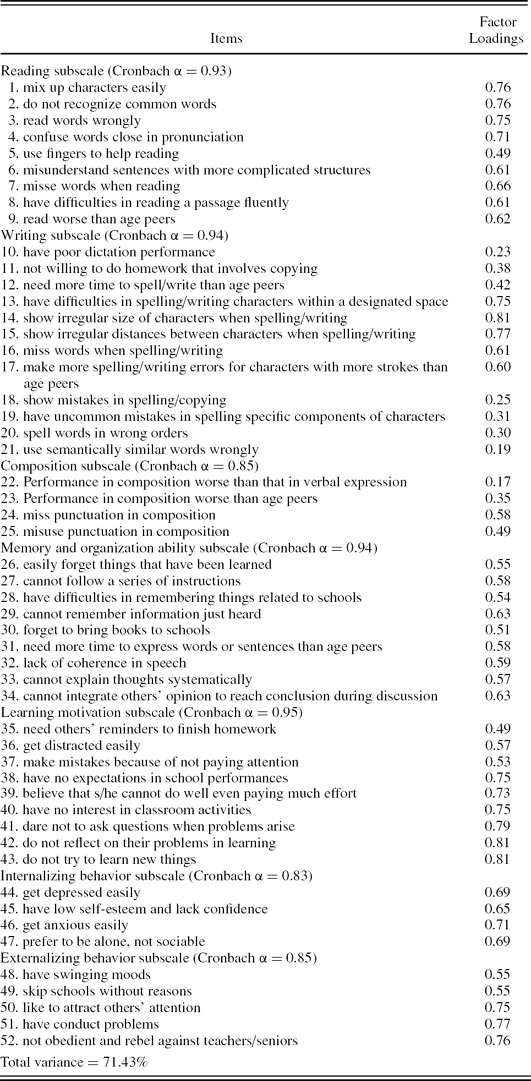
An exploratory factor analysis using principal-axis estimation with a varimax rotation was conducted to assess the underlying factor structure of the BCL-JS. An initial estimation yielded seven factors with eigen values exceeding 1, accounting for 71.43% of the total variance. The seven-factor solution was interpretable and was regarded as an adequate representation of the data to describe this sample of Chinese students. Table 1 presents the factor loadings of individual items of the scale. Names were chosen for all seven factors based on the content of the items that loaded on the same factor. The 9 items that comprised Factor 1, the reading subscale, represented behavior reflecting students’ reading abilities. Factor 2, the writing subscale, included 12 items related to students’ performance in writing domains. The 4 items that loaded on Factor 3, the composition subscale, reflected students’ proficiency in composition. Factor 4, the memory and organization ability subscale, included 9 items that described students’ ability to memorize and organize materials in their mind. Factor 5, the learning motivation subscale, included 9 items that assessed students’ motivation to learn. Factor 6 and Factor 7 were labeled as the internalizing behavior subscale (4 items) and the externalizing behavior subscale (5 items), respectively.
Factor loadings for the exploratory factor analysis (varimax rotation) of the Behavior Checklist of Specific Learning Difficulties in Reading and Writing for Junior Secondary School Students

Although the factor loadings of several items were relatively low, we would like to keep these items in the checklist. Students without dyslexia scored significantly higher than dyslexic students on every item in the checklist (with results described in the following sections). In other words, although some of the items have low factor loadings, all of them could significantly differentiate students with dyslexia from those without. Moreover, excluding them does not further strengthen the sensitivity of the checklist. Given that the most important function of a screening tool is its ability to identify at-risk students, we decided to keep these items in the checklist.
Internal consistency reliability
Scale internal consistency reliability was determined by calculating Cronbach coefficient alphas. The Cronbach α of the entire BCL-JS was 0.91. The internal consistency of each subscale was also assessed using Cronbach alpha, indicating a high reliability among all subscales (reading = 0.93, writing = 0.94, composition = 0.85, memory and organization ability = 0.94, learning motivation = 0.95, internalizing behavior = 0.83, and externalizing behavior = 0.85).
Classification of students as dyslexic/nondyslexic
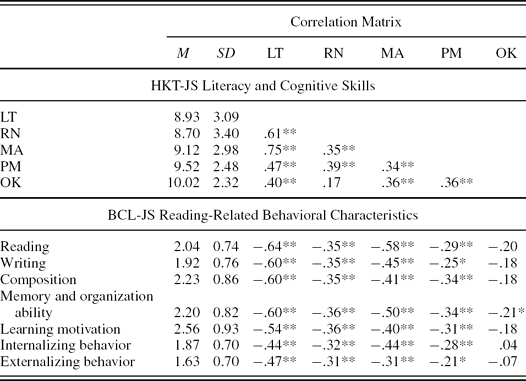
To examine the relationships between reading-related behavioral characteristics and literacy/cognitive skills, a correlation matrix was computed. Table 2 presents the pattern of correlations between the five composite scores of literacy/cognitive skills scored in the direction of positive abilities and the seven empirical scale scores of reading-related behavioral characteristics scored in the direction of problems or difficulties. The means and standard deviations of the seven scale scores of behavioral characteristics for the students are also included in the table. The correlation matrix indicated that all seven behavioral characteristics had significant negative correlations with literacy and all reading-related cognitive abilities (except orthographic knowledge), that is, rapid naming, phonological memory, and morphological awareness.
Means and standard deviations of composite scores on literacy and cognitive skills of young adolescents and their correlations with scales of reading-related behavioral characteristics (N = 90)
Note: The HKT-JS scores were standardized scores adjusted for age (M = 10, SD = 3). The maximum for each BCL-JS score was 5. HKT-JS, Hong Kong Test of Specific Learning Difficulties in Reading and Writing for Junior Secondary School Students; LT, literacy; RN, rapid naming; MA, morphological awareness; PM, phonological memory; OK, orthographic knowledge; BCL-JS, Behavior Checklist of Specific Learning Difficulties in Reading and Writing for Junior Secondary School Students.
*p < .05 (two tailed). **p < .001.
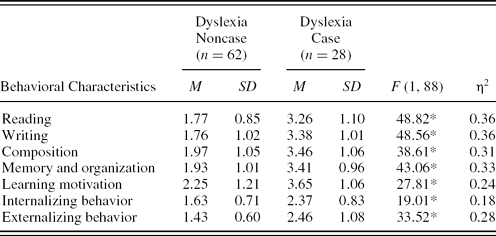
To investigate whether teachers’ ratings with the scale could effectively differentiate students with dyslexia from those without dyslexia as defined by test scores of the HKT-JS, we conducted a multivariate analysis of variance on the seven subscales’ scores of behavioral characteristics as dependent variables using the dyslexia case–noncase dichotomy as the grouping variable. The results showed significant differences for the seven scores of reading-related behavioral characteristics, Wilks λ = 0.58, F (7, 82) = 8.58, p < .001, η2 = 0.42. Follow-up univariate analyses of variance were then conducted on each of the seven empirical scale scores of reading-related behavioral characteristics to determine whether differences between adolescents with and without dyslexia on each of the seven scores were significant. Table 3 summarizes the results of the analysis. Using the Bonferroni procedure, all seen scores of reading-related behavioral characteristics for adolescents with dyslexia were significantly higher than those for adolescents without dyslexia.
Scores on Behavior Checklist of Specific Learning Difficulties in Reading and Writing for Junior Secondary School Students reading-related behavioral characteristics for young adolescents with and without dyslexia (N = 90)
Note: The maximum for each Behavior Checklist of Specific Learning Difficulties in Reading and Writing for Junior Secondary School Students score was 5. Case–noncase classification is based on the criteria using scores of the Hong Kong Test of Specific Learning Difficulties in Reading and Writing for Junior Secondary School Students (Chung et al., Reference Chung, Ho, Chan, Tsang and Lee2007). The F tests are follow-up analyses of variance tests after the overall test in multivariate analysis of variance, and they are evaluated at the .05/2 or .025 level of significance.
*p < .001.
Similar results were obtained in a discriminant analysis using the whole BCL-JS scale to predict membership in the dyslexic group. The overall results were significant, Wilks λ = 0.64, χ2 (1, n = 90) = 38.87, p < .001, indicating that the BCL-JS significantly differentiated adolescents with dyslexia from those without dyslexia. The dyslexic group had higher mean score (M = 3.14, SD = 0.84) than that of the nondyslexic group (M = 1.82, SD = 0.80). With prior probabilities based on group sizes for classification, the discriminant function correctly classified 82.2% of the 90 students.
Screening for dyslexia
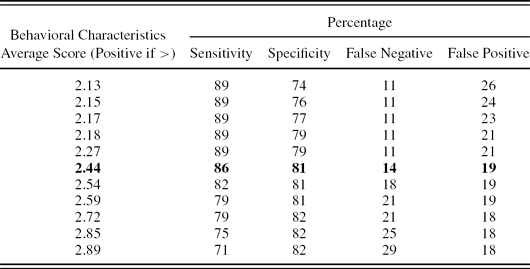
To effect a simple decision rule for probable dyslexia case–noncase classification for further follow-up assessment, a cutoff score was sought using receiver operating characteristic curve analysis, plotting sensitivity (correct identification of adolescents with dyslexia as cases) against false positives (incorrect identification of adolescents without dyslexia as cases), both variables being in percentages. Table 4 presents the results of the analysis. Average scores of the BCL-JS were computed for each student and a cutoff score of 2.44, that is, regarding a student with ratings above 2.44 as positive or a probable case, achieved a reasonably good sensitivity of 85.7%. This cutoff also resulted in a reasonably good specificity of 80.6% in correctly identifying adolescents without dyslexia as noncases.
Sensitivity and specificity in screening for dyslexia using different cutoff scores on reading-related behavioral characteristics (N = 90)
Note: The maximum for the overall Behavior Checklist of Specific Learning Difficulties in Reading and Writing for Junior Secondary School Students average scores was 5. Sensitivity is a measure of the ability to call positive (a case) those who are adolescents with dyslexia. Specificity is a measure of the ability to call negative (a noncase) those who are adolescents without dyslexia. False negative is an adolescent with dyslexia but is declared to be one without dyslexia. False positive is an adolescent without dyslexia but is declared to be one with dyslexia.
DISCUSSION
In order to make effective remedial provisions to dyslexic children and adolescents, teachers and related parties need a cost-effective measure to identify at-risk cases. Because literacy difficulties and specific cognitive deficits pertinent to dyslexia could be readily observed at the behavioral level (Frith, Reference Frith, Hulme and Snowling1997), we developed the BCL-JS. On the basis of the checklist, teachers could obtain a brief profile of their students’ reading-related behavioral characteristics by observing their everyday behaviors. This study describes the development and validation of the checklist and offers some evidence for adequate reliability and validity of the newly developed measure.
We conducted exploratory factor analyses on teachers’ ratings on the checklist, and seven distinct constructs emerged. We constructed individual scales from the checklist on the basis of the items within each construct, and this resulted in seven subscales: reading, writing, composition, memory and organization ability, learning motivation, internalizing behavior, and externalizing behavior. All the scales in the checklist showed good internal consistency reliabilities. The construct validity of the BCL-JS was supported by its significant relations with criterion measures. The correlation analyses indicated that all seven constructs of the BCL-JS significantly correlated with students’ performances on all tests on cognitive skills (except orthographic knowledge) and literacy as measured by the HKT-JS. This group of participants was relatively strong in orthographic knowledge as compared with their other cognitive skills. A mean composite score of 10.02 suggests that their orthographic skills are comparable to the general population (population mean = 10.0). We believe that orthographic knowledge is more important for Chinese young readers’ literacy development than it is in adolescent readers. This study revealed that all seven scores of reading-related behavioral characteristics of the BCL-JS could significantly differentiate adolescents with dyslexia from those without dyslexia. The discriminant analysis also showed that the BCL-JS had a high rate of correct classification (82.2%). These findings lent support to the reliability and validity of the BCL-JS as a screening tool for Chinese junior secondary school students at risk for dyslexia. Considering that behavioral checklists seldom have amazing hit rates, the present findings of over 80% hit rate could be deemed satisfactory for an initial screening tool. The consequences of missing a case may be more detrimental than having a false alarm. With the help of the behavioral checklist, we believe that the rate of false alarms would be drastically lowered.
In comparison to the study conducted by Chan et al. (Reference Chan, Ho, Tsang, Lee and Chung2003) on Chinese elementary students, we found that behavioral indicators of reading and writing ability as well as memory and organizational ability had high discriminative abilities to distinguish dyslexia cases and noncases for both children and adolescents. One interesting difference between Chan et al. (Reference Chan, Ho, Tsang, Lee and Chung2003) and the present study was that the behavioral characteristics of reading and writing emerged as one single factor in Chan et al. (Reference Chan, Ho, Tsang, Lee and Chung2003), whereas reading and writing emerged as two distinct factors in this study. Chan, Ho, Tsang, Lee, and Chung (Reference Chan, Ho, Tsang, Lee and Chung2006) examined the reading–writing connection in Chinese children with dyslexia. They found that the magnitude of the correlations between reading and writing appeared to decrease with age. Consistent with this finding, the two distinct factors for reading and writing in our study may reflect developmental differences in reading–writing connection between children and young adolescents. Reading and writing might be connected through other age-related variables. More studies based on longitudinal data might further evaluate the possible differences and underlying factors in relation to the reading–writing connection.
Chan et al. (Reference Chan, Ho, Tsang, Lee and Chung2004) found that children with and without dyslexia could not be differentiated by their social/emotional characteristics. In contrast, our study revealed that social/emotional behavioral characteristics, namely, internalizing behavior and externalizing behavior, could significantly predict the dyslexic membership in young adolescents. Internalizing behavior problems are characterized by an overcontrol of emotions. These problems include social withdrawal, demand for attention, feelings of worthlessness or inferiority, and dependency (Achenbach & Edelbrock, Reference Achenbach and Edelbrock1978; McCulloch, Wiggins, Joshi, & Sachdev, Reference McCulloch, Wiggins, Joshi and Sachdev2000). In general, children and adolescents with learning disabilities exhibited significantly lower self-concept and lower perceived academic competence than their peers without disabilities (Ayres, Cooley, & Dunn, Reference Ayres, Cooley and Dunn1990; Bear, Clever, & Proctor, Reference Bear, Clever and Proctor1991; Mulcahy, Reference Mulcahy1990; Raviv & Stone, Reference Raviv and Stone1991). While students with learning problems manifested a higher risk of depression (Hall & Halls, Reference Hall and Halls1989; Hayes & Sloat, Reference Hayes and Sloat1988; Huntington & Bender, Reference Huntington and Bender1993; Rourke, Young, & Leenaars, Reference Rourke, Young and Leenaars1989), the incidence of depression was more prevalent for adolescents (Maag & Behrens, Reference Maag and Behrens1989; Wright-Strawderman & Watson, Reference Wright-Strawderman and Watson1992). As the peer group takes on increasing importance in young adolescence, these internalizing problems may be exacerbated as children grow older.
Adolescents are vulnerable to feelings of being different and increasingly evaluate themselves through the eyes of others. While peer relationships assume cardinal importance in adolescents’ self-concept, those with learning disabilities are in particular vulnerable because they are generally weaker in diverse aspects of social competence (Calhoun & Beattie, Reference Calhoun and Beattie1987; Fine, Reference Fine1987; Ritter, Reference Ritter1989; Sater & French, Reference Sater and French1989; Toro, Weissberg, Guare, & Lievenstein, Reference Toro, Weissberg, Guare and Lievenstein1990). For instance, they performed worse than those without disabilities on nonverbal perception (Kavale & Forness, Reference Kavale and Forness1996; Swanson & Malone, Reference Swanson and Malone1992), and they were not competent at generating optimal solutions to social dilemma (Tur-Kaspa & Bryan, Reference Tur-Kaspa and Bryan1993). Therefore, it is not surprising that these students exhibited more problems in interpersonal relationships and were less socially accepted than students without learning disabilities (Houck, Engelhard, & Geller, Reference Houck, Engelhard and Geller1989; LaGreca & Stone, Reference LaGreca and Stone1990; Roberts & Zubrick, Reference Roberts and Zubrick1993; Schneider & Yoshida, Reference Schneider and Yoshida1988; Shondrick, Serafica, Clark, & Miller, Reference Shondrick, Serafica, Clark and Miller1992; Stone & LaGreca, Reference Stone and LaGreca1990; Wiener, Harris, & Shirer, Reference Wiener, Harris and Shirer1990). Problems in social relationships may in turn generate more internalizing problems, such as low self-esteem, anxiety, loneliness, and depression. Increasing demand on reading skills in higher levels of education may further aggravate the problems.
In addition to the increasing prevalence of internalizing problems, externalizing problems also appeared to increase with age from childhood to adolescence (Bryan, Pearl, & Herzog, Reference Bryan, Pearl and Herzog1989). Externalizing behavior problems are characterized by an undercontrol of emotions, including difficulties with interpersonal relationships and rule breaking as well as displays of irritability and belligerence (Achenbach & Edelbrock, Reference Achenbach and Edelbrock1978; Hinshaw, Reference Hinshaw1992). Out of academic failures and frustrations, adolescents with learning disabilities would exhibit more impulsive behavior, delinquency, and negative aggression than their age peers (Pearl, Bryan, & Herzog, Reference Pearl, Bryan and Herzog1990; Perlmutter, Reference Perlmutter1987; Safran & Safran, Reference Safran and Safran1987). Pearl and Bryan (Reference Pearl and Bryan1992) suggested that adolescents easily succumbed to peer pressure to engage in misconduct because they particularly longed for friendships at this stage of development. Moreover, their inappropriate behavior may also be the result of their insensitivity to social cues (Pearl & Bryan, Reference Pearl and Bryan1992). After all, one probable consequence of externalizing behavior is that they may be subjected to continual social isolation (Mishna, Reference Mishna1996), peer rejection (Kuhne & Wiener, Reference Kuhne and Wiener2000; Ochoa & Olivarez, Reference Ochoa and Olivarez1995), and loneliness (Margalit, Reference Margalit1998). In the present cross-sectional study, it is to be noted that elevated internalizing and externalizing behaviors may not be observed in the same individuals across time. We need further longitudinal study to examine this.
Both Chan et al. (Reference Chan, Ho, Tsang, Lee and Chung2004) and Jorm et al. (Reference Jorm, Share, Matthews and McLean1986) found that children with and without learning disabilities could not be differentiated in terms of social/emotional characteristics. However, as children enter adolescence, they may encounter more social problems and emotional hardship, which may become more observable signs of underlying reading problems. Consistent with this view, this study revealed that behavioral indicators in social and emotional domains, namely, internalizing and externalizing behavior, were useful for teachers to identify young adolescents at risk for dyslexia.
Sex differences in the association between behavior problems and dyslexia have been found in some (e.g., Maughan, Pickles, Hagell, Rutter, & Yule, Reference Maughan, Pickles, Hagell, Rutter and Yule1996) but not all studies (e.g., Boetsch et al., Reference Boetsch, Green and Pennington1996, Lamm, & Epstein, Reference Lamm and Epstein1996). Consistent with the latter studies, no significant gender differences were observed in both the dyslexic and nondyslexic groups in this study.
Another area that was not addressed in the study conducted by Chan et al. (Reference Chan, Ho, Tsang, Lee and Chung2003) was the use of learning motivation as one of the behavioral indicators. Motivation plays a crucial role in influencing students’ reading behavior (Lorch & van den Broek, Reference Lorch and van den Broek1997; Oldfather, Reference Oldfather2002; Wigfield, Reference Wigfield, Guthrie and Wigfield1997). Students with reading problems usually demonstrate poor academic self-concept (Chapman & Tummer, Reference Chapman and Tummer2003) and lack intrinsic interest in reading (van Kraayenoord & Schneider, Reference van Kraayenoord and Schneider1999). They tend to blame themselves for failure and attribute success to uncontrollable external causes such as luck (Borkowski & Muthukrishna, Reference Borkowski, Muthukrishna, Pressley, Harris and Guthrie1992; Chan, Reference Chan1994; Palladino, Poli, Masi, & Marcheschi, Reference Palladino, Poli, Masi and Marcheschi2000). On the basis of reviewing a number of studies, Gibb, Alloy, and Walshaw (Reference Gibb, Alloy and Walshaw2006) suggested that attribution style was relatively flexible when children were younger and appeared to become more fixed around the age of 12 years. As children with reading difficulties go from primary to secondary education, inflexible attribution styles as well as repeated experience of failures may discourage them to make constructive effort to remedy the worsening situation. This study revealed that the motivational issue of young adolescents was one of the behavioral manifestations of their underlying reading problems.
We could see the unique value of the present study based on the preceding discussion. Empirical evidence has showed that the use of behavioral checklists for dyslexic adolescents is rare in the literature. It may be partly due to the reason that dyslexic cases have already been identified when they are in their childhood, especially in countries where dyslexia has been widely recognized in the general public for a long time. However, this study suggested that the influences of dyslexia on adolescents were merely restricted not only to reading and writing domains but also extend to learning motivation, social, and emotional areas. There is an educational implication that teaching practices and remedial provisions for children and adolescents with dyslexia should be carefully tailored to their developmental needs.
We also believe that the identification instrument of dyslexia reported in this study could be applicable to other Chinese communities because its development was based on research studies conducted with Chinese dyslexic individuals in different Chinese communities (including Mainland China and Hong Kong). However, the instrument may require some adaptations because people in Mainland China and Taiwan learn to read Chinese characters with a phonemic coding system (Pinyin) or an onset-rime system (Zhu-Yin-Fu-Hao), respectively, as an aid, whereas people in Hong Kong learn to read Chinese characters in a more holistic manner with a look-and-say approach. Because the investigation of dyslexia and the development of service provision to dyslexic individuals are relatively new in the Chinese population, up till now the identification instrument reported here is the only standardized instrument of developmental dyslexia available in Chinese. More research on the instrument validation in other Chinese communities is warranted in the future. Educators should not stop at effective identification. The ultimate goal of identification is to facilitate intervention. A recent study reported that training in oral language, morphological awareness, orthographic skills, and syntactic skills were beneficial for children who learned to read Chinese, especially for struggling readers (Ho et al., Reference Ho, Wong, Yeung, Chan, Chung and Lo2012). A tiered intervention curriculum with these skill components is being implemented in Hong Kong primary and secondary schools.
Directions for future research
Reliability of a measure can be thought of in terms of stability over time and contexts as well as by internal consistency. Although internal consistency of the behavioral checklist is high, future examinations on its test–retest reliability are necessary. It would also be informative to carry out longitudinal studies. Children rated by teachers on the checklist could receive comprehensive testing both at the time of the initial ratings and some years later. Long-term follow-up on children would be essential to determine whether the measure has a strong predictive value over time.
Children's problem behaviors are not necessarily pervasive across settings. Comparisons between information provided by both parents and teachers would be a direction for future study. Parents and teachers are both valuable sources of information as an initial step in the assessment process because they are likely to perceive different aspects of the child/adolescent to give a more comprehensive portrayal (Sattler, Reference Sattler1992). Teachers may view students’ behavior through a lens that may be highly affected by classroom expectations and school culture. Moreover, they observe students within a group setting in a single context for a few hours a day. In contrast, parents have the unique perspective of watching their children in diverse settings and observing their children's development over many years. Thus, including both parents and teachers as informants at the time of initial screening for dyslexia would be an invaluable addition to the assessment process. Further exploration is necessary to determine the most effective way to incorporate both parent and teachers ratings.
CONCLUSION
The importance of timely intervention for dyslexia calls for the development of a reliable and valid screening tool for Chinese students in Hong Kong. We consider the BCL-JS to be an efficient and practical measure of students’ reading-related behavioral characteristics. The behavior checklist is not intended to replace comprehensive diagnosis for dyslexia but rather to identify children at risk of failure for a range of reading-related behavior. This study has demonstrated that the checklist carries an excellent capacity to accurately distinguish between young Chinese adolescents with dyslexia and those without. With some adaptations, we believe that the instrument could be applicable to other Chinese communities as well. As a consequence of the availability of the screening checklist, teachers would feel empowered to identify young adolescents with reading problems and to use this information as pointers for appropriate remedial interventions.
ACKNOWLEDGMENTS
The present study was funded through the READ & WRITE: A Jockey Club Learning Support Network from the Hong Kong Jockey Club Charities Trust. Special thanks are due to Suk-han Lee and Suk-man Tsang for their valuable support and consultation throughout the project.