Background
CHD is the most common congenital disease in children. Reference Linde, Konings, Slager, Witsenburg, Helbing and Takkenberg1 Primary repair of tetralogy of Fallot has been performed successfully for the last 45 years. It has low surgical mortality (<5%), with excellent long-term results. However, there are delayed adverse effects: progressive right ventricular dilation and dysfunction, arrhythmia, and sudden death. In our centre, tetralogy of Fallot is the most common form of cyanotic CHD (including transannular patch) and accounts for 7.5% of all cardiovascular surgical procedures. The mid-term follow-up results are reported. Incidence of pulmonary regurgitation after tetralogy of Fallot repair was 36–70%. Reference Tornell, Lopez, Gonzales, Cerdan, Ojeda and Orozco2–Reference Ylitalo, Nieminen, Pitkanen, Jokinen and Sairanen7 Chronic pulmonary regurgitation may result in chronic right ventricular volume overload, dysrhythmia, and ventricular dysfunction. Reference Geva8
At present, factors associated with severe pulmonary regurgitation in patients after tetralogy of Fallot repair are not completely understood. Surgical technique such as using transannular patch may result in pulmonary valve injuries. In another study, the diameter of pulmonary artery prior to surgery correlates with the severity of pulmonary regurgitation. Reference Gao, Yang, Shi, Diao, Xu and Guo9 Other factors that might be associated with pulmonary regurgitation severity are age at repair and follow-up duration. Reference Geva8,Reference Johnson and Haworth10 Age at repair correlates with lung development, thus contributes to pulmonary regurgitation severity. The aim of this study was to identify factors associated with pulmonary regurgitation severity that can be predicted prior to surgery.
Methods
Study design and population
This study is a cross-sectional study in the cardiovascular centre of Dr. Cipto Mangunkusumo Hospital, Jakarta, Indonesia. We recruited patients with repaired tetralogy of Fallot during routine examinations from April to June 2019. The inclusion criteria used were all patients under 18 years of age who underwent tetralogy of Fallot repair with transannular patch during January 2015 to October 2019 and diagnostic catheterisation prior to surgery. Forty-three patients who met the inclusion criteria were enrolled in the study. This study had been approved by the ethics committee of the University of Indonesia.
Data collection
Population characteristics were noted and grouped into before, during, and after surgery. Those included in the preoperative data were age at the time of surgery, gender, baseline systemic saturation, follow-up duration, McGoon ratio, and Nakata index. The McGoon ratio was calculated using the equation of left and right pulmonary arterial diameter summation divided by the aorta diameter at diaphragm level. The Nakata index was calculated by the summation of left pulmonary artery and right pulmonary area cross-sectional area divided by body surfaces area. Right pulmonary area and left pulmonary artery were measured proximal to the first branching point of each artery. Data included in the perioperative group were cardiopulmonary bypass time, aortic cross-clamp time, length of stay in ICU, and duration of intubation. After surgery, we assessed heart failure using modified Ross score and transthoracal echocardiography . Pulmonary regurgitation severity was estimated using diastolic and systolic velocity time integral and then categorised into severe (diastolic and systolic velocity time integral of more than 1), moderate (0.3–0.9), and mild (less than of 0.3). Reference Rosa, Wei, Kutty, Rychik, Fogel and Goldmuntz11 We also assessed myocardial performance index of right ventricle, right ventricular size, right ventricular ejection fraction, left ventricular ejection fraction, and residual PS. Grades of tricuspid regurgitation severity were also observed in accordance with the European guidelines Reference Lancelotti, Tribouiloy and Hagendorff12 . All patients had single transthoracal echocardiography examination using Philips Epiq 7 (Philips medical system, Bothel, WA,USA).
Statistical analysis
The baseline data were described using mean, median, or proportion as appropriate. We performed bivariate analysis using Chi-square test and multivariate analysis to determine the association between each predictor.
Result
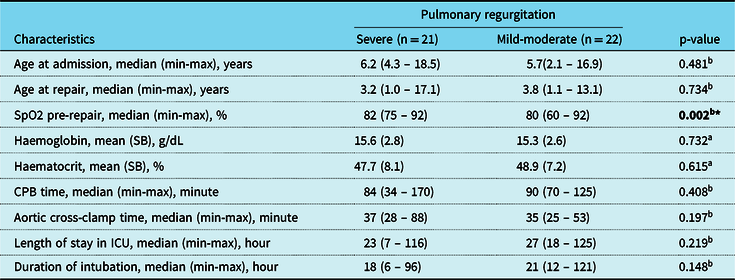
From a total population of 43 patients, the proportion between boys (n = 22) and girls (n = 21) was similar. Their median age was 6 (2.1–18.5) years at admission and 3.4 (1–17) years at repair. The median length of follow-up was 2.1 (1–4.3) years. All of the subjects had no pulmonary regurgitation before surgery. The median weight at repair was 10.5 (7–39) kg. There were seven patients with dysrhythmia after tetralogy of Fallot repair but resolved to sinus rhythm at the time of discharge. Table 1 presents the characteristics of the study subjects in accordance with their pulmonary regurgitation severity after surgery.
Subject characteristics by pulmonary regurgitation severity.

CPB = cardiopulmonary bypassaIndependent t-test, bMann–Whitney U-test, cChi-square test
*Statistically significant if p < 0.05.
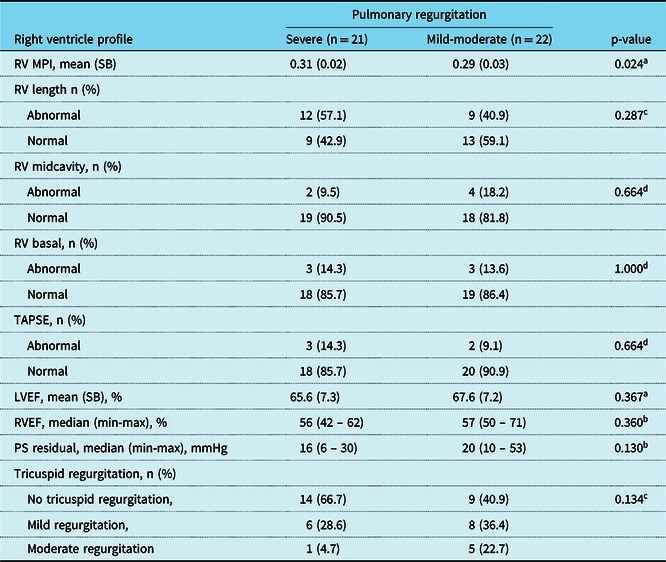
After surgery, transthoracal echocardiography study for right ventricular performance between two groups upon follow-up showed no differences for both the right ventricular size and function. We present right ventricular profiles of the subjects in Table 2.
Right ventricle profile after tetralogy of Fallot repair.

LVEF = left ventricular ejection fraction; MPI = myocardial performance index; PS = pulmonary stenosis; RVEF = right ventricular ejection fraction; RBBB = right bundle branch block
aUnpaired t-test, bMann–Whitney U-test, cChi-square test, dFisher exact Test
There was a subject with small residual Ventricular Septal Defect in both severe and mild-moderate pulmonary regurgitation groups. Both groups also had no difference on their QRS duration (90 [80–160] msec and 80 [60–120] msec, in severe and mild-moderate pulmonary regurgitation, consecutively). The incidence of mild tricuspid regurgitation was 32% and moderate tricuspid regurgitation was 13% in this study population.
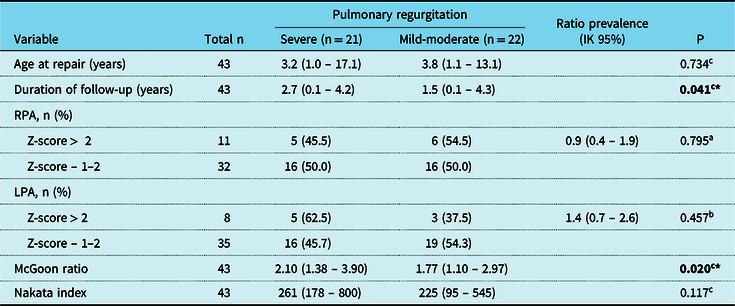
From these tables, we conclude that a few of variables were possible to be risk factors for pulmonary regurgitation severity; thus, these data were analysed as shown in Tables 3 and 4.
Bivariate analysis predictor of severe pulmonary regurgitation of post-repaired tetralogy of Fallot.

Notes: LPA = left pulmonary artery; RPA = right pulmonary artery; TAP = transannular patch. aChi-square test; bFisher exact test; cMann–Whitney U-test.
*Statistically significant if p < 0.05.
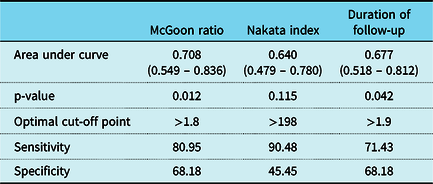
Receiver operator curve (ROC) for McGoon ratio and Nakata index.

There were no differences in right pulmonary area diameter, left pulmonary artery, and Nakata index between both groups. Receiver operator curve and multivariate analysis for three variables, i.e., follow-up duration, McGoon ratio, and Nakata index, were conducted to identify the predictors of severe pulmonary regurgitation. There were significant differences in the follow-up duration and McGoon ratio between both groups for predicting severe pulmonary regurgitation, but not for age, Z score, and Nakata index. Receiver operator curve analysis was also used to determine the optimum cut-off point for predicting severe pulmonary regurgitation.
For predicting severe pulmonary regurgitation in repaired tetralogy of Fallot, McGoon had sensitivity of 80.95% and specificity of 61.8%. Meanwhile, Nakata index had 90.48% sensitivity with 45.45% specificity, and follow-up duration had 71.43% sensitivity and 68.18% specificity as can be seen in Figure 1.
ROC analysis to predict relationship between pulmonary regurgitation and McGoon ratio, Nakata index, and follow-up duration.

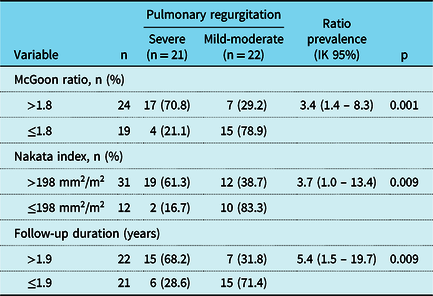
McGoon ratio of more than 1.8 presented 3.4 times higher risk of severe pulmonary regurgitation, while the Nakata index of more than 198 presented a 3.7 times higher risk for severe pulmonary regurgitation. A follow-up duration of more than 1.9 years also predicted severe pulmonary regurgitation 5.4 times higher. These data can be seen in Tables 5 and 6.
Bivariate analysis for predictors of severe pulmonary regurgitation in post-repaired tetralogy of Fallot with transannular patch technique.

Note: Chi-square test.
Multivariate analysis of risk factor for severe pulmonary regurgitation in post-repaired tetralogy of Fallot with transannular patch technique.

Discussion
Over the past years, cardiac surgery and postoperative management in the developed country have contributed to the excellent outcome of the totally corrected tetralogy of Fallot patients Reference Bacha, Scheule and Zurakowski13 ; however, the results in developing country are still unknown Reference Tanasan, Zanzani, Kocharian, Kiani and Navabi14 . A study on the outcomes of surgery in developing countries about the complications and mortality conducted by Murni et al. shows that the mortality of tetralogy of Fallot patients is 11%. Some factors associated with increased risk of mortality in developing countries after cardiac surgery are cyanotic CHD, longer cardiopulmonary bypass duration, high postoperative inotropes, and high blood lactate levels. Reference Murni, Djer and Yanuarso15 Transannular patch during tetralogy of Fallot repair may result in pulmonary regurgitation, but this surgery has excellent long-term results. However, progressive right ventricular dysfunction requires continuous monitoring. Reference Tornell, Lopez, Gonzales, Cerdan, Ojeda and Orozco2 To our knowledge, Indonesia has no studies describing mid-term outcomes, especially pulmonary regurgitation, in repaired tetralogy of Fallot. Therefore, this study proposes possible predictors for severe pulmonary regurgitation so that paediatric cardiologists, surgeons, and patients are well informed regarding further examinations related to pulmonary regurgitation and right ventricular function as well as other options in the follow-up.
Tetralogy of Fallot patients tend to have symptoms since early age; thus, they also have early corrective surgeries. This study shows that age at repair is not statistically significant for pulmonary regurgitation predictor. This result is in accordance with other studies. Cunningham et al. showed that surgeries in tetralogy of Fallot patients older than 55 days were safe. Reference Cunningham, Donofrio, Peer, Zurakowski, Jonas and Sinha16 A study in Pakistan by Memon et al. showed that mean age 9.39 ± 2.3 months had good outcomes after tetralogy of Fallot repair. Reference Memon, Akhtar, Mohsin, Ahmad, Arshad and Ahmed17 Baseline saturation <75% was an independent risk factor for low cardiac output syndrome and prolonged intubation. Reference Memon, Akhtar, Mohsin, Ahmad, Arshad and Ahmed17 The optimum age for tetralogy of Fallot repair in our centre is 1 year, though our study population had a median age of 3.2 years in severe pulmonary regurgitation group and 3.4 years in mild-moderate pulmonary regurgitation group. A study in London by Johnson et al. showed that children with tetralogy of Fallot had their pulmonary arterial circulation and alveoli fail to develop normally. This study suggested for early correction because the potential for growth decreases with age. Lung growth and remodelling occur most rapidly in the first 2 years of life, so it is considered as the best time to do tetralogy of Fallot repair. Reference Johnson and Haworth10
All subjects in this study had transatrial-transpulmonary approach for tetralogy of Fallot repair. This is the most commonly used approach in most centres with excellent long-term results. Reference Lutijen, Van den Bosch and Duppen18 Unfortunately, using transannular patch in this kind of surgery may lead to pulmonary regurgitation, and our study shows that severe pulmonary regurgitation tends to happen in patients with higher McGoon ratio and longer follow-up duration after having this surgery. This result is slightly different from those of Gao et al. in China which shows that McGoon ratio of more than 1.63 and Nakata index of more than 270.05 contribute to pulmonary regurgitation. Our study shows that McGoon ratio is a better predictor for severe pulmonary regurgitation compared to Nakata index. This is because tetralogy of Fallot has pulmonary stenosis, which influences the diameter ratio of main pulmonary trunk and the ascending aorta. Keep in mind that McGoon ratio is a ratio of diameters of the pulmonic annulus divided by the aortic annulus Reference Chen, Chen, Wu, Li and Lue19 . In our opinion, Nakata index (the sum of cross-sectional area of both right and left pulmonary arteries divided by body surface area) is not suitable for pulmonary artery, considering its ovoid shape. Reference Chen, Chen, Wu, Li and Lue19
We also postulated that diameter of right pulmonary artery or left pulmonary artery could predict pulmonary regurgitation, but the study shows them to be insignificant for prediction. This difference with Gao’s study that has left pulmonary artery diameter as a better predictor than right pulmonary area might be explained by smaller left lung and its association with increased diastolic flow reversal in left pulmonary artery. Reference Gao, Yang, Shi, Diao, Xu and Guo9,Reference Killner, Balossino and Dubini20 Lungs in tetralogy of Fallot are smaller in relation to body surface area and age, so the diameter of right pulmonary area or left pulmonary artery alone does not contribute to severe pulmonary regurgitation. Reference Johnson and Haworth10
In developed countries, pulmonary regurgitation and right ventricular diastolic dysfunction are the most important outcome following tetralogy of Fallot repair. Prolonged and severe pulmonary regurgitation affect right ventricular function and size, leading to right ventricular dysfunction. Pulmonary regurgitation induces right ventricular volume overload and often progressive right ventricular dilatation which may lead to tricuspid regurgitation and right ventricular dysfunction. Reference Van der Ven, Van den Bosch, Bogers and Helbing21,Reference Redington22 There are studies measuring right ventricular function by myocardial performance index at mid-term and long-term follow-up. Pilla et al., Tanasan et al., and Shehata et al. measured right ventricular dysfunction in repaired tetralogy of Fallot with matching healthy subjects. All of them showed prolonged myocardial performance index and right ventricular dysfunction in the group with repaired tetralogy of Fallot. Reference Tanasan, Zanzani, Kocharian, Kiani and Navabi14,Reference Pilla, Pereira and Fin23,Reference Shehata, El Nagar, Shara and Abu-Farag24 Their studies are in line with our results, which showed that all of our subjects had pulmonary regurgitation of varying degrees. All of our subjects had single assessment of pulmonary regurgitation using transthoracal echocardiography during their routine control. A higher myocardial performance index is indicative of reduced global right ventricular function. The prolonged right ventricular myocardial performance index is a reflection of reduced right ventricular function due to severity of pulmonary regurgitation.
For evaluation, follow-up duration in severe pulmonary regurgitation group was 2.7 years and mild-moderate group was followed up for 1.5 years. However, continuous right ventricle volume overload due to pulmonary regurgitation has been proven to accelerate the rate of progressive right ventricular systolic and diastolic dysfunction and size. Reference Geva8.Reference Tanasan, Zanzani, Kocharian, Kiani and Navabi14,Reference Egbe, Mittnacht, Nguyen and Joshi25
In conclusion, McGoon ratio of more than 1.8 and duration of follow-up of more than 1.9 years may be associated with severe pulmonary regurgitation. Further examinations for pulmonary regurgitation are needed to see its impact on right ventricular dysfunction in mid-term and long-term follow-up.
There were several limitations in this study. Follow-up duration for the patients varied greatly with 6 months at the earliest and 4 years at the longest. Another limitation was a wide variability of age at repair, with the youngest being 1 year old and the oldest at 17 years old. This may have impact on their preoperative hypoxaemia and cardiac function and therefore did not give the real distribution on pulmonary regurgitation severity after surgery. Location also played an important role, since most patients did routine follow-up after tetralogy of Fallot repair with their nearest paediatric cardiologists, thus influencing the variability in follow-up duration for subjects.
Acknowledgement
The study was approved and supported by ethical committee of Dr. Cipto Mangunkusumo General Hospital, University of Indonesia.
Conflict of interest
None.
Ethical standards
Not applicable.