INTRODUCTION
Since the beginning days of the hospice movement in the United States (1970s), the number of organizations providing hospice services has grown rapidly. Hospice care encompasses a range of services based on a humanistic philosophy of care for the terminally ill and their families, with a focus on improving quality of life and controlling distressing symptoms at the end of life. It is delivered by an interdisciplinary team that includes healthcare professionals (physicians, nurses, social workers, chaplains, counselors) in close collaboration with family and other caregivers (Greer et al., Reference Greer, Mor and Sherwood1983; Hutcheson, Reference Hutcheson2011). The focus on improving quality of life in patients at the end of life prompted the American Association of Colleges of Nursing and the Institute of Medicine to develop end-of-life competency statements as necessary to provide high-quality care to terminally ill patients and their families. This included the development and use of evidence-based standardized tools for assessing symptoms experienced by patients at the end of life employed for measuring quality of life (QOL).
Symptom control is associated with a good quality of life (Steinhauser et al., Reference Steinhauser, Christakis and Clipp2000; Yurk et al., Reference Yurk, Morgan and Franey2002). Knowledge of symptom prevalence is important for clinical practice as it enables doctors and nurses to focus on patients' more prevalent symptoms and help them to anticipate problems, plan patient care, educate clinical staff, and direct appropriate healthcare resources. Patients with advanced cancer report symptoms such as pain, fatigue, nausea, depression, anxiety, anorexia, insomnia, dyspnea, and drowsiness at various stages of the disease and treatment. Most patients with cancer report on average four to six symptoms at any given time (Steinhauser et al., Reference Steinhauser, Christakis and Clipp2000; Yurk et al., Reference Yurk, Morgan and Franey2002; Cheung et al., Reference Cheung, Le and Zimmermann2009; de Santiago et al., Reference de Santiago, Portela and Ramos2012). Previous studies have reported associations among the various symptoms (Steinhauser et al., Reference Steinhauser, Christakis and Clipp2000). Another symptom, delirium, has been reported to occur in 50 % of cancer patients, and its incidence increases to 66 % at the end of life (Lawlor et al., Reference Lawlor, Gagnon and Mancini2000; Lawlor & Bruera, Reference Lawlor and Bruera2002). Delirium is a harbinger of serious illness and is associated with increased in-hospital mortality. Fifty percent of cases are reversible, and the remainder present with chronic cognitive changes or terminal delirium.
Approximately 35% of U.S. cancer patients die while receiving active care in hospice programs, and the number of Americans accessing hospice care has increased dramatically during the last decade. The National Hospice Study showed that patients enrolled in hospice had a better quality of life than those receiving conventional treatment (Greer et al., Reference Greer, Mor and Sherwood1983). A survey on hospices showed that approximately 66% report that they use assessment tools to guide symptom management. In the absence of validated tools, symptoms may be missed or inappropriately addressed. The absence of universal use of validated assessment tools coupled with limited hospice clinician visits may result in patients having uncontrolled symptoms during the last few days of life. Although symptoms in this period are widely reported in the literature, most studies describe patients in an inpatient setting. In our study, we describe the presence and severity of symptoms, including delirium, in patients with advanced cancer who were admitted to hospice during the last weeks of life. It is important to determine whether symptoms are appropriately assessed and managed to improve current practice and develop better care plans as part of our mission to improve patients' quality of life. We also sought to evaluate the usefulness of the Nursing Delirium Screening Scale (Nu-DESC) as a tool for assessing delirium in patients (Gaudreau et al., Reference Gaudreau, Gagnon and Harel2005). To our knowledge, data on the presence of symptoms in patients with advanced cancer receiving hospice services at home in their last days of life are limited.
METHODS
We conducted a secondary analysis of data from a randomized controlled trial on parenteral hydration (Bruera et al., Reference Bruera, Hui and Dalal2013). This retrospective study was approved by the institutional review board at The University of Texas MD Anderson Cancer Center. Patients were selected if they had undergone symptom assessment during days 7 + 3 days before death.
We collected the following data from the study charts: demographic information such as age, sex, Eastern Cooperative Oncology Group (ECOG) performance status, medications, cancer type, and scores on the Edmonton Symptom Assessment Scale (ESAS), the Memorial Delirium Assessment Scale (MDAS), the Nu-DESC, and the Richmond Agitation Sedation Scale (RASS). These tools were utilized during the initial protocol.
The ESAS was completed by the patient, who was sometimes assisted by a caregiver. The MDAS was completed by a trained research nurse and was used as the gold standard for diagnosing delirium. The Nu-DESC was completed by a research nurse during the morning shift and subsequently by the patient's caregiver during the evening and night shifts. The RASS score was determined by the nurse during the morning visit.
Assessment Questionnaires
Designed for both the patient and caregiver to complete, the ESAS is used to measure the severity of symptoms such as pain, fatigue, nausea, depression, anxiety, drowsiness, sleep problems, shortness of breath, appetite, and feelings of well-being (Bruera et al., Reference Bruera, Kuehn and Miller1991; Chang et al., Reference Chang, Hwang and Feuerman2000).
The MDAS is a 10-item clinician-rated scale for assessing delirium and its severity that covers all phenomenological areas of delirium. Each item is scored from 0 to 3 depending on intensity and frequency (possible range, 0–30). It has been validated in an advanced cancer population using a cutoff score of 7 (Breitbart et al., Reference Breitbart, Rosenfeld and Roth1997).
The Nu-DESC is a brief observational five-item instrument that includes four items of the Confusion Rating Scale and a brief nursing delirium screening instrument that is adapted to the fluctuating nature of delirium. It evaluates cognitive status as well as symptoms such as disorientation, inappropriate behavior, inappropriate communication, illusions or hallucinations, and psychomotor retardation. Each symptom is rated from 0 to 2 based on the presence and intensity of that symptom, with scores ranging from 0 to 10. It is a simple and reliable estimation of the presence of delirium (Gagnon et al., Reference Gagnon, Lawlor and Mancini2001).
The RASS measures the predominant features of delirium (agitation or sedation) in a very precise, unambiguous way (Sessler et al., Reference Sessler, Gosnell and Grap2002).
RESULTS
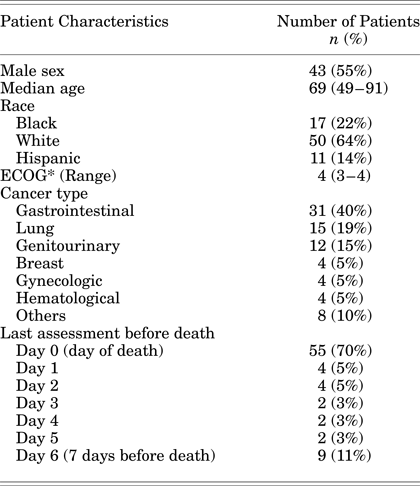
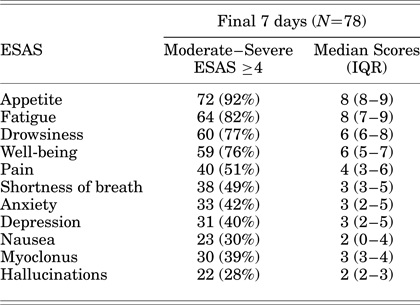
Of the 261 patients in the randomized controlled trial, 78 (30%) were eligible for this secondary analysis. A summary of patient demographics is presented in Table 1. Some 62 of 78 (80%) participants had at least one moderate-to-severe symptom during the last week of life using an ESAS score >4. The median ESAS scores for anorexia, fatigue, drowsiness, well-being, and pain were rated, with >4 ESAS scores corresponding to moderate-to-severe symptoms during the last week of life (Table 2).
Demographics of patients receiving hospice care in the last final days of life

* ECOG = Eastern Cooperative Oncology Group performance status.
Symptom distress during the last week of life in hospice
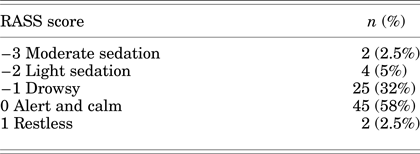
A cutoff of >7/30 on the MDAS was utilized, whereby delirium was diagnosed in 34 (44%) patients. Table 3 presents the sensitivity and specificity of the Nu-DESC on the same day, with MDAS employed as the gold standard for diagnosing delirium. The Nu-DESC had a sensitivity of 35%, specificity of 80%, positive predictive value (PPV) of 58%, and a negative predictive value (NPV) of 61% when used by the caregiver. Only two (2.5%) patients were reported to have agitation and/or restlessness using the RASS (Table 4).
Nu-DESC delirium diagnosis compared with MDAS as the gold standard*
* MDAS was abnormal (>7/30) in 34 of 78 (44%) patients and was used as a gold standard for delirium diagnoses.
Agitation and sedation (n = 78)
DISCUSSION
About 1.5 million Americans are enrolled in Medicare-certified hospices every year. Information about the quality of service patients receive through the hospice program is limited, but outcome measures for quality improvement and public reporting have been increasingly placed in the forefront (Currow et al., Reference Currow, Ward and Plummer2008; Anderson & Squires, Reference Anderson and Squires2010). In our study, which focused on terminally ill patients with advanced cancer who were enrolled in hospice, more than half had moderate-to-severe symptoms in at least four domains of the ESAS. Anorexia, fatigue, drowsiness, well-being, and pain were rated as moderately severe. Early involvement of palliative and hospice care services has been shown to improve patient-centered outcomes such as pain and depression as well as distressing symptoms and quality of life (Bruera & Hui, Reference Bruera and Hui2010; Hui et al., Reference Hui, Parsons and Nguyen2010; Rodriguez et al., Reference Rodriguez, Hanlon and Perera2010; Hutcheson, Reference Hutcheson2011). The results of our study indicate, however, that patients express considerable suffering and caregivers perceive considerable symptom burden even up to the last days of life, indicating that we are not nearly as successful as we should have been.
Although data on patients enrolled in hospice during the last few days of life are limited, the literature suggests that fatigue, pain, and other symptoms like dyspnea and constipation are common in cancer patients receiving hospice care (Donnelly & Walsh, Reference Donnelly and Walsh1995; Weitzner et al., Reference Weitzner, Moody and McMillan1997; Allen et al., Reference Allen and Haley2002; McMillan & Small, Reference McMillan and Small2002). When compared with patients receiving conventional care at the end of life, patients in hospice report better pain management and symptom control. However, several studies have shown that patients in hospice report suboptimal control of their pain (McMillan, Reference McMillan1996a; Reference McMillan1996b). Proper assessment of pain and other common symptoms at the end of life is crucial in addressing these issues and should be part of the standard of care. For patients who are unable to rate their symptoms, tools such as the ESAS can be used by the caregiver (Nekolaichuk et al., Reference Nekolaichuk, Maguire and Suarez-Almazor1999; Reference Watanabe, Nekolaichuk and Beaumont2012; Watanabe et al., Reference Watanabe, Nekolaichuk and Beaumont2011; Reference Watanabe, Nekolaichuk and Beaumont2012). As we reported in our study, hospice patients still report moderate-to-severe symptoms of fatigue, drowsiness, anorexia, and well-being, suggesting that care at the end of life still warrants considerable attention.
Previous studies by our group that evaluated symptom management by a palliative care specialist in the outpatient setting showed that improvement in symptoms for patients with advanced cancer requires multiple and frequent visits and adjustment of medications (Yennurajalingam et al., Reference Yennurajalingam, Atkinson and Masterson2012). For patients admitted to hospice, multiple assessments by the physician may be needed to better control distressing symptoms and improve care.
Hypoactive delirium is largely missed by family and undiagnosed by healthcare providers (Fang et al., Reference Fang, Chen and Liu2008). A poor understanding of delirium can result in substandard management. The Nu-DESC is an attractive tool that can be used in conjunction with other more sensitive tools such as the MDAS. It has been touted as a simple screening tool for delirium that can be utilized in multiple settings. Previous studies have shown that the Nu-DESC has a sensitivity of 85.7% and a specificity of 86.8% (Gaudreau et al., Reference Gaudreau, Gagnon and Harel2005). Consequently, evaluation of delirium using more sophisticated tools may be warranted. Our study results show that the Nu-DESC is less powerful when administered by the caregiver. Perhaps more training is necessary to increase caregiver competency, or psychomotor retardation may not have been perceived as a component of delirium. The Nu-DESC is still an important screening tool that can be used by trained hospice staff and, if positive, could provide an alert to possible delirium and prompt initiation of diagnostic and therapeutic steps.
The RASS is a clinically useful tool that measures consciousness and agitation. Psychomotor agitation is one of the most distressing aspects of delirium, particularly for the families of affected patients (Bruera et al., Reference Bruera, Miller and McCallion1992). Patients with similar levels of delirium may have very different levels of agitation. Some 76 (97%) patients had a RASS score that corresponded to some level of calm or sedation. This result supports previous reports of hypoactive delirium being more common at the end of life (Lawlor et al., Reference Lawlor, Gagnon and Mancini2000; Casarett & Inouye, Reference Casarett and Inouye2001; Yang et al., Reference Yang, Marcantonio and Inouye2009). Patients with hyperactive delirium are likely transferred to inpatient hospice or hospital settings, as families may have difficulty caring for them at home.
Our data support the contention that we have not yet fully attained the palliative care goal of alleviating symptom distress, particularly in the home setting during the last few days of life. The presence of significant symptom distress continues to present as a challenge for us to increase our efforts to improve care in the last days and weeks of a terminal illness. There is an urgent need to improve the hospice system and the model of delivery of care to improve overall patient quality of life. The use of validated tools allows us to not only standardize care but also to monitor the success of our interventions.
DISCLOSURES AND ACKNOWLEDGMENTS
EB is supported by National Institutes of Health National Institute of Nursing Research Grant No. R01 NR010162-01A1. SY is supported in part by American Cancer Society Grant No. RSG-11-170-01-PCM. This study was presented in part at the Multinational Association of Supportive Care in Cancer (MASCC) International Symposium in 2013. We would like to thank Markeda Wade for editing this manuscript.