Introduction
Capsicum annuum L., commonly known as pepper, is a widely cultivated crop that holds significant economic and nutritional value globally. As a rich source of vitamins, proteins, sugars, and pigments, C. annuum is a staple in many cuisines and an important agricultural commodity (Liu et al., Reference Liu, Hu, Jiang, Liu and Bai2014). In addition to their culinary value, peppers are also cultivated for their medicinal properties, due to the presence of bioactive compounds such as capsaicinoids, carotenoids, and flavonoids, which are known for their anti-inflammatory and antioxidant effects (Deng and Wen, Reference Deng and Wen2021). In China, C. annuum is extensively grown across various regions, contributing to both local diets and the broader agricultural economy (Zou et al., Reference Zou, Yang, Dai, Hu, Xu, Zhu, Fei and Yuan2025). However, pepper cultivation faces numerous challenges, with pest infestations, particularly from aphids, being one of the most serious threats to yield and quality.
Among the pests that damage pepper crops, the cotton aphid, Aphis gossypii Glover (Hemiptera: Aphididae), is of particular concern (Blackman, Reference Blackman2013). A. gossypii is a highly adaptable and damaging pest that feeds on a wide range of plants, including C. annuum (Gong et al., Reference Gong, Yang, Zhang, Liu and Chen2001). The feeding behaviour of A. gossypii involves piercing plant cells with its stylet to extract sap, which weakens the plant, disturbs its growth, and can cause a reduction in yield and quality (Luo et al., Reference Luo, Zhang and Changsun2003). In addition, A. gossypii can transmit various plant viruses, further complicating pest control efforts. The damage caused by A. gossypii can result in significant economic losses, especially in large-scale pepper cultivation (Tang et al., Reference Tang, Chen, Zhu, Ren and Hu2013 ).
Although A. gossypii damages C. annuum by feeding on its sap, resulting in symptoms like wilting, leaf curling, and stunted growth, C. annuum also possesses natural insecticidal compounds that help protect it from pests. These include capsaicin, phenolic acids, and flavonoids, which contribute to the plant’s defence mechanisms (Deng and Wen, Reference Deng and Wen2021). For instance, a study developed a chili extract-based biopesticide that significantly reduced red leaf mite populations, achieving a 94.9% killing rate at a 100-fold dilution (Meng et al., Reference Meng, Lin, Lv, Chen and He2024). This underscores the potential of capsaicin and other chili-derived compounds as natural pest control agents, supporting the role of peppers in integrated pest management. However, the specific impact of these compounds on A. gossypii has not been thoroughly studied.
In addition to the chemical defences of C. annuum, A. gossypii itself exhibits considerable genetic diversity (Satar et al., Reference Satar, Kersting and Yokomi2013). Traditionally, A. gossypii populations have been categorised into different biotypes based on host preferences. Recent molecular studies have refined this classification by identifying 57 haplotypes using Cytb and 16S gene regions (Zhang et al., Reference Zhang, LUO, WANG, WANG, Lü, ZHANG, Zhu and CUI2018). Among these, Hap1, Hap3, and Hap4 are the major haplotypes, accounting for 86% of the total A. gossypii population in northern China. Hap1 and Hap4 are the predominant haplotypes on cotton, while Hap3 is the most common haplotype found on cucurbit hosts. Hap3, in particular, shows a strong preference for cotton but also exhibits adaptability to other hosts, including C. annuum. Hap17, although less common, is another significant haplotype associated with differences in host preferences, further highlighting the genetic diversity of A. gossypii and its ability to infest and damage specific crops. The differentiation of these haplotypes is based on single-nucleotide polymorphisms in the complete mitochondrial genome sequences (Bao et al., Reference Bao, Yang, Su, Zhou, Jing, Yang and Zhang2023; Ji et al., Reference Ji, Bao, Yang and Zhang2024).
Currently, the control of A. gossypii on C. annuum relies heavily on chemical insecticides. While effective, these methods often result in resistance development, environmental pollution, and the resurgence of pest populations, representing the challenges associated with resistance, residue, and resurgence (Ma et al., Reference Ma, Ma, Ma, Song, Zhao and Wang2024). As a result, there is an increasing interest in exploring alternative pest management strategies that leverage the natural insecticidal properties of C. annuum and better understand the interactions between aphid populations and host plants. This is particularly important as natural resistance mechanisms in plants may offer more sustainable and environmentally friendly solutions to pest management.
Prior research has indicated that the adaptability of A. gossypii populations can vary significantly depending on the host plant. For example, different A. gossypii haplotypes exhibit varying performances on crops like cotton and cucumber (Li et al., Reference Li, Yang, Su, Zhou, Jing, Yang and Zhang2023). However, the specific adaptability of A. gossypii on different varieties of C. annuum has not been comprehensively studied. In our field surveys, we identified that Hap3 and Hap17 were the most prevalent A. gossypii haplotypes infesting C. annuum in Yangzhou University’s Experimental Field. This selection was intentional, as it allows us to study the behaviour and adaptability of naturally occurring biotypes in the local environment. By focusing on these haplotypes, we aim to assess their performance on various C. annuum varieties. The objective of this research is to investigate how these two haplotypes respond to different pepper varieties, focusing on key factors such as survival, reproduction, and host selection. By comparing the performance of these haplotypes across different pepper varieties, this study aims to provide valuable insights into the adaptability of A. gossypii and contribute to the development of more effective pest management strategies for pepper cultivation.
Materials and methods
Plants and insects
The C. annuum varieties used in the experiment include ‘Lvzhou101’ (LZ), ‘Lashen’ (LA), ‘Saierweilvtianjiao’ (SE), ‘Haimaihongri’ (HM), ‘Chaotianjiao’ (CT), and ‘Luosijiangjun’ (LS). All varieties were first grown in an artificial climate room, then transplanted to Yangzhou University’s Experimental Field (32°15ʹN, 119°01ʹE) for natural growth without chemical exposure, ensuring they were free from insect damage before use.
In 2022, A. gossypii specimens of the Hap3 and Hap17 biotypes were collected in Yangzhou University’s Experimental. These specimens were moved to the lab and reared individually to establish populations. Haplotypes were identified through haplotype-specific sequence analysis as previously described (Zhang et al., Reference Zhang, Luo, Wang, Lv, Li, Jiang, Cui and Rajput2016). Following confirmation as Hap3 and Hap17 A. gossypii, these aphids were reared for several generations on healthy cotton plants under controlled conditions in an artificial light incubator (26 ± 1°C, light/dark cycle (L/D) = 14 hours light/10 hours dark, RH = 70%–80%) for future experiments.
Establishment of life tables for A. gossypii on C. annuum
The experiments were conducted in an incubator with controlled conditions: temperature of 26 ± 1°C, relative humidity of 65 ± 5%, and a light/dark cycle of 14 hours light to 10 hours dark (L:D = 14:10 hours). Different host plant leaves were affixed to petri dishes containing 1.8% agar, with fresh leaves replaced as needed.
Two haplotypes of A. gossypii, Hap3, and Hap17, were utilised to establish life tables on various C. annuum varieties. Specifically, Hap3 was established on six different pepper varieties, while Hap17 was established on three different pepper varieties, resulting in a total of nine distinct life tables. Each life table consisted of 35 replicates, requiring approximately 315 petri dishes in total for the entire experiment.
During the life table parameter measurement, G1 generation adults were selected and transferred to the corresponding host plants. After 12 hours, the adults were removed, leaving 35 nymphs per treatment (one nymph per petri dish), corresponding to the 35 biological replicates for each life table. These G1 generation nymphs served as the starting observation stage. The survival and offspring production of aphids in each treatment were observed and recorded every 24 hours until all initial aphids died.
Host selection behaviour experiment
Leaves from cucumbers and C. annuum were cut into fan-shaped pieces at a 120° angle, each less than one-third the size of a petri dish (9 cm diameter, 1.5 cm height) to facilitate controlled host plant comparisons and enable clear observation of aphid host preference. These pieces were arranged with the angled sides in contact and placed back-side-up in petri dishes containing 1.8% agar. Each behavioural choice test involved 10 A. gossypii per dish, with 6 biological replicates per experimental group, totalling 60 A. gossypii per experiment.
Before the experiments, Hap3 and Hap17 A. gossypii were subjected to a 2 hour starvation treatment to standardise their physiological state. After the starvation treatment, the aphids were placed in the centre of the petri dishes to allow free movement. The number of A. gossypii on each treated leaf area was recorded at intervals of 30 minutes, 1 hour, and 12 hours.
A total of 24 behavioural choice experiments were conducted, each comprising 6 biological replicates (6 petri dishes per experiment), resulting in the use of approximately 144 petri dishes in total for all behavioural assays.
Data analysis methods for life tables
Data analysis adheres to the methodology detailed in the referenced study (Wang, Reference Wang2015).
 \begin{align*} {R_{\textrm{0}}} &= \sum l_x {m_x};\\ T &= \sum (x{l_x}{m_x})/ \sum (l_x {m_x});\\ {r_{\mathrm{m}}}& = {\textrm{ln}}\,{R_{\textrm{0}}}/T_{\textrm{o}} \end{align*}
In this study, ‘x’ represents the unit time period in days. ‘lx’ indicates the survival rate of A. gossypii at day ‘x’, and ‘mx’ denotes the average offspring produced per surviving A. gossypii within the time period ‘x’. ‘R₀’ refers to the net reproductive rate, i.e. the multiplication factor of a parthenogenetic aphid population over one generation (the average number of parthenogenetic offspring produced per parthenogenetic aphid). ‘T’ signifies the average duration in days for one A. gossypii generation, while ‘r m’ represents the intrinsic rate of increase. Together, these life table parameters provide a comprehensive understanding of the population dynamics of A. gossypii, helping to assess its growth potential and reproductive success in different environmental conditions.
Data analysis methods for host selection behaviour experiment
For each behavioural choice experiment, the selection percentage for each plant was calculated. In each biological replicate, 10 aphids were placed in a dish with leaves from 2 host plants available for choice. Aphids that did not choose either plant were excluded from the analysis. The percentage of aphids selecting the first host plant was calculated by dividing the number of aphids on the first host plant by the total number of aphids that made a choice (total aphids minus those that did not select any plant). Similarly, the percentage of aphids selecting the second host plant was calculated by dividing the number of aphids on the second host plant by the total number of aphids that made a choice. For each treatment group, the selection percentages from the six biological replicates were averaged to obtain the final data.
Statistical analysis methods for survival rates
Significant differences in life table parameters among treatments are analysed using one-way ANOVA, with Tukey’s test for multiple comparisons performed in IBM SPSS Statistics 27.0. Tukey’s test is used to perform pairwise comparisons of life table parameters among different haplotypes across pepper varieties after conducting one-way ANOVA. This post hoc test is appropriate for controlling Type I errors when comparing multiple groups, ensuring reliable identification of significant differences between haplotypes while accounting for the risk of false positives.
In R, Kaplan–Meier survival curves for A. gossypii populations on different C. annuum varieties are generated using the ggplot2 package. The Kaplan–Meier method is a non-parametric statistical approach suitable for analysing survival time data with censored observations. This method effectively estimates the cumulative survival probabilities of aphids under different treatments and allows us to compare survival curve differences between treatment groups. Significance analysis involves one-way ANOVA, with subsequent group comparisons conducted via the Tukey’s test.
Each host selection behaviour experiment involves 60 A. gossypii. To calculate the selection rate, subtract the number of A. gossypii that do not choose from 60. Then, divide the remaining A. gossypii by the initial total and multiply by 100% to determine the percentage. Selection rates are visualised using stacked bar charts created with GraphPad Prism 10. Statistical significance is assessed with a chi-square test in IBM SPSS Statistics 27.0. Statistical significance of aphid selection rates among different C. annuum varieties were assessed using the chi-square test, as it is appropriate for evaluating associations between categorical variables and determining whether observed selection frequencies differ significantly from expected frequencies under the null hypothesis.
Results
Survival rate of A. gossypii on C. annuum
The Hap3 A. gossypii were transplanted onto six varieties of C. annuum, with their survival days ranked from highest to lowest as follows: LZ, HM, LS, SE, CT, and LA. The longest survival was observed on LZ, reaching up to 28 days, while the shortest was on LA, around 17 days (fig. 1A). The survival rate initially surged, then plateaued, while the mortality rate started low, increasing over time.
Changes in survival rate of Hap3 and Hap17 A. gossypii across different C. annuum varieties. (A) Kaplan–Meier survival curves of Hap3 A. gossypii on six C. annuum varieties. As determined by Tukey’s test, one-way ANOVA, the survival rate of A. gossypii on LA is significantly different from LS, LZ, and SE (***P < 0.0001). Survival rates of A. gossypii on CT are also significantly different from LA, SE, and LZ (*P < 0.05), while survival rates on HM differ significantly from LA, LZ, and SE (*P < 0.05). However, survival rates on HM do not significantly differ from CT and LS (P > 0.1). Survival rates on LS do not significantly differ from CT and LZ, and between SEWLTJ (P > 0.1). (B) Kaplan–Meier survival curves of Hap17 A. gossypii on three C. annuum varieties. As determined by Tukey’s test, one-way ANOVA, the survival rate of A. gossypii on LA significantly differs from that on LZ (***P < 0.0001). Survival rates of A. gossypii differ significantly between CT and LA (*P < 0.05). However, there is no significant difference in survival rates of A. gossypii between CT and LZ (P > 0.1).

The Hap17 A. gossypii, originally hosted by cotton, were transplanted onto three varieties of C. annuum, with their survival days on the three C. annuum varieties ranked from highest to lowest as follows: LZ, CT, and LA. The longest survival was observed on LZ, reaching up to 25 days, while the shortest survival period on LA was approximately 12 days. The survival rate curve demonstrated an initial rapid increase followed by a slowdown, with the mortality rate starting low and subsequently increasing (fig. 1B).
To better understand how different C. annuum varieties influence A. gossypii survival, we compared Hap3 and Hap17 performance across six host plants. The survival rate of Hap17 A. gossypii on C. annuum is significantly lower than that of Hap3 A. gossypii (fig. 1). Ten days following the inoculation of pepper plants, the survival rates of Hap3 A. gossypii on six pepper varieties are: SE (77.14%), LZ (62.86%), LS (57.14%), HM (48.57%), CT (48.57%), and LA (11.43%). Conversely, at the same time point, the survival rates of Hap17 A. gossypii are notably lower than those of Hap3, specifically at LZ (37.14%), CT (28.5%), and LA (2.86%). By the twentieth day after inoculation onto pepper hosts, Hap3 A. gossypii still had a survival rate of 22.86% on LZ, whereas Hap17 A. gossypii demonstrated a survival rate of only 14.29% on LZ. Additionally, the survival durations on peppers also reflect that the survival rate of A. gossypii is significantly lower than that of Hap3 A. gossypii. The survival durations of Hap3 A. gossypii on peppers are as follows: LZ (31 days), HM (30 days), LS (29 days), SE (25 days), CT (21 days), and LA (16 days). In contrast, Hap17 A. gossypii can only establish populations on LA, LZ, and CT, with survival durations of 20 days for LZ and CT, and 11 days for LS, much lower than the survival durations of Hap3 A. gossypii on peppers.
Comparison of life table parameters for A. gossypii on C. annuum
Hap3 A. gossypii demonstrated superior performance on LZ and SE, with net reproductive rates (R 0) of 26.49 and 1.49, respectively, significantly higher (P < 0.05) than those on other hosts. In contrast, Hap17 A. gossypii shows a peak R 0 of 8.8 on LZ, markedly outperforming other varieties (P < 0.05), while the lowest R 0 value is 0.2 on LA, suggesting this host is unsuitable for both strains. Moreover, the R 0 of the Hap17 A. gossypii population on the host plants LZ and CT does not show significant differences (P > 0.05), highlighting similar adaptability between these two hosts for this strain.
In terms of fecundity, Hap3’s days to oviposition (DO) are highest on SE and LZ, at 6.37 and 6.28 days, respectively. These values are significantly higher (P < 0.05) than on other varieties. Hap17’s peak days to oviposition (DO) is 2.51 days on LZ, considerably lower than Hap3’s, with the lowest at 0.09 days on LA, versus 0.42 days for Hap3. The average generation time (T) varies significantly, with Hap3 experiencing the longest times on SE (7.60 days) and LZ (7.21 days), and the shortest on LA (1.09 days). For Hap17, the average generation time (T) ranges from 3.02 days on LZ to a mere 0.18 days on LA (table 1).
Life table parameters of Hap3 and Hap17 A. gossypii on C. annuum after mutual host transfer

Notes: Data in the table are mean ± standard error. Different lowercase letters in the same column indicate significant differences at the P < 0.05 level by the Tukey test.
The intrinsic rate of increase (r m) underlines these differences further, with Hap3 achieving the highest rates on SE and LZ (0.27 d−1 and 0.22 d−1, respectively), significantly exceeding those on LA (0.03 d−1, P < 0.05). Hap17, however, reaches its highest r m value on SE and LZ (0.08 d−1and 0.07 d−1, respectively), far surpassing the rate on LA (0.01 d−1). Both Hap3 and Hap17 A. gossypii perform poorly on LA, confirming its unsuitability as a host. However, parameters are more favourable on LZ, indicating a higher susceptibility to aphid infestation. Despite this, Hap3 displays more robust life table parameters across all pepper varieties compared to Hap17 (P < 0.05), indicating an increased potential risk to pepper crops (table 1).
A. gossypii host selection behaviour experiment on C. annuum and cucumbers
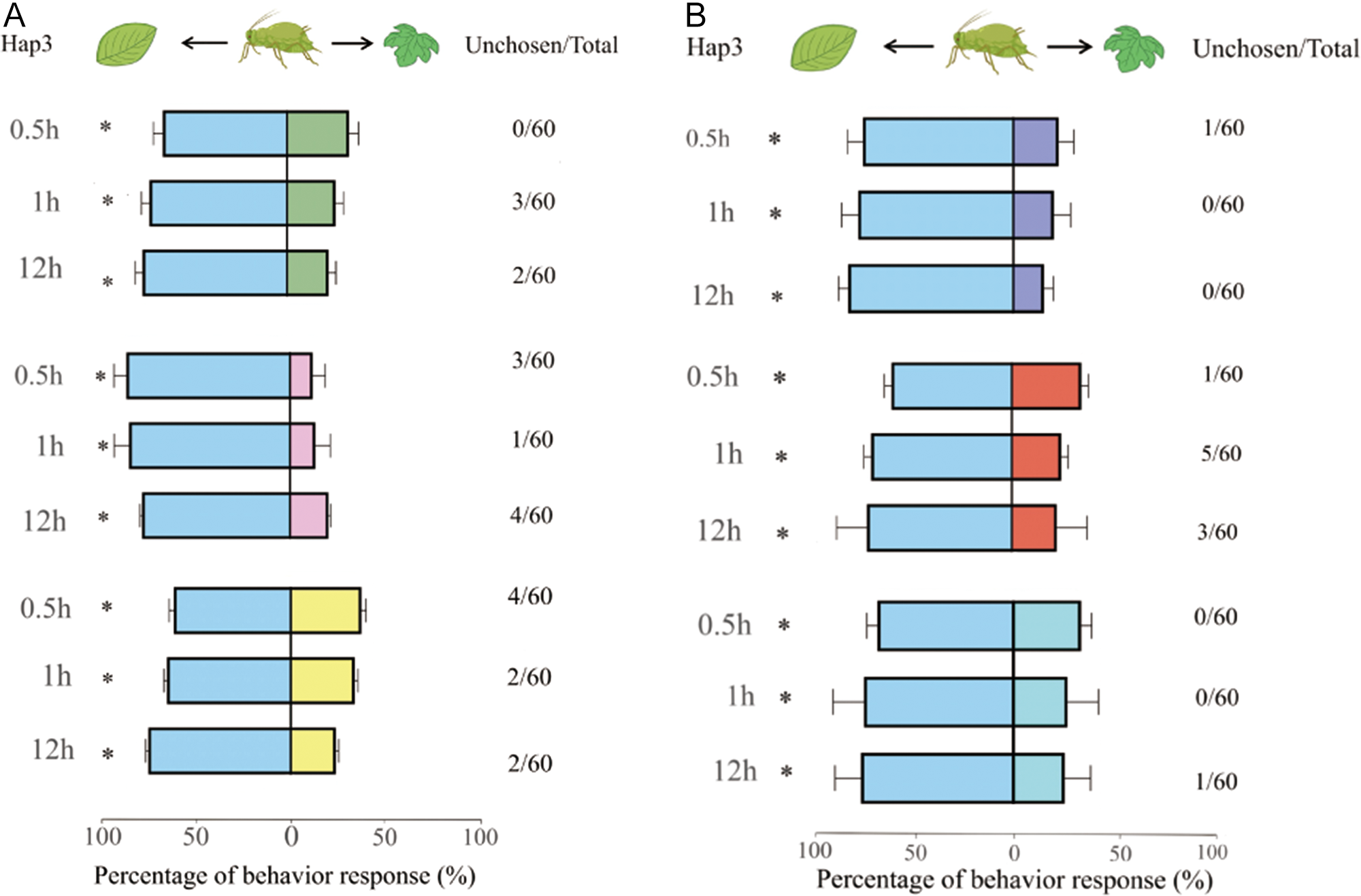
The host selection behaviour of Hap3 and Hap17 A. gossypii was assessed between C. annuum varieties and cucumber. Significant preferences were observed in some cases, while in others, no significant differences were found. The behaviour selection of Hap3 A. gossypii when exposed to cucumber and different varieties of pepper demonstrated significant differences. The experimental results indicate that the selection rate of Hap3 A. gossypii for cucumber is significantly higher relative to any variety of pepper (fig. 2).
Behaviour selection proportion of Hap3 A. gossypii on cucumber and different C. annuum varieties. (A) Behaviour selection proportion of Hap3 A. gossypii on cucumber and SE, LA, LS.  present cucumber (blue),
 present SE (green),
 present LS (yellow),
 present LA (pink). (B) Behaviour selection proportion of Hap3 A. gossypii on cucumber and LZ, HM, CT.
 present LZ (purple),
 present HM (red), and
 present CT (light blue). ‘*’ indicates significant difference at P < 0.05 level by the chi-square test.

Hap3 A. gossypii were simultaneously introduced to SE, LA, LS, LZ, HM, CT leaves, and cucumber leaves. After 12 hours, the population on cucumber leaves consistently increased while the population on all other leaves decreased. Specifically, for SE, the population on SE decreased from 33% to 23%, while the cucumber population increased from 67% to 77%. For LA, the population on LA increased from 14% to 21%, while the cucumber population decreased from 86% to 79%. For LS, the population on LS decreased from 37% to 24%, while the cucumber population increased from 63% to 76% (fig. 2A). For LZ, the population on LZ decreased from 23% to 15%, while the cucumber population increased from 77% to 85%. For HM, the population on HM decreased from 36% to 23%, while the cucumber population increased from 64% to 77%. For CT, the population on CT decreased from 33% to 30%, while the cucumber population increased from 67% to 70% (fig. 2B). At intervals of 0.5 hours, 1 hour, and 12 hours, Hap3 A. gossypii consistently showed a significantly higher preference for cucumber leaves over all other leaves tested.
Similarly, we conducted selection behaviour experiments for Hap3 and Hap17 A. gossypii on different pepper varieties. The results indicated that the aphids’ preference for peppers was not as pronounced as their preference when choosing between cucumber and pepper varieties. As discussed in the previous section, although the selection rate of A. gossypii for cucumber decreased at several time intervals, cucumber was overall significantly more attractive to A. gossypii than any pepper variety. However, the behavioural selection results of A. gossypii on different pepper varieties did not show such a consistent trend.
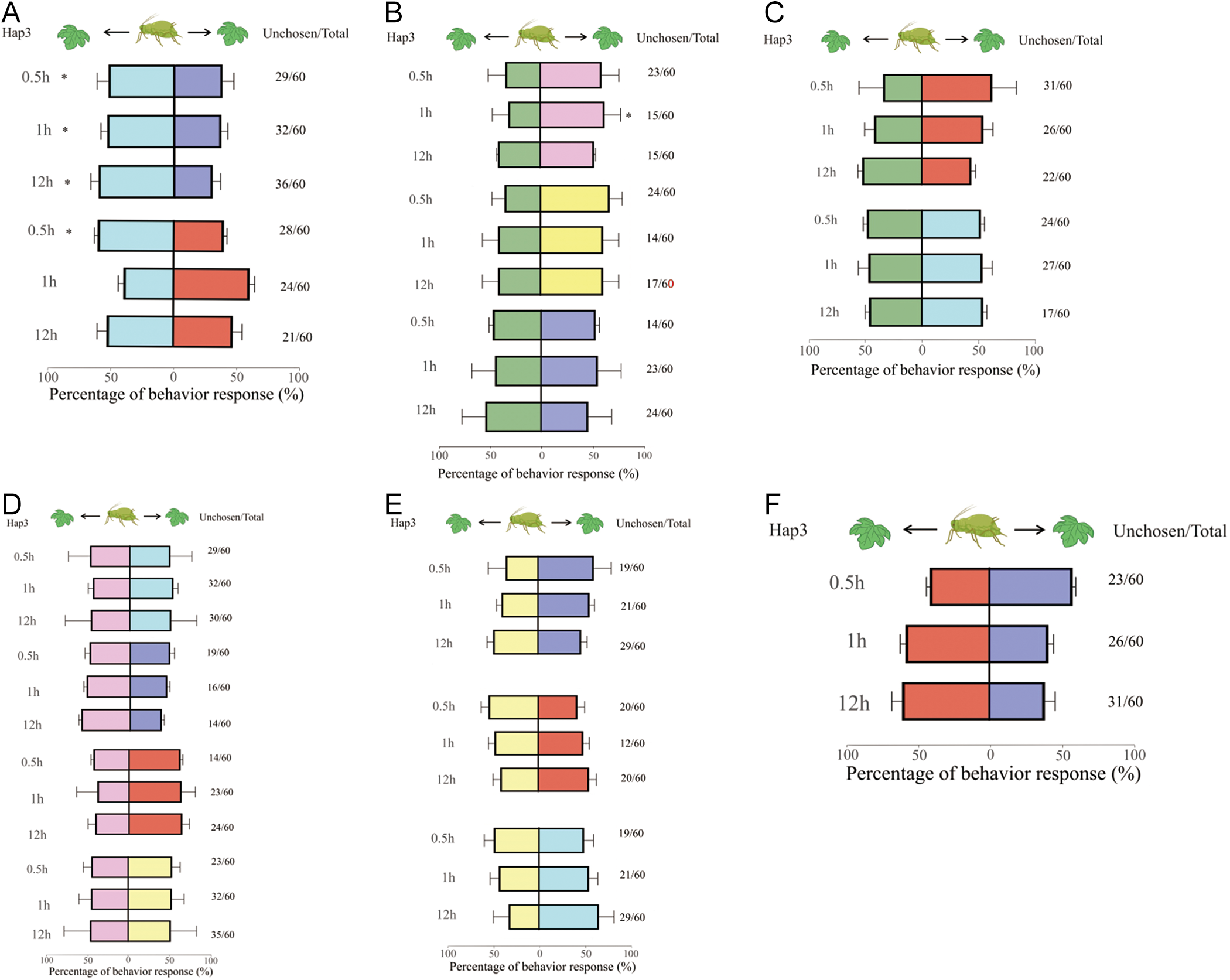
Further analysis of the behavioural selection experiment results shows that Hap3 A. gossypii significantly prefers CT and LZ pepper varieties. In the experiment with LZ and CT, the population on LZ decreased from 45% to 33%, while on CT it increased from 55% to 67%, showing significant differences at 0.5, 1, and 12 hours (fig. 3A). In the experiment with HM and CT, the population on HM increased from 39% to 43%, while on CT it decreased from 61% to 57%. The initial preference was for CT within 30 minutes, but shifted to HM at the 1 hour mark (fig. 3A). When exposed to SE and LA leaves, Hap3 A. gossypii showed a lower preference for SE relative to LA, with a significantly higher preference for LA after 1 hour (fig. 3A). These results demonstrate Hap3 A. gossypii’s varying preferences for different pepper varieties, with notable preferences for CT and LA.
Behaviour selection proportion of Hap3 A. gossypii among different C. annuum varieties. (A) Behaviour selection proportion of Hap3 A. gossypii on CT (light blue) and LZ (purple), HM (red). (B) Behaviour selection proportion of Hap3 A. gossypii on SE (green) and LA (pink), LS (yellow), and LZ (purple). (C) Behaviour selection proportion of Hap3 A. gossypii on SE (green) and HM (red), CT (light blue). (D) Behaviour selection proportion of Hap3 A. gossypii on LA (pink) and CT (light blue), LZ (purple), HM (red), LS (yellow). (E) Behaviour selection proportion of Hap3 A. gossypii on LS (yellow) and LZ (purple), HM (red), CT (light blue). (F) Behaviour selection proportion of Hap3 A. gossypii on HM (red) and LZ (purple). ‘*’ indicates a significant difference at P < 0.05 level by the chi-square test.

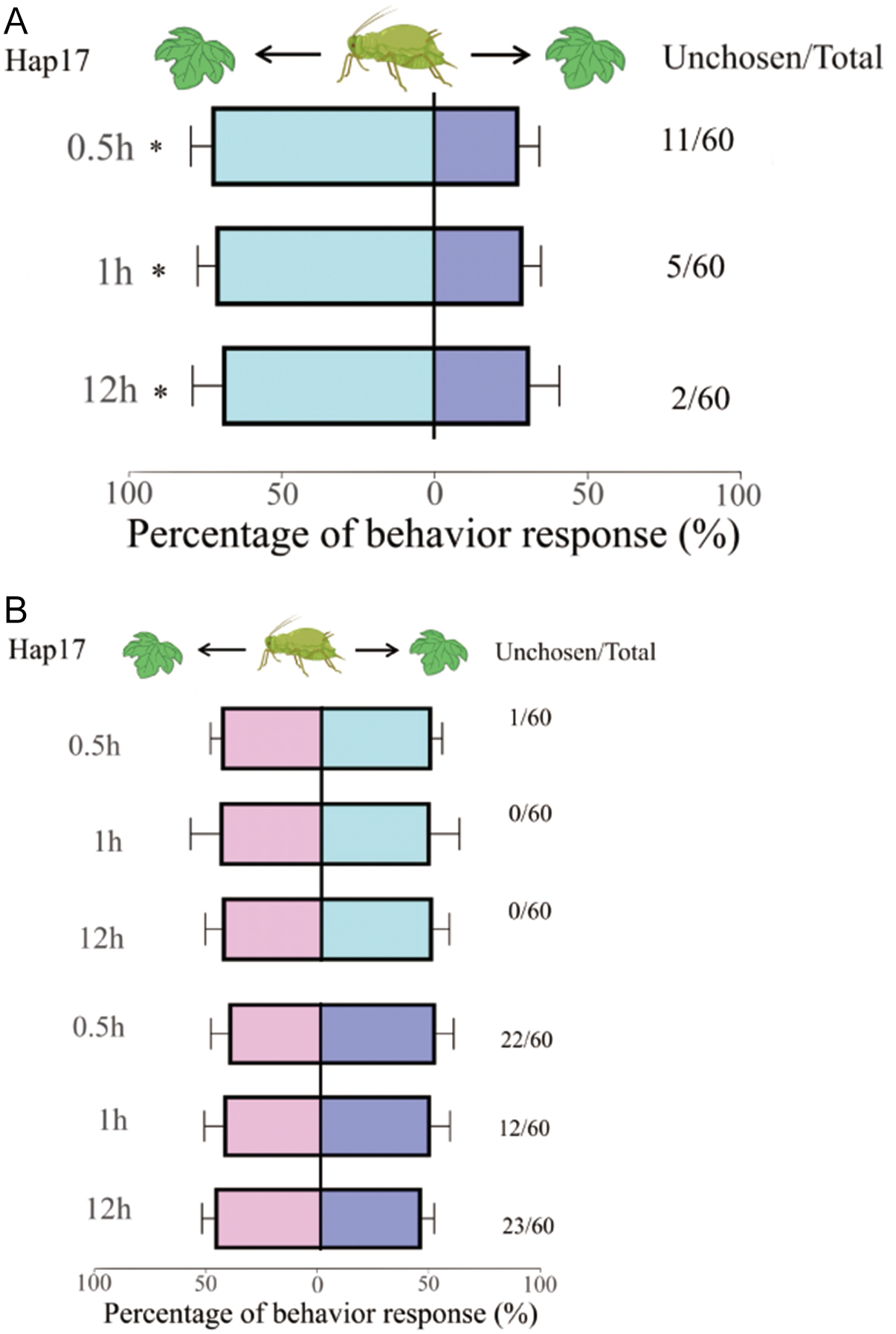
The behavioural selection preference of Hap17 A. gossypii among different pepper varieties is not distinct. Notably, Hap17 A. gossypii exhibited significant differences only between the CT and LZ varieties. After 12 hours of introducing Hap17 A. gossypii to CT and LZ, the A. gossypii population on LZ rose from 23% to 31%, whereas on CT, it fell from 77% to 69%. Hap17 A. gossypii exhibited a marked preference for CT over LZ at 0.5, 1, and 12 hours, showing a significant inclination towards CT (fig. 4).
Behaviour selection proportion of Hap17 A. gossypii on cucumber and different C. annuum varieties. (A) Behaviour selection proportion of Hap17 A. gossypii on CT (light blue) and LZ (purple). (B) Behaviour selection proportion of Hap3 A. gossypii on LA (pink) and CT (light blue), LZ (purple). ‘*’ indicates significant difference at P < 0.05 level by the chi-square test.

Apart from the aforementioned significant differences, the selection of Hap3 and Hap17 A. gossypii for most other pepper varieties exhibited some fluctuations but did not show significant differences. Specifically, after 12 hours of treatment, the Hap3 A. gossypii population fluctuated on both SE (41%–46%) and LS (59%–64%). When introduced to SE and LZ, the Hap3 A. gossypii population slightly increased on the former (47%–52%) and decreased on the latter (53%–48%), showing no significant preference difference. Continuous increases in the Hap3 A. gossypii population were observed on SE (41%–55%) and decreases on HM (59%–45%). Similarly, after 12 hours, the preference ratios between SE and CT showed no significant difference. After 12 hours, Hap3 A. gossypii showed a similar low preference for LA and CT, with populations slightly fluctuating. The populations on LA (45%–47%) and CT (55%–53%) showed no significant difference. Introducing Hap3 A. gossypii to LA and LZ resulted in an increased population on LA (51%–61%) and a decreased population on LZ (49%–39%). HM consistently showed a higher preference than LA. When exposed to both LA and LS, the populations slightly changed, showing no significant difference. In experiments, the Hap3 A. gossypii population increased on LS (40%–51%) and decreased on LZ (60%–49%), showing no significant difference. The Hap3 A. gossypii population on HM increased (43%–56%), while it decreased on LS (57%–44%). Similarly, the Hap3 A. gossypii population decreased on LS (52%–40%) and increased on CT (48%–60%), showing no significant preference. After 12 hours, the Hap3 A. gossypii population decreased on LZ (from 57% to 41%), while it increased on HM (from 43% to 59%). In the experiment with Hap17 A. gossypii introduced to CT and LA, after 12 hours, the Hap17 A. gossypii population on CT slightly decreased (52%–50%) and slightly increased on LA (48%–50%), showing no significant difference. Similarly, when introduced to LZ and LA, the Hap17 A. gossypii population on LZ decreased (52%–46%) and increased on LA (48%–54%), with no significant preference difference.
Discussion
C. annuum is a crucial crop in agricultural production, both for its widespread consumption and its inherent resistance to various agricultural pests. This resistance is largely attributed to the diverse array of natural compounds found in peppers, which play an essential role in pest defence. For example, methyl jasmonate (MeJA) and methyl salicylate (MeSA) have been shown to inhibit the development, reproduction, and population growth of Myzus persicae on peppers (Fan et al., Reference Fan, Chen, Liang, Wu, Liu, Dou and Wu2021). In addition, the total free amino acids, soluble sugars, free proline, and vitamin C in pepper leaf tissues correlate strongly with their resistance to Myzus persicae (Chen, Reference Chen2002). Elevated levels of chlorophyll, soluble proteins, and phenolic compounds contribute further to pest resistance (Li et al., Reference Li, He, Gu, Su, Wu, Zhang, Jie, Wu and Zhou2017). Moreover, tannin content in different pepper varieties has been shown to affect resistance to Frankliniella occidentalis, with resistant varieties maintaining higher tannin levels after thrips feeding (Jia et al., Reference Jia, Pang, Jiang and Wang2018). Additionally, transgenic approaches such as stacking AtEDT1/HDG11 and Cry2Aa2 in pepper plants have significantly enhanced resistance to pests like Prodenia litura, with an 81.3% mortality rate in larvae (Zhu et al., Reference Zhu, Xu, Chen, Chen, Xiang, Chen and Lei2015).
Building on these findings, we further investigated the survival, development, and behavioural preferences of Hap3 and Hap17 A. gossypii on various C. annuum varieties. The performance of both haplotypes was markedly different across the varieties, which highlights the intricate relationship between aphids and their host plants. These findings contribute to a deeper understanding of the complex interactions between A. gossypii and C. annuum, providing valuable insights for pest management strategies. This research not only deepens our knowledge of the intrinsic pest resistance mechanisms in peppers but also provides crucial guidance for breeding new pest-resistant varieties. By analysing the survival rates, developmental speeds, and behavioural preferences of Hap3 and Hap17 A. gossypii on various pepper varieties, we can more accurately identify the plant traits that are critical for resisting these specific pests. These findings will offer new perspectives for the development of agricultural biotechnology, aiding in the design of more effective pest management strategies.
While our experiments provide valuable insights into the survival, development, and host selection behaviour of A. gossypii on C. annuum varieties, the study has several limitations. Firstly, the number of pepper varieties examined is limited, which may constrain the applicability of our findings to other C. annuum cultivars. Additionally, our focus on two specific haplotypes, Hap3 and Hap17, may restrict the broader generalisation of these results to other A. gossypii populations with different genetic backgrounds. The results should, therefore, be considered specific to the varieties and haplotypes tested. Moreover, this study does not address the overall adaptability of A. gossypii across a wider range of host plants or environmental conditions. Future research incorporating a broader selection of C. annuum varieties and additional haplotypes would help to further elucidate the factors influencing A. gossypii adaptability and expand the potential applications of these findings in pest management strategies.
The differences in adaptability observed between Hap3 and Hap17 A. gossypii populations could be attributed to various factors related to the physical and chemical properties of the pepper varieties. One potential mechanism involves leaf texture: rougher surfaces may deter aphid feeding, while smoother leaves may facilitate sap extraction. Key physical traits, such as trichome density, vascular bundle depth, wax content, and leaf colour, may influence aphid behaviour. Increased trichome density and wax content, for example, can act as physical barriers to aphids, whereas smoother leaf surfaces may provide easier access to sap, supporting A. gossypii survival and reproduction (He et al., Reference He, Zhou, Su, Zhao, Shao, Yang, Zhang, Heng, Zhang and Xia2017). Additionally, nutritional components of the host plant, such as free amino acids, sugars, and nitrogen content, may significantly influence aphid survival and reproduction. Varieties with higher concentrations of these nutrients might provide a more suitable environment for aphid development (Guo et al., Reference Guo, Chen, Guo, Du, Yang, Lin, Yang, Wu and Xiao2024). Furthermore, secondary metabolites such as phenolic compounds, tannins, and alkaloids are known to have insecticidal effects, influencing aphid behaviour and survival (Farhan et al., Reference Farhan, Pan, Hussain, Zhao, Yang, Ahmad and Zhang2024). For instance, higher levels of phenolic compounds and flavonoids in certain pepper varieties may act as a deterrent for aphid feeding, thus reducing their reproductive success (Zhao et al., Reference Zhao, Zhang, Yu and Yu2019). These factors, in combination, could explain why certain haplotypes perform better on specific varieties. Investigating the specific role of each of these factors in determining aphid fitness will be essential for a more comprehensive understanding of the mechanisms behind host-plant interactions and aphid adaptability.
In this study, Hap3 and Hap17 A. gossypii fed on different C. annuum varieties, reproducing on most pepper varieties. This is consistent with the findings of Wang et al., who found that the main A. gossypii on C. annuum in the Shihezi region are cotton aphids and peach aphids (Wang et al., Reference Wang, Li, Qu, Wang and Zhao2016), which might be related to the geographical location, crop layout, and climatic conditions of the survey area.
Understanding these interactions not only deepens our knowledge of the mechanisms underlying pest resistance in peppers but also provides crucial guidance for breeding new pest-resistant varieties. By selecting pepper varieties that exhibit lower adaptability to A. gossypii, we can effectively manage and control aphid populations. For instance, promoting varieties such as LA, which show poor adaptability for both Hap3 and Hap17 A. gossypii, in regions heavily infested by these aphids, can significantly reduce aphid-related damage. Additionally, incorporating traits such as rough leaf surfaces, which hinder aphid feeding, or higher levels of defensive secondary metabolites, can further enhance resistance (Chen et al., Reference Chen, Cao, Huang, Wang, Ji and Li2011). This approach leverages the natural defences of the plants and can reduce the reliance on chemical pesticides, leading to more sustainable pest management practices.
Moreover, understanding the specific nutritional and physical traits that confer resistance can be invaluable for targeted breeding programs. By crossbreeding susceptible varieties with resistant ones, we can develop new pepper cultivars that are both high-yielding and resistant to aphids. These breeding programs can focus on enhancing traits such as increased levels of phenolic compounds, which are known to deter aphid feeding, or optimising the plant’s overall health to improve its natural defence mechanisms. Integrated pest management strategies that combine the use of resistant cultivars with other control measures, such as biological control agents and cultural practices, not only help in controlling aphid populations but also contribute to the overall health and productivity of pepper crops. This holistic approach ensures that pest management is both effective and sustainable, benefiting both the environment and agricultural productivity.
Summarising the results of this study: Hap3 and Hap17 A. gossypii are more suited for growth and development on SE and LZ, thus the possibility of outbreaks causing damage on these two C. annuum is higher. Attention should be paid to the fluctuation of A. gossypii populations on these two C. annuum, with real-time monitoring of population dynamics and timely pest control measures. Additionally, it might be worth considering using C. annuum varieties that are less suitable for A. gossypii adaptation as the main crop varieties for aphid pest control.
Financial support
This research was supported by the National Natural Science Foundation of China (Grant No. 32272521).
Competing interests
No potential conflict of interest was reported by the authors.