Legislatures in parliamentary systems are often seen as relatively weak. Bills need formal parliamentary approval to become law, but cohesive parties and the confidence relationship between government and legislature can create the impression of executive dominance. Thus scholars often note how most government-initiated bills and amendments are agreed, while most proposals from non-government actors fail (e.g. Arter Reference Arter1985; Kerrouche Reference Kerrouche2006; Zubek Reference Zubek2011). The Westminster majoritarian system is frequently presented as an extreme case of such dynamics, contrasted with greater assumed legislative influence in multiparty or presidential systems (e.g. Kreppel Reference Kreppel2014; Lijphart Reference Lijphart2012; Martin and Vanberg Reference Martin and Vanberg2011).
Yet recent developments in the UK, and new research approaches, have challenged such assumptions – showing Westminster to have substantial hidden influence of what Blondel (Reference Blondel1970: 78, 82) termed both ‘reactive’ and ‘preventive’ kinds. This raises questions about which groups of non-government parliamentarians at Westminster have influence, and why. Our article addresses such questions by analysing 4,361 amendments proposed to 12 government bills during their UK parliamentary passage. But studying non-government amendment success provokes further questions about actors’ motivations for proposing such amendments – since many are found not actually to be sincere attempts at legislative change. As well as assessing policy influence at Westminster, we thus offer a tentative typology of motivations for legislative amendments with wider potential application.
The remainder of the article is structured in seven parts. We first present some background on legislative decision-making as presently understood, and set out our research questions. We then summarize our methods. Next we present initial quantitative data on the success of non-government amendments at Westminster. This is followed by three sections, in turn, on the roles of opposition frontbenchers, government backbenchers and cross-party groups, drawing on both qualitative and quantitative evidence. Finally we present our conclusions. These indicate that cross-party work and opposition policy proposals are both more important at Westminster than generally assumed, challenging common assumptions in both British and comparative politics. We also argue that non-government amendment ‘failure’ should not be taken at face value, and that a better understanding of the multiple motivations behind legislative amendments – as well as of ‘preventive’ influence – is necessary for the better understanding of legislatures.
Parliaments, Actors and Outcomes
In both comparative studies (e.g. Martin and Vanberg Reference Martin and Vanberg2011; Mezey Reference Mezey1979) and accounts of domestic politics (summarized in Flinders and Kelso Reference Flinders and Kelso2011) the UK parliament is typically presented as weak. While similar claims are made in many other parliamentary systems, the ‘Westminster model’ is particularly closely associated with legislative weakness and excessive executive control (Lijphart Reference Lijphart2012).
But recent changes at Westminster have been significant. In the House of Commons, the departmental ‘select committees’ have grown in strength and reputation (Benton and Russell Reference Benton and Russell2012; Kelso Reference Kelso2009), while party voting cohesion has gradually declined (Cowley Reference Cowley2002, Reference Cowley2005; Cowley and Stuart Reference Cowley and Stuart2012). In the House of Lords, a reform in 1999 that removed most hereditary peers and created a ‘no overall control’ chamber gave members both greater confidence, and greater potential, to challenge government policy (Russell Reference Russell2010, Reference Russell2013). The failure of any party to gain an overall Commons majority in 2010 then brought Britain closer to the European norm, producing its first post-war coalition government.
Scholars studying Westminster have thus begun making more sophisticated use of data to chart clear evidence of influence (e.g. Benton and Russell Reference Benton and Russell2012; Cowley Reference Cowley2002, Reference Cowley2005; Russell Reference Russell2013; Russell and Sciara Reference Russell and Sciara2008; Thompson Reference Thompson2013). We added to this, with a detailed study of 12 government bills between 2005 and 2012, proposing six ‘reasons for doubt’ regarding executive dominance at Westminster (Russell et al. Reference Russell, Gover and Wollter2015). Ours was the most detailed research on the British legislative process since the major study by Griffith (Reference Griffith1974) over 40 years ago, and we believe it is unrivalled in recent studies of other domestic parliaments. Tracking 4,361 legislative amendments, we demonstrated that although almost all agreed amendments were proposed by ministers, 70 per cent of government amendments had little policy substance, while 60 per cent of those with substance followed pressure from non-government parliamentarians. Too literal a reading of amendment outcomes thus risks overstating both government success and non-government failure. It also overlooks parliament’s significant influence before and after the formal legislative process.
If there is, as various scholars claim, ‘increasing influence’ at Westminster (Ryle Reference Ryle2005: 11), this raises questions about which group(s) in parliament the government listens to, and why. These questions were addressed by Anthony King’s (Reference King1976) now classic analysis, which is also four decades old. King compared ‘modes of executive–legislative relations’ in Britain, France and Germany, suggesting that the ‘opposition mode’ was ‘the one in which the larger part of party politics in Britain [took] place’. Yet there was little expectation that such confrontations had policy effect, as in a majoritarian setting the ‘Government fully expects the Opposition to make hostile speeches. It does not need, or want, the Opposition’s moral support . . . [or] votes’ (King Reference King1976: 18). More recent analyses conform to this assumption, presenting oppositions in majoritarian settings as essentially office- rather than policy-seeking, with ‘the UK model . . . a standout case of negative rather than constructive oppositional politics’ (Andeweg Reference Andeweg2013; Helms Reference Helms2004, Reference Helms2008; Kaiser Reference Kaiser2008; Norton Reference Norton2008; Uhr Reference Uhr2009: 67). Such authors assume that policy-seeking opposition is more prevalent in ‘consensus’ style democracies, though a recent study of legislative amendments in two such parliaments failed to bear this out (Martin and Vanberg Reference Martin and Vanberg2005).
Turning to other ‘modes’ at Westminster, King emphasized that when the governing party has a Commons majority, and the Lords is weak, the key swing voters are its own backbench MPs. The primary dynamic in terms of influence was thus the ‘intraparty mode’. In contrast, the ‘interparty mode’, key to coalition politics in Germany, and also visible in France, clearly did not apply. The ‘cross-party mode’ – also important in Germany thanks to specialist committees (and the Bundesrat, although King did not consider intercameral aspects) – was likewise judged so weak as to be non-existent. But subsequent changes at Westminster may well have changed these dynamics.
Our previous article (Russell et al. Reference Russell, Gover and Wollter2015) did not explore the relative success rates of amendments from different kinds of non-government parliamentarians. Griffith’s (Reference Griffith1974) earlier study found that more opposition amendments than government backbench amendments went on to be taken up but that the overall success rate of opposition amendments was low – because they were so numerous. Nonetheless our findings emphasized that the apparent ‘failure rate’ of non-government amendments was misleading – partly because some of the amendments lead to ministerial proposals, but also because non-government parliamentarians freely admit that their amendments are often not sincere attempts at legislative change. This is consistent with the acknowledged diverse motivations of opposition parties (see above), and also studies of the interparty politics of coalition (e.g. Martin and Vanberg Reference Martin and Vanberg2008). Scholars conducting other amendment analyses have likewise noted that ‘[a]mendments may have one or more of a great variety of purposes’ (Griffith Reference Griffith1974: 37). Hence Shephard and Cairney (Reference Shephard and Cairney2005: 307) observed that proposers of amendments in the Scottish Parliament may have ‘masked motives’ of ‘numerous’ kinds, while Earnshaw and Judge (Reference Earnshaw and Judge1996: 102) acknowledged the difficulty of measuring influence in the European Parliament, given the ‘propagandistic’ nature of some amendments. But to date, while the diversity of motivations for amendments has been noted, no systematic typology has been proposed.
So we are now left with several questions. The first concerns influence in British politics, in terms of which actors at Westminster achieve changes to legislation and why. Echoing King (Reference King1976), we first focus on the separate contributions of the opposition frontbench and government backbenchers. We then consider cross-party working, to explore whether recent changes have indeed strengthened this ‘mode’, bringing Westminster more into line with other European legislatures. Our assessment considers both visible ‘reactive’ influence, through amendments, and less visible ‘preventive’ influence (Blondel Reference Blondel1970), through the government seeking to anticipate legislative concerns. In addition, given how central Westminster is to the wider literature, we ask how these findings can inform the study of parliamentary actors’ strategies more generally, both in majoritarian and consensus settings. In particular, we explicitly link the literature on such strategies to that on legislative amendments to develop a typology of motivations for proposing such amendments, mapped onto different groups. We argue that the influence of legislative institutions will always be understated, and perhaps underappreciated, unless the diversity of motivations for non-government amendments is better understood.
Methods and Data
Our analysis uses 12 government bills at Westminster: seven in the 2005–10 parliament (when Labour was in government) and five from 2010–12 (under the Conservative/Liberal Democrat coalition).Footnote 1 Although such a small sample can never be completely representative, the bills were selected on a range of indicators – for example, coming from different government departments, having varying length and levels of controversy, and starting their parliamentary passage in the Commons or Lords.
Our starting point is all 4,361 amendments proposed during these bills’ passage through both chambers of parliament – as summarized in Table 1. There are seven stages when amendments may potentially be agreed – three in the Commons, and four in the Lords – including the stages when each chamber considers the other’s amendments, which may occur repeatedly. When disputes arise, the Commons can as a last resort override the Lords, but most disagreements are instead resolved through negotiation (Russell Reference Russell2013).
Amendments Proposed to 12 Case Study Bills, by Legislative Stage and Outcome

In terms of outcomes, almost a thousand amendments were agreed, and only 135 rejected, with or without a division (that is, a recorded non-unanimous vote). But three-quarters were not formally decided on at all – for example, because they were not selected, not moved, or withdrawn.Footnote 2 Nonetheless, many of these amendments were debated, and some went on to be influential, as further discussed below.
We coded all of these amendments on a range of key variables. Some – such as the party (or parties) of the parliamentarian(s) proposing the amendment – were objective and straightforward. Others – such as the amendment’s policy substantiveness, or proposed legislative effect – were less so. But we used a detailed coding scheme, and each researcher’s codes were checked by another. The building of our data set drew on, but also went significantly beyond, the methods used in previous amendment analyses (e.g. Griffith Reference Griffith1974; Kreppel Reference Kreppel1999; Shephard and Cairney Reference Shephard and Cairney2005) – in particular to deal with the lengthy nature of the Westminster legislative process. By coding the proposers of individual amendments, and including both those that succeeded and those that failed, we also went beyond studies that ascribe influence solely on the basis of policy outcomes and known party positions (e.g. Martin and Vanberg Reference Martin and Vanberg2005).
We traced influence by linking each amendment to any others with similar effects proposed at earlier or later stages, in what we called legislative ‘strands’. The shortest strands involved relatively unique amendments, occurring at just one legislative stage, while the longest comprised 14 such stages. At any one stage, a strand could include only one legislative proposal (that is, a lead amendment and any associated consequential amendments) proposed by one actor/group – unless one of the actors was government.Footnote 3 This reduced the 4,361 amendments to 2,050 distinct legislative strands. Of these, 300 could easily be judged ‘successful’ because they included at least one amendment (usually from a minister) which was agreed and not subsequently overturned. An additional 176 strands also contributed to policy changes, usually because a successful amendment was made in a related strand.Footnote 4 Hence 476 strands in total were judged ‘not unsuccessful’. The remaining 1,574 were wholly unsuccessful, resulting in no policy change.
The construction of strands allowed us to chart otherwise hidden influence. Because government amendments were grouped with any related non-government proposals, the policy effects of these could be seen. Typically, non-government amendments are withdrawn (sometimes at one stage, sometimes repeatedly), following ministerial promises to reflect, or to bring forward revised proposals.Footnote 5 Importantly, the method also allowed us to trace which groups’ proposals ultimately attained success. Plus it avoided ascribing spurious influence to non-government amendments that passed, but were later overturned.
In addition to coding amendments and strands, we conducted over 120 interviews with policy actors closely involved with the case study bills (and draw quotations from these below). Interviewees included front and backbenchers in both chambers from government and non-government parties, civil servants, parliamentary officials and representatives of outside lobby groups. The interviews helped to validate our quantitative analysis, but primarily helped to uncover behind-the-scenes negotiations, and explore actors’ motivations and strategies.
Measuring Legislative Influence Through Amendment Success
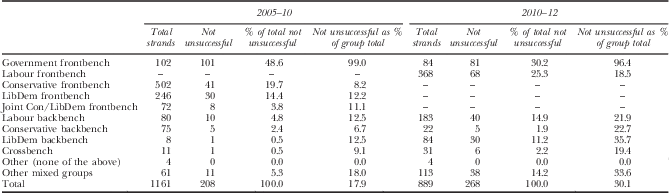
The crudest use of this data would be to look at the success rates of government and non-government amendments. Of our 4,361 amendments, 886 were proposed in the name of a minister, and 839 (95 per cent) of these were agreed.Footnote 6 The remaining 3,475 came from non-government actors (that is, backbenchers, opposition frontbenchers or non-party parliamentarians) – of these just 125 were agreed,Footnote 7 of which 99 were overturned later in the process (a visible success rate of below 1 per cent). Yet, as indicated above, our analysis demonstrated that just one-third of government amendments had policy substance, and a majority of these responded to points raised by non-government parliamentarians (Russell et al. Reference Russell, Gover and Wollter2015).Footnote 8 As Table 2 shows, legislative strands allow us to explore who these non-government actors were. Because of the change of party positions in 2010, figures are shown separately for 2005–10 and 2010–12.
Outcome of Strands, by Group(s) Sponsoring Initial Amendment(s)

During 2005–10, 208 legislative strands helped initiate policy change.Footnote 9 Just under half of these originated with the government, but the majority (107) began with non-government amendments. The two opposition parties – individually or jointly – initiated by far the largest number of strands – 820. Of these, 79 (9.6 per cent) ended in some kind of policy success. In contrast, government backbenchers initiated only 80 strands, of which just 10 (12.5 per cent) resulted in policy change. Thus, opposition-initiated strands succeeded more frequently, but in terms of the proportion of each group’s amendments, government backbenchers may have been marginally more successful. However, a chi-squared test shows no statistically significant difference between the two.
In 2010–12 the pattern was similar, with hundreds of strands initiated by the main opposition party (Labour) and just over 100 by government backbenchers. The proportion of non-government-initiated strands resulting in change was markedly higher than for 2005–10, though this was somewhat skewed by events on one particular bill.Footnote 10 Again, the largest number of non-government-initiated strands resulting in change came from opposition frontbenchers, but the success rate of government backbenchers – particularly Liberal Democrats – appeared somewhat higher (33.0 to 18.5 per cent). A chi-squared test does indicate significance (p<0.01), but the numbers are small.
The numeric data thus do little to suggest that government backbenchers are Westminster’s most influential non-ministerial actors. The greater overall number of successful legislative initiatives come from the opposition. This group makes a particularly large number of proposals – but its success rate is relatively poor. To gain a fuller understanding of these data, more qualitative exploration is needed, which we turn to next. Ministers almost invariably move amendments only when they actually wish to see change to a bill, and can generally rely on their Commons majority to achieve this. In contrast, non-government parliamentarians, having less ability to garner a majority in the division lobbies, may propose amendments for various other reasons.
Opposition Frontbench
We start with the opposition frontbench, which is responsible for by far the largest number of both amendments and legislative strands. Across the 12 bills, 1,116 strands (and 2,028 amendments) originated with frontbenchers in one or other of the main opposition parties.Footnote 11 Yet almost 90 per cent of these proposals had no discernible legislative effect.
Given that scholars often divide opposition strategies into office-seeking in majoritarian democracies such as Britain, and policy-seeking in more consensus settings (Helms Reference Helms2004), this lack of visible influence is hardly surprising. Scholars classically suggest that for opposition politicians Westminster serves as ‘merely a forum from which to influence the next election . . . not an arena to influence public policy’ (Andeweg Reference Andeweg2013: 102), primarily providing a forum for the opposition to present itself as a credible alternative government. As the UK’s longest-serving opposition leader of the twentieth century, Neil Kinnock, has put it, ‘the only test of a good opposition is to stop being in opposition’ (Reference Kinnock2011: 131). This group’s real focus is thus traditionally longer-term electoral success, not short-term policy impact.
In this respect it could be seen as odd for opposition parties to propose so many legislative amendments – implying that these are driven by other motivations, beyond actual legislative change. Opposition interviewees freely admitted this to us. Interviews suggested four additional broad categories of motivation, which we call information seeking, policy signalling, political gameplaying and procedural devices.
Information seeking
It is widely noted that the role of ‘Her Majesty’s Loyal Opposition’ is particularly well-established and institutionalized in the British system, giving the main opposition party a clear function in subjecting government policies to scrutiny (Helms Reference Helms2004; Johnson Reference Johnson1997; Norton Reference Norton2008). It – and to some extent the smaller opposition parties – is formally recognized through ‘opposition days’ for debate, privileges during question times and other debates, and informally through frequent selection of its Commons amendments.Footnote 12 This gives the main opposition party significant agenda-setting power, in return for which its frontbenchers take the lead in subjecting bills to scrutiny. And at Westminster, legislative debate is structured primarily around amendments. These form the main tool for extracting information about the government’s policy intent, resulting in large numbers of so-called ‘probing’ amendments, particularly at the committee stage (where the main clause-by-clause scrutiny occurs). In total there were 1,485 opposition frontbench amendments at this stage. In interview frontbenchers freely admitted that they, for example, ‘just wanted to have a brief debate to understand what [the government] were going to do’ using amendments ‘never intended to appear on the face of the bill’, and which would even ‘make the bill make no sense’. This process hence enables parliamentarians to test policy robustness and identify possible flaws.
Signalling
A second function of opposition amendments is signalling policy alternatives, again with no serious expectation of changing the bill. Publicity is central to opposition strategy (Uhr Reference Uhr2009), and signalling of other kinds is an acknowledged opposition tactic – for example, through the introduction of bills (Brunner Reference Brunner2012), or ‘issue politicisation’ using agenda-setting power (Seeberg Reference Seeberg2013). The true audience for such signals is not government, but the media, interest groups and wider electorate. As one frontbencher told us, amendments of this kind allow you ‘to put your stall out’ and say ‘we completely disagree with what you’re saying, this is what we would do’. This may both help frame wider debates outside parliament and develop the opposition’s own policy thinking. Some signalling amendments are not even particularly focused on the bill under discussion (though must be presented as such, if not to be ruled out of order). One opposition frontbencher described debate on a bill as an ‘opportunity to talk about the wider economic issues, because the bill itself was pretty dull or didn’t offer much political capital’.
Political gameplaying
Other amendments are simply mischievous. As Griffith (Reference Griffith1974: 38) suggested, ‘[t]he purpose of many Opposition amendments is not to make the bill more generally acceptable but to make the Government less generally acceptable’. These amendments primarily seek not to advertise the opposition, but to embarrass or split the government, and may take two main forms. Some are substantive, described by interviewees as ‘the ideological ones’ or ‘straight political’, being designed to ‘hijack the bill and highlight the bill’s inadequacies . . . in no way to improve the bill’. So in one case the objective was, ‘just to make the government have to say “yeah, we want to cut benefits”’. After 2010, many Labour opposition amendments sought to destabilize the coalition, particularly through forcing the centrist Liberal Democrats to vote for apparently ‘right-wing’ policies. Other amendments instead facilitated procedural complaints – for example, allowing opposition frontbenchers to argue that insufficient time for debate had been provided. We were told that at committee stage, ‘you’ve got to be seen using up all those sessions’, and ‘there are various tricks that you can use to string it out’ – including tabling numerous amendments. Likewise opposition frontbenchers ‘can’t not bring amendments forward at report stage, because then it looks like either the government’s doing something right or we’re not interested’.
Procedural devices
A fourth opposition tactic is also procedural but more constructive, by using some amendments to manipulate the timing of debates and hence facilitate discussion of others. Parliamentarians want key amendments debated in ‘prime time’, so that colleagues are present to vote, and the media may hear the arguments. This matters particularly in the Lords, where lighter whipping makes it hard for the opposition to win votes late at night. Hence frontbenchers explained that ‘sometimes you would put some [amendments] down to, not exactly to make the sitting longer, but to work out a timetable’. It is thus important to ‘have some amendments that you could drop’.
Although strict quantification would be difficult (in part because they are not mutually exclusive), the great majority of opposition frontbench amendments at Westminster almost certainly fall into one of these four categories. Hence, if such amendments fail to change the wording in a bill, it would be far too simplistic to interpret this (as many casual observers are prone to do) as a sign of opposition failure. For the opposition frontbench, ‘success’ may instead come in various other forms.
Given these multiple motivations, and the government’s natural hostility to opposition amendments, it is perhaps surprising that so many strands coded ‘not unsuccessful’ – 139 in total – originated with one of the main opposition parties. Despite scholars’ established expectations of Westminster opposition, a final motivation is thus clearly to change the bill, though this admittedly blurs somewhat with other motivations set out above. If probing amendments uncover government vulnerabilities, or signalling attracts significant outside support, more policy-oriented amendments may follow at later stages. In addition some opposition frontbench amendments – particularly in the less confrontational settings of Commons committee stage or the Lords – are from the outset constructive attempts to present workable policy alternatives.
Of the 139 ‘not unsuccessful’ opposition-initiated strands, just 20 were resolved wholly within the Commons and with no involvement by government backbenchers.Footnote 13 The Commons opposition can very rarely win a vote against a majority government (and any surprise committee stage defeats can normally be easily overturned on report). The 20 cases included Conservative committee-stage amendments to remove an exemption for public authorities with a duty of care towards children from the Corporate Manslaughter and Corporate Homicide Bill, and to explicitly include an offence of ‘manufacturing’ false ID cards in the Identity Cards Bill.Footnote 14 But most opposition frontbench-initiated strands with policy effect clearly involved either the Lords (in 105 cases) and/or related Commons amendments with government backbench support. Since 1999, the opposition has had the potential to inflict defeat on government through the ‘no overall control’ House of Lords, though many opposition-inspired changes to the bills in the Lords were also achieved through negotiation. Since defeats require cross-party support, and even consensual Lords changes depend to some extent on ministerial concerns about such cross-party alliances forming, we discuss these issues separately below.
Government Backbenchers
In contrast to opposition frontbenchers, just 186 of 2,050 strands (9.1 per cent) were initiated solely by government backbenchers. In terms of success rates, while the proportion of opposition policy initiatives succeeding might seem high from a traditional Westminster perspective, the proportion of backbench-initiated strands leading to policy change (24 per cent across the whole period) demonstrates little sign of the centrality of King’s (Reference King1976) ‘intraparty mode’. However, an examination of motivations behind amendments, plus consideration of government’s relationship with its backbenchers, again shows a more complex situation. Here our results found elements of continuity between backbench behaviour under the single-party Labour government before 2010 and the post-2010 coalition, but also some elements of discontinuity, as noted below.
Government backbenchers share some, but not all, of the motivations ascribed to opposition frontbenchers. ‘Information seeking’ (probing) amendments are sometimes moved to explore a bill’s meaning or the government’s intent in its implementation, but most of this work is left to the opposition. Backbenchers also occasionally use procedural devices to facilitate other sincere amendments. In contrast, ‘political gameplaying’ is unlikely on the government’s own side. ‘Signalling’ is also rare, but not unknown – and became more common under the coalition. Before 2010 some Labour MPs (particularly established mavericks) used amendments as signalling devices to groups outside parliament – as, for example, when some backbenchers proposed a new clause to the Employment Bill to reform strike balloting arrangements. This was unrelated to the bill’s core topics, and Labour frontbenchers strongly resisted it (with opposition support). But it sent clear signals to left-wing trade unions and activists.
Under the coalition government, UK scholars have noted the Liberal Democrats’ ‘serious problem . . . [of] signalling to the public their distinctive contribution in [the Conservative-led] government’ (Yong Reference Yong2012: 115). Studies of coalition elsewhere suggest that parliament can provide a forum to signal policy differences between the partners (e.g. Martin and Vanberg Reference Martin and Vanberg2008, Reference Martin and Vanberg2011). We found some evidence of this, with interviewees reporting critical Liberal Democrat backbench amendments having been unofficially sanctioned by the party’s frontbenchers, either to bolster their negotiating strength within the coalition or to placate party activists. Despite this party’s far smaller size, its backbenchers notably initiated far more strands (84 to 22) than Conservatives in this period.
Government backbenchers mostly do not wish to embarrass the government or delay its legislation, so their amendments will more often be serious attempts to alter policy. Nonetheless, not all seek immediate legislative change, and here there are two other important motivations.
Attempts at non-legislative change
Since most government backbenchers broadly support the direction of policy, their amendments often focus on the detail. Demands may thus be satisfied through changes short of amending the bill itself – for example, by promises from ministers about future policy guidance to public authorities, increased funding, or simply clear statements in Hansard about the bill’s interpretation (notably, these can have legal force in the British courtsFootnote 15 ). Hence ministers’ precise wording in response to amendments is occasionally negotiated with backbenchers behind the scenes. The same can occasionally apply to the opposition, but backbenchers’ demands, being more modest, may be more easily satisfied. They also have less interest in visible ‘victory’ on the face of the bill.
Markers for the future
Given government backbenchers’ general sympathy with the prevailing policy direction, they often play what interviewees described as a ‘long game’: using debates on a bill to flag future policy priorities. As one backbencher put it, ‘I wasn’t planning to try and seriously get any amendments to the bill’, but rather making proposals for ‘things I wanted ministers to think about’. Another spoke of private meetings that ‘strike some kind of a deal to say, look, what I want is the minister to say warm words about this amendment’. This can feed future policy development, within either the governing party or the executive. Such amendments could be seen as another form of ‘signalling’, but differ by targeting the government itself, and sincere policy negotiation, rather than broadcasting policy differences to the outside world.
As with opposition frontbenchers, government backbench ‘failure’ cannot thus be taken at face value, as the parliamentarians may feel they have achieved their goals without changes to the bill. Yet a final motivation for their amendments is, of course, achieving immediate legislative change. And there are obvious reasons why the government should take such amendments seriously. As King (Reference King1976: 15) put it, ‘ministers have needs of Government backbenchers. They need their moral support. They need them not to cause rows and to make hostile speeches that will attract publicity. They need, above all, their votes.’ Whips may try to rein in errant backbenchers, but if they propose serious amendments with wide backing, ministers may be forced to think again. One former minister explained, ‘you’d be barmy’ not to listen to backbenchers on the government side, whereas confronted with opposition objections you can ‘just plough on’.
The fact that few changes were driven solely by government backbench amendments does not necessarily indicate backbench weakness; indeed, it could be interpreted as the reverse. If the relationship between parliament and government is viewed as one between principal and agent, a lack of conflict may simply signify the agent acting as the principal desires (McGann Reference McGann2006; Strøm Reference Strøm2000). Ministers and their backbenchers share broadly similar policy objectives, so it is unsurprising if the former often act as the latter want. But where ministers face pressures to introduce controversial measures, and must think through parliament’s likely reaction, as one former minister told us, ‘your own backbenchers are the ones you worry about the most’. This dynamic is expressed by Blondel’s (Reference Blondel1970: 78, 82) ‘preventive’ rather than ‘reactive’ legislative power – which has conventionally resided largely with government backbenchers. We thus found examples of policies being amended prior to introduction to satisfy government backbench concerns – a dynamic which may usually result in a ‘watering down’ of government initiatives, but at times can also drive policy introduction. The Corporate Manslaughter and Corporate Homicide Bill had been pressed on government for years by its backbenchers (and trade unions, and the wider party) and was introduced only reluctantly by civil servants and senior ministers. One government insider, explaining why this happened, commented that there is ‘constant’ pressure from government backbench MPs and ‘you have to reach a sort of modus vivendi with them and . . . have some policy agreement on some issues that they think are important’. Yet such dynamics are largely invisible to the outside world.
In terms of the relatively small numbers of concessions to government backbenchers in parliament, under Labour these included new provisions to ‘name and shame’ offenders in the Corporate Manslaughter Bill, and to extend provisions in the Saving Gateway Accounts Bill to recipients of carers’ benefit. More such concessions were given under coalition, primarily in response to backbench Liberal Democrats. But we found little evidence of an ‘interparty’ parliamentary mode, with the junior coalition partner using parliament to ‘police the bargain’ as other studies have suggested (Martin and Vanberg Reference Martin and Vanberg2004, Reference Martin and Vanberg2011). In the 2010 coalition almost all departments included ministers from both parties which, alongside a complex range of interparty bodies inside the executive, primarily fulfilled this purpose instead. Hence changes responding directly to backbench Liberal Democrat amendments – like those under Labour – tended to be small.Footnote 16 Larger changes, in contrast, involved elements of cross-party working, as we discuss next.
Cross-party and Non-party Working
King (Reference King1976) suggested that cross-party working was weak to non-existent at Westminster. But since then much has changed – in terms of declining party cohesion and the establishment of specialist committees, followed by the change to a ‘no overall control’ House of Lords. In the latter forum from 1999 to 2010 the two main opposition parties could jointly fairly readily defeat the Labour government, while after 2010 Labour could defeat the Conservative–Liberal Democrat coalition if supported by sufficient independent Crossbenchers. Such defeats have become fairly commonplace, often resulting in government climbdowns (Russell Reference Russell2013; Russell and Sciara Reference Russell and Sciara2008).
In both chambers, government backbenchers cannot inflict defeats unless their amendments can gain opposition support, while even in the Lords opposition frontbenchers know that they will struggle ultimately to succeed if government backbench opinion is solid, since hostile amendments can be overturned in the Commons.Footnote 17 Thus growing incentives exist for cross-party working. The select committees, which are increasingly respected for their expert status and non-partisan cross-party ethos, add to this. They have no formal role in amending legislation (the committee stage instead occurring on the floor of the chamber or in a Commons ‘public bill committee’). But some Lords and joint committees routinely report on bills from a constitutional perspective, while Commons departmental select committees also occasionally comment.
In terms of visible influence through amendments, cross-party collaboration on changes to bills in our sample took two forms – largely mirroring these two opportunities. First, informal coalitions of support around particular proposals, and second, formal interventions from select committees. We deal with informal coalitions first.
Up to this point, we have considered party groups proposing amendments largely as separate: opposition frontbench or government backbench. But Table 2 indicated that cross-party support is also fairly common. This can involve joint working between two opposition parties, an opposition party and government backbenchers, or the inclusion of others. In the Commons these were limited to small numbers of MPs from Northern Ireland parties, and nationalists in Scotland and Wales; in the Lords they mostly comprised the (very numerous) Crossbenchers.Footnote 18 Table 2 shows that 133 legislative strands in 2005–10 began with amendments sponsored on a cross-party basis (broadly defined, to include non-party parliamentarians). A marginally higher proportion of these (14.3 per cent) resulted in change than amendments initiated by any single non-government group. In 2010–12 the number of such initiatives remained stable (mostly comprising Labour/Crossbench partnerships in the Lords), and at 33.6 per cent their success rate substantially exceeded that of the opposition.
However, Table 2 reflects only the proposers of the initial amendment(s) in each legislative strand, and cross-party cooperation goes far further. In terms of measurable support demonstrated through amendments, other actors may sign related amendments later in a strand, or in a very similar ‘sibling’ strand.Footnote 19 Including these indicators within the definition, 25 per cent of non-government-initiated strands in 2005–10 and 27 per cent in 2010–12 could be considered to be cross-party.Footnote 20 Cross-party initiatives were markedly more common among Lords-only strands (25 per cent over the whole period) than Commons-only strands (12 per cent), but were most common among strands pursued across both chambers (50 per cent, or 191 of 385). These latter cases were the ones where the government came under the most sustained pressure, both cross-party and intercamerally. Crucially, policy change was far more likely to result from strands demonstrating cross-party support (as just defined): 20 per cent of such strands were coded ‘not unsuccessful’ in 2005–10, compared with 7 per cent of those with only single party support; in 2010–12 the equivalent figures were 33 per cent and 20 per cent (in both cases, chi-squared p<0.001). Beyond signing up to amendments, other forms of cross-party collaboration (not reflected in these figures) will increase the pressure: such as behind-the-scenes conversations, speeches in debate and crucially – should an amendment be pushed to that point – votes in the division lobbies.
These statistics give little feel for how informal cross-party coalitions at Westminster tend to come about. They may begin with a joint-sponsored amendment, but more often in an uncoordinated way, through similar amendments proposed by more than one group at committee stage. If these uncover government weaknesses, groups may join forces, with more determined attempts at report stage or (for the majority of bills that begin in the Commons) on arrival in the Lords. If there is a real desire for policy change, initial proponents actively seek out new supporters. Lords interviewees particularly emphasized how cross-party working was a key means for getting ministers to listen. One Conservative frontbencher, reflecting on Labour’s time in government, said that ‘the real trick was to have four names: one Conservative, one Liberal Democrat, one Crossbench and one Labour’. Indeed one opposition frontbencher in the Lords commented that when proposing amendments ‘it’s partly a signal to the government that you’re not serious if you do it [only] in your own name’.
Returning to motivations, explicit, organized cross-party initiatives fit relatively easily into the categories above. Coordination on probing or political gameplaying is unusual, while procedural devices are in any case fairly rare. This leaves signalling, and genuine attempts at (legislative or non-legislative) policy change. During 2005–10, joint signalling by the two opposition parties occurred frequently, as a means of making the Labour government appear isolated – as, for example, when Conservative and Liberal Democrat frontbenchers worked together to demonstrate their libertarian credentials in opposing the Identity Cards Bill. Likewise, Labour made considerable efforts after 2010 to enlist respected Crossbench ‘experts’, for example in attacking the coalition’s so-called ‘bedroom tax’ in the Welfare Reform Bill. But generally, given the makeup of the Lords, such initiatives were partly genuine attempts at policy change.
The biggest policy reversals on the case study bills tended to occur on amendments demonstrating broad cross-party support. For example, a proposal to extend the new corporate manslaughter law to deaths in (police, etc.) custody began with the Labour chairs of two select committees in the Commons. It was then pursued by a joint opposition alliance in the Lords, headed by Crossbench expert David Ramsbotham. Similarly, a Conservative/Liberal Democrat initiative to remove compulsion from the identity cards scheme capitalized on disquiet among Labour backbenchers, in part because the party’s manifesto had promised a voluntary scheme. Both initiatives triggered government reversals.
But cross-party working is not merely a matter of informal coalitions, and it is certainly not limited to the Lords. Among our case studies, 47 strands included government amendments traceable to select committee recommendations. In 13 cases ministers simply responded voluntarily to the committee. But the remainder involved at least one non-government amendment pressing the case, and some of these were substantial. For example, several committees proposed major changes to the Public Bodies Bill which were pursued through non-government amendments with cross-party support. These included initiatives led by Conservative peer Lord Norton (a former Constitution Committee chair) to delete a schedule of 150 bodies identified for abolition, and by Liberal Democrat Lord Lester (a Joint Committee on Human Rights member) to protect judicial bodies. The latter committee also helped start the chain of amendments on deaths in custody in the Corporate Manslaughter Bill. Another major change concerned the ban on smoking in public places in Labour’s Health Bill 2005–6 – where the government had originally proposed certain exclusions, but a critical report from the Commons Health Committee instead called for a comprehensive ban. Committee members lobbied for this, and it was agreed overwhelmingly by MPs after the government conceded an unwhipped vote.
While King’s (Reference King1976) ‘opposition mode’ may therefore not result in much policy change – and indeed should not be expected to do so – opposition politicians at Westminster now contribute jointly with government backbenchers to a far more effective ‘cross-party mode’ than he identified. The development of specialist committees, and latterly Lords reform, has boosted this increasingly visible influence. But its greatest effect – like that of backbenchers – probably comes through ‘anticipated reactions’, shaping proposals before they are put to parliament. Benton and Russell (Reference Benton and Russell2012: 792) have emphasized how anticipated reactions are key to select committee power, with ministers often asking themselves ‘how would this look if there was an inquiry into it?’. Ministers will likewise work hard to avoid informal cross-party coalitions forming and causing problems in the Lords. As Russell (Reference Russell2010, Reference Russell2013) documents, since the late 1990s government departments have been required to prepare written parliamentary ‘handling strategies’ for cabinet committee approval before any bill is introduced. These must identify any parliamentary pressure points and how they will be dealt with (see, for example, Cabinet Office 2012). While handling strategies initially focused only on the Lords, they now extend to the Commons, not least because cross-party alliances formed there may spread to the other chamber. In this respect backbenchers in the Commons remain, as King (Reference King1976) highlighted, crucially important. But ministers must now also work hard to consider the reaction of other parliamentarians, in both chambers.
Conclusions
This article reports on the largest study of Westminster’s legislative process for 40 years, which to our knowledge is the largest detailed amendment analysis to date in any domestic parliament. By studying 4,361 amendments proposed to 12 government case study bills, complemented by over 120 interviews, we have explored which actors have legislative influence at Westminster. Our analysis has highlighted the complexity of such a question, in any parliament. First, visible influence through successful amendments (even when defined widely, to include government concessions in response) tells only a partial story. This captures Blondel’s (Reference Blondel1970) ‘reactive’ influence, meaning how parliament responds to proposals made to it by government; but parliament’s ‘preventive’ influence, in determining what government brings forward in the first place, is at least as important. Second, when considering the degree of ‘success’ of non-government legislative amendments it must be recognized that these serve many purposes, not all being motivated by changing the bill at hand.
In terms of influential actors at Westminster, our construction of legislative ‘strands’, linking all related amendments on a topic (including government concessions), detected both opposition and government backbench influence on bills. Numerically, more opposition-initiated strands ‘succeed’, but the success rate of government backbenchers is, if anything, marginally higher. Nonetheless the importance of this latter group is not readily visible through amendment success, as King’s (Reference King1976) ‘intraparty mode’ operates largely behind the scenes, including before bills are introduced. His interparty mode, between coalition partners, has appeared at Westminster since 2010 – but is likewise largely played out privately, rather than in the glare of parliamentary publicity.
The most striking departure from King’s characterization of Westminster, however, is the growth of a ‘cross-party mode’ – which he considered essentially non-existent. Non-governmental strands demonstrating cross-party support proved particularly likely to result in policy change (primarily through government concessions). Lords reform in 1999, the growth of select committees, and declining party cohesion have all fed the ability for non-government actors to work together across party lines. And while this success is traceable through legislative change, its bigger impact is again almost certainly ‘preventive’. UK ministers must now be responsive to a wide range of parliamentary actors to avoid the formation of blocking coalitions.
Our findings thus have importance for British politics, suggesting influence at Westminster to be significantly greater, and more plural, than traditionally thought. Britain appears to be moving from its long-held position as the key exemplar of a majoritarian, executive-dominated parliament to something closer to Lijphart’s (Reference Lijphart2012) consensus model. Nonetheless parliaments serve many functions, and our findings – particularly our interview data – point to the many purposes of non-government legislative amendments. The Westminster opposition is classically not seen as policy-seeking, and we demonstrate how other political objectives may play out through the amendment process – identifying four opposition motivations behind amendments other than seeking to change the bill. Government backbenchers likewise have additional such motivations, which are more policy-focused but likewise not always targeted at immediate change.
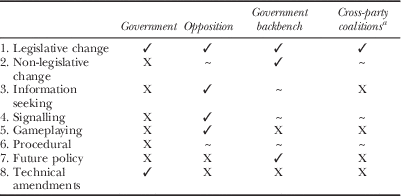
Table 3 summarizes the eight distinct motivations that we identified, and their mapping onto different groups. Government amendments at Westminster are invariably sincere, though many are minor and technical. Opposition amendments may be information seeking, signalling, gameplaying or simply procedural. Government backbench amendments are more often aimed at (or at least satisfied by) modest non-legislative changes, or at influencing future policy rather than the present bill. In contrast, when non-government parliamentarians sincerely wish to pursue legislative change, they routinely work cross-party.
Motivations for Amendments, by Type of Policy Actor

Note: ✓=used frequently; ~ used occasionally; X=not used.
a This is interpreted more broadly than the two previous columns combined, including joint working between the two main opposition parties under Labour.
These categories may well not have universal application. They are necessarily influenced both by Westminster’s established patterns of party competition and its specific procedural rules. While the former may be edging closer to the European norm, the latter still potentially creates context-specific incentives for amendments. For example, Westminster’s emphasis on ‘probing’ amendments may not be matched in other settings. Researchers working on other systems may well thus be able to expand on our typology. But it provides an initial starting point.
This article has urged greater clarity on the multiple motivations behind non-government legislative amendments. As indicated at the start, scholars often suggest that the great majority of non-government initiatives in parliament ‘fail’, while executive initiatives dominate. But both conclusions may be exaggerated. Executives can be more responsive than commonly assumed, through concessions both to non-government initiatives – as we have traced – and to ‘preventive’ influence behind the scenes. Crucially, judging non-government ‘failure’ on the basis that amendments do not reach the statute book risks misunderstanding key parliamentary dynamics. If parliamentarians have multiple motivations for proposing legislative amendments, such proposals may be far more ‘successful’ at achieving their goals than is commonly assumed.
Acknowledgement
This work was funded by the Nuffield Foundation (grant OPD/38858), and draws on earlier work funded by the ESRC (grant RES-063-27-0163). The views expressed are those of the authors and not necessarily of the Foundation.