Interventional electrophysiology with radiofrequency ablation or cryoablation has become a widely used, accepted, and powerful management option in adults and older children with arrhythmia. However, the role of interventional electrophysiology in infants is less well defined, with ongoing debate about its role in young infants with tachyarrhythmias.Reference Blaufox, Felix and Saul1–Reference Blaufox7
On the one hand, there is a small proportion of infants with tachyarrhythmias who either have life-threatening episodes and/or have frequent or incessant tachyarrhythmia that cannot be controlled despite combination antiarrhythmic therapy.Reference Case2–Reference Aiyagari, Saarel, Etheridge, Bradley, Dick and Fischbach5, Reference Blaufox7 These patients often have ventricular dysfunction because of incessant tachycardia and sometimes have structural congenital heart disease that impinges on cardiovascular reserve.Reference Blaufox, Felix and Saul1, Reference Erickson, Walsh, Triedman and Saul4, Reference Blaufox7 In addition, long-term combination arrhythmic therapy when used for this group of patients adds risk, particularly when negative inotropic agents are used in the setting of incessant tachycardia. Even assuming adequate compliance with multiple medications, antiarrhythmics do not always control tachycardia, and multiple, often frequent, repeat clinical assessments are necessary, which places a large burden on the family.
On the other hand, the natural history of tachyarrhythmias in this population is one of resolution, with the vast majority of young infants being effectively treated with antiarrhythmic agents until this occurs. In this case, a combination of pharmacological agents may be required.Reference Weindling, Saul and Walsh3, Reference Deal, Keane, Gillette and Garson8 There are also concerns regarding the safety, both acutely and in the long term, of radiofrequency-generated lesions in the immature and growing heart.Reference Saul, Hulse, Papagiannis, Van Praagh and Walsh9–Reference Paul, Bokenkamp, Mahnert and Trappe11
This debate has been ongoing for 20 years. As knowledge accumulates regarding the long-term outcomes of babies that have had interventional electrophysiology procedures, as interventional techniques are further refined and improved, and as patient selection improves, the role of the interventional electrophysiology procedure will become clearer.
We reviewed our experience with the interventional electrophysiology procedure in a highly selected group of infants with tachyarrhythmia to assess the efficacy and safety, in order to better understand its role in young infants.
Materials and methods
We identified all electrophysiology studies performed in children under 2 years of age, carried out at the Heart Centre for Children, between October 1995 and May 2009. The medical records and electrophysiological study data were analysed to determine the indication for the study, prior antiarrhythmic therapy, age at intervention, and the presence or absence of ventricular dysfunction. We identified the main indications for the procedure. Procedural parameters included size and number of catheters used, diagnosis at the interventional electrophysiology procedure, type of energy source used for ablation, and number of lesions applied. From follow-up records, immediate and long-term outcome and complications were noted. Initial success was defined as no inducible arrhythmia before finishing the procedure. The following complications were defined as major: death, heart block requiring pacemaker implantation, pericardial effusion, pneumothorax, or other complications requiring intervention. Minor complications were defined as complications that did not have any clinical manifestation and did not require any treatment. Institutional ethical approval was obtained for this review.
Results
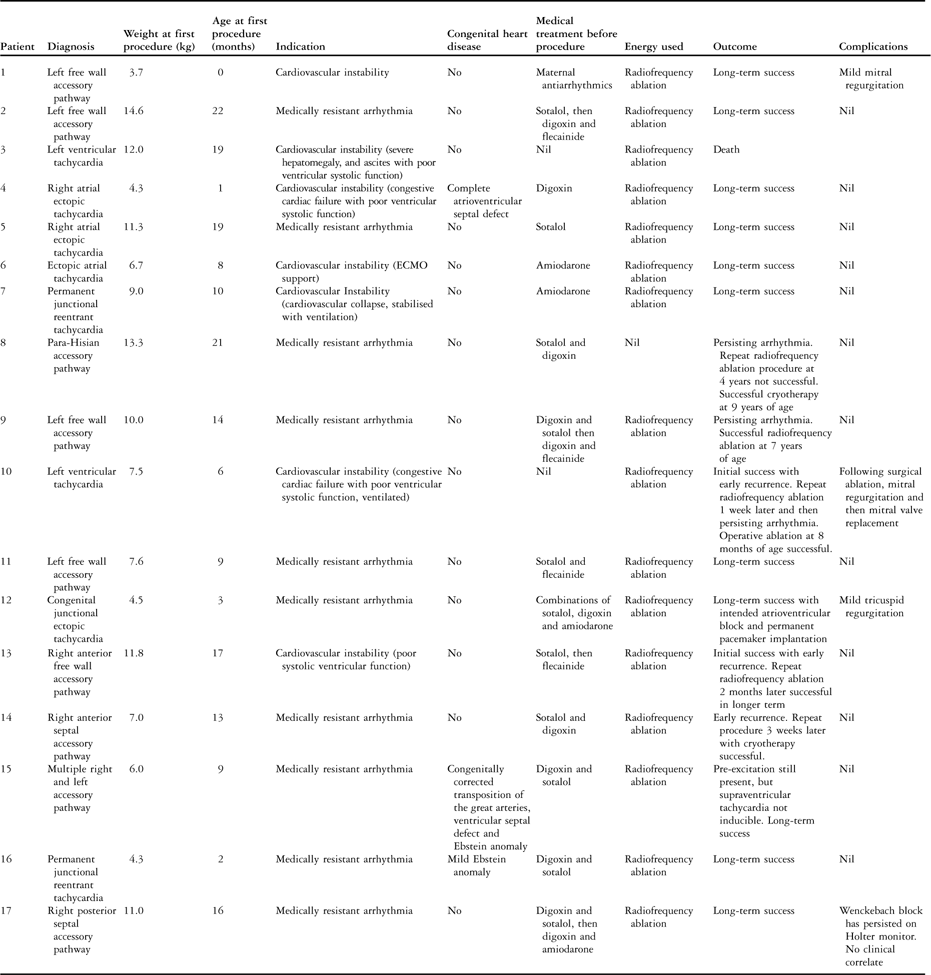
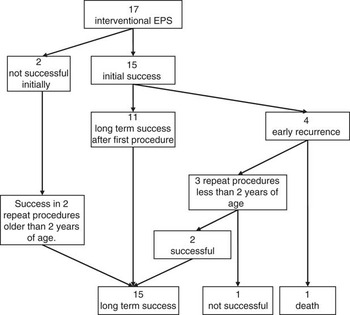
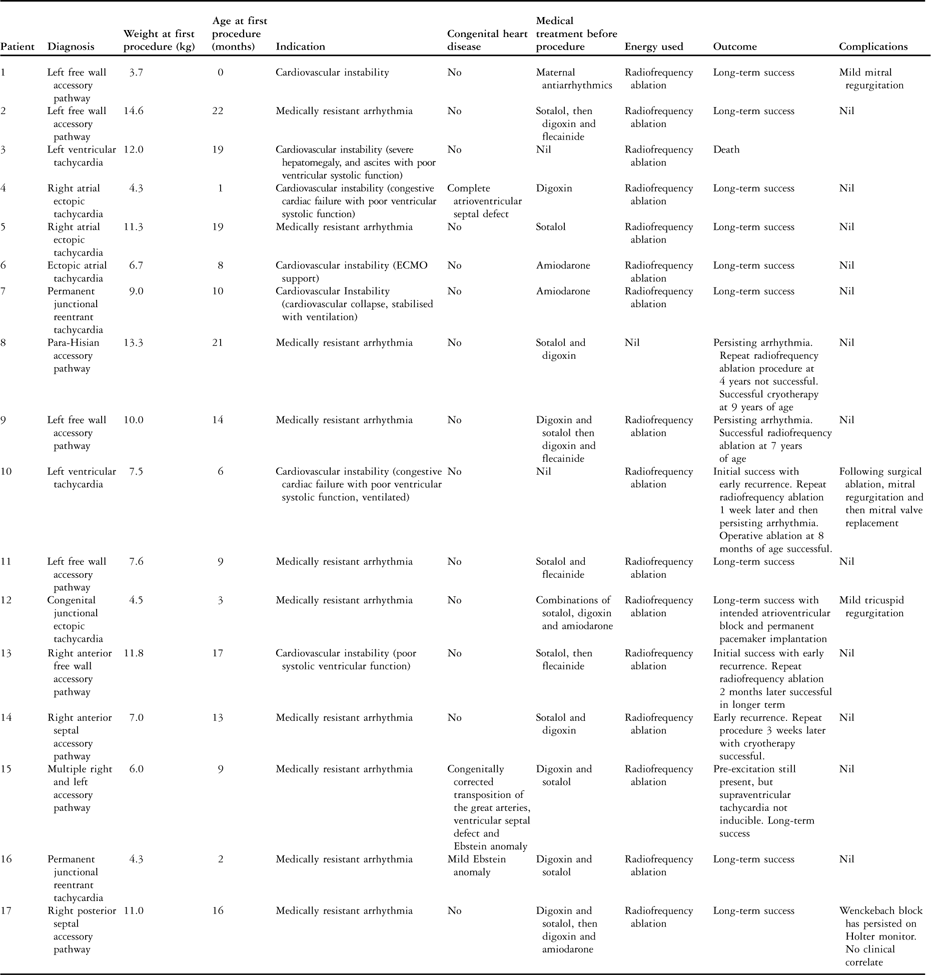
Between October, 1995 and May, 2009, 676 interventional electrophysiology procedures were carried out in children. A total of 23 procedures were carried out in 17 patients who were younger than 2 years of age at first procedure. Of the 17 patients, three patients had one repeat procedure each before they reached 2 years of age (Table 1), and two patients had repeat procedures when they were older than 2 years, with one of them having two repeat procedures. There were three patients (17.6%) with congenital heart disease. At first procedure, the weight range of the patients was 3.7–14.6 kilograms (median 7.6 kilograms) and age range was 0–22 months (median 10.6 months). Of the 17 patients, in seven (41%) the indication was arrhythmia causing cardiovascular instability, and in the remaining 10 (59%) the indication was medically resistant arrhythmia. All seven patients with cardiovascular instability had reduced ventricular function. In one patient with medically resistant arrhythmia, the interventional electrophysiology procedure was undertaken before surgery, which would have rendered venous access to arrhythmic focus difficult. Figure 1 describes the outcomes of the patients.
Patient characteristics and results.
Outcomes.

Of the 10 patients with medically resistant arrhythmia, nine had been treated with combination antiarrhythmics, the most common combination being sotalol and digoxin. There were five patients being treated with single antiarrhythmics – digoxin, amiodarone, or sotalol. In one patient who had incessant ventricular tachycardia with depressed ventricular function, antiarrhythmic therapy was not commenced before the interventional electrophysiology procedure given the risk of worsening the already depressed ventricular function.
Of the 17 patients, nine (53%) had accessory pathways. These were evenly distributed between the right and left, four with left- and four with right-sided pathways. There was one patient who had multiple pathways on both sides. Of the remaining eight patients, three (18%) had atrial ectopic tachycardia, two (12%) had ventricular tachycardia, two (12%) had permanent junctional reentrant tachycardia, and one (6%) had congenital junctional ectopic tachycardia.
Radiofrequency ablation was used in all procedures but one. When a patent foramen ovale was not present, left-sided pathways were accessed by the retrograde approach.
Of the seven patients who had reduced ventricular function and haemodynamic instability, normal ventricular function returned after the interventional electrophysiology procedure in five patients. Of the two patients in whom normal ventricular function was not achieved, one patient subsequently died (see Results below) and one patient went on to have a surgical ablation (see Results below) following a repeat unsuccessful radiofrequency ablation. Of the 10 patients in whom the interventional electrophysiology procedure was performed because of “medically resistant tachyarrhythmia”, all 10 achieved long-term success, with three patients requiring repeat procedures to achieve this success. Of these three patients, success was achieved in one at 9 years of age.
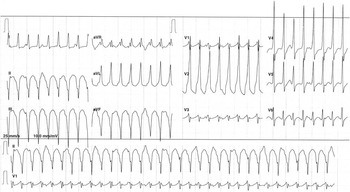
In one of the two patients in whom long-term success was not achieved, one further interventional electrophysiology procedure was carried out; however, a left ventricular focus could not be ablated (see Fig 2). There was histiocytoid transformation of the myocardium in this case, and the child went on to a successful operative ablation. The operation eliminated the abnormal rhythm but was complicated by the induction of significant mitral regurgitation, and subsequently a mechanical mitral valve replacement.
ECG from a 6 month old infant demonstrating ventricular tachycardia with a left superior axis and a right bundle branch-like pattern indicating an origin in the posterior left ventricle.

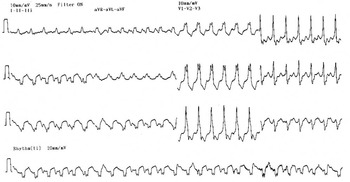
There was one death, after initial successful ablation of an incessant left ventricular tachycardia with ventricular systolic dysfunction (see Fig 3). The patient, on returning to the paediatric intensive care unit, had recurrence of haemodynamically unstable ventricular tachycardia and died of poor cardiac output. Post mortem attributed congestive cardiac failure due to persisting arrhythmia as the cause of death and identified no procedural complication.
ECG from a 19 month old infant showing ventricular tachycardia with a left superior axis and right bundle branch block morphology, also indicating a posterior left ventricular origin.

There were no major procedural complications.
There were three minor complications. A 1-day-old baby (described in Results below) who had a successful ablation for a left-sided accessory pathway has had persisting mild mitral regurgitation. In a 3-month-old infant with intractable congenital junctional ectopic tachycardia, radiofrequency ablation was used to intentionally induce complete heart block with associated permanent pacemaker implantation. This procedure produced mild-to-moderate tricuspid regurgitation. Radiofrequency ablation was performed successfully in a 16-month-old patient with multiple episodes of supraventricular tachycardia despite combination antiarrhythmics. Asymptomatic Wenckebach block has been documented on Holter monitor 10 years post procedure.
A 1-day-old baby was delivered at 35 weeks’ gestation by Caesarean section because of incessant tachycardia. There was hydrops despite antiarrhythmic treatment, and after birth she had further tachycardia despite loading with intravenous amiodarone and direct current cardioversion. Hypotension with ventricular dysfunction was managed with ventilation, dopamine, dobutamine, and then adrenaline infusions. Transoesophageal overdrive pacing followed by temporary transvenous overdrive pacing were each unsuccessful at restoring sinus rhythm. Radiofrequency ablation, while on an adrenaline infusion, was successful at eliminating a left free-wall pathway-mediated tachycardia at 24 hours of age. Access to the left side was via a patent foramen ovale.
Cryotherapy was utilised in a 13-month-old infant. Initially, radiofrequency ablation at 13 months of age was successful after ablating a right anterior septal accessory pathway. There was early recurrence of arrhythmia, and combination antiarrhythmic therapy was recommenced. Cryotherapy performed 3 weeks later at 13 months and 7.7 kilograms was successful, with no recurrence up to 8 months follow-up, using a 7 French, 4-millimetre tip catheter. The procedure was complicated by transient atrioventricular block during energy application, which resolved within minutes.
Discussion
We reviewed a subgroup of infants with intractable tachyarrhythmia and identified unifying clinical and technical features.
A combination antiarrhythmic therapy was generally used in patients with well-preserved ventricular function. Greater caution in those who had ventricular dysfunction led to avoidance of combination antiarrhythmic therapy in order to diminish the chance of provoking further functional deterioration and inducing haemodynamic compromise.
The mechanisms of arrhythmia in our series were similar to those described in other reports of infants undergoing radiofrequency ablation. The majority of patients in our study and others had atrioventricular reentry tachycardia, with the remaining minority having atrial ectopic tachycardia, ventricular tachycardia, and permanent junctional reentrant tachycardia.Reference Blaufox, Felix and Saul1, Reference Aiyagari, Saarel, Etheridge, Bradley, Dick and Fischbach5
Children weighing less than 15 kilograms have previously been shown to be at an increased risk of complications following cardiac ablation procedures.Reference Erickson, Walsh, Triedman and Saul4, Reference Kugler, Danford and Deal12, Reference Kugler, Danford, Houston and Felix13 The complication rate has also been shown to be dependent on the number of applications of energy when indexed to body size.Reference Blaufox, Paul and Saul6 More recently, however, Aiyagari et alReference Aiyagari, Saarel, Etheridge, Bradley, Dick and Fischbach5 showed that complication and success rates were similar between children less than 15 kilograms and those between 15 and 20 kilograms. Body weight less than 15 kilograms is also a risk factor for complete heart block.Reference Blaufox, Felix and Saul1, Reference Kugler, Danford, Houston and Felix13 Ablation of septal pathways in infants is risky given the relative size of the lesion delivered by radiofrequency ablation and important anatomical structures.Reference Blaufox7 In our series of patients, when a pathway was located close to the atrioventricular node, extreme caution was exercised, prioritising the avoidance of heart block over procedural success. In those patients in whom success was not achieved initially, combination antiarrhythmics were continued after the interventional electrophysiology procedure until the patient was older and repeat procedures involved less risk. In the nine patients with accessory pathways, this approach was successful in all, although with five repeat procedures in four patients. With this strategy, there was no unintended complete heart block. There were only two minor complications: asymptomatic Wenckebach block on ambulatory electrocardiogram and mild mitral regurgitation.
There are other significant risks in the use of radiofrequency ablation in infants documented in the literature. The coronary arteries may be vulnerable as suggested by animal studiesReference BÖKenkamp, Wibbelt and Sturm10, Reference Paul, Bokenkamp, Mahnert and Trappe11 and case reports.Reference Paul, Kakavand, Blaufox and Saul14, Reference Blaufox and Saul15 Valvular structures may also be injured during radiofrequency ablation.Reference Minich, Snider and Dick16 In a more recent report of children aged 0–16 years, however, there was little evidence of injury to valvular structures;Reference Van Hare, Colan and Javitz17 however, that study did not include a subset analysis of infants. In addition, radiofrequency lesions on growing myocardium may continue to enlarge, as suggested in an animal model.Reference Saul, Hulse, Papagiannis, Van Praagh and Walsh9
We believe that with recent modifications learnt from published experience, safety has improved in the ablation of infants with significant tachyarrhythmias. Examples of these improvements include: three-dimensional mapping systems, which may improve accuracy of catheter position with relation to anatomy,Reference Noë, Van Driel, Wittkampf and Sreeram18 using the least possible applications of energy,Reference Aiyagari, Saarel, Etheridge, Bradley, Dick and Fischbach5, Reference Blaufox, Paul and Saul6 resisting the use of “insurance” lesions,Reference Aiyagari, Saarel, Etheridge, Bradley, Dick and Fischbach5–Reference Blaufox7 meticulous anticoagulation, particularly when ablating left-sided lesions, temperature control and monitoring during radiofrequency ablation, and the use of smaller, 5 French catheter tips.Reference Blaufox, Felix and Saul1, Reference Erickson, Walsh, Triedman and Saul4, Reference Aiyagari, Saarel, Etheridge, Bradley, Dick and Fischbach5, Reference Schaffer, Gow, Moak and Saul19
Of the seven patients who required left-sided access, the retrograde approach was used in three when a patent foramen ovale was not present. There was no documented aortic regurgitation or coronary artery injury as a result of the retrograde approach in these patients. A left-sided accessory pathway was successfully ablated in a 2-day-old infant with incessant foetal and postnatal tachycardia. However, mild mitral regurgitation has persisted. Although Van Hare et alReference Van Hare, Javitz and Carmelli20 found no statistical difference in the early complication rate after interventional electrophysiology between a retrograde or transseptal approach, the population studied demonstrated a much wider age range of 0–16 years, and did not offer a subanalysis of infants. Given the small number of patients in this report, a difference could not be shown between the two left-sided approaches.
Of the two cases where long-term success was not achieved, each patient had incessant left ventricular tachycardia. In one patient, no tumour or abnormal myocardium was identified on post mortem and thus would be classed as idiopathic. Incessant left ventricular tachycardia is known to carry significant risk of both morbidity and mortality.Reference Wang, Zhu, Hamilton, Kirsh, Stephenson and Gross21 In the other patient, the ventricular tachycardia was secondary to histiocytoid malformation of the myocardium. This entity is known to be associated with a poor outcome due to incessant and often fatal arrhythmias.Reference Freedom, Lee, MacDonald and Taylor22 A previous report notes the difficulty in ablating this substrate and suggests caution in case selection for interventional electrophysiology.Reference Case2 Medical treatment can also be challenging. We would also now suggest caution in case selection for interventional electrophysiology in incessant left ventricular tachycardia.
There are few reports of transcatheter cryoablation in infants.Reference Makhoul, Von Bergen, Rabi, Gingerich, Evans and Law23, Reference Shah, Wieand and Vetter24 In our case, although there was transient atrioventricular block during the procedure, this resolved within minutes. In follow-up, there has been long-term success with no atrioventricular block. Cryotherapy catheters currently available are somewhat stiffer and larger than radiofrequency ablation catheters. On the basis of experience with differences in catheter stiffness, this would increase the risk of cardiac perforation in smaller hearts. Cryoablation catheters are currently designed for adults, and when used in infants can be susceptible to technical problems that can be overcome to deliver effective therapy.Reference Makhoul, Von Bergen, Rabi, Gingerich, Evans and Law23 Cyroablation, however, offers significant benefits over radiofrequency ablation. In an animal study, it has been shown that cryotherapy lesions do not injure the coronary arteries of growing myocardium as is sometimes the case with radiofrequency ablation.Reference Kriebel, Hermann and Schneider25 Cryoablation, after cryoadhesion has been established, offers greater catheter stability, which is of particular importance when ablating close to vital structures in smaller hearts.Reference Blaufox7 When ablating close to the atrioventricular node, cryoablation importantly offers the safety of causing only transient tissue injury if energy application is ceased early.Reference Friedman, Dubuc and Green26 Lesions created by cryoablation are discrete with sharp borders when compared with radiofrequency ablation lesions.Reference Friedman, Dubuc and Green26, Reference Khairy, Chauvet and Lehmann27 We now consider transcatheter cryoablation an important additional tool in infants who require interventional electrophysiology.
The risk–benefit assessment for infants undergoing interventional electrophysiology for serious intractable arrhythmia requires consideration of the consequences and efficacy of pharmacological alternatives. There are reports of various combination antiarrhythmics in infants with refractory tachyarrhythmias with varying degrees of success, adverse reactions and safety concerns.Reference Fenrich28–Reference Saul, Scott and Brown30 In a report documenting the safety and efficacy of medical therapy for supraventricular tachycardia in neonates and infants, it was also acknowledged by the authors that there is a small group of children, who despite antiarrhythmic treatment, may reasonably be considered for radiofrequency ablation.Reference Weindling, Saul and Walsh3
Although it may be argued that the risks of radiofrequency ablation in children are lower at an older age, the potential benefit from performing radiofrequency ablation at a later age may diminish. In children with ventricular dysfunction secondary to incessant tachycardia such as permanent junctional reentrant tachycardia or atrial ectopic tachycardia, it has been shown that recovery time to normal ventricular function is shorter if the ablation is undertaken at an earlier age.Reference Noë, Van Driel, Wittkampf and Sreeram18, Reference De Giovanni, Dindar and Griffith31
In 2001, the Northern American Society of Pacing and Electrophysiology Expert Consensus statement listed radiofrequency ablation for supraventricular tachycardia in children who are less than 5 years old when antiarrhythmic medications, including sotalol and amiodarone, are not effective or associated with intolerable side effects as a Class IIB indication (clear divergence of opinion regarding the need for the procedure).Reference Friedman, Walsh and Silka32 Although our report describes a relatively small number of patients, we have shown that in patients who have failed antiarrhythmic therapy, radiofrequency ablation, when used judiciously, can provide success with acceptable levels of safety. We would see this as a strong basis for further consideration and study of this strategy in infants.
Conclusion
Our experience supports the use of interventional electrophysiology procedures in infants with incessant tachyarrhythmia and reduced ventricular function refractory to antiarrhythmic therapy. In experienced hands, this can be safe and effective; however, we continue to advocate adherence to high risk indicators in this age group at this time.
Acknowledgement
We wish to thank Dr Andrew Cole for his assistance in the collection of data.