




No CrossRef data available.
Cost-effectiveness of reduction mammaplasty
Published online by Cambridge University Press: 01 August 2004
Abstract
Objectives: The purpose of this study is to provide a comparison of the benefits of reduction mammaplasty (RM) for women with heavy breasts often termed macromastia or breast hypertrophy (BH) surgery. The rationale is to provide information to allow decision-makers to make judgments about the cost-effectiveness of this intervention and make comparisons with other interventions which are commonly undertaken within publicly financed health-care systems.
Methods: Data from a previous outcomes study in Sweden is re-analyzed to derive quality of life measures, from which a mean level of benefit outcome is derived and a cost per quality-adjusted life year is calculated (cost per QALY).
Results: The low Cost per QALY suggests that reduction mammaplasty is cost-effective when compared with other treatments which are commonly undertaken.
Conclusions: The authors suggest that the evidence in favor of funding reduction mammaplasty is strong and that decision-makers review their policy in light of this new evidence.
Information
- Type
- GENERAL ESSAYS
- Information
- International Journal of Technology Assessment in Health Care , Volume 20 , Issue 3 , August 2004 , pp. 269 - 273
- Copyright
- © 2004 Cambridge University Press
Women who have heavy breasts (macromastia) typically suffer symptoms such as pain in the upper part of the body, back pain, poor body posture, and headache. In addition, they have difficulty finding suitable clothes and experience uncomfortable feelings in body image and sexual relationships (9).
Reduction mammaplasty is still considered by many decision-makers, some medical professionals, and members of the public, despite the evidence, as a cosmetic rather than a functional intervention. Previous work tended to focus on the volume and size of the breast, rather than the functional impact of macromastia. However, Gonzalez et al. presented a revised approach in which macromastia was defined as a condition where pain exists in at least three locations in the upper part of the body (11).
OUTCOME STUDIES
Because macromastia does not appear to have specific objective medical outcomes, it is necessary to evaluate the functional results after surgery in terms of improvements in health-related quality of life (HRQL). Outcome studies, of course, are useful in this respect and a well-known outcome measure is the SF-36, a general health-related quality of life instrument. This measure is even used as a “gold standard” comparator for other instruments (8;14). The SF-36, produced by the Medical Outcomes Trust, of Boston, Massachusetts, measures the following eight health concepts, which are relevant across age, disease, and treatment groups:
- limitations in physical activities because of health problems
- limitations in usual role activities because of physical health problems
- limitations in usual role activities because of emotional problems
- bodily pain
- vitality (energy and fatigue)
- general health perceptions
- limitations in social activities because of physical or emotional problems
- mental health (psychological distress and well-being)
THE SWEDISH STUDY
The original study from which this study is derived was conducted in Sweden at the Department of Reconstructive Plastic Surgery, Stockholm Söder Hospital/Karolinska Hospital from January 1 to June 30, 1997 (1;2). Patients accepted for breast reduction surgery at the department were asked if they wanted to participate in a questionnaire survey. Of the forty-nine patients approached, all volunteered to participate. The study accepted those people who were consistent with the definition of macromastia as determined by Gonzalez et al. (10).
This prospective study involved using the Swedish SF-36 as a measure of outcome (16), allowing comparison to a control group, standardized for the Swedish population. The SF-36 was administered to the patients preoperatively and at six, twelve, and thirty-six months postoperatively.
The demographics of the study population were as follows. The mean age was thirty-nine years (range, 20–71 years), height was 165 cm (range, 152–180 cm), weight was 66 kg (range, 54–87 kg), and body mass index was 24.4 (range, 20.1–37.2). Further details of the characteristics of the patient group and the outcomes are given in the original study and are not repeated here for the sake of brevity (2).
The response rate after six months was 36 (73 percent), after twelve months was 38 (78 percent), and after thirty-six months was 39 (80 percent).
THE UK EXPERIENCE
In the UK, breast reduction surgery is available in some areas on the National Health Service. UK Department of Health hospital activity statistics show that, in 1993–1994, breast reduction operations totalled 2,353, increasing to 3,266 in the year 2000–2001.
There are many areas in the UK, however, where breast reduction surgery is a restricted procedure (13). This is due to breast reduction surgery within the UK often being seen as a cosmetic procedure by purchasers of health care.
Reviewing the current published evidence of the benefits of breast reduction surgery is not straightforward for potential commissioners of a breast reduction service. Two reviews of the published papers up until 1999 on the evidence of the benefit of breast reduction surgery have been conducted and published (5;12). They both conclude that the majority of studies carried out in this area are observational, retrospective in nature, and many are of poor quality. The main design problem in these studies is the difficulty in identifying a control group of similar women with a similar problem to those undergoing surgery.
Both reviews conclude that there appears to be evidence that breast reduction surgery is of benefit to these patients; however, the lack of a suitable control group does not allow for a quantification of the benefit in those that undergo surgery compared with those who undergo alternative therapies. One possibility might be to use a control group of women with equivalent macromastia who do not elect to breast reduction. This group, however, might have different profiles of quality of life than those who have presented requesting surgery. Also, the practicalities of recruiting might be problematic and, once recruited, increased awareness of macromastia may further bias the group's usefulness as a comparator.
Chadbourne et al. identify that there is a need to “categorize subjective patient information into workable, consistent formats” (5). This study answers this need by deriving Quality of Life estimates of breast reduction patients, which are consistent and may be compared with the Quality of Life of the population as a whole. The approach is fully described in a later section of this study.
ECONOMIC ANALYSIS AND ALLOCATION OF FUNDING
It is difficult for decision-makers to weigh the effectiveness of RM against other treatments when balancing scarce resources. Recently, a prospective study has been published, which shows improvement in physical symptoms up to twelve months postoperative (6).
Of interest in this area is the investigation completed by the UK National Health Service (NHS) Ombudsman who received a complaint in 2001 when a woman was refused RM, recommended by her consultant to reduce back pain, by Essex Health Authority. The Ombudsman ruled that, because the RM decision was “based purely on medical grounds” supported by her general practitioner, consultant, and surgeon, the surgery should be allowed (17).
Existing work on breast reduction has encountered difficulties in sufficiently demonstrating the impact on the patient so that decision-makers give appropriate consideration to the debilitating character of the condition. This is to a large extent because the outcome measures used, for example the SF-36 questionnaire, contain several different domains. These give good information of health gains in specific areas, but it is not clear how these outcomes interact with each other and how an improvement in one area of quality of life (say bodily pain) is comparable to an improvement in another (say physical function; 7). Furthermore, this type of outcome measure on its own, whereas useful for showing effectiveness or cost-effectiveness of a treatment, does not allow comparison with other treatments.
We see in current policy decisions, for example within the National Institute of Clinical Excellence (NICE) in the United Kingdom, that decision-makers appear to value a single-figure measure of HRQL. This is because it is possible to combine a single measure of HRQL with the cost of the treatment and compare across diverse treatments in terms of incremental cost per quality-adjusted life year (cost per QALY). It then becomes possible to compare between interventions with different outcomes and rank according to their cost per QALY. The normal decision rule is to begin with the most cost-effective treatment and work through the rankings until the finite budget is spent (15). This is to some extent an idealized approach, because in practice, there is a lack of such information for many interventions.
Despite the published evidence, it is apparent that some uninformed decision-makers might regard interventions such as breast reduction as a “lifestyle” treatment. Without good information on the cost per QALY of breast reduction, there is a danger that the full impact on the HRQL of women might be dismissed or undervalued by decision-makers with the result that there might be underprovision of the service. To assist in clarification of this issue, the data from the Swedish Study (2) was re-analyzed using an algorithm developed at the University of Sheffield, United Kingdom (3;4).
The original Swedish study of breast reduction established within the SF-36 that there were substantial and long-term improvements in health-related quality of life. Unfortunately, it was not possible to establish a cost per QALY from the data.
SF-6D AND HEALTH-RELATED QUALITY OF LIFE
The potential to extend this work appeared with the final development of the Brazier algorithm, which derived a preference-based measure of health from the SF-36 to develop an economic evaluation. By using the Brazier algorithm, the SF-36 is first revised into a six-dimensional health domain classification, called the SF-6D. This defines 249 health states, validated by reference to 611 UK individuals using standard gamble and visual analogue scales. A robust econometric approach addresses issues such as the hierarchical nature of the data and the skewed distribution of the original data. The econometric models were tested and found acceptable for predicting health states (p=>.05). The algorithm gives the opportunity to estimate a preference-based single index based from existing SF-36 data.
METHODS
The study derived SF-36 scores for forty-nine women who entered the Reduction Mammaplasty program at the Department of Reconstructive Plastic Surgery at the Stockholm Söder Hospital/Karolinska Hospital in Sweden. SF-36 questionnaires were completed in four stages at first visit, preoperatively, six months postoperatively (thirty-six women), twelve months postoperatively (thirty-eight women), and thirty-six months postoperatively (thirty-nine women). The Brazier algorithm was used to derive mean and median SF-6D scores for each of these time points.
Total Health-Related Quality of Life
It is very desirable to derive a single HRQL figure that may be used in economic evaluations to give an indication of the cost-effectiveness of an intervention. The Brazier algorithm provides such a measure from the raw SF-36 data.
Cost per QALY
The direct cost of reduction mammaplasty in the United Kingdom is assessed to be between approximately £1,563 and £1,892 (mean average costs from UK Department of Health National Schedule of Reference Costs—NHS Trusts 2003) in terms of hospital stay and surgical costs. Using a direct analysis, from the perspective of the NHS or third party payer and assuming that the benefits last through three years, the estimated cost per QALY is between £4,733 and £5,729. It might be expected that the benefits of surgery might be experienced through a longer period than three years, in which case the cost-effectiveness of the intervention would be even more favorable. The cost per QALY calculations discount the benefits over three years at 5 percent, with the costs not being discounted because they fall in the first months of treatment.
Of course, there may also be indirect costs to the patient, which would probably be within the region of two weeks foregone earnings, one-day hospital stay followed by one to two weeks off work. In the United Kingdom, with average earnings at £23,667, this would equate to approximately £900 lost earnings (or productivity). In reality, however, people might receive sick pay, so that a proportion of the costs fall on the employer or government. In this scenario, it is likely that the losses in productivity might be valued. This issue is under academic debate, as it has been realized that such productivity costs might not be easily quantifiable because coworkers might be able to “fill the gap,” work might be left until the patient returns to work, or the patient might take some holiday. Because the original study did not assess these areas, this study does not examine the analysis from an indirect or societal viewpoint but merely comments that even with full foregone earnings included in the analysis, the cost-effectiveness ratio would be very favorable.
Breast Reduction and Ranking against Other Interventions
Having derived a cost per QALY, it is important to consider how reduction mammaplasty compares in terms of other treatments. Comparisons of reduction mammaplasty with interventions that have been approved by the NICE in the United Kingdom are informative. NICE has approved, over the past two years, interventions on cost per QALY ratios as in Table 1. It would seem, therefore, to be appropriate to argue that reduction mammaplasty falls well within the boundaries of what would normally be considered cost-effective by NICE.

DISCUSSION
Heavy breasts are a source of pain, discomfort, and cause a deficit in psychological well-being. Funding of surgery (reduction mammaplasty) is sometimes refused because the treatment is considered to be “cosmetic” in nature. Methodological difficulties arise in study design, due to the difficulties of providing a control group. Despite this, according to recent reviews, published evidence is supportive of surgery and recommends the use of reduction mammaplasty. In the past, there has been no evidence of the cost-effectiveness of treatment.
The original data from a prospective Swedish study of forty-nine women operated on with reduction mammaplasty is analyzed using the Brazier algorithm to derive HRQL measures for breast reduction surgery (3). The preoperative data six, twelve, and thirty-six months postoperatively is analyzed. The results show a consistent and persistent improvement in HRQL for women who have undertaken this surgery. It should be noted that the analysis probably shows an underestimate, because it is likely that, if there were SF-36 data available for the period between zero and six months, there would be a relatively speedy improvement in HRQL. In the analysis, no deterioration in SF-36 score is assumed for patients with no surgery, but the results in SF-36 for this group would probably decrease during the three-year period making the comparison even more favorable. Still, the cost per QALY is calculated to be between £4,733 and £5,729 (Swedish Kroner 65,898–79,744). The cost per QALY ratio is found to be very favorable when compared with interventions recently sanctioned by the UK NICE.
It is not possible with this type of analysis to conduct a blinded randomized controlled trial, however, this methodology provides a comparison with the HRQL values from a large sample, representative of the European and UK population as a whole. This process gives a rigorous and rich insight into the benefits of the intervention. Future research might replicate this work, with different data sets or prospective trials with larger sample sizes.
POLICY IMPLICATIONS
This study argues that the cost-effectiveness evidence in favor of funding reduction mammaplasty is strong, and the authors recommend that decision-makers review their policy in light of this new evidence.
References
Blomqvist L,
Brandberg Y.
Three years follow up on clinical symptoms and health related quality of life after reduction mammaplasty.
Plast Reconstr Surg.
Accepted for publication.
Blomqvist L,
Eriksson A,
Brandberg Y.
2000
Reduction mammaplasty provides long-term improvement in health status and quality of life.
Plast Reconstr Surg.
106:
991–
997.Google Scholar
Brazier J,
Roberts J,
Deverill M.
2002
The estimation of a preference-based measure of health from the SF-36.
J Health Econ.
21:
271–
292.Google Scholar
Brazier J,
Usherwood T,
Harper R,
Thomas K.
1998
Deriving a preference-based single index from the UK SF-36 health survey.
J Clin Epidemiol
51:
1115–
1158.Google Scholar
Chadbourne EB,
Zhang S,
Gordon MJ, et al.
2001
Clinical outcomes in reduction mammaplasty: A systematic review and meta-analysis of published studies.
Mayo Clin Proc.
76:
503–
510.Google Scholar
Collins ED,
Kerrigan CL,
Kim M, et al.
2002
The effectiveness of surgical and nonsurgical interventions in relieving the symptoms of Macromastia.
Plast Reconstr Surg.
109:
1556–
1566.Google Scholar
Drummond M,
O'Brien B,
Stoddart GL,
Torrance GW.
1997
Methods for the economic evaluation of health care programs.
Oxford:
Oxford University Press
Falcoz PE,
Chocron S,
Mercier M,
Puyraveau M,
Etievent JP.
2002
Comparison of the Nottingham Health Profile and the 36-item health survey questionnaires in cardiac surgery.
Ann Thorac Surg.
73:
1222–
1228.Google Scholar
Goin MK,
Goin JM,
Gianini MH.
1977
The psychic consequences of a reduction mammaplasty.
Plast Reconstr Surg.
59:
530–
534.Google Scholar
Gonzalez F,
Brown FE,
Gold ME,
Walton RL,
Shafer B.
1993
Preoperative and postoperative nipple-areola sensibility in patients undergoing reduction mammaplasty.
Plast Reconstr Surg.
92:
809–
814;
discussion 815-818.Google Scholar
Gonzalez F,
Walton RL,
Shafer B,
Matory WE Jr,
Borah GL.
1993
Reduction mammaplasty improves symptoms of Macromastia.
Plast Reconstr Surg.
91:
1270–
1276.Google Scholar
Jones SA,
Bain JR.
2001
Review of data describing outcomes that are used to assess changes in quality of life after reduction mammaplasty.
Plast Reconstr Surg.
108:
62–
67.Google Scholar
Klassen A,
Fitzpatrick R,
Jenkinson C,
Goodacre T.
1996
Should breast reduction surgery be rationed? A comparison of the health status of patients before and after treatment: Postal questionnaire survey.
BMJ.
313:
454–
457.Google Scholar
Norholm V,
Bech P.
2001
The WHO Quality of Life (WHOQOL) Questionnaire: Danish validation study.
Nord J Psychiatry.
55:
229–
235.Google Scholar
Sloan FAE.
1996
Valuing health care.
Cambridge:
Cambridge University Press
Sullivan M,
Karlsson J,
Ware JE Jr.
1995
The Swedish SF-36 Health Survey–I. Evaluation of data quality, scaling assumptions, reliability and construct validity across general populations in Sweden.
Soc Sci Med.
41:
1349–
1358.Google Scholar
The UK Ombudsman.
2001
The UK Ombudsman ruling on reduction mammaplasty.
London;
The UK Stationery Office
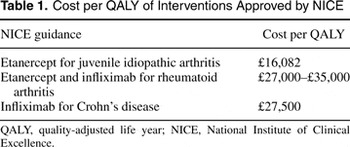
Cost per QALY of Interventions Approved by NICE
 You have
Access
- 16
- Cited by