1. Introduction
We have all made poor decisions – had one too many drinks, dated the wrong person, overused a credit card, accepted employment at a toxic workplace and so forth. Some such questionable decisions are artistic in nature. Indeed, when looking back on one’s early work, it is easy to have tinges of embarrassment and regret. However, those emotions are often at least partially counterbalanced by feelings of warm nostalgia. I have love/hate feelings about my own early compositions and suspect that many artists have similar relationships with their early output. Conceptual artist John Baldessari made this dynamic compellingly tangible in 1970 through his Cremation Project, an undertaking in which he burned all of his paintings, baked some of the resulting ashes into cookies, and publicly announced the act in a newspaper. Viewing some of these ex-painting-based cookies several years ago, I felt that Baldessari’s approach to his previous work, simultaneously embracing, annihilating and remaking, was a fitting way to let go of one’s artistic past.
Confessional is a user-driven electroacoustic installation I created that provides the opportunity for composers to briefly take pleasure in and then (symbolically) destroy one of their dubious creations. This process is accomplished with a computer running Cycling 74’s Max and a recording provided by the user that is processed live. The audio processing unfolds in stages and mirrors the phases of animal decomposition. Through this series of transformations, the user’s piece transitions from its original state to nearly imperceptible bits of noise. In this article, I discuss Confessional, focusing on its conceptual background (Baldessari’s art and animal decomposition), related issues such as memory and hierarchy, and the structure of the Max patch that is used for live processing.
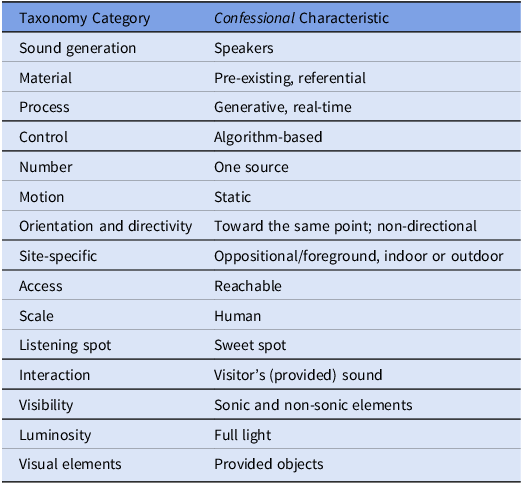
I identify Confessional as an installation as it is typically located in spaces such as a lobby or gallery rather than traditional performance venues such as a concert hall or theatre. Despite this categorisation, it is not site-specific like many installations – it could be appropriately exhibited in any number of spaces and have more or less the same effect. As such, Fink, who states that ‘sound installations require a spatial context’, would classify Confessional as a ‘sound sculpture’ (Fink Reference Fink2019: 239) and Rose would consider it to be an ‘object-based installation … [which] engage[s] an audience by actuating a visibly present object’ (Rose Reference Rose2013: 65). It also could be simply identified as ‘sound art’, which Landy uses an umbrella term for ‘sound installations (associated with art galleries, museums, and public spaces), sound sculptures, public sonic artifacts, and site-specific sonic art events’ (Landy Reference Landy2007: 11). Fraisse et al. recognise the ‘wide range of approaches, practices, and contexts’ presented by sound installations and offer a multifaceted taxonomy for situating these works (Fraisse et al. Reference Fraisse, Giannini, Guastavino and Boutard2022: 227, 229–33). Using this taxonomy, I would categorise Confessional as described in Table 1.
Confessional as positioned by Fraisse et al.’s (Reference Fraisse, Giannini, Guastavino and Boutard2022) taxonomy

Rooted firmly in conceptual art, Confessional employs relatively commonplace audio transformations such as filtering and ring modulation that have long been part of electroacoustic music and covered in any number of classic texts such as Schrader (Reference Schrader1982) and Dodge and Jerse (Reference Dodge and Jerse1997). As such, the piece diverges from many current trends in electroacoustic music that use technology in more novel ways such as data sonification, artificial intelligence integration and new instrument/interface design, though it has some congruence with ubiquitous music. Ubiquitous music has been an area of focus in electroacoustic music and sound art for approximately two decades and is described as ‘an approach to music-making which operates at the intersection between diverse technologies (often networked or otherwise modular) and social, interactive and enactive musical and/or sonic practices’ (Bridges et al. Reference Bridges, Lazzarini and Keller2023: 321). Confessional particularly resonates with the social dimensions of ubiquitous music, such as its tendency to ‘[question] existing approaches based on discourses of virtuosity and specialism … [and seek] to embrace grassroots and participatory approaches to design and co-design’ (ibid.).Footnote 1 This aspect of Confessional is discussed in greater depth in the ‘Hierarchy and Identity’ section of this article.
2. John BaldessarI
John Baldessari (1931–2020) was a California-based American conceptual artist who is particularly known for ‘incorporating letters, words and photographs in his works’ (Roark Reference Roark2013). He began as a semi-abstract painter, but in the mid-1960s started working primarily with photographs and text (Jones Reference Jones, Morgan and Jones2009: 49). In the later 1960s and 1970s he also created of number of video and film works (ibid.: 51). Baldessari’s Wrong (1966–8, Figure 1) is a well-known early example of this creative direction. The piece comments on ‘how the artist viewed his place in the art world at that time’ (ibid.: 47). The composition of the photograph is ‘wrong’, with the prominent palm tree seemingly emanating from Baldessari’s head. Further, it depicts a ‘wrong’ context for an artist at that time – a California suburb rather than New York City (ibid.).Footnote 2 Though not the focus of this article, I find that Wrong resonates with me personally as I create music and art that typically falls outside of established trends, even within the contemporary and electroacoustic music realms, and I often lean towards less hip life choices such as preferring to live in a quiet inner suburb rather than a trendy urban neighbourhood.
John Baldessari’s Wrong (1966–68). © John Baldessari 1966–68. Courtesy Estate of John Baldessari © 2025. Courtesy John Baldessari Family Foundation; Sprüth Magers Digital Image © [2025] Museum Associates/LACMA. Licensed by Art Resource, NY.

I encountered Baldessari’s Cremation Project (Figure 2) at the Hirshhorn National Museum of Modern Art in Washington DC in the mid- to late 2000s. This work was created as the artist ‘realized that his photo-and-text compositions … embodied a new direction in his work, and he decided to destroy all the paintings that preceded them’ (ibid.: 50). Thus on 24 July 1970, Baldessari cremated all his paintings from May 1953 to March 1966 that he possessed. He published an affidavit in the San Diego Union commemorating the act, boxed up some of the ashes, and used others to make cookies in a related work titled Corpus Wafers. The exhibit I saw at the Hirshhorn included written and photographic documentation of the cremation, newspaper affidavit, cookie recipe and a jar of ashes-infused cookies. The Cremation Project is cited as a tangible expression of Baldessari’s shift in the late 1960s from abstract expressionist painting to conceptual art, though other parts of his creative output from around that time, such as his photo- and text-based work, have received greater critical attention. Viewing the Cremation Project, though, had a significant impact on my own thinking about art and music at a time when I was exploring what constituted a ‘work’ in some of my compositions, ultimately leading me to contemplate how the concept underlying Baldessari’s piece might be realised in a musical setting.
Installation view of John Baldessari’s Cremation Project, Corpus Wafers (With Text, Recipe and Documentation) (1970). Gift of The Glenstone Foundation, Mitchell P. Rales, Founder, in honor of Ned Rifkin’s tenure as Director of the Hirshhorn Museum and Sculpture Garden (2002-2005), 2005. Hirshhorn Museum and Sculpture Garden. Photo credit: Cathy Carver. © John Baldessari 1970. Courtesy Estate of John Baldessari © 2025. Courtesy John Baldessari Family Foundation; Sprüth Magers.

3. Memory
Memory and nostalgia are central components of Confessional. Composers using the installation are asked to consider and evaluate their past musical output, employing what is referred to as autobiographical (Brewer Reference Brewer and Rubin1986) or episodic memory (Thompson and Madigan Reference Thompson and Madigan2005: 8–10). Alvin Lucier’s (Hartford) Memory Space is a well-known experimental composition from 1970 that foregrounds memory by asking performers to reproduce an observed soundscape using voices and instruments (Lucier and Simon Reference Lucier and Simon1980: 43). Discussing the possibility of using audio recordings as an aid for the performance of this piece, Lucier noted that ‘tape is now memory’ (ibid., 48). On this point, Chasalow comments that while composers have traditionally employed ‘memories of other music’ in their creative process, ‘[t]he ability of electroacoustic music to build structures from absolutely any recorded material allows it to reference memory in new ways … [r]ecordings of older music can be restructured into new works to produce deliberate musical commentary on our past’ (Chasalow Reference Chasalow2006: 63). Young (Reference Young and Doğantan-Dack2008) affirms and further explores this notion that memory can figure prominently in electroacoustic music and sound art through audio recording, which is, of course, the mechanism through which memory is brought into Confessional.
Organised Sound and Leonardo Music Journal published thematic issues on history and memory in 2006 and 2017, respectively, that covered a range of ideas and artistic approaches, the scope of which are summarised in Lane and Parry (Reference Lane and Parry2006) and Collins (Reference Collins2017a). Though the topics of space and place are particularly prominent in these collections, several articles relate to aspects of Confessional. Bullock (Reference Bullock2017) discusses the author’s memory and evaluation of recordings made in prior decades. Lane (Reference Lane2006), LaBelle (Reference LaBelle2006), Chasalow (Reference Chasalow2006) and Collins (Reference Collins2017b) address various uses of archival and oral history materials to create sound and installation art. Voegelin approaches this issue in a more theoretical manner, identifying such sources as ‘sonic memory material’ that foster ‘emotional engagement [that] involves the listener centrally in the production of the artwork’ (Voegelin Reference Voegelin2006: 13). This broader topic is explored further in numerous sources such as Männistö-Funk (Reference Männistö-Funk, Cobussen, Meelberg and Truax2017), Varchausky (Reference Varchausky2018), Young (Reference Young2018) and Devito (Reference Devito2021).
Memory also plays a prominent role in two of my performance-based electroacoustic works. Bit of nostalgia… (Boyd Reference Boyd2006, Reference Boyd2011) features one or two percussionists interpreting modestly similar pages of a graphic score with varied groupings of instruments and objects while a live electronics performer uses the same graphic score to shape the transformation and playback of recordings of rehearsals and/or previous performances of the composition, bringing a sense of self-history into the composition. The work the ongoing process (Boyd Reference Boyd2012, Reference Boyd2019) is for a networked laptop duo of composer-performers who employ recordings of their own compositions as the source sound material. Responding to a series of network-based graphic images, each performer shapes the presentation of their own work while also interfering with and distorting the activities of the other.
4. Animal Decomposition
The formal structure of Confessional – its temporal proportions and the transformations employed in each section – is based on animal decomposition.Footnote 3 This phenomenon is a continuous process that is often described as unfolding in a series of stages, which are a ‘convenient means to summarize physiochemical changes’ (Carter et al. Reference Carter, Yellowlees and Tibbett2007: 14). Jerry Payne’s 1965 study of baby pig decomposition identifies six such stages: fresh, bloated, active decay, advanced decay, dry and remains (Payne Reference Payne1965: 595–8). Most subsequent work on the topic follows this basic conception, with some grouping dry and remains together into a single, final stage. The ‘fresh’ stage is characterised by the ‘cessation of the heart and the depletion of internal oxygen’, the latter of which leads to fly colonisation and autolysis, ‘the destruction of cells by enzymatic digestion’ (Carter et al. Reference Carter, Yellowlees and Tibbett2007: 14). In the ‘bloated’ stage, ‘internal pressure from gas accumulation forces purge fluids to escape from cadaveric orifices’ (ibid.: 15). ‘Active decay’, the stage when mass decreases markedly and maggot activity peaks, begins when skin ruptures caused by bloating and maggot activity ‘allow oxygen back into the cadaver and expose more surface area for the development of fly larvae and aerobic microbial activity’ (ibid.). ‘Advanced decay’ occurs when maggots depart the cadaver to pupate; during this stage most, but not all, of the flesh is gone and the cadaver starts to dry out (ibid.; Payne Reference Payne1965: 596–7). ‘The transition from “Advanced Decay” to “Dry” to “Remains” is difficult to identify’, but is characterised by ‘increased plant growth’, further mass loss, and the presence of only ‘dried animal skin, cartilage, and bones’ (Carter et al. Reference Carter, Yellowlees and Tibbett2007: 17; Payne Reference Payne1965: 597).
5. Installation
Confessional is typically set up on a table with a computer, audio interface and pair speakers (Figure 3; Supplementary Max Patch). Composers upload a recording of a composition of any duration to the computer using a USB drive or other means. The installation’s audio processing is currently accomplished using Cycling 74’s Max, though the piece could easily be reconstructed with other software at any point in the future. Figure 4 depicts the Max interface, or patch, for the piece. The large leftmost box provides instructions and conceptual background. The seven smaller boxes on the right provide a series of steps to execute the installation. Box 1 provides a button that resets the patch to its default state. Box 2 allows the user to identify the soundfile that they wish to ‘destroy’. In Box 3 the user inputs the length of the identified recording in seconds. Box 4 allows the user to record the ‘destruction’ of their piece by naming and specifying the location for the resulting soundfile. Box 5 features a volume slider that adjusts the level of sound output and can be used while the installation is running. Box 6 provides a toggle button that will start the installation, as well as number boxes that indicate the amount of elapsed time in minutes and seconds. Box 7 allows the user to optionally turn off audio. The capabilities provided in Boxes 5 and 7 could, of course, also be accomplished by adjusting the computer’s or external interface’s audio output. Interested individuals that download the Supplementary Max Patch can choose ‘Show on Lock’ for various subpatchers while in edit mode to reveal more details about patch structure.
Confessional physical set up for the 2018 Electroacoustic Barn Dance.

Confessional Max interface, Confessional Max patch.

A range of visual and potentially theatrical components are provided with the installation. Inspired by Baldessari’s published affidavit, 8.5″×11″ certificates (Figure 5) and inexpensive frames are provided for installation users to complete and take home, commemorating their piece’s destruction. Participants are also encouraged to take a ‘selfie’ photo with the installation setup and completed certificate and post it to the piece’s Facebook page.Footnote 4 Additional implements may be provided to users who are destroying score-based compositions, such as scissors or a barbeque grill to cut up or burn scores, respectively. The array of visual options create tangible extensions of the piece and offer temporally permanent artefacts of the more metaphorical and transient audio process.
Confessional certificate.

6. Electroacoustic Processes
As mentioned previously, Confessional unfolds in a series of five sections that mirror the stages of animal decomposition both in terms of temporal proportionality and the type of electroacoustic processing that is employed (Table 2). In research I found only rough approximations of decomposition stage lengths because temperature and other factors can make such times vary wildly (Carter et al. Reference Carter, Yellowlees and Tibbett2007: 14). With the goal of an approximately five-minute-long experience, I established sectional durations to mirror the approximations I found, highlighting the fact that decomposition stages are increasingly expansive as the process unfolds. Ultimately, I settled on the following: fresh 6″, bloat 20″, active decay 40″, advanced decay 1′40″ and dry/remains 2′00″. I kept the final stage bit shorter than suggested by actual decomposition in order to make the installation a little more compact and user-friendly; having someone sit through ten or more minutes of barely perceptible noise seemed potentially ill-advised.
Confessional section durations and transformations summary

I chose a series of relatively simple audio transformations to characterise each stage. In the ‘fresh’ stage, the user’s piece is played from the beginning without any processing. During the ‘bloat’ stage, four different segments of the recording are played back simultaneously, and multiple delays are used to further saturate the total texture. For ‘active decay’, the delays are faded and the remaining segments of the recording are degraded through reductions in sampling rate and bit depth. The resulting noise is filtered in the ‘advanced decay’ stage. Finally, during ‘dry/remains’, the filtered signals are ring modulated with each other, resulting in nearly inaudible noise.
The toggle button that the user clicks to initiate the installation sends a single ‘bang’ message that passes through a series of delays to navigate the piece’s form. It first travels to four ‘sfplay∼’ objects. These objects play the user’s soundfile at different points: the first starts playing the file at the beginning, while the other three play at one-quarter, one half, and three-quarters of the way through. Once initiated, all four loop continuously until the piece ends. Throughout the process, the output of the first two ‘sfplay∼’ objects is sent to the left speaker while the output of the latter two is routed to the right speaker.
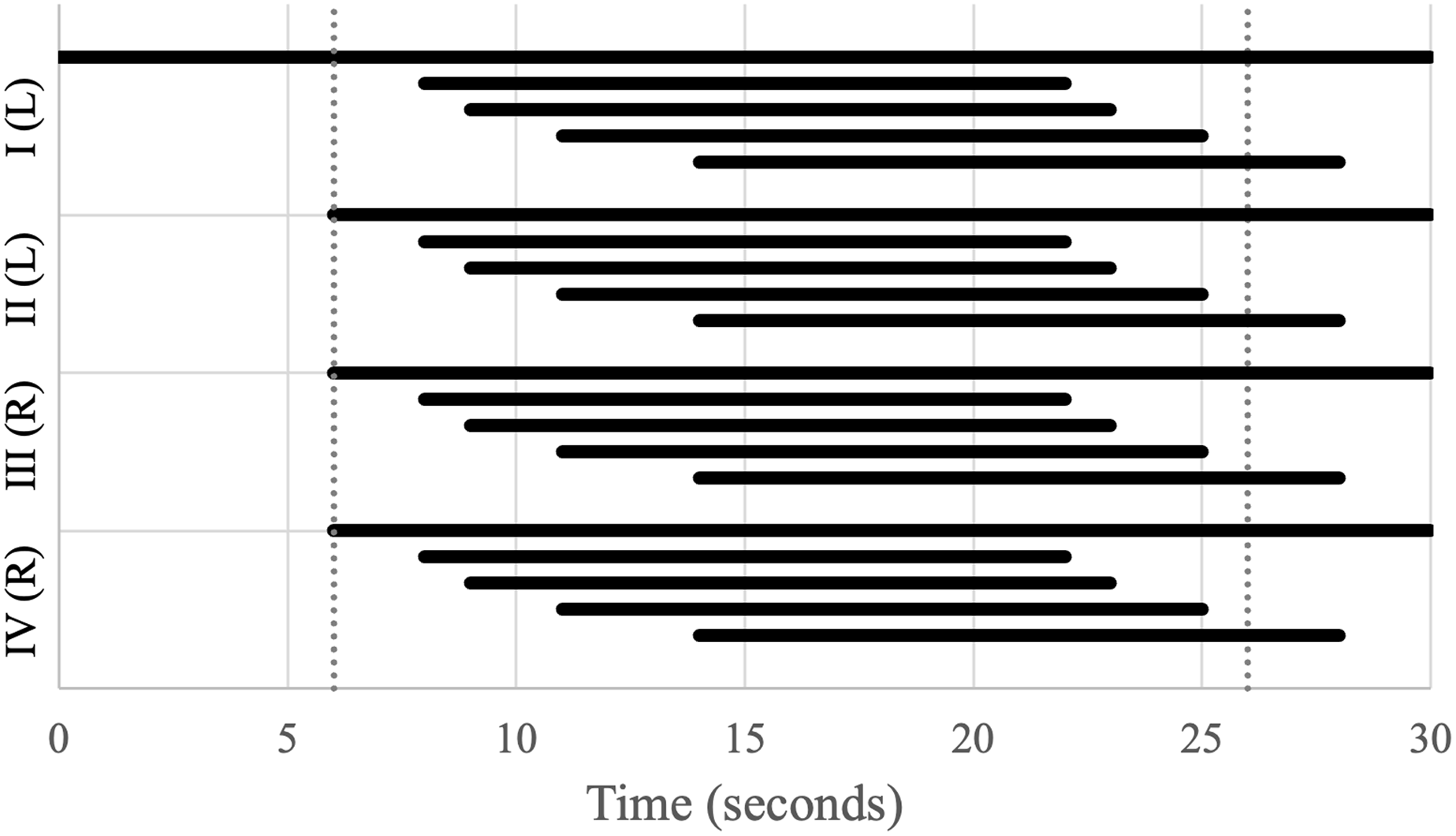
For the first six seconds of Confessional (the ‘fresh’ stage), only the first ‘sfplay∼’ object is active so that one hears beginning of the user’s piece by itself. At the six second mark, the ‘bloat’ stage begins with the activation of the other three ‘sfplay∼’ objects. The signals from these objects are echoed by a series of delays set at two, three, five and eight seconds, further saturating the texture as the section unfolds. Near the end of the section (20 seconds into the piece and 14 seconds into the section), the signals feeding into the delays are faded so that delayed sounds disappear as the next section commences. Figure 6 graphically depicts the first 30 seconds of Confessional and thus captures piece’s first two sections (‘fresh’ and ‘bloat’) plus an additional few seconds that allow the ending of the final delay to be shown. The signals from each of the four sfplay∼ objects are labelled with Roman numerals (I–IV), and channel output (left or right) is specified for each. Section divisions are indicated with vertical dotted grey lines.
Graphic representation of the first two sections of Confessional (‘fresh’ and ‘bloat’).

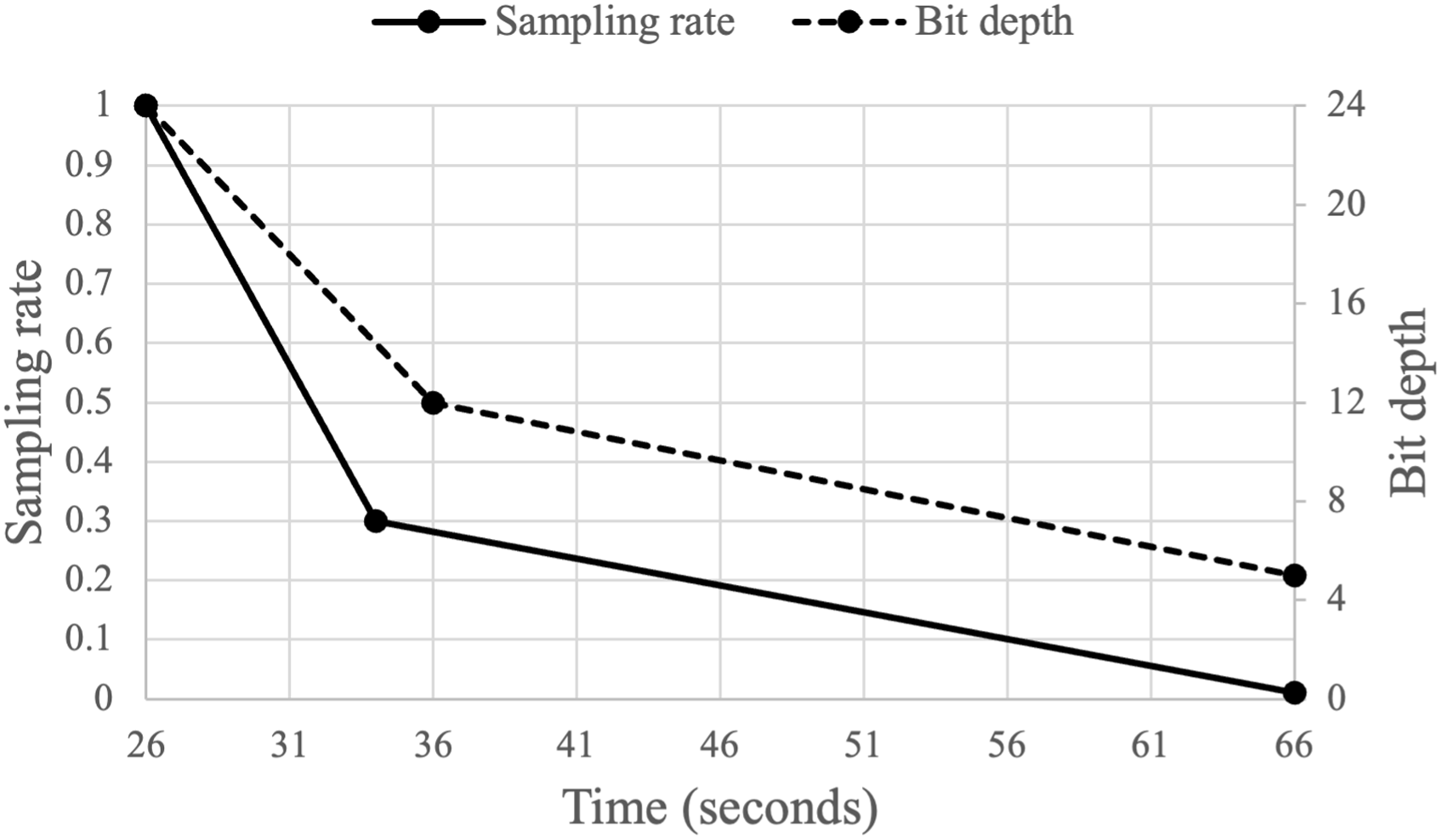
The ‘active decay’ stage begins 26 seconds into the piece and lasts for 40 seconds. The Max object ‘degrade∼’ is used to reduce sampling rate and bit depth, thereby making the sound increasingly gritty and noisy. Initially the sampling rate is rate is reduced from 1 to .3 over 8 seconds, while the bit depth moves from 24 to 12 over 10 seconds. The sampling rate is then further reduced to .01 over 32 seconds, and the bit depth drops to 5 over 30 seconds. Figure 7 graphs the sampling rate and bit depth reductions featured in this section.
Graphic representation of the third section of Confessional (‘active decay’).

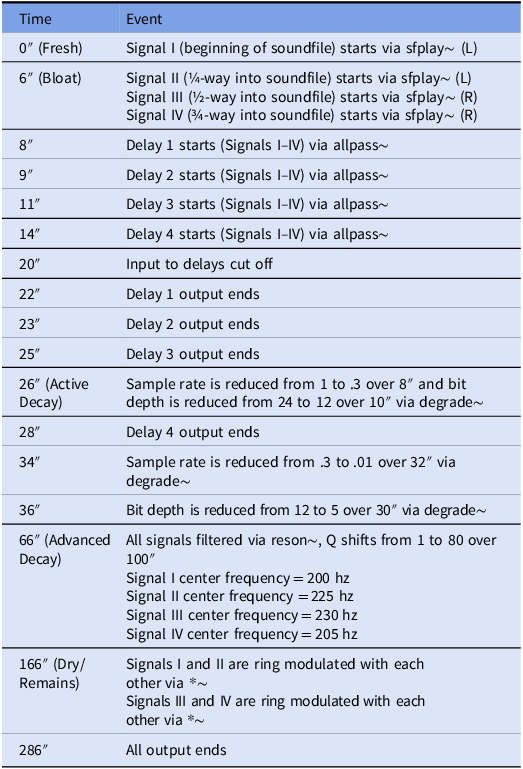
‘Advanced decay’ starts 66 seconds into the installation and is 100 seconds long. This section uses the Max object ‘reson∼’ to filter the now quite noisy sounds. The centre frequencies for the four filters are all different but fall in the 200–230 hertz range. Over the course of the section, the Q for each filter starts at 1 and moves to 80, thus narrowing each filter’s bandwidth significantly. The ‘dry/remains’ stage starts at the 166″ mark and lasts for two minutes. The four filtered signals are paired off and ring modulated against each other using the Max ‘*∼’ object. At this point one hears quiet, barely perceptible noise. At 286″ into the piece, any remaining sound is faded out and the ‘sfplay∼’ objects are stopped. Table 3 provides a complete, chronological list of sonic events and transformations that occur during the use of Confessional. This list includes both currently employed Max objects as well as generic specifications that would allow the piece to be recreated with another platform.
Chronological list of sonic events in Confessional

7. Reception
To date, Confessional has been presented three times: in-person at the 2015 Electronic Music Midwest (Kansas City, Kansas) and 2018 Electroacoustic Barn Dance (Fredericksburg, Virgina) festivals, and virtually as part of the 2020 Society for Electro Acoustic Music in the United States (SEAMUS) National Conference. It also won the Foundation for Emerging Technologies and Arts 2016 Feta Prize. Several attendees used the installation at the two in-person exhibitions of the piece. However, participation at these events could have been higher and was likely limited by a few factors despite the enthusiastic support of both festival organisers. First, attendees of American electroacoustic festivals and conferences tend to prioritise concerts over engagement with spatially adjacent, non-traditional works such as Confessional. Further, these events are largely populated by compositions that are focused strictly on sound or novel technological design rather than conceptual sound art. Finally, not every composer had easy access to recordings of early, possibly embarrassing work while travelling. To address this last point, I will attempt, if possible, to inform potential users about the installation in advance of future presentations of Confessional.
Most composers found the ‘destruction’ of their compositions amusing and enjoyed using the installation. Notably, some participants skipped the certificate and selfie portion of the piece, which I consider to be integral to the total experience. This occurrence reinforced the aforementioned notion that non-concert conceptual art falls outside of typical rubric for such events, affecting the ancillary non-sonic components of Confessional that are most distant from this norm to the greatest degree. However, several enthusiastic users did fill out certificates, take photos and upload those photos to the installation’s Facebook page. Figure 8 features a selfie taken by composer Jerod Sommerfeldt after running a recording of his Essay for String Quartet through Confessional. All installation users skipped framing their certificates, likely due to air travel to and from the festivals limiting space for ‘souvenirs’ and the low likelihood that they might actually hang the certificate in their home or office.
Selfie taken by Jerod Sommerfeldt after using Confessional.

I prepared a registration book for the SEAMUS conference by modifying a guest book purchased at a Party City store that would have provided another quick visual engagement for installation users. This conference, which was scheduled for spring 2020, unfortunately shifted to a virtual modality due to the COVID-19 lockdown, and the participatory aspect of the installation was thus not possible. I have yet to find a venue that allows for score burning or barbequing. However, since SEAMUS 2020 was a virtual event, I burned one of my own scores in my backyard grill to create the visual component of a video for the online conference. It is perhaps ironic that the more physically permanent results of the installation – such as certificates, shredded scores, ashes – are conceptually tangential accompaniments to the primary, but temporally impermanent, sonic element. Even when destruction is recorded as a soundfile, it exists in a digital state that does not have the same material presence of a framed certificate or a pile of ashes.
8. Hierarchy and Identity
Confessional has provided a lighthearted and aesthetically interesting way to engage with and discuss a typically avoided topic – the variously deficient pieces that composers have written. In this way, the installation highlights one of the issues that drives much of my creative work – problematising hierarchy. This issue is addressed in Confessional by foregrounding compositional lapses, thereby calling into question the outdated notion of ‘genius composer’. On this issue Alex Ross writes that ‘[t]he adulation of the master, the genius … all too easily lapses into a cult of white male hero’ (Ross Reference Ross2018: 69). He cautions that ‘[t]he danger of the word “genius” is that it implies an almost biological category … [and that] it is probably no accident that the category of “genius”, an obsession of the nineteenth century, coincided with the pseudoscience of race, which held that certain peoples were genetically fitter than others’ (Ross Reference Ross2019: 31). Discussing Beethoven, an individual to whom ‘genius’ is often ascribed, Philip Ewell notes that the composer ‘occupies the place he does because he has been propped up by whiteness and maleness for two hundred years, and we have been told by whiteness and maleness that his greatness has nothing to do with whiteness and maleness … [because] music theory’s white-male frame obfuscates race and gender’ (Ewell Reference Ewell2020). ‘Genius composer’ is thus essentially a euphemism for white, male composer, and this concatenation is both racist and sexist.
From my perspective, this concern with hierarchy is also addressed in much of Baldessari’s work. The aforementioned Wrong humorously challenges aestheticism, as does Pure Beauty (1967–8), which features only the text of the work’s title in black capital letters on a white canvas (Solomon-Godeau Reference Solomon-Godeau, Davies and Hales1996: 33). Further, Baldessari’s frequent use of other individuals to physically take photos and letter text for his works ‘uncompromising reject[ed] the fetishism of authorship’ (ibid.: 35). Further, I see his ‘signature technique … [of] painting, white, black or colored dots over faces in photographs’, developed in the 1980s, as another hierarchy-disrupting strategy (Finkel Reference Finkel2020). This practice, which was initially accomplished with round stickers placed over faces in newspaper articles, essentially anonymised individuals so that they ‘could be seen not as Mayor Bradley or Police Chief Gates … [but as] types – the mayor, the police chief’ (Siegel Reference Siegel1988: 89). Shifting the focus these images from personal identities of local notoriety to anonymous societal archetypes, for me, erases the intended element of prestige or social elevation that such photos were meant to convey.
In much of my creative work, I approach my antipathy towards hierarchy through various indeterminate structures and non-traditional notations that configure the composer and performer in an equal, collaborative partnership and structure chamber and large ensembles non-hierarchically. Further, by generally eschewing standard musical notation in favour of graphic and text scores, I make possible a wider range of performance possibilities, as opposed to a singular sonic ideal, and welcome performers with any level of prior experience from novice through professional. I see subverting and pushing against traditional musical norms as both artistically and socially important. Robert Walser, referencing Christopher Small and Eric Hobsbawm, poignantly notes that ‘“classical music” is less a useful label for a historical tradition than a genre of twentieth-century music … [that has] become a set of interchangeable great works … [and led to an] “invented tradition”, whereby present interests construct a cohesive past to establish or legitimate present-day institutions or social relations’ (Walser Reference Walser1993: 59–60). A primary goal of my creative work is to destabilise this often-unquestioned metanarrative, which subtly upholds our current stratified social structures.
This impetus for my artistic output has been influenced by my evolving racial identity. I am biracial South Asian-American and part of a transracial adoption. My adoption papers incorrectly postulated my racial background as either entirely white or partly ‘Mediterranean’. I learned that I am half South Asian a little before my 37th birthday in 2015 through a DNA test. The testing company has since suggested, though not definitively, that my non-white half is predominantly South Indian, and subsequent contact with my birth mother identified my birth father’s last name is Khan. Born and adopted in the late 1970s, I grew up being told that I was white but clearly not looking like the others in my peer group. Since I did not have accurate information about my background, I also did not have a community of similar background connect with. The combination of these two factors essentially made me an unidentified brown person for the first four-fifths of my life. Awkwardly positioned in American society, being both brown and biracial, I have become gradually aware of how formal and informal social structures hierarchically privilege whiteness. I am only now starting to wrestle with how the amorphous nature of my identity has affected me as a composer. I think that the blurry, outside-of-mainstream nature of my identity is perhaps reflected in my interest in experimental, often unfixed musical and artistic forms. Further, existing as an unidentified ‘other’ likely helped make me comfortable in creating personally satisfying work that sits outside of and, in some cases, pushes against popular compositional trends.
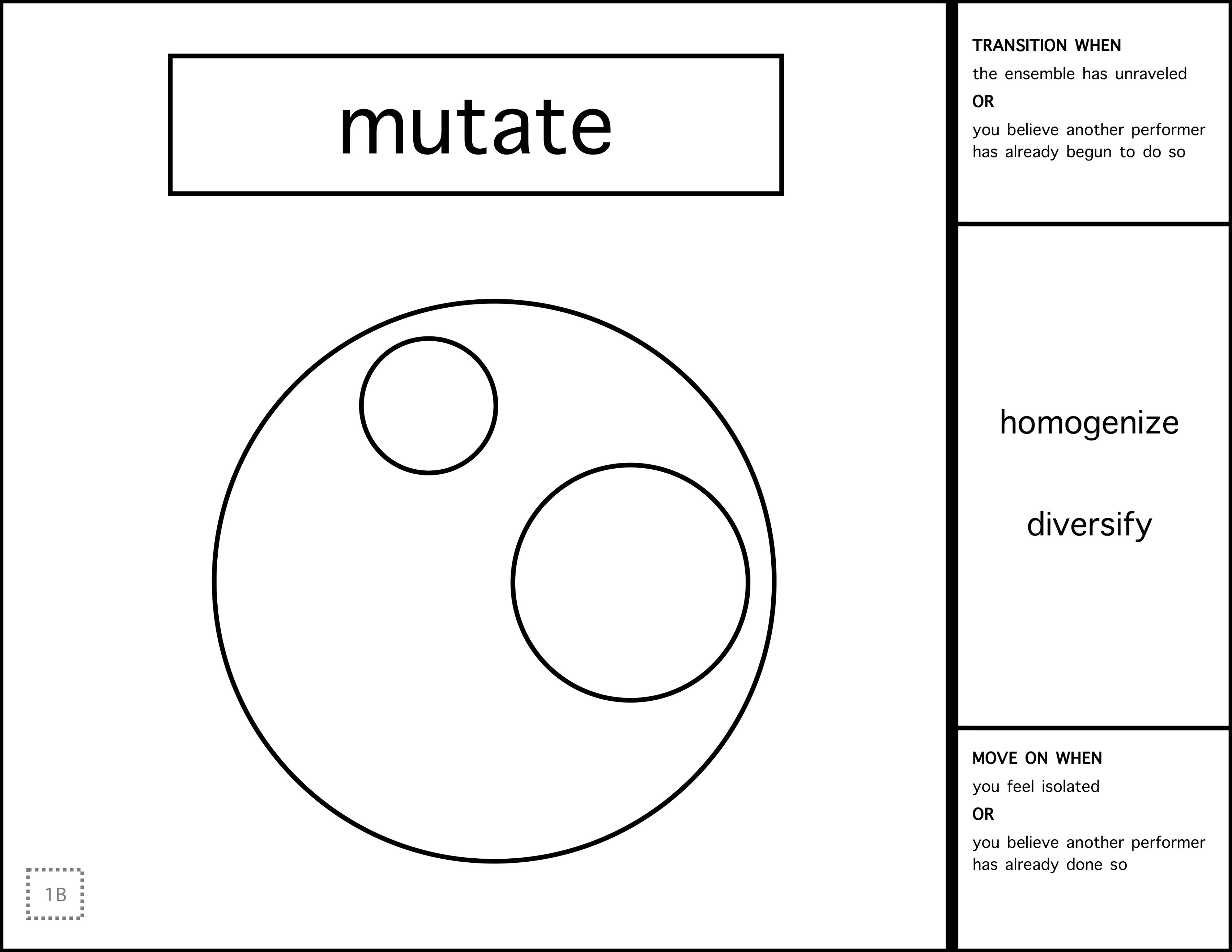
I will briefly describe two compositions – a concert piece and a performed installation – that illustrate how I have grappled with these issues in other work. I wouldn’t eat the strawberries…, a piece from 2015 for unspecified trio, is an example of such an approach from the past decade (Boyd Reference Boyd2015). This composition uses graphics images and text to shape performance gestures and guide the ensemble through the work’s form. Figure 9 reprints a page of the piece’s score. Performers largely focus on concurrently interpreting the large graphic image (variations of circles, lines and numbers) and text (variations of imitate, transform and oppose). The oppositional verbs found on the right are interpreted at moments of transition – before moving to the next page of the score or ending. The boxes above and below these verbs provide situational criteria for moving to the transitional material, next page, or ending such as ‘Move on when you have nothing new to add’ or ‘when something strangely familiar happens’ (ibid.).
I wouldn’t eat the strawberries… performance score sample.

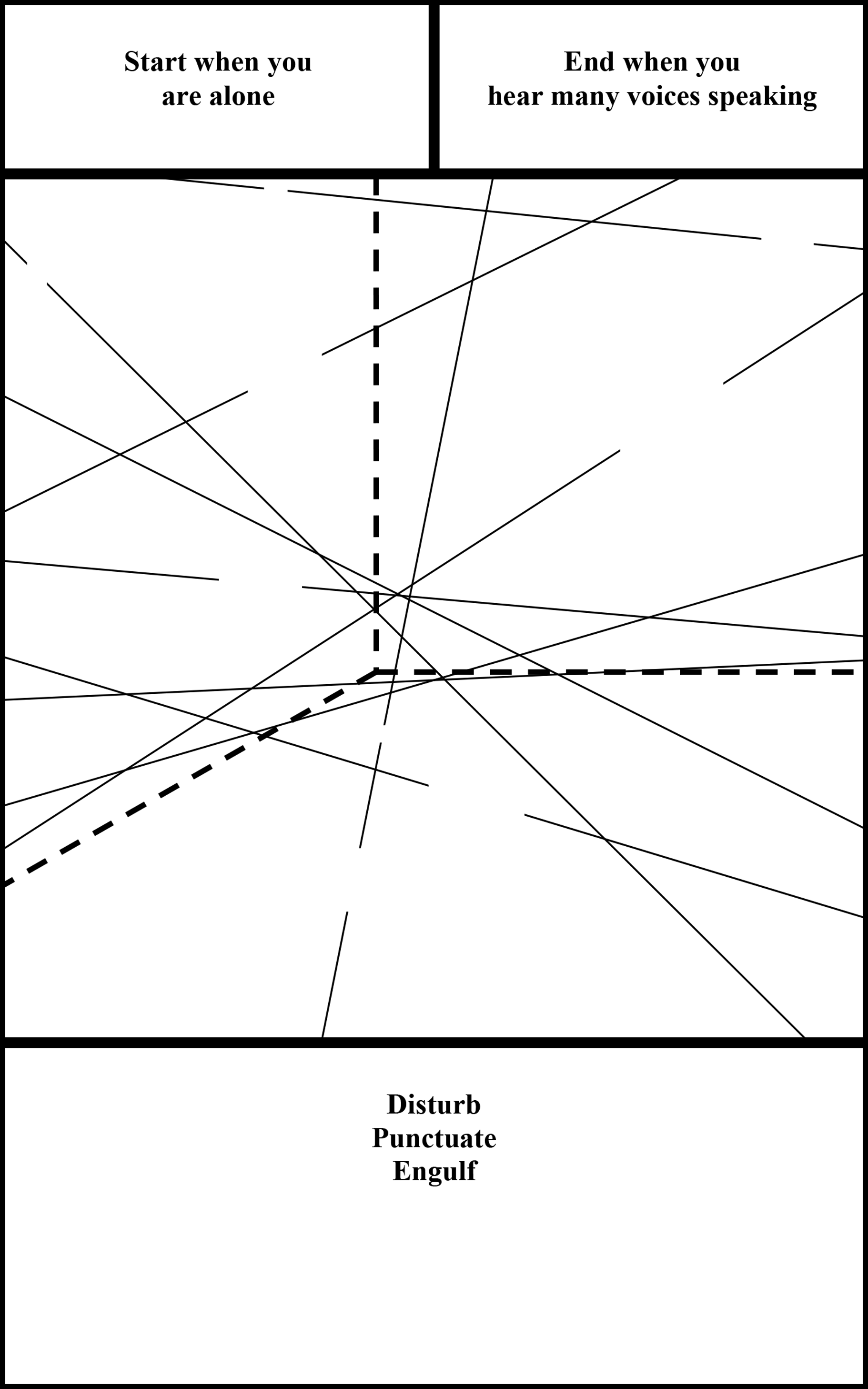
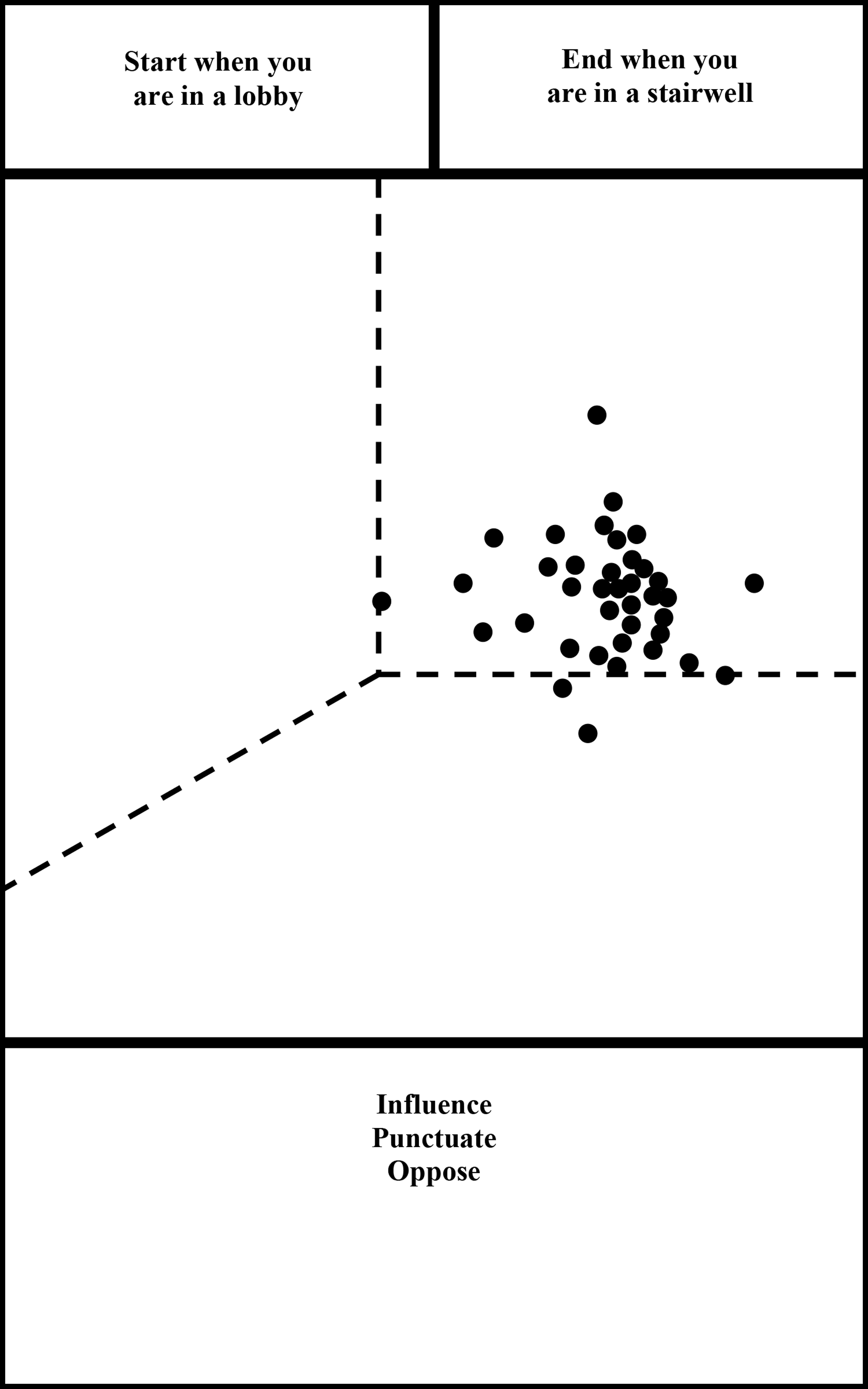
Becoming…everything else is an older composition from 2004 for three or more performers of any type that merges this broad approach to performance with installation art (Boyd Reference Boyd2004).Footnote 5 Performers of this work use a simple image- and text-based score to perform at times of their own choosing in the public spaces of a building. Sights, sounds and actions encountered randomly in the course of a day, week or longer duration trigger creative responses from the installation’s performers that are heard and seen throughout the building’s halls, stairwells and other open spaces. Figures 10 and 11 reprint two pages of the work’s performance score that are typically printed on 5″ × 7″ cards for portability. Information found at the top, which references sights, sounds and behaviours that might be encountered, indicates when an individual should start and stop performing. The image and verbs found on the rest of the score are concurrently interpreted to create sonic, visual, and/or theatrical gestures.
Becoming…everything else performance score sample.

Becoming…everything else performance score sample.

9. Conclusion
Cultural erasure affects historically marginalised populations in a range of ways that vary in magnitude from broad and systemic to individualised and personal. Instances of explicit and pernicious erasure of course abound in our postcolonial world. Johnathan Sterne, for example, discusses the efforts of early audio ethnographers to preserve ‘dying cultures’ in the face of ‘political and cultural programs designed to eradicate native cultures’ (Sterne Reference Sterne2003: 311–25). This issue can be more covert within the arts.Footnote 6 Writing about literature in the United States, Toni Morrison notes that ‘a certain set of assumptions conventionally accepted among literary historians and critics … holds that traditional, canonical American literature is free of, uninformed, and unshaped by the four-hundred-year-old presence of, first, Africans and then African-Americans in the United States’ (Morrison Reference Morrison1992: 4–5), pointing to the conclusion that ‘American means white’ (ibid.: 47). A similar sentiment is expressed about music theory by Philip Ewell, who states that the field is constrained by a white racial frame that is based on the tacit belief that ‘the music and music theories of white persons represent the best framework for music theory’; this assertion is validated by his analysis of ‘the seven most widely used theory textbooks in the United States’ that feature only 49 musical examples written by non-white composers out of a total of 2,930 (Ewell Reference Ewell2021: 325). Percival Everett’s novel Erasure deals with this issue in a humorous manner by satirically examining the ways in which American (white) expectations for Black writers constrain and exclude those work sits outside of expected generic tropes (Everett Reference Everett2001). The phenomenon that Everett explores is certainly present in analogous forms for non-white artists from other demographics.
Erasure is a common experience for South Asian Americans. Kurien and Purkayastha cite multiple factors for this phenomenon including the tendency in the United States to focus primarily on ‘whiteness and blackness’ and associate the label Asian solely with East Asian populations (Kurien and Purkayastha Reference Kurien and Purkayastha2024: 352, 359–62).Footnote 7 My personal experience with erasure has been shaped by these dynamics as well as my status as a biracial adoptee. The misidentification of my race in my adoption papers essentially effaced my actual racial identity until my late thirties, nearly 80 per cent of my lifetime at this point. I am unsure about the reason for this error, which could range from a communication or entry issue to an attempt to make me a more attractive prospect to white families averse to adopting a child of colour. This erasure created an incongruity between my purported identity – white – and my lived experience as a person of colour. Though I could provide numerous examples where this disconnect created internal conflict and confusion, I noticed it with particular poignancy while living in Long Island (New York) as a young adult immediately after 11 September 2001. At that moment, racism, suspicion and antipathy towards a range of brown Americans became more overt, leading to a category now referred to as ‘post-9/11 Brown’ that includes South and West Asians (Sharma Reference Sharma, Radano and Olaniyan2016). At that time, while processing incidents such as being given the middle finger or having objects tossed at me while bicycling, I often wondered whether the impetus for such actions was my skin colour or chosen mode of transportation. The resulting feelings of unease and discomfort were complicated and amplified by the erroneous notion that I was (strictly) white!Footnote 8 While I still cannot definitely state that these occurrences were not solely anti-cyclist in nature, understanding my racial background accurately at least aligns my identity with my experience and suspicion that such events may have been racially motivated. Finding congruence between my racial identity and lived experience over the past decade has led to a growing sense of clarity for how I now understand both my past and present.
On the surface, both Baldessari’s Cremation Project and my Confessional appear to feature the act of erasure as each work’s primary mechanism. However, I understand the role of erasure in these works differently. Both pieces do indeed demarcate a line in an artist’s output that identifies and cordons off early, ‘immature’ work. Typically, such works are ignored or otherwise left behind. Arnold Schoenberg, to cite a traditional musical example, used opus numbers to identify his ‘official’ output. He started composing in the early 1880s but waited until 1898 to begin assigning these numbers to his compositions (Rosen Reference Rosen1975: xiii–xiv; Neighbour Reference Neighbour2001). While some of his very early pieces were understandably lost, others from to mid- to late 1890s were preserved, including a string quartet in D major and several songs from 1897, but not granted opus numbers by Schoenberg (Neighbour Reference Neighbour2001). One could reasonably conclude that the composer assigned or withheld opus numbers as a strategy to curate his oeuvre. I see this silent abandonment of early work as an act of erasure. The Cremation Project and Confessional both upend this convention in an admittedly complicated way that simultaneously codifies a division within an artist’s creative output while also foregrounding early, ‘immature’ works, which are given a new life and meaning.
The ontological nature of a work of art influences the actions necessary to destroy it. Thomasson notes that ‘[w]orks of painting and (non-cast) sculpture … [are ordinarily treated as] individual entities’ while ‘[w]orks of (traditionally scored classical) music and literature, on the other hand, may have many performances and many copies’ (Thomasson Reference Thomasson and Kivy2004: 78–9). As such, the former are thought of a ‘concrete objects’ and the latter as ‘some kind of abstract object’ (Rossberg Reference Rossberg and Uidhir2012: 62); Thomasson ultimately proposes that such musical works are ‘abstract artifacts created by human intentional activities’ (2004: 90).Footnote 9 A unique concrete object is much simpler to destroy than an abstract object. When Baldessari burned his early paintings as part of the Cremation Project, they presumably ceased to exist. The situation for a piece of music is more complicated as it ‘may survive as long as some copy of it remains, though it may be destroyed if all copies and memories of it are gone’ (ibid.: 79).Footnote 10 In order to actually destroy one of the pieces that I have run through Confessional, I would need to die or permanently lose my long-term memory, my paper and digital files pertaining to the pieces would need to be destroyed and deleted, and any individuals that performed or heard the pieces would also need to die or permanently forget them. Confessional thus presents the opportunity for a symbolic, rather than literal, act of destruction.
Aesthetically, I am particularly struck by the fact that at the end of a use of Confessional, pieces that may sound wildly different are reduced to nearly identical noise. This phenomenon nicely mirrors Baldessari’s Cremation Project, which converted an array of the artist’s paintings to ash that was so uniform it could be used in lieu of flour to make undoubtedly inedible cookies, as well as the physical process of animal decomposition. Most of my own compositions from the mid- to late 1990s are moderately to very embarrassing. As such, I have run two pieces through Confessional: an untitled piano solo from 1997 and a trio for flute and two electric basses from 1999 (Sound Examples 1 and 2). I like the results quite a bit more than the original compositions!
Supplementary material
To view supplementary material for this article, please visit https://doi.org/10.1017/S135577182500007X