Johnson and Raye (Reference Johnson and Raye1981) developed a reality monitoring model that characterizes the processes involved in deciding whether certain information is of external origin – meaning it has been obtained through perceptual processes – or of internal origin – generated by thought or imagination. Later, Johnson et al. (Reference Johnson, Hashtroudi and Lindsay1993) proposed the source monitoring model as an extension of the reality monitoring model, noting that remembering involves not only distinguishing between the external/internal origin of the information, but also between the different sources, either external (e.g., whether a statement was made by this or that person) or internal. ”Source monitoring”, or “source memory”, involves making attributions about the origin of the information.
According to the reality monitoring model and various related empirical findings, compared to imagined events, perceived events typically have more contextual, sensory and semantic information (Johnson & Raye, Reference Johnson and Raye1981), affective information (thoughts and feelings) (Hashtroudi, Johnson, & Chrosniak, Reference Hashtroudi, Johnson and Chrosniak1990; Johnson et al., Reference Johnson, Hashtroudi and Lindsay1993; Suengas & Johnson, Reference Suengas and Johnson1988) and supporting information (Johnson et al., Reference Johnson, Foley, Suengas and Raye1988; Suengas & Johnson, Reference Suengas and Johnson1988). Conversely, imagined events typically have more operational attributes (Johnson & Raye, Reference Johnson and Raye1981), later identified as cognitive operations (Hashtroudi et al., Reference Hashtroudi, Johnson and Chrosniak1990; Johnson et al., Reference Johnson, Hashtroudi and Lindsay1993).
To confirm some of the source monitoring model assumptions, the authors developed an instrument that measures the characteristics of memories – the Memory Characteristics Questionnaire or MCQ. This questionnaire asks people to rate their phenomenal experience of both general memory characteristics, e.g., “My memory for this event is 1 (dim) to 7 (sharp/clear), and more specific attributes such as perceptual detail, temporal information, and so on. The psychometric analysis of the original MCQ (Suengas & Johnson, Reference Suengas and Johnson1988) has shown there are five factors that distinguish memories of perceived events from memories of imagined ones: (1) Clarity (visual detail, vividness, event detail, comprehensibility of the order of events, and overall memories of the event); (2) Sensory information (sound, smell, and taste); (3) Contextual information (memory of location, spatial arrangement of objects, and spatial arrangement of people); (4) Thoughts and feelings (memory of thoughts, memory of feelings, and how much the event reveals about oneself); and (5) Intensity of feelings (how intense they were at the time of the event and how intense they are while remembering). On average, memories for perceived events should score higher than memories of imagined events in all these factors.
The study carried out by Suengas and Johnson (Reference Suengas and Johnson1988) involved 144 university students of both sexes. After assessing both types of memory with a shortened form of the questionnaire, the authors compared the recollection of subjects who had taken part in a series of activities (wrapping a package in a meeting with an Indian woman, having a cup of coffee with cookies, looking at photographs of two people, visiting an office at the Department of Psychology, and so on) with those of others who had received written information about the development of these same activities. In each group, an independent principal component factor analysis of the questionnaire measures showed that their structure was similar and matched the five factors mentioned above. The factor analysis did not yield a single factor related to cognitive operations or to supporting information. Regarding information on feelings, there was a distinction between the affective quality itself and its intensity – both at the time of the event and at the time of the memory. The MCQ can be very useful in a forensic context, given that, on many occasions – rape, sexual abuse, mobbing, bullying, emotional abuse, and many more –, there is no material evidence of the crime and legal decisions must be based on testimonial evidence (Higueras, Reference Higueras2003).
The aim of our study was to adapt the MCQ to the Spanish population and test the psychometric properties of the Spanish MCQ. The MCQ data used to test the psychometric properties was obtained from an experimental study simulating a forensic context in which two groups of participants were compared similarly to Suengas and Johnson’s (Reference Suengas and Johnson1988) study. In this case, the comparison was made between the responses of subjects who had been instructed to tell the truth in an interview and the responses of those who had been asked to lie about the facts.
Method
Participants
A total of 240 university students with an age range between 18 and 41 years old (M = 21.55, SD = 3.18) were interviewed. Half of the participants were men (M = 21.63 years, SD = 3.72) and the other half were women (M = 21.48 years, SD = 2.54). There was no significant difference between the average male age and the average female age, t(238) = 0.36, p = .731.
Materials
The original MCQ consists of 39 items assessing a wide range of memory characteristics (e.g., visual detail, complexity, spatial and temporal information, thoughts and feelings) in order to differentiate the origin of the remembered event: perceived event versus imagined event (Suengas & Johnson, Reference Suengas and Johnson1988). For all of the items on the MCQ, participants respond by checking a number on a 7-point Likert-style scale (from dim to sharp/clear) for each item. Clearer memory events will score higher. The original MCQ version was adapted to Spanish based on International Test Commission Guidelines (ITC, 2010), specifically, using a back-translation method in the translation phase. The back-translation method focuses mainly on keeping the “psychological meaning” in addition to producing a linguistically correct version of each item (van de Vijver & Hambleton, Reference van de Vijver and Hambleton1996). The direct and back translations steps were carried out by members of the research team working independently. They were competent in both languages (English and Spanish), with a great expertise in memory research. Lastly, to adjudicate the final Spanish version of the MCQ, the comparison of both English versions (original and back translated) was performed in several meetings in which items from both English versions were compared, item by item, to evaluate whether they measured the exact same behavior. As a result of these comparisons, no special difficulties were identified in adjudicating the final Spanish version of the MCQ items. However, during the adjudication phase, it was decided that original items number 23 (“The overall tone of the memory is negative/positive”), and number 28 (“Feelings at the time were positive/negative”), of the source questionnaire should be broken down into items, 23–24 and 30–31 respectively. This was decided based on current theories on affect suggesting that positive and negative feelings are independent (Cacioppo & Gardner, Reference Caccioppo and Gardner1999). The final version of the Spanish MCQ based on the psychometrics obtained for the total sample is presented in the Annex.
Procedure
The data collection for the MCQ was performed under the framework of a broader research on the source-monitoring model and its possible application to the credibility of testimony. The interviewees arrived at a laboratory of the School of Psychology after having been invited to participate in a memory experiment. Subjects were informed that they would see a video clip, and then receive instructions about the following tasks.
Half of the participants randomly selected were shown a 2-minute clip of the film Thelma and Louise, directed by Ridley Scott (Scott & Polk, Reference Scott and Polk1991), which depicted the rape of a woman by a man. The clip was dubbed into Spanish. The clip shows a man and a woman about 30 years old strolling at night in a public parking lot while talking cheerfully. Suddenly, the man tries to hug and kiss the woman to which she refuses. Then, the woman slaps him and he tries to rape her. When the woman asks her friend for help, the clip ends. The other half of participants were shown a fragment of the same length of the film Bajo la Piel, directed by Francisco Lombardi (Herrero & Lombardi, Reference Herrero and Lombardi1996), showing consensual sex between a man and a woman. Participants saw the original Spanish version of the fragment. Directly after viewing the clip, within each group, subjects randomly received written instructions to provide an account of what they had seen in an interview, either telling the truth – Honest condition – or lying – Lie condition –. In the latter condition, participants who were shown the film directed by Ridley Scott were instructed to explain that they had seen consensual sex, whereas those who had seen the film directed by Lombardi were instructed to say that they had seen a rape. Participants were asked not to make any changes in the rest of the material they had seen. After the interview, all participants were administered the Spanish version of the MCQ. Participation was voluntary and students received course credits in exchange for their participation. Confidential use of data was guaranteed. The group of interviewers was composed of eight psychologists (6 females and 2 males), and 10 police officers (9 males and 1 female).
Analysis
First, mean (M), standard deviation (SD), and the Pearson item-total correlations taken for the discrimination index (DI) of each item of the Spanish MCQ were calculated for the total sample. Cronbach’s alpha coefficient was also calculated to assess the internal consistency of responses to each question in the questionnaire. In general, the criteria used to assess an item’s performance were: (a) items with a discrimination index under .20 were eliminated; and (b) items had to contribute positively to the internal consistency of questionnaire (Kline, 1994). The relevance of items for the content validity of the questionnaire was also considered when items failed to meet both criteria.
The authors of the original version of the MCQ developed a theoretical model of the factor structure of the measuring instrument. However, this model did not include all the items of the original version of the MCQ, only a subset of them (Suengas & Johnson, Reference Suengas and Johnson1988). Therefore, the factor structure analysis and gathering of validity evidence were carried out in two phases. First, an Exploratory Factor Analysis (EFA) was performed using all the items in the Spanish version of the MCQ. The aim of this analysis was to obtain evidence of the factor structure of the questionnaire on a Spanish sample, given that such information was not available. Secondly, a Confirmatory Factor Analysis (CFA) was performed using only the items of the Spanish version of the MCQ that matched the items of the original version included by Suengas and Johnson (Reference Suengas and Johnson1988) in the original theoretical model. This analysis was expected to obtain evidence of fit between the Spanish version of the MCQ and the original theoretical model proposed by Suengas and Johnson (Reference Suengas and Johnson1988). SPSS software (version 14.0) was used to perform the EFA and LISREL 8 software, version 8.8 (Jöreskog & Sörbom, Reference Jöreskog and Sörbom2007) was used to perform the CFA.
Two items of the preliminary Spanish version of the MCQ were not included in any of the analyses performed because in the procedure used in the adaptation of the MCQ, participants watched the films at the same time and were instructed not to talk about the film they had watched until the end of the experiment. Such items were item 40, “Talked about it” and item 41, “About when did this event happen?” Thus, the analyses were performed on an initial set of 39 items.
Once the Spanish MCQ version was developed based on psychometrics for the total sample, psychometrics for the two experimental conditions were obtained. Cronbach’s alpha coefficients and factor structures by EFA were analyzed comparing MCQ responses between participants asked to tell the truth and those asked to lie. Feldt’s W statistic (Feldt, Reference Feldt1969) was calculated to test the null hypothesis that Cronbach’s alpha coefficients for the two experimental conditions are equal. Finally, a two-factor ANOVA (video clip x condition), was performed to analyze the experimental data. F statistics were used to test the null hypothesis about main effects and interactions between both experimental conditions. SPSS 21 software was used to perform all these analyses.
Results
Firstly, the psychometric properties of the Spanish MCQ for the total sample are reported, followed by the results for the two experimental conditions. Finally, the results for the differences between MCQ scores for the experiment are also presented.
MCQ psychometrics for the total sample
Statistical analyses of items
Results from the initial group of items for the total sample showed inadequate properties in three of them. These items were item 24 (“The overall tone of the memory is”), M = 2.82, SD = 1.90, DI = –.92; item 30 (“Feelings at the time were”), M = 2.99, SD = 1.75, DI = –.14 and item 38 (“Do you have any doubts about the accuracy of your memory for this event?”), M = 2.66, SD = 1.75, DI = –.13. All these items were removed from the final Spanish MCQ, as they showed a negative or null relation with the rest of the items in the questionnaire, and their contributions to the Cronbach’s alpha coefficient were also negative.
After removing such items, the Spanish MCQ was composed of 36 items. All the analyses were performed on this new group of items.
The internal consistency of the MCQ, estimated by Cronbach’s alpha, was .79. DI values of the Spanish MCQ items ranged from .12 to .49. Only DI values for item 2 and item 6 were lower than .12. It is important to point out that item 6 (“Do you remember tactile sensations?”) had the lowest DI. The most likely reason is that a film was used as the event to remember, and, obviously, a film cannot involve tactile sensations. Nevertheless, both, item 2 and item 6 were maintained in the Spanish version because they capture important elements in the clarity and sensory information factors. The rest of items exhibited adequate indexes, given the complexity of the scale, for instance, the use of different evaluation dimensions across items.
Factor structure and validity evidence
Regarding the EFA, the Kaiser-Meyer-Olkin value, KMO = .752 and Bartlett’s Test of Sphericity value, χ2(465) = 2530.79, p <.001, illustrate the sampling adequacy and the strong relationship between variables. After this, principal component analyses with Varimax rotation were performed on all 36 items included in the Spanish MCQ version. In order to determine the optimal number of factors, three criteria established by Scholz, Gutiérrez-Doña, Sud, and Schwarzer (Reference Scholz, Gutiérrez-Doña, Sud and Schwarzer2002) were combined: (a) the eigenvalues of the factors should be greater than 1.00; (b) the multifactor solution should contain at least three loadings for each factor, that is, additional factors with only two or less loadings were unacceptable; and (c) each factor should explain at least 5% of the variance.
The principal component analyses revealed 11 factors with eigenvalues greater than 1.00. Nevertheless, only 5 factors had at least three loadings and only these 5 factors explained more than 5% of the total variance. The analysis was repeated specifying a 5-factor solution. The factor loadings of Item 11 (“Order of events is…”); item 12 (“Story line is…”); item 14 (“General setting is…”); item 22 (“The event seems…”), and item 34 (“This memory reveals or says about me…”), were below .30 and they did not group in a meaningful factor. Thus, such items were removed from the final Spanish MCQ version.
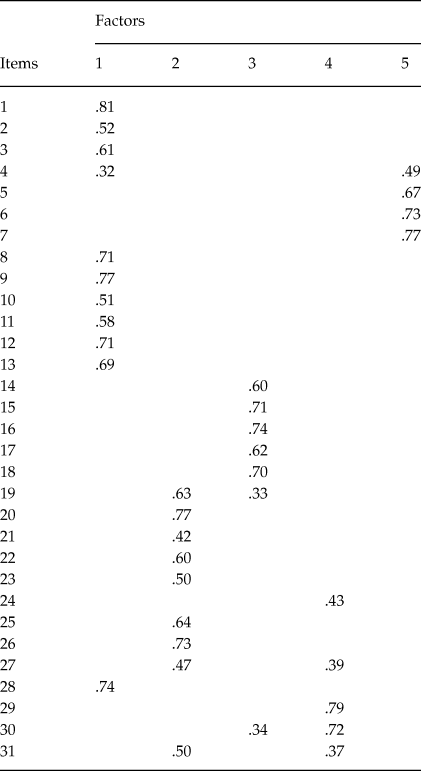
After this last change, the principal component analyses were performed one more time, specifying a 5-factor solution and using 31 items (see Annex). The factor loading matrix is shown in Table 1.
Factor Loadings of EFA with Varimax Rotation of the MCQ Spanish version

Note: Factors loading < .30 were eliminated.
The five factors identified explained 48.94% of the variance. The first factor –Clarity– had an eigenvalue of 5.05, explained 16.29% of the total variance and was composed of items 1, 2, 3, 8, 9, 10, 11, 12, 13, and 28 of the present adaptation. It informs about the visual aspects of the memory – items 1, 2, 3, 8, 9, 10, and 28 – and the spatial location of stimuli – items 13, 15, and 16 – and is therefore a visual-spatial factor. The Clarity factor in the present version is equivalent to Clarity (Factor 1) – without including item 2 – and Contextual Information (Factor 2) factors in Suengas and Johnson’s (Reference Suengas and Johnson1988) version.
The second factor – Emotional involvement – had an eigenvalue of 3.76 and explained 12.12% of the total variance. It is composed of items 19, 20, 21, 22, 23, 25 and 26. The factor is defined by aspects related to the intensity of feelings, the negative valence of memories and the implications/consequences of the event for the subject. It is a compound factor that partly includes the Emotional Intensity factor (Factor 5) – items 20 and 26 – of the original model.
A third factor with an eigenvalue of 2.52 explained 8.12% of the total variance and was composed of items 14, 15, 16, 17 and 18, which refer to the amount of temporal information of the memory. Hence, it was called Temporal Information. There is no equivalent dimension in Suengas and Johnson’s (Reference Suengas and Johnson1988) model.
Items 24, 27, 29, 30 and 31 loaded on a factor called Thoughts and Feelings, which explained 6.41% of the total variance and had an eigenvalue of 1.99. This factor is also compound like the first two factors. It encompasses both the qualitative aspects of the thoughts and feelings during the event and what the model calls “supporting memories”, that is, what happened before and after the event. The original model proposes a Factor 4, also called Thoughts and Feelings but defined only by items 24, 27 and 29.
Finally, a fifth factor – Sensory Information – had an eigenvalue of 1.86 and explained 6% of the total variance. It accounts for all the information remembered with regard to the senses, except visual aspects – items 4, 5, 6 and 7 –. Suengas and Johnson (Reference Suengas and Johnson1988) proposed an identical factor, although it was second in its explanatory importance.
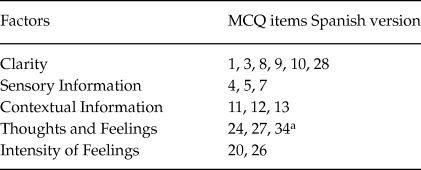
In the present study, confirmatory factor analyses was used to check whether the data distribution obtained by the MCQ Spanish version matched the original factor structure proposed by Suengas and Johnson (Reference Suengas and Johnson1988). This model did not include all MCQ items to test the fit of the Spanish MCQ to the original model. Table 2 shows the Spanish MCQ items which were included in the original theoretical model (Suengas & Johnson, Reference Suengas and Johnson1988).
Original model by Suengas and Johnson (Reference Suengas and Johnson1988)

Note: aOriginal item 34 was removed from the Spanish MCQ version because it did not show an interpretive factor loading.
As can be seen in Table 2, Suengas and Johnson (Reference Suengas and Johnson1988) established a theoretical model composed by five factors: Clarity, Sensory Information, Temporal (contextual) Information, Thoughts and Feelings and Intensity of Feelings.
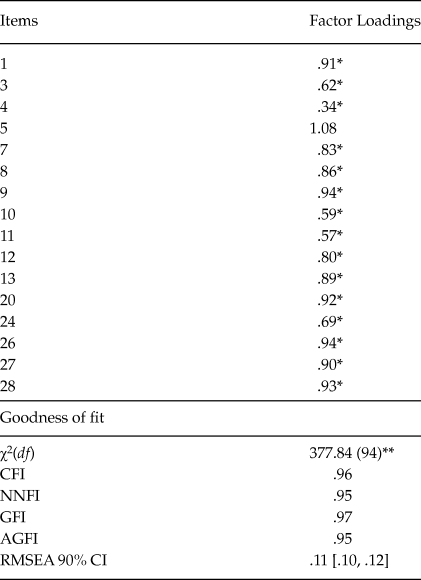
The Weighted Least Squared (WLS) method was used to estimate ordinal data, as recommended by Jöreskog and Sörbom (Reference Jöreskog, Sörbom, Bollen and Long1993). In a previous step, covariance matrices and asymptotic covariance matrices were obtained by using Prelis software, version 8.8 (Jöreskog & Sörbom, Reference Jöreskog and Sörbom2007). The following standard indexes were considered as indicators of good fit: the root mean square error of approximation (RMSEA) should not exceed .08; the goodness of fit index (GFI), the non-normed fit index (NNFI), and the comparative fit index (CFI) indices should reach values above .90, and adjusted goodness of fit index (AGFI) index should reach values above .80. Table 3 shows factor loadings of 16 items included in the CFA and the indices mentioned (original item 34 was not included because it did not exhibit adequate loadings in the EFA).
Factor Loadings and Fit Indices for MCQ Spanish version

Note: *p ≤ .05; **p < .001.
As Table 3 illustrates, on the one hand, as a negative point, the RMSEA value exceeded .08, 90% CI [.10, .12], and the chi-square value was significant, χ2(94) = 377.84, p < .001. However, this index is totally dependent on sample size (Bentler & Bonnet, Reference Bentler and Bonnet1980). On the other hand, the values of goodness-of-fit statistics were optimal. The NNFI, CFI, GFI and AGFI had values higher than established criteria. These results are considered to be adequate. Thus, the score distribution of these MCQ Spanish version items matched the theoretical model proposed by Suengas and Johnson (Reference Suengas and Johnson1988).
With respect to factor loadings, all factor loadings were significant and ranged from .34 to .94, M FL = .80, except item 5, whose factor loading was higher than one. This effect could be caused by the RMSEA value. Moreover, it is important to note that item 5, “...involves smell” asks about a sensation which was not included in the experiment.
MCQ psychometrics and results across conditions
Internal consistency analyses were performed for each experimental condition. Cronbach’s alpha of the Honest condition was .78, slightly higher than that of the Lie condition, which was .76. However, Feldt’s W (Feldt, Reference Feldt1969) did not reveal a significant difference (w = .19, p =.650).
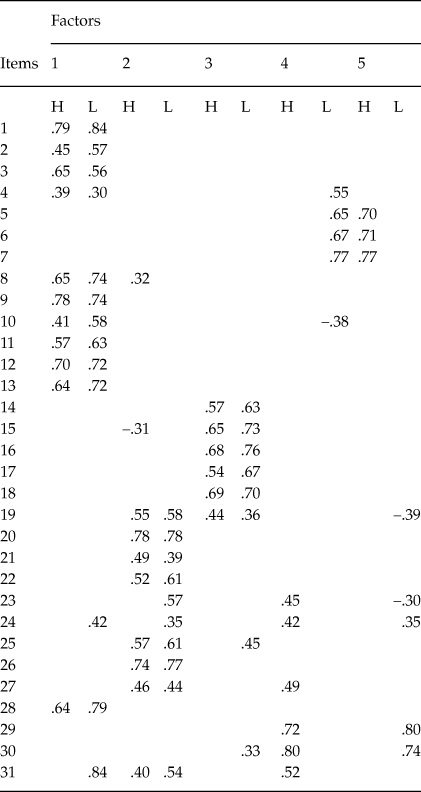
The KMO values for both conditions, Honest: KMO = .678 and Lie: KMO = .691, and Bartlett’s Test of Sphericity values, Honest: χ2(465) = 1358,932, p < .001; Lie: χ2(465) = 1597,647, p < .001, illustrate the sampling adequacy for EFA. After this, principal component analyses with Varimax rotation were performed on all 36 items included in the Spanish MCQ version. The 5-factor solution explained 49.13% and 52.11% of the variance for the Honest and the Lie conditions respectively. The factor loading matrix for both conditions is shown in Table 4.
Factor Loadings of EFA with Varimax Rotation of the MCQ Spanish version

Note: Factors loading < .30 were eliminated.
H: honest; L: lie.
In general terms, factor loadings are very similar in both experimental conditions and to the factor structure found for the total sample. For example, distributions of all factor loadings of Factor 3 items (“Temporal information in memory”), for both conditions are equal to those found in total sample and above .54, but item 18 whose factor loading in Factor 2 is slightly above the criteria. On the other hand, 3 out of 4 items of Factor 5 (“Sensory information”), show also relevant factor loadings in Factor 4 (“Thought and feelings”) for Lie condition.
A two-factor ANOVA (clip x condition) was performed to analyze experimental data. Total scores from the Spanish MCQ were set as the dependent variable. Interaction was not significant, F(236) = 1.189; p = .277, neither were the main effects: film, F(1) = 24.727; p = .126, and condition, F(1) = 1.308; p = .457. When both conditions were compared regardless of the film, no significant differences were found in mean scores between participants asked to tell the true and those asked to lie, t(238) = –2.783; p = .240.
Discussion
The aim of study was to develop and test psychometric properties of the Spanish MCQ. First, a careful translation was performed using the back-translation method and attention was paid to ITC guidelines. The final version of the Spanish MCQ is based on psychometrics obtained from MCQ responses in an experiment. Experimental data allow the researcher to obtain validity evidence in a way that satisfies the current views on validity theory, especially source of validity evidence based on relationships with other variables and on internal structure (AERA, APA, NCME, 1999; Sireci & Padilla, Reference Sireci and Padilla2014). Psychometric and validity evidence for the total sample and for both experimental conditions support the adequacy of the Spanish MCQ.
However, it must be highlighted that the structure of the Spanish MCQ is not exactly the same as that of the original English version. The discriminative analysis of the items shows inadequate psychometric properties in 3 items (24, 30 and 38) that were removed from the final version of the Spanish MCQ. Items 24 and 30 are particularly important. They refer to positive affect. Yet, items 19 and 25, which assessed negative affect, showed adequate discrimination indices. No explanation has been found for these results. It is possible that, although a priori, the emotional valence of the two film clips seen by participants was different, participants tended to assess them with a negative valence. This may have been influenced by the sexual content of both stimuli. In any case, future studies will have to determine whether the emotional characteristics of memories assessed with procedures such as the MCQ are more likely to be assessed in bipolar or unipolar terms.
Moreover, the factor structure of the MCQ in the Spanish sample shows some characteristics that are not observed in the original version. Perhaps, this is influenced by the fact that the present principal component analysis was performed with 31 items, whereas Suengas and Johnson (Reference Suengas and Johnson1988) used 30 items. Therefore, the variables measured differ between both studies. This may explain the fact that the Temporal Information factor does not appear in the original study (items 15–18 refer clearly to this). Furthermore, the Emotional Involvement factor of the present adaptation is more complex than the original Emotional Intensity factor because it includes the memory of the consequences that the event could have had for the subject. This may have been influenced by the fact that items 22 and 23 were not measured. Something similar has happened with other adaptations of the MCQ to various cultural contexts. For example, the adaptation to the German language by Sporer and Kuepper (1994) included 35 items and obtained 8 factors in an EFA. In a Japanese adaptation, Takahashi and Shimizu (Reference Takahashi and Shimiza2007) obtained 8 factors from 38 items. In summary, future research should use the Spanish version of the revised MCQ with Spanish samples due to the adequate psychometric properties shown in this study.
Other aspects to highlight in the present adaptation refer to the explanatory importance of the Clarity factor, which matches the original model. However, in the present adaptation it is defined by the visual and spatial aspects of the memory, whereas it is exclusively visual in Suengas and Johnson’s version. This is consistent with the predictions of the model, since it is postulated that the memory of what was perceived is characterized by the number of details of the stimuli and their spatial location. The same applies to the Sensory Information factor. In addition, the compound structure of the present Clarity factor explains the absence of the Contextual – spatial – factor of the original model in the Spanish sample.
It is also worth mentioning the different order of some factors in both studies. For example, the Sensory Information factor is second in explanatory importance in the original study but fifth in the present study; the second factor in the present study – Emotional Involvement – has an equivalence in the fifth factor – Emotional Intensity – in Suengas and Johnson’s study, although in the present study the factor includes other aspects apart from mere emotional quantification. It seems as if there has been a permutation in the order of both factors. This may be related to the differences in the manipulations of both studies. In the present study, participants watched film clips showing a rape or consenting sex and half of them were instructed to lie about this in the interview. However, subjects in the study by Suengas and Johnson (Reference Suengas and Johnson1988) participated in activities that included visits to various places, introductions to several people and food and drink (cookies, soda, and coffee). It is possible that the conditions of the present study are more prone to eliciting emotional activation. To the extent to which such effect was provoked, the data analyzed in this study could have been obtained in similar conditions to which victims or witness of serious offense experience. These conditions could lead to research on whether a high emotional activation increases the number of memories that victims or witness remember. This could be very useful in forensic contexts.
The results of the present study have also shown that the original model proposed by Suengas and Johnson (Reference Suengas and Johnson1988) is viable in a Spanish sample, as shown by the CFA. However, we consider that it is a restrictive model, since it does not include some aspects present in the context of Source Monitoring and that the present exploratory analysis has highlighted. Such aspects are Temporal Information, Emotional Involvement and Supporting Information. The present study should be considered as a first step in the Spanish adaptation of the MCQ. Future studies about the credibility of testimony should determine whether a broader theoretical model including such aspects would adjust better to the data.
In conclusion, the MCQ approach provides a useful, replicable way of exploring the nature of the subjective experience of remembering (Johnson et al., Reference Johnson, Foley, Suengas and Raye1988) and of clarifying our understanding of the relevant features of memory. Furthermore, the general source monitoring framework and the MCQ procedure provide a systematic approach not only for studying the differences in true and false accounts of memories reported in good faith, but also for exploring the differences that appear between the accounts of subjects attempting to tell the truth and subjects attempting to lie about what they have seen.
This research was partially funded by the Andalusia Regional Government (Spain), under the Excellent Research Fund (Project n° SEJ-5188 and SEJ-6569).
ANNEX: Spanish Memory Characteristics Questionnaire (MCQ)
A continuación, se le hacen una serie de preguntas sobre el recuerdo del acontecimiento que nos ha descrito. Por favor, conteste a cada una de las preguntas utilizando la escala de 7 puntos que se incluye. Puede redondear cualquier valor de los indicados.
Mi recuerdo del acontecimiento es: