Introduction
Anzia Stizenb. (Parmeliaceae; Lumbsch & Huhndorf Reference Lumbsch and Huhndorf2010; Thell et al. Reference Thell, Crespo, Divakar, Kärnefelt, Leavitt, Lumbsch and Seaward2012) comprises foliose lichens characterized by a brown-black or pale brown spongiostratum (spongy cushion) covering the lower surface (Calvelo Reference Calvelo1996), pale greyish white to greyish green narrow lobes, and asci with numerous crescent-shaped ascospores (Stizenberger Reference Stizenberger1861). The genus has a rather cosmopolitan distribution, and includes c. 38 species, occurring primarily between 1000 and 4000 m in subtropical or temperate latitudes of both hemispheres. Anzia may be closely related to Pannoparmelia (Müll. Arg.) Darb., which also has a spongy cushion on the lower surface, but differs by the asci containing eight spores and the yellow-green upper cortex (Darbishire Reference Darbishire1912). Asahina (Reference Asahina1935) divided Anzia into three sections (Simplices, Duplices, and Nervosae) based on the anatomy of the medulla. Section Nervosae was identified by the presence of a central axis. Sections Simplices and Duplices were defined by the presence of a single-layered or double-layered medulla, respectively. Yoshimura (Reference Yoshimura1987) observed both of these medulla types within a single species (i.e. A. japonica) and therefore combined these two sections as section Anziae.
The circumscription of the genus and geographical ranges of the species have been revised for Macaronesia (Haugan Reference Haugan1992), Asia (Yoshimura & Elix Reference Yoshimura and Elix1993; Yoshimura Reference Yoshimura1995; Yoshimura et al. Reference Yoshimura, Singh and Elix1997; Jayalal et al. Reference Jayalal, Wolseley, Gueidan, Aptroot, Wijesundara and Karunaratne2012; Liang et al. Reference Liang, Qian, Wang, Chen, Liu and Wang2012) and South America (Calvelo Reference Calvelo1996). Eight species are currently recognized from mainland China (Wei Reference Wei1991; Liang et al. Reference Liang, Qian, Wang, Chen, Liu and Wang2012), mostly from Yunnan Province (Wu & Wang Reference Wu and Wang1992; Wang Reference Wang1995), but the diversity, variation and hence boundaries of species have not been comprehensively investigated. Anzia leucobatoides (Nyl.) Zahlbr., for example, was described based on a single collection from Yunnan and has not been collected since.
Here we critically revise the genus Anzia in China based on a morphological and chemical study of all collections held in KUN, and on phylogenetic inferences from ITS sequences obtained for a set of exemplars. We propose to recognize ten species, including A. pseudocolpota sp. nov. and A. hypomelaena comb. & st. nov., based on A. leucobatoides f. hypomelaena, and highlight under A. aff. hypoleucoides a set of populations that are closely related to A. hypoleucoides but differ by their narrower lobes and their pigmented medulla, and which may constitute an additional species. A key to all Anzia taxa in China is provided.
Materials and Methods
Morphological and chemical studies
Approximately 500 specimens were examined in the Lichen Herbarium of the Kunming Institute of Botany (KUN-L), including recent collections from 2013 and 2014, made mostly in the Hengduan Mountains. Specimens were examined using standard microscopy techniques and hand-cut sections under a NIKON SMZ 745 T dissecting microscope. Anatomical descriptions are based on observations of these preparations under a NIKON Eclipse 50i microscope and photographs were taken using a NIKON digital camera head DS-Fi2. Size of the thallus, apothecia and lobes are based on measurements for each specimen, and ascospore dimensions reflect ten measurements typically from a single apothecium per specimen. Size is in each case represented by the range between the smallest and largest single values.
Secondary metabolites of all the specimens were identified using spot test and thin-layer chromatography as described by Elix et al. (Reference Elix, Johnston and Parker1987), White & James (Reference White and James1985) and Orange et al. (Reference Orange, James and White2001). Solvent C (toluene: acetic acid = 85:15) was used for TLC analysis.
DNA extraction
Total DNA was extracted from small fragments of fresh thallus tips following the protocol by Ekman (Reference Ekman1999) using Axyprep Multisource Genomic DNA Miniprep Kit. The nrDNA ITS region (ITS1-5.8S-ITS2) was amplified by PCR using the ITS1F (Gardes & Bruns Reference Gardes and Bruns1993) and ITS4 (White et al. Reference White, Bruns, Lee and Taylor1990) primers. Conditions previously described by Arup (Reference Arup2002) were used for PCR: 2 μl of genomic DNA was added to the following mix: 2 μl of primer (1 μl for each primer of a 10 mM solution), 12·5 μl of 2×Taq PCR Mastermix (Aidlab) (containing Taq DNA Polymerase: 0·1 unit/μl; MgCl2: 4 mM; dNTPs: 0·4 mM) and 8·5 μl dH2O for a total volume of 25 μl. Amplifications were carried out in a thermocycler (C 1000TM), with the following profile: initial denaturation at 94°C for 5 min, followed by 30 cycles, each of three steps (94°C for 1 min, 56°C for 1 min, 72°C for 1·5 min), and a final extension at 72°C for 7 min. The PCR products were sanger-sequenced by Sangon Biotech.
Phylogenetic analyses
All raw sequences were assembled and edited using SeqMan (DNAstar packages). The newly generated ITS sequences were complemented by sequences available in GenBank. Sequences were aligned using MUSCLE v3.6 (Edgar Reference Edgar2004), and ambiguous regions were excluded using Gblocks (Talavera & Castresana Reference Talavera and Castresana2007) with the default settings. Phylogenetic relationships were inferred using Bayesian Inference (BI) and under the Maximum Likelihood criterion (ML), with Pannoparmelia angustata (Pers.) Zahlbr. selected as the outgroup.
BI analyses were performed using MrBayes v3.1.2 (Ronquist & Huelsenbeck Reference Ronquist and Huelsenbeck2003). The optimal substitution model implemented in MrBayes was determined based on the Akaike Information Criterion (AIC) using jModelTest 3.7 (Posada Reference Posada2008). BI analyses were run for 1 000 000 Markov chain Monte Carlo (MCMC) generations and 4 incrementally heated chains; MCMC started from a random tree and trees were sampled every 1000 generations, with the first 10% of trees discarded as burn-in. Posterior probabilities (PP) were obtained from the 95% majority-rule consensus tree of all saved trees.
ML analyses were performed with an online version of RAxML v7.2.6 (Stamatakis Reference Stamatakis2006). All parameters in the ML analysis were set to their default setting, and statistical support values were estimated by 1000 non-parametric bootstrapping pseudoreplicates. Bootstrap support values (MLBS) were obtained from the 70% majority-rule tree of all saved trees, using RAxML.
Results
Phylogenetic analyses
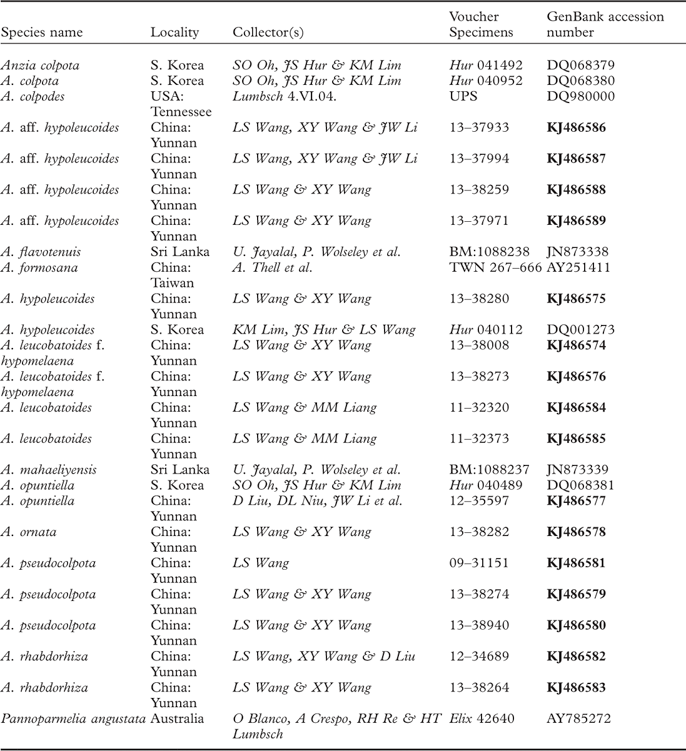
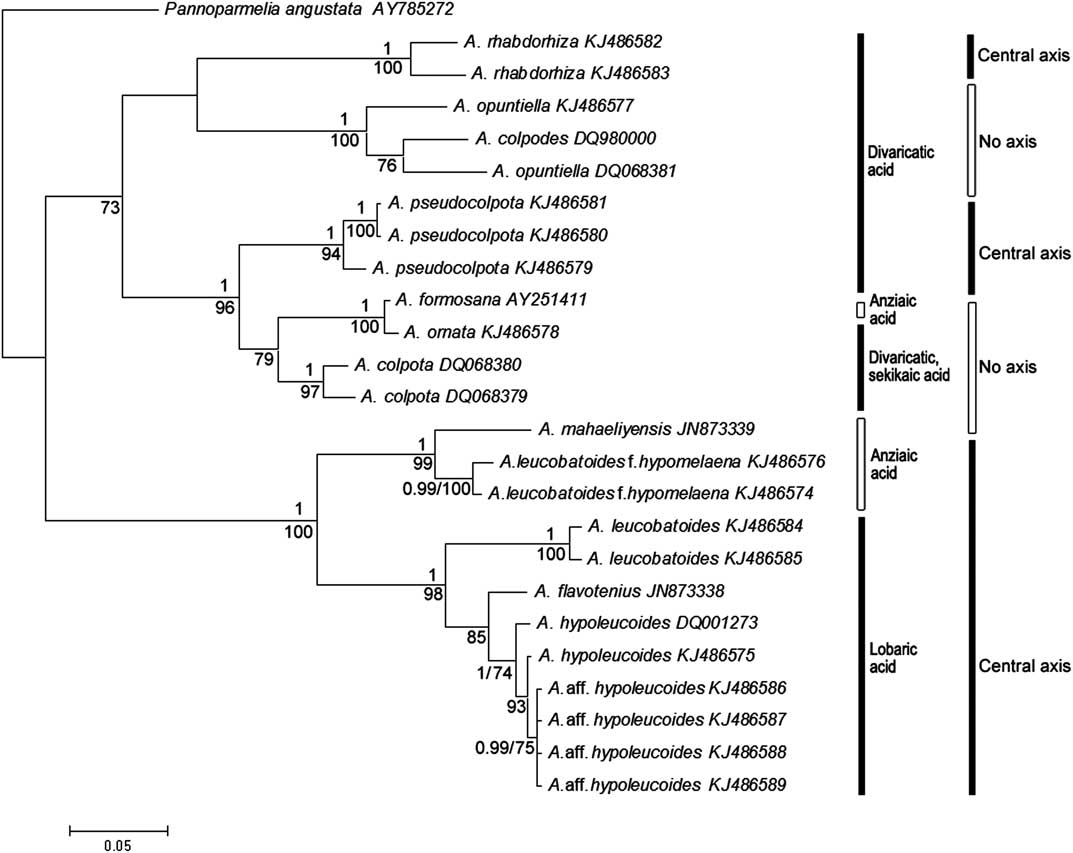
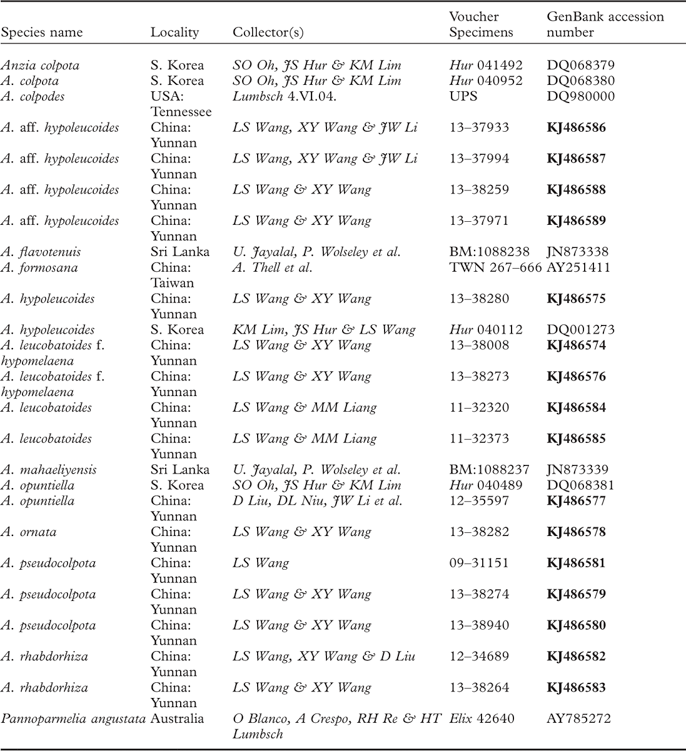
Sixteen new ITS sequences were generated and the final matrix included 25 samples of Anzia and the outgroup exemplar (Table 1). The most likely tree is composed of one well-supported (MLBS = 100; PP = 1·0) and one unsupported clade (Fig. 1). The presence or absence of a central axis does not define a single clade wherein the character is conserved. All species producing lobaric acid, divaricatic or divaricatic and sekikaic acids form respective monophyletic lineages. By contrast, species producing anziaic and divaricatic acids compose a polyphyletic group (Fig. 1).
Specimens used in this study, newly obtained sequences are in bold
Most likely phylogenetic relationships of Anzia samples from China inferred from ITS sequences using Pannoparmelia angustata as the outgroup. Posterior probabilities are shown above and ML bootstrap frequencies below branches.
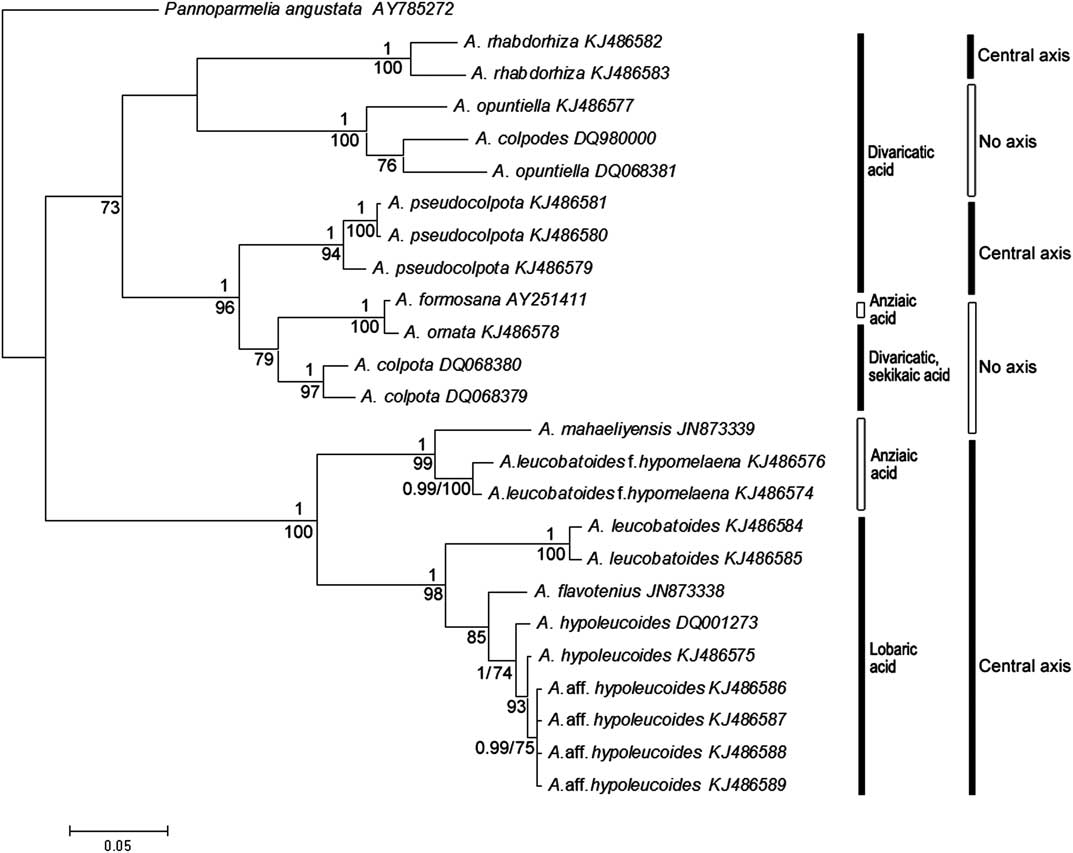
The three populations of a putative new species (i.e., A. pseudocolpota), similar to A. colpota but differing by the presence of a central axis, form a highly supported clade (MLBS = 94%; PP = 1·0; Fig. 1) sister to A. colpota, A. formosana and A. ornata. Specimens resembling A. hypoleucoides but distinguished by their yellow medulla and their mostly subtropical distribution, clustered (MLBS = 75%; PP = 0·99) within the A. hypoleucoides clade, and are subtended by a clade of two typical exemplars (Fig. 1). The two samples of A. leucobatoides f. hypomelaena form a robust clade (MLBS = 100%; PP =0·99) separated from typical A. leucobatoides by A. mahaeliyensis.
Taxonomic treatment
Anzia colpota Vain.
Botan. Magaz. 35: 19 (1921); type: Japan, Rikuzen Province, Gamo, A. Yasuda 248 (TUR—holotype).
Morphology and chemistry. See Yoshimura (Reference Yoshimura1974).
Ecology and distribution. Usually growing on Pinus, Quercus or Rhododendron bark, at altitudes between 2000 and 3500 m. Known from Japan, Korea and China (Yoshimura Reference Yoshimura1974). The Chinese specimens are mostly distributed in the Hengduan Mountains area.
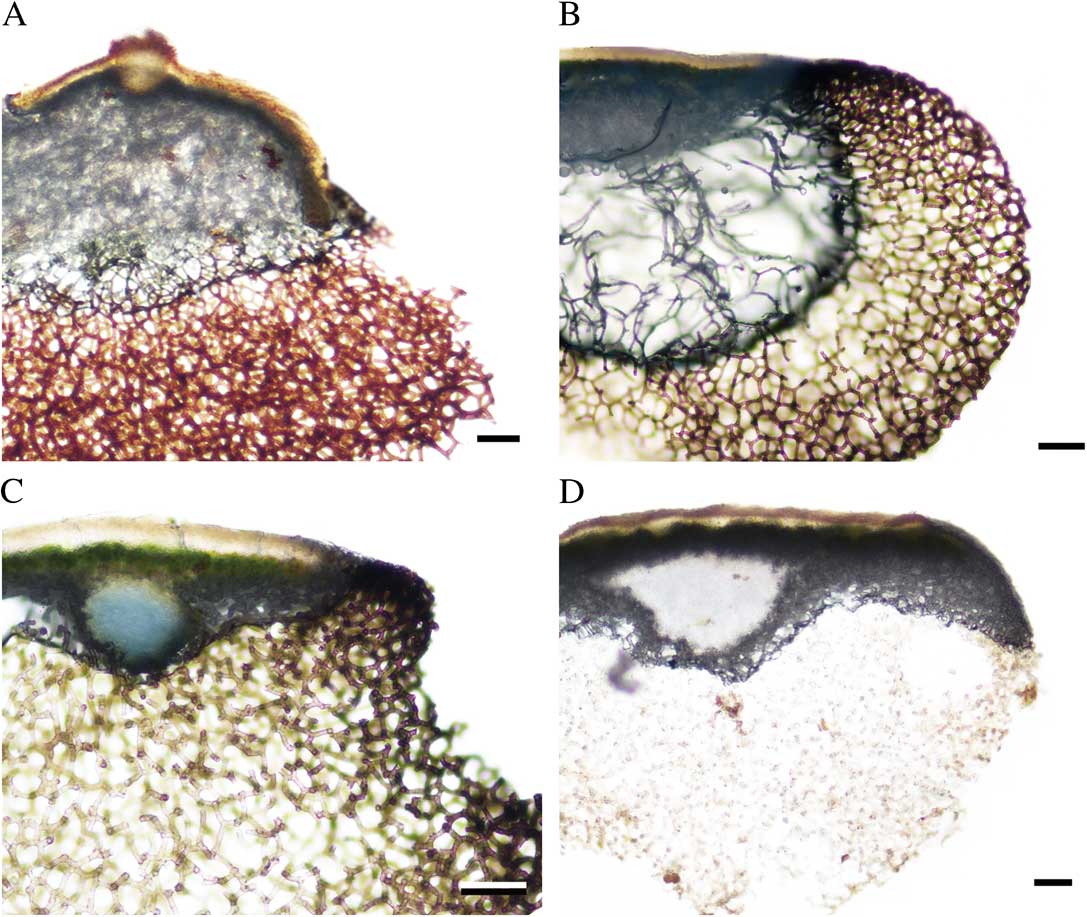
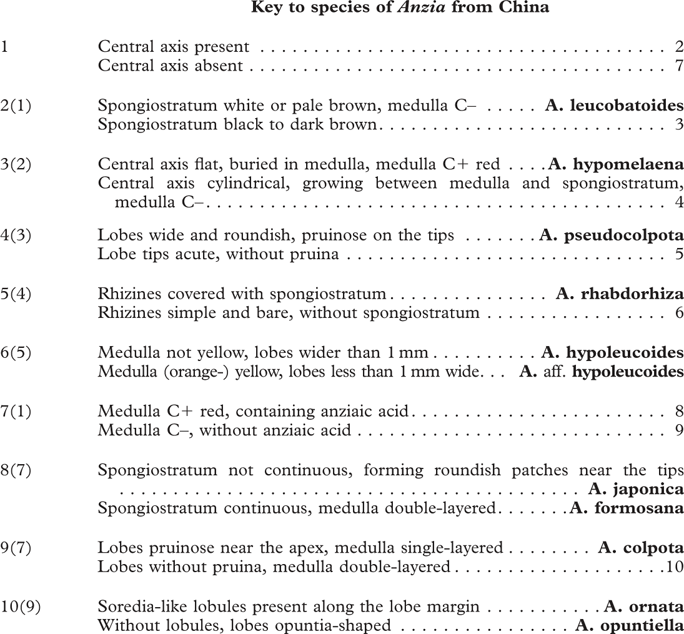
Comments. This species is characterized by the pruinose upper surface, palmate (apically densely branched) lobes and a single-layered medulla (Fig. 2A), containing divaricatic and sekikaic acids.
Medulla types of Anzia. A, single-layered medulla of A. colpota; B, double-layered medulla of A. formosana; C, black and cylindrical central axis growing between medulla and spongiostratum (A. hypoleucoides); D, white and flattened central axis buried in medulla (A. leucobatoides). Scales: A–D = 100 μm. In colour online.
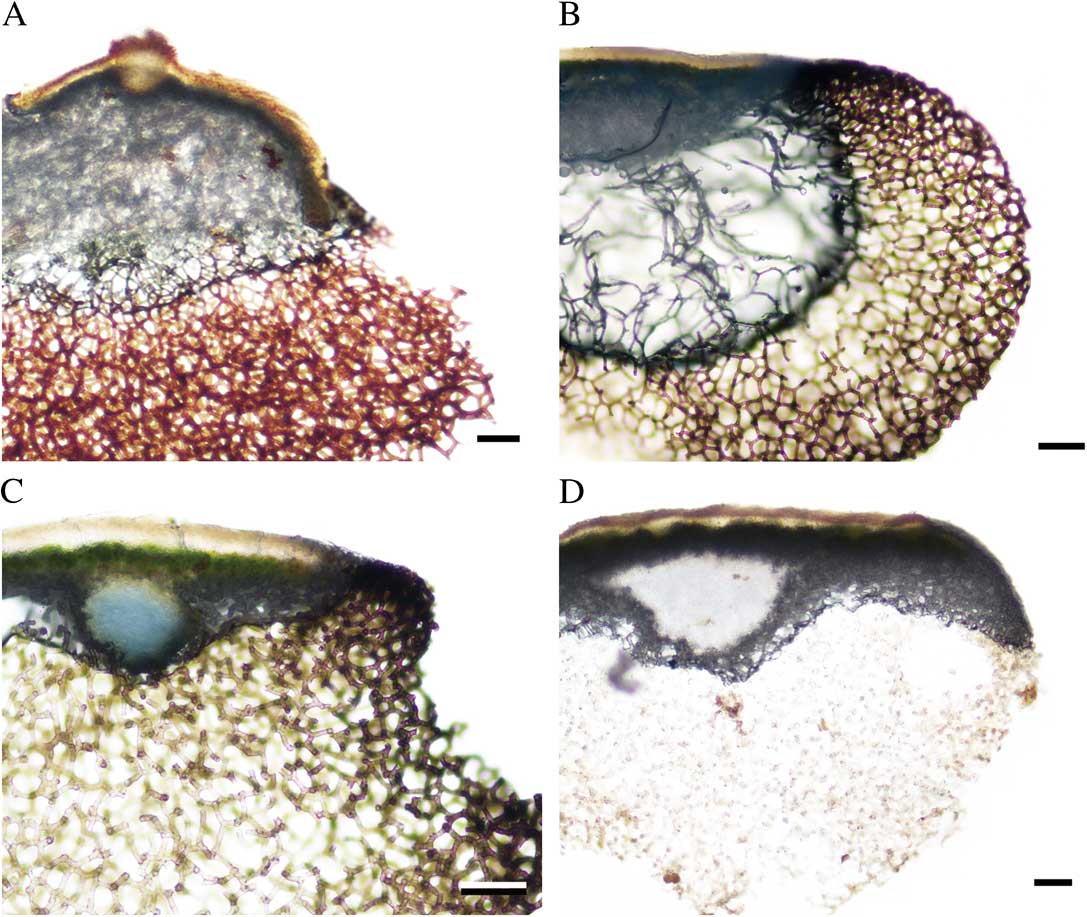
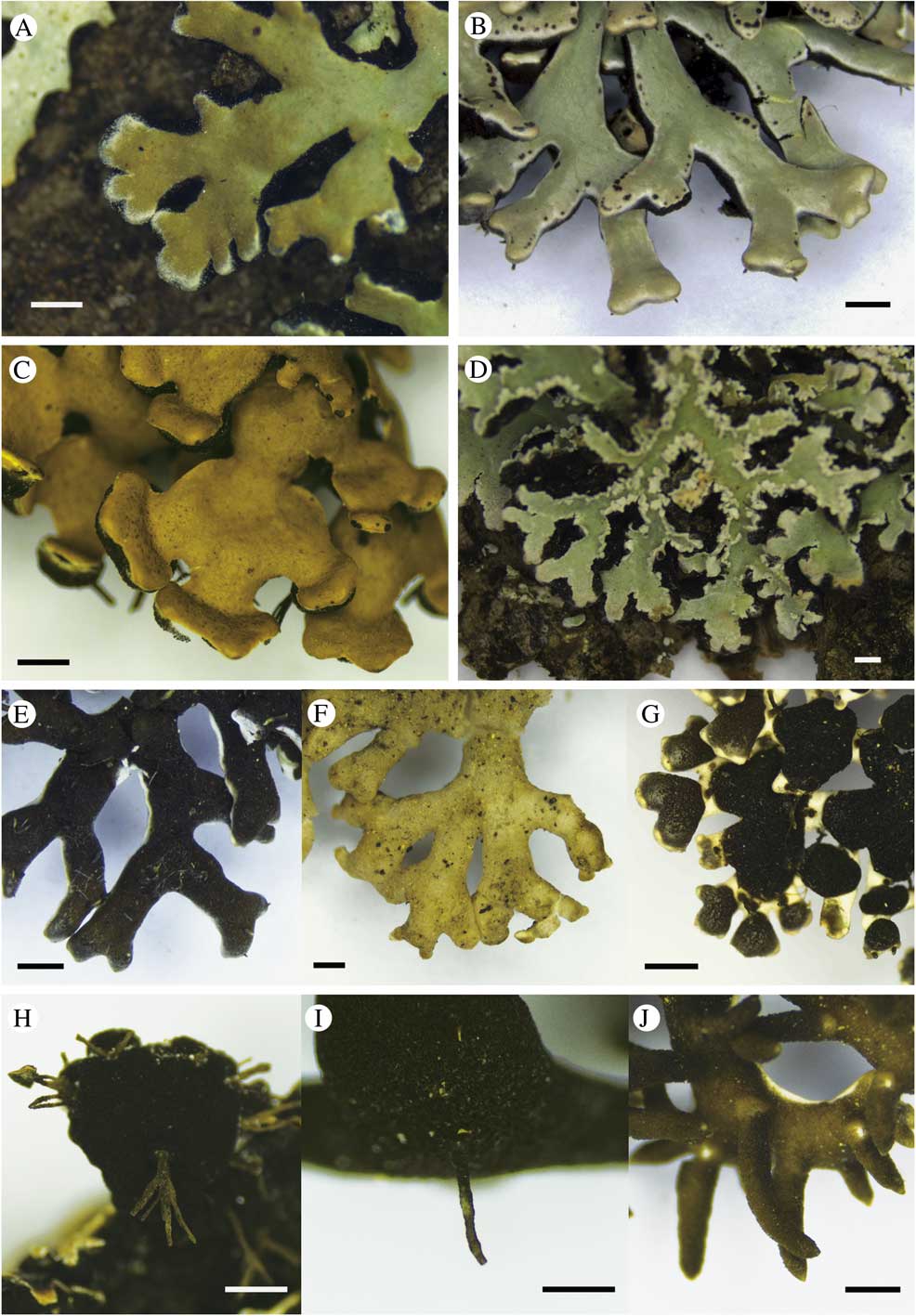
Anzia colpota may be confused with A. japonica, but that species has a central axis, and the spongy cushion is clearly not continuous over the lower surface but forms roundish patches (Fig. 3G). Furthermore, A. japonica contains anziaic acid (medulla C+ red), whereas divaricatic and sekikaic acids are present in A. colpota.
Lobe (A–D), spongiostratum (E–G) and rhizine (H–J) types in Anzia. A, pruinose lobe (A. colpota); B, dichotomously branched lobe (A. hypoleucoides); C, opuntia-like lobe (A. opuntiella); D, lobulate lobe (A. ornata); E, black (A. hypoleucoides); F, white (A. leucobatoides); G, patchy spongy cushion (A. japonica); H, 3–5 bundled (A. pseudocolpota); I, single (A. hypoleucoides); J, covered with spongiostratum (A. rhabdorhiza). Scales: A–J = 1 mm. In colour online.
This species, which is common in Eastern Asia, is morphologically identical to A. colpodes (Yoshimura Reference Yoshimura1974; Wu & Wang Reference Wu and Wang1992; Hur et al. Reference Hur, Wang, Oh, Kim, Lim, Jung and Koh2005), a species considered to be endemic to the East Coast of North America (Hale Reference Hale1955). Anzia colpodes and A. colpota differ only by the presence or absence of sekikaic acid which, given the morphological similarity, led Culberson (Reference Culberson1961) to suggest that they should perhaps be considered conspecific. We have been unable to obtain ITS sequences for A. colpota but inferences from publically available sequences for this species and A. colpodes suggest that they belong to two well-supported distinct clades (Fig. 1). We propose to retain the Asian and American populations in separate taxa until further sequence data can be analyzed.
Selected specimens examined. China: Yunnan Prov .: Deqin Co., Meili Snow Mt., 3200 m, 28°38′13·48"N, 98°39′47·01"E, on Rhododendron bark, 2012, L-s. Wang KUN-L 23961, 23962; Lijiang Co., Yulong Snow Mt., 3000 m, 28°24′N, 98°45′E, on Pinus bark, 1987, L-s. Wang KUN-L 17626, 17710; Gongshan Co., Dulongjiang, 3600 m, on Quercus bark, 2005, L-s. Wang KUN-L 11697.
Anzia formosana Asahina
J. Jap. Bot. 13: 221 (1937); type: Taiwan, Mt. Alishan, leg. M. Ogata (hb. Asahina—holotype).
Morphology and chemistry. See Asahina (Reference Asahina1937).
Ecology and distribution. Growing on Picea, Pinus, and Rhododendron between 1800 and 3000 m. Originally reported from Taiwan, and mainly distributed in the southern part of China (Sichuan and Yunnan; Yoshimura Reference Yoshimura1987).
Comments. This species endemic to China is characterized by the long linear lobes with pointed tips, two-layered medulla (Fig. 2B), and the presence of anziaic acid. Anzia hypoleucoides differs by the presence of a central axis in the medulla and by containing lobaric versus anziaic acid. Anzia opuntiella also has a two-layered medulla, but it contains divaricatic and sekikaic acids and has opuntia-like lobes rather than the linear branched lobes of A. formosana.
This species is related to A. colpota and A. ornata, with which it shares the lack of a central axis in the medulla and a similar ecological distribution.
Selected specimens examined. China: Yunnan Prov.: Jingdong Co., Ailao Mt., near Xujiaba reservoir, 2500 m, 24°32′28·81"N, 101°01′01·47"E, on Quercus bark, 2013, L-s. Wang KUN-L 23963, 23964; Lijiang Co., Jiuhe Village, Laojun Mt., 3800 m, 26°37·940′N, 99°43·494′E, on Rhododendron bark, 2011, L-s. Wang KUN-L 23965. Xizang Prov .: Chayu Co., Ridong village, on bark, 2000 m, 1982, J-j Su KUN-L 11677. Sichuan Prov.: Muli Co., No. 915 woodland, 3700 m, 28°24·574′N, 99°46·685′E, on Picea bark, 2001, L-s. Wang KUN-L 18976.
Anzia hypoleucoides Müll. Arg.
Flora 74: 111 (1891); type: Japan, Tosa, Miyoshi (G—holotype).
Morphology and chemistry. See Yoshimura (Reference Yoshimura1974).
Ecology and distribution. Growing on the bark of Rhododendron, Quercus or Abies in subalpine regions in Japan, Korea and China (Sichuan and Yunnan; Yoshimura Reference Yoshimura1974).
Comments. This species is characterized by the black, cylindrical central axis lying between the medulla and the spongy layer, a dark brown spongy cushion, and the presence of lobaric acid.
Anzia hypoleucoides may be confused with A. leucobatoides, but it forms much smaller thalli (up to 8 cm in diam.) with rounded lobes c. 1 mm wide (Fig. 3B), whereas the latter species forms rather large thalli (to 12 cm in diam.) with pointed lobes to 2 mm wide. Furthermore, the central axis is black and cylindrical, developing under the medulla (Fig. 2C), versus white and flat, buried in the medulla in A. leucobatoides (Fig. 2D). Anzia rhabdorhiza also has a central axis and forms rather small thalli but differs by the spongy cushion covering the rhizines (Fig. 3J), the rather long rhizines (to 7 mm long vs to 2 mm in A. hypoleucoides), and the presence of divaricatic (instead of lobaric) acid.
Selected specimens examined. China: Yunnan Prov.: Lijiang Co., Alpine Botanical Garden, 3450 m, 27°00.447′N, 100°10.502′E, on Rhododendron bark, 2011, L-s. Wang KUN-L 23966; Jingdong Co., Ailao Mt., Xujiaba, 2500 m, 25°44·290′N, 99°03·565′E, on stump, 1994, L-s. Wang KUN-L 14527. Sichuan Prov.: Miyi Co., north slope of Malong Mt., 2800 m, on bark, 1983, L-s. Wang KUN-L 4972, 4818.
Anzia aff. hypoleucoides
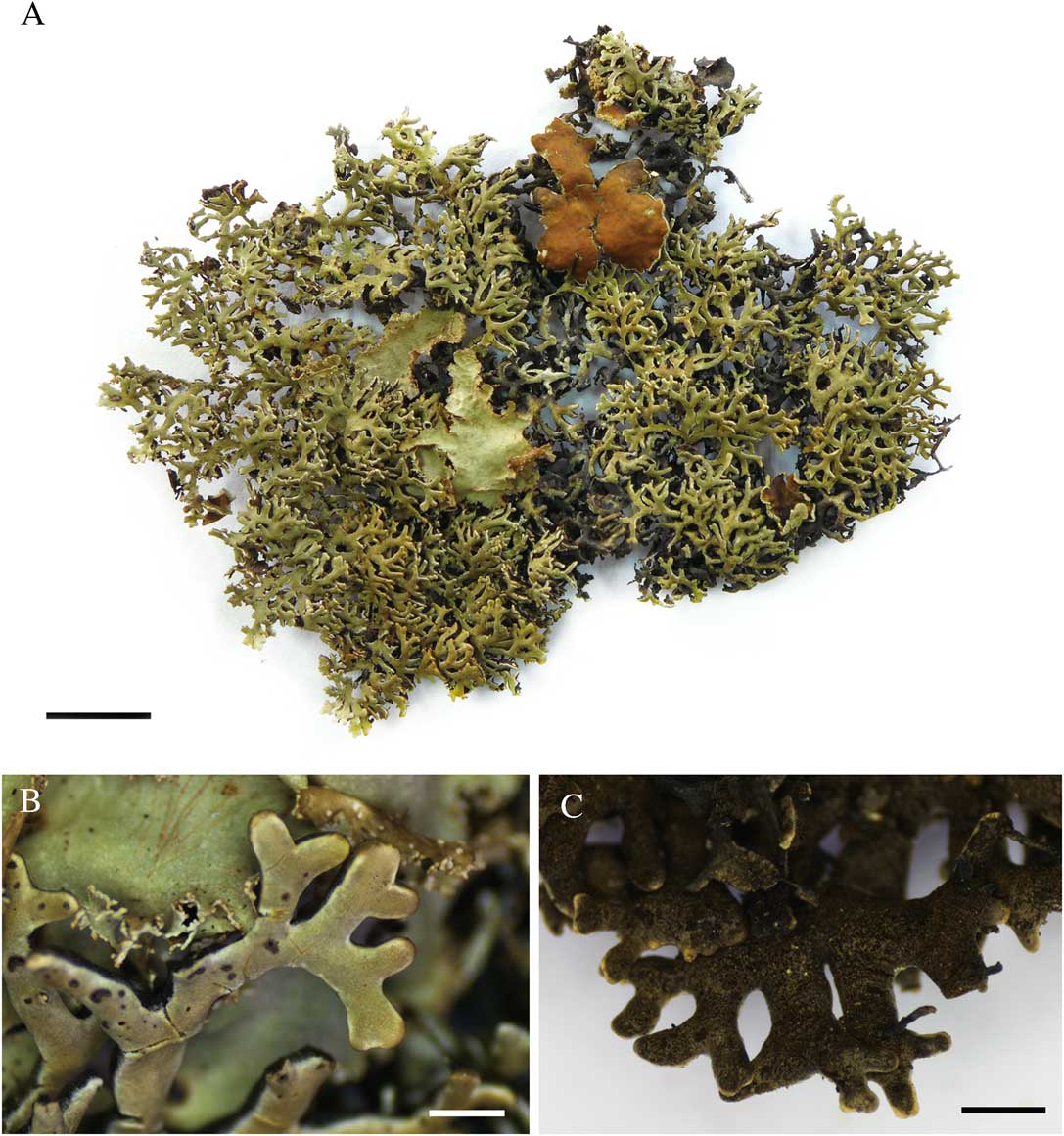
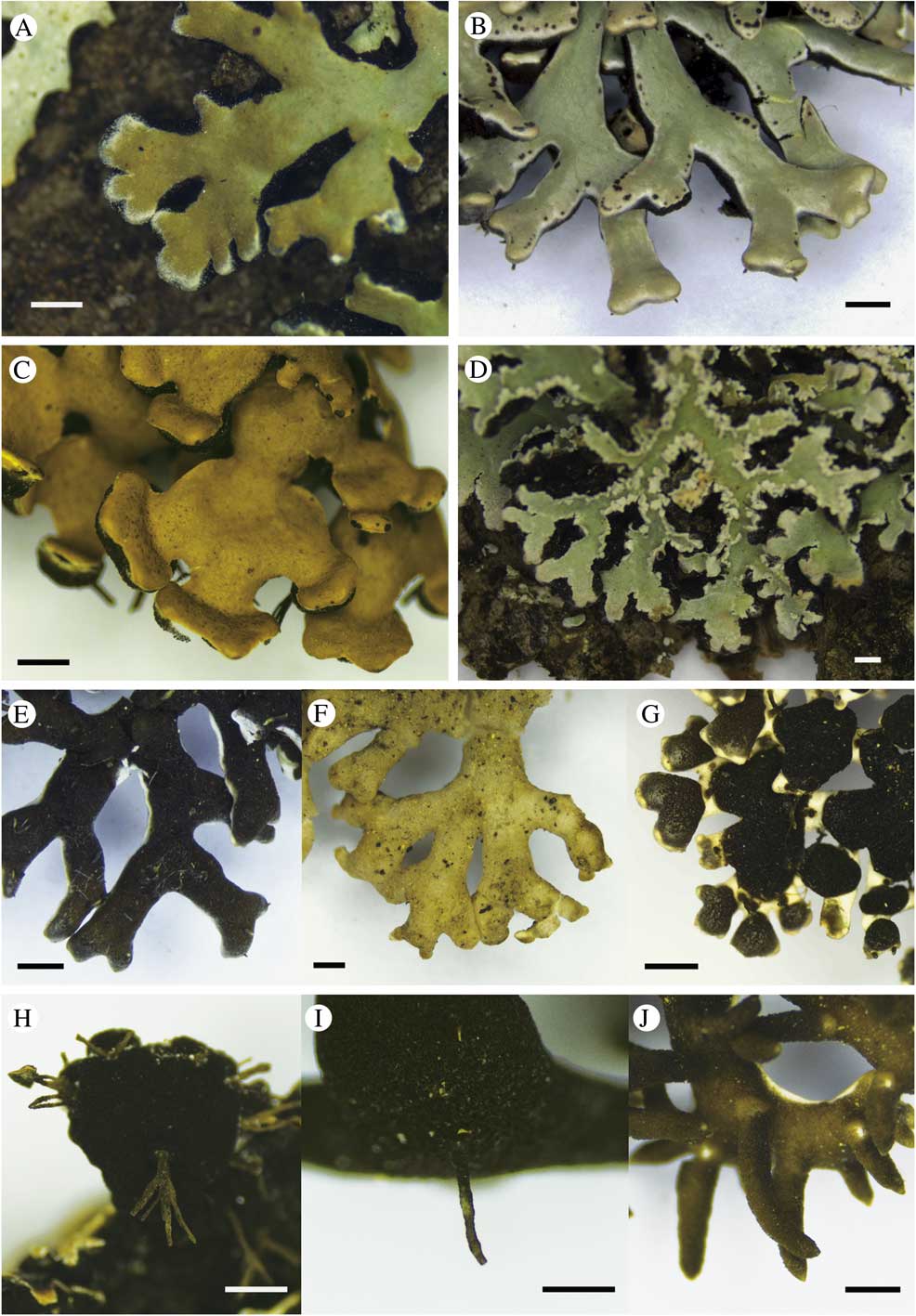
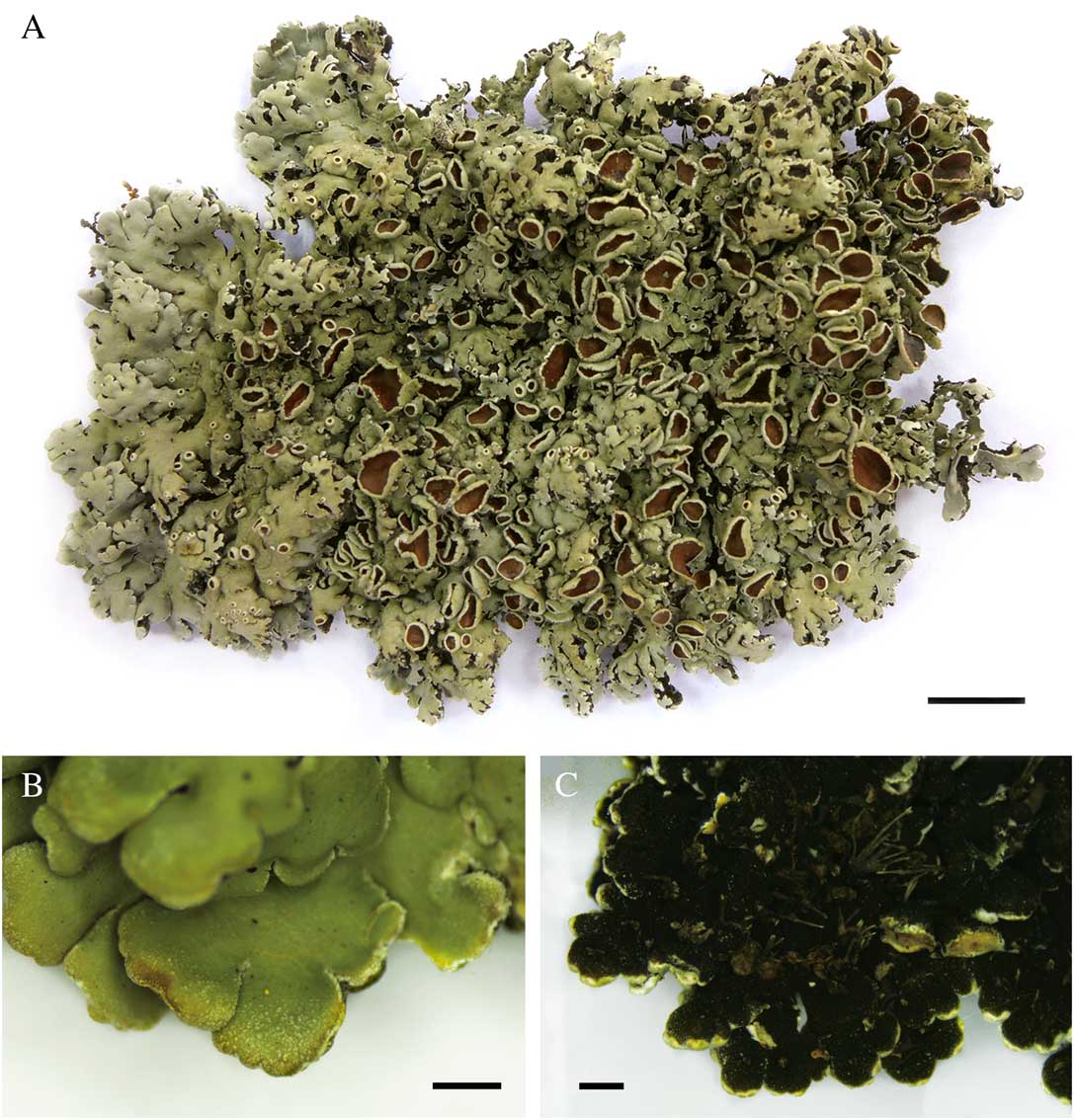
(Fig. 4)
Thallus foliose, upper surface convex, greyish green to brownish green (herbarium stored), loosely adnate to the substratum, to 8 cm diam., without soredia or isidia; lobes linear, anisotomic dichotomously branched, lobes rather slim (0·5–1·0 mm wide), internodes 1·0–1·5 mm long, lobe tips roundish, cracks present on the marginal part of mature lobes; medulla yellow to orange-yellow (mature), single-layered, with black central axis growing between medulla and spongiostratum, cylindrical to oblate; lower surface covered with black to brownish black spongy cushions, continuous, spongy cushions narrower than the upper cortex, invisible from upper surface, hyphae brown in section, 7·5–9·0 μm thick; rhizines rather rare, simple, to 1 mm long (Fig. 3I).
Apothecia disc-shaped, rare, usually on the central part of the upper surface; disc reddish brown, 1–10 mm diam., roundish when young, becoming cracked and irregular when mature; epihymenium brownish yellow, 8–10 μm thick, hymenium hyaline, 25–30 μm thick, subhymenium 40–50 μm, colourless; ascus rod-shaped, c. 30 μm long, with numerous ascospores spirally arranged, spores simple and curved, 10·0–12·5 ×2·5 μm.
Pycnidia black, prominent above the surface, always on the margin of the lobe tips.
Chemistry. Cortex K+ yellow, medulla C+ yellow, KC–, containing atranorin, lobaric acid and an unknown pigment.
Ecology and distribution. Growing usually on Quercus or Rhododendron, in mesic montane forests (south end of the Hengduan Mountains), with only limited occurrence on Rhododendron in subalpine forests in NE Yunnan (Lijiang Co.), endemic to south-western China (Yunnan).
Comments. This potential taxon differs from all other Chinese Anzia by the yellow pigment in the medulla, and the rather small lobe size. Anzia aff. hypoleucoides may be confused with A. hypoleucoides, as both have a central axis and contain lobaric acid, but is distinguished by the yellow pigmented medulla, narrow lobes (less than 1 mm wide) and shallow hymenium (less than 30 μm thick). The two entities are thus morphologically and chemically distinct (Fig. 4). Substitutions in the ITS sequences distinguish A. aff. hypoleucoides from A. hypoleucoides, but the latter is not recovered as monophyletic. Paraphyly is not inconsistent with the recognition of a taxon and is known from cases of budding evolution or recent cladogenic events (Zander Reference Zander2013). Our sampling is limited and the molecular differentiation of A. aff. hypoleucoides is weak in comparison to other species pairs, and we therefore only tentatively highlight its uniqueness until inferences from a more exhaustive sampling can be completed.
Anzia aff. hypoleucoides, habit. A, thallus; B, rounded lobe apex; C, lower surface. Scales: A = 1 cm; B & C = 1 mm. In colour online.
Anzia endoflavida Yoshim., A. gregoriana Müll. Arg., and A. tianjarana Yoshim. & Elix also comprise individuals with a yellow medulla. The variation in medullar pigmentation is not paralleled by changes in other traits, as seen here in A. hypoleucoides, and hence the yellow medulla was not given any taxonomic weight. Yoshimura (Reference Yoshimura1995) noticed that the yellow pigmentation occurred only in species producing anziaic acid, and proposed that perhaps the yellow pigment may be metabolically related to anziaic acid. Anzia aff. hypoleucoides, however, lacks anziaic acid, suggesting that either these compounds are not chemically similar or that the yellow pigment in var. flavohypoleuca differs from that in other Anzia species.
Selected specimens examined. China: Yunnan Prov.: Jingdong Co., Ailao Mt., Xujiaba water reservoir, 2400 m, 24°32′22·60"N, 101°01′62·91"E, on Quercus bark, 2013, L-s. Wang KUN-L 23995; Ailao Mt., Xujiaba protection station, 3200 m, 26°38·324′N, 99°49·978′E, on Rhododendron bark, 2008, L-s. Wang KUN-L 23996; Wuliang Mt., Gaofeng, 2460 m, 24°32·808′N, 101°01·367′E, on stump, 2005, L-s. Wang KUN-L 23997; Gongshan Co., Yeniugu, 2950 m, 27°48·045′N, 98°49·518′E, on Rhododendron bark, 2000, L-s. Wang KUN-L 19012, 19015.
Anzia hypomelaena (Nyl.) Xin Y. Wang & Li S. Wang comb. & stat. nov.
MycoBank No.: MB 807710
Anzia leucobatoides (Nyl.) Zahlbr. f. hypomelaena Zahlbr. in Symb. Sin. 3: 196 (1930); type: China, Yunnan, Lijiang Co., Rock 11575, 11778 (Y—syntypes).
Thallus foliose, greyish green to brownish green (herbarium stored), closely adnate to the substratum, thallus size medium, 3–7 cm diam., without soredia or isidia, upper surface slightly convex, sometimes with cracks along the margin in old parts, lobes 1·0–1·5 mm wide, dichotomously branched, internodes 1–3 mm long, tips blunt, rounded; medulla white, single layered, with flat and white central axis in the middle; lower surface covered with a black to brownish black spongy cushion, hyphae brown in section, 7–9 μm thick; rhizines rare, simple and black, 1–2 mm long, growing from the middle of the spongy cushion.
Apothecia disc-shaped, rare, usually in the centre of the surface, 1–8 mm wide; disc chestnut brown, epihymenium brownish, 8–10 μm thick, hymenium hyaline, 35–40 μm thick, subhymenium 50–60 μm thick, colourless; ascus rod-shaped, c. 30 μm long, with numerous ascospores spirally arranged, spores simple and curved, 10–12(± 1·0) × 2·5(± 0·5) μm.
Pycnidia rare, at the tip of the lobes.
Chemistry. Cortex K+ yellow, medulla C+ red, containing atranorin and anziaic acid.
Ecology and distribution. Common on Rhododendron, in subalpine to alpine elevations, between 3000 and 3800 m; known only from Yunnan and primarily from the Hengduan Mountains.
Comments. Anzia leucobatoides f. hypomelaena was originally separated from the type form by the colour of the spongy cushion (black vs white; Fig. 3E & F), and the smaller thallus size. Examination of the type specimen and collections from the type locality confirmed these differences and also revealed that f. hypomelaena differs by containing anziaic acid (medulla C+ red) rather than lobaric acid, as in f. leucobatoides. Such differentiation is consistent with the phylogenetic inferences from ITS sequences whereby these two entities are not most closely related (Fig. 1), and f. hypomelaena shares a common ancestor with the Sri Lankan endemic A. mahaeliyensis, which also produces anziaic acid. We therefore propose to recognize f. hypomelaena at the species rank, as A. hypomelaena.
Anzia formosana, which also contains anziaic acid, differs from A. hypomelaena by the two-layered medulla. Furthermore, the lobes of A. formosana are rimmed by a white margin and the tips are pointed, whereas they lack a differentiated margin and are rounded in A. hypomelaena.
Anzia hypoleucoides is also similar to A. formosana but differs in the black, cylindrical central axis below the medullar layer, and in the presence of lobaric acid (C–).
Selected specimens examined. China: Yunnan Prov.: Luquan Co., Zhuanlong Vil., Jiaozi Snow Mt., 3814 m, 26°04′45·6"N, 102°50′18·6"E, on Rhododendron bark, 2007, L-s. Wang KUN-L 23967; Lijiang Co., Jiuhe Vil., Laojunshan Mt., 3860 m, 26°37·940′N, 99°43·494′E, on Rhododendron bark, 2011, L-s. Wang KUN-L 23968; Weixi Co., Lidiping Mt., 3350 m, 27°11′01·53"N, 99°24′50·44"E, on Loranthus bark, 2013, L-s. Wang KUN-L 23969.
Anzia japonica (Tuck.) Müll. Arg.
Flora 72: 507 (1889); type: Japan, Musahi, Mt. Ryogami, Kurokawa 550620 (FH—holotype).
Morphology and chemistry. See Yoshimura (Reference Yoshimura1974).
Ecology and distribution. Common on Rhododendron and Abies in the subalpine region, above 3000 m; known from China (Sichuan and Yunnan) and Japan (Yoshimura Reference Yoshimura1974).
Comments. This species is characterized by the palmate (apically densely branched) lobes, the patchy and discontinuous spongy cushion (the lower surface of terminal branches appears paw-shaped), and the presence of anziaic acid (C+ red).
Anzia formosana also has a two-layered medulla and contains anziaic acid, but the thallus is larger (to 10 cm vs 5 cm in diam. in A. japonica), the lobe is acute rather than broadly obtuse, and the spongy cushion is continuous.
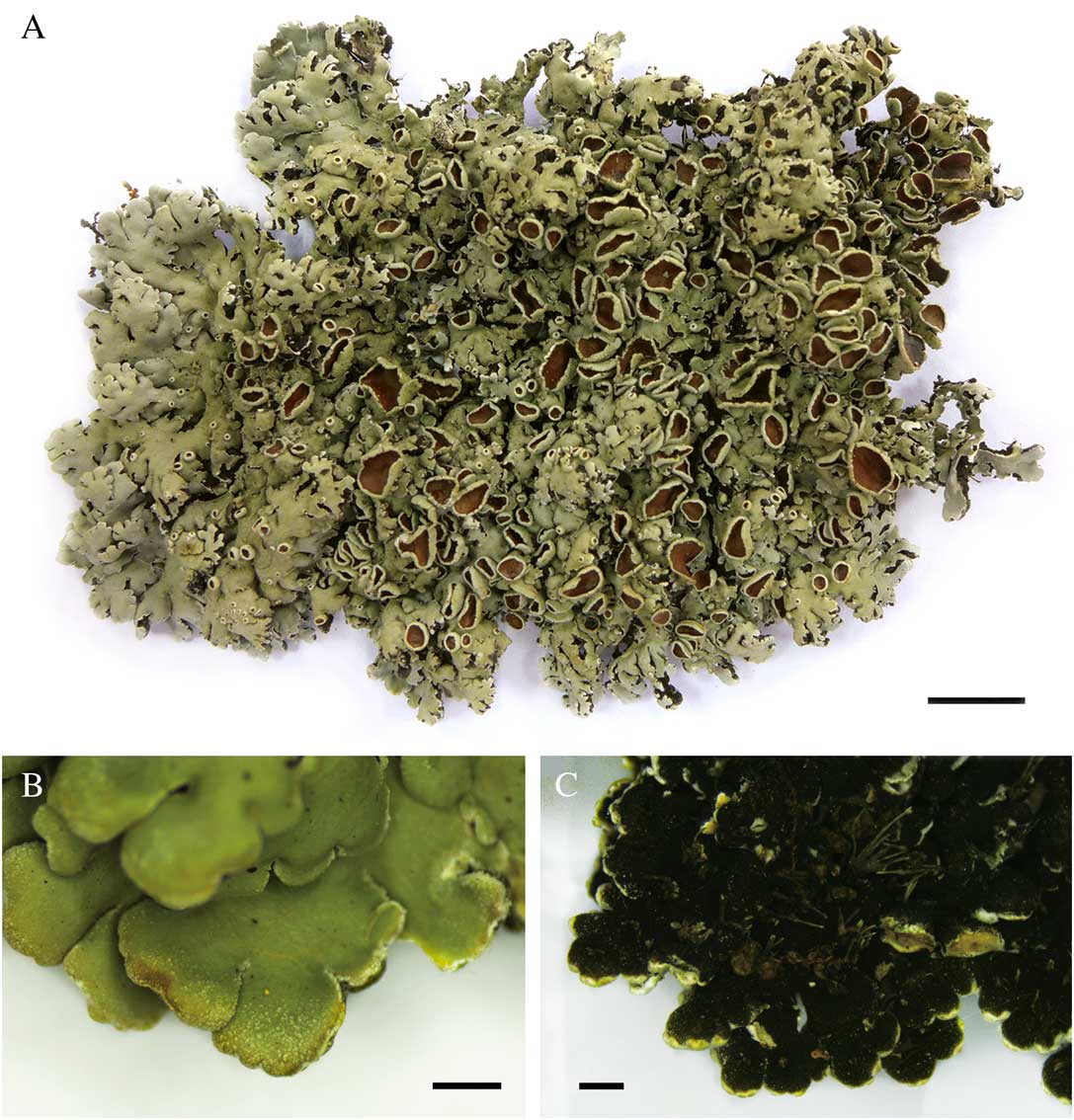
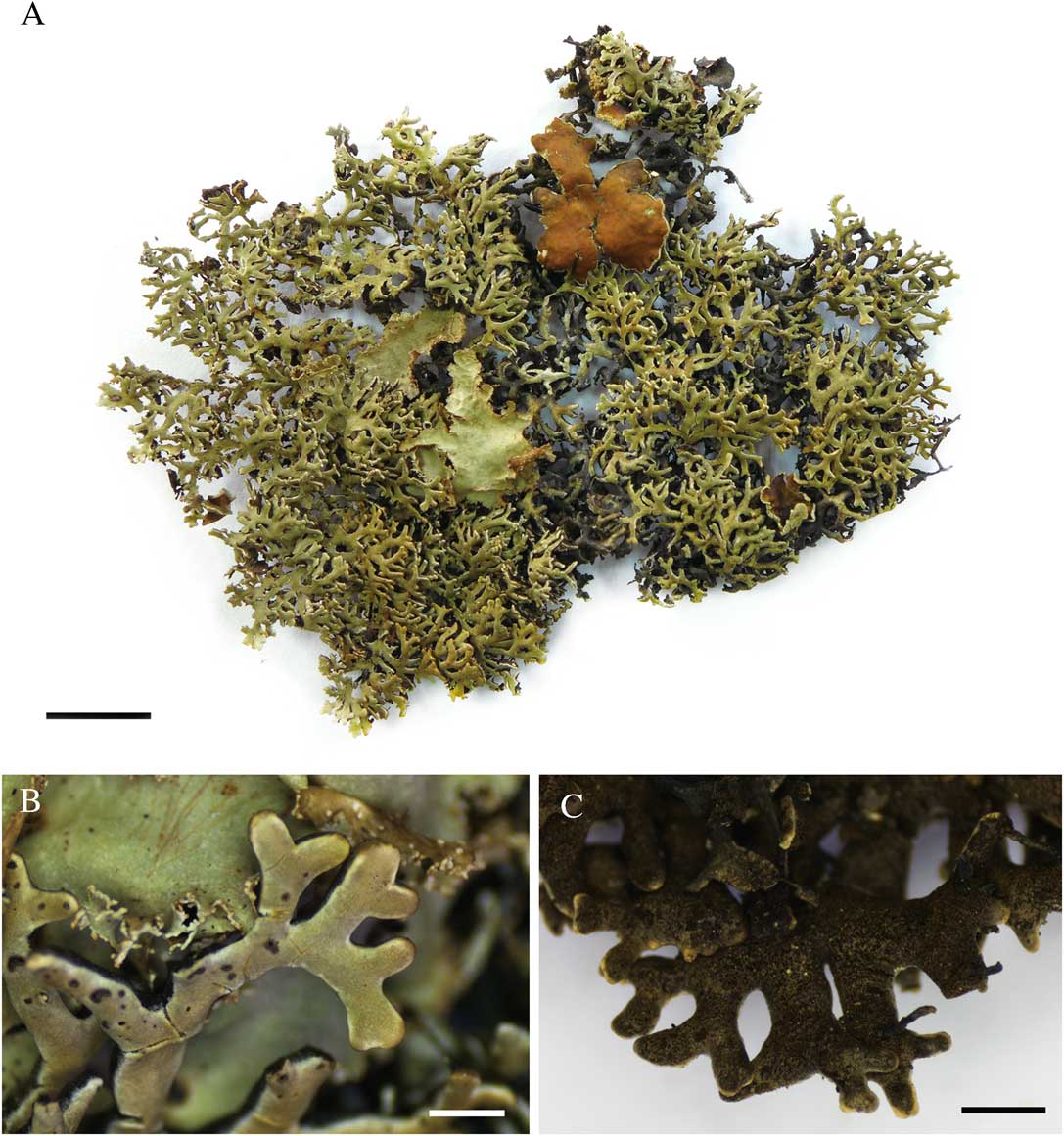
Anzia japonica may be confused with the new species A. pseudocolpota, which also has palmate lobes (Fig. 5B), and a patchy, discontinuous spongy cushion, but it differs in the cylindrical central medullar axis, the consistently pruinose upper surface and the presence of divaricatic acid.
Anzia pseudocolpota, habit. A, thallus; B, lobe apex with pruina; C, lower surface. Scales: A = 1 cm; B & C = 1 mm. In colour online.
Selected specimens examined. China: Yunnan Prov.: Caojian Co., Ziben Mt., 3245 m, 27°05′N, 100°11′E, on Rhododendron bark, 2000, L-s. Wang KUN-L 17893; Chuxiong City, Zixishan Mt., 2500 m, 25°44·290′N, 99°03·565′E, on Rhododendron bark, 1994, L-s. Wang KUN-L 15540; Luquan Co., Jiaozi Snow Mt., 3700 m, 26°03′N, 102°05′E, on Abies bark, 2006, L-s. Wang KUN-L 23998. Sichuan Prov.: Huili Co., Louzhou Mt., 3500 m, 26°03′N, 102°05′E, on Salix bark, 1996, L-s. Wang KUN-L18982.
Anzia leucobatoides (Nyl.) Zahlbr.
Nat. Pflanzenfam. 1: 214 (1907); type: China, Yunnan, 1887, P. J. M Delavay (H9505563—lectotype!).
Thallus foliose, loosely adnate to the substratum, 5–10(–12) cm diam., upper surface convex, greenish grey to brownish grey (herbarium stored), without soredia or isidia, with clear cracks along the margin when mature, especially on the central part; lobes usually rather large, 1–2 mm wide, isotonic dichotomously branched, internodes 3–5 mm long, tips acute, with an angle smaller than 30°; medulla white, single-layered; central axis present, white and flattened, always buried inside the medulla, 200–300 μm thick, white in section (Fig. 2D); lower surface covered with continuous spongy cushion, loosely composed, narrower than upper surface, white to pale brown (Fig. 3F), hyphae hyaline in section, 12–15 μm thick; rhizines rare, simple and black, 2–4 mm long, growing from the centre of the spongy cushion.
Apothecia disc-shaped, on the central part of the upper surface, 2–15 mm wide; disc pale yellowish brown, epihymenium yellow, 10–12 μm thick, hymenium hyaline, 50–60 μm thick, subhymenium 70–80 μm, colourless; ascus rod-shaped, c. 50 μm long, with numerous ascospores spirally arranged, spores simple and curved, 13–15( ±1·0) ×2·5(±0·5) μm.
Pycnidia black, prominent above the surface, usually along the lobe margin near the tips.
Chemistry. Cortex K+ yellow, medulla C–, KC+ pale red, containing atranorin and lobaric acid.
Ecology and distribution. On Larix, Picea, Quercus or Rhododendron in the subalpine region between 2500 and 3700 m; endemic to south-western China (Sichuan, Yunnan), and occurring primarily in the north-eastern part of the Hengduan Mountains.
Comments. This species is characterized by a large thallus with elongate lobes, with a thick central axis in the medulla (Fig. 2D), so that its thallus is rather flexible. The axis is always flat with a whitish colour. It is most easily distinguished from its sympatric congeners by the white to pale yellowish brown spongy cushion.
This species was first described by Nylander in Hue (Reference Hue1887) from Yunnan Province, Lijiang Co., without information regarding its medullary chemistry. Sato (Reference Sato1954) distinguished this species from A. hypoleucoides by the presence of anziaic acid in the medulla (C+ red), but none of our specimens collected from that region contains anziaic acid. In fact, the type specimen (H) and all other collections from the region of the type locality lack anziaic acid, but contain lobaric acid.
Anzia leucobatoides resembles A. hypoleucoides, which also has a central axis and contains lobaric acid, but the latter species has a black to brown spongy cushion, a black and cylindrical central axis below the medullar layer, forms smaller thalli (to 8 cm in diam.), and has red-brown (vs pale yellowish brown) apothecial discs.
Selected specimens examined. China: Yunnan Prov.: Lijiang Co., Alpine Botanical Garden, 3370 m, 27°00·204′N, 100°10·826′E, on Rhododendron bark, 2011, L-s. Wang KUN-L 23970; Binchuan Co., Jizu Mountain, 3220 m, 25°58·402′N, 100°21·254′E, on Quercus bark, 2012, L-s. Wang KUN-L 23971; Jingdong Co., Ailao Moutain, Xujiaba reservoir, 2500 m, 24°32′28·81"N, 101°01′01·47"E, on bark, 2013, L-s. Wang KUN-L 23972. Sichuan Prov.: Muli Co., Mahuanggou village, 2650 m, on decaying bark, 1983, L-s. Wang KUN-L 5179, 5280.
Anzia opuntiella Müll. Arg.
Flora 74: 112 (1891); type: Japan, Tosha, Miyoshi (G—holotype).
Morphology and chemistry. See Yoshimura (Reference Yoshimura1974).
Ecology and distribution. Usually on Abies, Acer or Quercus in the temperate mountains between 800 and 2000 m; known from Korea, Japan and China (Guizhou and Yunnan; Yoshimura Reference Yoshimura1974).
Comments. This species is characterized by and named for the opuntia-like lobes (Fig. 3C), a double-layered medulla, and the presence of divaricatic acid. It may be confused with A. japonica, which also has a double-layered medulla, but the latter species produces anziaic acid (C+ red), has palm-shaped lobes, and a consistently patchy and, especially near the tip, roundish spongy cushion. Anzia ornata also has a two-layered medulla, but is distinguished by soredia-like lobules along the margin, and regular linear rather than opuntia-like lobes. Based on the current taxon sampling, A. opuntiella shares a unique common ancestor with A. colpodes and A. rhabdorhiza. All three species produce divaricatic acid.
Selected specimens examined. China: Yunnan Prov.: Lijiang Co., Baishuihe village, 3000 m, on Quercus bark, 1985, L-s. Wang KUN-L 9171. Guizhou Prov.: Jiangkou Co., Fajingshan Mt., 2100 m, on bark, 1988, L-s. Wang KUN-L10703, 10840. Zhejiang Prov.: Hangzhou city, Linan village, Xitianmushan Mt., on bark, 1956, Lu Ding-an KUN-L 2580, 2538.
Anzia ornata (Zahlbr.) Asahina
J. Jap. Bot. 13: 221 (1937); type: Taiwan, Mt. Niitaka, 1927, Sasaki (W—holotype; TNS—isotype).
Morphology and chemistry. See Yoshimura (Reference Yoshimura1974).
Ecology and distribution. Usually on Abies, Quercus or decaying bark, and sometimes on rock in the temperate mountains between 1500 and 2900 m; known from Japan, China (Guizhou, Taiwan and Yunnan) and North America (Yoshimura Reference Yoshimura1974).
Comments. Anzia ornata differs from all other Chinese species by the marginal soredia-like, roundish lobules (Fig. 3D). It has a double-layered medulla, and contains both sekikaic and divaricatic acids. This taxon was initially known as A. japonica var. ornata. It resembles A. japonica s. str. due to its double-layered medulla, but the latter species produces anziaic acid (C+ red), lacks lobules on the margin, and develops a spongy cushion that is always patchy and roundish, especially near the tips. Anzia ornata resembles A. ornatoides in having lobules, but the latter species has much more linear and narrow lobes (c. 1 mm), contains lobaric acid and has a single-layered medulla with a central axis rather than a double-layered medulla.
Selected specimens examined. China: Yunnan Prov.: Weixi Co., Lidiping Mt., 3450 m, 26°39·207′N, 99°46·588′E, on bark, 2006, L-s. Wang KUN-L 23973; Lijiang Co., Alpine Botanical Garden, 3174 m, on Rhododendron bark, 2011, L-s. Wang KUN-L 23974. Guizhou Prov.: Jiangkou Co., Fanjingshan Mt., 1400 m, 1995, L-s. Wang KUN-L 14346. Taiwan Prov.: Taizhong Co., Xueshan Mt., 3200 m, on Rhododendron bark, 1977, Lai Ming-zhou KUN-L 9329.
Anzia pseudocolpota Xin Y. Wang & Li S. Wang sp. nov.
MycoBank No.: MB 807711
Resembles A. colpota, from which it differs by the presence of a central axis, patchy spongiostratum and containing divaricatic acid.
Type: China, Yunnan Prov., Weixi Co., Lidiping Mt., on Loranthus bark, 3350 m, 15 June 2013, Li S. Wang 13–38274 (KUN-L 22479—holotype).
(Fig. 5)
Thallus foliose, upper surface convex, light green to greyish green, turning yellowish green when herbarium stored, closely adnate to the substratum, to 6 cm diam., without soredia or isidia; lobes linear, irregularly branched, narrow at young stage (0·5–1·0 mm wide), then widening (1–2 mm wide), tips roundish, palm-shaped, usually broadened towards the ends of the tips; pruina always present on the margin of the lobes, especially near the lobe tips, sometimes extending to the lower surface; medulla white, single-layered, with black central axis growing between the medulla and spongy cushion, cylindrical to oblate, c. 200–300 μm diam.; lower surface covered with a black spongy cushion, roundish near the lobe tips, sometimes patchy, mature lobes lacking a spongy cushion in the central part, exposing the black central axis; a spongy cushion extending beyond the lower surface when young, narrower than the surface when mature; rhizines simple, forming 3–5 bundles, 1–2 mm long (Fig. 3H).
Apothecia disc-shaped, common, usually on the central part of the upper surface; disc chestnut brown, 1–6 mm diam.; epihymenium yellow, 10–12 μm thick; hymenium hyaline, 70–80 μm thick, subhymenium 30–40 μm, colourless; ascus rod-shaped, 50–70 μm long, with numerous ascospores spirally arranged, spores simple and curved, 13–15(± 1·0) × 2–3(± 0·5) μm.
Pycnidia black, prominent above the surface, rare.
Chemistry. Cortex K+ yellow, medulla C−, KC−, containing atranorin and divaricatic acid.
Ecology and distribution. On Larix, Picea, Quercus or Rhododendron between 2500 and 3700 m in the subalpine region; known only from south-western China (Sichuan and Yunnan).
Comments. Anzia pseudocolpota is diagnosed, and differs from the morphologically similar A. colpota, by the following combination: presence of a central axis (vs a single-layered medulla without central axis), a roundish or patchy spongy cushion (vs a continuous and thick spongy layer), and wide, roundish, white pruinose lobe tips (Fig. 5B; vs narrower, acute tips, Fig. 3A). The three populations sampled for their ITS sequence form a well-supported monophyletic group of ambiguous affinities to either A. colpodes or the clade comprising A. formosana and A. ornata (Fig. 1).
Anzia pseudocolpota resembles A. centrifuga Haugan, endemic to Madeira, by the chondroidal band, pruinose lobe tips and chemistry, but 1) A. centrifuga is saxicolous growing on bare rock in dry, sun-exposed habitats, whereas A. pseudocolpota grows on bark in the subalpine region; 2) A. centrifuga forms large thalli (30 cm in diam.) compared to A. pseudocolpota, which forms much smaller thalli (c. 6 cm in diam.) and 3) the hymenium is deep in A. centrifuga (i.e., to 125 μm high; Haugan Reference Haugan1992), and shallower in A. pseudocolpota (i.e., 80 μm high). Anzia japonica, which has a patchy spongy cushion and roundish lobes, may be confused with A. pseudocolpota, but it contains anziaic acid instead of divaricatic acid, and has no central axis but a double-layered medulla.
Selected specimens examined. China: Yunnan Prov.; Lijiang Co., Alpine Botanical Garden, 3370 m, 27°00·204′N, 100°10·826′E, on Rhododendron bark, 2011, L-s. Wang KUN-L 23974; Zhongdian Co., Haba Snow Mt., 2800 m, 27°20·356′N, 100°04·776′E, on Picea bark, 2002, L-s. Wang KUN-L 23975; Weixi Co., Lidiping village, 3350 m, 27°11′01·53"N, 99°24′50·44"E, on Loranthus bark, 2013, L-s. Wang KUN-L 22479. Sichuan Prov.: Yanyuan Co., er-da-dui, 3250 m, on Quercus bark, 1983, L-s. Wang KUN-L 7045.
Anzia rhabdorhiza Li S. Wang & M. M. Liang
Bryologist 115: 383 (2012); type: China, Yunnan Prov., Lijiang Co., 2011, Wang 11–32047 (KUN–L 20000—holotype!; HMAS—isotype).
Morphology and chemistry. See Liang et al. (Reference Liang, Qian, Wang, Chen, Liu and Wang2012).
Ecology and distribution. Growing on branches and twigs of Rhododendron, also on bark of Abies, Picea and Salix, between 2400 and 3900 m; endemic to China (Yunnan).
Comments. Anzia rhabdorhiza is distinguished by the long and thick rhizines wrapped by spongiostratum (Fig. 3J), a flat central axis in the medulla, and the presence of divaricatic acid. The rhizines wrapped with spongiostratum resemble those of A. physoidea, which is found in the eastern Himalayas. However, A. physoidea clearly differs from A. rhabdorhiza by the lack of a central axis, and the presence of lobaric rather than divaricatic acid. Anzia hypoleucoides also has a central axis and is similar in morphology, but differs in containing lobaric acid, and its rhizines are simple without spongiostratum wrapped around.
Selected specimens examined. China: Yunnan Prov.: Lijiang Co., Jiuhe village, Laojunshan Mt., 3516 m, 26°38·540′N, 99°45·992′E, on Rhododendron bark, 2010, L-s. Wang KUN-L 23976; Alpine Botanical Garden, 3450 m, 27°00·447′N, 100°10·502′E, on Sorbus bark, 2011, L-s. Wang KUN-L 23977; Jingdong Co., Ailao Mt., Xujiaba water reservoir, on Salix bark, 1994, L-s. Wang KUN-L 23978. Sichuan Prov.: Miyi Co., Malong village, Beipo Mt., 2800 m, on bark, 1983, L-s. Wang KUN-L 4818.
Discussion
Species of Anzia in China are distinguished on morphological (e.g., size and distribution of spongy tissue), anatomical (medulla with or without a central axis) and chemical characters. Characters such as medullary colour and size of the lobes have previously been neglected as taxonomic traits.
Yoshimura (Reference Yoshimura1987) had rejected the concept proposed by Asahina (Reference Asahina1935) whereby species with single versus two-layered medulla should be separated into two sections. This view is supported here as the phylogenetic structure is not congruent with the distribution of these states: A. colpota (single layer) is closely related to A. formosana and A. ornata, which have two layers, and A. colpodes (one layer) shares a putatively unique common ancestry with A. opuntiella (two layers; Fig. 1).
Yoshimura (Reference Yoshimura1987) thus accommodated the species of Anzia in two subgenera based on the presence (Nervosae, erected by Asahina Reference Asahina1935) or absence (Anzia, which included the sections Simplices and Duplices of Asahina Reference Asahina1935) of a central axis. Such classification is, however, not supported by the present inferences from ITS data, as both traits define polyphyletic assemblages. The poor phylogenetic value of the central axis is best illustrated by the highly supported shared ancestry between A. pseudocolpata (axis present) and a clade comprising A. formosana, A. ornata and A. colpota, which all lack the axis, or between A. mahaeliyensis (no axis) and A. hypomelaena (with axis; Fig. 1), as already suggested by Jayalal et al. (Reference Jayalal, Wolseley, Gueidan, Aptroot, Wijesundara and Karunaratne2012). As both character states define polyphyletic groups, polarity of character transformation is not obvious; the central axis could be plesiomorphic for the genus and subsequently be lost in at least two lineages, or be gained independently, a hypothesis less favoured if the axis is considered a complex trait.
Among the main secondary compounds only lobaric acid currently defines a monophyletic group of three species. The ability to synthesize anziaic acid clearly evolved twice, whereas that of sekikaic acid may have arisen once but was lost again in A. formosana (Fig. 1).
A reconstruction of the evolutionary history of Anzia, and hence a better understanding of the morphological, anatomical and chemical transformations that characterize cladogenic events, must await inferences from an exhaustive taxon sampling.
We are very grateful to Dr Leena Myllys and Dr Marko Hyvärinen from the University of Helsinki (H) for the loan of the type specimens. This study was supported by a grant from the National Natural Science Foundation of China (No. 31170023, 31370069), West Light Foundation of The Chinese Academy of Sciences, Foundation of Key Laboratory for Plant Diversity and Biogeography, Kunming Institute of Botany, CAS (KLBB-201210, 201306), and Flora Lichenum Sinicorum (KSCX2-EW-Z-9). BG was supported by grant DEB—1354631 from the US National Science Foundation.