Title of show: Conselho de Classe (Faculty Meeting)
Name of theatre company: Companhia dos Atores
Director: Bel Garcia and Susana Ribeiro
Playwright: Jô Bilac
Cast: Cesar Augusto, Leonardo Netto, Marcelo Olinto, Paulo Verlings, and Thierry
Trémouroux
Set design: Aurora Campos
Costume design: Rô Nascimento and Ticia Passos
Lighting design: Maneco Quinderé
Sound design: Felipe Storino
Venue, city and date of performance reviewed: Teatro Mezanino of Espaço SESC
Copacabana, Rio de Janeiro, 2013
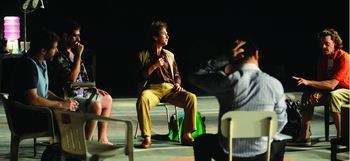
Conselho de Classe (Faculty Meeting). Photographer: Dalton Valério.

One has a feeling of extraordinary pleasure when attending a performance confirming the maturity of Brazil's theatre: Conselho de Classe (Faculty Meeting), by Jô Bilac, performed at the Mezanino of Espaço SESC as part of the commemoration of the twenty-fifth anniversary of Companhia dos Atores, is an articulate, relevant play, agreeably modest in its form and even more interesting for being pleasant, without exaggeration or artifice. The text presents a meeting attended by five out of eleven members of a faculty council, which must debate all aspects of public high-school life in the unexpected presence of a new principal.
The greatest achievement of Bilac's exceptional text is its routine tone, registered both in agreements and arguments, in the pure and simple acceptance of inescapable reality, fatigue, despondency and despair, without a single moment of mawkishness, of emotional appeal for an abused group of workers or anything else of the kind. The problems are there, both professional and personal, and the theatre fulfils its mission of explicating human behaviour extremely well, of getting us to reflect by means of an exceptional aesthetic experience, and not with cheap didacticism, thereby revealing the problems of education even more blatantly.
I don't know if the author intended an all-male cast for the four female teachers as well as the school principal, but in the current production, with absolutely no suggestion of feminine behaviour, this fact contributes to placing the school's problems above and beyond the gender of the teaching staff. The production is exemplary; Aurora Campos's set design uses items belonging to a typical school environment, like the one where this group works, in order to create the proper atmosphere. The equally appropriate costumes by Rô Nascimento and Ticia Passos, and both the lighting by Maneco Quinderé and the subtle soundtrack by Felipe Storino, are excellent. The direction by Bel Garcia and Susana Ribeiro ably mined the atmosphere suggested by the text: the exhaustion, the sameness, the differing personalities and ideologies that arise, provoked by the physical and conceptual problems of that school-life hell.
Conselho de Classe achieves its objectives thanks to performances made possible by the total integration of the cast with the actors Cesar Augusto, Leonardo Netto, Marcelo Olinto, Paulo Verlings and Thierry Trémouroux. The acting is individually fine, but it is the group work, the precise balance achieved by the intersection of those ideas and those temperaments that lends the performance a special charm. Conselho de Classe is what can truly be called good theatre, with no explanations or excuses, just very good.