INTRODUCTION
Burrowing shrimps belonging to the infraorders Gebiidea and Axiidea, known collectively as thalassinideans (formerly belonging to the infraorder Thalassinidea and partitioned by Robles et al., Reference Robles, Tudge, Dworschak, Poore, Felder, Martin, Crandall and Felder2009), are a common group of benthic invertebrates in coastal sedimentary environments. These cryptic decapods construct complex systems of galleries (Suchanek, Reference Suchanek1983; Felder, 2011) in intertidal and shallow sublittoral habitats (Dworschak, Reference Dworschak1988; Griffis & Suchanek, Reference Griffis and Suchanek1991), and have received particular attention because of their role as ecosystem engineers (Pillay & Branch, Reference Pillay and Branch2011). However, in spite of their important role in shaping the community structure in shallow-water habitats (Posey et al., Reference Posey, Dumbauld and Armstrong1991; Nates & Felder, Reference Nates and Felder1998), studies concerning population aspects of American species (e.g. Lemaitre & Rodrigues, Reference Lemaitre and Rodrigues1991; Pezzuto, Reference Pezzuto1993, Reference Pezzuto1998; Dumbauld et al., Reference Dumbauld, Armstrong and Feldman1996; Shimizu, Reference Shimizu1997; Souza & Borzone, Reference Souza and Borzone1996; Souza et al., Reference Souza, Borzone and Brey1998; Nates & Felder, Reference Nates and Felder1999; Corsetti & Strasser, Reference Corsetti and Strasser2003; Botter-Carvalho et al., Reference Botter-Carvalho, Santos and Carvalho2007; Girard, Reference Girard2009; Simão et al., Reference Simão, Ramos and Soares-Gomes2006; Hernáez & Wehrtmann, Reference Hernáez and Wehrtmann2007; Silva & Martinelli-Lemos, Reference Silva and Martinelli-Lemos2012) cover only two of the 52 species of Gebiidea recorded for the Atlantic and Pacific coasts of the Americas (see Melo, Reference Melo1999; Sakai, Reference Sakai2006).
Among Gebiidea, the family Axianassidae Schmitt, 1924 is a broadly distributed group in tropical waters; the ecology of members of this family is poorly known compared with their relatives, the Upogebiidae (see Felder, Reference Felder2001; Pillay & Branch, Reference Pillay and Branch2011). Currently, four species of Axianassidae are known from tropical and subtropical waters of the western Atlantic (Kensley & Heard, Reference Kensley and Heard1990; Rodrigues & Shimizu, Reference Rodrigues and Shimizu1992), all belonging to the genus Axianassa Schmitt, 1924). Species of Axianassa seem to occur mainly in poorly oxygenated sediments in protected environments (Dworschak & Rodrigues, Reference Dworschak and Rodrigues1997).
Axianassa australis is a common and widespread burrower inhabiting coastal mangroves and mud flats near the low-tide level (Felder, Reference Felder2001) from Florida to Brazil (Pernambuco to Paraná; Melo, Reference Melo1999; Melo et al., Reference Melo, Loyola e Silva and Masunari2006; Coelho et al., Reference Coelho, Almeida, Bezerra and Souza-Filho2007; Rosa & Almeida, Reference Rosa and Almeida2012). Until now, little has been known about the biology and ecology of A. australis; existing studies have examined the burrow morphology (Dworschak & Rodrigues, Reference Dworschak and Rodrigues1997), larval development (Rodrigues & Shimizu, Reference Rodrigues and Shimizu1992; Strasser & Felder, Reference Strasser and Felder2005) and feeding behaviour (Coelho & Rodrigues, Reference Coelho and Rodrigues2001). With a view toward filling gaps in the knowledge of this ecologically significant group of benthic invertebrates, the present contribution provides the first information about the population structure, reproductive biology and fecundity of A. australis from a tidal flat in north-eastern Brazil.
MATERIALS AND METHODS
Study area
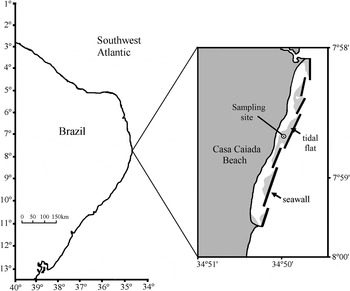
The study area was located at Casa Caiada Beach (7°58′15″S and 34°49′49″W), in a densely urbanized area on the north-eastern coast of Brazil (Olinda City, Pernambuco State) (Figure 1). During the last three decades, beach structures to protect against coastal erosion (breakwaters, groynes and seawalls), even though they were unsuccessful, have profoundly changed the beach hydrodynamics (Pereira et al., Reference Pereira, Jimenez, Medeiros and da Costa2003). The disruption of natural water and sediment turnover at this beach (Pereira et al. Reference Pereira, Jimenez, Medeiros and da Costa2003, Reference Pereira, Jimenez, Medeiros and da Costa2006) has favoured depositional processes and resulted in the formation of wide mud flats and changes in the structure of the benthic communities, marked by colonization by several species typical of low-energy coastal habitats (Botter-Carvalho, unpublished data).
Location of the study site on Casa Caiada Beach, north-eastern coast of Brazil.

Environmental data
Infralittoral water salinity was measured monthly with the use of an optical refractometer, and data on total monthly precipitation and air temperature were obtained from the Instituto Nacional de Meteorologia website (www.inmet.gov.br).
Sampling
Sampling was carried out during low tide on a sand-mud tidal flat (5.3% coarse sand, 81.2% fine sand, 4.5% silt and 9% clay) from September 2011 to December 2012, applying a standardized catch effort two people for 2 h, using ‘yabby pumps’ modified from Hailstone & Stephenson (Reference Hailstone and Stephenson1961). During the sampling period, it was only possible to collect specimens in the months when the low-tide levels (0.0–0.1 m) exposed the mudflat and the burrow openings were visible. Sampling during high tide using scuba diving was not feasible because of the highly turbid water. Only five of 12 sampling surveys were successful in collecting specimens. The pumped material was sieved through a 1.0 mm mesh to retain shrimp and gallery-associated infauna. All specimens were immediately fixed in a 4% buffered seawater-formaldehyde solution, stored individually, and after 24 h were transferred to 70% ethanol.
Population parameters and analyses of data
Identification of species was based on Rodrigues & Shimizu (Reference Rodrigues and Shimizu1992). Anker (Reference Anker2010) and Kensley & Heard (Reference Kensley and Heard1990) were also checked for comparisons.
Biometric measurements were taken using a digital caliper (nearest 0.01 mm) or a micrometric eyepiece. The carapace length (CL) and length of the propodus of the major cheliped (PL) were measured, following Biffar's (Reference Biffar1971) morphometric standards. Also, the handedness pattern of the major cheliped was investigated (left-handed – ‘L’ or right-handed – ‘R’), and the statistical significance of departures from the ratio 1L:1R was tested using a chi-square test (χ2) (α = 5%).
The individuals were distributed into CL size classes with 2 mm width. The size-frequency distributions for males and females were tested assuming the null hypothesis that the data were normally distributed, using the Kolmogorov–Smirnov goodness-of-fit test.
Sex was determined by the presence (male) or absence (female) of the appendix masculina on the second pair of pleopods, and the presence of eggs. Variations in the male-female sex ratio (M:F) were tested using a chi-square test (χ2) (α = 5%).
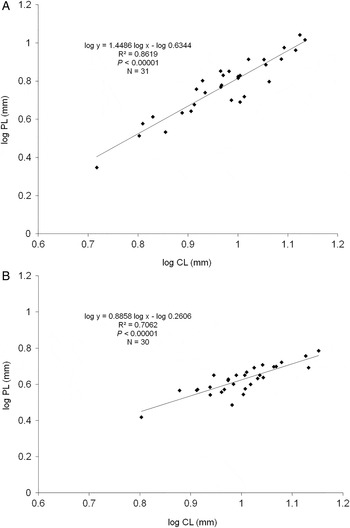
The differential growth between CL and PL was determined by using the allometric function Y = aX b (Huxley, Reference Huxley1950) linearized by logarithmic transformation as logY = loga + b logX, in which X is the independent variable (CL), Y is the dependent variable (PL), a is the value of Y when X = 0, and b is the slope of the regression line (Hartnoll, Reference Hartnoll1978, Reference Hartnoll and Abele1982; Lovett & Felder, Reference Lovett and Felder1989). Analysis of the allometric growth constant (b) gives information about the increase of one biometric dimension in relation to another, as follows: negative allometric growth was considered when b < 0.90 (in which the dependent variable grows more slowly than CL), isometric growth when b was between 0.90 and 1.10, and positive allometry with b > 1.10 (in which the dependent variable grows more rapidly than the CL) (Pinheiro & Fransozo, Reference Pinheiro and Fransozo1993). All incomplete individuals were excluded from these analyses and from the determination of size at first sexual maturity. The statistical significance (α = 0.05) of b was tested using ANOVA.
The reproductive period was determined by the presence of at least 10% adult egg-bearing females (ratio of ovigerous females; Hill, Reference Hill1977; Pezzuto, Reference Pezzuto1998). The percentage of ovigerous females by length class was calculated using the total number of females. The estimate of the minimum size at sexual maturity in females was based on the smallest ovigerous specimen collected.
The stages of embryonic development were classified, according to Rodrigues (Reference Rodrigues1976) and Dworschak (Reference Dworschak1988), as follows: stages 1 to 4 (uneyed embryos) and stages 5 to 9 (eyed embryos). Only females carrying uneyed embryos were used to estimate the fecundity (number of eggs carried on the pleopods, per female), in order to avoid errors related to loss of embryos during incubation (Hill, Reference Hill1977).
To estimate the fecundity, egg masses were mechanically removed from the pleopods and counted. The diameter (major axis) of each egg (embryo) was measured under a dissecting microscope equipped with a calibrated ocular micrometer.
In order to determine the embryo size, two females of each size class were selected, and then 30 eggs were randomly separated from the egg mass of each female. Only females bearing uneyed eggs were included in the statistical analyses. Because egg diameter changes during embryonic development, it is essential to use samples that are all at the same stage of development (Clarke et al., Reference Clarke, Hopkins and Nilssen1991). To compare the mean diameter of eggs from egg masses extracted from females belonging to different CL size classes, the Friedman test was applied. Post-hoc Wilcoxon tests for multiple pairwise comparisons were performed, followed by Bonferroni corrections. Linear regressions were applied to the relations CL (X) vs. fecundity (Y) in order to find the best fit (the highest coefficient of determination). The log10 transformation was used in order to meet or approach a normal distribution. Pearson product-moment correlation was used to assess whether fecundity and mean egg size covaried in a linear fashion. All statistical analyses (α = 0.05) were based on procedures described by Zar (Reference Zar1996).
RESULTS
Environmental data
Water salinity levels recorded at Casa Caiada Beach varied between 37 (August) and 40 (May, June, October).
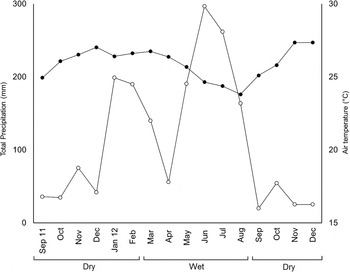
Monthly total precipitation showed two paired peaks, in January–February 2012 (dry season) and June–July 2012 (wet season). The mean annual precipitation was 2200 mm, of which approximately 80% falls during the wet season (March through August). Mean air temperature varied between 23.8 (August 2012) and 27.02°C (December 2011) (Figure 2).
Monthly variations in total precipitation (open circles) and mean air temperature (solid circles) (Curado Meteorological Station, Pernambuco State, north-eastern Brazil) from September 2011 to December 2012 (INMET, 2013), indicating the dry and wet seasons.

Population structure
A total of 79 specimens of Axianassa australis were captured, including 44 females, of which 34 were bearing eggs. Because of the difficulty of capturing specimens by means of the pumping method, specimens were successfully obtained only in September, October and November 2011 and March, August and December 2012. The size (CL) of males and females ranged from 3.61 to 13.61 mm and from 5.47 to 14.19 mm CL, respectively. Total length of males and females ranged from 11.03 to 47.18 mm and from 16.55 to 43.18 mm CL, respectively.
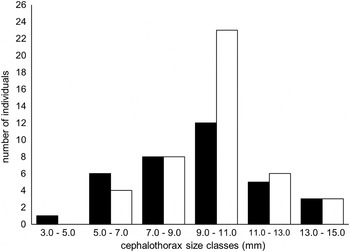
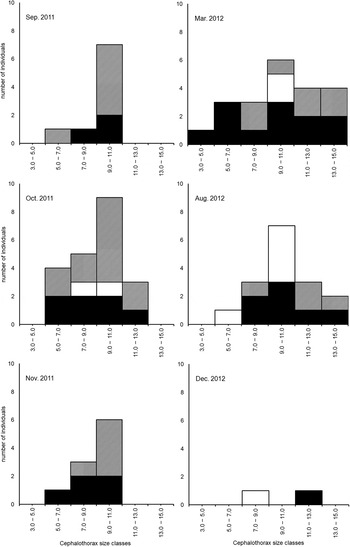
The individuals were distributed into six CL size classes with 2 mm width. The overall size distribution was unimodal (Figure 3) and did not depart from normality for males (P > 0.05) or females (P > 0.05). Size-frequency distributions over the sampling period are shown in Figure 4. Both the smallest and the largest specimens were collected in March 2012. Considering that only one juvenile (male) was collected (March 2012) we cannot reach further conclusions about the population structure of A. australis.
Cephalothorax length-frequency distribution for Axianassa australis on Casa Caiada Beach (Olinda, north-eastern Brazil). Black bars denote males; white bars denote females (non-ovigerous and ovigerous females combined).

Cephalothorax length-frequency distributions for individuals of Axianassa australis collected over the study period on Casa Caiada Beach (Olinda, north-eastern Brazil). Black bars denote males; white bars denote non-ovigerous females; grey bars denote ovigerous females.

Sex ratio
Fluctuations in the sex ratio were observed throughout the sampling period; these mostly favoured females, with a marked predominance of females in October 2011. Although the overall sex ratio was biased toward females (0.79M:1F), this did not depart significantly from the expected 1:1 proportion (χ2 = 1.0253; P > 0.05). Most males and females fell in size classes larger than 9 mm, with a conspicuous peak at 9–10 mm CF (Figure 3); the differences in the sex ratio among the size classes were not significant (χ2 = 3.4571; P > 0.05).
Handedness
The study population showed a definite handedness pattern, with the major cheliped on the left side predominating (ratio L:R = 7.14; χ 2= 32.43, P < 0.05). Considering the sexes separately, left-handedness predominated in both males (L:R = 13.5; χ2=21.55, P < 0.05) and females (L:R = 4.6; χ 2 = 11.57, P < 0.05).
Relative growth
The regression between CL and PL showed negative allometric growth for females (ANOVA: F = 67.29; P < 0.00001) and positive allometric growth for males (ANOVA: F = 180.92; P < 0.00001) (Figure 5). Thus, the propodus of the major cheliped of the males grew more rapidly than the cephalothorax, inversely to the pattern observed in the females.
Linear regressions of CL (log-transformed) against PL (log-transformed) for Axianassa australis on Casa Caiada Beach (Olinda, north-eastern Brazil). A – males; B – females.

Because of the scarcity of small individuals (<7.0 mm CL) obtained over the sampling period, the size at onset of sexual maturity of males and females could not be estimated through analyses of the relative growth changes of the major cheliped.
Reproduction and fecundity
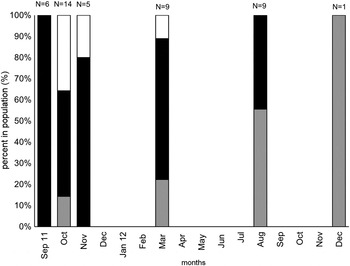
Ovigerous females (N = 34) were found from September to November 2011, and in March and August 2012, with frequencies up to 40% (Figure 6). The smallest ovigerous female measured 5.55 mm CL and the largest 14.19 mm CL. However, the highest percentages were in the 9–11 (47.05%) and 11–13 mm (17.64%) CL size classes.
Axianassa australis, monthly frequencies of non-ovigerous females (grey bars), and ovigerous females bearing eyed (white bars) and uneyed (black bars) embryos during the study period on Casa Caiada Beach (Olinda, north-eastern Brazil).

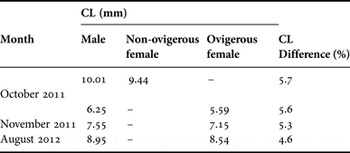
Most of the shrimp were collected as solitary individuals. However, four male-female pairs (presumably sexual pairs) of A. australis (each pair inhabiting the same gallery) were collected in October 2011 (two pairs), November 2011 (one pair) and August 2012 (one pair). In all pairs collected, the males and females were in a similar size range (Table 1). Among pairs, the larger-bodied individuals tended to be males (3M:1F). Among females forming pairs, three were ovigerous and had uneyed embryos.
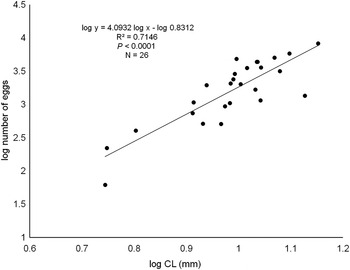
Axianassa australis, linear regression of number of eggs (log-transformed) against CL size (log-transformed) of ovigerous females on Casa Caiada Beach (Olinda, north-eastern Brazil).

Cephalothorax length (CL) of individuals (males and females) collected as sexual pairs of Axianassa australis on Casa Caiada Beach (Olinda, north-eastern Brazil).

Considering that the size of smallest ovigerous female obtained in this study (5.55 mm CL) was almost the same as the only female collected (5.47 mm CL) that was below 5.55 mm CL, it is not possible to make statements about the size at onset of sexual maturity of females.
Uneyed orange embryos predominated during all months in which ovigerous females were collected. The number of uneyed embryos per female ranged from 5 (7.55 mm CL) to 8300 (14.19 mm CL) (mean = 2379 eggs; SD = ±2,061; N = 27).
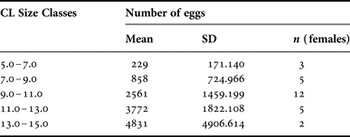
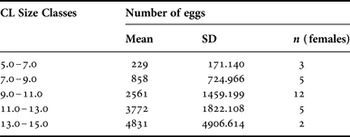
Fecundity (number of uneyed embryos) was positively correlated with female size (CL) (ANOVA: F = 60.102; P < 0.0001) (Figure 7). Mean fecundity values versus CL size classes are shown in Table 2. Mean egg size correlated negatively with fecundity in this population (r = −0.838; N = 7; P < 0.05).
Axianassa australis, mean fecundity against cephalothorax length (CL) size classes on Casa Caiada Beach (Olinda, north-eastern Brazil). SD, Standard deviation.
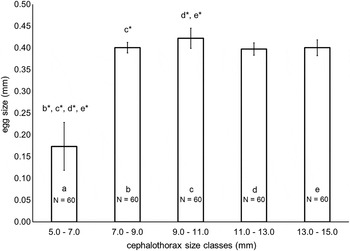
The diameter of uneyed eggs ranged from 0.123 mm to 0.459 mm (mean = 0.358 SD ±0.098 mm, N = 300 from 10 females) and showed significant differences when compared with clutches of females belonging to different CL size classes (F r = 139.7233; P < 0.00001). Paired comparisons between CL size classes revealed marked differences between the diameter of ovigerous females from smaller size classes (5.0–7.0 mm CL) and the other classes (Figure 8). Although significant differences were also observed between size classes above 7.0 mm, these were not as great.
Axianassa australis, egg size in relation to CL size classes of ovigerous females on Casa Caiada Beach (Olinda, north-eastern Brazil). Label: * – denotes statistically significant (P < 0.05) according to the Wilcoxon multiple pairwise test.

Symbionts and tidal flat cohabiting macrofauna
Four males and five females, none of them male-female pairs, of the alpheid shrimp Leptalpheus axianassae Dworschak & Coelho, Reference Dworschak and Coelho1999 were found associated with the galleries of A. australis.
Other burrowing shrimps, Biffarius fragilis (Biffar, Reference Biffar1971), B. biformis (Biffar, 1970), Upogebia omissa (Gomes Corrêa, 1968) and Neocallichirus maryae Karasawa, 2004 were found on the same tidal flat. Some of the commonest infaunal invertebrates of other groups were accidentally collected, but not associated with A. australis galleries, such as the sipunculid Sipunculus sp., the stomatopod Lysiosquilla scabricauda (Lamarck, 1818); the bivalve Anomalocardia brasiliana (Gmelin, 1791), echiurids, and several polychaetes of the families Ampharetidae and Capitellidae.
DISCUSSION
Population structure and sex ratio
In thalassinidean crustaceans, the sex ratio can vary among species (see Hill, Reference Hill1977 and Hanekom & Erasmus, Reference Hanekom and Erasmus1989) or within species (among size classes or seasons of the year) (Berkenbusch & Rowden, Reference Berkenbusch and Rowden2000; Rotherham & West, Reference Rotherham and West2009). Variations in the sex ratio have also been attributed to other stochastic factors such as differential mortality between sexes (loss of males due to fights for females), migration, predation (Felder & Lovett, Reference Felder and Lovett1989; Dumbauld et al., Reference Dumbauld, Armstrong and Feldman1996), and bias imposed by sampling gear (Rowden & Jones, Reference Rowden and Jones1994; Botter-Carvalho et al., Reference Botter-Carvalho, Santos and Carvalho2007; Butler et al., Reference Butler, Reid and Bird2009). Although the general pattern for thalassinideans is equality for the overall population, among adult individuals, female dominance is common (Tunberg, Reference Tunberg1986; Felder & Lovett, Reference Felder and Lovett1989; Dumbauld et al., Reference Dumbauld, Armstrong and Feldman1996; Tamaki et al., Reference Tamaki, Ingole, Ikebe, Muramatsu, Taka and Tanaka1997; Pezzuto, Reference Pezzuto1998; Shimoda et al., Reference Shimoda, Wardiatno, Kubo and Tamaki2005; Botter-Carvalho et al., Reference Botter-Carvalho, Santos and Carvalho2007) and the competition among males for females appears to be the driving force for this dominance (Felder & Lovett, Reference Felder and Lovett1989). On the other hand, male-biased sex ratios can occur in some species, such as Upogebia pusilla (Kevrekidis et al., Reference Kevrekidis, Gouvis and Koukouras1997) and Callianassa subterranea (Rowden & Jones, Reference Rowden and Jones1994). In the present study, although the estimate of the sex ratio was limited to adult individuals, the equal ratio found in the population concords with findings for other species of Gebiidea (e.g. Dworschak, Reference Dworschak1988, for Upogebia pusilla; Hanekom & Baird, Reference Hanekom and Baird1992, for U. africana) and Axiidea (e.g. Berkenbusch & Rowden, Reference Berkenbusch and Rowden1998, for Callianassa filholi; Shimizu, Reference Shimizu1997 and Botter-Carvalho et al., Reference Botter-Carvalho, Santos and Carvalho2007, for Callichirus major; Dumbauld et al., Reference Dumbauld, Armstrong and Feldman1996, for Neotrypaea californiensis; Hernáez & Wehrtmann, Reference Hernáez and Wehrtmann2007, for Callichirus seilacheri; and Butler et al., Reference Butler, Reid and Bird2009, for Trypaea australiensis and Biffarius arenosus.
Most axiideans and gebiideans live individually, each inhabiting a burrow of its own, except for some axiids (Axiopsis serratifrons), strahlaxiids (Neaxius), and coral-boring or sponge-inhabiting upogebiids and axiids that live in male-female pairs (some only occasionally) (Dworschak et al. Reference Dworschak, Felder, Tudge, Schram, Vaupel Klein, von Forest and Charmantier-Daures2012). Although on Casa Caiada Beach most of the shrimp were collected as solitary individuals, the small number of pairs captured (four pairs in October and November 2011 and August 2012) concords with observations by Dworschak & Coelho (Reference Dworschak and Coelho1999), who in most cases captured only one specimen per gallery, by the pumping method. The underlying reason for the difficulty of capturing specimens of A. australis through the pumping and corer methods may be related to the architectural complexity of their galleries. Dworschak & Rodrigues (Reference Dworschak and Rodrigues1997) described A. australis galleries as having spiral shafts leading to wide horizontal galleries from which several corkscrew-shaped spirals (up to 15, with total length at least 8 m) lead to further horizontal galleries at greater depths (130 cm). Therefore, we suggest caution in the choice of sampling method in population studies of A. australis, because the samples (e.g. sex ratio) may be affected by artefacts attributable to the sampling gear. One feasible way to increase the sampling efficiency is by combining the yabby pump and the digging method.
Handedness
According to Hartnoll (Reference Hartnoll and Abele1982), the majority of heterochelous decapod species have no preference for handedness of the major cheliped. Prevalence of a larger right or left cheliped in decapods has been reported mainly for Brachyura (see Mariappan et al., Reference Mariappan, Balasundaram and Schmitz2000). Among gebiideans, heterochely varies from slightly unequal chelipeds (e.g. Thalassinidae, Axianassidae, Axiidae, Strahlaxiidae, Eiconaxiidae and Thomassiniidae) to undifferentiated between sides (Upogebiidae, Laomediidae, Micheleidae and Calocarididae) (Dworschak et al., Reference Dworschak, Felder, Tudge, Schram, Vaupel Klein, von Forest and Charmantier-Daures2012). Especially in heterochelate thalassinidean decapods, an obvious pattern of handedness has not yet been established in the several species that have been studied, such as Neotrypaea californiensis, by Labadie & Palmer (Reference Labadie and Palmer1996); Paratrypaea bouvieri, by Dworschak & Pervesler (Reference Dworschak and Pervesler1988) and Dworschak (Reference Dworschak2012); Callianassa subterranea, by Rowden & Jones (Reference Rowden and Jones1994); Callianassa filholi, by Berkenbusch & Rowden (Reference Berkenbusch and Rowden1998); Lepidophthalmus sinuensis, by Nates & Felder (Reference Nates and Felder1999); and Callichirus major, by Botter-Carvalho et al. (Reference Botter-Carvalho, Santos and Carvalho2007). Axianassa australis showed a strong prevalence of the major cheliped on the left side in both males and females. This concords with the finding by Dworschak & Rodrigues (Reference Dworschak and Rodrigues1997), who during their study on the morphology of the galleries of A. australis in southeastern Brazil observed that in six of the seven individuals collected with the major cheliped present, it was on the left side. This information indicates that left-handed prevalence must be a species-specific pattern of A. australis, and may be the first evidence of a consistent pattern of handedness of the major cheliped in thalassinidean decapods.
Reproduction
The prevalence of females of A. australis carrying uneyed embryos (stages 1–4) is similar to the level recorded for Callianassa japonica by Tamaki et al. (Reference Tamaki, Ingole, Ikebe, Muramatsu, Taka and Tanaka1997). According to these authors, this prevalence may be related to the shorter duration of stages 5–9 (4–6 days) compared with stages 1–4, and to the sampling intervals, which were probably longer than the total embryonic development time. However, the prevalence of clutches with uneyed embryos in A. australis was inverse to that observed by Botter-Carvalho et al. (Reference Botter-Carvalho, Santos and Carvalho2007) for Callichirus major on Piedade Beach, which is located about 20 km south of Casa Caiada Beach. This difference may be related to the shorter duration of stages 1–4 in C. major (Rodrigues, Reference Rodrigues1976).
Fecundity
Egg size and fecundity are among the most important life-history traits that directly determine fitness in aquatic invertebrates, including estuarine macrobenthos species with planktonic larvae (Kubo et al., Reference Kubo, Shimoda and Tamaki2006). In some crustaceans, egg size has been shown to increase with female body size (pelagic copepods, mysids, euphausiids, decapods, ostracods and amphipods by Mauchline, Reference Mauchline1988; isopods by Clarke & Gore, Reference Clarke and Gore1992; caridean shrimps by Clarke, Reference Clarke1993). A study by Parker & Begon (Reference Parker and Begon1986) showed that if resources are depleted as the females age, they should produce smaller eggs or smaller clutches. The positive relationship between fecundity and female body size is common in thalassinideans, and has been reported for gebiideans of the genus Upogebia (see Hill, Reference Hill1977; Dworschak, Reference Dworschak1988; Hanekom & Erasmus, Reference Hanekom and Erasmus1989) and for the axiideans Callianassa kraussi (see Forbes, Reference Forbes1977), Pestarella (formerly Callianassa) tyrrhena (see Thessalou-Legaki & Kiortsis, Reference Thessalou-Legaki and Kiortsis1997), Nihonotrypaea harmandi, N. petalura and N. japonica (see Kubo et al., Reference Kubo, Shimoda and Tamaki2006), but not for Calocaris macandreae (see Buchanan, Reference Buchanan1963). In this population of A. australis, about 71% of the variation in the number of eggs per female was explained by the carapace length of the female (Figure 8), indicating that fecundity is dependent on individual size. Marshall & Keough (Reference Marshall and Keough2008) explained that the brooding capacity of females to hold eggs or developed offspring is size-limited, because if a female produces more offspring, she may have to produce offspring of smaller size so that they still fit within her reproductive structures.
The fecundity (Table 1) of A. australis is relatively low compared with gebiideans such as Upogebia pusilla (400–12,000 eggs) (see Dworschak, Reference Dworschak1988) and U. pugettensis (14,000) (see Dumbauld et al., Reference Dumbauld, Armstrong and Feldman1996). On the other hand, the number of eggs of A. australis is higher than that recorded for Upogebia africana (see Hill, Reference Hill1977).
Egg size is a highly variable character between closely related species of marine invertebrates (Moran & McAlister, Reference Moran and McAlister2009), and especially among thalassinidean taxa (Dworschak et al., Reference Dworschak, Felder, Tudge, Schram, Vaupel Klein, von Forest and Charmantier-Daures2012). Comparisons of the egg size obtained for A. australis confirm the wide variability relative to other gebiideans and axiideans. On Casa Caiada Beach, the mean egg size of A. australis is similar to that of the gebiidean Upogebia africana from South Africa (see Hill, Reference Hill1977), but smaller than those of Upogebia deltaura (see Tunberg, Reference Tunberg1986), Upogebia pusilla (see Dworschak, Reference Dworschak1988), Glypturus armatus (see de Vaugelas et al., Reference de Vaugelas1986) and Callichirus major (see Pohl, Reference Pohl1946).
Comparative studies of related taxa of marine invertebrates with different egg sizes have frequently demonstrated a covariation between egg size and fecundity, suggesting a trade-off between fecundity and egg size (see Clarke, Reference Clarke1993). In some members of Gebiidea, egg size is related to the number of eggs produced per female. In this population of A. australis, the significant negative correlation between mean egg size and clutch size concords with the finding by Dworschak (Reference Dworschak1988) for U. pusilla. However, according to Dworschak (Reference Dworschak1988), in axiideans such as Callianassa the diameter of eggs is more related to the duration of larval development.
Considering all the above points, we suggest that large females of A. australis invest their gonadal material in producing more and larger eggs, compared with smaller-sized females.
Relative growth
After maturation, the majority of gebiideans and axiideans develop sexual dimorphism in the major cheliped, with the male cheliped becoming larger than the female one (Dworschak et al., Reference Dworschak, Felder, Tudge, Schram, Vaupel Klein, von Forest and Charmantier-Daures2012). The greater development of the chelipeds is a secondary sexual character probably related to agonistic and reproductive behaviours (Felder & Lovett, Reference Felder and Lovett1989; Witbaard & Duineveld, Reference Witbaard and Duineveld1989; Rowden & Jones, Reference Rowden and Jones1994; Tamaki et al., Reference Tamaki, Ingole, Ikebe, Muramatsu, Taka and Tanaka1997; Shimoda et al., Reference Shimoda, Wardiatno, Kubo and Tamaki2005). Intersexual differences in allometric growth patterns related to the major cheliped have been studied in several axiideans (Hailstone & Stephenson, Reference Hailstone and Stephenson1961; Dworschak & Pervesler, Reference Dworschak and Pervesler1988; Felder & Lovett, Reference Felder and Lovett1989; Rowden & Jones, Reference Rowden and Jones1994; Dumbauld et al., Reference Dumbauld, Armstrong and Feldman1996; Berkenbusch & Rowden, Reference Berkenbusch and Rowden1998; Dworschak, Reference Dworschak1998; Nates & Felder, Reference Nates and Felder1999; Botter-Carvalho et al., Reference Botter-Carvalho, Santos and Carvalho2007), but not yet for heterochelous gebiideans (e.g. Axianassidae and Thalassinidae). The present study showed that the propodus of the major cheliped of adult males of A. australis grew at a greater rate than the cephalothorax, inversely to the cheliped growth observed in adult females, suggesting a trade-off between somatic growth and reproductive effort. Alunno-Bruscia & Sainte-Marie (Reference Alunno-Bruscia and Sainte-Marie1998) stated that energy allocation to reproduction should be proportionally greater in females, because more energy is needed for the production of oocytes than spermatocytes, and therefore females may decrease or cease their somatic growth during the period of egg incubation.
Symbionts and cohabiting macrofauna
Galleries of A. australis are almost invariably inhabited by at least one pair of alpheoid shrimps (Felder, Reference Felder2001). In the present study, a few specimens of the symbiotic alpheid shrimp Leptalpheus axianassae were collected during the study period. On the other hand, the benthic fauna cohabiting on the tidal flat of Casa Caiada Beach resembled the fauna recorded by Dworschak & Rodrigues (Reference Dworschak and Rodrigues1997) during a study of the burrow shape of A. australis on Araça Beach in south-eastern Brazil. On both Araça and Casa Caiada beaches, sipunculids (Sipunculus sp.), stomatopods (Lysiosquilla scabricauda), bivalves (Anomalocardia brasiliana) and echiurids were recorded. The sympatric species of axiideans and gebiideans collected in the present study are similar to those recorded as sharing similar habitats of Axianassa australis in Nicaragua (Upogebia sp. and Lepidophthalmus sp.) (see Felder et al., Reference Felder, Nates and Robles2003) and Belize (Biffarius fragilis and Neocallichirus maryae) (see Felder et al., Reference Felder, Dworschak, Robles, Bracken, Windsor, Felder and Lemaitre2009).
In conclusion, the scarcity of published information on Axianassa australis, the small number of individuals collected, and the absence of specimens in several months of the study period impeded gaining a wider understanding of its population ecology, especially with respect to the population structure (juvenile stratum), the reproductive cycle and how this is influenced by environmental factors, as well as the mortality rates and the temporal dynamics of recruitment events.
ACKNOWLEDGEMENTS
The authors are grateful to anonymous referees for comments provided on an earlier version of the manuscript. The authors also thank Janet W. Reid (JWR Associates) for English language revision.
FINANCIAL SUPPORT
L.B. Costa thanks the Conselho Nacional de Desenvolvimento Científico e Tecnológico (CNPq) of the Brazilian Government for a PIBIC Scientific Initiation Grant in the period from August 2011 to July 2012. L.L. Gomes and C.C.C. Clemente thank the Fundação de Amparo à Ciência e Tecnologia do Estado de Pernambuco (FACEPE) for a PIBIC Scientific Initiation Grant.