


1. INTRODUCTION
In the last decade, the rapid development of the laser technology has aroused considerable interest in the problem of laser–plasma interactions. The Ultrahigh intensity lasers (Perry & Mourou, Reference Perry and Mourou1994; Mourou et al., Reference Mourou, Tajima and Bulanov2006; Minami et al., Reference Minami, Kurihara, Yamaguchi, Nakajima and Suemoto2013; Novak et al., Reference Novak, DivokY, Turcicova and Straka2013) are high enough (up to I > 1025 W/cm2) to cause nonlinearity, which can give rise to a number of nonlinear effects. In this case, nonlinearity arises because of the electrons oscillations at relativistic velocities in laser fields and it leads to the consideration of problems in the relativistic regime. The study of the nonlinear interaction of ultra-intense laser pulses with plasmas is subjected to many instabilities such as the parametric Raman and Brillouin instabilities, modulational, and filamentational instabilities (McKinstrie & Bingham, Reference Mckinstrie and Bingham1992; Esarey et al., Reference Esarey, Sprangle, Krall and Ting1996; Mori, Reference Mori1997; Shalabi & Al-Khateeb, Reference Shalabi and Al-Khateeb2001; Mendonc et al., Reference Mendonc, Thide and Then2009; Mishra & Pallavi, Reference Mishra and Pallavi2011; Reference Mishra and Pallavi2013; Paknezhad & Dorranian, Reference Paknezhad and Dorranian2011; Reference Paknezhad and Dorranian2013; Panwar et al., Reference Panwar, Kumar and Ryu2012; Hao et al., Reference Hao, Liu and Zheng2013; Singh, Reference Singh2013; Sepehri Javan & Adli, Reference Sepehri Javan and Adli2013a; Reference Sepehri Javan and Adli2013b; Sepehri Javan & Nasirzadeh, Reference Sepehri Javan and Nasirzadeh2012).
The modulation instability (MI) is a nonlinear instability. The pondermotive force originating from the electromagnetic (EM) wave stimulates low frequency perturbations of the electron density; then, they interact with the primary high frequency EM wave in which the amplitude of the pump wave becomes modulated, and the MI of the EM wave occurs. The development of the MI has brought a variety of nonlinear process, such as envelope solitons, field collapse, envelope shocks, etc. (Liu & Li, Reference Liu and Li2000; Reference Liu and Li2001; Lehmann et al., Reference Lehmann, Laedke and Spatschek2008; Zakharov & Ostrovsky, Reference Zakharov and Ostrovsky2009). The MI of laser beams in plasmas and dielectrics has been the subject of several publications (McKinstrie & Bingham, Reference Mckinstrie and Bingham1992; Esarey et al., Reference Esarey, Sprangle, Krall and Ting1996; Sprangle et al., Reference Sprangle, Esarey and Hafizi1997; Shukla et al., Reference Shukla, Marklund and Eliasson2004; Marklund & Shukla, Reference Marklund and Shukla2006; Asenjo et al., Reference Asenjo, Munoz, Valivia and Hada2009). The MI of strong EM waves in plasmas with arbitrary large amplitude is studied by Shukla and Bharuthram (Reference Shukla and Bharuthram1987). Most of the early publications about MI considered ID-models in which the laser beam is represented as a plane wave (McKinstrie & Bingham, Reference Mckinstrie and Bingham1992; Sprangle et al., Reference Sprangle, Esarey and Hafizi1997). The MI of a laser pulse in the cold nonmagnetized plasma has been considered by several authors (Shukla et al., Reference Shukla, Rao, Yu and Tsintsadze1986; Shukla & Bharuthram, Reference Shukla and Bharuthram1987; Esarey et al., Reference Esarey, Krall and Sprangle1994; Sprangle et al., Reference Sprangle, Esarey and Hafizi1997). The MI of a linearly polarized laser pulse propagating in cold magnetized plasma is studied by Jha et al. (Reference Jha, Kumar, Raj and Upadhyaya2005). The MI of right-hand elliptically laser pulse in cold magnetized plasma has been investigated by Chen et al. (Reference Chen, Liu and Li2011). Recently, the MI of an intense circularly polarized laser beam in the hot magnetized electron–positron and electron gas plasmas is studied by Sepehri Javan (Reference Sepehri Javan2012; Reference Sepehri Javan2013).
In this paper, we theoretically investigate the MI of the circularly polarized laser beam propagating along an external magnetic field in a non-Maxwellian magnetized plasma. Nonlinear effects, existence of external forces, and interaction of waves with plasma results in the deviation of non-Maxwellian distribution from Maxwellian one. In effect of the mentioned mechanisms, high energy (super-thermal) particles can be formed and it can lead to a distribution with high-energy tail. Presence of superthermal particles in non-Maxwellian plasmas has already been proved in the laboratory (Hellberg et al., Reference Hellberg, Mace, Armstrong and Karlstad2000) and space plasmas (Feidman et al., Reference Feidman, Asbridge, Bame and Montgomery1973; Steinberg et al., Reference Steinberg, Gosling, Skoug and Wiens2005), experimentally. A situation in an underdense plasma, where the electrons are relativistic and ions are superthermal, is difficult to visualize in real experiments, but there are several applications for this situation. The application for the situation where the velocity of electrons in plasma is relativistic is relevant to many scenarios in high-energy-density science, such as fast ignition of fusion targets, fast electron transport in solid targets, proton acceleration, or shocks.
In this paper, we consider MI of circularly polarized laser in the interaction with non-Maxwellian plasma, containing electrons and ions with Kappa distribution. The first observations of the ions non-Maxwellian distribution in a hot magnetized tokamak plasma were reported by Korotkov et al. (Reference Korotkov, Gondhalekar and Akers2000). Such high-energy ions can be produced by close elastic collisions (knock-on) between deuterium–tritium fusion α-particles and thermal plasma fuel ions. We considered relativistic nonlinear interaction of intense laser beam with such plasmas. However, in the interaction of laser with ions of plasma, we supposed that the ion slow motion is nonrelativistic. When the phase velocity of the ion oscillation is much smaller than the thermal velocity, the quasi-static ion number density can obtain from a balance of the ion thermal pressure and the slow field. Since the quasi-static interaction arises on very slow time scale [typically larger than the ion plasma period  ${\rm \omega} _{{\rm pi}} ^{ - 1} = (4 {\rm \pi} n_{0{\rm i}} e^2 /m_{0{\rm i}} )^{ - 1/2} $, where n 0i and m 0i are unperturbed density of ion and rest mass of ion, respectively], one may assume an isothermal equation of state for ions, and obtain the ion number density expression. Kappa distribution (Vasyliunas, 1968) is the well-known one in the astrophysics, ionospheric plasma physics, and laboratory complex plasmas (Maksimovic et al., Reference Maksimovic, Pierrard and Lemaire1997). A literature review indicates that Kappa distributions have been widely used in the variety of phenomena, either in laser–plasma interaction phenomena or in the astrophysical events. Self-modulation of dust acoustic waves in the presence of non-Maxwellian ion and electron populations is studied by Kourakis and Shukla (Reference Kourakis and Shukla2005). Furthermore, recently, by Sepehri Javan (Reference Sepehri Javan2014) it has been shown that the existence of super-thermal particles can magnificently improve the self-focusing property of circularly polarized laser propagating in a magnetoactive plasma. As far as our knowledge tells, the effect of the super-thermal particles on the MI of laser pulse in non-Maxwellian magnetized plasma has not been studied so far. Only MI of linearly polarized EM waves in the unmagnetized non-Maxwellian plasma is considered by the perturbation method (Rios & Galvao, Reference Rios and Galvao2010). Since non-Maxwellian distribution of particles widely uses in some laser–plasma experiments, we are impelled to investigate the effect of super-thermal particles on the MI. The present work is devoted to the study of MI for the right- and left-hand circularly polarized laser beam propagating along the external magnetic field in the hot plasma with non-Maxwellian distribution. From elementary plasma physics we know that in the parallel propagation of EM waves in the magnetized plasma, fundamental modes are circularly polarized left- and right-hand waves. Furthermore, combination of two circularly polarized waves with different amplitudes and the same rotation sense can lead to the creation of elliptically polarized beam. Here, we considered the MI of circularly polarized laser beam. We expect the same results for the elliptically polarized wave. However, in the case of incidence of linearly polarized laser on the magnetized plasma, it can experience the well-known phenomenon of Faraday rotation effect. The paper is structured as follows. First, in Section 2, the basic assumptions are presented and the nonlinear wave equation is derived. Then, in Section 3, the nonlinear dispersion relation of the circularly polarized EM wave propagating in a hot magnetized non-Maxwellian plasma in the weakly relativistic regime is considered and the MI is discussed. Next, in Section 4, the MI in magnetized non-Maxwellian plasma is numerically studied. Finally, in Section 5, the results are summarized.
2. NONLINEAR WAVE EQUATION
Consider a non-Maxwellian two-component electron–ion plasma is immersed in the static magnetic field. The magnetic field is a constant and here we assume  ${\bf B}_{\bf 0} = B_0 {\hat{\bf e}}_{\bf z} $. We assume that in the equilibrium state the distribution function of plasma particles is determined by Kappa distribution as following (Vasyliunas, Reference Vasyliunas1968):
 $$\eqalign{f_{\rm s} (v) & = \displaystyle{1 \over {({\rm \pi} {\rm \kappa} _{\rm s} {\rm \theta} _{\rm s} ^2 )^{3/2}}} \displaystyle{{{\rm \Gamma} ({\rm \kappa} _{\rm s} + 1)} \over {{\rm \Gamma} ({\rm \kappa} _{\rm s} - (1/2))}}\left( {1 + \displaystyle{{v^2} \over {{\rm \kappa} _{\rm s} {\rm \theta} _{\rm s} ^2}}} \right)^{ - ({\rm \kappa} _{\rm s} + 1)}, \cr & s = i,e,} $$
where for κs > 3/2, v is the velocity, indices i and e denote ion and electron, respectively,  ${\rm \theta} _{\rm s} = [({\rm \kappa} _{\rm s} - (3/2))/{\rm \kappa} _{\rm s} ]^{1/2} v_{{\rm Ts}} $, v Ts=(k BT s/m s)1/2 is the thermal velocity of s sort of plasma particles, k B, T s, and m s are Boltzmann constant, temperature, and mass of s sort of plasma particles, respectively.
For describing nonlinear dynamics of an EM wave interaction with plasma, we define electric and magnetic fields of EM wave E, B through the vector and scalar potentials A, ϕ as below:
 $${\bf E} = - \displaystyle{1 \over c}\displaystyle{{{\partial} {\bf A}} \over {{\partial} t}} - {\rm \nabla} {\rm \phi}, \quad {\bf B} = {\rm \nabla} \times {\bf A}, $$
where c is the speed of light. In the Coulomb gauge (viz., ▿.A = 0), using Eq. (2) in the Maxwell equations, we can write
 $$\displaystyle{1 \over {c^2}} \displaystyle{{{\partial} ^2 {\bf A}} \over {{\partial} t^2}} - {\rm \nabla} ^2 {\bf A} = \displaystyle{{4 {\rm \pi}} \over c}{\bf J}, $$
where J=−n ee ve is the current density of electrons of plasma, and e, n e, ve are the electron charge, density, and fluid velocity, respectively.
To clarify this situation let us return to the similar condition in a Maxwellian plasma. In the non-equilibrium state of the Maxwellian magnetized plasma, which is irradiated by a weakly relativistic laser pulse, momentum of electron can be obtained as (Rao et al., Reference Rao, Shukla and Yu1984; Sepehri Javan, Reference Sepehri Javan2012; Reference Sepehri Javan2013)
 $${\bar{\bf p}}_{\rm e} = \displaystyle{{ {\bar{\bf A}}} \over {(1 - {\rm \sigma} {\rm \alpha} /{\rm \gamma} _{\rm e} )}}. $$
Here  ${\bar{\bf p}}_{\rm e} = {\bf p}_{\rm e} /m_{\rm e} c$ is the normalized electron momentum,
 ${\bar{\bf A}} = (e/m_{\rm e} c^2 ){\bf A}$ is the normalized vector potential,
 ${\rm \gamma} _{\rm e} =$
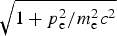 $\sqrt {1 + p_{\rm e}^2 /m_{\rm e} ^2 c^2} $ is the relativistic Lorentz factor of electron, m e is the electron rest mass, α = ωc/ω0, ω0 is the laser frequency, ωc = eB 0/m ec is the electron cyclotron frequency and
 ${\rm \beta} _{\rm e} = c^2 /v_{{\rm Te}}^2 $. σ = +1, −1 denote the right- and left-hand circularly polarized waves, respectively. The form of the vector potential of circularly polarized radiation field, which propagates parallel to the direction of external magnetic field is assumed
 $${\bf A} = \displaystyle{1 \over 2}\tilde A({\hat{\bf e}}_{\bf x} + i{\rm \sigma} {\hat{\bf e}}_y )\,\exp ( - i{\rm \omega} _0 t + ik_0 z) + {\rm c}{\rm c}., $$
where k 0 is the frequency and wave number and  $\tilde A(z,t)$ is the slowly varying amplitude that satisfies the following condition:
 $$\left\vert {\displaystyle{1 \over {{\rm \omega} _0}} \displaystyle{{{\rm \partial} \tilde A} \over {{\rm \partial} t}}} \right\vert \ll \left\vert {\tilde A} \right\vert. $$
In this case, the density of electron is obtained (Sepehri Javan, Reference Sepehri Javan2012; Reference Sepehri Javan2013)
 $${\kern 1pt} n_{\rm e} = n_{0{\rm e}} \exp \left\{ {{\rm \Phi} - \beta _{\rm e} \left[ {{\rm \gamma} _{\rm e} - 1 - \displaystyle{{{\rm \sigma} {\rm \alpha} \vert {\bar{\bf p}}_{\bf e} \vert ^2} \over {2{\rm \gamma} _{\rm e} ^2}}} \right]} \right\}, $$
where Φ=eϕ/k BT e is the normalized scalar potential. To obtain Eq. (7), it is assumed that the plasma is unperturbed at infinity and therefore we have the boundary conditions n e = n 0e, Φ→0,  $\bar{\,p}_{\rm e} \to 0$ at |z|→∞. It is clear from comparing Eqs. (7) and (1) that for the non-Maxwellian magnetized plasma irradiated by the circularly polarized laser pulse, the distribution function should be modified as
 $$\eqalign{\,f_{\rm e} (v) &= \displaystyle{{n_{0{\rm e}}} \over {({\rm \pi} {\rm \kappa} _{\rm e} {\rm \theta} _{\rm e} ^2 )^{3/2}}} \displaystyle{{{\rm \Gamma} ({\rm \kappa} _{\rm e} + 1)} \over {{\rm \Gamma} ({\rm \kappa} _{\rm e} - (1/2))}}\cr & \times\quad\left[ {1 + \displaystyle{{v^2 - 2e{\rm \phi} /m_{\rm e} + 2c^2 \left( {{\rm \gamma} _{\rm e} - 1 - ({\rm \sigma} {\rm \alpha} /2{\rm \gamma} _{\rm e}^2 )\vert {\bar {\bf p}}_{\bf e} \vert ^2} \right)} \over {{\rm \kappa} _{\rm e} {\rm \theta} _{\rm e} ^2}}} \right]^{ - ({\rm \kappa} _{\rm e} + 1)}}. $$
By integrating Eq. (8) over all the velocity space, we can find the electron density distribution as following:
 $$n_{\rm e} = n_{0{\rm e}} \left[ {1 - \displaystyle{{{\rm \Phi} - {\rm \beta} _{\rm e} ({\rm \gamma} _{\rm e} - 1 - ({\rm \sigma} {\rm \alpha} /2{\rm \gamma} _{\rm e}^2 )\vert {\bar {\bf p}}_{\bf e} \vert ^2 )} \over {({\rm \kappa} _{\rm e} - 3/2)}}} \right]^{ - ({\rm \kappa} _{\rm e} - 1/2)}. $$
In this case for Maxwellian plasma, by considering non-relativistic behavior for the slow motion of ions, the ion density can be described by the relation
 $$n_i = n_{0{\rm i}} \,\exp ( - \rm \delta {\kern 1pt} {\rm \Phi} ), $$
where δ=T e/T i is the ratio of the electron temperature to the ion temperature. Then, in similar way, for the ion density of non-Maxwellian plasma, one can achieve
 $$n_{\rm i} = n_{0{\rm i}} \left[ {1 + \displaystyle{{{\rm \delta} {\rm \Phi}} \over {({\rm \kappa} _{\rm i} - 3/2)}}} \right]^{ - ({\rm \kappa} _{\rm i} - 1/2)}. $$
In the weakly relativistic regime by considering the quasi-neutrality condition n e = n i (and also n e0 = n i0 = n 0), expanding Eqs. (9) and (11) and using Eq. (4) we can obtain
 $$n_{\rm e} = n_{\rm i} = n_0 \left( {1 - \displaystyle{1 \over 2}{\vert \bar{\bf A} \vert }^{\bf 2} Q} \right), $$
where
 $$\eqalign{Q & = \displaystyle{{({\rm \kappa} _{\rm i} - (1/2))({\rm \kappa} _{\rm e} - (1/2))} \over {{\rm \delta} ^{ - 1} ({\rm \kappa} _{\rm e} - (1/2))({\rm \kappa} _{\rm i} - (3/2)) + ({\rm \kappa} _{\rm i} - (1/2))({\rm \kappa} _{\rm e} - (3/2))}} \cr & \quad \times \displaystyle{{{\rm \beta} _{\rm e}} \over {(1 - {\rm \sigma} {\rm \alpha} )}}}. $$
In order to formulate nonlinear interaction of EM wave propagating along external magnetic field in the non-Maxwellian plasma let us obtain J. From Eq. (4) the electron velocity can be obtained
 $${\bf v}_{\rm e} = \displaystyle{e \over {m_{\rm e} c}}\displaystyle{{\bf A} \over {{\rm \gamma} _{\rm e} - {\rm \sigma} {\rm \alpha}}}. $$
Also, for electron Lorentz factor we can approximately write
 $${\rm \gamma} _{\rm e} \approx \sqrt {1 + \displaystyle{{\vert {\bar{\bf A}}\vert ^2} \over {(1 - {\rm \sigma} {\rm \alpha} )^2}}}, $$
And in the weakly relativistic laser intensity, when  $\vert {\bar{\bf A}}\vert ^2,$
 ${\hskip-2pt\kern 1pt} \,\vert {\bar{\bf P}}_{\bf e} \vert ^2 \ll 1$we can expand it as
 $${\rm \gamma} _{\rm e} \approx 1 + \displaystyle{1 \over 2}\vert {\bar{\bf P}}_{\bf e} \vert ^2. $$
Using Eqs. (4), (12), (14), and (15) yields to the following nonlinear current:
 $$ - \displaystyle{{4 {\rm \pi}} \over c}{\bf J} = \displaystyle{{{\rm \omega} _{\rm p}^2} \over {c^2}} \displaystyle{{\bf A} \over {{\rm \gamma} _{\rm e} - {\rm \sigma} {\rm \alpha}}} \left( {1 - \displaystyle{1 \over 2}\vert {\bar{\bf A}}\vert ^2 Q} \right), $$
where  ${\rm \omega} _{\rm p} = \sqrt {4\pi n_0 e^2 /m_{\rm e}} $ is the plasma frequency.
Expanding the nonlinear current density of Eq. (16) with respect to the normalized vector potential amplitude, saving only the second orders and substituting it in the wave equation of (3) yields
 $$\eqalign{& \left( \{ {\rm \nabla}^2 - \displaystyle{1 \over c^2} \displaystyle{{\partial}^2 \over {\partial} t^2} \right)ae^{i(k_0 z - {\rm \omega} _0 t)} = k_{\rm p}^2 \left[\displaystyle{1 \over 1 - {\rm \sigma} {\rm \alpha}} - \vert a \vert^2 \right. \cr & \left. \quad \times \quad \left(\displaystyle{1 \over 2} \displaystyle{Q \over (1 - {\rm \alpha} {\rm \sigma})} + \displaystyle{1 \over 2} \displaystyle{1 \over (1 - {\rm \alpha} {\rm \sigma})^4} \right) \right] ae^{i(k_0 z - {\rm \omega} _0 t)},}$$
here  $a = e/m_{{\rm oe}} c^2 \tilde A$ is the normalized amplitude of vector potential (also
 $\vert a\vert = \vert {\bar{\bf A}}\vert $) and k p = ωp/c.
3. NONLINEAR DISPERSION RELATION AND MODULATION INSTABILITY
After mathematical simplifications, Eq. (17) can be presented in its new form
 $$\eqalign{& \displaystyle{{\partial}^2 a \over {\partial} t^2} - c^2 \displaystyle{{\partial}^2 a \over {\partial} z^2} - 2i{\rm \omega}_0 \displaystyle{{\partial} a \over {\partial} t} - 2ik_0 c^2 \displaystyle{{\partial} a \over {\partial} z} + \bigg \{- {\rm \omega} _0^2 + c^2 k_0^2 + {\rm \omega}_{pe}^{2} \cr & \quad \times\bigg[\displaystyle{1 \over 1 - {\rm \sigma} {\rm \alpha}} - \vert a\vert^2 \times \bigg(\displaystyle{1 \over 2} \displaystyle{Q \over (1 - {\rm \sigma} {\rm \alpha})} + \displaystyle{1 \over 2} \displaystyle{1 \over (1 - {\rm \sigma} {\rm \alpha})^4} \bigg) \bigg] \bigg \} a \cr & \quad = 0.} $$
The coefficient of a in the last term of Eq. (18) is the nonlinear dispersion relation. In the absence of interaction between EM wave and plasma, when amplitude is a real constant (a = a 0), we can derive the nonlinear dispersion relation for non-Maxwellian magnetoplasma as following:
 $$\eqalign{& c^2 k_0^2 - {\rm \omega} _0^2 + {\rm \omega} _{\rm p}^2 \left[ {\displaystyle{1 \over {1 - {\rm \sigma} {\rm \alpha}}} - a_0 ^2 \,\left( {\displaystyle{1 \over 2}\displaystyle{Q \over {(1 - {\rm \sigma} {\rm \alpha} )}} + \displaystyle{1 \over 2}\displaystyle{1 \over {(1 - {\rm \sigma} {\rm \alpha} )^4}}} \right)} \right] \cr & \quad = 0.} $$
In the linear limit (when a 2→0) Eq. (19) can be reduced to the well-known linear dispersion relation of circularly polarized EM waves in magnetized plasma
 $$k_0 = \displaystyle{{{\rm \omega} _0} \over c}\left( {1 - \displaystyle{{{\rm \omega} _{\rm p}^2} \over {{\rm \omega} _0 ({\rm \omega} _0 - {\rm \sigma} {\rm \omega} _{\rm c} )}}} \right)^{1/2}. $$
By considering the condition of slowly varying amplitude [Eq. (6)] and assuming that ω0 and k 0 satisfy the linear dispersion of Eq. (20), Eq. (19) can be modified to the following equation
 $$\eqalign{& i \bigg( {\displaystyle{{{\rm \partial} a} \over {{\partial} t}} + v_{\rm g} \displaystyle{{{\partial} a} \over {{\partial} z}}} \bigg) + \displaystyle{{c^2} \over {2{\rm \omega} _0}} \displaystyle{{{\partial} ^2 a} \over {{\partial} z^2}} + \displaystyle{{{\rm \omega} _{{\rm pe}} ^2} \over {2{\rm \omega} _0}} \vert a\vert ^2 \cr & \quad \times \, \bigg( {\displaystyle{1 \over 2}\displaystyle{Q \over {(1 - {\rm \sigma} {\rm \alpha} )}} + \displaystyle{1 \over 2}\displaystyle{1 \over {(1 - {\rm \sigma} {\rm \alpha} )^4}}} \bigg)a = 0},$$
here v g = k 0c 2/ω0 is the group velocity. Using the following dimensionless variables:
 $${\rm \tau} = \displaystyle{{{\rm \omega} _{{\rm pe}}^2} \over {{\rm \omega} _0}} t,\quad U_{\rm g} = \displaystyle{{{\rm \omega} _0} \over {{\rm \omega} _{{\rm pe}}}} \displaystyle{{v_{\rm g}} \over c},\quad {\rm \zeta} = \displaystyle{{{\rm \omega} _{{\rm pe}}} \over c}z - U_{\rm g} {\rm \tau}, $$
in Eq. (21), we can write
 $$i\displaystyle{{{\partial} a} \over {{\partial} {\rm \tau}}} + \displaystyle{1 \over 2}\displaystyle{{{\partial} ^2 a} \over {{\partial} {\rm \zeta} ^2}} + D_{\rm NL} a = 0, $$
where
 $$D_{\rm NL} = \displaystyle{1 \over 2}\vert a\vert ^2 \,\left( {\displaystyle{1 \over 2}\displaystyle{Q \over {(1 - \sigma \alpha )}} + \displaystyle{1 \over 2}\displaystyle{1 \over {(1 - \sigma \alpha )^4}}} \right).$$
Equation (22) is the well-known modified nonlinear Schrödinger equation and describes the nonlinear dynamics of slowly varying envelope of EM wave in the quasi-neutral limit. In the case of cold plasma and large amplitude fields this approximation is not valid (Shukla et al., Reference Shukla, Marklund and Eliasson2004).
To obtain the dispersion relation for MI, we use the usual method introduced by Shukla and Bharuthram (Reference Shukla and Bharuthram1987). In this approach, we suppose
 $$a = (a_0 + a_1 )\,\exp (i \Lambda {\rm \tau} ), $$
where a 0 is a real constant parameter, a 0≫|a 1|, and
 $$\Lambda \equiv D_{{\rm NL}} (a = a_0 ) = \displaystyle{1 \over 2}a_0 ^2 \,\left( {\displaystyle{1 \over 2}\displaystyle{Q \over {(1 - {\rm \sigma} {\rm \alpha} )}} + \displaystyle{1 \over 2}\displaystyle{1 \over {(1 - {\rm \sigma} {\rm \alpha} )^4}}} \right). $$
By substituting Eq. (23) into (22) and linearizing this equation with respect to a 1, we can achieve
 $$\eqalign{& i \displaystyle{{{\partial} a_1} \over {{\partial} {\rm \tau}}} + \displaystyle{1 \over 2}\displaystyle{{{\partial} ^2 a_1} \over {{\partial} {\rm \zeta} ^2}} + \displaystyle{1 \over 2}a_0 ^2 \,\left( {\displaystyle{1 \over 2}\displaystyle{Q \over {(1 - {\rm \sigma} {\rm \alpha} )}} + \displaystyle{1 \over 2}\displaystyle{1 \over {(1 - {\rm \sigma} {\rm \alpha} )^4}}} \right)\,(a_1 + a_1 ^{\ast} ) \cr & \quad = 0}. $$
Introducing a 1=X+iY, inserting it into Eq. (25) and separating the real and imaginary parts of this equation yields
 $$\left\{ \matrix{\eqalign{&\displaystyle{{{\partial} X} \over {{\partial} {\rm \tau}}} + \displaystyle{1 \over 2}\displaystyle{{{\partial} ^2 Y} \over {{\partial} {\rm \zeta} ^2}} = 0, \cr & - \displaystyle{{{\partial} Y} \over {{\partial} {\rm \tau}}} + \displaystyle{1 \over 2}\displaystyle{{{\partial} ^2 X} \over {{\partial} {\rm \zeta} ^2}} + a_0^2 \left( {\displaystyle{1 \over 2}\displaystyle{Q \over {(1 - {\rm \sigma} {\rm \alpha} )}} + \displaystyle{1 \over 2}\displaystyle{1 \over {(1 - {\rm \sigma} {\rm \alpha} )^4}}} \right) = 0 }} \right. .$$
We consider the following oscillational form for X and Y
 $$\left( {\matrix{ X \cr Y \cr}} \right) = \left( {\matrix{ {\tilde X} \cr {\tilde Y} \cr}} \right)\,\exp ( - i{\rm \Omega} {\rm \tau} + iK{\rm \zeta} ), $$
where  ${\tilde X},\,{\tilde Y}$ are real amplitudes, Ω is the modulation frequency normalized by
 ${\rm \omega} _{\rm p}^2, \,{\rm \omega} _0 $ and K is the modulation wave number normalized by ωp/c. Constituting Eq. (28) into the set of Eqs. (26) and (27) we can obtain the nonlinear dispersion relation of MI
 $${\rm \Omega} ^2 = - \displaystyle{{K^2} \over 2}\left[ {a_0^2 \left( {\displaystyle{1 \over 2}\displaystyle{Q \over {(1 - {\rm \sigma} {\rm \alpha} )}} + \displaystyle{1 \over 2}\displaystyle{1 \over {(1 - {\rm \sigma} {\rm \alpha} )^4}}} \right) - \displaystyle{{K^2} \over 2}} \right]. $$
The temporal growth rate Γ=−iΩ can be extracted from Eq. (29) as below:
 $${\rm \Gamma} = \displaystyle{K \over {\sqrt 2}} \left[ {a_0^2 \left( {\displaystyle{1 \over 2}\displaystyle{Q \over {(1 - {\rm \sigma} {\rm \alpha} )}} + \displaystyle{1 \over 2}\displaystyle{1 \over {(1 - {\rm \sigma} {\rm \alpha} )^4}}} \right) - \displaystyle{{K^2} \over 2}} \right]^{1/2}. $$
The maximum growth rate of MI that occurs at  $K = K_{\rm m} = $
 $\left[ {a_0^2 \left( {\displaystyle{1 \over 2}\displaystyle{Q \over {(1 - {\rm \sigma} \rm \alpha )}} + \displaystyle{1 \over 2}\displaystyle{1 \over {(1 - {\rm \sigma} {\rm \alpha} )^4}}} \right)} \right]^{1/2} $, is
 $${\rm \Gamma} _{\max} = \displaystyle{{a_0^2} \over 2}\left( {\displaystyle{1 \over 2}\displaystyle{Q \over {(1 - {\rm \sigma} {\rm \alpha} )}} + \displaystyle{1 \over 2}\displaystyle{1 \over {(1 - {\rm \sigma} {\rm \alpha} )^4}}} \right). $$
We note that, for the Maxwellian plasma, when κe, κi → ∞, Eq. (12) reduces to
 $$Q = \displaystyle{{{\rm \beta} _{\rm e}} \over {(1 + {\rm \delta} ^{ - 1} )(1 - {\rm \sigma} {\rm \alpha} )}}, $$
and by substituting this equation into Eq. (30) we can derive the growth rate for the Maxwellian plasma
 $${\rm \Gamma} = \displaystyle{K \over {\sqrt 2}} \left[ {\displaystyle{{a_0^2} \over {2(1 - {\rm \sigma} {\rm \alpha} )^2}} \left( {\displaystyle{{{\rm \beta} _{\rm e}} \over {(1 + {\rm \delta} ^{ - 1} )}} + \displaystyle{1 \over {(1 - {\rm \sigma} {\rm \alpha} )^2}}} \right) - \displaystyle{{K^2} \over 2}} \right]^{1/2}. $$
4. RESULTS AND DISCUSSIONS
In this section, we could analyze the numerical results of Eqs (30), (31) and discuss the variation of the growth rate as a function of the physical parameters. The order of parameters in the figures is in accordance with the usual ranges of parameters used in the laser–plasma interaction experiments (Jha et al., Reference Jha, Kumar, Raj and Upadhyaya2005; Sepehri Javan, Reference Sepehri Javan2012). We suppose a Nd:YAG laser with frequency ω0 = 1.88 × 10¹⁵ s−1 (that corresponds to the laser wave length λ ≈ 1 μm) and intensity I ≈ 1.4 × 10¹⁶ W/cm2 (or a 0 = 0.1) for the all investigated cases. In addition, for all the cases, T e = 10 keV, solid lines denote the unmagnetized plasma and dotted (dashed) lines are used to denote the propagation of the circularly polarized right(left)-hand laser in the magnetized plasma with α = 0.1 or ωc = 1.88 × 10¹⁴ s−1.
Figure 1 shows the variation of growth rate Γ with respect to K at four different values of κe and κi for magnetized (α = 0.1) and unmagnetized (α = 0) plasma, when δ = T e/T i = 1. In all the cases, it is shown that the growth rate increases by exerting the external magnetic field for the right-hand laser polarization. Inversely, the growth rate decreases by using the magnetic field for the left-hand polarization. This result can be explained as follows: By increasing the external magnetic field the transverse velocity of the electrons of plasma that is driven by the right-hand polarization wave in the direction of cyclotron motion, increases and it leads to the increase of the medium's nonlinearity. Oppositely, for the case of left-hand polarization, electrons are driven opposite to the cyclotron motion and increase in the external magnetic field leads to the decrease in the velocity of electrons and consequently to the decrease in the nonlinearity of plasma medium. In Figure 1 we set κe = κi = 100 and as we know for the large values of κe and κi the state of plasma thermodynamically tends to the Maxwellian. In Figure 1b electrons and ions are super-thermal and κe = κi = 2. It is clear that the existence of super-thermal particles leads to an increase in the nonlinearity and consequently to the substantial increase in the growth rate of MI. In Figure 1c, we choose the super-thermal electrons and Maxwellian ions (κe = 2 and κi = 100). Comparison of Figure 1b and 1c shows that the presence of Maxwellian ions causes the decrease in the growth rate. In Figure 1d, we exchange the values of kappa between electrons and ions and set κe = 100 and κi = 2. One can see that in Figure 1c and 1d situation is the same and interchanging of κe and κi does not affect on the growth rate. As a matter of fact, when the ions and electrons are equi-temperature, in Eq. (11) parameter Q is invariant with interchanging of indices i and e. To interpret these results, it is important to remember that the hydrodynamic pressure force created by the hot particles can extinguish the ponderomotive force induced by the nonlinear laser–plasma interaction (Sepehri Javan, Reference Sepehri Javan2012; Reference Sepehri Javan2013). Thermodynamic pressure force is proportional to the density gradient and the decrease in the slope of the density profile via presence of the super-thermal particles leads to the decrease in the pressure and consequently to the increase in the effective ponderomotive force in the medium. As a result, enhancement of the ponderomotive force for non-Maxwellian plasma leads to the increase in the growth rate.
Variation of normalized growth rate Γ as a function of normalized wave number K for solid line unmagnetized plasma and dashed(dotted) line right(left-)-hand polarized laser in magnetized plasma (α = 0.1), when T e = 10 keV and δ =T e/T i = 1, for four different values of κe and κi, (a) κe=κi = 100, (b) κe=κi = 2, (c)κe = 2 and κi = 100, and (d) κe = 100 and κi = 2.

In Figure 2, the effect of κe on the maximum growth rate is studied, numerically for δ =1. For all the cases, the increase of κe yields the decrease in the growth rate; however for large values of κe the growth rate (decreases at an infinitesimal constant rate) is saturated and tends to the value of growth rate in the Maxwellian state. Figure 3 demonstrates the effect of the decrease in the ion temperature on the growth rate. Here, we set δ = T e/T i = 10. We can see that the decrease in the ions temperature causes a significant enhancement of the growth rate for all the cases. Figure 3a reveals that in the case of super-thermal ions growth rate is a sharp decreasing function of κe and is very sensitive to the variation of κe, especially in the range κe < 2. From Figure 3b it is evident that in the case of super-thermal electrons with a fixed κe = 2, variation of growth rate respect to κi is very smooth. After value κi = 5 the growth rate practically (stops) saturates and becomes constant.
Variation of normalized maximum growth rate Γmax versus κe when κi = 2, T e = 10 keV and δ =T e/T i = 1, solid line for unmagnetized plasma and dashed (dotted) line for right (left)-hand polarized laser in magnetized plasma (α = 0.1).

Variation of normalized maximum growth rate Γmax (a) versus κe when κi = 2 and (b) versus κi when κe = 2, when T e = 10 keV and δ = T e/T i = 10, solid lines for unmagnetized plasma and dashed (dotted) lines for right(left)-hand polarized laser in magnetized plasma (α = 0.1).

5. CONCLUSIONS
In this paper, the MI of a circularly polarized laser pulse in a magnetized non-Maxwellian plasma with kappa distribution is discussed. Modified nonlinear Shrödinger equation, describing the laser–plasma interaction for non-Maxwellian medium is derived. From the discussions of this paper we get the following conclusions: first, it is found that for the non-Maxwellian plasma, application of external magnetic field enhances the MI growth rate of right-hand polarization but for the left-hand polarization it is reduced. Second, the existence of super-thermal particles causes the improvement of the nonlinearity of the plasma medium and consequently it increases the MI growth rate of both the polarizations.



