Introduction
Post-traumatic stress disorder (PTSD) is one of the leading psychiatric disorders to develop in the aftermath of trauma (Kessler et al. Reference Kessler, Sonnega, Bromet, Hughes and Nelson1995; Creamer et al. Reference Creamer, Burgess and McFarlane2001). PTSD comprises at least one re-experiencing symptom (Criterion B), three avoidance symptoms (Criterion C) and two arousal symptoms (Criterion D). One of the most common causes of PTSD is traumatic injury; millions of people survive traumatic injury each year and up to 30% of these people develop PTSD (Zatzick et al. Reference Zatzick, Jurkovich, Gentilello, Wisner and Rivara2002; O'Donnell et al. Reference O'Donnell, Bryant, Creamer and Carty2008).
Chronic musculoskeletal pain is another common occurrence following traumatic events (Sareen et al. Reference Sareen, Cox, Stein, Afifi, Fleet and Asmundson2007; Shipherd et al. Reference Shipherd, Keyes, Jovanovic, Ready, Baltzell, Worley, Gordon-Brown, Hayslett and Duncan2007). However, the literature describing the different physical diagnostic outcomes is poorly integrated with the traumatic stress literature (McFarlane, Reference McFarlane2007). According to the International Association for the Study of Pain (IASP), pain is defined as ‘an unpleasant sensory and emotional experience associated with actual or potential tissue damage, or described in terms of such damage’ (Merskey & Bogduk, Reference Merskey and Bogduk1994). In injury populations, the prevalence rates of chronic pain (defined as pain persisting for more than 3 months) range up to 44% (Jenewein et al. Reference Jenewein, Moergeli, Wittmann, Büchi, Kraemer and Schnyder2009). In these traumatic events where an injury is involved, pain may be a direct consequence of the injury but then become chronic over time, with psychological factors playing an increasing role in pain maintenance. Although multivariate models of chronic pain pathogenesis need to be considered (Vlaeyen & Linton, Reference Vlaeyen and Linton2000; Norton & Asmundson, Reference Norton and Asmundson2003), pain-related fear and avoidance have been theorized as central factors underpinning the trajectory to chronic pain (Lethem et al. Reference Lethem, Slade, Troup and Bentley1983; Vlaeyen et al. Reference Vlaeyen, Kole-Snijders, Boeren and van Eek1995). It is hypothesized that this pattern of behaviour leads to the amplification of peripheral sensations, in particular chronic pain (Vlaeyen et al. Reference Vlaeyen, Kole-Snijders, Boeren and van Eek1995; Cook et al. Reference Cook, Brawer and Vowles2005).
Although chronic pain and PTSD are distinct disorders that can occur independently after a traumatic event, the high co-morbidity between PTSD and pain is well recognized (Otis et al. Reference Otis, Keane and Kerns2003; Villano et al. Reference Villano, Rosenblum, Magura, Fong, Cleland and Betzler2007). When accompanied by co-morbid pain, PTSD is associated with increased levels of depression, lower life satisfaction, and poorer community functioning (Bryant et al. Reference Bryant, Marosszeky, Crooks, Baguley and Gurka1999). In a prospective study of young adults, PTSD was the psychiatric disorder that was found to have the strongest relationship with somatization and particularly with medically unexplained pain (Andreski et al. Reference Andreski, Chilcoat and Breslau1998). However, the nature of the relationship between pain and PTSD is largely unknown. Furthermore, the issue of the causal direction between PTSD and chronic pain and therefore the underlying mechanisms that drive this relationship warrant further investigation.
One of the first research groups to theorize how PTSD and pain are linked comprised Sharp & Harvey (Reference Sharp and Harvey2001), who proposed a maintenance model of PTSD and pain. This mutual maintenance model incorporates several cognitive, affective and behavioural mechanisms that may exacerbate and maintain PTSD and chronic pain. They argue that PTSD patients may interpret chronic pain as a constant reminder of the event. Although not stated explicitly by Sharp & Harvey (Reference Sharp and Harvey2001), the implication is that the mechanism underpinning this relationship is that pain acts as a trigger of distressing trauma memories that, in turn, drive arousal and then avoidance.
The Perpetual Avoidance Model (PAM; Liedl & Knaevelsrud, Reference Liedl and Knaevelsrud2008) is also a mutual maintenance model that was developed from the fear avoidance literature. This model is one of few models offering an explanation about how PTSD symptoms and chronic pain develop after a traumatic experience. It assumes that PTSD symptoms drive the development of chronic pain. According to the PAM, re-experiencing triggers arousal, which in turn leads to avoidance. High levels of arousal also drive pain through muscle tension. Pain is highly distressing and thus leads to avoidance, which in turn triggers re-experiencing symptoms. The result is a vicious circle of mutual maintenance of chronic pain and avoidance/arousal.
In terms of evidence supporting these models, some studies suggest that PTSD drives pain (Dirkzwager et al. Reference Dirkzwager, Van Der Velden, Grievink and Yzermans2007) whereas others suggest that pain leads to PTSD (Norman et al. Reference Norman, Stein, Dimsdale and Hoyt2008). Recent research suggests that the interaction of pain severity and PTSD may differ across PTSD symptom clusters; for example, Clapp et al. (Reference Clapp, Beck, Palyo and Grant2008) found a significant interaction of pain and emotional numbing on role functioning in addition to an interaction of pain and hyperarousal for life satisfaction. These studies, however, fail to explicitly identify the mechanisms that perpetuate the relationship between PTSD and chronic pain. There are, furthermore, no studies examining the relationship between each PTSD symptom cluster and chronic pain after a traumatic event.
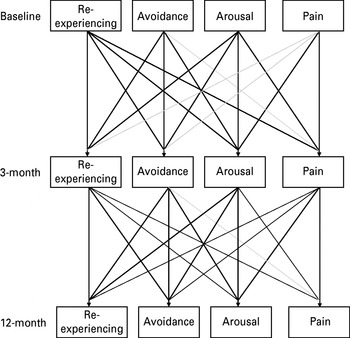
This study explored the development and maintenance of the relationship between chronic pain and the PTSD symptom clusters of re-experiencing, avoidance and arousal over time. As the empirical literature in this field is only developing, and as the theoretical models differ concerning the mechanisms of the relationship, we tested a model with all possible relationships (Fig. 1). Our aim was to investigate the development of chronic pain after a traumatic injury and to analyse the mutual maintenance of PTSD symptom clusters and chronic pain. Structural equational modelling (SEM) was used to identify the causality of the relationship.
Complete model with all possible pathways between the post-traumatic stress disorder (PTSD) symptom clusters and pain over time. All black paths are significant at p<0.05, larger paths are significant at p<0.01, grey paths are not significant. The model also includes paths from baseline symptoms to 12-month symptoms, which are all significant at p<0.05 or at p<0.01 (as the figure would be too complex, these paths are not shown).

Method
Participants
Trauma service patients were recruited at four hospitals across three states in Australia between April 2004 and February 2006. Human Research and Ethics Committees at each hospital approved the study. Patients were included in the study if they had a hospital admission of >24 h following traumatic injury; were aged between 16 and 70 years; and could understand and speak English proficiently. Individuals were excluded from the study if they had a moderate or severe traumatic brain injury (TBI); were currently psychotic or suicidal; were non-Australian visitors, cognitively impaired, or under police guard.
The total sample consisted of 1166 patients, of whom 987 (84.6%) completed the 3-month assessment and 862 (73.9%) completed the 12-month assessment. A total of 824 (70.7%) completed all parts of the study. The majority of the sample were men (72.3%, n=596). The average age was 38.9 years (s.d.=13.7, range=16–71). The principal mechanism of injury was motor vehicle accident (65.9%, n=543), followed by fall (15.5%, n=128), assault (5.8%, n=48), non-fall work injury (5%, n=41) and injuries due to other accidents (6.8%, n=56). Participants stayed on average 12.8 days in hospital (s.d.=13.3) and their average injury severity score (ISS; Baker et al. Reference Baker, O'Neil, Haddon and Long1974) was 11.2 (s.d.=8.1).
Patients who refused to participate in the current study did not differ from participators in terms of gender (χ2=1.50, df=1, n.s.), length of hospital admission [t(1571)=0.92, n.s.] or ISS [t(1571)=1.46, n.s.]. Refusers were younger than participants [t(1561)=3.44, p=0.001] and less likely to have an intensive care unit (ICU) admission (χ2=5.37, df=1, p=0.02).
Patients who completed the follow-up assessments did not differ from those who did not complete in terms of gender (χ2=0.05, df=1, p=0.83) or length of hospital admission [t(1100)=1.14, p=0.26]. Drop-outs had a lower ISS [(9.53±6.81 v. 11.32±8.31), t(466.63)=3.06, p=0.002] and were younger [(35.54±13.07 v. 38.62±13.76), t(1093)=3.27, p<0.001] than those who did complete.
Measures
Re-experiencing, avoidance and arousal
The Clinician-Administered PTSD Scale (CAPS; Blake et al. Reference Blake, Weathers, Nagy, Kaloupek, Charney and Keane1998) was used to assess re-experiencing, avoidance and arousal severity within the first week, and 3 and 12 months after the traumatic event. The CAPS is a structured clinical interview assessing the DSM-IV criteria for PTSD and is considered the ‘gold standard’ for diagnosing and measuring severity of PTSD. It provides information on the frequency and intensity of each PTSD symptom. Following normal practice (Weathers et al. Reference Weathers, Keane and Davidson2001), frequency and intensity scores were summed to obtain overall severity scores for each symptom cluster. The CAPS has demonstrated excellent reliability and validity (Weathers et al. Reference Weathers, Keane and Davidson2001). All CAPS interviews were audio-taped and 5% of these were selected randomly for inter-rater reliability by an independent assessor. The diagnostic consistency was 0.97 at baseline, and 1.00 at both 3 and 12 months. The total diagnostic agreement for the whole sample was 0.99.
Pain
Subjective experience of pain within the first week, and also at 3 and 12 months after the traumatic event, was recorded using a 100-mm Visual Analogue Scale (VAS), which is considered a reliable measurement strategy for pain (Jensen et al. Reference Jensen, Karoly and Braver1986). At the baseline assessment, participants were asked to rate their average pain level since their injury. At 3- and 12-month assessments participants were asked to rate their average pain intensity over the past 2 weeks.
Procedure
Weekday hospital admissions that met inclusion criteria were selected randomly to the study using an automated procedure, stratified by length of stay. Following written informed consent, participants were assessed prior to discharge from each trauma centre, an average of 7.2±9.0 days after injury. They completed a structured clinical interview during which the CAPS was administered, followed by the administration of the VAS. They were followed up at 3 and 12 months post-injury and completed the CAPS over the telephone. The VAS was posted to participants who returned them in reply paid envelopes.
Data analyses
Basic statistical analyses including correlation matrices, means, standard deviations and other descriptives were conducted using SPSS 15.0 for Windows (SPSS Inc., USA). SEM, using Analysis of Moment Structures (AMOS) version 7.0 (Arbuckle, Reference Arbuckle2005), was used to test the relationships between variables of interest. As depicted in Fig. 1, the model tested consisted of 12 variables; that is, four variables (re-experiencing, avoidance, arousal and pain) measured at three time points (7 days, 3 months and 12 months post-injury). Means were allowed to vary freely. For each time point, the four variables were all correlated with one another. Furthermore, all variables were connected with variables in the preceding and succeeding time points.
As the assumption of multivariate normality was not met in this study, the maximum likelihood for parameter estimation was applied, as this method is fairly robust with violations of the normality assumption. For the same reason (non-normality of the data), the bootstrap method was applied with n=1000. The Bollen–Stine bootstrap was used to get a bootstrapped correction to the χ2 test (Finney & DiStefano, Reference Finney, DiStefano, Hancock and and Mueller2006).
To test the fit of the model, χ2, the Comparative Fit Index (CFI; Bentler, Reference Bentler1990) and the root mean square error of approximation (RMSEA; Browne & Cudeck, Reference Browne, Cudeck and Long1993) were used. The χ2 statistic provides a test of the null hypothesis that the model fits the data. Schermelleh-Engel et al. (Reference Schermelleh-Engel, Moosbrugger and Mueller2003) recommended that the evaluation of model fit requires more than a χ2 test statistic, as this measure is sensitive to sample size. They recommend the RMSEA (0<RMSEA<0.05 for good fit) as a descriptive measure of overall model fit. As a descriptive measure that compares the fit of the model of interest to the fit of the baseline model (e.g. the null model), they recommend the CFI (0.97<CFI<1.0 for good fit).
Results
Descriptive information
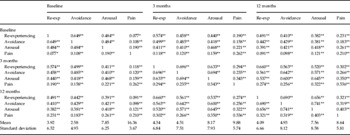
Table 1 displays descriptive information (mean and standard deviation) and bivariate correlations among all PTSD symptom clusters and pain at each time point. At every time point pain correlated significantly with all PTSD symptom clusters either at the 0.01 or the 0.05 level. Of note, the correlations between PTSD symptom clusters and pain became stronger over time. Arousal, relative to avoidance and re-experiencing, had the strongest relationships with pain over time: r at baseline=0.19, r at 3 months=0.34, r at 12 months=0.40.
Correlation matrix and descriptive statistics of post-traumatic stress disorder (PTSD) symptom clusters and pain across time (n=824)

Re-exp, Re-experiencing.
* Correlation is significant at the 0.05 level (two-tailed).
** Correlation is significant at the 0.01 level (two-tailed).
Path analysis
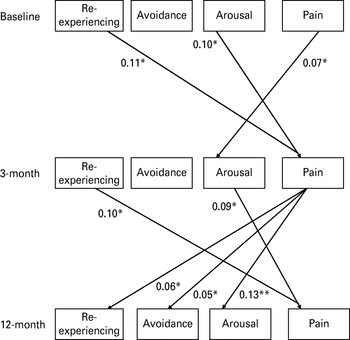
The complete model as presented in Fig. 1 fitted the data well: χ2 (12, n=824)=16.97, p=0.151, CFI=0.999, RMSEA=0.022. As expected, the strongest predictor of each PTSD symptom cluster was its prior symptom level. A similar relationship was found between baseline, 3- and 12-month pain; prior pain was the best predictor for later pain. Importantly, however, apart from these within-symptom relationships there were significant paths between pain and PTSD symptom clusters. To assist the discussion about the relationship between pain and PTSD over time, we created Fig. 2, which depicts a simplified version of Fig. 1 by displaying only the significant pathways between the PTSD symptom clusters and pain over time; that is, all the other pathways indicated in Fig. 1 are hidden in Fig. 2.
Model with significant pathways between the post-traumatic stress disorder (PTSD) symptom clusters and pain over time. ** Paths are significant at p<0.01, * paths are significant at p<0.05.

The model presented in Fig. 2 shows that 3-month pain was predicted directly by baseline re-experiencing (standardized regression weight=0.11, p<0.05) and arousal (standardized regression weight=0.10, p<0.05). The same pattern was found for 12-month pain; 3-month re-experiencing (standardized regression weight=0.10, p<0.05) and arousal (standardized regression weight=0.09, p<0.05) predicted 12-month pain. There was no significant path from avoidance to pain at any time point. It seems, therefore, that high levels of re-experiencing and arousal after a traumatic event are important in the development of chronic pain and have more influence than avoidance. The important role of arousal was also confirmed by its mediating role; the relationship between baseline pain and 12-month pain was mediated by 3-month arousal, over and above the influence of 3-month pain.
Concerning the influence of pain on PTSD symptoms, only one symptom cluster was predicted by baseline pain: 3-month arousal. Pain at 3 months, however, predicted all PTSD symptom clusters at 12 months. The strongest association was found between 3-month pain and 12-month arousal (standardized regression weight=0.13, p<0.01). Similar to the mediating role of arousal in the maintenance of pain, it seems that pain also has a mediating influence in the persistence of PTSD.
Discussion
The main aim of this study was to examine the development and maintenance of the relationship between chronic pain and PTSD symptom clusters. By using longitudinal data and SEM, causal and mediating relationships between chronic pain and PTSD could be examined. To our knowledge this is the first study to examine the interaction between PTSD and pain with a longitudinal design.
The results provide support for the mutual maintenance theory of chronic pain and PTSD. It is already well established that early PTSD symptoms are strong predictors of future PTSD symptoms (O'Donnell et al. Reference O'Donnell, Creamer, Pattison and Atkin2004). Our study shows that a high level of acute pain is a strong predictor of later (chronic) pain. The current data demonstrate that PTSD symptoms significantly impact on pain maintenance/development, and pain significantly impacts on PTSD development/maintenance, over and above these symptom-specific relationships.
The finding that arousal played a key causal role in the development and persistence of pain over time offers support for components of the PAM. The fact that 3-month arousal mediated the relationship between baseline and 12-month pain suggests that high arousal is an important mechanism in the longer-term maintenance (i.e. chronicity) of pain. One explanation for this relationship is that experience of trauma may result in increased activity of the central nervous system, the autonomic nervous system, and the musculoskeletal system. This presents clinically in symptoms such as high muscle tension, insomnia and exaggerated startle response. These characteristic hyperarousal symptoms may drive, maintain and aggravate pain (Wall & Melzack, Reference Wall and Melzack1999; Burns, Reference Burns2006) and escalate into chronic, stress-related musculoskeletal pain (McFarlane, Reference McFarlane2007). In addition to the mediating role of arousal in pain, we also found a mediating influence of 3-month pain on persistent arousal. This finding may suggest a feedback loop – arousal increases pain that increases arousal – and therefore supports the mutual maintenance of the two disorders. Another explanation is that the hypervigilence that is associated with the arousal cluster of PTSD may contribute to attentional bias to pain. PTSD has been shown to be characterized with attentional bias to threatening stimuli at both conscious (Bryant & Harvey, Reference Bryant and Harvey1995) and subconscious levels of processing (Harvey et al. Reference Harvey, Bryant and Rapee1996). There is also evidence that chronic pain patients attend to pain cues selectively (Roelofs et al. Reference Roelofs, Peters and Vlaeyen2002). It is possible that the hypervigilence associated with PTSD results in these patients attending excessively to their pain, which enhances their PTSD symptoms, which in turn may compound their pain perception.
In further support of mutual maintenance theories, we found that persistent pain significantly and independently mediated the relationship between the acute symptom clusters of re-experiencing and arousal, and all three PTSD symptom clusters at 12 months. As the majority of participants in this study were injury patients, the traumatic event itself (i.e. the injury event) was likely to involve high pain for many. In these cases, the patient's trauma memory may include a sensory pain component. These memories can then evoke and maintain re-experiencing, avoidance and arousal. There are several case studies reporting pain flashbacks, for example in survivors of the 2005 London bombings (Whalley et al. Reference Whalley, Farmer and Brewin2007), which could be an explanation for the mediating interaction between re-experiencing and pain.
Another hypothesis for the relationship between pain and re-experiencing is that traumatic memories can modify the underlying mechanism of working memory and attention through the process of sensitization, leading to problems in correctly processing and interpreting environmental information, including somatic sensations such as pain (Moores et al. Reference Moores, Clark, McFarlane, Brown, Puce and Taylor2008). There has been an increasing recognition of a shared pattern of aetiology between whiplash, fibromyalgia, chronic fatigue, irritable bowel syndrome and PTSD (McFarlane et al. Reference McFarlane, Ellis, Barton, Browne and Van Hooff2008). Similar abnormalities of the hypothalamic–pituitary–adrenal (HPA) axis of enhanced negative feedback have been identified in these disorders (Pillemer et al. Reference Pillemer, Bradley, Crofford, Moldofsky and Chrousos1997; Heim et al. Reference Heim, Ehlert and Hellhammer2000). Also documented are stress-induced changes in neurogenesis and brain functioning (McEwen, Reference McEwen2000; Korte et al. Reference Korte, Koolhaas, Wingfield and McEwen2005), which play an important role in the onset of chronic widespread musculoskeletal pain in a general population sample (McBeth et al. Reference McBeth, Silman, Gupta, Chiu, Ray, Morriss, Dickens, King and Macfarlane2007).
In contrast to previous research (e.g. Leeuw et al. Reference Leeuw, Goossens, Linton, Crombez, Boersma and Vlaeyen2007) and models of mutual maintenance such as that proposed by Sharp & Harvey (Reference Sharp and Harvey2001), we failed to find any impact of avoidance on pain at any time point. Most of the research focusing on avoidance and pain, however, is based on fear-avoidance beliefs and not on PTSD avoidance. Even though there are some overlapping (mainly cognitive) components between fear avoidance and PTSD avoidance symptoms, there are several important differences between the two constructs. One of the main differences is that fear avoidance beliefs in the context of pain focus on the consequences of physical activity and movements, which are perceived as harmful and will increase the pain level. As a result of inactivity, persistent avoidance behaviour results in increasing physical disability. This may be a pathway that also supports the relationship between PTSD and chronic pain, as suggested by the PAM. This type of avoidance, however, is different to avoidance in the context of PTSD. Avoidance in PTSD is specifically about attempts to prevent activation of the painful traumatic memories.
The finding of an increasing relationship between pain and post-traumatic symptoms over time is an interesting one. Although several explanations may account for this relationship, one well-recognized hypothesis concerns the concept of the wind-up of C-fibres, which are associated with chronic pain and central sensitization. There is significant similarity between the neural networks involved in PTSD and those associated with the phenomenon of the wind-up of C-fibre-evoked pain (Staud et al. Reference Staud, Craggs, Robinson, Perlstein and Price2007).
It is important to recognize that in the current study only PTSD symptom clusters and pain were considered. There is evidence, however, that other factors have an impact on both PTSD and chronic pain. Sharp & Harvey propose in their model that depression is one of seven mechanisms that may exacerbate and maintain PTSD and chronic pain. The high co-morbidity of depression and pain (e.g. Bair et al. Reference Bair, Robinson, Katon and Kroenke2003; Beesdo et al. Reference Beesdo, Jacobi, Hoyer, Low, Höfler and Wittchen2009), depression and PTSD (e.g. Campbell et al. Reference Campbell, Felker, Liu, Yano, Kirchner, Chan, Rubenstein and Chaney2007) and depression with both disorders (e.g. Roth et al. Reference Roth, Geisser and Bates2008) is well substantiated. There is also some evidence that arousal may play an important role in persistent depression (Rubacka et al. Reference Rubacka, Schmeidler, Nomura, Luthra, Rajendran, Abramovitz and Chemtob2008). Future research on PTSD and pain should, therefore, include depression to investigate possible moderating or mediating relationships.
Another limitation of our study is that participants were injury survivors, with the majority of injury caused by motor vehicle accidents. Our findings may, therefore, have limited generalizability to other trauma populations. Furthermore, it should be recognized that the co-morbidity between pain and PTSD depends on pain type; patients with muscle tension pain report higher rates of PTSD-like symptoms than headache pain patients (de Leeuw et al. Reference de Leeuw, Schmidt and Carlson2005). This suggests that the generalizability of our findings may differ between different groups of pain patients.
Our findings of the negative impact of PTSD symptoms on chronic pain, and vice versa, have important clinical implications. As high levels of re-experiencing and arousal after a traumatic event seem to have a crucial impact in the chronification of pain, early PTSD interventions that target these symptoms may assist in the prevention of chronic pain. There is a growing body of evidence that trauma-focused cognitive behaviour therapy (CBT) is efficacious in treating acute PTSD (Roberts et al. Reference Roberts, Kitchiner, Kenardy and Bisson2009). However, as our findings did indicate that early pain levels predicted later pain and PTSD, it is important for early interventions to also target pain symptoms. This should include a multifaceted approach that includes medical practitioners ensuring adequate analgesic pain coverage. Patient's pain cognitions should be assessed and targeted with cognitive restructuring if problematic, and pain-related fear avoidance addressed with graded exposure. Heightened arousal may also benefit from early intervention strategies that include relaxation training and biofeedback (Mueller et al. Reference Mueller, Karl, Denke, Mathier, Dittmann, Rohleder and Knaevelsrud2009). In conclusion, our findings offer support for mutual maintenance theories of PTSD and pain, which will help to increase the sophistication of targeted early intervention approaches.
Acknowledgements
This study was supported by a Victorian Trauma Foundation, grant no. V-11, a National Health and Medical Research Council Australian Clinical Research Fellowship (359284), and a National Health and Medical Research Council Program Grant (300304). We thank all the patients who participated in this study.
Declaration of Interest
None.