Introduction
Hypertensive disorders of pregnancy (HDP) affect up to 10%of women during pregnancy. Reference Sotiriadis, Hernandez-Andrade and da Silva Costa1,Reference Duley2 HDP are multi-systemic diseases that cause endothelial dysfunction, defective placentation, autoimmunity, platelet and thrombin activation, and inflammation. They are one of the leading causes of maternal and perinatal mortality worldwide Reference Practice Bulletin No3 and are associated with adverse health outcomes, including perinatal death, intrauterine growth restriction, and neonatal morbidity. Reference McCowan and Horgan4,Reference Sibai, Dekker and Kupferminc5
Reports regarding the association between maternal HDP and child neurodevelopment are inconsistent. While some studies have reported that HDP influence child neurodevelopment, including mental and motor function, Reference Morsing and Maršál6–Reference Mann, McDermott and Griffith10 others have reported either negative associations Reference Seidman, Laor and Gale11–Reference Love, Crum and Bhattacharya13 or a decreased risk. Reference Silveira, Procianoy and Koch14,Reference Wu, Nohr and Bech15 Moreover, it was reported that children born with intrauterine growth restriction to mothers with HDP have a risk of a neurodevelopmental outcome Reference Many, Fattal and Leitner16 ; contrastingly, no differences were found between children born with intrauterine growth restriction to mothers with or without HDP in another study. Reference Leitner, Harel and Geva12 Thus, the neurological outcome in children born to mothers with HDP is not well established. Although a few studies with a large sample size using birth, disease, and hospitalization registries from northern Europe have been performed, Reference Strand, Heimstad and Iversen9,Reference Wu, Nohr and Bech15 there is no population-based study with a large sample size that evaluates the association between maternal HDP and child neurodevelopment in Asia.
Early developmental intervention for children who are resuscitated or have cerebral palsy has been reported to improve neurodevelopmental outcomes. Reference Carlo, Goudar and Pasha17,Reference Zhang, Zhang and Jia18 As early detection of neurodevelopmental disorder in children allows for early intervention, it is crucial to identify such neurodevelopmental disorders and assess when they can be detected during early childhood. As the age at which neurological abnormalities occur have not been mentioned in previously published large cohort studies, Reference Strand, Heimstad and Iversen9,Reference Wu, Nohr and Bech15 we aimed to assess whether maternal HDP correlate with child motor and mental abnormalities at 3 years of age. To this end, we used data obtained from the mandatory checkups system, involving 43,854 mothers during pregnancy and their 3-year-old children during follow-up in Kobe city, Japan.
Materials and methods
Design and setting
This study was a population-based cohort study that utilized maternal pregnancy records and data from health checkups of children aged 0–3 years born to mothers in Kobe city, Japan. Reference Tanaka, Shinzawa and Tokumasu19 Kobe city is located on the southern side of the main island of Japan. It is Japan’s sixth-largest city, with a population of approximately 1.5 million people in 2010. Between 2004 and 2010, 90,216 children were born in Kobe city. All pregnant women and children up to 3 years of age who lived in Kobe city participated in the health checkup program. All entries in the pregnancy confirmation, newborn visit, and health checkup forms were made via a mark sheet, and the filled information was collected automatically as electronic information into the municipal database in Kobe city.
In Japan, including Kobe city, pregnant women must submit a pregnancy confirmation form to their municipality to receive maternal and child health public services during pre- and post-pregnancy periods, as well as a Maternal and Child Health Handbook (MCCH). The MCCH is filled out by health providers and parents to monitor maternal health during the pregnancy, as well as to evaluate child growth and development from birth to the preschool period. It also provides educational information regarding child growth and health. Reference Takayanagi, Iwasaki and Yoshinaka20 Under the Maternal and Child Health Act, prenatal care of pregnant women and neonatal and infantile health checkups are mandatory. Reference Fujiwara, Natsume and Okuyama21,Reference Miyaji and Lock22 The pregnancy health examination is conducted periodically based on the condition of the pregnant woman and fetus. The information on maternal blood pressure, body weight, protein and sugar in urine analysis, the existence of edema during pregnancy, and the mother’s and offspring’s general condition post-partum are filled in the MCCH by medical staff. Public health nurses or midwives perform home visit neonatal health checkups within 4 months after delivery and perform face-to-face interviews with the mothers while referring to the MCCH. The pregnancy confirmation and newborn visit forms contain information on parental lifestyle factors and the infant‘s condition during the perinatal period. In Kobe city, the health checkup at 3 years of age is performed by trained pediatricians and public health nurses at healthcare centers of ward offices, using parent-reported questionnaires and the information on MCCH.
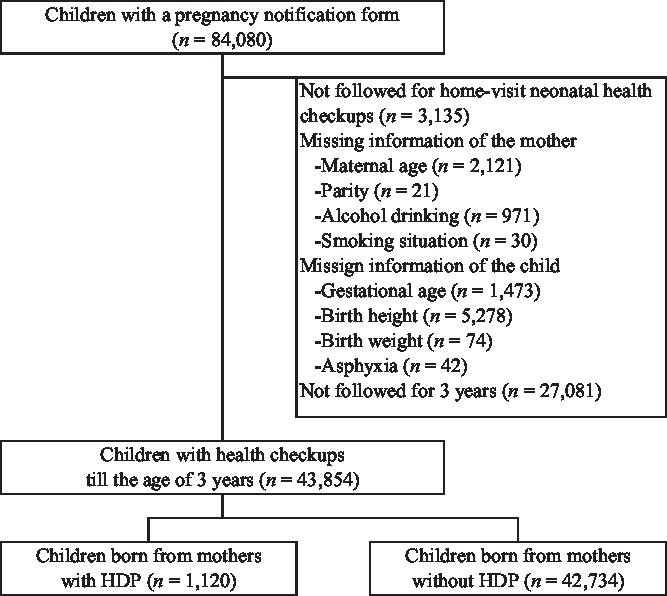
We included children who were born in Kobe city with available information on associated HDP in pregnancy confirmation form and newborn visit form, and neurodevelopmental evaluation at 3-year checkup records. We initially identified 84,080 children born in Kobe City between April 2004 and March 2013 to mothers who had submitted pregnancy forms. Home visit neonatal health checkup records with perinatal information on the mothers and children were available for 80,945 children. We excluded mothers with missing information regarding age (n = 2121), parity (n = 21), alcohol drinking (n = 971), and smoking status (n = 30). We also excluded children with missing data regarding gestational age (n = 1473), birth height (n = 5278), birth weight (n = 74), and asphyxia (n = 42). After excluding 27,081 children without any 3-year-old health checkup records, we enrolled a final number of 43,854 children for this study.
Since the individuals’ identities were hidden in the data provided to us, this study was exempted from obtaining informed consent from participants, according to the Ethical Guideline for Medical and Health Research Involving Human Subjects by the Ministry of Health, Labor, and Welfare. The population was notified and given the option to opt-out. The study protocol was approved by the ethics committees of Kyoto University Graduate School and Faculty of Medicine (R1655) and Kobe city (30-5).
Exposure and outcome
The exposure variable was the presence of HDP, which was identified on either the pregnant confirmation forms or the home visit neonatal checkup forms. HDP in Japanese guidelines include gestational hypertension, preeclampsia, and superimposed preeclampsia or eclampsia. Reference Watanabe, Naruse and Tanaka23 The information of HDP in the home visit neonatal checkup form was referred to for the MCCH, which was filled by trained medical staff during the pregnancy health examination. The outcome variables, abnormalities of motor and mental development, were identified on 3-year-old health checkup forms. During the 3-year-old health checkups, a pediatric physician performed physical, motor, and mental evaluation. Gross and fine motor development was assessed by medical examination with reference to the parent-reported questionnaire (e.g., jumping with both feet leaving the floor, running without falling, and drawing a single circle). Mental development was evaluated for cognition and behavior by medical examination with reference to the questionnaire (e.g., distinguish between large and small objects, communicate with conversation, speak sentences with three words or more, say a friend’s name, imitate others, hypersensitivity to noise or touch with hand, suddenly jumping into the road, etc.). A clinical psychologist performed a mental assessment when requested by the physician or public health nurse. Motor and mental development evaluations in 3-year-old children were based on seven categories: (a) normal, (b) required instructions, (c) required re-checkups, (d) required observations, (e) required detailed examination in a hospital, (f) required medical therapy, and (g) receiving treatment. The outcome was defined as motor and mental development abnormalities in 3-year-old children if the diagnosis outcome was either (e) required detailed examination in a hospital, (f) required medical therapy, or (g) receiving treatment.
Variables
The pregnancy notification forms were used to obtain information on maternal age at pregnancy (<20, 20–34, 35≦); parity (first birth, second birth, or more); prenatal smoking (none, past, current); and alcohol drinking (none, occasional, or daily). Home visit neonatal health checkups forms were used to obtain information on multiple pregnancy (yes, no), sex of the child (boy, girl), gestational week (<28, 28–33, 34–36, 37≦), asphyxia (yes, no), jaundice requiring treatment (yes, no), and small for gestational age (SGA) (yes, no). We defined children with both birth weight and birth height less than the 10th percentile for babies in that gestational age as SGA.
Statistical analysis
The baseline characteristics of mothers and children are summarized according to maternal HDP status. Continuous and categorical variables are described as mean (standard deviation) or median (interquartile range) and as frequency or proportion, respectively. Differences in prevalence were analyzed by χ 2 statistics. Differences between mothers with and without HDP, as well as differences between their children, were evaluated using the Mann–Whitney test. Univariable and multivariable logistic regression were used to analyze the association between maternal HDP and motor and mental developmental abnormality in 3-year-old children and was reported as the odds ratios (ORs), 95% confidence intervals (95% CI), and P values. Confounding factors were selected based on previous studies Reference Warshafsky, Pudwell and Walker7,Reference Love, Crum and Bhattacharya13,Reference Wu, Nohr and Bech15,Reference Walker, Krakowiak and Baker24-Reference Ip, Chung and Kulig32 and using causal models. Reference Lederer, Bell and Branson33 For these analyses, we used different regression models: (1) model 1 was an unadjusted model, (2) model 2 was fully adjusted for all potential confounders (maternal age, multiple pregnancy, parity, maternal smoking, maternal drinking, and sex of the child) and all potential intermediate covariates (gestational week, asphyxia, jaundice, and SGA), and (3) model 3 was adjusted for all potential confounders.
We performed two sensitivity analyses. First, we described the baseline characteristics of mothers and children, including those without the 3-year-old checkup forms. Second, we performed multivariable logistic regression only on HDP information obtained from home visit neonatal health checkup forms. Furthermore, we stratified the data according to the gestational age (<37 or ≧37 gestational weeks) and SGA (SGA or no SGA) as subgroup analyses. Complete case analyses were performed using multivariable analysis by excluding missing covariates. All P values were two-tailed, and statistical significance was set at P < 0.05. We used STATA (version 13.1, Stata Corp LP) for statistical analyses.
Results
Fig. 1 shows the number of enrolled participants. None of the participants opted out of this study. Of the 43,854 participants, 1120 and 42,734 children were born from mothers with and without HDP, respectively. In the exposed and control groups, 1.7% and 0.95%, respectively, had a motor developmental abnormality, while 2.41% and 1.22%, respectively, had a mental developmental defect. A total of 0 and 27 children in the exposed and control groups, respectively, presented with both motor and mental abnormalities.
Flow chart for participants’ selection in this study.

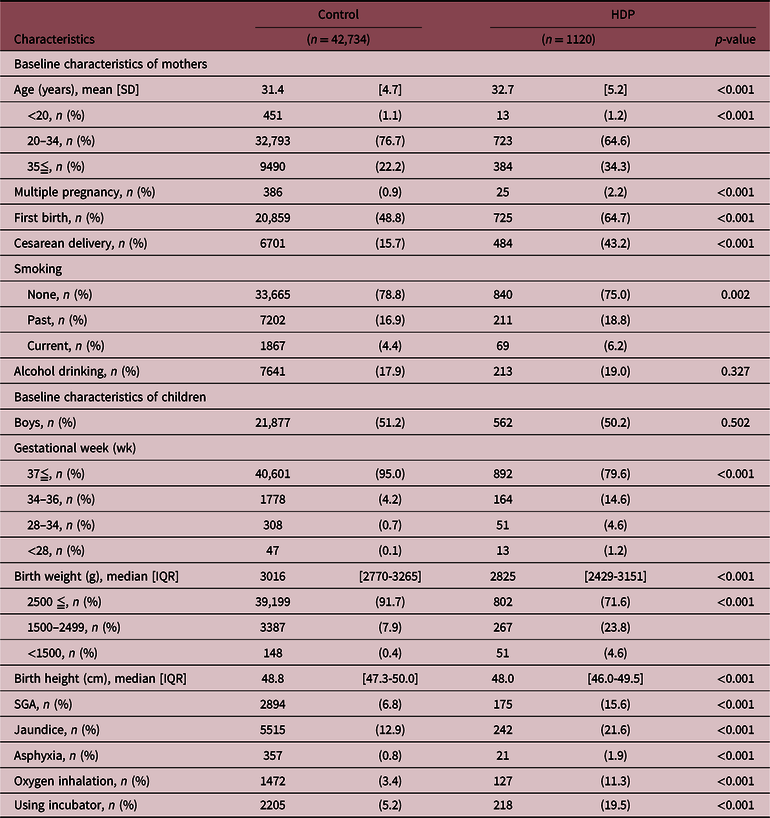
Table 1 shows the baseline characteristics of the mothers and children based on the HDP status. The maternal age and proportions of multiple pregnancies, first birth, cesarean section, and smoking were higher in the HDP group than in the control group. Moreover, the proportions of preterm birth, low birth weight, SGA, jaundice, asphyxia, oxygen inhalation, and incubator use were higher in the HDP group than in the control group.
Baseline characteristics of mothers with or without HDP and their children

HDP, hypertensive disorders of pregnancy; IQR, interquartile range; SD, standard deviation; SGA, small for gestational age.
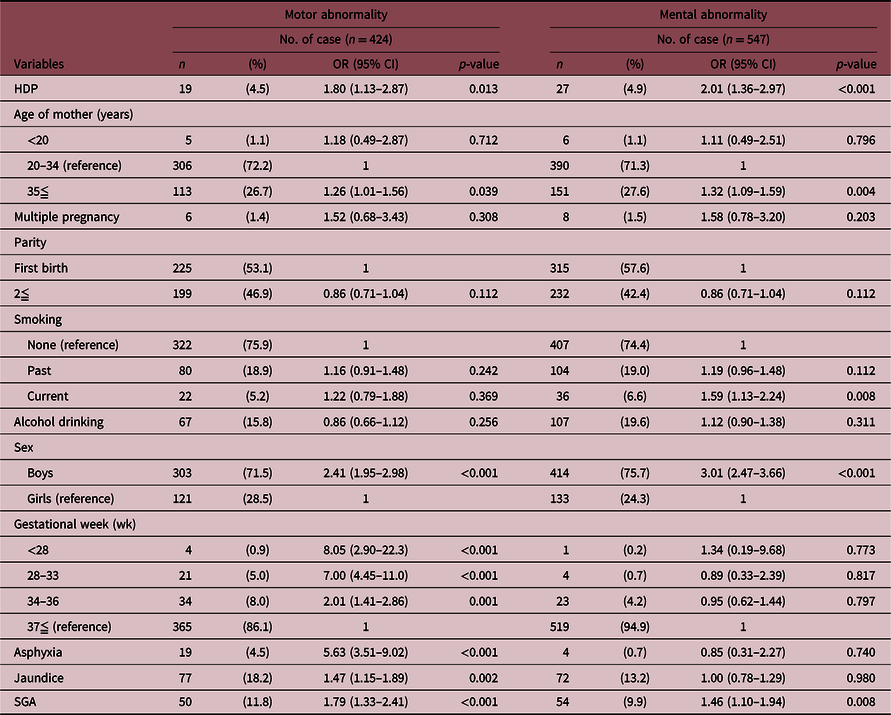
Table 2 shows the results of univariable logistic regression analyses of the relationship between variables and child motor or mental developmental abnormalities. HDP, pregnancy in advanced age, male sex, premature baby, asphyxia, jaundice, and SGA contributed to the increased risk of motor abnormality in children. HDP, pregnancy in advanced age, maternal smoking, male sex, and SGA contributed to an increased risk of mental abnormality in children at the age of three. Though children in the HDP group had a higher risk of motor and mental developmental abnormalities at the age of three in the analysis of model 1 and 3, they had no observable increased risk in the analysis of model 2 [model 1: OR 1.80, 95% CI 1.13–2.87; model 2: OR 1.17, 95% CI 0.72–1.91; model 3: OR 1.69, 95% CI 1.06–2.70; Table 3]. In contrast, these children had a higher risk of mental developmental abnormality (model 1: OR 2.01, 95% CI 1.36–2.97; model 2: OR 1.80, 95% CI 1.21–2.69; model 3: OR 1.79, 95% CI 1.21–2.66; Table 3).
Crude odds ratios (95% CIs) from logistic regression models for variables and child motor or mental development abnormalities at the age of 3 years

CI, confidence interval; HDP, hypertensive disorders of pregnancy; OR, odds ratio; SGA, small for gestational age.
Odds ratios (95% CIs) from logistic regression models for maternal HDP and child motor or mental development abnormalities at the age of 3 years

The reference group was defined as children born from mother without HDP.
a Unadjusted model.
b Multivariable logistic models were adjusted for maternal age, multiple pregnancy, parity, maternal smoking, maternal drinking, sex of the child, gestational week, asphyxia, jaundice, and small for gestational age.
c Multivariable logistic models were adjusted for maternal age, multiple pregnancy, parity, maternal smoking, maternal drinking, and sex of the child.
CI, confidence interval; HDP, hypertensive disorders of pregnancy; OR, odds ratio.
Sensitivity analysis showed that the distribution of baseline characteristics in the sample, including those without the 3-year-old checkup forms (n = 70,935), was similar to that in the study group (Supplementary Table S1). Multivariable logistic regression of HDP information from home visit neonatal health checkup forms (n = 1020) revealed that children in the exposed group had an increased risk of mental developmental abnormality (adjusted OR 1.88, 95% CI 1.25–2.83; data not shown).
In the subgroup analysis based on gestational age, we found that only the term group significantly contributed to the positive relationship between HDP and mental abnormality (model 2: OR 1.92, 95% CI 1.25–2.94; model 3: OR 1.96, 95% CI 1.28–3.00), while HDP seemed to increase the risk of motor abnormality in the term group, but this estimate was imprecise (Supplementary Table S2). Additionally, when using the term group without HDP as a reference group, the preterm group without HDP showed an increased risk of motor abnormality (Supplementary Table S3). Subgroup analysis based on SGA showed that the proportions of 3-year-old children with motor and mental abnormalities were 1.6% and 1.7% in the SGA group, and 0.9% and 1.2% in the non-SGA group, respectively. Multivariable logistic regression showed that children in both the non-SGA and HDP groups had an increased risk of mental development abnormality (model 2: OR 2.20, 95% CI 1.46–3.30; model 3: OR 2.14, 95% CI 1.43–3.21), while HDP seemed to increase the risk of motor abnormality in the non-SGA group, although this estimate was imprecise (Supplementary Table S4). Moreover, using the non-SGA group without HDP as a reference group, we found that SGA in the absence of exposure to HDP increased the risk of motor and mental abnormalities (Supplementary Table S5).
Discussion
The present study shows that maternal HDP are significantly associated with mental developmental abnormality in 3-year-old children, and this association does not change after adjusting for the maternal and child characteristics and is confirmed by the sensitivity analysis in a Japanese population. In contrast, maternal HDP was not associated with child motor abnormality after adjusting for maternal and child characteristics.
Although previous findings on the association between maternal HDP and child neurodevelopment are controversial, our findings are consistent with some of these findings. Walker et al. Reference Walker, Krakowiak and Baker24 reported, in a case-control study, that autism spectrum disorder and developmental delay are associated with a two- and five-fold higher risk, respectively, of prior preeclampsia exposure than that in healthy controls. Another cohort study reported that HDP is associated with increased neurodevelopment delay at 3 years of age. Reference Warshafsky, Pudwell and Walker7 In both studies, the neurological abnormality was detected in children under 5 years of age born to mothers with HDP. Notably, these studies and our findings suggest that maternal HDP may be a risk factor of neurodevelopment abnormality and that these abnormalities can be detected during early childhood. In contrast, Love et al. Reference Love, Crum and Bhattacharya13 reported that HDP does not increase the risk of neurological abnormality. The inconsistency of outcomes may be due to the heterogeneity of neurodevelopmental outcomes. This difference may be attributable to milder cases remaining undetected in previous studies, Reference Love, Crum and Bhattacharya13 while milder cases in our study were detected owing to the definition of the outcome.
In our study, motor abnormality in children was not associated with maternal HDP after adjusting for maternal and child characteristics. Our outcomes are in line with those of previous studies that reported that children exposed to HDP do not exhibit an increased risk of motor abnormality after adjusting for gestational age. Reference Strand, Heimstad and Iversen9,Reference Love, Crum and Bhattacharya13 Similar to previous research, Reference Strand, Heimstad and Iversen9,Reference Love, Crum and Bhattacharya13 as shown in Supplementary Tables S3 and S5, perinatal factors, including gestational age, and SGA were strongly associated with motor developmental abnormality in our study. Because HDP cause placental dysfunction and hypoxemia, Reference Grether and Nelson34-Reference Burton and Jauniaux36 it is plausible that HDP could be a risk factor for motor abnormality in infants, including cerebral palsy. One study reported that HDP with onset before 37 weeks of gestation is a significant risk factor of cerebral palsy. Reference Mann, McDermott and Griffith10 With regards to the epidemiology of cerebral palsy, the incidence is higher in preterm than in term infants, according to data from the national register study. Reference Hirvonen, Ojala and Korhonen37 These findings and our results suggest that the risk of motor abnormality in children is mainly mediated by perinatal factors, especially gestational age or SGA. Moreover, our findings suggest that HDP may partially contribute to an increased risk of motor abnormality in children, which may be of clinical importance.
Despite reports on the association between HDP and abnormal cytotrophoblast invasion and differentiation, the exact etiology of HDP remains unclear. Reference Ilekis, Tsilou and Fisher38-Reference Ilekis, Reddy and Roberts40 Several mechanisms of HDP affecting fetal brain development have been reported, including hypoxia and oxidative stress due to impaired fetal placental circulation resulting from HDP-induced incomplete spiral artery remodeling. Reference Grether and Nelson34-Reference Burton and Jauniaux36 Another study reported mechanisms involving several toxins, cytokines, angiogenic factors, syncytiotrophoblast microparticles, and blood products that are activated in the intervillous space. Reference Roberts and Hubel41 Moreover, hypoxia, ischemia, and inflammation have been reported to induce perinatal brain injury marked by neuronal excitotoxicity, Reference Novak, Ozen and Burd42 with maternal inflammation being linked to an increased risk of autism in offspring. Reference Brown, Sourander and Hinkka-Yli-Salomäki43 Furthermore, structural and vascular anatomic alterations, which may lead to functional deficits, have been reported in numerous brain regions in the offspring of mothers with HDP. Reference Rätsep, Paolozza and Hickman44 Taken together, these reports suggest that maternal HDP affects mental abnormalities in children.
Interestingly, in our subgroup analysis based on gestational age, multivariable regression analysis of maternal HDP and mental developmental abnormality showed a statistically significant association only in children born at a gestational age of 37 weeks or more. Consistently with our findings, previous studies Reference Wu, Nohr and Bech15,Reference Many, Fattal and Leitner16 have reported that preterm babies exposed to maternal HDP do not have an increased risk of mental developmental abnormality, while term babies do have such a risk. Unlike our results, Cheng et al. reported an association between delivery before 32 weeks due to HDP and poor cognitive outcomes. Reference Cheng, Chou and Tsou26 However, our results in the preterm group could have been attributed to the smaller sample size, given that the point estimation of the HDP-mental abnormality relationship was close to that of the primary analysis, suggesting that children born from mothers with HDP and at less than 37 weeks of gestation may also be at risk of developing mental abnormality. Though HDP have been reported to be neuroprotective in preterm babies, Reference Strand, Heimstad and Iversen9,Reference Wu, Nohr and Bech15 our findings showed that the preterm group exposed to HDP does not have a lower risk of motor abnormality. Additionally, when using the term group without HDP as a reference group, we found that being born preterm contributes to increased risk of motor abnormality, regardless of exposure to HDP. These findings highlight that the risk of motor developmental abnormality may increase in children who are born preterm.
As reported previously, HDP are associated with an increased risk of fetal growth restriction (FGR), and studies have reported that FGR or SGA is associated with an increased risk of child neurodevelopment abnormality. Reference Strand, Heimstad and Iversen9,Reference Many, Fattal and Leitner16,Reference Jarvis, Glinianaia and Torrioli27,Reference Kronenberg, Raz and Sander45 Although a higher prevalence of motor and mental abnormalities in children in the SGA group was noted in our study, unexpectedly, multivariable regression of maternal HDP and mental abnormality, stratified by SGA, showed a statistically significant association only in the non-SGA group. Additionally, maternal HDP seemed to be associated with a higher risk of motor abnormality only in the non-SGA group, although this result was not statistically significant. Consistently with our findings, a previous study showed that maternal HDP does not increase the risk of neurodevelopmental outcome in children with intrauterine growth retardation. Reference Leitner, Harel and Geva12 In contrast to a previous study, Reference Morsing and Maršál6 we found that children in the SGA group have a decreased risk of mental development abnormality. These differences might be due to the smaller number of exposed cases in the SGA group in the subgroup analysis stratified by SGA. Using the non-SGA group without HDP as a reference group suggested that SGA itself might increase the risk of motor and mental outcomes. Grisaru-Granovsky et al. reported that intrauterine growth restriction in HDP is not associated with the severity of hypertension. Reference Grisaru-Granovsky, Halevy and Eidelman46 Since previous studies have used various definitions for restricted intrauterine growth or newborn weight (<5∼15th percentile), Reference Strand, Heimstad and Iversen9,Reference Many, Fattal and Leitner16,Reference Kronenberg, Raz and Sander45 this difference may be due to variations in the definition of SGA Reference Clayton, Cianfarani and Czernichow47 ; thus, a unified definition of SGA is needed for future studies.
Strengths
Our study has several strengths. First, we used population-based data from a mandatory health checkup system under the law for all citizens. Thus, the study data represent the general population much better than any previous similar studies that used data from preterm infants or those receiving medical care with a suitable follow-up system. Reference Kallioinen, Eadon and Murphy48,49 While a previous cohort study using the general population reported impaired adult cognitive ability in offspring of mothers with HDP, Reference Tuovinen, Eriksson and Kajantie50 our study found an association between maternal HDP and mental abnormality in 3-year-old children. Importantly, these findings highlight the possibility of early detection and intervention for children with mental abnormality born to mothers with HDP. Finally, previous large cohort studies using birth and disease registries to assess the association between maternal HDP and child neurodevelopment have been limited to only one abnormality, such as that in cognitive function or cerebral palsy, whereas studies that have evaluated both motor and mental development in children had small sample sizes. Reference Strand, Heimstad and Iversen9,Reference Mann, McDermott and Griffith10,Reference Wu, Nohr and Bech15,Reference Many, Fattal and Leitner16 Conversely, we assessed both motor and mental development in children, and our findings will provide useful information for clinical practice.
Limitations
Our study had a few limitations. First, the 3-year-old checkup forms were not available for approximately 27,000 children; this number is consistent with the reported annual number of children aged 0–4 years (3140) who migrate from Kobe city to other cities. 51 Since the proportion of 3-year-old health checkups in Kobe City was high between 2010 and 2012 (96.4%, 96.2%, and 96.6% in 2011, 2011, and 2012, respectively), 52 it can be assumed that the decrease in the number of 3-year-old checkups was not related to maternal HDP or any other outcomes. Furthermore, the baseline characteristics of the 70,935 mothers and children, including those without 3 year-old checkups, were similar to those of the main study group (Supplementary Table S1). Second, the mothers filled the pregnant confirmation forms by themselves, leading to the possibility of recall-related inaccuracy and inconsistency. However, as shown in the sensitivity analysis, our findings were not changed when using only home visit neonatal checkup forms as the source of HDP information. The information on these forms is considered more accurate because either public health nurses or midwives confirmed the information with mothers by referring to the MCCH. Furthermore, the timing of the home visit would allow for the inclusion of data regarding late-onset HDP. In contrast, the information on the pregnancy confirmation form was reported only by the mother, and the period in which information relevant for HDP could be acquired was likely limited to early pregnancy. These differences must be considered, although they do not appear to have affected the results. Moreover, the evaluation of the 3-year-old checkups was not confirmed by multiple doctors, leading to the possibility of observer bias. Furthermore, since the outcome of our study was not a final diagnosis, we may have overestimated the result because children marked as “required detailed examination in a hospital” at the 3-year health checkups could have been evaluated as normal after visiting a hospital. As Kobe city is a large city with many people moving in and out, this limits the generalizability of these findings to suburban populations. Although logistic regression was performed by using maternal preferences during the early stages of pregnancy and perinatal information of children, we could not obtain information on the onset time and severity or details of HDP, nor the therapeutic agents used, which could affect the prognosis for the child. Reference van Wassenaer, Westera and van Schie8,Reference Mann, McDermott and Griffith10 We also did not adjust our analysis for some reported confounding factors, including maternal body mass index, educational history, and social status. Reference Walker, Krakowiak and Baker24 Detailed interpretations of these findings could be conducted by linking the health checkup data to hospital and disease registries, such as disease names, severity, and drug use history.
Conclusion
The prevalence of mental abnormality in 3-year-old children was almost two-fold higher in those born to mothers with HDP than without HDP. Maternal HDP were associated with mental developmental abnormality in 3-year-old children. This is clinically important as mental abnormality in children born to women with HDP may be detected during early stages, which would allow for early intervention.
Supplementary materials
For supplementary material for this article, please visit https://doi.org/10.1017/S2040174420000586
Data sharing
Not allowed due to governmental restrictions.
Acknowledgments
The authors thank the ethics committee of Kobe city for contributions to the availability of this study information. The authors have not previously reported present research at a conference and have not published an abstract. The authors received assistance from Editage (www.editage.jp) for English language editing.
Author contribution
Noda conceived the study, and all authors contributed to the development and improvement of the protocol and study design. All authors approved the final version for submission.
Financial support
This research received no specific grant from any funding agency, commercial, or not-for-profit sectors.
Conflicts of interest
None.
Ethical standards
The data had been wholly deidentified when provided to us. This study was exempt from obtaining informed consent from participants, based on the Ethical Guideline for Medical and Health Research Involving Human Subjects by the Ministry of Health, Labor, and Welfare. Informed consent was not required, and we allowed an opt-out for study participants.