Cerebral blood flow is controlled to provide overall adequate oxygenation to the brain through a complex interplay between cerebral blood flow ‘autoregulation’, to maintain a basal supply of oxygen to the brain, and ‘neurovascular coupling’, to increase blood flow to areas of the brain with increased neuronal activity (Refs Reference Faraci and Heistad1, Reference Harder2, Reference Girouard and Iadecola3, Reference Krizanac-Bengez, Mayberg and Janigro4, Reference Filosa and Blanco5, Reference Koehler, Gebremedhin and Harder6, Reference Koehler, Roman and Harder7).
Autoregulation is defined as maintenance of constant organ blood flow over a wide range of arterial pressures (Refs Reference Strandgaard and Paulson8, Reference Johnson9, Reference Roman, Izzo and Black10). Cerebral blood flow is autoregulated at arterial pressures from 70 to 120 mmHg to ensure adequate oxygen delivery to the brain (Refs Reference Strandgaard and Paulson8, Reference Roman, Izzo and Black10). Myogenic regulation of precapillary blood vessels and metabolic regulation of organ blood flow are the two general mechanisms that contribute to autoregulation (Ref. Reference Johnson9). Myogenic response is defined as the constriction of small arteries and arterioles in response to an increase in transmural pressure. Cerebral arteries originating from the circle of Willis and pial arteries on the surface of the brain are highly myogenically active (Ref. Reference Roman, Izzo and Black10). This myogenic response increases cerebral vascular resistance to minimise changes in blood flow and pressure to cerebral capillaries. Metabolic cerebral blood flow autoregulatory adjustments occur at the level of small precapillary arterioles (Ref. Reference Roman, Izzo and Black10). Thus, autoregulation is provided by the myogenic and metabolic responses of cerebral arteries and arterioles, resulting in constant organ blood flow over a wide range of arterial pressures. Impaired autoregulation results in inappropriate blood flow to organs and increased transmural pressures at the level of the arterioles and capillaries. Although autoregulatory responses can initially adapt in disease states such as hypertension, autoregulation eventually becomes dysfunctional in these chronic pathophysiological states such as arterial hypotension, carotid stenosis or intracranial hypertension (Refs Reference Girouard and Iadecola3, Reference Krizanac-Bengez, Mayberg and Janigro4). This impaired blood flow autoregulation over time contributes to vascular and organ damage associated with these disease states.
Neurovascular coupling (also known as functional hyperaemia) is a process whereby local neuronal activity leads to dynamic changes in cerebral blood flow. Neurovascular coupling requires dynamic regulation of glucose and oxygen levels to match metabolic demand in active regions of the brain (Refs Reference Filosa and Blanco5, Reference Koehler, Roman and Harder7, Reference Dunn and Nelson11). Experimental studies have determined that sensory activation results in increases in cortical cerebral blood flow within 1–2 s that reach a steady state by 5–10 s (Refs Reference Filosa and Blanco5, Reference Koehler, Gebremedhin and Harder6, Reference Koehler, Roman and Harder7). Astrocytes have a pivotal role in this dynamic regulation of cerebral circulation (Refs Reference Girouard and Iadecola3, Reference Filosa and Blanco5, Reference Koehler, Gebremedhin and Harder6, Reference Koehler, Roman and Harder7). Neuronal activity is transmitted by astrocyte cell signalling events that travel to astrocytic foot processes surrounding arterioles within the brain (Refs Reference Koehler, Gebremedhin and Harder6, Reference Koehler, Roman and Harder7, Reference Dunn and Nelson11), which provide a venue for controlling vascular smooth muscle tone. This process results in increased cerebral blood flow to regions of the neuronal network with increased activity, while preventing a passive decrease in blood flow to other regions (Refs Reference Filosa and Blanco5, Reference Koehler, Gebremedhin and Harder6, Reference Koehler, Roman and Harder7).
Interestingly, in numerous disease states impaired cerebral blood flow autoregulation and an altered neurovascular coupling are both evident (Refs Reference Girouard and Iadecola3, Reference Krizanac-Bengez, Mayberg and Janigro4). Additionally, these interactions between cerebral blood flow autoregulation and dynamic changes in blood flow in response to neuronal activation remain poorly understood.
Metabolites of the arachidonic acid cytochrome P450 (CYP) pathway – epoxyeicosatrienoic acids (EETs) and 20-hydroxyeicosatetraenoic acid (20-HETE) – are produced by cerebral blood vessels, astrocytes and neurons, and have actions on the regulation of cerebral blood flow that position them as crucial regulators required for the interaction between autoregulation and neurovascular coupling (Refs Reference Filosa and Blanco5, Reference Koehler, Gebremedhin and Harder6, Reference Koehler, Roman and Harder7). Overall, EETs have been demonstrated to be key mediators coupling neuronal activity and astrocytes to evoke cerebral arteriolar dilatory responses (Refs Reference Filosa and Blanco5, Reference Koehler, Gebremedhin and Harder6, Reference Koehler, Roman and Harder7), whereas 20-HETE is a key contributor to the myogenic response and autoregulation of cerebral blood flow (Refs Reference Harder2, Reference Koehler, Gebremedhin and Harder6, Reference Koehler, Roman and Harder7); however, many specific details of their roles in these processes remain to be explored. This review summarises recent findings on these CYP eicosanoids with regard to cerebral vascular function and the potential for manipulating the metabolites to provide protection to the brain in various pathological states.
Cerebral CYP metabolites
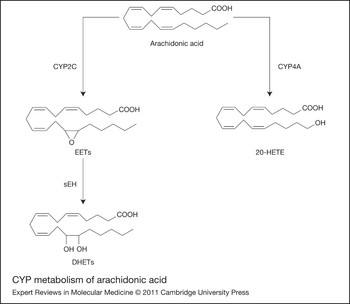
The eicosanoids EETs and 20-HETE are generated by the action of CYP enzymes on arachidonic acid in two distinct pathways: the CYP epoxygenase pathway generates EETs, and the CYP hydroxylase pathway generates 20-HETE (Fig. 1). CYP4A hydroxylase enzymes are responsible for cerebral vascular 20-HETE generation (Refs Reference Dunn12, Reference Harder13). CYP4A3 is the major rat isoform expressed in cerebral circulation (Ref. Reference Dunn12); other CYP enzymes that could contribute to rat cerebral vascular 20-HETE generation include CYP4F isoforms, CYP4A1 and CYP4A8 (Refs Reference Dunn12, Reference Roman14). CYP2C and CYP2J epoxygenase enzymes are primarily responsible for the generation of EETs in the brain (Refs Reference Koehler, Roman and Harder7, Reference Iliff15). These CYP epoxygenase enzymes have been localised to neurons and astrocytes in various regions of the brain (Refs Reference Koehler, Roman and Harder7, Reference Iliff15); interestingly, there is limited experimental evidence that cerebral blood vessels show epoxygenase activity (Ref. Reference Iliff15). EETs are further metabolised by soluble epoxide hydrolase (sEH) into their less active diol, dihydroxyeicosatrienoic acids (DHETs) (Fig. 1). Neurons, astrocytes, oligodendrocytes, ependymal cells, endothelial cells and vascular smooth muscle cells have all been found to express sEH (Ref. Reference Iliff15).
CYP metabolism of arachidonic acid. Arachidonic acid can be metabolised by CYP2C enzymes to generate EETs. EETs can be converted by sEH to the corresponding less active DHETs. CYP4A is a hydroxylase that converts arachidonic acid to 20-HETE. Abbreviations: CYP, cytochrome P450; DHET, dihydroxyeicosatrienoic acid; EET, epoxyeicosatrienoic acid; 20-HETE, 20-hydroxyeicosatetraenoic acid; sEH, soluble epoxide hydrolase.

CYP metabolites in neurovascular coupling
Neurovascular coupling is the result of neuronal activity in a specific region of the brain that culminates in a local increase in blood flow (Refs Reference Filosa and Blanco5, Reference Koehler, Gebremedhin and Harder6, Reference Koehler, Roman and Harder7). The biological mechanisms responsible for this temporally and spatially coordinated coupling are complex and involve nitric oxide, CYP epoxygenases and K+ channel activation (Refs Reference Koehler, Gebremedhin and Harder6, Reference Koehler, Roman and Harder7).
Nitric oxide does not appear to be an essential component because mice deficient in endothelial nitric oxide synthase (eNOS; encoded by Nos3) and neuronal nitric oxide synthase (nNOS; encoded by Nos1) have normal cerebral blood flow responses to whisker stimulation (Refs Reference Koehler, Gebremedhin and Harder6, Reference Koehler, Roman and Harder7). Other findings show that nitric oxide acts in a permissive manner to ensure that cGMP levels in vascular smooth muscle cells are at a level that allows for vasodilation by other mediators (Refs Reference Girouard and Iadecola3, Reference Filosa and Blanco5, Reference Koehler, Gebremedhin and Harder6, Reference Koehler, Roman and Harder7).
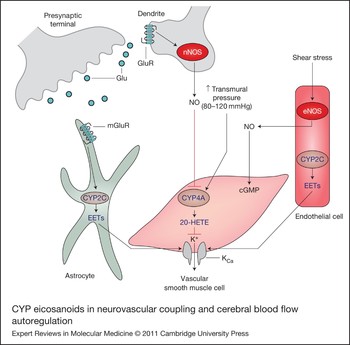
Another key contributor to the functional hyperaemic response is CYP-derived EETs generated in astrocytes in response to release of glutamate by neurons (Refs Reference Filosa and Blanco5, Reference Koehler, Gebremedhin and Harder6, Reference Koehler, Roman and Harder7). EETs generated by astrocytes can then act to open large-conductance Ca2+-activated K+ channels (KCa) on astrocytes and vascular smooth muscle cells, resulting in hyperpolarisation and vasodilation (Refs Reference Koehler, Gebremedhin and Harder6, Reference Koehler, Roman and Harder7). EET antagonists or EET synthesis inhibition can attenuate the increase in cerebral blood flow on activation of the cerebral cortex (Ref. Reference Koehler, Gebremedhin and Harder6).
The eicosanoid 20-HETE can also impact neurovascular coupling. 20-HETE does not have a great influence on the increase in cortical cerebral blood flow in response to whisker barrel stimulation in either rats or mice (Ref. Reference Liu16); however, when nNOS is inhibited, 20-HETE exerts a greater influence on the functional hyperaemic response by diminishing the EET contribution (Ref. Reference Liu16). Nitric oxide suppresses 20-HETE generation by binding to the CYP4A haem group to inhibit hydroxylase activity, resulting in facilitation of EET activation of KCa channels (Ref. Reference Roman14). Taken together, 20-HETE and EETs influence neurovascular coupling and this is in part due to vascular interactions between these CYP metabolites.
CYP metabolites in autoregulation
With regard to cerebral blood flow autoregulation, previous studies have demonstrated that EETs can limit pressure-mediated vasoconstriction (Ref. Reference Imig, Falck and Inscho17). In support of this notion, enzymatic inhibitors of epoxygenase activity enhance arteriolar constriction when perfusion pressure is increased from 80 to 120 mmHg (Ref. Reference Imig, Falck and Inscho17). An interesting aspect of the interaction between EETs and 20-HETE in the functional hyperaemic response is that 20-HETE has been identified as an essential component of the myogenic response (Fig. 2) (Ref. Reference Gebremedhin18). CYP hydroxylase inhibitors abolish arteriolar constriction in response to perfusion pressure (Refs Reference Strandgaard and Paulson8, Reference Roman14, Reference Gebremedhin18). 20-HETE activation of the protein kinase C pathway appears to be a key cell signalling mechanism contributing to the myogenic response (Ref. Reference Roman14).
CYP eicosanoids in neurovascular coupling and cerebral blood flow autoregulation. This simplified diagram indicates how CYP metabolites might link neural activity and haemodynamics to cerebral blood flow regulation. (Upper left) Neurovascular coupling involves presynaptic release of Glu, which acts on mGluRs on astrocytes and GluRs on dendrites. In astrocytes, this results in activation of CYP2C to generate EETs. In dendrites Glu increases neuronal nitric oxide synthase (nNOS/NOS1) to produce NO. NO can act on vascular smooth muscle cells to decrease CYP4A generation of 20-HETE. (Upper right) An increase in transmural pressure as occurs in the cerebral blood flow autoregulation myogenic response can increase 20-HETE production. In addition, shear stress can activate endothelial nitric oxide synthase (eNOS/NOS3) in endothelial cells to produce NO; this increases vascular smooth muscle cell cGMP, which results in vasodilation. Endothelial cells can also produce EETs; however, endothelial-derived EETs appear to play a lesser role in cerebral blood flow control compared to their role in other organs. (Lower centre) In vascular smooth muscle cells, EETs can activate large-conductance calcium-activated K+ channels (KCa), resulting in vasodilation, whereas 20-HETE inactivates KCa. Abbreviations: CYP, cytochrome P450; EET, epoxyeicosatrienoic acid; Glu, glutamate; GluR, postsynaptic AMPA (α-amino-3-hydroxy-5-methyl-4-isoxazolepropionic acid) receptor; 20-HETE, 20-hydroxyeicosatetraenoic acid; mGluR, postsynaptic metabotropic glutamate receptor; NO, nitric oxide.

CYP metabolites in cerebral vascular disease
Neurovascular coupling and cerebral blood flow autoregulation can be altered in pathophysiological states (Ref. Reference Girouard and Iadecola3). Hypertension is one such disease state, which can result in cerebral vascular remodelling, impaired endothelial function and impaired cerebral blood flow autoregulation (Refs Reference Faraci and Heistad1, Reference Harder2, Reference Girouard and Iadecola3). A decrease in the functional hyperaemic response to whisker stimulation has been observed in animal models of hypertension, and there is evidence that functional hyperaemic responses are altered in humans with hypertension (Refs Reference Girouard and Iadecola3, Reference Liu16, Reference Dickinson19, Reference Jennings20). Mouse models of Alzheimer disease demonstrate impaired neurovascular coupling and cerebral blood flow autoregulation: cerebral blood flow autoregulation is almost absent and functional hyperaemia is impaired (Refs Reference Niwa21, Reference Niwa22). Ischaemic stroke is also associated with impaired cerebral blood flow autoregulation and a reduced functional hyperaemic response (Refs Reference Dietrich, Kajita and Dacey23, Reference Iadecola24). These pathophysiological states demonstrate that impaired neurovascular coupling and vascular dysregulation can affect overall brain function. Interestingly, each of these disease states has impaired cerebral blood flow autoregulation and an altered functional hyperaemic response. The unique and complex interactions between functional hyperaemic responses, cerebral blood flow autoregulation and CYP eicosanoids are just beginning to be defined.
As mentioned, pathophysiological states such as hypertension, carotid stenosis or intracranial hypertension impair neurovascular coupling and cerebral blood flow autoregulation and decrease appropriate adaptation of cerebral myogenic tone (Refs Reference Faraci and Heistad1, Reference Girouard and Iadecola3, Reference Dickinson19, Reference Jennings20). A decrease in myogenic tone could possibly limit vasodilation during neuronal activation. In addition, increases in myogenic tone are associated with increases in 20-HETE generation that counteract the opening of vascular smooth muscle cell KCa channels (Refs Reference Harder13, Reference Gebremedhin18). Because increases and decreases in cerebral myogenic tone occur during the confounding issues associated with pathophysiological states, it has been difficult to assess the interaction between metabolic and autoregulatory control of cerebral blood flow. Dysregulation of EETs or sEH has the potential to be associated with impaired neurovascular coupling. Rat astrocytes express CYP2C11, which synthesises EETs, and in turn these can be degraded and inactivated by sEH localised in neurons and cerebral blood vessels (Refs Reference Koehler, Gebremedhin and Harder6, Reference Koehler, Roman and Harder7). Interestingly, an increase in CYP2C11 and EET production in astrocytes following intermittent hypoxia appears to confer a neural protective action (Refs Reference Koehler, Gebremedhin and Harder6, Reference Koehler, Roman and Harder7). Although the contribution of the CYP metabolites EETs and 20-HETE to the interaction between metabolic and autoregulatory regulation of cerebral blood flow is not completely defined, it is clear that pharmacological manipulation of these metabolites can have profound effects on the brain damage that occurs with cerebral ischaemia and stroke.
Cerebral ischaemia: stroke and CYP eicosanoids
Stroke is the third leading cause of death in the USA, and someone dies of stroke every three minutes. Of even more concern is the fact that stroke is the number one cause of serious, long-term disability in the USA (Refs Reference Goldstein25, Reference Zweifler26, Reference Alberts27). Haemorrhagic strokes are commonly associated with an aneurysm in the brain and account for a small percentage of all strokes. As such, there are limited data on the contribution of CYP-derived EETs and 20-HETE to haemorrhagic stroke; however, 20-HETE inhibition has potential therapeutic value for this stroke type. Ischaemic strokes or strokes caused by blood clots (thrombotic or embolic) account for 80% of all strokes (Refs Reference Goldstein25, Reference Zweifler26, Reference Alberts27). Because ischaemic stroke occurs along with a loss of cerebral blood flow regulation and is associated with cardiovascular diseases such as hypertension, manipulation of CYP-derived EETs and 20-HETE has potential for managing ischaemic stroke.
Protective role for EETs?
CYP-derived EETs are vasodilators, profibrinolytic, anti-inflammatory and angiogenic, and can match cerebral blood flow to increased neural activity and metabolic demand (Refs Reference Koehler, Roman and Harder7, Reference Sudhahar, Shaw and Imig28, Reference Imig29). Hence, increasing EETs has the potential to protect the brain from damage that occurs during and following a cerebral ischaemic event. Delivering EETs is impractical because, as fatty acids, they can rapidly bind to plasma proteins or be metabolised. The application of more metabolically stable and active EET agonists to treat animals has recently been successful (Refs Reference Sodhi30, Reference Imig31), but the pharmacological approach that has been widely used is to reduce the degradation of EETs by inhibiting sEH (Ref. Reference Imig and Hammock32).
Epidemiological data demonstrating an association of increased risk for ischaemic stroke in patients with a genetic polymorphism in EPHX2, the gene responsible for generating the sEH protein, support the notion that sEH inhibition could be beneficial for the treatment of stroke (Refs Reference Fornage33, Reference Koerner34). The EPHX2 G860A polymorphism but not CYP2J2-50T allele frequency had a protective influence on ischaemic stroke in Chinese nonsmokers (Ref. Reference Zhang35), whereas homozygosity for the EPHX2 K55R polymorphism conferred a higher risk for hypertension prevalence and increases the risk for ischaemic stroke in Swedish men (Ref. Reference Fava36). In another study, three single-nucleotide polymorphisms identified in Caucasian Europeans in or near the EPHX2 gene were associated with increased risk for ischaemic stroke (Ref. Reference Gschwendtner37). However, a more recent report that genotyped participants in three Copenhagen studies failed to find a relationship between the EPHX2 gene and risk for ischaemic stroke and other cardiovascular diseases (Ref. Reference Lee38); thus, the risk for ischaemic stroke in humans with EPHX2 polymorphisms requires additional evaluation in larger and more ethnically diverse populations.
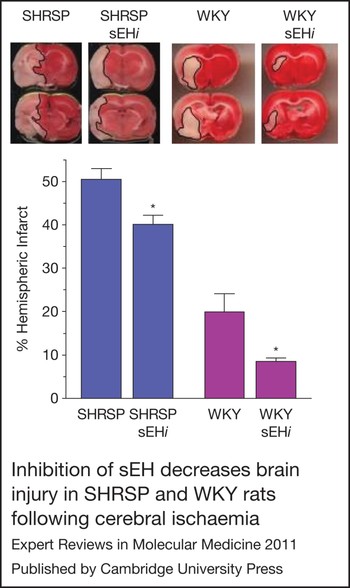
Even though epidemiology studies in humans concerning sEH and risk for ischaemic stroke are somewhat divisive, inhibitors of sEH have been consistently demonstrated to decrease cerebral ischaemic injury in rats and mice (Refs Reference Dorrance39, Reference Simpkins40, Reference Zhang41, Reference Zhang42). The sEH inhibitor 12-(3-adamantan-1-yl-ureido)dodecanoic acid (AUDA) protects against cerebral ischaemia in spontaneously hypertensive stroke-prone (SHRSP) and Wistar–Kyoto (WKY) rats (Refs Reference Dorrance39, Reference Simpkins40). The SHRSP rat is an inbred strain that is derived from the SHR strain and is characterised by hypertension, vascular wall remodelling and reduced cerebral blood flow (Ref. Reference Yamori and de Jong43). Cerebral haemorrhage or infarct occurs by five months of age in a majority of SHRSP rats (Ref. Reference Yamori and de Jong43). Likewise, middle cerebral artery occlusion in young SHRSP rats results in a large area of infarct (50%) when compared with age-matched WKY rats (20%, Fig. 3) (Ref. Reference Yamori and de Jong43). Chronic AUDA treatment in SHRSP rats decreased infarct size induced by middle cerebral artery occlusion even though blood pressure was not altered in this hypertensive animal (Refs Reference Dorrance39, Reference Simpkins40). Cerebral ischaemic–reperfusion injury in normotensive mice was also decreased by sEH inhibition (Ref. Reference Zhang42). Short-term sEH inhibitor treatment also protects the brain from cerebral ischaemic injury. Inhibitors of sEH have also been administered within hours prior to cerebral ischaemic insult and at the time of reperfusion (Ref. Reference Zhang42). Decreased cerebral injury was found irrespective of the timing of treatment with the sEH inhibitor and appears to be mediated by EETs because CYP epoxygenase inhibition negates the decrease in injury with sEH inhibitor treatment (Refs Reference Zhang41, Reference Zhang42). These experimental studies have provided strong evidence for the fact that inhibiting sEH as a means to increase EET levels protects the brain from injury that occurs with cerebral ischaemic stroke.
Inhibition of sEH decreases brain injury in SHRSP and WKY rats following cerebral ischaemia. (Top panels) Inhibition of sEH (sEHi) decreases infarct size after middle cerebral artery occlusion in SHRSP rats (left) and WKY rats (right), as demonstrated by the representative coronal slices stained with triphenyltetrazolium chloride. (Bottom panel) Quantification of hemispheric infarct size (percentage) in SHRSP and WKY rat groups treated with vehicle and with sEHi. Figure adapted, with permission, from Ref. Reference Simpkins40 [© 2009, American Society for Investigative Pathology. Published by Elsevier Inc. (2009)]. Abbreviations: sEH, soluble epoxide hydrolase; SHRSP, spontaneously hypertensive stroke-prone; WKY, Wistar–Kyoto.

Molecular mechanisms of EET action
Interestingly, the mechanisms by which sEH inhibition imparts protection from cerebral ischaemic insult appear to be multifactorial. Experimental evidence supports the notion that cerebral protection by sEH inhibition involves changes in vascular structure and neuronal cell signalling pathways (Refs Reference Dorrance39, Reference Simpkins40, Reference Zhang41, Reference Zhang42). These changes in the vasculature and neurons appear to alter cerebral blood flow and neuronal cell apoptosis in response to a cerebral ischaemic stroke.
Neuronal protective actions attributed to EETs include reducing astrocytic cell death following oxygen–glucose deprivation (Refs Reference Iliff15, Reference Alkayed44, Reference Liu and Alkayed45). Overexpression of sEH, and human polymorphisms associated with variations in sEH activity, increased cell death induced by oxygen–glucose deprivation (Ref. Reference Koerner34). Hypoxic preconditioning has been found to increase CYP2C11 expression in astrocytes by hypoxia-inducible factor 1α, which provides cytoprotection (Ref. Reference Liu and Alkayed45). Chronic administration of sEH inhibitor to SHRSP or WKY rat strains resulted in upregulation of antiapoptotic mediators and neuroprotectants in WKY rats and decreased expression of proapoptotic mediators in SHRSP rats (Ref. Reference Simpkins40). These findings are in agreement with studies where EETs, CYP epoxygenase overexpression and sEH inhibition have been demonstrated to have antiapoptotic properties (Refs Reference Sudhahar, Shaw and Imig28, Reference Imig29).
EETs can inhibit apoptosis by mechanisms that involve Bcl2 upregulation, inhibition of ceramide production and inhibition of reactive oxygen species (Refs Reference Imig29, Reference Fleming46). In addition, sEH inhibition was also shown to reduce cell death following hypoxic reperfusion, possibly by antagonising reactive oxygen species (Ref. Reference Yang47). Chronic administration of sEH inhibitors dampens the enhanced expression of Fas and Tnf ligands, Tnf receptors and Sphk2 in SHRSP rats, while increasing the expression of several antiapoptotic members of the Bcl2 gene family, genes encoding inhibitors of FAS-induced apoptosis (Cflar and Faim), and the antioxidant-encoding gene Prdx2 in WKY rats (Ref. Reference Simpkins40). In particular, Mapk8ip [encoding c-Jun N-terminal kinase-interacting protein (JIP)] was upregulated by AUDA treatment in WKY and SHRSP rats (Ref. Reference Simpkins40). JIP has been shown by several investigators to promote tolerance to ischaemia and cellular stress in neuronal cells, and its effects have been attributed to its ability to sequester mitogen-activated protein kinases (MAPKs) in the cytoplasm, preventing gene transcription and thus apoptosis (Refs Reference Dickens48, Reference Kim49, Reference Whitmarsh50). Increased Mapk8ip mRNA expression in the brain has been associated with increased tolerance to cerebral hypoxia in rats (Ref. Reference Becker51). Lastly, activation of the MAPK and phosphoinositide-3-kinase–AKT signalling pathways could be contributing to not only neuronal but also endothelial cell cytoprotection (Refs Reference Iliff15, Reference Simpkins40, Reference Fleming46). Thus, EETs and sEH inhibition have the ability to target several cell types that contribute to protection against cell death following a cerebral ischaemic event.
Protective role for 20-HETE inhibition?
20-HETE also represents a potential therapeutic target for cerebral ischaemia and stroke. There is evidence that CYP4A11 and CYP4F2 genetic variants are associated with cerebral infarction in the Asian population (Refs Reference Fu52, Reference Fu53, Reference Ding54). Inhibition of 20-HETE synthesis by using TS-011 protects rats from haemorrhagic or ischaemic stroke (Refs Reference Miyata55, Reference Renic56, Reference Marumo57). TS-011 was demonstrated to inhibit human recombinant CYP4A11, CYP4F2, CYP4F3 and CYP4F3B hydroxylase enzymes and had no effect on epoxygenase activity (Ref. Reference Miyata55). Inhibition of 20-HETE synthesis eliminated the decrease in cerebral blood flow and cerebral vasospasm after subarachnoid haemorrhage (Ref. Reference Miyata55). In support of a contribution of 20-HETE to cerebral ischaemic stroke, it has been demonstrated that brain 20-HETE levels are increased within 8 h after middle cerebral artery occlusion (Ref. Reference Tanaka58). TS-011 significantly improved long-term neurological and functional outcomes following cerebral ischaemia and was associated with reduced brain 20-HETE levels (Refs Reference Miyata55, Reference Renic56). Another inhibitor of 20-HETE synthesis, HET0016, has also been demonstrated to decrease cerebral damage following cerebral ischaemia (Refs Reference Dunn12, Reference Renic56, Reference Poloyac59). HET0016 decreased brain 20-HETE levels and attenuated the decrease in cerebral blood flow (Ref. Reference Dunn12). A contribution for cerebral-vascular-generated 20-HETE to blood flow and damage following middle cerebral artery occlusion has been demonstrated in SHRSP rats (Ref. Reference Dunn12). SHRSP rats showed a large and sustained postischaemic hyperperfusion compared with WKY rats (Ref. Reference Dunn12). HET0016 eliminated the hyperaemic response in SHRSP rats and was associated with a decrease in cerebral vascular oxidative stress and improved endothelium-dependent dilation (Ref. Reference Dunn12). These findings suggest that higher cerebral vascular 20-HETE levels contribute to oxidative stress and endothelial dysfunction and increase the susceptibility to cerebral damage following ischaemia. The 20-HETE antagonist 20-hydroxyeicosa-6(Z),15(Z)-dienoic acid also reduces infarct size in rats with cerebral ischaemia (Ref. Reference Renic56). Similar to sEH inhibition, there is evidence that 20-HETE inhibition might decrease ischaemic action through protective effects on neurons in addition to cerebral vascular actions (Ref. Reference Renic56). More recently, TS-011 was reported to improve defects in cerebral microcirculatory autoregulation near the infarct site, which reduces cerebral ischaemic damage (Ref. Reference Marumo57). Taken together, these studies support the notion that 20-HETE inhibition protects the brain from damage following subarachnoid haemorrhage or cerebral ischaemia.
Cerebral vascular remodelling and CYP eicosanoids
Vascular remodelling is a physiological process that can be triggered by changes in haemodynamics, pressure and other factors and culminates in the reorganisation of the vessel around a larger or smaller lumen. Vascular remodelling occurs with hypertension, arterial stenosis/atherosclerosis and vascular injury (Refs Reference De Mey60, Reference Berk61). In these disease states, outward remodelling occurs in the vasculature in response to reductions in lumen diameter to maintain lumen diameter in the face of encroachment (Refs Reference Glasglov62, Reference Korshunov, Schwartz and Berk63). In humans this process is successful at maintaining lumen diameter until the stenosis becomes greater than 40% (Refs Reference Glasglov62, Reference Korshunov, Schwartz and Berk63). After this point, the vasculature is no longer able to compensate for the lumen encroachment, and blood flow to end organs becomes compromised.
In hypertension, the large vessels, such as the middle cerebral artery of SHRSP rats, show hypertrophic outward remodelling that includes increases in blood vessel wall thickness (Refs Reference Korshunov, Schwartz and Berk63, Reference Integan and Schiffrin64, Reference Toda, Okunishi and Miyazaki65, Reference Buus66). In addition, chronic hypertension leads to hyperplasia of vascular smooth muscle cells and neointimal formation (Ref. Reference Korshunov, Schwartz and Berk63). Neointimal formation occurs when vascular smooth muscle cells change phenotypes to the proliferative/synthetic phenotype and invade and proliferate in the media (Refs Reference De Mey60, Reference Berk61, Reference Glasglov62, Reference Zargham67). Vascular smooth muscle cell hyperplasia also occurs with arterial stenosis, atherosclerotic plaque progression and vascular injury (Refs Reference Korshunov, Schwartz and Berk63, Reference Zargham67). Because all the previously mentioned causes of vascular remodelling increase the risk for, and are pathologically associated with causes for, ischaemic stroke, it is important to elucidate key mediators of vascular remodelling to develop new targets for therapeutics.
EETs
Interestingly, genetic polymorphisms in the sEH enzyme in humans have been linked to the incidence of cardiovascular disease. This association could be related to modifications in sEH activity, and thus EET catabolism (Refs Reference Fornage33, Reference Przybyla-Zawislak68, Reference Srivastava69). In the Caucasian subpopulation of the Atherosclerosis Risk in Communities (ARIC) study, the EPHX2 K55R polymorphism results in an increase in the risk for incidence of symptomatic coronary artery disease – that is, myocardial infarction, death or requirement of an intravascular procedure (Ref. Reference Lee70). Additionally, in the African American subpopulation of the Coronary Artery Risk Development in young Adults (CARDIA) study, having one allele that results in the EPHX2 R287Q substitution increased the risk for the presence of coronary calcification (Ref. Reference Fornage71). These findings indicate that reduction in sEH activity could result in plaque stabilisation and decreased incidence of acute cardiovascular events resulting from atherosclerosis.
Several experimental studies indicate that sEH inhibition has the potential for protecting against pathological vascular remodelling. Exogenous EETs and sEH inhibition decrease platelet-derived growth factor (PDGF)-stimulated proliferation of vascular smooth muscle cells in cell culture by downregulation of cyclin D1 (Refs Reference Ng72, Reference Davis73, Reference Nieves and Moreno74). CYP epoxygenase overexpression also decreases vascular smooth muscle cell migration stimulated by PDGF through the cAMP/protein kinase A pathway (Ref. Reference Sun75). Indeed, sEH inhibition decreases collagen deposition in the kidneys of angiotensin-infused hypertensive rats and decreases renal vascular remodelling (Ref. Reference Zhao76). These findings provided the impetus for examining sEH inhibition on vascular remodelling in the SHRSP rat.
The SHRSP rat is an appropriate experimental model of stroke, and SHRSP rats have poor formation of cerebral collateral vessels and reduced microvessel density (Refs Reference Coyle and Jokelainen77, Reference Carswell78, Reference Jesmin79, Reference Coyle and Heistad80). One mechanism by which chronic AUDA treatment of SHRSP rats decreased cerebral ischaemic damage was attenuation of vascular hypertrophic remodelling and collagen deposition that occurs in the middle cerebral artery (Ref. Reference Simpkins40). Several reports suggest that EETs and sEH inhibition attenuate vascular remodelling by modulating intracellular signalling pathways in vascular smooth muscle cells and fibroblasts (Refs Reference Davis73, Reference Nieves and Moreno74). In addition to its effects on the middle cerebral artery, sEH inhibitor treatment increased cerebral microvessel density in SHRSP rats (Ref. Reference Simpkins40). This finding is in agreement with reports that EETs induce angiogenesis in several in vivo models and on co-culture of astrocytes and endothelial cells (Refs Reference Fleming46, Reference Zhang and Harder81). Because hypoxia and increased metabolic demand are potential triggers for astrocyte EET-mediated angiogenesis, it can be speculated that sEH inhibition resulted in increased cerebral microvessel density by countering the deficiencies present in SHRSP rats (Refs Reference Zhang and Harder81, Reference Munzenmaier and Harder82). Administration of an sEH inhibitor also improved inward remodelling induced by carotid artery ligation in SHRSP rats to a level that was comparable to that in WKY rats (Ref. Reference Simpkins83). Taken together, these results suggest that the cerebral protective effects of sEH inhibition in SHRSP rats were in part due to structural changes in the vasculature.
20-HETE
20-HETE also has the ability to impact cerebral vascular remodelling and microvessel density. PDGF-stimulated migration of vascular smooth muscle cells increases in response to 20-HETE and decreases in the presence of the 20-HETE inhibitor HET0016 (Ref. Reference Stec84). 20-HETE increases vascular smooth muscle cell migration through MAPK and tyrosine kinase cell signalling pathways (Ref. Reference Stec84). Correspondingly, endothelin-1-induced vascular smooth muscle cell proliferation appears to be mediated by 20-HETE (Ref. Reference Ljuca and Drevensek85). However, 20-HETE decreased the proliferation of vascular smooth muscle cells and attenuated PDGF-induced expression of cyclin D1 (Ref. Reference Liang86). In these studies, 20-HETE increased vascular smooth muscle cell transforming growth factor β levels to mediate the growth-inhibitory effect (Ref. Reference Liang86). 20-HETE also acts as a nonhypoxic regulator of hypoxia-inducible factor 1α in human microvascular endothelial cells (Ref. Reference Guo87). Endothelial cell proliferation can be increased by 20-HETE, in part due to activation of vascular endothelial growth factor (Refs Reference Guo87, Reference Guo88). These findings support the notion that 20-HETE could impact cerebral vascular remodelling and microvessel density; however, this has not been explored.
Conclusion: expert opinion
The CYP eicosanoid molecular and enzymatic pathway and its contribution to cerebral vascular function provide several opportunities for experimental investigation and therapeutic targeting. In particular, CYP hydroxylase and sEH enzymes and the regulation of cerebral vascular 20-HETE and EETs could influence cerebral blood flow regulation. The complexity of cerebral blood flow regulation has made it difficult to investigate experimentally. Cerebral blood flow autoregulation and neurovascular coupling involve several cell types and expression of different molecular signalling pathways to provide intricate coordination of blood flow (Refs Reference Faraci and Heistad1, Reference Harder2, Reference Girouard and Iadecola3, Reference Krizanac-Bengez, Mayberg and Janigro4, Reference Filosa and Blanco5, Reference Koehler, Gebremedhin and Harder6). The regulation of CYP eicosanoid enzymes and the generation of 20-HETE and EETs in astrocytes and cerebral endothelial and vascular smooth muscle cells contribute to cerebral blood flow autoregulation and neurovascular coupling (Refs Reference Filosa and Blanco5, Reference Koehler, Gebremedhin and Harder6, Reference Koehler, Roman and Harder7). Our understanding of the interaction between cerebral blood flow autoregulation and neurovascular coupling is in its infancy. Experimental studies will require investigation in animal models where there is an absence of cerebral blood flow autoregulation or neurovascular coupling and selective manipulation of CYP eicosanoids in astrocytes, endothelial or vascular smooth muscle cells.
Human genetic studies support the notion that CYP eicosanoids are associated with cerebral vascular disorders. The importance of 20-HETE and EETs has been corroborated by experimental studies in animal models of stroke and vascular remodelling. There have been promising studies in cerebral ischaemia and subarachnoid haemorrhage animal models that demonstrate decreased damage following 20-HETE or sEH inhibition. These would indicate that decreasing 20-HETE or increasing EETs would benefit humans. Experimental findings have also determined that manipulation of CYP eicosanoids improves cerebral blood flow regulation, can positively influence vascular structure and microvessel number, and protects neurons from cell death. Thus, therapeutic targeting of CYP eicosanoids for treating cerebral vascular disorders and stroke demonstrates great promise.
There are several factors and hurdles that will have to be overcome for inhibition of 20-HETE or sEH to result in treatment for humans. One positive for 20-HETE and sEH inhibitors is that researchers and pharmaceutical companies have developed compounds that have been tested in a preclinical setting and an sEH inhibitor actually made it through to human clinical trials (Refs Reference Imig and Hammock32, Reference Tanaka58). Another aspect for targeting CYP eicosanoids is that these metabolites affect different cerebral cell types and several mechanisms responsible for cerebral vascular disorders. 20-HETE and EETs regulate cerebral blood flow, vascular remodelling, platelet aggregation, angiogenesis and inflammation (Refs Reference Roman14, Reference Imig29, Reference Imig and Hammock32). In addition, CYP eicosanoids have antiapoptotic and antioxidant actions on astrocytes and neurons. However, even with this great promise for targeting CYP eicosanoids, there are areas of concern. A major concern is that treatments for a stroke after the ischaemic event have in large part been unsuccessful. To date, the ability of manipulating CYP eicosanoids after the ischaemic event to decrease cerebral damage has not been thoroughly investigated. 20-HETE and EET interactions with other eicosanoid pathways or other yet to be defined unwanted actions could limit targeting this pathway for cerebral vascular diseases. The angiogenic action of EETs is one such action that has the potential to accelerate tumour growth in patients with some types of cancer. Alternatively, 20-HETE and sEH inhibitors have the potential to be used as a preventive therapy in patients with cardiovascular diseases who are at higher risks for ischaemic strokes. These preventive therapies have a much more difficult path for approval in humans. Therefore, the therapeutic targeting of the CYP eicosanoid molecular and enzymatic pathways for the treatment of cerebral vascular disorders and stroke awaits further investigation.
The importance and contribution of CYP eicosanoids to other neural functions and disorders is beginning to emerge. EETs have been demonstrated to have antipyretic effects in mice (Ref. Reference Kozak89). CYP epoxygenase induction or central EET administration attenuated the fever response to lipopolysaccharide (Ref. Reference Kozak89). Recent evidence provides significant support that EETs can decrease pain through manipulation of neural pain pathways (Refs Reference Terashvili90, Reference Inceoglu91). 14,15-EET activates brain opioid receptors in the ventrolateral periaqueductal grey area to produce antinociception (Ref. Reference Terashvili90). Additionally, sEH inhibition reduces inflammation-induced pain and demonstrates promise as an analgesic (Ref. Reference Inceoglu91). The contribution of CYP eicosanoids to other neurological disorders such as Alzheimer disease or multiple sclerosis has yet to be explored. All in all, there are several unexplored research areas with regard to CYP eicosanoids, cerebral vascular function, and cardiovascular and neurological diseases.
Acknowledgements and funding
We thank the peer reviewers for their helpful comments. This work was supported by NIH grants HL59699 (J.D.I.), HL59996 (D.R.H.), F31 HL087723 (A.N.S.) and Advancing a Healthier Wisconsin (J.D.I.).