INTRODUCTION
In most languages, singular and plural are expressed by grammatical morphemes on nouns, verbs, pronouns and articles. The morphological expression of number can be seen as the information distinguishing reference to ‘one’ (singular) from reference to ‘more than one’ (plural) (Matthews, Reference Matthews2005).
Studies on singular and plural comprehension often show conflicting results: for example, regarding the morpheme /s/ in English, Kouider, Halberda, Wood and Carey (Reference Kouider, Halberda, Wood and Carey2006) have shown that, while children aged 2 ; 0 failed to understand the difference in quantity according to the plural morpheme in nouns (i.e. balls vs. ball), those aged 3 ; 0 understood such a difference. On the other hand, Schnoor and Newman (Reference Schnoor and Newman2001) have shown that children aged 1 ; 8 are sensitive to the morpheme /s/ marking ‘more than one’ referent, but they do not understand the absence of this morpheme referring to ‘one’ (it is important to stress that this work only examined one real word and one novel word). As for verbs, Johnson, de Villiers and Seymour (Reference Johnson, de Villiers and Seymour2005) demonstrated that only five- and six-year-olds understand that the morpheme /s/ is an index of the third person singular.
In order to explain the contradiction of these studies, as well as to better understand the novelty of the present contribution, it is worth dwelling on the two paradigms used in the studies describe above. In the Preferential Looking Paradigm (Koudier et al., Reference Kouider, Halberda, Wood and Carey2006; Schnoor & Newman, Reference Schnoor and Newman2001) two arrays of novel objects are displayed simultaneously on two different screens. On the first there is a single object while on the other there are two or more objects. The child is seated in front of the two screens and listens to a sentence (e.g. “Look at the blickets” or “Look at the blicket”). The dependent measure is whether the child looks at the array that matches the sentence according to the singular/plural distinction. Using the Preferential Looking Paradigm, Soderstrom (Reference Soderstrom2002) found that children aged 1 ; 7 and 1 ; 11 showed a strong bias toward the ‘more than one’ array, regardless of the information provided by the morphemes /s/ of nouns (plural) or verbs (singular) (e.g. “look at the balls” vs. “look, it rolls”).
In the Picture-Choice Comprehension Task (Johnson et al., Reference Johnson, de Villiers and Seymour2005) children see a pair of pictures with identical items; in one there is a single item, whereas in the other there is more than one item. The child has to point to one of the two pictures according to the information provided by the instruction (e.g. “Show me the picture where the rabbit sniffs the flower”; “the ducks swim in the water”). The dependent measure is whether the child points to the array that matches the sentence according to the singular/plural distinction.
Recently, Dispaldro (Reference Dispaldro2009) has compared the performance in the Picture-Choice Comprehension Task with a task (named Drawing task) in which the child was required to draw some objects according to the morphological information of number provided by the instruction (i.e. “Mostrami la penna” ‘Show me the pen’ vs. “Disegna la penna” ‘Draw the pen’): the results showed that, when the examiner used the singular form (e.g. la penna ‘the pen’), children were much more likely to perform an error in the Picture-Choice condition (choosing the array with two objects) than in Drawing Condition (where the error is drawing two or more objects). The author argued that in the Picture-Choice task there is an underestimation of the children's singular comprehension of the definite article, since their performance significantly improved if they had to draw.
Both these works (Dispaldro, Reference Dispaldro2009; Soderstrom, Reference Soderstrom2002) lead us to suppose that a discrepancy between children's grammatical knowledge of singular and plural and their performance is present. In our view, this happens because children tend to interpret the context of the task in a way that is different from how adults would understand it: in the experiments described above, the context, that is the spatial configuration, is formed by two well separated arrays, with a different number of items on them, in order to stress the correspondence of singular vs. plural forms, with the two different item groups. Given this condition, adults should easily identify the singular form with the array with ‘one’ object and the plural form with more than one object, but this association could be not so immediate for children. More precisely, if only one ball is present in the context, then it could be easy for them to identify the referent in hearing a singular request, since there is a univocal relation between the linguistic information of quantity (singular, one object) and the only object in the array. Instead, when several exemplars are shown, the singular form does not provide sufficient information to identify the intended object: each single item of the plural array is a possible candidate for the singular form, from a quantitative point of view. Consequently, it cannot be excluded that the child chooses the array with more items even if he/she is considering only one of them.
To test children's grammatical knowledge that singular forms refer to ‘one’ entity and that plural forms to ‘more than one’ entity it is necessary to use a task that allows the examiner to understand the child's real intention. To understand if children tend to choose the array with more items, even if they are considering only one of them, in the present work we used a task in which they are asked to pick objects from two separated dishes, on which either one [X] or two [XX] identical objects are placed. The request to pick the objects should help the children to plan their motoric actions, at least to a certain extent, and the examiner to understand their real intentions, on the basis of their performed movements; in other words, it should be easier to understand the children's actual grammatical knowledge of singular and plural, since lifting an object is less ambiguous than simply looking at or pointing to it.
On the basis of what has been said so far, we tried to answer the following questions:
(1) When do children understand that the singular forms of morphemes concern the quantity ‘one’ and the plural forms concern ‘more than one’?
(2) Do children show different strategies to select ‘one’ or ‘more than one’ object?
(3) Do these strategies change during development?
(4) When and how do children understand that some morphological forms fit the displayed arrays better than others, not simply from a quantitative point of view but also from a communicative point of view (X=singular and XX=plural).
To answer these questions we compared three-year-olds to four- and six-year-olds and adults on two different Italian morphemes: definite articles, marked for number (Experiment 1) and the verb inflection of the third person of the indicative present tense (Experiment 2). Given that the main data on singular and plural knowledge come from English, it is necessary to collect data from other languages such as Italian, which is a complex morphological language (Scalise, Reference Scalise1994). To our knowledge, no studies have so far investigated the comprehension of singular and plural of Italian children; collecting empirical data on the understanding of these forms could provide useful information about the development of more general processes of grammar acquisition. The first forms of Italian morphemes are usually produced at the age of three: in particular, singular forms are used before plural forms, both for bound and free morphemes (Caprin & Guasti, Reference Caprin and Guasti2009; Caselli, Brutti, Campagnoli & Leonard, Reference Caselli, Brutti, Campagnoli and Leonard1994; Cipriani, Chilosi, Bottari & Pfanner, Reference Cipriani, Chilosi, Bottari and Pfanner1993; Dispaldro, Caselli & Stella Reference Dispaldro, Caselli and Stella2009; Leonard, Caselli & Devescovi Reference Leonard, Caselli and Devescovi2002). The present contribution aims at providing information also on their actual comprehension.
EXPERIMENT 1: SINGULAR AND PLURAL IN DEFINITE ARTICLES
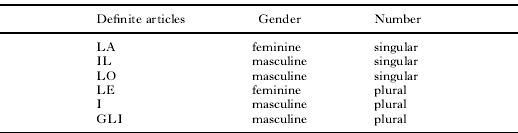
The Italian definite article system includes six different forms, each marked for gender (masculine and feminine) and number (singular and plural) (Table 1). The use of the articles lo ‘the’ and gli ‘the’ is governed by phonological exception, for example in front of nouns beginning with /ts ds ŋ/. The use of these articles is hard to acquire (Caprin & Guasti, Reference Caprin and Guasti2009; Dispaldro et al., Reference Dispaldro, Caselli and Stella2009) and for this reason they have been excluded from the experiment.
Definite articles

Definite articles must precede common nouns. In Italian the noun is always inflected by a final vowel, which marks gender (masculine or feminine) and number (singular or plural); for example, singular vs. plural feminine: la cas-a vs. le cas-e (‘the house’ vs. ‘the houses’). For these reasons, given that in a Noun Phrase like la casa children could understand the number (singular) from the agreement between the article and the noun, in this experiment we used only plausible non-real Italian words ending in a consonant (for example, la betun vs. le betun). In this way we were sure that children would process the number only on the basis of the article.
METHOD
Participants
Seventy-one children and thirty-eight adults participated in the study. The children were divided in three groups: Group 1 included twenty children (3 ; 0 years, range 2 ; 11–3 ; 1); Group 2 consisted of sixteen children (4 ; 0 years, range 3 ; 11–4 ; 1); Group 3 included thirty-five children (6 ; 6 years, range 6 ; 0–6 ; 11). The adult group was formed by thirty-eight individuals (M=27 years old). The participants were all monolingual Italian speakers. The children were recruited from nursery and primary schools serving the middle socioeconomic class of an urban area of north-eastern Italy. None of the children showed evidence of language disorders and none had any known certified articulatory, hearing, neurological or psychiatric deficit, as reported by parents and teachers. Ethical approval and parental consent were obtained prior to any child's inclusion in the experiment.
Material and procedure
The test was composed of eight items (four items for singular forms and four for plural), plus three practice items. Each item was formed by two dishes (placed about 20 cm from each other) on which either one [X] or two [XX] objects were placed (see Appendix A). The three objects were identical and non-real. In this way we had two groups of stimulus items:
— a singular group [X];
— a plural group [XX].
Every non-real object was attributed a non-real noun (of one or two syllables) ending in a consonant (for example betun) and therefore indeclinable according to number in Italian.
Each dish was described by the examiner: for instance, “Qui c'è una betun. Qui due betun” ‘Here there is one betun and here there are two betun(s)’. Then the examiner asked the child to pick some objects: for example “Prendi la betun” ‘Take the betun’. The participant had to choose the quantity of objects (‘one’ or ‘more than one’) asked by the examiner, on the basis of the definite article, from whichever dish he/she wanted. The order of the dish and the order of the questions were random.
The participant was instructed to perform one single action and not a sequential strategy; this means that if participants intended to pick two or three objects, they had to pick them at the same time using both hands. If, instead, the child picked one object, and after a while the other one, this answer was considered as unscorable since it did not allow the examiner to ascertain whether the child really considered them as plural or as a singular followed by another singular.
SCORING
We divided the answers into correct and incorrect on the basis of the correspondence between the quantity expressed by the morphemes and the number of items selected by the participant:
(A) Singular forms (for example “Prendi la betun” ‘take the betun’):
(1) Correct responses:
— ‘One’ in singular group [X] [XX]: the participant picked one object placed by itself on the dish. This answer means that the participant understood that the singular form meant just ‘one’ object. Moreover, this answer means that the participant correctly associated the quantity ‘one’ with the group that better represented it in the spatial array.
— ‘One’ in plural group [X] [XX]: the participant picked one object from the dish with two objects. This answer means that the participant understood that the singular form meant just ‘one’ object.
Incorrect responses:
— Two objects in the plural group [X] [XX]: the participant picked two objects.
— All objects [X] [XX]: the participant picked all the objects.
— One + One [X] [XX]: the participant picked two objects, one from a dish and one from the other.
These answers reveal that the participant did not understand that the singular form refers to the quantity of just ‘one’ object.
Plural forms (for example “prendi le dumat” ‘take the dumats’]:
(1) Correct responses:
— ‘More than one’ in the plural group [X] [XX]: the participant picked the two objects placed on the same dish. This answer means that the participant understood that the plural form meant ‘more than one’. Moreover, it means that the participant correctly associated the quantity ‘more than one’ with the group that better represented it in the spatial array.
— One + One [X] [XX]: the participant picked two objects, one placed on one dish and one on the other. This answer means that the participant understood that the plural form meant ‘more than one’.
— All objects [X] [XX]: the participant picked all the objects. This answer means that the participant understood that the plural form meant ‘more than one’.
Incorrect responses:
— ‘One’ in singular group [X] [XX]: the participant picked one object placed by itself on the dish.
— ‘One’ in plural group [X] [XX]: the participant picked one object placed in the dish with two objects.
Both these answers mean that the participant did not understand that the plural form meant ‘more than one’ object. The cases in which the participants did not answer, or used a sequential strategy, were excluded from the analysis.
RESULTS AND DISCUSSION
Age of acquisition of singular and plural articles
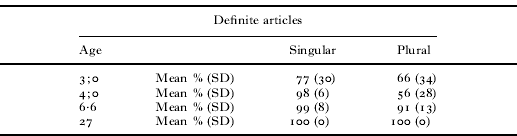
Just three unscorable responses were obtained, due to clear sequential strategy. The means of correct responses and standard deviations are shown in Table 2.
Correct responses on singular and plural comprehension in the definite articles (mean percentage and standard deviation)

A mixed-design analysis of variance (ANOVA) allowed us to establish if there is a significant change of mean percentages of correct response (dependent variable), with Number (two levels: singular and plural) as a within-subjects factor, and Age (four levels: 3 ; 0, 3 ; 6, 6 ; 6 and 27 ; 0) as a between-subjects factor. The analysis was conducted with arcsine-square-root transformation (Winer, Brown & Michels, Reference Winer, Brown and Michels1971). The hypothesis of sphericity was satisfied.
As expected, the effect of Age was significant (F(3,105)=52·198, p<0·0001, ηp2=0·599). The effect of Number was also significant (F(1,105)=22·269, p<0·0001, ηp2=0·200): children understand singular forms of definite articles (94%) more accurately than plural forms (78%). Moreover, there was a significant interaction between Age and Number (F(3,105)=8·102, p<0·0001, ηp2=0·188), indicating that at the age of 3 ; 0 and 4 ; 0, more than at older ages, children show differential performance between singular and plural.
We tested the acquisition level to know when singular and plural can be considered acquired. To define our parameter it is important to separate that used to refer to an individual child (‘individual criterion’) to that used to judge the age of acquisition by children in general (‘criterion for acquisition’).
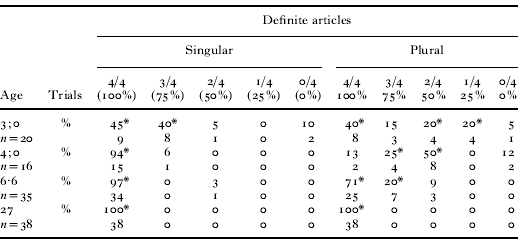
Regarding the individual criterion, it is important to stress that four trials out of eight required a ‘singular’ response and four required a ‘plural’ response. This means that a child would have to get all four out of four trials correct (100% of correct responses) or three out of four correct (75% of correct responses), and so on. We considered that a child masters the singular form when his/her ‘individual criterion’ is four out of four, that is, 100% correct responses.
To judge the age of acquisition by children in general we considered as the criterion for acquisition that 90% of participants had reached the ‘individual criterion’, that is four out of four. Table 3 present the percentages of participants who correctly performed the trials at the different age levels. The results show that children reached the ‘criterion for acquisition’ at the age of 4 ; 0 for the singular forms; by contrast, for the plural forms they did not reach the ‘criterion for acquisition’ even at the age of 6 ; 6; since we don't have participants between six and adults we cannot specify at what age plural can be considered fully understood.
Percentages of participants who correctly comprehend the trials in the definite articles
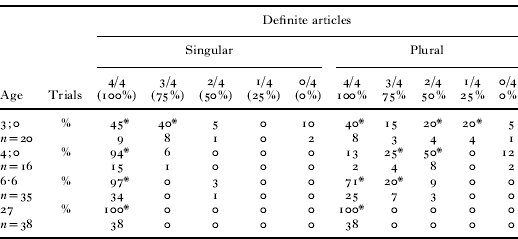
* One sample t-test p<0·05.
Different strategies to select objects
Singular articles
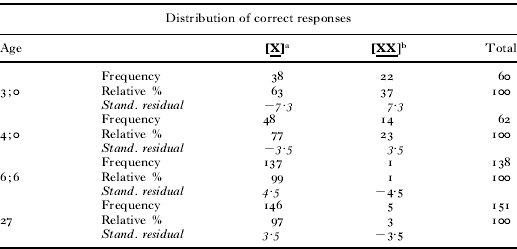
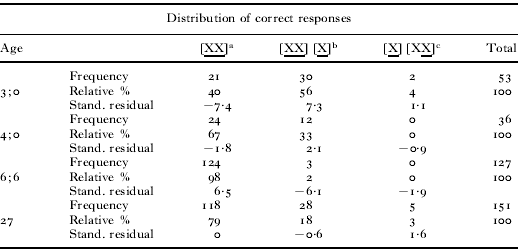
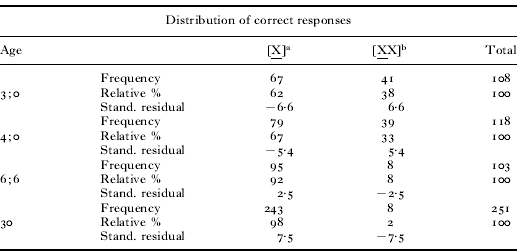
The percentages of responses are based on the total number of correct answers for each age group (relative percentages). Raw frequencies are also reported. The results (displayed in Table 4) show that participants used both strategies: they took either the single object placed on one dish [X] or one of the two objects placed on the other dish [XX].
Distribution of the two strategies of correct response for the singular form in the definite articles

a The participant picked one object placed by itself.
b The participant picked one object from the dish with two objects.
Note 1: χ2(3 N=109)=77·752, p<0·001.
Note 2: For 3 d.f. the z-score is |2·394|.
To verify whether these strategies change during development a chi-square model was used. The comparison between the Standardized Residual and the z-scores showed that the three- and four-year-olds chose one object placed on the dish with two objects [XX] more often than the children aged 6 ; 6 and the adults (30% vs. 2%). In contrast, the children aged 6 ; 6 and the adults chose the object by itself [X] more than preschool children (98% vs. 70%).
Plural articles
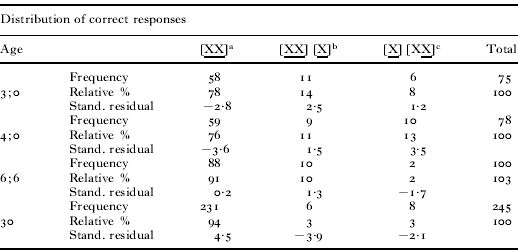
The results (Table 5) show that participants either picked two objects from the same dish [X] [XX] or picked all the objects [X] [XX]. In very few cases the participants selected one object from one dish and one from the other [X][XX].
Distribution of the three strategies of correct responses for the plural form in the definite articles

a The participant picked the two objects placed on the same dish.
b The participant picked all the objects.
c The participant picked two objects, one placed on one dish and one on the other.
Note 1: χ2(6 N=109)=85·563, p<0·001.
Note 2: For 6 d.f. the z-score is |2·638|.
The comparison between the Standardized Residual and the z-scores allows us to assume that three-year-olds chose all the objects present in the context [X] [XX] more than the children aged 6 ; 6; the children aged 6 ; 6 chose the two objects together [X][XX] more than the three-year-olds.
EXPERIMENT 2: SINGULAR AND PLURAL IN THE THIRD PERSON OF THE INDICATIVE PRESENT TENSE
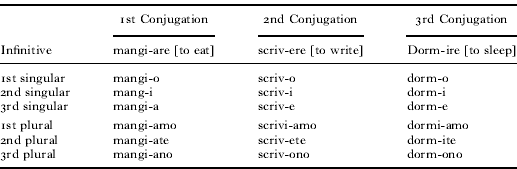
The object of this experiment was to duplicate the results of Experiment 1 with a different kind of morpheme: the third person of the indicative present tense. Despite their complexity, the Italian inflectional verb form is a very regular system. There are three major conjugation classes, distinguished by the infinitive ending: -are (e.g. mangiare ‘to eat’), -ere (e.g. scrivere ‘to write’) and -ire (e.g. dormire ‘to sleep’). In Italian, in all conjugations, the indicative present tense marks the person (first, second and third) and the number (singular and plural) (Table 6 shows the inflections).
The conjugation of the indicative present tense

METHOD
Participants
A total of 100 individuals with typical language (58 children and 42 adults) participated in the study. The children were divided in three groups: Group 1 included twenty children (3 ; 0 years, range 2 ; 11–3 ; 1); Group 2 consisted of twenty children (4 ; 0 years, range 3 ; 11–4 ; 1); Group 3 included eighteen children (6 ; 6 years, range 6 ; 0–6 ; 11). The last group was formed of forty-two adults (M=30 years). None of these participants had taken part in the previous experiment.
The children were recruited from nurseries and a primary school serving the middle socioeconomic class of an urban area of north-eastern Italy. None of the children showed evidence of language disorders and none had any known certified articulatory, hearing, neurological or psychiatric deficit, as reported by parents and teachers. The participants were all monolingual Italian speakers. Ethical approval and parental consent were obtained prior to any child's inclusion in the experiment.
Material and procedure
The test was composed of twelve items (plus three practice items); each conjugation was equally represented in the test. Each item was formed of two dishes (placed far from each other) on which either one [X] or two [XX] identical teddy bears were placed (see Appendix B). The three teddy bears were identical. Thus, two groups were created:
— a singular group [X];
— a plural group [XX].
The order of the dish and the order of the question was random.
Every dish was described by the examiner: for instance, “Qui c'è un orsetto. Qui due orsetti” ‘Here there is one teddy bear. Here there are two teddy bears’. Then the participant was asked to play with them following the examiner's instructions (e.g. “Fammi vedere come ballano” ‘Show me how (they) dance’). The participant had to pick the teddy bear/bears (‘one’ or ‘more than one’) only on the basis of the verb inflection (ball-ano). In Italian (a pro-drop language) the subject is not mandatory, because it is marked by the verb morphological inflection; so the quantitative information is conveyed only by the verb morphology and not by its agreement with nouns or pronouns. The participant was instructed to perform just one action and not a sequential strategy.
Scoring
We divided the answers into correct and incorrect, according to the correspondence between the verb morphemes and the number of teddy bears chosen.
(A) Singular forms: e.g. “Fammi vedere come dorme” ‘Show me how (it) sleeps’:
(1) Correct responses:
— ‘One’ in singular group [X] [XX]: the participant picked the bear placed by itself on the dish.
— ‘One’ in plural group [X] [XX]: the participant picked one bear placed on the dish with two bears.
(2) Incorrect responses:
— Two teddy bears in the plural group [X] [XX]: the participant picked two bears from the same dish.
— All teddy bears [X] [XX]: the participant picked all the bears.
— One + One [X] [XX]: the participant picked two teddy bears, one from one dish and one from the other.
(B) Plural forms: e.g. “Fammi vedere come ballano” ‘Show me how (they) dance’:
(1) Correct responses:
— ‘More than one’ in the plural group[X] [XX]: the participants picked the two teddy bears placed on the same dish.
— One + One [X] [XX]: the participant picked two bears, one from one dish and one from the other.
— All objects [X][XX]: the participant picked all the bears.
(2) Incorrect responses:
— ‘One’ in singular group [X] [XX]: the participant picked the one bear placed by itself on the dish.
— ‘One’ in plural group [X] [XX]: the participant picked one bear from the dish with two bears.
The cases in which the participants did not answer or used a sequential strategy were excluded from the analysis.
RESULTS AND DISCUSSION
Age of acquisition of singular/plural verb inflection
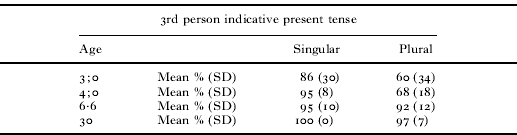
No unscorable responses were obtained. The mean of correct response and standard deviations are shown in Table 7.
Correct responses on singular and plural comprehension in the third person of the indicative present tense (mean percentage and standard deviation)
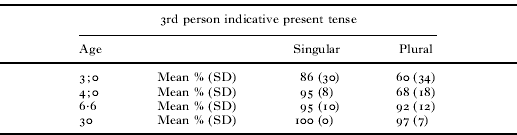
A mixed-design analysis of variance (ANOVA) was carried out on the percentages of correct response (dependent variable), with Number (two levels: singular and plural) as a within-subjects variable, and Age (four levels: 3 ; 0, 3 ; 6, 6 ; 6 and 27 ; 0) as a between-subjects variable. The analysis was conducted with arcsine-square-root transformation. The hypothesis of sphericity was satisfied. The analysis showed a significant main effect of Age (F(3,96)=74·956, p<0·0001, ηp2=0·701). A significant main effect of Number was found which showed that children understand singular forms (94%) more accurately than plural forms (74%) (F(1,96)=49·059, p<0·0001, ηp2=0·338). Finally, there was a significant two-way interaction between Age and Number which showed that the two younger ages, more than the older one, show a discrepancy across number (F(3,96)=11·280, p<0·0001, ηp2=0·261).
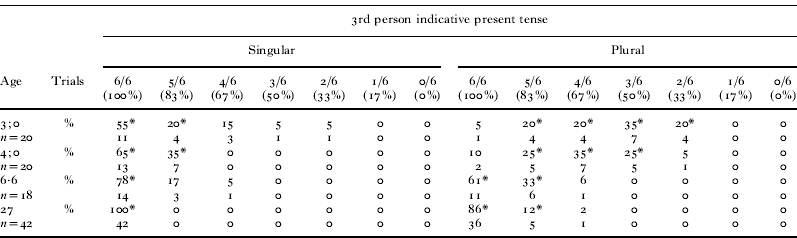
In this experiment, six out of twelve trials required a singular response and six required a plural. At the individual level a child would have to get all six out of six trials correct (100% correct responses) or five out of six correct (83% correct response), and so on. Given the larger number of obligatory contexts present in this experiment, with respect to the previous one, we considered as ‘criterion for acquisition’ that 90% of participants had correctly used the morphemes in at least five obligatory contexts (that is 6 out of 6 or 5 out of 6) (see Table 8). The percentages of participants who correctly used the trial were then calculated. The results show that children reached the criterion of acquisition at 4 ; 0 for the singular forms and at 6 ; 6 for the plural forms.
Percentages of participants who correctly comprehended the trials in the third person indicative present tense
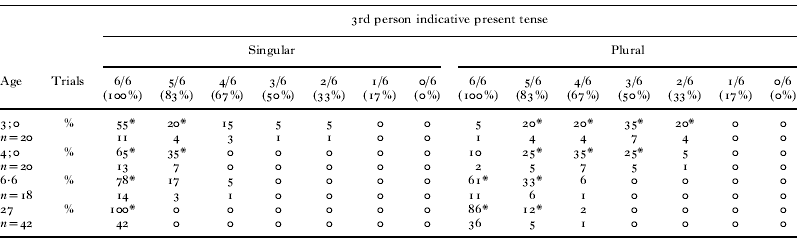
* One sample t-test p<0·05.
Different strategies to select objects
Singular requests
The choices made in accord with the singular verb forms are shown in Table 9: the percentages of responses are based on the total number of correct answers for each age group (relative percentages). Raw frequencies are also reported. The results show that children exhibit both responses: the most frequent response is [X]; nevertheless, some preschool children also selected one teddy from the dish with two teddies [XX].
Distribution of the two strategies of correct responses for the singular form in the indicative present tense

a The participant picked one object placed by itself.
b The participant picked one object from the dish with two objects.
Note 1: χ2(3 N=100)=95·695, p<0·0001.
Note 2: For 3 d.f. the z-score is |2·394|.
To verify whether these strategies change along with development, the Standardized Residual was computed and then compared with the z-scores. The results show that children at 3 ; 0 and 4 ; 0 chose the bear on the dish with two bears [XX] more than children at 6 ; 6 and adults (35% vs. 5%). In contrast, children aged 6 ; 6 and adults chose the bear by itself [X] more than preschool children (95% vs. 65%).
Plural requests
As regards the choice of ‘more than one’ item, the results show that the most frequent response is [XX]. Some participants also picked all the teddy bears [XX] [X] or one from one dish and one from the other [X] [XX] (Table 10).
Distribution of the three strategies of correct response for the plural form in the indicative present tense
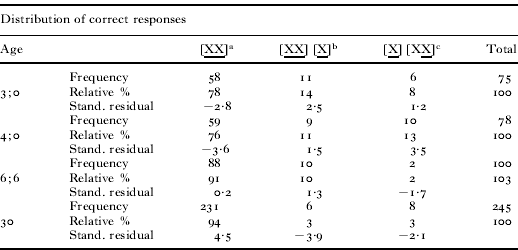
a The participant picked the two objects placed on the same dish.
b The participant picked all the objects.
c The participant picked two objects, one placed on one dish and one on the other.
Note 1: χ2(6 N=100)=33·972, p<0·0001.
Note 2: For 6 d.f. the z-score is |2·638|.
When comparing the Standardized Residual with the z-scores we can see that the adults chose the two bears placed together on the tray [XX] more frequently than the preschool children (94% vs. 77%). Moreover, only adults chose all the bears present in the context [X] [XX] less frequently than other groups. No difference was found between the children aged 6 ; 6 and the adults for the [XX] response and between the children aged 6 ; 6 and the preschool children for the [XX] [X] response.
GENERAL DISCUSSION
The first aim of this study was to asses at which age children understand that singular forms of grammar morphemes mean ‘one’ entity whereas the plural forms mean ‘more than one’ entity (Question 1). Two different morphemes were chosen in order to ascertain whether their acquisition reflect general trends and processes and not local factors and specific morphological properties.
The two experiments have shown a trend that confirms data on production showing that, regardless of the lexical category, singular forms of morphemes are produced earlier than plural forms (Caselli, Brutti, Campagnoli & Leonard, Reference Caselli, Brutti, Campagnoli and Leonard1994; Caprin & Guasti, Reference Caprin and Guasti2009; Cipriani et al., Reference Cipriani, Chilosi, Bottari and Pfanner1993; Dispaldro et al., Reference Dispaldro, Caselli and Stella2009; Leonard et al., Reference Leonard, Caselli and Devescovi2002): children understand that singular forms refer to ‘one’ when they are about four, whereas they understand that plural forms refer to ‘more than one’ when they are older than six (Tables 2, 3, 7 and 8). The fact that understanding plural with definite articles seems to be more difficult than with the third person of the indicative verbs could be attributable to our criteria for acquisition, which are less strict in Experiment 2 (Experiment 1: 90% of children getting 4/4; Experiment 2: 90% of children getting at least 5/6).
Italian children have been found to produce singular and plural morphemes correctly from the age of three (Caselli et al., Reference Caselli, Brutti, Campagnoli and Leonard1994; Caprin & Guasti, Reference Caprin and Guasti2009; Cipriani et al., Reference Cipriani, Chilosi, Bottari and Pfanner1993; Dispaldro et al., Reference Dispaldro, Caselli and Stella2009; Leonard et al., Reference Leonard, Caselli and Devescovi2002), whereas our study shows that three-year-old children don't completely understand the semantic proprieties of these morphemes; this seems to support several studies (in Italian as well in other languages) showing that, in the first phase of grammar acquisition, children may produce the morphemes without a deeper knowledge of their semantic proprieties (Antinucci & Miller, Reference Antinucci and Miller1976; Devescovi, D'Amico & Gentile, Reference Devescovi, D'Amico and Gentile1999; Johnson et al., Reference Johnson, de Villiers and Seymour2005; Li & Shirai, Reference Li and Shirai2000; Mulford, Reference Mulford1985; Orsolini, Fanari & Di Giacinto, Reference Orsolini, Fanari and Di Giacinto1994; Pérez-Pereira, Reference Pérez-Pereira1991; Tomasello, Reference Tomasello1992). Since this view is the opposite to the conventional wisdom that comprehension of a form precedes its productive mastery (e.g. Fenson, Dale, Reznick, Bates, Thal & Pethick, Reference Fenson, Dale, Reznick, Bates, Thal and Pethick1994), further research and more empirical data are required to disentangle this issue.
The second aim was to verify which strategies children use in applying their morphological knowledge of ‘one’ and ‘more than one’ to a context in which the singular form was best represented by the [X] array and the plural by the [XX] array (Question 2). For both articles and verbs, preschool children used different strategies: for the singular forms they picked one object placed by itself [X] as well as one object on the dish with two items [XX] (Tables 4 and 9); for the plural forms they picked the two objects placed on the same dish [XX] as well as all the objects [X] [XX] (Tables 5 and 10).
These strategies change with age (Question 3); in particular, at the age of six children understand that some arrays are more appropriate than others to the specific morphological forms used by the speaker: for the singular form they picked the object placed by itself [X] (Tables 4 and 9), and for the plural forms they picked the two objects placed on the same dish [XX] (Tables 5 and 10).
One open issue is why these strategies change during development, specifically how children progressively realize that not all the quantitatively correct responses have the same value. We hypothesize that this happens because the child's consideration of the referential context and of the speaker's communicative intentions change. A central aspect of good communication is the degree to which the interlocutors share the same language rules, presuppositions and understanding of the referential context (Meroni, Reference Meroni2005; Munn, Miller & Schmitt Reference Munn, Miller and Schmitt2005; Sperber & Wilson, Reference Sperber and Wilson1986). The notion of referential context deals with the ‘theory of interpretation’, claiming that the situated interpretation of any utterance is always a matter of inferences made in an interactive exchange; the interpretation of a message is constrained both by what is said and by how it is interpreted (Gumperz Reference Gumperz, Duranti and Goodwin1992; Sperber & Wilson, Reference Sperber and Wilson1986).
In our study, the interlocutors were children and adults, clearly having different degrees of cognitive and social abilities; our explanatory hypothesis is that the developmental trend found in this work reflects children's increasing understanding of the experimenter's communicative intent, which is to apply the singular form to the single object [X] and the plural form to the objects placed together on the other dish [XX]. As age increases, children progressively abandon a purely quantitative criterion in interpreting singular (one) and plural (more than one) and start identifying them according to the referential–communicative context. This progression could be attributed to the increasing socio-cognitive skills of children who, as the literature has shown, after the age of four understand that people's behaviour is guided by mental states, such as desires, notions, beliefs, intentions, etc. (Theory of Mind: Nelson, Reference Nelson1996; Nelson, Skwerer, Goldman, Henseler, Presler & Walkenfeld, Reference Nelson, Skwerer, Goldman, Henseler, Presler and Walkenfeld2003; Tomasello, Reference Tomasello1999). Another kind of study has shown that children become more expert in providing and evaluating communicative messages, from school age onwards (Referential Communication Tasks: Gluksberg, Krauss & Weisberg, Reference Glucksberg, Krauss and Weisberg1966). Their increasing social and cognitive experience teaches them that the message form is crucial to realize its correspondence to the intended meaning, both as speakers and as listeners. In fact, the correspondence between, for example, the non-linguistic condition [X] and the linguistic form ‘singular’ could be seen as a use of the ‘Gricean maxims’ for good communication, such as ‘be perspicuous’ (Manner) or ‘avoid redundancy’ (Quantity) (Grice, Reference Grice, Cole and Morgan1975). The application of the singular form to the single object [X] reduces the listener's uncertainty in detecting the referents intended by the speaker, as compared to the other possible options – [XX] or [XX] – which are equivalent in principle, from a simple numerical point of view. In this case ([XX] or [XX]), the most appropriate utterance should be “Prendi una/qualunque betun” ‘Take one/a/whatever betun’, or “Fammi vedere come un/qualsiasi orso balla” ‘Show me how one/a/whatever teddy bear dances’. Our interpretation of the child performance in term of ‘Gricean maxims’ is supported by studies showing that children start to understand this prescription form preschool age onward (Conti & Camras, Reference Conti and Camras1984; Eskritt, Whalen & Lee, Reference Eskritt, Whalen and Lee2008).
As we have seen from the two experiments, the appropriate referential use of singular is not immediately obvious for three-year-olds, but the plural is even more difficult; in fact, many participants picked all the objects present in the context, especially with articles. The difficulties in linking plural with the appropriate context may be because, by definition, plural broadens the number of alternatives one has to consider and compare: its intrinsic meaning is related not to the specific number of the denoted entities (whether two, three or more) but only to the fact that they are ‘more than one’. Therefore, identifying which object group best fits the plural form requires an even more complex analysis of the objects' disposition and property. For example, Zapf and Smith (Reference Zapf and Smith2008) have found that two-year-old children's use of the plural is limited by the properties of the sets: they found that children were more likely to use the plural to describe objects when there were four rather than two items and when they were identical instead of similar.
The strategy of picking all three objects according to the plural morphemes is present in both articles and verbs, but with some differences: only in the case of articles is this strategy present in adults and not only in preschool children (Table 5). A tentative explanation could be that, in the case of articles, the youngest children follow a principle that could be called ‘maximization of the quantitative components of the linguistic form’; more precisely, if plural refers to ‘more than one’ item, the safest strategy could be to select the largest group of items ([X] [XX]). As age increases, children progressively also follow the notion that some arrays are more suitable than other arrays to some linguistic forms.
This notion is clear to adults who, nevertheless, also tended to select all three objects but, in our interpretation, following a different principle. This principle is the proper semantic–syntactic function of articles, regularly joined to nouns, according to the kind of language. In English, categories expressed by count nouns do not require determiners (e.g. “dogs have four legs”) and definite articles are added in order to identify specific exemplars (e.g. “I have seen the black dog”). In Italian, count nouns not introduced by articles are less frequent, both in singular and in plural forms, and the definite articles have the same function as in English of specifying a given exemplar (e.g. “Ho visto il cane nero”). The plural form is usually added when describing categorical exemplars (e.g. “I cani hanno quattro zampe” ‘[the] dogs have four legs’), especially in conventional definitions (e.g. “I cani sono animali domestici: ‘[the] dogs are domestic animals’) (Benelli, Belacchi, Gini & Lucangeli, Reference Benelli, Belacchi, Gini and Lucangeli2006). In our experiment, the association of plural articles with nouns may have led the adults to select all the exemplars available in the context, considering them as members of the same category. Verbs do not have an object categorization function, and the number morphemes are enough to satisfy the linguistic distinction between singular and plural forms. Perhaps the strategy of selecting all the items is hindered by the fact that usually in Italian the totality of the referents is conveyed by adding the quantifier ‘all’ (e.g. “Fammi vedere come tutti mangiano” ‘Show me how (they) all eat’).
Clearly, both these interpretations are tentative and need further research and more empirical data.
In general, our work, requiring a more constrained action to perform the task, confirms our hypothesis that, for preschool children, there is not a clear relation between the linguistic information of quantity and the intended reference to the spatial configuration of the objects. Looking at, or pointing to, objects makes it more difficult to ascertain whether the youngest children share the experimenter's knowledge framework, and more age-appropriate tasks should be based on clear behavioural decisions, to allow the experimenter to really understand the preschool child's grammar knowledge (Soderstrom, Reference Soderstrom2008; Tomasello, Reference Tomasello2003).
In conclusion, this study has shown that there is a progression in mastering the different dimensions of the linguistic expressions of quantity. The child has to acquire not only the formal aspects of the linguistic system but also its communicative–pragmatic functions. The first step of this progression starts with an early understanding that language, specifically morphology, has the function of coding the differences in the number of items forming physical arrays. The second step requires children to connect the quantitative information to the specific organization of the context, which determines the speaker's linguistic options.
APPENDIX A: DEFINITE ARTICLES
Examples:

1. la bin
2. il cot
3. le taf
4. il nafac
5. le dumat
6. i tev
7. la betun
8. i chefen
APPENDIX B: THIRD PERSON INDICATIVE PRESENT TENSE
Examples:
1. ballano ‘(they) dance’
2. dorme ‘(it) sleeps’
3. cammina ‘(it) walks’
4. saltano ‘(they) jump’
5. cade ‘(it) falls’
6. corrono ‘(they) run’
7. vola ‘(it) flies’
8. nuota ‘(it) swims’
9. piangono ‘(they) cry’
10. canta ‘(it) sings’
11. girano ‘(they) turn’
12. mangiano ‘(they) eat’