Introduction
In the early stages of the disease, people with dementia and informal carers experience insufficient support for self-management (Martin et al., Reference Martin, Turner, Wallace, Choudhry and Bradbury2012) and a lack of meaningful activities to spend the day (Castillo et al., Reference Castillo, Woods and Orrell2010; Castillo et al., Reference Castillo, Woods and Orrell2013; Van der Roest et al., Reference Van der Roest2009). Facilitating self-management and meaningful activities for people with dementia promotes autonomy and wellbeing and relieves the burden of informal carers (Graff et al., Reference Graff, Vernooij-Dassen, Thijssen, Dekker, Hoefnagels and Rikkert2006). Technology can potentially support people in their ability to manage life and to engage in meaningful activities despite chronic diseases (Huber et al., Reference Huber2011). Handheld touchscreen devices, such as tablets and their applications (apps), provide an intuitive and user-friendly interface. The use of tablets for eHealth purposes is increasing as the availability of new apps in the field of health and social care increases (Marceglia et al., Reference Marceglia, Bonacina, Zaccaria, Pagliari and Pinciroli2012). In recent years many Information Communication Technology (ICT) applications that support independence in daily living have been developed, such as apps for cognitive training, calendar, games, and art, which can also be used by people with dementia (Hitch et al., Reference Hitch, Swan, Pattison and Stefaniak2017; Joddrell and Astell, Reference Joddrell and Astell2016; Tyack and Camic, Reference Tyack and Camic2017).
There is growing evidence that people with mild dementia are able to use tablets and apps (Tyack et al., Reference Tyack, Camic, Heron and Hulbert2015; Astell et al., Reference Astell2016; Cutler et al., Reference Cutler, Hicks and Innes2016; Groenewoud et al., Reference Groenewoud, de Lange, Schikhof, Astell, Jodrell and Goumans2017; Kerkhof et al., Reference Kerkhof, Rabiee and Willems2015; Lim et al., Reference Lim, Wallace, Luszcz and Reynolds2013; Upton et al., Reference Upton, Upton, Jones, Jutlla and Brooker2011) which stimulate self-management activities, e.g. apps to cope with memory loss (Kerkhof et al., Reference Kerkhof, Rabiee and Willems2015; Øksnebjerg et al., Reference Øksnebjerg2020), and which engage people with dementia in meaningful activities, e.g. apps for leisure activities (Smith and Mountain, Reference Smith and Mountain2012) such as gaming (Astell et al., Reference Astell2016; Groenewoud et al., Reference Groenewoud, de Lange, Schikhof, Astell, Jodrell and Goumans2017) or art (Tyack et al., Reference Tyack, Camic, Heron and Hulbert2015). However, people with dementia need support to learn how to use the tablet and its apps (Groenewoud et al., Reference Groenewoud, de Lange, Schikhof, Astell, Jodrell and Goumans2017; Kerkhof et al., Reference Kerkhof, Rabiee and Willems2015; Lim et al., Reference Lim, Wallace, Luszcz and Reynolds2013; Upton et al., Reference Upton, Upton, Jones, Jutlla and Brooker2011).
Introducing tablets to community-dwelling people with mild dementia is a new development. It may therefore be important to take into account specific preconditions, such as related to their cognitive disabilities and living situation (e.g. cohabiting with an informal carer or living alone). To this end, a person-centered tablet programme to assist people with mild dementia and their carers in the effective usage of tablets will be developed in co-creation with end users (Kerkhof et al., Reference Kerkhof, de Vocht, Graff and Dröes2016). This programme consists of a selection tool to help users find apps for self-management and meaningful activities and a training for informal carers to support people with dementia in using the tablet. This training will be based on available evidence on effective coaching interventions for people with dementia to (re)learn the use of technologies.
Kessels and Joosten-Weyn Banningh (Reference Kessels and Joosten-Weyn Banningh2008) describe that new skills can be taught to people with dementia using their implicit memory. This part of the long-term memory is responsible for performing procedural tasks that are acquired through fixed routines, such as biking and washing hands, and are conducted automatically (Kessels and Joosten-Weyn Banningh, Reference Kessels and Joosten-Weyn Banningh2008).
The review by De Werd et al. (Reference De Werd, Boelen, Rikkert and Kessels2013) found that an Errorless (EL) learning approach is more effective than an Errorful (EF) learning approach to teach people with dementia a variety of daily tasks or skills. EL approaches keep errors during the learning process to a minimum, because memory limitations prevent learning from mistakes (Clare and Jones, Reference Clare and Jones2008; De Werd et al., Reference De Werd, Boelen, Rikkert and Kessels2013). EL employs error-reduction methods, such as a stepwise approach with feed-forward instruction, vanishing cues and spaced retrieval (Clare and Jones, Reference Clare and Jones2008; De Werd et al., Reference De Werd, Boelen, Rikkert and Kessels2013). Another review indicates that spaced-retrieval training is effective in enabling people with dementia to learn new information and to teach associations between a cue and a specific behavior in order to improve performance of skills (Creighton et al., Reference Creighton, van der Ploeg and O’Connor2013). In EF approaches, the idea is that skills can be learned by guessing the correct response and learning from any errors made (Bourgeois et al., Reference Bourgeois2016).
EL might be the best way to introduce tablets to people with dementia, but because of the broad scope of both reviews (Creighton et al., Reference Creighton, van der Ploeg and O’Connor2013; De Werd et al., Reference De Werd, Boelen, Rikkert and Kessels2013) – they included studies with a wide range of activities of daily living, such as relearning names of persons and objects – they are not conclusive about the effectiveness of EL specifically for (re)learning skills for using technologies. It is uncertain whether EL is the best approach for people with dementia to (re)learn the use of technology. For example, the stepwise approach may not be suitable when learning to use ICT applications, because the actions needed when using ICT are not as predictable as relearning names of objects or executing ADL. The (re)learning of technology is a different process. This becomes clear by acknowledging the three layers of technology significance formulated by Martins and Dal Sasso (Reference Martins and Dal Sasso2008): that of physical objects (such as instruments and machines); that of a form of knowledge (such as how to use it); and as it forms part of a complex set of human activities (Martins and Dal Sasso, Reference Martins and Dal Sasso2008). Hence, only studies with training interventions focusing on (re)learning how to use technologies have been included in this review. Because the uptake of Information Communication Technology (ICT) applications is a recent development in people with dementia and relatively few publications were therefore expected in this area, we also included training interventions for the use of other technologies, such as technologies to assist people in Instrumental Activities of Daily Living (IADL), e.g. microwaves and coffee makers.
To the best of our knowledge, no review has been conducted that examines which training interventions are most appropriate to assist people with mild dementia in (re)learning to use technologies. The purpose of this literature review is to identify which training interventions work best in helping people with mild dementia (re)learn how to use technologies, in particular the tablet. To gain insight into the context of the included studies, the following characteristics were described: (a) dementia type and severity; (b) technology task type; (c) training intensity and setting; (d) components training; (e) study design and outcome measures; and (f) learning effects and efficiency.
The research question is:
-
Which training interventions are effective for people with mild dementia in (re)learning how to use technologies, including handheld touchscreen devices?
Method
Design
A literature review (Grant and Booth, Reference Grant and Booth2009) with a systematic approach was performed in order to find training interventions for (re)teaching people with mild dementia how to use technologies. Our intention was not to get a full picture of all available evidence, but rather to understand what works best for people with mild dementia to (re)learn the use of technology, so we can include these insights in our training for the person-centered tablet programme (Kerkhof et al., Reference Kerkhof, de Vocht, Graff and Dröes2016). We did not perform a complete systematic review. We used systematic review methods for transparency and reproducibility of our work, such as methods for determining the search strategy, for setting the inclusion and exclusion criteria based on PICO, and for the selection of publications and the data extraction procedure as described below (Higgins and Green, Reference Higgins and Green2011).
Data sources and search strategy
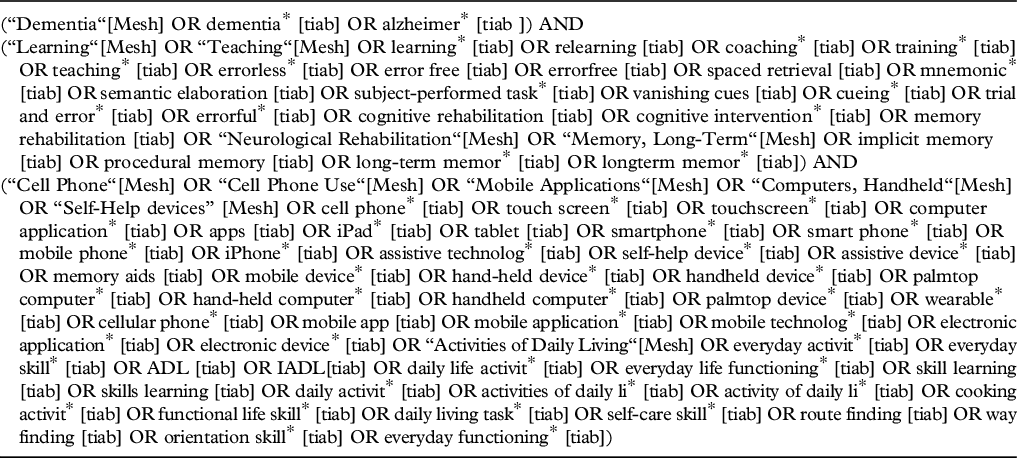
A systematic search of the literature was conducted in 3 electronic databases (CP). PubMed, APA PsycInfo (EBSCO), and CINAHL (EBSCO) were searched from inception up to 19 June 2020 with comparable search strategies (see Table 1 for the search strategy used for PubMed). The complete search strategies for the other databases are available on request.
Search strategy in PubMed

Inclusion and exclusion criteria
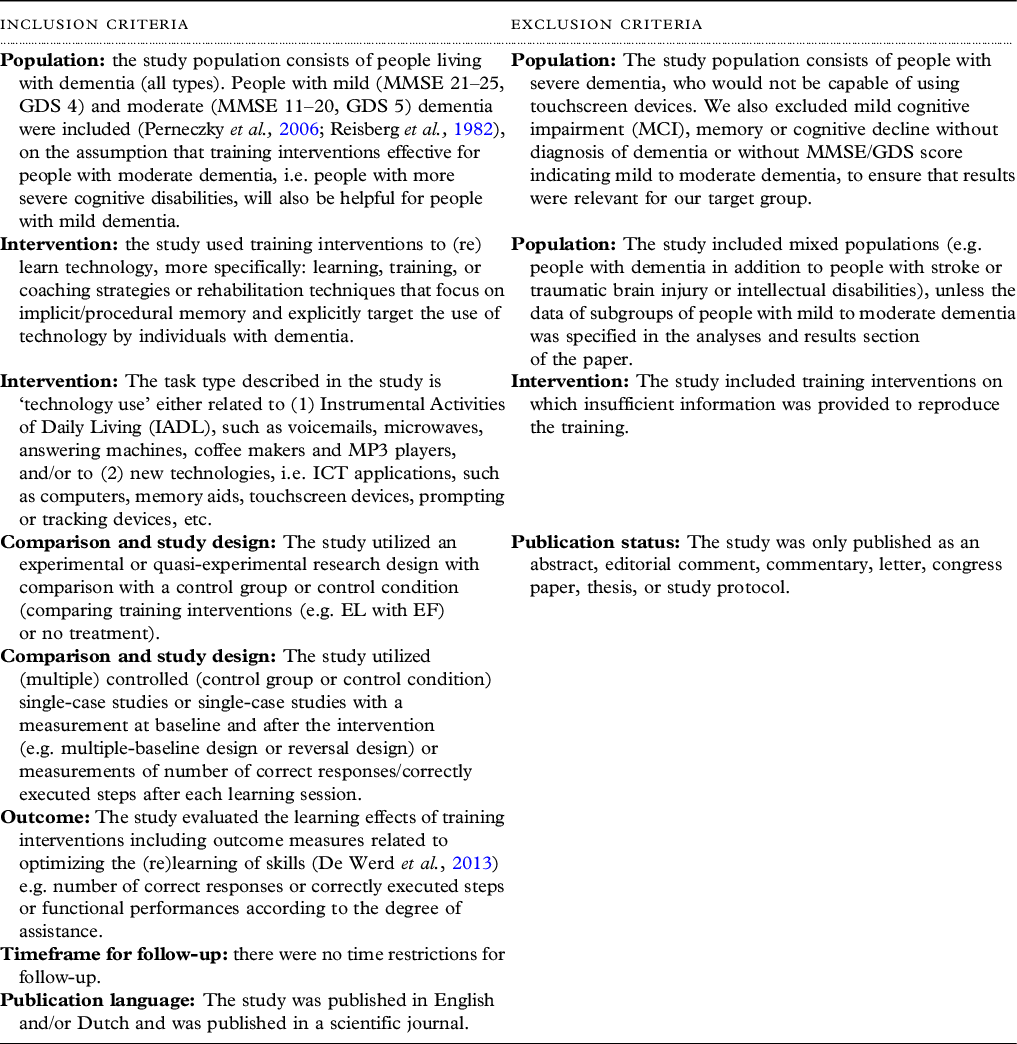
For the selection of the articles, we used the inclusion and exclusion criteria presented in Table 2.
Inclusion and exclusion criteria for this literature review

Selection of publications
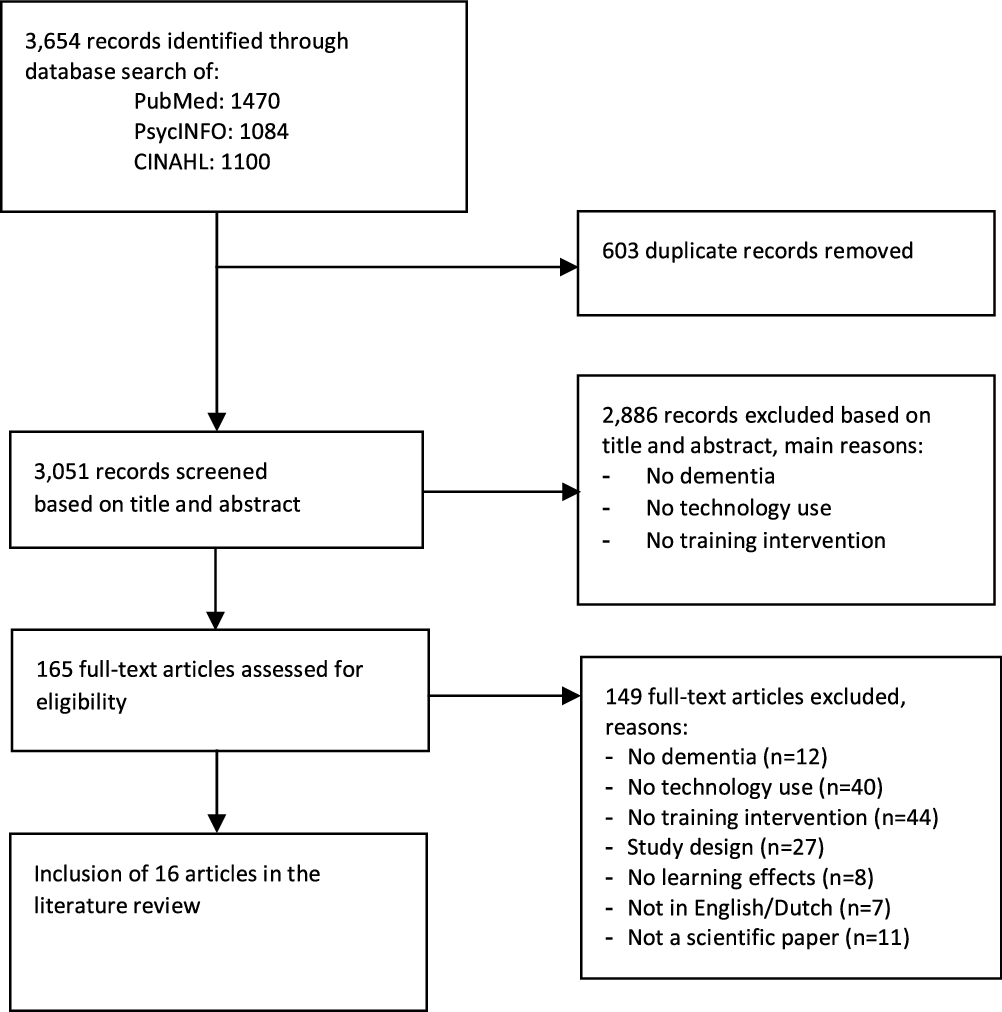
The search results were uploaded into EndNoteX7. Duplications were removed. The Preferred Reporting Items for Systematic Reviews and Meta-Analysis flow diagram (Moher et al., Reference Moher, Liberati, Tetzlaff and Altman2009) were used to summarize the study selection processes (see Figure 1). Two researchers (YK and AB) independently screened the publications, by title and abstract, and three researchers (YK, AB, and FM) independently screened the publications’ full texts. In this phase further duplicates, not previously detected by EndNote, were removed. Any discrepancies between researchers regarding inclusion were resolved through discussion.
Flow diagram of the search and the selection process (Moher et al., Reference Moher, Liberati, Tetzlaff and Altman2009).

Data extraction and data synthesis
Initially, two researchers (YK and AB) independently extracted data from one included article and this was followed by a consensus meeting. Next, data were extracted from another article by the same researchers. When this resulted in similar outcomes, it was decided to divide the remaining articles and to extract the data independently. For data extraction concerning the effectiveness of training interventions and maintenance of treatment gains, additional consensus meetings took place (YK and AB). Small samples (n < 26) were used in 13 of the 16 studies reviewed, and the training interventions and procedures, outcomes of learning effects and research designs varied considerably among studies. We therefore performed a qualitative analysis on previously described characteristics.
Results
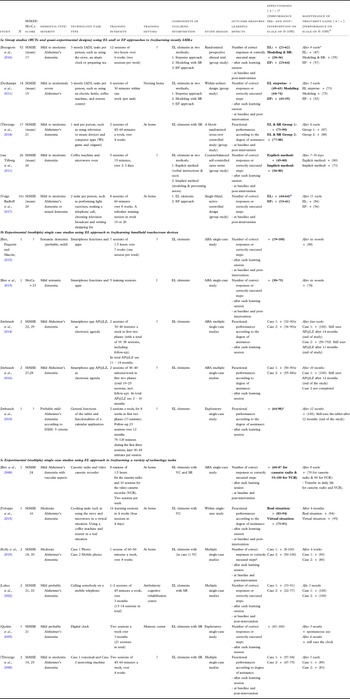
The search in the PubMed, PsycINFO, and CINAHL databases resulted in a total of 3,654 references of which 3,638 were excluded either because they did not meet the inclusion criteria (see Figure 1). The study selection resulted in 16 articles describing training interventions to assist people with mild dementia in (re)learning how to use technology. Table 3 shows a detailed description of each study.
Detailed description of reviewed studies

a + improvement in performance of target functions between baseline and post-intervention; – is no learning effect. The entries in bold indicate a significant effect. Performance of the task refers to performance without help, cues, or written instructions.
b + improvement in performance of target functions between baseline and follow-up; – means the learning effect has disappeared at follow-up. The entries in bold indicate a significant effect.
c After the end of the training.
d Average of two different tasks recalculated to scale of 0–100.
e At the end of acquisition and application phase.
f The application phase was with help from trainers.
g Only included objective measure of percentage of correct responses, not self-rated goal performance and satisfaction.
Dementia type and severity
The most common diagnosis was Alzheimer’s disease (Bier et al., Reference Bier, Provencher, Gagnon, Van der Linden, Adam and Desrosiers2008; Bourgeois et al., Reference Bourgeois2016; Dechamps et al., Reference Dechamps2011; Foloppe et al., Reference Foloppe, Richard, Yamaguchi, Etcharry-Bouyx and Allain2015; Imbeault et al., Reference Imbeault2014; Reference Imbeault2016; Reference Imbeault, Langlois, Bocti, Gagnon and Bier2018; Kelly et al., Reference Kelly, Lawlor, Coen, Robertson and Brennan2019; Lekeu et al., Reference Lekeu, Wojtasik, Van der Linden and Salmon2002; Quittre et al., Reference Quittre, Olivier and Salmon2005; Thivierge et al., Reference Thivierge, Simard, Jean and Grandmaison2008; Reference Thivierge, Jean and Simard2014; Voigt-Radloff et al., Reference Voigt-Radloff2017). One study reported mixed type (Bier et al., Reference Bier, Provencher, Gagnon, Van der Linden, Adam and Desrosiers2008), others mentioned semantic dementia (Bier, Paquette and Macoir, Reference Bier, Paquette and Macoir2015; Bier et al., Reference Bier2015), and in one study the form of dementia was not specified (Van Tilborg et al., Reference Van Tilborg, Kessels and Hulstijn2011). With regard to the severity, most studies reported MMSE/MoCa scores between 11 and 25, indicating a mild to moderate dementia. Two single-case studies did not mention scores, but based on the case description we can assume it was mild dementia (Bier et al., Reference Bier2015; Imbeault et al., Reference Imbeault, Langlois, Bocti, Gagnon and Bier2018).
Technology task type
The technology tasks ranged from using telephones and (mobile) ICT devices, to using music and television devices, and conducting household activities and operating household devices (IADL). Examples of telephone and (mobile) ICT devices were learning to operate a:
-
voicemail and answering machine (Thivierge et al., Reference Thivierge, Simard, Jean and Grandmaison2008);
-
(mobile) phone (Kelly et al., Reference Kelly, Lawlor, Coen, Robertson and Brennan2019; Lekeu et al., Reference Lekeu, Wojtasik, Van der Linden and Salmon2002; Voigt-Radloff et al., Reference Voigt-Radloff2017);
-
smartphone/tablet and its apps (Bier et al., 2015; Bier et al., 2015; Imbeault et al., Reference Imbeault, Langlois, Bocti, Gagnon and Bier2018);
-
computer, to use e-mail, Internet search and computer games (Dechamps et al., Reference Dechamps2011; Thivierge et al., Reference Thivierge, Jean and Simard2014).
Two studies described people with dementia learning to use the AP@LZ application (Imbeault et al., Reference Imbeault2014; Reference Imbeault2016). AP@LZ is an electronic personal organizer application, developed for people with dementia and installed on a smartphone. The application consists of five functions: (1) Appointments; (2) Personal; (3) Medical; (4) Contacts; and (5) Notepad (Imbeault et al., Reference Imbeault2014; Reference Imbeault2016).
The use of music and television devices consisted, for example, of learning to operate a:
-
radio and video cassette (Bier et al., Reference Bier, Provencher, Gagnon, Van der Linden, Adam and Desrosiers2008; Thivierge et al., Reference Thivierge, Jean and Simard2014);
-
remote control (Dechamps et al., Reference Dechamps2011; Voigt-Radloff et al., Reference Voigt-Radloff2017);
-
CD player and DVD player with leisure activities, such as Wii game and origami (Dechamps et al., Reference Dechamps2011; Thivierge et al., Reference Thivierge, Jean and Simard2014).
In other studies participants with dementia focused on (re)learning household activities such as:
-
making tea (Bourgeois et al., Reference Bourgeois2016; Dechamps et al., Reference Dechamps2011):
-
making coffee with a coffee machine (Dechamps et al., Reference Dechamps2011; Foloppe et al., Reference Foloppe, Richard, Yamaguchi, Etcharry-Bouyx and Allain2015; Van Tilborg et al., Reference Van Tilborg, Kessels and Hulstijn2011);
-
using the oven (Bourgeois et al., Reference Bourgeois2016; Foloppe et al., Reference Foloppe, Richard, Yamaguchi, Etcharry-Bouyx and Allain2015);
-
using the microwave (Foloppe et al., Reference Foloppe, Richard, Yamaguchi, Etcharry-Bouyx and Allain2015; Van Tilborg et al., Reference Van Tilborg, Kessels and Hulstijn2011):
-
setting the alarm clock or using a digital clock (Bourgeois et al., Reference Bourgeois2016; Quittre et al., Reference Quittre, Olivier and Salmon2005).
Training intensity and setting
The number and duration of training sessions varied considerably between the reviewed studies. In nine studies the number of training sessions was fewer than ten, ranging from 5 to 9 sessions (Bier et al., Reference Bier, Provencher, Gagnon, Van der Linden, Adam and Desrosiers2008; Bier, Paquette and Macoir, Reference Bier, Paquette and Macoir2015; Bier et al., Reference Bier2015; Dechamps et al., Reference Dechamps2011; Kelly et al., Reference Kelly, Lawlor, Coen, Robertson and Brennan2019; Thivierge et al., Reference Thivierge, Simard, Jean and Grandmaison2008; Reference Thivierge, Jean and Simard2014; Van Tilborg et al., Reference Van Tilborg, Kessels and Hulstijn2011; Voigt-Radloff et al., Reference Voigt-Radloff2017).
In seven studies the number of training sessions was more than ten, ranging from 12 to 39 sessions (Bourgeois et al., Reference Bourgeois2016; Foloppe et al., Reference Foloppe, Richard, Yamaguchi, Etcharry-Bouyx and Allain2015; Imbeault et al., Reference Imbeault2014; Reference Imbeault2016; Reference Imbeault, Langlois, Bocti, Gagnon and Bier2018; Lekeu et al., Reference Lekeu, Wojtasik, Van der Linden and Salmon2002; Quittre et al., Reference Quittre, Olivier and Salmon2005; Voigt-Radloff et al., Reference Voigt-Radloff2017).
The duration of each session ranged from 15 to 120 minutes and the total training programmes were given during a period ranging from 2 days to 14 months. In three studies no duration of each session was mentioned (Bier et al., Reference Bier2015; Foloppe et al., Reference Foloppe, Richard, Yamaguchi, Etcharry-Bouyx and Allain2015; Quittre et al., Reference Quittre, Olivier and Salmon2005), and in one study the length of the total training programme was unclear (Bier et al., Reference Bier2015).
With task types relating to mobile devices, such as operating a mobile phone, smartphone, or tablet and its apps, the intensity of training sessions varied among the studies. In two studies (Bier et al., Reference Bier2015; Bier, Paquette and Macoir, Reference Bier, Paquette and Macoir2015) participants attended 5 to 7 sessions to learn new (smart)phone functions and apps, whereas in other studies (Imbeault et al., Reference Imbeault2014; Reference Imbeault2016; Reference Imbeault, Langlois, Bocti, Gagnon and Bier2018; Kelly et al., Reference Kelly, Lawlor, Coen, Robertson and Brennan2019; Lekeu et al., Reference Lekeu, Wojtasik, Van der Linden and Salmon2002) 8 to 14 sessions were needed.
In studies by Imbeault et al. (Reference Imbeault2014; Reference Imbeault2016; Reference Imbeault, Langlois, Bocti, Gagnon and Bier2018) a training programme developed by Sohlberg and Mateer (Reference Sohlberg and Mateer1989) was conducted in which participants learned to operate a smartphone or tablet and a calendar app (e.g. AP@LZ). This training programme consisted of three stages: the acquisition phase (i), where participants learned to operate the smartphone or tablet and calendar app; the application phase (ii), where participants learned “how” and “when” to use the app; and the adaption phase (iii), where participants were required to demonstrate their ability to use the app in a real-world setting (Imbeault et al., Reference Imbeault2014; Reference Imbeault2016; Reference Imbeault, Langlois, Bocti, Gagnon and Bier2018). An average of 10, 9, and 13 training sessions of merely 30–40 minutes were needed to complete the acquisition, application, and adaption phases respectively (Imbeault et al., Reference Imbeault2014; Reference Imbeault2016; Reference Imbeault, Langlois, Bocti, Gagnon and Bier2018) with one missing value because the adaption phase, in one case, was not completed (Imbeault et al., Reference Imbeault2016).
The training setting was at home (Bier et al., Reference Bier, Provencher, Gagnon, Van der Linden, Adam and Desrosiers2008; Foloppe et al., Reference Foloppe, Richard, Yamaguchi, Etcharry-Bouyx and Allain2015; Kelly et al., Reference Kelly, Lawlor, Coen, Robertson and Brennan2019; Thivierge et al., Reference Thivierge, Jean and Simard2014; Voigt-Radloff et al., Reference Voigt-Radloff2017), an ambulatory rehabilitation center (Lekeu et al., Reference Lekeu, Wojtasik, Van der Linden and Salmon2002), a memory center (Quittre et al., Reference Quittre, Olivier and Salmon2005), a nursing home (Dechamps et al., Reference Dechamps2011) or not specified.
Components training intervention (training method)
All reviewed studies used EL approaches and included a variety of error-reduction components for (re)teaching people with mild dementia how to use technology. Although studies varied in the level of detail of description of the training components, the following error-reduction methods, as described in the review by De Werd et al. (Reference De Werd, Boelen, Rikkert and Kessels2013) were identified: no guessing; a stepwise approach; modeling; verbal instructions or visual instructions; vanishing cues and spaced retrieval.
First, in some studies participants were encouraged to avoid guessing to prevent errors (Imbeault et al., Reference Imbeault2014; Kelly et al., Reference Kelly, Lawlor, Coen, Robertson and Brennan2019; Lekeu et al., Reference Lekeu, Wojtasik, Van der Linden and Salmon2002; Voigt-Radloff et al., Reference Voigt-Radloff2017). When errors occurred, the therapist/researcher intervened offering the correct response and/or steps were repeated to prevent errors (Bier, Paquette and Macoir, Reference Bier, Paquette and Macoir2015; Bier et al., Reference Bier2015; Bourgeois et al., Reference Bourgeois2016; Foloppe et al., Reference Foloppe, Richard, Yamaguchi, Etcharry-Bouyx and Allain2015; Imbeault et al., Reference Imbeault2014; Reference Imbeault2016; Reference Imbeault, Langlois, Bocti, Gagnon and Bier2018; Lekeu et al., Reference Lekeu, Wojtasik, Van der Linden and Salmon2002; Van Tilborg et al., Reference Van Tilborg, Kessels and Hulstijn2011; Voigt-Radloff et al., Reference Voigt-Radloff2017).
Second, a stepwise approach was applied in all the studies except one (Quittre et al., Reference Quittre, Olivier and Salmon2005) and this was done by dividing tasks into small steps.
Third, participants received a demonstration of how each step had to be performed (modeling), supported by verbal or visual instructions (Bier, Paquette and Macoir, Reference Bier, Paquette and Macoir2015; Bier et al., Reference Bier2015; Bourgeois et al., Reference Bourgeois2016; Dechamps et al., Reference Dechamps2011; Foloppe et al., Reference Foloppe, Richard, Yamaguchi, Etcharry-Bouyx and Allain2015; Imbeault et al., Reference Imbeault2016; Reference Imbeault, Langlois, Bocti, Gagnon and Bier2018; Thivierge et al., Reference Thivierge, Simard, Jean and Grandmaison2008; Reference Thivierge, Jean and Simard2014; Van Tilborg et al., Reference Van Tilborg, Kessels and Hulstijn2011; Voigt-Radloff et al., Reference Voigt-Radloff2017). In other studies, participants received verbal and/or visual instructions without physical demonstration (Bier et al., Reference Bier, Provencher, Gagnon, Van der Linden, Adam and Desrosiers2008; Kelly et al., Reference Kelly, Lawlor, Coen, Robertson and Brennan2019; Lekeu et al., Reference Lekeu, Wojtasik, Van der Linden and Salmon2002; Quittre et al., Reference Quittre, Olivier and Salmon2005; Van Tilborg et al., Reference Van Tilborg, Kessels and Hulstijn2011).
Fourth, the method of vanishing cues (VC), which refers to gradually withholding cues after successful response performance (De Werd et al., Reference De Werd, Boelen, Rikkert and Kessels2013) was applied in three studies (Bier et al., Reference Bier, Provencher, Gagnon, Van der Linden, Adam and Desrosiers2008; Foloppe et al., Reference Foloppe, Richard, Yamaguchi, Etcharry-Bouyx and Allain2015; Kelly et al., Reference Kelly, Lawlor, Coen, Robertson and Brennan2019). Last, the spaced retrieval (SR) method, referring to increasing recall intervals after reproducing the desired response (De Werd et al., Reference De Werd, Boelen, Rikkert and Kessels2013), was applied in six studies (Bourgeois et al., Reference Bourgeois2016; Dechamps et al., Reference Dechamps2011; Lekeu et al., Reference Lekeu, Wojtasik, Van der Linden and Salmon2002; Quittre et al., Reference Quittre, Olivier and Salmon2005; Thivierge et al., Reference Thivierge, Simard, Jean and Grandmaison2008; Reference Thivierge, Jean and Simard2014).
Three studies used not only EL but also EF approaches (Bourgeois et al., Reference Bourgeois2016; Dechamps et al., Reference Dechamps2011; Voigt-Radloff et al., Reference Voigt-Radloff2017). One study examined the effectiveness of EF in addition to EL approaches (Bourgeois et al., Reference Bourgeois2016) and in two of the studies EF was applied as a control condition for EL method(s) (Dechamps et al., Reference Dechamps2011; Voigt-Radloff et al., Reference Voigt-Radloff2017).
Study design and outcome measures
Five studies used a group experimental design, three were randomized controlled trials (RCTs) and two had quasi-experimental designs. Two RCTs compared different training interventions (Bourgeois et al., Reference Bourgeois2016; Voigt-Radloff et al., Reference Voigt-Radloff2017) and in one RCT the training intervention was compared with controls on the waiting list (Thivierge et al., Reference Thivierge, Jean and Simard2014). As to the quasi-experimental designs, one study used a within-subject design in which participants received three different training interventions (Dechamps et al., Reference Dechamps2011), the other study used a counterbalanced self-controlled cases series in which both healthy controls and participants with dementia were trained individually (Van Tilborg et al., Reference Van Tilborg, Kessels and Hulstijn2011). Eleven articles reported experimental case studies, of which six were single-case studies (Bier et al., Reference Bier, Provencher, Gagnon, Van der Linden, Adam and Desrosiers2008; Reference Bier2015; Bier, Paquette and Macoir, Reference Bier, Paquette and Macoir2015; Foloppe et al., Reference Foloppe, Richard, Yamaguchi, Etcharry-Bouyx and Allain2015; Imbeault et al., Reference Imbeault, Langlois, Bocti, Gagnon and Bier2018; Quittre et al., Reference Quittre, Olivier and Salmon2005) and five multiple single-case studies (Imbeault et al., Reference Imbeault2014; Reference Imbeault2016; Kelly et al., Reference Kelly, Lawlor, Coen, Robertson and Brennan2019; Lekeu et al., Reference Lekeu, Wojtasik, Van der Linden and Salmon2002; Thivierge et al., Reference Thivierge, Simard, Jean and Grandmaison2008). Three single-case studies and three multiple single-case studies applied an ABA design, where A represents the measurements and B the intervention (Bier et al., Reference Bier, Provencher, Gagnon, Van der Linden, Adam and Desrosiers2008; Bier, Paquette and Macoir, Reference Bier, Paquette and Macoir2015; Bier et al., Reference Bier2015; Imbeault et al., Reference Imbeault2014; Reference Imbeault2016; Lekeu et al., Reference Lekeu, Wojtasik, Van der Linden and Salmon2002). One single-case study (Bier, Paquette and Macoir, Reference Bier, Paquette and Macoir2015) and three multiple single-case studies had a multiple baseline design (Imbeault et al., Reference Imbeault2014; Reference Imbeault2016; Kelly et al., Reference Kelly, Lawlor, Coen, Robertson and Brennan2019), one study a multiple baseline design by activity (Bier et al., Reference Bier, Provencher, Gagnon, Van der Linden, Adam and Desrosiers2008) and one study a multiple-baseline across-subjects design (Thivierge et al., Reference Thivierge, Simard, Jean and Grandmaison2008).
In all studies, the number (percentages) of correct responses or correctly executed steps done without help was an important outcome measure and of these studies the number of correct responses or correct steps was assessed during the intervention with the exception of two studies (Thivierge et al., Reference Thivierge, Jean and Simard2014; Voigt-Radloff et al., Reference Voigt-Radloff2017). In twelve studies the number of correct responses or correct steps was measured at baseline and at post-intervention assessments (Bier et al., Reference Bier, Provencher, Gagnon, Van der Linden, Adam and Desrosiers2008; Bier, Paquette and Macoir, Reference Bier, Paquette and Macoir2015; Bier et al., Reference Bier2015; Bourgeois et al., Reference Bourgeois2016; Dechamps et al., Reference Dechamps2011; Foloppe et al., Reference Foloppe, Richard, Yamaguchi, Etcharry-Bouyx and Allain2015; Kelly et al., Reference Kelly, Lawlor, Coen, Robertson and Brennan2019; Lekeu et al., Reference Lekeu, Wojtasik, Van der Linden and Salmon2002; Thivierge et al., Reference Thivierge, Simard, Jean and Grandmaison2008; Reference Thivierge, Jean and Simard2014; Van Tilborg et al., Reference Van Tilborg, Kessels and Hulstijn2011; Voigt-Radloff et al., Reference Voigt-Radloff2017). In some studies, the response was scored according to the degree of assistance needed to perform the task (Foloppe et al., Reference Foloppe, Richard, Yamaguchi, Etcharry-Bouyx and Allain2015; Imbeault et al., Reference Imbeault2014; Imbeault et al., Reference Imbeault2016; Reference Imbeault, Langlois, Bocti, Gagnon and Bier2018; Thivierge et al., Reference Thivierge, Simard, Jean and Grandmaison2008; Reference Thivierge, Jean and Simard2014) and in two studies performance of tasks was divided into implicit performance (or knowledge) and explicit performance (or knowledge) (Bourgeois et al., Reference Bourgeois2016; Dechamps et al., Reference Dechamps2011). All studies reported the maintenance of treatment gains. In twelve studies follow-up assessments were performed and in the remaining four studies it was reported how participants used the learned technology in a real-life context (Imbeault et al., Reference Imbeault2014; Reference Imbeault2016; Reference Imbeault, Langlois, Bocti, Gagnon and Bier2018; Quittre et al., Reference Quittre, Olivier and Salmon2005).
Learning effects and efficiency
Group studies (RCTs and quasi-experimental designs) using EL and/or EF approaches to (re)learning mostly IADLs (table 3a)
In five experimental group studies, three RCTs and two quasi-experimental designs, the training interventions contributed to significant improvements in task performance at post measures including follow-up (Bourgeois et al., Reference Bourgeois2016; Dechamps et al., Reference Dechamps2011; Thivierge et al., Reference Thivierge, Jean and Simard2014; Van Tilborg et al., Reference Van Tilborg, Kessels and Hulstijn2011; Voigt-Radloff et al., Reference Voigt-Radloff2017). An average of 46% in performance across studies at baseline improved to 60% at post measures, which was maintained at follow-up assessments with an average of 60% after 6 weeks (range from 1.5 to 15 weeks). The studies, one with a sample size of n = 161 (Voigt-Radloff et al., Reference Voigt-Radloff2017), showed that participants with dementia were able to relearn, mostly IADL-orientated tasks, regardless of the type of training intervention, i.e. EL approaches versus EF approach (Bourgeois et al., Reference Bourgeois2016; Voigt-Radloff et al., Reference Voigt-Radloff2017) or explicit (verbal instructions, with errors) versus implicit (modeling, preventing errors) training intervention methods (Van Tilborg et al., Reference Van Tilborg, Kessels and Hulstijn2011). In one study performances of the implicit training method in both the control and the experimental group decreased significantly at follow-up compared to post-intervention (Van Tilborg et al., Reference Van Tilborg, Kessels and Hulstijn2011) and in another study performance in the EL group decreased the most at follow-up (Bourgeois et al., Reference Bourgeois2016). However, in one study with a small sample size (n = 14) the EL approach, consisting of modeling with SR and a stepwise approach with feed-forward instruction, resulted in a significantly better learning effect compared to the EF approach (Dechamps et al., Reference Dechamps2011). There was even a slight improvement after EF at post measures, which was not, however, maintained at a 3-week follow-up (Dechamps et al., Reference Dechamps2011). In another study, EL elements, such as a stepwise approach, modeling and SR versus no training intervention, resulted in significantly better performance of the experimental group (Thivierge et al., Reference Thivierge, Jean and Simard2014). In the experimental group studies, participants needed an average of 8 sessions of 56 min during 4 weeks to learn and improve task performance (average intervention time across the studies).
Experimental (multiple) single-case studies using EL approach to (re)learning handheld touchscreen devices (table 3b)
The EL approach, consisting of a stepwise approach, modeling and verbal instructions, was used in three experimental single-case (Bier, Paquette and Macoir, Reference Bier, Paquette and Macoir2015; Bier et al., Reference Bier2015; Imbeault et al., Reference Imbeault, Langlois, Bocti, Gagnon and Bier2018) and two multiple single-case studies (Imbeault et al., Reference Imbeault2014; Reference Imbeault2016). Participants were taught to use a smartphone or a tablet. Studies found an improved task performance after learning sessions and/or at post measures. An average of 40% in performance across studies at baseline improved to 90% at post measures and was maintained at follow-up with an average of 78% after 33 weeks (ranged from 4 to 52 weeks). Transfer in everyday life was difficult in the two multiple single-case studies. In one case this was because the participant lived alone (Imbeault et al., Reference Imbeault2016) and in the other case the severity of the participant’s cognitive problems became an obstacle (Imbeault et al., Reference Imbeault2014). In these (multiple) single-case studies participants needed an average of 9 sessions of 47 min during 5 weeks to learn and improve task performance (intervention time across the studies).
Experimental (multiple) single-case studies using EL approach to (re)learning a variety of technology tasks (table 3c)
In one experimental single-case (Quittre et al., Reference Quittre, Olivier and Salmon2005) and two multiple single-case studies (Lekeu et al., Reference Lekeu, Wojtasik, Van der Linden and Salmon2002; Thivierge et al., Reference Thivierge, Simard, Jean and Grandmaison2008) EL elements such as a stepwise approach were used in combination with the SR method, and in two (multiple) single-case studies (Foloppe et al., Reference Foloppe, Richard, Yamaguchi, Etcharry-Bouyx and Allain2015; Kelly et al., Reference Kelly, Lawlor, Coen, Robertson and Brennan2019) in combination with the VC method. Participants learned to successfully operate (mobile) telephone devices and IADL (Foloppe et al., Reference Foloppe, Richard, Yamaguchi, Etcharry-Bouyx and Allain2015; Kelly et al., Reference Kelly, Lawlor, Coen, Robertson and Brennan2019; Lekeu et al., Reference Lekeu, Wojtasik, Van der Linden and Salmon2002; Quittre et al., Reference Quittre, Olivier and Salmon2005; Thivierge et al., Reference Thivierge, Simard, Jean and Grandmaison2008) and succeeded in maintaining autonomy in these tasks (Foloppe et al., Reference Foloppe, Richard, Yamaguchi, Etcharry-Bouyx and Allain2015; Quittre et al., Reference Quittre, Olivier and Salmon2005; Thivierge et al., Reference Thivierge, Simard, Jean and Grandmaison2008). One single-case study used three combinations of error-reduction methods to teach the participant how to use a cassette radio and video cassette recorder (Bier et al., Reference Bier, Provencher, Gagnon, Van der Linden, Adam and Desrosiers2008). The stepwise approach with VC method was successful for learning the target functions, but maintenance, transfer, and spontaneous use of target functions, learned with the SR method, remained difficult (Bier et al., Reference Bier, Provencher, Gagnon, Van der Linden, Adam and Desrosiers2008). In these (multiple) single-case studies, an average of 46% in performance across studies at baseline improved to 92% at post measures and it was maintained at follow-up with an average of 89% after 12 weeks (range from 5 to 26 weeks), with one missing value of performance at follow-up (Quittre et al., Reference Quittre, Olivier and Salmon2005). In addition, participants needed an average of 13 sessions of 66 min during 8 weeks to learn and improve task performance (average intervention time across the studies) with two missing values of duration of sessions in minutes (Foloppe et al., Reference Foloppe, Richard, Yamaguchi, Etcharry-Bouyx and Allain2015; Quittre et al., Reference Quittre, Olivier and Salmon2005).
Discussion
All studies (Bier et al., Reference Bier, Provencher, Gagnon, Van der Linden, Adam and Desrosiers2008; Bier, Paquette and Macoir, Reference Bier, Paquette and Macoir2015; Bier et al., Reference Bier2015; Bourgeois et al., Reference Bourgeois2016; Dechamps et al., Reference Dechamps2011; Foloppe et al., Reference Foloppe, Richard, Yamaguchi, Etcharry-Bouyx and Allain2015; Imbeault et al., Reference Imbeault2014; Reference Imbeault2016; Reference Imbeault, Langlois, Bocti, Gagnon and Bier2018; Kelly et al., Reference Kelly, Lawlor, Coen, Robertson and Brennan2019; Lekeu et al., Reference Lekeu, Wojtasik, Van der Linden and Salmon2002; Quittre et al., Reference Quittre, Olivier and Salmon2005; Thivierge et al., Reference Thivierge, Simard, Jean and Grandmaison2008; Reference Thivierge, Jean and Simard2014; Van Tilborg et al., Reference Van Tilborg, Kessels and Hulstijn2011; Voigt-Radloff et al., Reference Voigt-Radloff2017) that were included in this review reported improvements in task performance in people with dementia (re)learning how to use technology, regardless of training intensity, setting, and method they used and whether they had mild or moderate dementia. The successes were not limited to the studies that used EL and were not limited to simpler tasks, such as making tea with an electric kettle.
In the experimental group studies, we did not find evidence that EL, compared to EF, resulted in e.g. improved task performance, except in one study (Dechamps et al., Reference Dechamps2011) with a smaller sample size. This is in contrast with the findings of De Werd et al. (Reference De Werd, Boelen, Rikkert and Kessels2013), who concluded that EL is more effective than EF for people with dementia when learning everyday tasks. However, they also included studies that focus on (re)learning names of objects or other daily tasks instead of solely focusing on the use of technologies. In most of the studies in the review by De Werd et al. (Reference De Werd, Boelen, Rikkert and Kessels2013), only error-reduction training interventions were used, which resulted in improved task performance. Also, in most of the studies included in our review, i.e. in two experimental group studies (Thivierge et al., Reference Thivierge, Jean and Simard2014; Van Tilborg et al., Reference Van Tilborg, Kessels and Hulstijn2011) and eleven experimental (multiple) case studies (Bier et al., Reference Bier, Provencher, Gagnon, Van der Linden, Adam and Desrosiers2008; Bier, Paquette and Macoir, Reference Bier, Paquette and Macoir2015; Bier et al., Reference Bier2015; Foloppe et al., Reference Foloppe, Richard, Yamaguchi, Etcharry-Bouyx and Allain2015; Imbeault et al., Reference Imbeault2014; Reference Imbeault2016; Reference Imbeault, Langlois, Bocti, Gagnon and Bier2018; Kelly et al., Reference Kelly, Lawlor, Coen, Robertson and Brennan2019; Lekeu et al., Reference Lekeu, Wojtasik, Van der Linden and Salmon2002; Quittre et al., Reference Quittre, Olivier and Salmon2005; Thivierge et al., Reference Thivierge, Simard, Jean and Grandmaison2008), only error-reduction (EL) training interventions were used. Although the EL training generally resulted in improved outcomes, the task performances in three studies using EF training interventions also improved. Hence, based on this review we cannot conclude that EL training interventions are more effective than EF training interventions. Nevertheless, our review contributes to additional evidence for the potential impact of EL training interventions when people with mild to moderate dementia (re)learn how to use technology.
Most of the studies included in this review used a combination of error-reduction training interventions, i.e. a stepwise approach with a demonstration of steps (modeling) supported by verbal or visual instructions. Unfortunately, the content of training components between the different studies is inconsistent and studies also vary regarding the details described in the training components. This makes it difficult to determine which components contribute most to learning. Also, combinations of EL elements with SR and VC were tested, which generally resulted in positive outcomes (Bier et al., Reference Bier, Provencher, Gagnon, Van der Linden, Adam and Desrosiers2008; Foloppe et al., Reference Foloppe, Richard, Yamaguchi, Etcharry-Bouyx and Allain2015; Kelly et al., Reference Kelly, Lawlor, Coen, Robertson and Brennan2019; Lekeu et al., Reference Lekeu, Wojtasik, Van der Linden and Salmon2002; Quittre et al., Reference Quittre, Olivier and Salmon2005; Thivierge et al., Reference Thivierge, Simard, Jean and Grandmaison2008), which is in line with findings of previous reviews (Creighton et al., Reference Creighton, van der Ploeg and O’Connor2013; De Werd et al., Reference De Werd, Boelen, Rikkert and Kessels2013; Hopper et al., Reference Hopper2013) and with studies on supporting people with mild to moderate dementia in IADL that did not meet the inclusion criteria of our search (Germain et al., Reference Germain2019; Kurth et al., Reference Kurth2020).
When we focus on training interventions for people with mild dementia to (re)learn how to use the smartphone or tablet, which was the specific purpose of this review, studies of Bier et al. (Reference Bier2015) showed that fewer EL sessions (5–7) were needed for learning new smartphone functions than the 8–12 sessions needed in the studies by Imbeault et al. (2014; 2016; Reference Imbeault, Langlois, Bocti, Gagnon and Bier2018). Moreover, in studies by Bier et al. (Reference Bier2015) these sessions proved to be sufficient for continued regular use of half of the learned app functions at a six-month follow-up. In the studies by Imbeault et al. (2014; 2016; Reference Imbeault, Langlois, Bocti, Gagnon and Bier2018), on the other hand, from 5 to 16 sessions were needed to learn “how” and “when” to use the app, and from 5 to 23 extra sessions were needed for transfer to/spontaneous use in daily life, and this remained difficult in two cases (Imbeault et al., Reference Imbeault2014; Reference Imbeault2016). Possible explanations for these variations in training sessions may be that participants in the studies conducted by Imbeault et al. (2014; Reference Imbeault2016) were older, had Alzheimer’s dementia, one participant lived alone and none of the participants had touchscreen experience. In studies of Bier et al. (Reference Bier2015), participants were relatively young, had Semantic Dementia, all lived with their partner and they already had touchscreen experience. Other studies acknowledge that people are more likely to be able to engage with technology if they have learned how to use it before the onset of dementia (Naumann et al., Reference Naumann, Hurtienne, Göllner, Langdon and Clarkson2011; Tyack and Camic, Reference Tyack and Camic2017) and that support of informal carers in the home environment must be sufficiently frequent and ongoing (Hitch et al., Reference Hitch, Swan, Pattison and Stefaniak2017).
Nowadays the use of ICT applications is becoming an integral part of everyday life, even among the older generation and people with dementia. Recent reviews show that touchscreen technology is feasible and can improve the well-being of people with dementia (Hitch et al., Reference Hitch, Swan, Pattison and Stefaniak2017; Joddrell and Astell, Reference Joddrell and Astell2016; Tyack and Camic, Reference Tyack and Camic2017). This increases the need to design digital systems and applications that can be used by all, regardless of physical or cognitive impairments (Gibson et al. Reference Gibson2016), along with appropriate support for learning to use them (Hitch et al., Reference Hitch, Swan, Pattison and Stefaniak2017).
Strengths and limitations
This is the first review that examines which training interventions are most appropriate for people with mild dementia to (re)learn how to perform technology-orientated tasks. This review contributes to the body of knowledge concerning effective training interventions to help people with dementia (re)learn how to use technology, including the use of touchscreen technology. This is important, because so far it is unclear whether proven best learning methods for people with mild to moderate dementia are also applicable to the teaching of how to use technologies that are complex and at times may be difficult to learn.
The scarcity of available studies forced us to include different study designs with different levels of evidence. We included quasi-experimental and (multiple) single-case studies with small sample sizes in this review, because RCTs were limited for technology training interventions studies in people with dementia, which is also acknowledged in De Werd et al. (Reference De Werd, Boelen, Rikkert and Kessels2013).
Another potential limitation is that this review may not have included all studies that involved training interventions to assist people with mild to moderate dementia in learning to use technology, as we only searched databases related to health and social sciences, not databases specifically related to technology only. However, relevant journals focusing on a combination of healthcare and technology were also indexed in these databases. We may have missed studies due to the selected keywords we used when searching, but we made a concerted effort to be as comprehensive as possible. Although our search strategy had a broad set-up and covered a wide range of training interventions and we used a transparent selection process, all studies included in this literature review used the EL approach as a training intervention. Moreover, only studies in English and Dutch were included. This may have caused publication bias within and across studies.
Implications for research and practice
Regarding the uptake of touchscreen technology by people with mild dementia, there is a growing need to build on evidence that supports best practice and to recommend and implement meaningful activities via handheld touchscreen devices (Hitch et al., Reference Hitch, Swan, Pattison and Stefaniak2017). Therefore, more evidence is necessary to find the most appropriate and effective training interventions to help people with mild dementia learn these skills and informal carers how they can support this. To date high quality training intervention studies are lacking, the included studies had small sample sizes and many of them were (multiple) single-case studies. Moreover, the content of the training interventions was not consistently described and used across studies. This makes it difficult to draw conclusions on which training interventions are most successful. In addition, there was little variation in training interventions, the EL approach was included in all studies. In future studies, in addition to EL, investigation of other training interventions for (re)learning the use of technology, such as associative learning (Caffò et al., Reference Caffò, Hoogeveen, Perilli and Groenendaal2014), is recommended. Furthermore, there is a lack of reliable information about how informal carers can successfully support their relatives with dementia during training intervention. In the studies described in this review, the researchers or therapists provided the training, but successful implementation in the home environment requires ongoing support of informal carers (Hitch et al., Reference Hitch, Swan, Pattison and Stefaniak2017). Although training interventions to assist those with mild to moderate dementia to (re)learn technology-driven tasks proved to be feasible, the findings were not comparable due to the variations in study design, content of training interventions and technology tasks. Future studies should consider using more consistent training methodologies and more robust study designs, such as RCTs, to evaluate the effectiveness of training interventions for (re)learning technology-orientated tasks, including tasks to operate mobile ICT devices.
Conclusion
It is promising that people with mild dementia can (re)learn technology-driven tasks such as using handheld touchscreen devices. An increasing number of ICT applications for self-management and meaningful activities, which can also potentially support people with mild dementia, are becoming available. This may help increase their autonomy and reduce social exclusion, and thereby improve their quality of life.
Conflict of interest
None.
Description of authors’ roles
Y. Kerkhof designed and conducted the literature review and wrote the draft of the manuscript. Y. Kerkhof and C. Planting developed the search strategies and C. Planting conducted the search in the databases. Y. Kerkhof, A. Bergsma, and F. Mangiaracina contributed to the article selection and Y. Kerkhof and A. Bergsma contributed to the data extraction. A. Bergsma, M. Graff, and R. M. Dröes supervised the study. All authors contributed to the design of the study, provided comments on, and edited drafts of the manuscript. All authors agreed on the submission of the manuscript.