Introduction
Education has been extensively studied both as a risk factor and as one of the intervening factors for the clinical presentation of dementia. Some studies have focused on the correlation of education with cognitive decline and its severity whereas some other publications have looked into whether education may be one of the explanations for a clinical diagnosis of dementia (Wilson et al., Reference Wilson2002; Lee et al., Reference Lee, Kawachi, Berkman and Grodstein2003; Dufouil et al., Reference Dufouil, Alpérovitch and Tzourio2003; Smyth et al., Reference Smyth, Fritsch, Cook, McClendon, Santillan and Friedland2004; Roe et al., Reference Roe, Xiong, Miller and Morris2007). Also, in developing countries such as Brazil, studies have demonstrated that illiterate or low educated elderly show a higher prevalence of dementia than those with better educational levels (Bottino et al., Reference Bottino, Lopes, Moreno, Hototian, Azevedo and Tatsch2005; Reference Bottino2008; Laks et al., Reference Laks2005; Scazufca et al., Reference Scazufca2008).
The cognitive reserve theory states that more education may result in more effective use of brain networks, providing resources to sustain brain damage without any observable deficit in cognition at least for a given period of time (Wilson et al., Reference Wilson2002). Longitudinal studies have provided data supporting the view that elderly people with higher educational status (years of formal education) show a delay in presenting with clinical symptoms of dementia as compared with lower educated peers. Education and professional occupation are good indicators of cognitive competence and of the cognitive reserve which may compensate for the clinical manifestations of Alzheimer's disease (Christensen et al., Reference Christensen1997; Deary et al., Reference Deary, Starr and MacLennan1999; Fritsch et al., Reference Fritsch, McCledom, Smyth and Ogrocki2002; Wilson et al., Reference Wilson2002; Addae et al., Reference Addae, Youssef and Stone2003; Scarmeas et al., Reference Scarmeas, Albert, Manly and Stern2006; Bourne et al., Reference Bourne, Fox, Deary and Whalley2007). Likewise, continued education and learning may enhance cognitive functions over the life cycle, especially in elderly people with lower levels of education in childhood (Wight et al., Reference Wight, Aneshensel and Seeman2002). Some biological features of the brain have also been associated with educational status. Years of education have been associated with greater brain weight but not to less neurodegenerative or vascular brain pathology in autopsy studies. A recent large cohort study has presented convincing data which further support the cognitive reserve theory, since more educated elderly presented less cognitive decline than lower educated subjects with the similar number of neurodegenerative lesions at autopsy (Brayne et al., Reference Brayne2010).
Although years of formal education are indeed an objective and quantitative variable which relate to cognitive attainment, test performance in school certainly differs according to the children's global abilities. Also, certain learning abilities may be better shown by the degree obtained in tests of language, mathematics, and other disciplines. Only a few studies have analyzed education attainment as measured by scores in tests and lifelong occupation in relation to cognitive reserve and cognitive decline (Christensen et al., Reference Christensen1997; Deary et al., Reference Deary, Starr and MacLennan1999; Fritsch et al., Reference Fritsch, McCledom, Smyth and Ogrocki2002; Addae et al., Reference Addae, Youssef and Stone2003; Scarmeas et al., Reference Scarmeas, Albert, Manly and Stern2006; Bourne et al., Reference Bourne, Fox, Deary and Whalley2007). This study aimed to establish whether lower school performance in childhood as measured by global performance and by school results in Portuguese, mathematics, and geography is a risk factor for developing dementia in old age.
Methods
Sample
Participants were 111 patients recruited from an outpatient psychiatric center (n = 20) and a psychosocial program for the elderly located in Rio de Janeiro (n = 91). All were included provided that they were older than 60 years of age and were able to show documents which ascertained not only their educational level but also their final scores in Portuguese, mathematics, and geography. Patients who had a clinical diagnosis of depression, anxiety disorders, or psychosis according to the DSM-IV (American Psychiatric Association, 1995) were excluded from the study, as were those with neurological disorders such as Parkinson's disease and traumatic brain injury. A trained psychiatrist used the DSM-IV (American Psychiatric Association, 1995) criteria to diagnose dementia blind to all the sociodemographic data of the participants.
Cognitive status was assessed by means of two tests. The Mini-Mental State Examination (MMSE) (Folstein et al., Reference Folstein, Folstein and McHugh1975) is a brief screening test for cognitive capabilities. It evaluates orientation (space and time), attention, concentration, memory, calculation, language, and praxis. The score ranges from 0 to 30, with higher scores indicating better performance. In this study we used a Brazilian version of the MMSE and only scored the serial sevens as the item for attention/concentration and calculation. The CAMCOG is a structured interview for the diagnosis of neuropsychiatric disorders in the elderly and takes about 30 minutes to administer. It is designed to detect cognitive deficits, consisting of 60 items in 11 subscales. A Brazilian version was used for the present study (Roth et al., Reference Roth, Tum, Mountjoy, Huppert, Hendrie and Verma1986; Bottino et al., Reference Bottino, Almeida, Tamai, Fortalenza, Scalco and Carvalho1999).
Sociodemographic and clinical data were collected in an interview with the participants. Socioeconomic status was assessed by using the National Readership Survey (NRS) social grade (Market Research Society, 2010), which takes into account the occupation of the head of the household. The social classes are classified as follows: A – upper middle class; B – middle class; C1 – lower middle class; C2 – skilled working class; D – working class; E – those at the lowest levels of subsistence. School performance and years of education were ascertained by checking the participants’ documents issued to them by their schools. Information on grades in Portuguese, mathematics, and geography were recorded, and the individual grades and the mean final grade, obtained from marks in all disciplines across the curriculum (here termed “overall performance”) were further analyzed. Portuguese, mathematics, and geography were specifically recorded for a separate analysis based on Piaget's concept of the critical role of language, logical thinking (mathematics), and spatial/time perception and laterality (mathematics/geography) for the development of reasoning and mental status from early childhood to adulthood (Piaget, Reference Piaget1950). A cut-off score of 7 was used to separate lower and higher performance. In Brazil, a mean score of 7 or more (on a scale ranging from 0 to 10) in each discipline is required for students not to be submitted to final exams. The final pass mark in each discipline is 5. We thus chose the cut-off of 7 to mirror better performance. With regard to clinical data, questions were asked about hypertension and diabetes and self-reported by the participants.
Statistical analysis
Means, standard deviations, and proportions were initially calculated for the continuous and categorical variables, respectively. The statistical significance of differences in distributions of these variables between groups with and without dementia was evaluated with the Student t and χ2 tests. When assumptions for the use of the t test were absent we applied the non-parametric Mann-Whitney test. Multivariate log-binomial regression models were used to assess the role of school performance on the increased/decreased risk of dementia in adult life. As these models did not converge we decided to fit multivariate logistic regression models to estimate the chance (odds ratios; OR) of developing dementia in adult life associated with school performance and years of education. These estimates were adjusted for age, gender, health status (based on self reported hypertension and/or diabetes), social grade as classified by the NRS social grades, and type of school (private or public) since schools might differ in quality demands on performance. We also evaluated the impact of school performance on the chance of developing dementia controlled by the level of education (first grade, second grade, or college). As this variable is collinear with years of schooling, we removed the latter when performing this particular analysis. A p < 0.05 value was considered as statistically significant, and values from 0.06 to 0.10 were considered as presenting a borderline level of significance.
Ethics
This study was approved by the Ethics Committee of the University Hospital Pedro Ernesto (1725- CEP/HUPE – CAAE: 0012.0.228.000–07) and all the participants signed the informed consent form prior to taking part.
Results
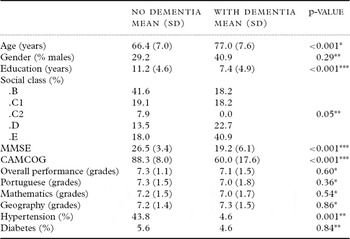
Of the 111 participants recruited, 22 were diagnosed with dementia while 89 had no mental disorder. Table 1 shows the sociodemographic characteristics of the 111 participants who were grouped according to whether they or not they had dementia. Overall, the group with dementia was older, with a higher proportion of males, fewer years of education and lower scores in the MMSE and the CAMCOG. With regard to education level, 73 completed primary school, whereas 26 and 11 finished the secondary and college education, respectively. The majority of participants in the dementia group were from social class E, whereas most participants in the non-dementia group belonged to the middle class.
Sociodemographic and clinical characteristics of the sample according to the presence of dementia (n = 111)

* t-Student test; ** chi-squared test; *** Mann-Whitney-U test.
The mean overall performance and the performance for each discipline did not differ between those with and without dementia. However, overall school performance over 7 was achieved by 68% of the subjects without dementia whereas 32% of the elderly with dementia performed likewise (p = 0.002). The proportions of subjects with and without dementia with scores above or below 7 in Portuguese (no dementia = 69.7%; dementia = 68.1; p = 0.89), mathematics (no dementia = 71.9%; dementia = 59.1; p = 0.24), and geography (no dementia = 74.2; dementia = 68.2; p = 0.57) were not significantly different.
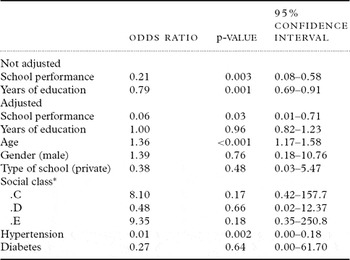
Table 2 presents the OR obtained in the multivariate analysis for years of education and school performance, respectively. A higher school performance decreases the chance of dementia by nearly 94% (OR = 0.06). Despite statistical significance, the magnitude of this reduction should be cautiously appraised because of its large confidence interval. We also observed a 21% reduction in the chance of having dementia for each additional year of education for the unadjusted odds ratio (OR = 0.79), although this effect was no longer valid when the adjusted model for potential confounders was applied. It is also worth mentioning that variables included in the final model in Table 2 were able to explain 60% of the variation in the dementia group (R2 = 0.60).
Odds ratios for dementia according to school performance and years of education: not adjusted and adjusted for gender, age, type of school, social class, hypertension, and diabetes (n = 111)

* class B used as reference.
As the level of education to which the performance (grades) is referred varied among the individuals, we decided to use this information to adjust the analysis. However, as this variable is highly correlated with years of education, we performed this analysis again replacing the latter by the former. The school performance remained as a protective factor for dementia (OR = 0.07; 95% CI = 0.01–0.85).
We then proceeded to investigate the specific role of Portuguese, mathematics, and geography on the risk of having dementia in late life. Although none of the disciplines was associated with a reduction in the chance of having dementia, we observed a trend for reducing this chance by 27% for each additional half point in mathematics when we omitted the adjustment for duration of education (OR = 0.73; 95% CI: 0.51–1.04; p = 0.08). Likewise, there was a 79% decreased risk of dementia when the cut-off score of 7 was used (OR = 0.21; 95% CI: 0.06–0.78; p = 0.02). In turn, each additional half point obtained in the Portuguese test reduced the chance of dementia by 28% (OR = 0.72; 95% CI: 0.52–0.99; p = 0.05), whereas geography showed no relation whatsoever. When these specific performances were analyzed using additional adjustment for social class, they were no longer significant.
Discussion
The present study shows that elderly people who have had higher educational attainment in childhood as measured by means above 7 in Portuguese, mathematics, and geography tests have a decreased chance of developing dementia independently of gender, age, years of education, social class, and health status. It is also noteworthy that each additional half point in the mathematics and Portuguese scores, but not in geography, produces a decreased chance of dementia, when the model is not controlled for years of study and social class.
Our study dovetails nicely wth the mounting evidence that lower education is a risk factor for having and developing dementia (Fritsch et al., Reference Fritsch, McCledom, Smyth and Ogrocki2002; Wight et al., Reference Wight, Aneshensel and Seeman2002; Lee et al., Reference Lee, Kawachi, Berkman and Grodstein2003; Dufouil et al., Reference Dufouil, Alpérovitch and Tzourio2003; Scarmeas et al., Reference Scarmeas, Albert, Manly and Stern2006). An interesting study on how years of formal education is an independent risk factor for delirium has provided a model for investigating the interaction of social and epidemiological factors and clinical and mechanistic variables to explain cognitive reserve, delirium and dementia (Jones et al., Reference Jones, Yang, Zhang, Kiely, Marcantonio and Inouye2006). There are in fact many questions to be answered in this field. To the best of our knowledge, ours is the first study in Latin America to investigate the impact of school performance in certain disciplines as a protective factor for dementia in the elderly. Most previous research has looked into the association between years of education and dementia prevalence, or years of education and cognitive decline in Alzheimer's disease (Scarmeas et al., Reference Scarmeas, Albert, Manly and Stern2006). Lower education has been identified as a direct risk factor for the rate of cognitive decline as measured by the MMSE. Fritsch et al., (Reference Fritsch, McCledom, Smyth and Ogrocki2002) observed that elderly people with more years of education showed a less pronounced decline than those with lower levels of education. This effect was not present when occupational status was the studied variable, leading the authors to the conclusion that early life and continuing education has a direct protective effect on cognition and dementia risk. Also, data from post-mortem brain studies have shown associations between duration of education with total brain weight and the absence of clinical symptoms of dementia at one year prior to death despite existing brain neurodegenerative lesions which would allow a diagnosis of dementia (Roe et al., Reference Roe, Xiong, Miller and Morris2007; Brayne et al., Reference Brayne2010). There are, however, some contradictory studies which show that there is a faster rate of cognitive decline in higher educated than in lower educated elderly people with incident Alzheimer's disease (Scarmeas et al., Reference Scarmeas, Albert, Manly and Stern2006), although the same cognitive reserve hypothesis is also put forward to explain these findings.
It is interesting to note that early life education has a marked effect on brain diseases and cognitive symptoms that can evolve in late life (Roe et al., Reference Roe, Xiong, Miller and Morris2007). Important large cohort studies have found that lower childhood mental abilities are predictive of mental decline and of dementia in middle and late life (Whalley et al., Reference Whalley, Starr, Athawes, Hunter, Pattie and Deary2000; Richards et al., Reference Richards, Shipley, Fuhrer and Wadsworth2004; Bourne et al., Reference Bourne, Fox, Deary and Whalley2007). Some biological risk factors and markers of neurodegenerative dementia may play an interacting role to explain the poorer performance of children who are at risk of developing dementia in late life. An interesting study has shown that children who possess both a positive family history for Alzheimer's disease and the ApoE-ε4 allele achieve lower scores on cognitive tests, especially in language and reading subtests and in the Rey Complex Figure Test (Bloss et al., Reference Bloss, Delis, Salmon and Bondi2008). The Nun study has also shown that those subjects with higher linguistic abilities in early adulthood were the ones who presented higher cognitive ability in later life and lower incidence of dementia (Snowdon et al., Reference Snowdon, Kemper, Mortimer, Greiner, Wekstein and Markesbery1996). Thus, although it is fair to say that aging is kinder to children with greater aptitude (Deary et al., Reference Deary, Starr and MacLennan1999) there may also be a possibility that active enforcement of these abilities through education may lead to protection from dementia in late life of the less able subjects.
Mastering language and developing mathematical abilities are important features of cognition which lead to better opportunities and quality of life over the coming years. So, a qualitative approach to assess school attainment rather than just ascertaining years of formal education may further distinguish those who are at risk of developing dementia, as found in our study. Grades in geography made no difference in our analysis, however. This might be explained by the fact that spatial resolution and formal knowledge of places and events are also related to mathematical features and to the mastering of the language. Also, it is possible that geography may exert a differential effect on higher levels of education, such as college and university courses.
This study has some limitations. First, the small sample size may be held responsible for some negative or marginal statistical results. In fact, some of the confidence intervals are rather large, and a larger sample is definitely needed in further studies. Second, it is possible that duration of education and school performance are associated with, or even due to, the intellectual abilities of children. In other words, our study cannot distinguish whether the better school attainment of the elderly who were found to have a lower risk of dementia is a consequence of higher intelligence (Pavlik et al., Reference Pavlik, Doody, Massman and Chan2006). However, one may argue that higher school performance is also an indirect measure of higher intelligence and overall capacities, rendering further support for the cognitive reserve theory. We also have not controlled for nutritional and socioeconomic deprivation in childhood. These factors might exert an impact on intelligence and cognitive attainment throughout life. Therefore, our findings should be viewed with caution with regard to the generalization to other populations. Also, special caution should be taken to evaluate the data on hypertension and diabetes in our study. First of all, we had more hypertensive participants in the non-dementia group. As this is certainly an unusual finding, we can presently only bring forward a hypothesis that this may have happened due to the self report of health problems in our study. It is reasonable to think that the participants without dementia have greater awareness of their health problems, whereas the subjects with dementia would not complain of many problems. One of the strengths of this study is that we have used a longitudinal design since we had documentation from childhood performance and of the present cognitive and overall status of the participants.
Brazil is now a middle income country with nearly 5 million lower educated elderly people (37% of the total elderly inhabitants) (Instituto Brasileiro de Geografia e Estatística, 2005). With the increasing aging trend of the Brazilian population, these figures pose a major threat to the organization of health services for the prevention and treatment of dementia. As stated by Brayne et al., (Reference Brayne2010), simple interventions in early life, such as improving the education of children, may have a profound impact on the risk of dementia. This study presents convincing data from a Latin American country that supports the view that education in early life should also be viewed as a health issue over the life course.
Conflict of interest
None.
Description of authors’ roles
A. Bezerra collected the data and drafted the paper. E. Coutinho carried out the statistical analysis and contributed to writing the paper. M. Barca, K. Engedal, and E. Engelhardt contributed to the interpretation of the data and assisted with writing the paper. J. Laks conceptualized the study, supervised the data collection and assisted in the drafting and editing of the paper.
Acknowledgments
The authors thank the Brazilian National Council of Research (CNPq) for supporting Jerson Laks and Evandro Coutinho.