Lower respiratory tract infections can cause severe morbidity and mortality in infancy. Respiratory syncytial virus infections are responsible for approximately 70–80% of lower respiratory tract infections in children aged <2 years.Reference Simoes1 There is no specific treatment for respiratory syncytial virus, and the efficacies of supportive medications which are widely used in the treatment of bronchiolitis are not proved.Reference Drysdale, Green and Sande2 Even previously healthy infants may develop severe disease with respiratory syncytial virus. In certain situations like prematurity, congenital heart disease (CHD), and bronchopulmonary dysplasia, patients are at high risk of respiratory syncytial virus infection.Reference Feltes, Cabalka and Meissner3 In these infants, respiratory syncytial virus infections are usually more serious, patients may require mechanical ventilation and longer hospitalisation, and mortality rates are higher.Reference Thorburn4
Palivizumab is a monoclonal antibody used for respiratory syncytial virus prophylaxis. Passive immunisation with palivizumab is recommended between October and March, in infants at risk of severe respiratory syncytial virus disease. Palivizumab has been shown to decrease the incidence of hospitalisation due to respiratory syncytial virus in these infants.5 Adherence to a monthly dosing regimen, both in timing and injection number, is essential to sustain therapeutic levels of palivizumab and maintain protective status. As the recommended dose is once a month for 5 months, some patients have difficulty in compliance.
We aimed to identify palivizumab compliance in CHD patients, factors affecting compliance, frequency of hospitalisations for lower respiratory tract infections, and microorganisms responsible for lower respiratory tract infections after palivizumab prophylaxis.
Methods
This is a retrospective, single-centre study enrolled in Hacettepe University Faculty of Medicine, Pediatric Cardiology Department, Ankara, Turkey. Between October 2015 and March 2017, in two consecutive respiratory syncytial virus seasons (seasons 1 and 2), palivizumab were prescribed in a total of 176 patients with CHD. We retrospectively searched palivizumab compliance through a special online prescription provision system of Social Security Institution in Turkey by patients’ citizenship number. We investigated how many palivizumab injections a patient had during the respiratory syncytial virus season (between October to March). The desired injection number was determined from the beginning of prescription of palivizumab, until February or March or until corrective surgery. A patient was considered compliant if he or she received all of the desired injections or ≥5 injections within the appropriate dosing intervals. We tried to contact all the patients’ relatives, face to face or by phone, and asked if the patient had any hospitalisation during this period. Special attention was given to patients who were hospitalised because of lower respiratory tract infections or sepsis during respiratory syncytial virus season. We investigated the microorganisms responsible for lower respiratory tract infections or sepsis after palivizumab prophylaxis. Although our hospital is a tertiary medical centre with patients from all over the country, most of our patients were from the same city.
Results
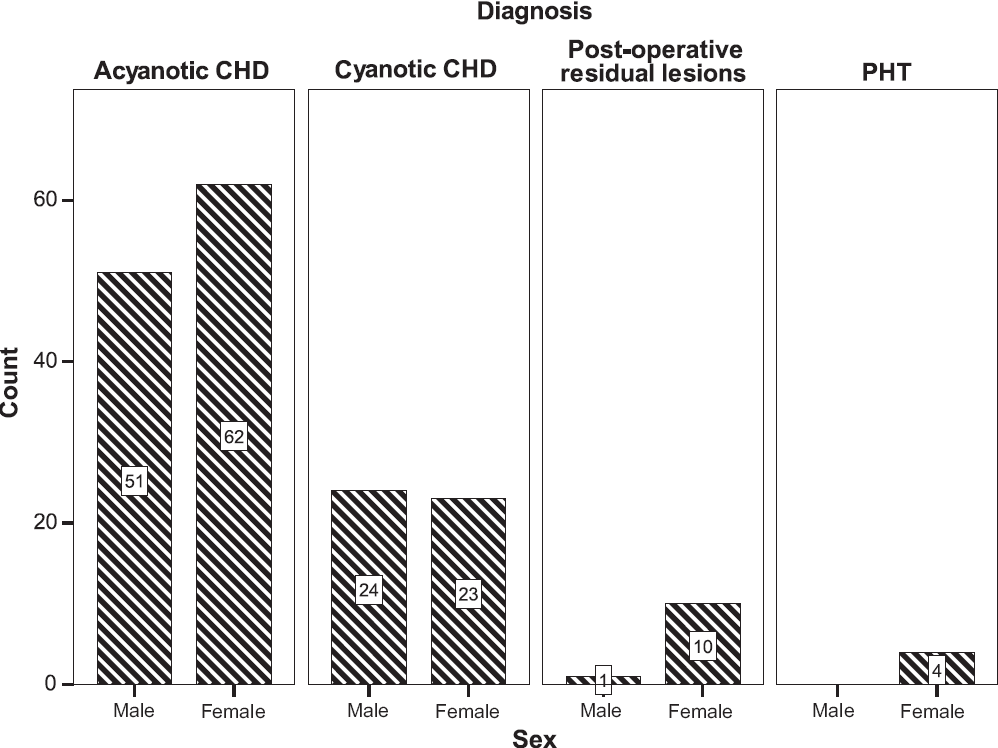
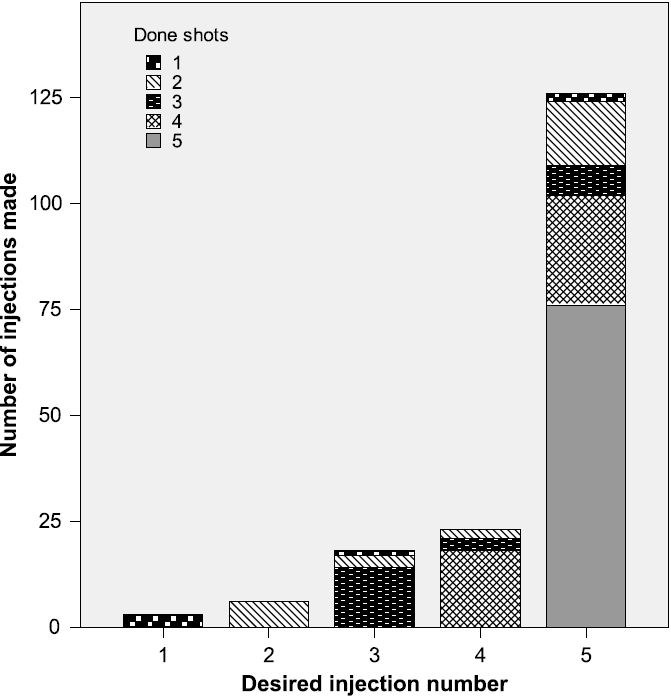
Between October 2015 and March 2017, in two consecutive respiratory syncytial virus seasons, palivizumab were prescribed in a total of 176 patients (100 female) with CHD. Out of these, 110 patients (62.5%) were less than 1 year old. The indications for palivizumab prophylaxis were left to right shunt acyanotic CHD in 64.8% of patients, cyanotic CHD in 26.7%, post-operative residual lesions in 6.3%, and pulmonary hypertension in 2.3% (Fig 1). In these patients, our total desired injection number was 791, and the number of injections patients had was 686 (86.7%); 117 patients (66.4%) received all the doses they were prescribed. Of the 126 patients who needed 5 doses, 76 patients (60.3%) received 5 doses and 26 patients received 4 doses. In patients who were prescribed 4 doses of palivizumab, 78.2% of the patients (18/23) received all the doses. The doses that the patients were prescribed and the patients’ palivizumab compliance are shown in Figure 2.
Diagnosis of the patients according to indications for palivizumab prophylaxis. PHT = pulmonary hypertension.

Compliance rates of patients with palivizumab.

When we compared the subgroups (acyanotic CHD or cyanotic CHD; patients <1year old or >1 year old; patients living in a big city or in suburb; first season or second season), no statistically significant differences were found with respect to compliance. Male patients had higher compliance with palivizumab than female patients but this was also statistically not significant (Table 1).
Comparison of factors related to compliance with palivizumab

CHD = congenital heart disease; vacc = vaccination; M = male; F = female.
In these two consecutive respiratory syncytial virus seasons, six patients had mortality – four patients died during the early post-operative period, one patient with primary pulmonary hypertension died due to pulmonary hypertension crisis, and one patient died because of sepsis and multi-organ failure. Human metapneumovirus was isolated in this patient. In case of these deceased patients, compliance for four was 100%, for one 80%, and for other one 60%.
Information about hospitalisation history was available in the remaining 143/170 patients (84.1%); 11 patients were hospitalised once and 2 patients were hospitalised twice because of lower respiratory tract infections during respiratory syncytial virus seasons. Of these 13 patients, compliance rates were 80% in one patient, 66% in one patient, and 100% in the others. During these hospitalisations, viral studies were performed in 6/15 occasions. Parainfluenza type 3 was detected in two patients, human metapneumovirus in one patient, and bocavirus in one patient; two viral studies were negative. One patient was diagnosed as aspiration pneumonia and the other as atypical pneumonia.
Discussion
The prevalence of hospitalisation for respiratory syncytial virus infection is highest in infants less than 6 months of age and decreases after 2 years of age.Reference Schanzer, Langley and Tam6 Furthermore, re-infections are frequent because previous infection with respiratory syncytial virus does not provide long-term immunity and can be severe despite antibodies from mother.Reference Glezen, Taber, Frank and Kasel7 Respiratory syncytial virus-associated bronchiolitis is more severe than other pathogens. Cyanotic or complicated CHD increases the severity of respiratory syncytial virus-associated lower respiratory tract infections.Reference Kimberlin, Brady, Jackson and Long8 The mortality rates associated with respiratory syncytial virus infection in CHD have been reported significantly higher than in infants without underlying diseases.Reference Resch and Michel-Behnke9 Palivizumab prophylaxis was recommended in children with CHD in the following conditions: children <2 years of age with un-operated haemodynamically significant CHD or children with cyanotic CHD or pulmonary hypertension, or symptomatic airway abnormalities; <1 year with cardiomyopathies requiring treatment; in the 1st year of life with surgically operated CHD with haemodynamically significant residual problems or aged 1–2 years up to 6 months post-operatively; and on heart transplant waiting lists or in their 1st year after heart transplant. The efficacy of palivizumab has been proved by several studies.Reference Simoes1,Reference Chang and Chen10 In our country, Özyurt et al found that palivizumab prophylaxis significantly decreased lower respiratory tract infections-related hospital admissions, lower respiratory tract infections-related hospitalisations, diagnosis of severe lower respiratory tract infections-related intensive care unit admissions, and mortality rates.Reference Ozyurt, Narin and Baykan11 In our study, 7.6% of the patients (11/143) who had palivizumab prophylaxis were hospitalised for lower respiratory tract infections; respiratory syncytial virus was not detected in viral studies performed in six patients. Our hospitalisation rates were also lower according to previous studies.Reference Ozyurt, Narin and Baykan11
Respiratory syncytial virus is a typically seasonal virus with outbreaks spanning from late autumn through early spring in temperate climates. In Turkey, the epidemic season is between November and March, with a peak between January and March, as shown by Turkish epidemiological studies.Reference Kanra, Tezcan and Yılmaz12,Reference Yurdakök13 Therefore palivizumab prophylaxis is recommended monthly between September or November until March, with five doses. Because palivizumab has a mean half-life of approximately 20 days, monthly injections are recommended during the respiratory syncytial virus season to maintain an effective serum concentration of 40 μg/ml.14 The most important factor for achieving effective protection is compliance of the family. There is no standardised definition of compliance or adherence.Reference Frogel, Stewart, Hoopes, Fernandes and Mahadevia15 In our study, we started to evaluate compliance from beginning of the first desired injection. The desired injection numbers were determined from beginning of the first desired injection month until February or March, or until corrective surgery, death or 2 years of age. Therefore, the compliance is the percentage of the shots done from determined doses. In our study, we found a high compliance rate (86.7%). In our study, 117 (66.4%) children had all their desired injections and 32 children (18.1%) had one less of their desired injections. In a review by Frogel et al, overall compliance rates varied between 25 and 100%.Reference Frogel, Stewart, Hoopes, Fernandes and Mahadevia15 The variations may be due to different calculation ways of compliance. In our country, Ozyurt et al found that 50.5% of the patients received the full dose.Reference Ozyurt, Narin and Baykan11 In our department, we explained the importance of compliance to the families with a great effort for awareness of severe disease risks and gave a card with simple descriptive written information. Frogel et al concluded that home health programmes also raises compliance rates.Reference Frogel, Stewart, Hoopes, Fernandes and Mahadevia15 Interview of our patients’ parents for the main reasons of non-compliance revealed that they had difficulty in accessing palivizumab because of socio-economic issues.
Compliance with palivizumab was higher in patients living in a big city than living in suburb. In addition, cyanotic patients and patients <1 year old were more compliant. However, these differences were not statistically significant. In our study, 24 patients were recommended palivizumab prophylaxis in two consecutive seasons. When we compared compliance with respect to seasons, patients were more compliant during the first season; however, this was also not statistically significant. Male patients had higher compliance than female patients, which can be explained by cultural issues but this was also statistically not significant. Although, there is no statistically significant difference between these five subgroups; the differences in the compliance rates may guide health professionals for higher patient compliance rates in the future.
Our study is unique in that this is the first study in our country which investigated palivizumab compliance in CHD patients and factors related to compliance. In literature, most of the studies concerning palivizumab adherence were based on information obtained from interviews with family members.Reference Frogel, Stewart, Hoopes, Fernandes and Mahadevia15,Reference Chan, Li, Paes, Abraha, Mitchell and Lanctôt16 In Canadian registry of palivizumab study, monthly interviews collected information on palivizumab administration and respiratory syncytial virus-associated outcomes.Reference Chan, Li, Paes, Abraha, Mitchell and Lanctôt16 In our opinion, information gathered from interviews may not be reliable and accurate. In addition, the researchers may bias the study results. Our study was not a questionnaire study; patients’ data were reached from an online system which contains more accurate data about immunisation.
It is not surprising that there may be some other viruses trying to sit the throne which respiratory syncytial virus has emptied with the use of palivizumab. In our study, there were six positive viral studies: parainfluenza type 3, human metapneumovirus, and bocavirus which are well-known viruses for lower respiratory tract infections. These viruses may be the next targets for CHD patients.
Conclusion
The efficacy of palivizumab to respiratory syncytial virus pneumonia has already been demonstrated by several studies. In our study, we emphasise that which patient groups we should give more importance in order to increase palivizumab compliance regardless of the questionnaires conducted with the parents. Patients with CHD can survive the period of infancy with less problem by making palivizumab prophylaxis more effective and awareness about non-respiratory syncytial virus factors may be a guide for the development of new treatments.
Acknowledgements
None.
Financial support
This research received no specific grant from any funding agency, commercial or not-for-profit sectors
Funding
This research received no specific grant from any funding agency, commercial or not-for-profit sectors.
Conflicts of Interest
The authors declare that they have no conflicts of interest with respect to this work.
Ethical standards
The authors assert that all procedures contributing to this work comply with the ethical standards of the relevant national guidelines on human experimentation and with the Helsinki Declaration of 1975, as revised in 2008, and has been approved by the institutional committees.