Introduction
Typologies of capitalist diversity have advanced well beyond classification to a focus on identifying causal connections. Analysing welfare and production regimes together suggests that it is possible and useful to combine theories of capitalist diversity. Specifically, a combination of the typologies by varieties of capitalism (Hall, Reference Hall, Beckert, Ebbinghaus, Hassel and Manow2006, Reference Hall, Hancké, Rhodes and Thatcher2007; Hall and Soskice, Reference Hall and Soskice2001b; Soskice, Reference Soskice, Hancké, Rhodes and Thatcher2007) and by Esping-Andersen's (Reference Esping-Andersen1990, Reference Esping-Andersen1999) welfare typology appears to be theoretically promising. This claim will be supported by statistical evidence and an assessment of existing typologies (Amable, Reference Amable2003; Boyer, Reference Boyer2004a, Reference Boyer2004b, Reference Boyer2004c), in which their different angles of analysis and their surprising degree of overlap in delineating ‘families of nations’ is highlighted. Not only is the argument made that we should integrate different typological approaches to get a full understanding of capitalist diversity in terms of arrangements for production and welfare distribution, but I also argue that the varieties of capitalism approach can benefit from explanations about the emergence of different welfare regimes and vice versa. In short, integrating insights from welfare typologies into the framework of varieties of capitalism suggests important questions concerning the shared common heritage of capitalist countries: a factor lately cited as key to understanding varieties of capitalism (Becker, Reference Becker2007; Hancké et al., Reference Hancké, Rhodes, Thatcher, Hancké, Rhodes and Thatcher2007). In turn, integrating insights from varieties of capitalism into welfare typologies can thus help us to understand the cultural framework in which welfare arrangements are operating. This is not to say that we should stop using typologies centred on isolated aspects of capitalism, such as welfare or production regimes.Footnote 1 If singular aspects of capitalist countries are to be analysed for their own sake, and in an isolated way, then the typologies we already possess are sufficient. However, if we want to understand capitalist diversity from a macro-historical perspective, then it is fruitful to integrate typologies along the lines that will be proposed here.
I will first show in what way varieties of capitalism (VOC) and Esping-Andersen's welfare state research (WSR) differ in their epistemological approach. That the integration of VOC and WSR is empirically justified will be shown in the section that follows. The article then highlights the ways in which some of the most important typologies can be combined. In the last section, I discuss the benefit of such a synthesis for the study of advanced economies, by hinting at hypotheses that a combination of the two approaches would allow for.
VOC and WSR – commonalities and differences
The most recent version of the varieties of capitalism approach, developed by Hall and Soskice (Hall, Reference Hall, Beckert, Ebbinghaus, Hassel and Manow2006, Reference Hall, Hancké, Rhodes and Thatcher2007; Hall and Soskice, Reference Hall, Soskice, Hall and Soskice2001a, Reference Hall and Soskice2001b; Soskice, Reference Soskice, Hancké, Rhodes and Thatcher2007), analyses how production takes place in two diametrically opposed institutional settings. The typology is essentially rooted in a functionalistic explanation of institutions: they are upheld as long as they support competitive advantage. By analysing the institutional fields of industrial relations, vocational training, corporate governance, corporate financing, inter-firm relations and relations of firms with employees, the authors establish a dualistic classification of ideal-typical production systems, which they name ‘coordinated’ and ‘liberal’ market economies. Whereas the allocative efficiency of the market is the all-pervasive advantage of the liberal regime type, the capacity to coordinate production strategically is the advantage of coordinated market economies.
Esping-Andersen's typology of welfare states (Reference Esping-Andersen1990, Reference Esping-Andersen1999; but also see Scharpf, Reference Scharpf1999; Scharpf and Schmidt, Reference Scharpf and Schmidt2000a, Reference Scharpf and Schmidt2000b) captures capitalist diversity from a very different angle, namely seeking to understand ‘under what conditions the class divisions and social inequalities produced under capitalism can be undone by parliamentary democracy’ (Esping-Andersen, Reference Esping-Andersen1990: 11). Consequently, Esping-Andersen's account of capitalist diversity relies not on functionalism but on a perspective rooted in class conflicts, with the key question centred on the manner in which various coalitions involving the working class led to the development of different welfare states (Esping-Andersen, Reference Esping-Andersen1990: 18). In Scandinavia, the working class was able to form a coalition with small, capital-intensive and politically well-organised farmers and then take the middle class on board by providing high-quality social services and public jobs. In Great Britain, where the middle classes could largely care for themselves on the market, the welfare state became residual in that it cared only for the poor. In continental Europe, labour-intensive large-scale farmers were already in a coalition with the conservatives to isolate the labour movement. The middle classes were tied to the state by a state-administered system of welfare benefits that functioned as insurance against social risks. So Esping-Andersen not only uses different variables and causal mechanisms than VOC, he also performs his analysis to distinguish welfare regimes with different indicators. Countries with social programmes providing high population coverage and homogeneity of benefits at a high level are seen as ‘social democratic’ welfare states. Those with the highest scores on private contribution to health and retirement schemes as well as the highest degree of means-tested welfare programmes are seen as ‘liberal’ welfare states. Countries with a ‘conservative’ welfare state score highest on segmentation of welfare programmes along occupational status lines. Esping-Andersen has somewhat refined and rearranged these classifications in later works, but the basic concept has remained the same (cf. 1990: 69–77 as opposed to 1999).Footnote 2
Whereas VOC wants to understand how firms deal with institutional environments that vary between production systems of different countries, Esping-Andersen analyses modes according to which welfare is distributed based on rights and duties of individuals vis-à-vis the state. Importantly, though, both typologies arrive at very similar country groupings, since ‘virtually all liberal market economies are accompanied by “liberal” welfare states’ (Hall and Soskice, Reference Hall, Soskice, Hall and Soskice2001a: 50) and all coordinated market economies are accompanied by either a social democratic or a conservative welfare arrangement.Footnote 3 These two typologies are the point of departure for the idea that I now wish to elaborate on.
To what extent can VOC and WSR be integrated?
Yet before any attempt to integrate Hall and Soskice's VOC and Esping-Andersen's WSR typologies can be made, we need to be sure that countries indeed group in families when their welfare and production regimes are analysed together. Why, in short, is it justified to speak of ‘families of nations’ at all? After all, there is a vast literature which argues against families of countries as the basis of typologies, be it because national arrangements are said to erode in the face of international homogenisation (Cerny, Reference Cerny, Crouch and Streeck1997; Cerny et al., Reference Cerny, Menz and Soederberg2005; Deeg and Jackson, Reference Deeg and Jackson2007: 154ff.), or because every country is argued to be a unique case (Crouch, Reference Crouch2005a, Reference Crouch2005b; Kasza, Reference Kasza2002), or because families of nations are different from what WSR or VOC propose (Deeg and Jackson, Reference Deeg and Jackson2006; Ferrera, Reference Ferrera1996; Leibfried, Reference Leibfried, Ferge and Kolberg1992; Lessenich, Reference Lessenich1994).
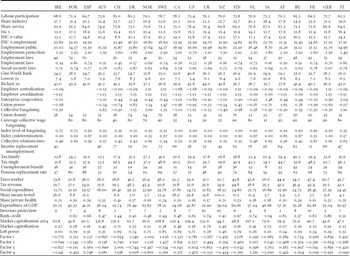
To illustrate that, in spite of these criticisms, empirical evidence suggests that it nonetheless makes sense to use typologies (and in this case to combine them), I will analyse indicators that reflect the welfare and production system of different countries. The indicators, which are shown in Tables 1 and 2, reflect the structure of labour markets (for example, participation rates, specialisation of the labour force, rigidity of labour market regulations), the financial system (for example, protection of investors, importance of the stock market, importance of bank credit), income distributions (Gini coefficient, comparison of the richest 10 per cent of the population to the poorest), industrial relations (for example, power of union and employer associations, coverage and strength of collective bargaining) and the form of the welfare state (for example, wage replacement rates, welfare expenditures). These are the main variables on which typologies of production and welfare regimes are based (cf. the indicators used in Esping-Andersen, Reference Esping-Andersen1990, Reference Esping-Andersen1999; Hall and Gingerich, Reference Hall and Gingerich2004; Hall and Soskice, Reference Hall, Soskice, Hall and Soskice2001a). It now remains to be seen if these indicators are systematically more similar between certain countries. It is conceivable, for example, that most countries with a strong union movement also have a more extensive welfare state and more organised wage bargaining. If this is the case, many of the variables will correlate.
Factor loadings for principal component analysis.

Note: 71 % of the variance of the dataset explained. All factor loadings below +/-, 5 are suppressed.
Data used for factor loadings in Table 1.

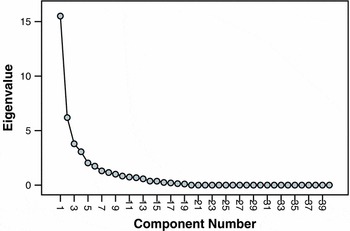
I will now test this claim using a principal component analysis:Footnote 4 a statistical data reduction tool used to develop condensed dimensions on the basis of the relational structure of a set of observed variables (for more details on this method, cf. Dunteman, Reference Dunteman1989; Jolliffe, Reference Jolliffe2002). If variables in the dataset do indeed correlate, a first factor will emerge that correlates with many of the variables. The remaining variables can then be loaded on a second factor, with each additional factor explaining somewhat less of the dataset. Thus, a principal component analysis necessarily has to make a compromise between parsimony (explaining many variables with few components) and accuracy (explaining as much of the variance within the dataset as possible). A ‘scree plot’ illustrates how each additional factor explains less variance than the preceding one. The sharp fall after the fourth factor in the scree plot (see Figure 1) suggests that four factors should be used for the analysis, as the use of more factors adds little accuracy while causing a sharp decrease in parsimony. The first of the four factors shows that organised industrial relations, a strong welfare state and evenly distributed income go together. The second factor displays indicators of the labour market and the power of left parties. The third factor is charged with indicators of the financial system, while the fourth factor mainly takes up variables of the health system. The four factors together explain 71 per cent of the variance within the dataset.
Scree plot for factor loadings.

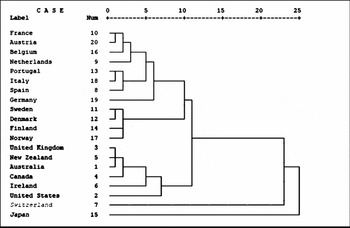
In the next step, these factors are subjected to a hierarchical cluster analysis that checks whether some of the countries systematically have values that are close to each other. After having calculated a hierarchical cluster analysis on these factors, I plotted its results in a so-called dendogram (see Figure 2).Footnote 5 Expressing the proximity of the factors graphically gives a visual measure of whether and to what degree countries can be grouped in families of nations.
Dendogram of hierarchical cluster analysis.

We can see that, judging from a quantitative analysis of empirical indicators that reflect countries' welfare and production regimes, some countries are closer to each other than others. Based on this method, we can state that some countries' welfare and production regimes combined are remarkably similar within certain families of nations. The way that countries group into distinct families of nations confirms the original typologies by Esping-Andersen and Hall and Soskice; it also suggests that the two typologies show potential for being combined. On the one side, we can see Esping-Andersen's familiar clustering of countries in an Anglo-American, Scandinavian and continental European variety, whereas Switzerland and Japan do not belong to any specific group. We also see that the group of Scandinavian countries stand, together with the group of Continental European countries, against the Anglo-American ones, which reflects the distinction by Hall and Soskice (Reference Hall and Soskice2001b) between coordinated and liberal market economies.
Nevertheless, caution has to be exercised in this sort of empirical undertaking. First, the data used are somewhat historical and might not reflect newest developments. Also, using slightly different variables and methods of calculation for the factor analysis, the Mediterranean countries and Finland end up in separate subgroups. Other potential outliers are Norway, Ireland and Great Britain. However, there are also a number of recurring groupings that are relatively robust, even when adding or leaving out individual indicators and altering the methods of calculating the components and clusters. This provides evidence that differences between and similarities within regimes are somewhat robust. Thus, the existence of a distinct Anglo-American cluster was usually confirmed. In addition, a further stable result is that Switzerland and Japan usually formed separate clusters. Overall, the continental European cluster was most often the one that could be divided into subgroups, which is interesting, because, as we will see later, this is what is usually done by different typologies on capitalist diversity.
The foregoing analysis is not at odds with Crouch's (Reference Crouch2005a) claim that every country is to a certain degree unique in its socio-economic configuration, a claim that has also been validated by case studies of single countries (Crouch and Streeck, Reference Crouch and Streeck1997; Scharpf and Schmidt, Reference Scharpf and Schmidt2000a, Reference Scharpf and Schmidt2000b). Also, the results corroborate Crouch's forceful critique against the VOC approach, that one should not conflate ideal typical models with national cases (cf. Becker, Reference Becker2007: 265). Yet the approach adopted here allows us to argue that some countries, when analysed quantitatively, are more similar than others and that these cases group in families of nations that are similar to those proposed by both typologies of production and welfare arrangements. However, given the limitations of the empirical analysis performed above, the next section advances a similar argument based on the literature on capitalist diversity.
Typologies and their congruence
Apart from the typologies based on modes of distribution of welfare from Esping-Andersen (Reference Esping-Andersen1990, Reference Esping-Andersen1999) and based on production from Hall and Soskice (Hall, Reference Hall, Beckert, Ebbinghaus, Hassel and Manow2006, Reference Hall, Hancké, Rhodes and Thatcher2007; Hall and Soskice, Reference Hall, Soskice, Hall and Soskice2001a; Soskice, Reference Soskice, Hancké, Rhodes and Thatcher2007), there are a number of typologies on capitalist diversity that use different approaches, yet come to similar conclusions: notably that of Robert Boyer (Reference Boyer2004a, Reference Boyer2004b, Reference Boyer2004c), which is rooted in the tradition of the ‘regulation theory’, and that of Bruno Amable (Reference Amable2003), who utilises an empirical approach like the one used above, yet in a much more comprehensive way. I will briefly outline these here, to show to what extent they would support the proposed integration of VOC and WSR.Footnote 6
Robert Boyer (Reference Boyer2004a, Reference Boyer2004b, Reference Boyer2004c), arguably the most prominent proponent of the French ‘regulation school’, proposes a typology based on different regulation regimes that come along with historically different ‘growth trajectories’ of countries. Following the tradition of the regulation school, Boyer sees capitalism as inherently unstable and analyses institutions that deal with this instability. Boyer's typology is based on five institutional domains: the wage–labour nexus, forms of competition, the monetary regime, state–economy relations and international trade embeddedness (Boyer, Reference Boyer2004a: 13, 21). With these aspects, partly similar to those of VOC and WSR, Boyer arrives at a typology that relies on four regime types. Apart from a market-based capitalism, Boyer not only sees a social democratic alternative, but also a state-coordinated continental European form of capitalism and an Asian ‘meso-corporatist’ variety.
Amable (Reference Amable2003) takes yet another approach to map out capitalist diversity, building a typology based on a quantitative assessment using a principal component and cluster analysis of five institutional domains. The domains examined are product market competition, the wage–labour nexus and labour market institutions, the financial sector and corporate governance, social protection and the welfare state, and the education sector (Amable, Reference Amable2003: 14). Using multiple indicators in each domain, Amable performs an analysis separately for each domain, employing the same method as used in the foregoing section in a more elaborate form. What distinguishes Amable's analysis from other approaches is that he refrains from forming any country groupings ad hoc or on theoretical grounds; he instead performs his statistical analysis with an open outcome and then builds his families of nations on it. Thus, what he does is the opposite of what Hall and Soskice do by conflating countries to ideal types and aligning all other countries on a scale between these two types (cf. this critique Crouch, Reference Crouch2005b). Nonetheless, the analysis largely reproduces the outcome of existing typologies, but with a greater degree of precision as seen in the addition of types similar to the ones that Boyer proposed and an additional Mediterranean variety of capitalism, which has also been proposed by scholars of welfare state research as a possible extension of Esping-Andersen's typology (Ferrera, Reference Ferrera1996; Leibfried, Reference Leibfried, Ferge and Kolberg1992; Lessenich, Reference Lessenich1994).
The common picture behind different typologies
To sum up, Hall and Soskice's perspective on VOC highlights two ideal-typical ways to organise capitalist production, which has implications for competitiveness in certain sectors. Esping-Andersen instead stresses that the distribution of social rights follows at least three distinct patterns. Boyer highlights how countries, understood as accumulation regimes, use a variety of regulatory institutions to deal with the instability of capitalism, leading to four regime types. Amable instead performs a strictly quantitative and open outcome analysis with a wide range of statistical indicators. The crucial point is that even though all these approaches analyse capitalist diversity from a distinct angle, they nonetheless arrive at broadly similar classifications of countries, which are compatible to the welfare typology proposed by Esping-Andersen. This is the crucial point that should be highlighted here.
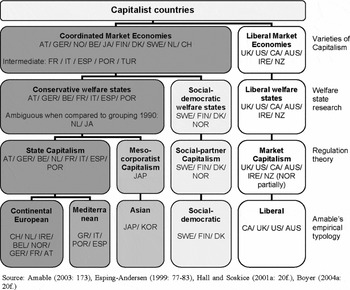
To the degree that they have analysed them, all authors see the United States, the United Kingdom, New Zealand, Australia, Ireland and Canada as pertaining to a liberal or market-based regime. The only difference between the typologies is how many other regimes are distinguished from this. The most parsimonious classification is that of VOC, which takes Austria, Germany, Belgium, the Netherlands, Switzerland, Sweden, Denmark, Norway, Finland and Japan and labels these coordinated market economies. Esping-Andersen's (Reference Esping-Andersen1999) typology then splits Sweden, Denmark, Norway and Finland out of the group of coordinated market economies and calls these the social democratic regimes, whereas other countries of the group of coordinated market economies and some of the ambiguous cases in VOC are seen as conservative welfare states. However, Esping-Andersen (cf. Reference Esping-Andersen1999) is not certain about where to place the Netherlands and Japan. Taking Japan out of the group of coordinated conservative countries yields Boyer's (Reference Boyer2004a) typology, with an additional variety that he labels meso-corporatist, essentially establishing a new model for Japan. The remaining countries (the group of conservative or coordinated market economies) are subsumed under the label of ‘state capitalism’ in his typology. However, Boyer sees Norway as partially belonging to the liberal cluster. Amable (Reference Amable2003) then simply adds a (fifth) Mediterranean capitalism by splitting Spain, Italy, Portugal and Greece out of the model of state capitalism, and distinguishes these countries from continental European capitalism, but also mentions that Switzerland as well as Norway might require a sixth type of capitalism (Reference Amable2003: 172). This might sound quite complicated, yet the ensuing scheme is as simple as Figure 3 portrays.
Typologies and their congruence.

Therefore, even though different typologies propose a varying number of families of nations, based on different approaches to analyse capitalist diversity, the outcomes are ‘nested’ within each other, related like the famous Russian matryoshka dolls. In this sense, if the category of coordinated market economies is opened, we find in it countries that have this form of production system flanked by conservative or social democratic welfare arrangements. Again, this is not to argue that conservative and social democratic welfare states are the same. It also does not imply that, for example, there is no difference between state capitalism and meso-corporatist capitalism, only because both are seen to have a conservative welfare state and are coordinated market economies. Instead, the foregoing analysis suggests that integrating VOC with a perspective based on welfare regimes is a fruitful enterprise for the reasons given below.
The added value of adding typologies: the utility of a vertical perspective
Even if, as I have argued, we can integrate typologies of production and welfare regimes, the question remains why this should be done. First, as a rather fundamental answer to this, it can be argued that an approach that labels itself varieties of capitalism (and not varieties of production systems), should analyse complete capitalist configurations, of which welfare arrangements are an integral part and not only an appendix to the way production is organised (cf. Estevez-Abe et al., Reference Estevez-Abe, Iversen, Soskice, Hall and Soskice2001). Second, examining similarities associated with the vertical dimension of Figure 3, it becomes apparent that these have largely been overlooked as research has concentrated on differences on the horizontal level. Questions associated with this line of research consisted in asking how many forms of production systems or welfare states could be discerned. Indeed, if production systems or welfare arrangements are to be studied in isolation, one should keep typologies separated for this purpose. Yet it is where the aspects of welfare and production intersect that a vertical approach to analysing capitalisms can be useful. Because after having established that welfare and production systems covary, we can pose the important question as to why this is the case. Maybe certain welfare and production arrangements cause each other, or maybe an underlying third variable has an influence that aligns them. I will briefly touch on both debates to show how the approach that this article advocates can contribute to them.
One current debate centres on the question of whether capitalist configurations have emerged through (and rely on) class struggles, or whether they can survive because they inhibit complementarity. Whereas the first position is the power resource approach used in the literature on welfare states and represented by the work by Gøsta Esping-Andersen's (Reference Esping-Andersen1990, Reference Esping-Andersen1999) and Walter Korpi (Reference Korpi1985, Reference Korpi2006), the second position is one of the foundations of the VOC school (Mares, Reference Mares, Hall and Soskice2001a, Reference Mares, Ebbinghaus and Manow2001b; Soskice and Iversen, Reference Soskice and Iversen2001; Swenson, Reference Swenson2002). Tracing up and down the rightmost vertical column of Figure 3 indicates that all approaches include a liberal model. Nevertheless, as just mentioned, they each have a distinct take on why that model evolved, what its core elements are, and what the causal processes that perpetuate the model are. In addition, the liberal model is quite stable, whereas the non-liberal models can be split into a number of subgroups, depending on the specific angle from which capitalist diversity is analysed. We might therefore start to wonder how the different non-liberal capitalisms relate to each other on the vertical line: for example, in what way are the social democratic and the conservative welfare states different in their mode of coordination of production? Overall, the relationships highlighted by the vertical dimension of Figure 3 suggest a number of puzzles that demand further examination, and suggest that combining VOC and WSR research into an overall typology may offer additional leverage in explaining these dimensions of complementarities. A first step in answering these questions has been taken by the literature stressing complementarity between liberal welfare states and production regimes, as well as coordinated production regimes and more extensive welfare states (Ebbinghaus, Reference Ebbinghaus, Ebbinghaus and Manow2001; Estevez-Abe et al., Reference Estevez-Abe, Iversen, Soskice, Hall and Soskice2001; King and Wood, Reference King, Wood, Kitschelt, Lange, Marks and Stephens1999; Manow, Reference Manow, Ebbinghaus and Manow2001a, Reference Manow and Pierson2001b; Mares, Reference Mares, Hall and Soskice2001a, Reference Mares, Ebbinghaus and Manow2001b; Soskice and Iversen, Reference Soskice and Iversen2001; Swenson, Reference Swenson2002; Vogel, Reference Vogel2001; Wood, Reference Wood and Pierson2001). The most important but hitherto unconnected explanations why strong welfare states and coordinated production systems support each other are the following.
If welfare benefits exceed a minimum level, then the question arises who should profit and how. Trade unions have a privileged position to acquire information on workers; they are therefore apt to administer extensive welfare schemes. In order to do so, however, they need to be organised. If organisation of trade unions occurs, this can then lead to a similar coordination of employers' organisations. The associational structure that is necessary to coordinate an economy can therefore be induced by extensive welfare arrangements (cf. Manow, Reference Manow, Ebbinghaus and Manow2001a, Reference Manow and Pierson2001b). Accordingly, there is a negative correlation (r = −0.713) between the power of a trade union in a country and the degree to which the welfare state of that country is liberal.Footnote 7
Once an organised labour movement is employed to govern a production system, it may use this privileged position to push further towards a welfare state that conforms to its aims, and in times of financial austerity it may veto its retrenchment. To the degree that welfare arrangements are seen to support competitive advantage, business associations can do the same (cf. Mares, Reference Mares, Hall and Soskice2001a, Reference Mares, Ebbinghaus and Manow2001b).
High and uniform social benefits by the welfare state make it easier for companies to cooperate, as poaching by company-centred welfare schemes becomes more difficult when these are dwarfed by public benefits. An extensive welfare state can thus level the ground for coordination between companies (cf. Martin and Swank, Reference Martin and Swank2001; Swenson, Reference Swenson2002; Thelen, Reference Thelen, Iversen, Pontusson and Soskice2000). Accordingly, the degree to which labour is ‘decommodified’ correlates with the coordination of the economy in different countries (r = 0.683).Footnote 8
Equity-based pension systems and a rich top income stratum increase investments in stock markets. The stock market offers firms capital if these adopt a shareholder value-oriented form of corporate governance that is characteristic of liberal market economies. Therefore, corporate financing, an important aspect of the way production systems work, can be a function of the stratification and pension system of a society, which is part of welfare arrangements (cf. Deeg and Jackson, Reference Deeg and Jackson2006; Vitols, Reference Vitols, Streeck and Yamamura2001).
Employees may be prevented from learning highly specific skills as these confine their employability to certain firms or industries. Yet specialised skills are important for coordinated market economies. Generous wage replacement rates are offered by conservative and social democratic welfare states as incentives for the acquisition of specific skills, thus providing a functional equivalent for lost income in case of layoffs. Skills, which determine what production system a country can develop, therefore depend on welfare arrangements (cf. Iversen and Soskice, Reference Iversen and Soskice2006; Soskice and Iversen, Reference Soskice and Iversen2001). Accordingly, the strength of employment protection rules of countries is correlated with the degree to which the respective economies are coordinated (r = 0.751).Footnote 9
A welfare state that promotes inflexible labour market arrangements can induce a preference for long-term contracts. This renders investments in skills more rational and allows an economy to embark on a high skill/high wage equilibrium, which is characteristic of coordinated market economies. In turn, it deprives liberal market economies of the flexibility that they need (cf. Estevez-Abe et al., Reference Estevez-Abe, Iversen, Soskice, Hall and Soskice2001; Wood, Reference Wood and Pierson2001).
Generous pre-retirement programmes allow employee layoffs without violating loyalty necessary for the trust-based relationship between management and workforce that is needed in production modes with a longer time horizon. Extensive pre-retirement programmes as part of the welfare state therefore support the functioning of coordinated market economies (cf. Ebbinghaus, Reference Ebbinghaus, Ebbinghaus and Manow2001; Hall, Reference Hall and Bermeo2001). Accordingly, the pension replacement rate of countries correlates with the degree to which the respective economies are coordinated (r = 0.713).Footnote 10
The high costs imposed on production systems within the social democratic and conservative welfare states lead to pressure to specialise in highly profitable production techniques, which usually entail more coordination than mass production. Conversely, they rule out arrangements that rely on cheap and/or flexible labour. A costly welfare state thus promotes coordinated production systems and impedes liberal ones. Accordingly, there is a correlation between the public social expenditure of countries and the coordination of their respective economies (r = 0.644).Footnote 11
This list should show the fruitfulness of combining WSR and VOC by making it possible to connect the as yet unconnected aspects mentioned above. So not only can there be complementarity (or dysfunctionality) within the production system, as has been stressed in the literature on production regimes, but this complementarity may also exist between the production system and welfare arrangements. This combination of causal links between production and welfare arrangements is of obvious relevance to social policy-makers. By focusing on causal links between the two domains, it must be taken into account that changes in social policy also affect the production system and vice versa.
A combination of VOC and WSR is also helpful because VOC increasingly needs the conflict-based perspective on which the analysis of welfare regimes is built. The most recent contributions to VOC urge us to ‘consider the origins of different forms of coordination and different models of capitalism . . . by examining the cross-class coalitions that underpin the different modes of coordination’ (Hancké et al., Reference Hancké, Rhodes, Thatcher, Hancké, Rhodes and Thatcher2007: 37). Wondering where the production arrangements that distinguish VOC came from, Becker mentions that
[f]unctionality (which is a more appropriate term than complementarity) in a political economy is related to a reference frame of which competitiveness is only one, though existential, goal. A reference frame is comprised of existential as well as historically evolved but contested, political goals such as (more) income equality, welfare for everybody, participatory rights and environmental protection. (Becker, Reference Becker2007: 280)
Thus, if certain conceptions of social justice prevail in a given country or in a number of countries, then it should come as no surprise if these conceptions not only permeate welfare but also production regimes, transcending both spheres through attention to the conflicts surrounding the labour movement. In this perspective, class coalitions that forged welfare arrangements might also have forged production arrangements according to similar conceptions, thus linking certain welfare arrangements to certain production arrangements. However, on a more fundamental level, certain ‘conceptions’ that we might call cultural-historical ideas may have shaped what is seen as appropriate and legitimate in terms of welfare state and production regime organisation, and thus in turn have shaped the goals and strategies of class coalitions.
Discussion
In this regard, Fligstein's (Reference Fligstein2001) notion of ‘conceptions of control’ offers one route to extend the analysis of production arrangements to social policy. According to Fligstein, conceptions of control provide actors with a conception about how a particular market should be organised. The innovation would be to see conceptions of control not only as pertaining to specific markets, but also to the way production and welfare arrangements are organised writ large. In other words, if Max Weber (Reference Weber1988 [1904]) was right and a certain culture has given birth to capitalism, could it not also be possible that similarities in culture within families of nations have caused welfare and production arrangements to align to similar principles in these? Not only has a certain culture brought about capitalism, it is also responsible for different capitalisms and the similarity between welfare and production regimes within a certain capitalism. Culturally influenced ideas towards a certain economic policy, so the argument would go, might penetrate to welfare arrangements, which is why these covary. In that sense, differences in culture between families of nations explain why other families of nations show different elective affinities between welfare and production systems. For example, Frank Dobbin argued in his seminal work on industrial policy that certain national traditions, namely those that prevailed in organising political life, later came to shape industrial policy (Dobbin, Reference Dobbin1994: 2).Footnote 12 Therefore, in France, the state took over central planning of the railway system. Contrary to that, in the United States, industrial policy consisted mainly of ensuring well-functioning markets without the domination of particular actors, whereas, in Britain, entrepreneurs were enabled to shape markets. This is because Britain and the United States saw ‘economic self-determination as integral to economic order’ (Dobbin, Reference Dobbin1994: 20). To the degree that these liberal conceptions of how an economy has to be run were a ‘hegemonic belief system’ (Lehmbruch, Reference Lehmbruch, Streeck and Yamamura2001: 41), should it not come as a surprise if the welfare system turned out to be shaped by completely contrarian values? The mechanism here might be that when faced with challenges, actors look back in their history to what has worked and apply those principles to a new domain. It might therefore be more than a coincidence that, in the US, the welfare system is largely built on the same principles as the production system: a market on which people can assure their well-being by contracting. Contrary to that, in France, confidence towards the state is not only put forward in the organisation of production, but also in the management of welfare arrangements. In Britain, not only are companies shielded so that they can survive in markets, but social policy under the label of a ‘third way’ takes a similar approach in welfare arrangements, by trying to give people what it takes to survive in markets instead of providing long-term transfer income. In Germany, in turn, a perception of markets as inherently unstable could have established a preference for institutions that stabilised the economy (Lehmbruch, Reference Lehmbruch, Streeck and Yamamura2001) and a preference for a welfare system that provides long-term stability by status-stabilising wage conservation. In the Scandinavian countries, a general mindset seems to have been acquired that redistribution and market success can entail rather than mutually prevent each other, by economy-wide concertation and an extensive welfare system (Rothstein, Reference Rothstein1998). These cultural conceptions do not single-handedly influence welfare/production constellations, but do shape how social policy-makers think about challenge, crisis and change, meaning certain options are automatically off the table and others are seen to be more legitimate. That still leaves a range for choice (agency), such that the regimes are neither culturally nor institutionally pre-determined.
It implies, however, that a general mindset concerning the efficiency and equitability of state intervention, markets, firms and other governance modes not only influences industrial policy. Instead, to the degree that industrial and welfare policy are products of the same ‘hegemonic belief systems’ (Lehmbruch, Reference Lehmbruch, Streeck and Yamamura2001: 41) of countries and families of nations, it can also be the underlying reason for elective affinities between welfare and production policies. It is important to avoid the trap of cultural determinism, however. Beliefs about how a production and welfare system should be run are not carved in stone. Rather, the perspective advocated here is intended to open the door to new questions about how interests, ideas and institutions in the sphere of production have had an influence on the sphere of welfare and vice versa.
Conclusion
In this article, I have argued that typologies on modes of production and welfare arrangements can be combined, as families of nations that the two approaches discern are nested in each other. The systematic occurrence of certain welfare with certain production regimes forces us to take into account how welfare and production regimes systematically reinforce each other's mode of functioning in the form of complementarities. By analysing the ‘vertical dimension’ of different regime types, we can ask additional questions which seldom have been posed up to now. The most important issue is whether there are ‘hegemonic belief systems’ that not only influence production, but also welfare arrangements and thereby align these to similar principles, causing them to covary.
In following this path, this article has used a variety of methods, since the documentation of similar production/distribution regimes can rely on quantitative data, while their explanation calls for qualitative in-depth studies of political culture that might unearth explanations of homogeneity of production and welfare regimes. For this latter part, however, this article could only have been a starting ground.
However, if production and welfare arrangements are intertwined, as mentioned above, social policy-makers and analysts may better understand the principles underlying social policy if they look at the principles underlying production regimes. Thus, the legitimacy and efficiency of social policy cannot be judged without reference to the broader social system in which it is embedded.
Acknowledgements
This article has greatly benefited from discussions with and comments by Aaron Boesenecker, Martin Höpner, Philipp Klages, Patrick LeGalès, Tobias Lenz, Mark Lutter, Vivien Schmidt, Wolfgang Streeck and Helmut Voelzkow, as well as from the editors and two anonymous reviewers. All remaining errors are in the sole responsibility of the author.