


Introduction
Division of labour is ubiquitous among humans, more so (and more baroque) than among any of our relatives on the evolutionary tree. A surgical team performs an operation; a firm manufactures an automobile; a market supplies food, shelter, and so much else to millions of unrelated strangers; and a caste society assigns occupations by birth. The result in each case is that work that might in principle have been performed by a single agent (given enough energy reserves, resources, ingenuity, and life) is distributed among many, and the distributed activities must somehow be coordinated to produce a coherent outcome. The division of labour is thus the basic structural feature of social life, creating both opportunities for leverage of resources and for exploitation of the spoils that flow from it – opportunities impossible without it.
Yet for all the attention the division of labour has received, we still are not in possession of a principled taxonomy – an account of the dimensions along which the possible schemes of division-cum-coordination vary, one that locates the surgical team and the caste order in relation to the firm and the market. The gap runs through the social sciences but is sharpest where the disputes are most developed, in the study of institutions: economists dispute when coordination is best lodged within the firm or left to the market (Coase, Reference Coase1937; Williamson, Reference Williamson1985), while a parallel debate concerns whether institutions are at bottom systems of rules or equilibria of behaviour (Hindriks and Guala, Reference Hindriks and Guala2015; Hodgson, Reference Hodgson2015; Schotter, Reference Schotter1981). These disputes inevitably turn on prior structural questions: what kind of unit bears a differentiated assignment of labour, and how is the labour of making differentiated contributions cohere, itself distributed? A taxonomy answering those questions does not replace economic explanation of why one arrangement rather than another arises or persists. It organizes the geography of alternatives over which such explanations range, granting a perspective from which to contrast competing explanations of how particular arrangements can emerge.
We will build our preferred taxonomy around a single important observation, leading to what we will call the principle of placement: coordinating divided labour is itself labour, and the labour of coordination – which we will call coordinative labour – can accordingly be divided and distributed. Coordinative labour may remain distributed among the parties whose activities are coordinated, may be differentiated from the first-order labour and assigned to a specific entity (an individual, office, or organization) tasked with coordinating, or may be scattered through a wider field–diffuse over signals, practices, expectations, and arrangements of the most obscure origins. These placements define three broad families of integration, across which this paper identifies six distinct mechanisms. Because the labour of maintaining and/or revising a coordination scheme – yet another sort of labour, distinct from first-order labour and ordinary coordinative labour – can itself be seated in a variety of different sites, the same principle also illuminates the difference between rule by an entity or office, set over against the rest, and civic forms in which vigilance over the terms of coordination remains with the governed.
The next section surveys existing accounts and their limits. The subsequent two sections build the two axes of the taxonomy – first, the unit of differentiated assignment, then the placement and mechanisms of integration, while also distinguishing ongoing coordinative labour from vigilance and revising labour. The essay then turns from taxonomy to selection, persistence, and change: the taxonomy identifies the alternatives and their characteristic requirements and vulnerabilities, while comparative gains, coordination costs, and other institutional conditions explain why arrangements are selected, persist, or change. The conclusion subsequently draws together observations on the reach of the principle of placement.
Competing accounts and their limits
A general taxonomy of the division of labour might perform three labours that existing work has undertaken only piecemeal. It might aim to (1) identify the social units on which differentiated assignments of labour land; (2) identify how the coordinative labour that makes those differentiated contributions cohere is itself distributed, as well as locate the mechanisms operating there; and (3) connect those structural elements to explanations of economic change over time. A taxonomy that performs all three tasks within a common framework would be a genuine advance. The theoretical materials are abundant but dispersed: the classical tradition, contemporary social sciences, and contemporary philosophy supply rich analyses of differentiation and integration, but these have yet to be brought together within a common framework that allows each contribution to co-articulate with the others.
The classical tradition offers penetrating analyses of division and its coordinating conditions, without systematically distinguishing the dimensions along which schemes vary. Smith (Reference Smith1776, Book I, chs. 1–2) focuses on the division of labour as the engine of productivity, examining both differentiation within the workshop and specialization among occupations connected through exchange. He traces its emergence to the propensity to exchange, deriving (he speculates) from the faculties of reason and speech. Marx (Reference Marx1844, Reference Marx1867) separates the workshop, organized hiearchically, from society, coordinated by market competition; he embeds it, though, in a theory of capitalist exploitation that does not travel to the plantation, the estate, or the guild; and there is no coordination among these diverse sites. Durkheim (Reference Durkheim1893) treats differentiation as a source of solidarity rather than productivity, distinguishing cohesion by resemblance from cohesion by interdependence, yet slides between workshop and society as though one logic of differentiation governed all forms of division. Weber (Reference Weber1922) establishes the paradigm of role differentiation in the standing bureaucratic office, defined by position rather than the occupant’s tasks, but calibrates the analysis to that single modern form. These accounts supply resources for the present taxonomy; the task remains to distinguish systematically the units of differentiation and the placements and mechanisms of coordination, so that diverse schemes can be compared within a common framework.
A second locus of investigation is integration, how an arrangement is made to cohere. Economics reads it as a matter of efficiency and locates it at the boundary of the firm: building on the Smithian line that Becker and Murphy (Reference Becker and Murphy1992) and Stigler (Reference Stigler1951) extended, Coase (Reference Coase1937) identifies the cost of using the market – later theorized as transaction cost – that explains why some activity is coordinated within a firm rather than across a market; Williamson (Reference Williamson1975, Reference Williamson1985) develops this into a general account of when a firm’s own hierarchy, a market, or a hybrid of the two coordinates efficiently, Langlois (Reference Langlois2003) traces how that boundary shifts over historical time, and Simon (Reference Simon1951) models the employment relation as the acceptance of direction within an area of acceptance. The boundary they draw, between coordination lodged within an organization and coordination left to the market, is one contrast the present taxonomy will recover (see the section The second axis: integration), but economics theorizes it wholly within an efficiency frame.
Recent economic analysis pushes the questions concerning boundaries inside firms and down to tasks. Bloom et al. (Reference Bloom, Garicano, Sadun and Van Reenen2014) and Garicano (Reference Garicano2000) connect organizational design to the costs of acquiring and communicating knowledge; task-based labour economics treats technological change as reallocating work within and across occupations (Acemoglu and Autor, Reference Acemoglu, Autor, Ashenfelter and Card2011; Acemoglu and Restrepo, Reference Acemoglu and Restrepo2019; Autor et al., Reference Autor, Chin, Salomons and Seegmiller2024). The judgement-based entrepreneurship literature is concerned with how entrepreneurs exercise judgement under uncertainty by owning, controlling, combining, and deploying heterogeneous assets (Foss and Klein, Reference Foss and Klein2015). These supply mechanisms of selection and change rather than categories of labour division. Their explanatory contributions will become more illuminating once we have a principled account of the geography of division-cum-integration schemes, which allows us to distinguish different sorts of movement across it (see the section Selection, persistence, and change).
A third body of work, largely in sociology, takes up dynamics, how a form reproduces or decays once it is in place. Abbott (Reference Abbott1988) recasts the professions as a competitive ecology of jurisdictions rather than a fixed set of roles; DiMaggio and Powell (Reference DiMaggio and Powell1983) show that organizations conform to institutional templates sustained at the scale of the field; Tilly (Reference Tilly1998) traces durable inequality to organizations importing ready-made categories to solve internal problems. These accounts track with precision how differentiated forms emerge, stabilize, and erode. What they do not supply is a general treatment of the varieties of structure over which those dynamics span, and so they describe the reproduction of forms they cannot first systematically distinguish.
Organization theory also supplies important resources for this undertaking. Thompson (Reference Thompson1967) relates forms of interdependence to modes of coordination within organizations; Mintzberg (Reference Mintzberg1979) distinguishes mutual adjustment, direct supervision, and several forms of standardization; Malone and Crowston (Reference Malone and Crowston1994) analyse coordination as the management of dependencies among activities; and Okhuysen and Bechky (Reference Okhuysen and Bechky2009) identify accountability, predictability, and common understanding as integrating conditions. These accounts illuminate different aspects of coordination, but do not jointly supply a taxonomy of division-cum-coordination encompassing the diverse schemes found in firms, markets, professions, status orders, and transient groups.
It is not that these literatures fail to identify real mechanisms, but that each is calibrated to a parochially defined region of the space of schemes for dividing labour. A general taxonomy must therefore allocate some space to coordinative labour that remains distributed among the labouring parties, other space for schemes that assign it to a specially designated participant, unit or collective, and still another for schemes coordinated through signals, diffusely distributed norms, and practices with obscured origins. The taxonomy is built to distinguish these placements without rendering the others invisible.
The primary axis
In service of a coherent taxonomy, we first identify the primary variable as the unit of differentiated assignment: the kind of social unit on which the allocation of labour, responsibility, permission, or burden lands. Three such units organize the primary axis – task, role, and station.
Task differentiation
In the most basic form of division of labour, a practical undertaking is decomposed into contributory activities and those activities are assigned directly to individual participants. Call this task differentiation. The differentiation terminates in assignment of a portion of the labour itself.
Task differentiation requires that the practical undertaking admit of decomposition, participants capable of performing component tasks or activities, and some mode of coordination among them – the last can be as minimal as temporal sequencing or as demanding as real-time mutual adjustment. It does not require that participants occupy positions of relative authority over one another, or that the arrangement persist beyond the period in which tasks are performed.
The diagnostic mark of task differentiation is therefore that responsibilities attach to participants in the first instance, not to person-shaped functions or positions that outlast the undertaking. What is assigned is the labour contribution itself.
The emblematic case is the bucket brigade: strangers at a fire form a line for passing buckets, each taking up a place in a chain that lasts only as long as the emergency. The particular brigade disperses when the fire is extinguished. The other familiar instances are variants on it. An ad hoc group pushes a car out of a ditch; hikers divide who carries the water and who reads the map; and, from the literature on human evolution, Ofek’s (Reference Ofek2001) fire-keeper takes on the dedicated function of maintaining the cooking fire in a proto-human village while others hunt or forage. Each serves an immediate practical need and attaches responsibility to a participant rather than a standing position.
The particular assignments lapse when the purpose is served or the group disperses, but the pattern they establish can remain available as precedent. If a second fire starts nearby, attendees at one fire may reassemble the brigade by repeating a pattern learned in the first episode without thereby constituting roles between fires.
Role differentiation
While task differentiation assigns contributed primary labour directly to participants, many arrangements instead organize labour by assigning participants to person-shaped positions. Call such a position a role, and the resulting form role differentiation. A role supplies a standing basis for allocating further tasks, permissions, responsibilities, jurisdictions, and authority as circumstances arise.
Occupancy of a role is itself governed by conditions of eligibility. These may include competence or qualification, as in many professions, but need not: appointment, election, seniority, heredity, or other socially recognized conditions can likewise determine who may occupy the position. When a hospital distinguishes nurses, residents, and attending physicians, the relevant unit of assignment is not a task as such but a role to which tasks might subsequently redound. The position exists without regard for its current occupant and carries duties, permissions, jurisdictions, responsibilities, and authorities that bear on where further duties, prerogatives, and leadership will fall.
Because the role is not identical with its incumbent, a role-differentiated structure can persist beyond any particular episode of need or turnover among occupants: when an incumbent departs, the position may remain as a vacancy to be filled, hence the need for mechanisms by which positions are filled and (where necessary) vacated – which may be formal and explicit, as in a bureaucratic organization, or informal and tacit, as in the (currently defunct) guild system.
Replaceability of incumbents is therefore a characteristic consequence of role differentiation. The role is person-shaped but not person-specific: the arrangement need not dissolve when a participant departs.
Role differentiation comprises at least two sub-forms that deserve mention. In organizational role differentiation, positions are defined by an explicit authority structure – an ordered arrangement of offices with specified duties, jurisdictions, and lines of accountability. The paradigm case is Weber’s bureaucracy, but the form extends to any standing organization in which roles are formally constituted and officially assigned: the hospital, the law firm, the military unit, and the university department. In professional role differentiation, positions are defined not by an organization’s internal authority structure but by a community of practice that controls entry, certifies competence, and polices the boundaries of the role’s legitimate jurisdiction. The paradigm case is Abbott’s (Reference Abbott1988) profession, where the relevant unit is not the office but the licensed expert whose authority derives from demonstrated mastery of a recognized domain rather than from appointment within an authority structure.
These two sub-forms share the defining structure of role differentiation – person-shaped positions that supply a standing basis for allocating responsibilities and authority – while differing in how the position is constituted, who is eligible to occupy it, and how it is reproduced, as we will discuss below.
Why role and task are both taxonomically basic
Differentiation by role is no subspecies of differentiation by task. A task assignment allocates a contribution to be performed, whereas role assignment establishes a standing basis for allocating further tasks, permissions, responsibilities, and authority as circumstances arise. Once roles are in place, the question of allocating tasks is no longer answered from scratch: the existing role structure bears on where newly arising demands properly land. A role may therefore encompass tasks that could not have been specified when the role itself was first constituted – it is now part of the logic by which subsequent labour and authority are distributed.
Two features follow.
-
• Role norms and responsibilities. Roles carry duties, permissions, jurisdictions, and relations of accountability that govern the allocation of particular tasks without being exhausted by them. The attending physician’s standing, for example, determines which decisions and responsibilities fall to that role as cases arise, including circumstances not anticipated in advance.
-
• Anticipatory structure. Because roles carry within them rationales for assignment of not-yet-allocated and even not-yet-conceptualized duties, permissions and leadership, they allow an arrangement to defer allocations of duties, prerogatives and permissions, even ones that can be envisioned now.
None of this implies a natural progression from task differentiation to role differentiation. The two are distinct organizational forms. A task-differentiated arrangement may remain task-differentiated; role differentiation arises only where a standing structure of assignment is established or considered desirable. And both forms of division can coexist simultaneously, governing divisions of different undertakings by the same participants.
Station differentiation
Task and role differentiation both organize contributions to undertakings or standing functions. A third form concerns not an episodic contribution or a recurring one, but a participant’s place in a broader order governing access to work, burdens of work, permissions, exemptions, and claims on its surplus. Call this station differentiation. A station need not be a function in relation to an acknowledged enterprise of the group: its significance lies in the relative social placement it confers. Caste, estate, classed access to occupations, and gendered allocations of paid and unpaid labour supply familiar cases. Someone might resist labelling station differentiation as a form of division of labour, preferring to treat stratification as overlaid upon division of labour schemes. But stratification determines who is eligible for a role or task, who is exempt from particular roles or tasks, who is expected to undertake or withhold undesirable or ‘support’ labour, and who is entitled to the largest share of the resulting surplus of the division scheme. In that strict sense it bears quite fundamentally on division of labour.
Importantly, station differentiation is not role differentiation writ large. Roles are individuated by functions in a standing structure; stations by priorities assigned to participants in an order of access, burden, permission, and claim. A role presents a person-shaped vacancy that different incumbents may fill. A station does not present any vacancy, but a relationship of eligibility for or vulnerability to one or more: one can be related to a role or task as landed or landless, male or female, black or white, adult or dependent, without thereby occupying any office, possessing any qualifications, or aspiring to any relevant ambitions.
The mechanisms by which stations are maintained or reproduced are downstream questions about integration and persistence rather than further features of station differentiation. Social closure and social reproduction will therefore reappear in the section Selection, persistence, and change, as processes bearing on the durability of particular station arrangements.
The second axis: Integration
Within each scheme of division on the primary axis, differentiated activities or positions must be coordinated over time, resources, and other relevant dimensions of activity. The question of how this is achieved is the question of integration, and it yields the taxonomy’s second axis. We will say that coordinative labour – activity distinct from the first-order contributions, whose work is to make scattered contributions cohere – reduces an undertaking’s or system’s degrees of freedom. A system’s degrees of freedom are the independently varying features or loci of agency whose variation must be made to align in order to realize coordination.Footnote 1 So saying, we do not thereby reveal any specific mechanisms by which integration is achieved. That must be done independently.
When a bucket brigade falls into line, the many ways each member might have behaved, even with buckets in hand, converge instead onto a coherent pattern. To divide labour is to multiply potential loci of independent variation in its execution; to integrate the division is to constrain that variation. The taxonomic question is therefore not whether integration reduces degrees of freedom, but how the labour of producing and maintaining that reduction is itself distributed, and how earlier coordinative labour can remain available as precedent when a similar division is required again.
This yields the principle of placement: coordinating divided labour is itself labour; accordingly, different schemes of integration differ fundamentally in the placement of coordinative labour relative to the labour they coordinate. The coordinative labour may remain distributed among the parties themselves; it may be differentiated from their first-order work and assigned to a specific entity (an individual, office, or organization) tasked with coordination; or it may be widely scattered through a social environment with no coordinator performing it.
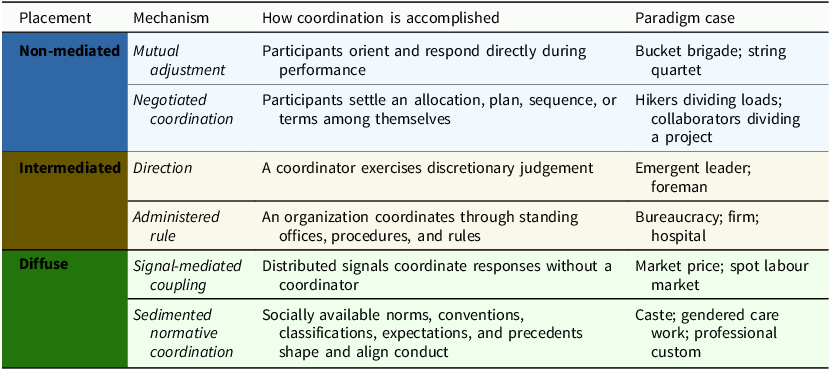
Across the three placements, we identify six mechanisms of integration. Where coordinative labour remains with participants, integration may proceed through live mutual adjustment or explicit negotiation; where it is intermediated, through a coordinator’s discretionary direction or organizationally administered rules; where it is diffuse, through decentralized signals or received norms and practices. We will call these mechanisms, respectively, mutual adjustment, negotiated coordination, direction, administered rule, signal-mediated coupling, and sedimented normative coordination. A specific placement of coordinative labour is associated with a broad family of integration mechanisms rather than a specific one. Placement and mechanism are therefore not coextensive classifications: each placement family contains more than one mechanism, distinguished by how coordination is accomplished within that placement. Figure 1 summarizes the resulting map; the sections Three placements of coordinative labour and Mechanisms within the three placements develop its placements and mechanisms by turns.
The two-axis taxonomy. Units of assignment cross-cut placements of coordinative labour; mechanisms are nested within placement families. Cells contain selected examples.

The three placements are categorical rather than points on a continuum. Non-mediated integration retains coordinative labour among a (predictably small) set of parties whose activities are being coordinated. Intermediated integration differentiates that labour from theirs and assigns it to an intermediary – a coordinator (individual, office, or organization). Diffuse integration is orchestrated across a wider field of signals, practices, conventions, classifications, expectations, and precedent – a kind of social ether.
The case of diffuse integration involves wide social distribution of coordinative labour. A price signal mediates interaction without identifiable intermediaries. And its ambit is vast. Likewise, tradition requires no living intermediaries, although the dispersed contributions of ancestors must surely not be discounted. In both cases coordinative effects are dispersed across the field rather than concentrated in an identifiable coordinator.
Three placements of coordinative labour
In non-mediated integration, those performing the differentiated labour also perform the work of making it cohere. Two people carrying a table through a doorway continually accommodate one another; a string quartet gives way and presses forward through reciprocal attention. The parties to the enterprise themselves bear the coordinative burden. Such coordination can be demanding in time, attention, and social skill, and its costs rise as the number of participants, distance, or temporal separation between them grows.
In intermediated integration, coordinative labour has itself been differentiated and assigned. A group may orient around a leader; a foreman may direct a crew; an organization may construct offices and procedures whose work is to coordinate the activities of others. The intermediary is identifiable even where, as in a bureaucracy, the coordinating entity contains a substantial division of labour of its own.
In diffuse integration, by contrast, no worker-coordinator performs the integrative work. Coordination is performed instead by many proxies: prices and other signals, professional or social expectations, customary classifications, received wisdom or convention, and sedimented patterns of conduct. Such coordination may be highly effective without a single agent performing integrative work.
Thomas Schelling’s famous (Reference Schelling1960) discussion of focal points makes one aspect of this phenomenon vivid. Participants may converge without direction or explicit agreement because social expectations raise the cognitive availability – the salience – of environmental or social cues, as each anticipates the anticipations of the others. This is a process of reverberating anticipation, in which participants take the measure not simply of what others think or express the intention to do, but of what others take to be shared as guidance in coordination. For present purposes, we thus draw attention here to coordinative work that may be performed by the surrounding field of signals, expectations, and socially available saliences: they can constrain and align conduct without themselves enjoying agentic powers.
The three placements can coexist at different scales in a single activity. A hospital ward may combine mutual adjustment among clinicians, administrative procedures, and the cadre of professional norms that is the preserve of no one single hospital.
Placement alone does not identify mechanism. We turn now to mechanisms within each family.
Mechanisms within the three placements
The first non-mediated mechanism is mutual adjustment: the parties coordinate in the course of performance by orienting and responding directly to one another. The bucket brigade and string quartet are paradigms. The philosophy of joint action addresses how divided activity is coordinated by the participants themselves – through meshing plans, joint commitment, or related structures (Bratman, Reference Bratman1987, Reference Bratman2014; Gilbert, Reference Gilbert1989, Reference Gilbert2014; Ludwig, Reference Ludwig2016; Roth, Reference Roth2017; Tuomela, Reference Tuomela2007). Not every joint action divides labour, but where it does, these accounts describe one important mechanism of non-mediated integration.
A second non-mediated mechanism is negotiated coordination. Here the parties themselves explicitly settle an allocation, plan, sequence, or set of terms that organizes their later contributions. Hikers may decide who carries water and who safeguards the map; collaborators on a research project may divide up responsibilities before beginning work. Unlike mutual adjustment, the principal coordinative work of negotiated coordination need not be performed continuously in real time. The mechanism is non-mediated because it is the parties themselves who settle the terms rather than an entity tasked with coordination.
Our first intermediated mechanism is direction, in which coordinative labour is assigned to a coordinator who exercises discretionary judgement about what those contributing first-order labour are to do. Direction includes emergent leadership, such as when a group looks to one of its number for direction, perhaps on the basis of experience, charisma, or trust. Command is a limiting form of the same mechanism, in which direction is backed by a standing office or preexisting authority (DeRue and Ashford, Reference DeRue and Ashford2010; Ganz, Reference Ganz2009; Hollander, Reference Hollander1992; Weber, Reference Weber1922). Marx’s workshop case and Simon’s employment relation isolate this placement from different angles: the former by contrasting organization via command with market coordination, the latter through the employee’s acceptance of direction within what Simon calls an “area of acceptance”. The wildcat strike that throws up a spokesperson and the work crew directed by a foreman differ in the grounding of direction while sharing its basic mechanism.
The second intermediated mechanism is administered rule. Here a standing organization coordinates through offices, procedures, schedules, jurisdictions, and rules that organize conduct without requiring case-by-case direction. Bureaucracies, civil services, hospitals, universities, and firms are familiar cases of administered rule (Miller, Reference Miller2019; Weber, Reference Weber1922). Weber’s bureaucratic office, introduced in the section Competing accounts and their limits as a paradigm of role differentiation, reappears here from the second axis: the office is a person-shaped unit of assignment, whereas the bureaucracy’s offices and procedures provide an intermediated mechanism of integration.
We proceed now to mechanisms of diffusely coordinated labour. The first diffuse mechanism is signal-mediated coupling. Signals generated across a wider field register dispersed activity and become inputs to further activity, thus reverberating: participants adjust to them, and those adjustments in turn alter the signals confronting others. Coordination is orchestrated by this distributed feedback rather than by any explicit direction or plan on the part of any agent. Hayek’s (1945) price system is the paradigm: a new use for tin raises its price, buyers automatically economize, and their responses propagate as further information. Exchanges, market-makers, contract law, property arrangements, and platforms help constitute the institutional setting in which actual market signals are generated and interpreted; within that setting, the price mechanism coordinates through decentralized responses rather than at the direction of entrants.
The labour market makes the cross-cutting character especially clear. A discrete task – a paint job, editing a manuscript, harvesting a field – may be allocated through spot contracting. The unit of differentiation remains a task, whereas its allocation is integrated diffusely through offered wages, bids, availability, and other market signals. The same task may be folded into the operations of a single firm, where it will be subject to a foreman or schedule, and the integration becomes intermediated without necessarily moving on the primary axis.
The firm/market boundary sketched in the section Competing accounts and their limits can now be stated more exactly. Coase (Reference Coase1937) raises the question of why some transactions are organized within firms rather than through markets; transaction-cost analysis explains selection of mechanism by comparing the costs of securing coordination through market exchange with those of internal organization under relevant conditions. The present taxonomy identifies the alternatives between which selection occurs. Market contracting leaves the task’s integration diffuse, orchestrated by prices, bids, and other signals; bringing the same task within a firm places much of its coordinative labour in an organization, typically through direction or administered rule. Placement therefore describes the structural change to be explained; it does not compete with an economic account of why one arrangement is advantageous under specified conditions.
The second diffuse mechanism is sedimented normative coordination. Participants encounter a field already patterned by norms, conventions, classifications, expectations, and precedents that make some assignments, responses, and claims socially ordinary and others anomalous. Precedent belongs here because what participants have done before can itself supply a reason to repeat an allocation or sequence – because it worked, because it has become familiar or settled, and sometimes even when the earlier arrangement worked poorly. Here coordination is orchestrated diffusely through what participants take to be customary, fitting, expected, or settled, rather than through continuously updated feedback from current activity or case-by-case direction from a coordinator.
Sugden’s (Reference Sugden1989) account of spontaneous order supplies a complementary economic case: rules can evolve and sustain coordination without deliberate design or formal machinery of enforcement. This differs from the self-governing arrangements considered below (see the section Vigilance and revising labour), in which participants retain practical capacity to monitor, contest, and revise the rules that govern them. In the present terms, spontaneous order is not a fourth placement but one way diffuse coordination via norms can arise and persist.
The field-level templates emphasized by DiMaggio and Powell (Reference DiMaggio and Powell1983) and the ready-made category distinctions that Tilly (Reference Tilly1998) sees organizations importing are examples of such already available coordinative materials. Caste-linked occupational assignments, inherited expectations about gendered care labour, professional custom, and other customary allocations are already socially available when participants encounter them; their conduct may reproduce or alter the pattern, but does not have to generate them from scratch.
The bucket brigade example supplies a minimal case. The first brigade may disband, yet its pattern can serve as precedent for reassembling a later brigade at a second fire without any role persisting between episodes. For task differentiation, an unspoken convention can allocate a one-off contribution – for example, that whoever cooks is spared cleanup – without negotiation or direction.
When it comes to roles, however, professional practice or other custom can organize how physicians, nurses, or lawyers hand work across standing jurisdictions. And where station is concerned, cultural expectations can align gendered care labour or caste-linked occupational access.
The rules/equilibria dispute can now be revisited from a different angle. Hindriks and Guala (Reference Hindriks and Guala2015) argue that equilibrium-based and rule-based accounts are individually inadequate and propose a unified conception of institutions as rules-in-equilibrium. Hodgson (Reference Hodgson2015) accepts the explanatory importance of equilibrium analysis but argues that equilibria are behavioural outcomes and should not enter the taxonomic definition of institutions, which he defines in terms of rules.
The present taxonomy is silent on the matter in dispute here. A rule does not, as such, determine where or how coordinative labour is performed: rules may be administered through offices or operate diffusely as norms, conventions, or precedents. Nor does an equilibrium pattern determine placement: settled patterns of conduct can be sustained by a variety of distributions of coordinative labour. Placement therefore cross-cuts the terms of the controversy. The present taxonomy thus leaves the disagreement between the parties, as to the definition of institution intact while identifying a structural question neither answer settles. Whether an institution is essentially a rule in equilibrium, a system of rules whose operation may be illuminated by equilibrium analysis, or something else, one may still ask where its coordinative labour is placed and by what mechanism it is performed. Indeed Hodgson’s observation that markets remain institutions even through disruptive disequilibria underscores this taxonomy’s neutrality: that particular institution can persist through an arbitrary sequence of equilibria and disequilibria. The taxonomy therefore cannot be utilized to settle the question of what institutions are fundamentally, but may be utilized to argue that a variety of patterns involving rules and placement can characterize different features of institutional order.
The profession is an especially instructive layered case. As Abbott’s (Reference Abbott1988) ecology of jurisdictions, surveyed in the section Competing accounts and their limits, already suggests, its differentiated unit is the role: physician, attorney, architect, and the like are person-shaped positions that supply standing bases for allocating responsibilities and jurisdiction. Yet ongoing integration can proceed diffusely through professional norms and reputation, whereas entry into the field itself and jurisdiction issues may be intermediated through licensing boards or professional bodies. The mechanisms governing who may enter need not be the mechanisms coordinating those already in the role.
Table 1 summarizes the three placement families and the two principal mechanisms distinguished within each.
Placement families and mechanisms of integration

Table 1. Long description
A table categorizing coordination mechanisms into placement families. The table has four rows and four columns. Column headers are Placement, Mechanism, How coordination is accomplished, and Paradigm case. Row labels are Non-mediated, Intermediated, and Diffuse. Row 1: Non-mediated, Mutual adjustment, Participants orient and respond directly during performance, Bucket brigade; string quartet. Row 2: Non-mediated, Negotiated coordination, Participants settle an allocation, plan, sequence, or terms among themselves, Hikers dividing loads; collaborators dividing a project. Row 3: Intermediated, Direction, A coordinator exercises discretionary judgement, Emergent leader; foreman. Row 4: Intermediated, Administered rule, An organization coordinates through standing offices, procedures, and rules, Bureaucracy; firm; hospital. Row 5: Diffuse, Signal-mediated coupling, Distributed signals coordinate responses without a coordinator, Market price; spot labour market. Row 6: Diffuse, Sedimented normative coordination, Socially available norms, conventions, classifications, expectations, and precedents shape and align conduct, Caste; gendered care work; professional custom.
Coordinative labour, once assigned, may therefore itself be divided: one coordinator may distribute parts of that work among several offices, or participants may retain some coordinative work while assigning other parts elsewhere.
Vigilance and revising labour
The principle of placement applies not only to the labour of coordinating an arrangement but also to the labour of watchfully keeping its terms under review. A division of labour may call for labour to maintain the terms on which coordination proceeds, and those terms may on occasion be contested or require revision. That work need not be undertaken by the same entities or units that implement the original scheme. A bureaucracy may coordinate through administered rules and also reserve revision to designated offices. But the prerogative to revise or contest these same rules may, in a civic setting, reside with the governed as a whole.
Consider a university department we will just refer to as Department D. Suppose it governs much of its ordinary life under practices widely approved by the profession – practices of shared governance and academic freedom – in connection with curriculum, hiring, and promotion policies – while remaining nested within a central administration that can direct it from above. If that administration presses Department D to alter its practices in order to shift the university’s profile, the department may take refuge in bylaws enshrining shared governance that record the terms under which its members understand their common work to be governed.
Those bylaws do not eliminate intermediated coordination: chairs, committees, standing procedures, and university rules still organize much of ordinary departmental life. But when pressure from above mounts, members can invoke the bylaws against encroachment, demand justification for departures from them, and, if necessary, use those bylaws as a basis for contesting or seeking renegotiation of administration-imposed strictures. The ongoing coordination is largely intermediated through offices, committees, and administered rules, but the labour of keeping its terms contestable and revisable need not be.
Call the standing distributed capacity that keeps such revision available vigilance. Vigilance includes noticing encroachment or malfunction, contesting departures from the terms of coordination, demanding justification, and activating revision when required; it need not mean continual rule-writing. What is distinctively civic is that vigilance and revising labour may be performed by the governed body even when everyday coordination is administered through offices and rules. Ostrom’s (Reference Ostrom1990) common-pool institutions exemplify arrangements in which a defined body of participants and collective-choice procedures help retain this revising capacity among those governed.
Relations of the axes
The two axes answer different questions and therefore cross-cut. The primary axis asks what kind of unit bears the differentiated assignment; the secondary asks how the coordinative labour is placed and by what mechanism it operates. A house-moving task can be coordinated non-mediatedly among friends, intermediated through a foreman, or allocated diffusely through spot labour contracting. A role-differentiated arrangement can be coordinated by mutual adjustment, as in a quartet with person-shaped roles, by administered rule, as in a hospital, or diffusely through professional norms. A station-differentiated order can be enacted directly in local relations, as when gendered expectations in a boss/secretary or doctor/nurse relation are sustained in the participants’ own interaction; it can be administered through law and offices, or reproduced diffusely through inherited expectation. The source and scale of an assignment need not coincide with the scale at which its performance is integrated.
The spot labour market is especially useful because it fills a combination that can otherwise look awkward: task differentiation with diffuse integration. The same first-order unit can therefore be coordinated in all three placement families. Equally, station differentiation need not be diffuse: a legally administered status order is station-differentiated on the primary axis and intermediated on the secondary. These off-diagonal cases establish the independence of the axes more strongly than the paradigm cases alone. The heterogeneous literatures surveyed in the section Competing accounts and their limits can thus be seen to isolate different variables or regions of this space rather than to offer mutually exclusive descriptions of a single structural dimension.
The taxonomy among its rivals
Three existing frameworks come nearest to different regions of the account. Functional differentiation (Luhmann, Reference Luhmann1982; Parsons, Reference Parsons1971) distinguishes social subsystems by the function they discharge, whereas the present primary axis distinguishes the unit of assignment and the secondary axis the distribution of coordinative labour. Polanyi’s (Reference Polanyi1944, 1957) reciprocity, redistribution, and exchange map naturally onto non-mediated, intermediated, and diffuse integration respectively, whereas the present scheme distinguishes mechanisms within those placements and reaches beyond economic exchange to offices, professions, civic bodies, and inherited normative orders. Treatments of divided cognitive labour likewise illuminate particular mechanisms rather than the full space (Goldberg, Reference Goldberg2011; Kitcher, Reference Kitcher1990). The gain is not that placement supersedes these frameworks but that it locates their explananda within a common taxonomy.
Selection, persistence, and change
Our taxonomy identifies potential schemes and mechanisms for organization and integration; it does not, as such, explain why one rather than another scheme or mechanism is selected, persists, or changes. The taxonomy can nonetheless specify the alternatives among which such explanations range and the different forms of coordinative work on which they depend. Economic and institutional explanation begins where that structural description leaves off, invoking such things as the gains available from a division of labour and the costs of securing and maintaining coordination under particular conditions.
Selection and movement across the space
A clean division of theoretical labour between taxonomic distinctions and causal-historical explanation (that may invoke mechanisms) allows us to specify more precisely what an account of organizational change has to explain. Because the axes cross-cut, a historical change may involve movement on the secondary axis, the primary axis, or both.
The economic canon already identifies forces capable of producing such movements. Smithian gains from specialization create reasons to divide labour, whereas coordination costs constrain the arrangements through which those gains can be secured (Becker and Murphy, Reference Becker and Murphy1992; Smith, Reference Smith1776; Stigler, Reference Stigler1951).
The gains from specialization are not equally realizable across all structural arrangements. Smith’s familiar gains from repetition and reduced switching time, and Babbage’s further principle that division permits each process to draw only on the degree of skill it requires, depend on conditions the taxonomy leaves open rather than guarantees (Babbage, Reference Babbage1832). Repetition requires continuity of assignment; saving transfer time favours proximity or cheap handoff; specialized machinery involves indivisibilities and capital commitments; the Babbage principle presupposes labour markets capable of separately pricing differentiated skill. These conditions can make some pairings of differentiation and placement more economical than others without turning any of them into defining features of the forms themselves.
Coase (Reference Coase1937) and Williamson (Reference Williamson1975, Reference Williamson1985) explain why some transactions are organized within firms rather than through markets, whereas Langlois (Reference Langlois2003) follows movement across that boundary with capabilities and shifts in historical conditions. Scale, knowledge, uncertainty, observability, communication technology, and transaction frequency can alter the comparative attractiveness of available arrangements. Our taxonomy identifies structural differences among those arrangements without foreclosing the choice of any on a given occasion, while at the same time providing a view of the landscape across which choices can be traced.
A discrete task may be purchased on a spot labour market and integrated into a larger enterprise through prices and bids, or the same task may be brought within a firm and coordinated through direction or administered rule. That is a change on the secondary axis without any necessary change on the primary. Separately, an organization may constitute a person-shaped role that governs where future tasks, permissions, and responsibilities land. That is a change in the unit of differentiated assignment. Economic explanations of organizational change should therefore not assume that movement in integration and movement in differentiation co-occur, even when both are observed in the same historical episode.
Recent economic analyses suggest new tracings. Knowledge and communication costs make the gains/costs comparison more discriminating. According to Garicano (Reference Garicano2000), costly knowledge acquisition and communication produce knowledge hierarchies: routine problems are handled with locally available knowledge, whereas harder problems are referred to specialists. In the present terms, the model bears first on the constitution and use of differentiated roles – and on the routing of tasks among them – within an intermediated organization. It therefore need not represent movement between placement families at all. Bloom et al. (Reference Bloom, Garicano, Sadun and Van Reenen2014) show, moreover, that information and communication technologies can pull organizational authority in opposite directions: better information technologies are associated with greater autonomy for workers and plant managers and a wider managerial span of control, whereas technologies that lower communication costs are associated with less autonomy. These results likewise need not imply movement between placement families. They can alter the distribution of decision rights and, where those decisions are coordinative, the seat of coordinative labour within an intermediated organization – pushing discretion downward towards workers or plant managers, or making direction from higher-level coordinators easier to sustain. Autonomy within a hierarchy is therefore not by itself non-mediated integration. The taxonomy lets us distinguish redistribution within a placement family from movement between placement families.
The tasks/jobs literature must be brought into contact with the primary axis with care, because its categories do not align exactly with our own. In that literature, jobs and occupations are commonly represented as bundles of tasks; for us, by contrast, a role is not a bundle of tasks but a person-shaped standing position that allocates future tasks, permissions, responsibilities, and authority. The mismatch is analytically useful rather than merely a caution: task-based models can register churn in a job’s task content without, by themselves, distinguishing that churn from persistence or reconstitution of the standing role that bears it. That literature suggests that automation can displace labour from some tasks, whereas new tasks create new domains for it (Acemoglu and Autor, Reference Acemoglu, Autor, Ashenfelter and Card2011; Acemoglu and Restrepo, Reference Acemoglu and Restrepo2019), and new occupational specialities continue to emerge (Autor et al., Reference Autor, Chin, Salomons and Seegmiller2024). Task content can therefore change without constituting or abolishing a role in our sense, whereas a person-shaped role can survive substantial change in its task bundle.
Entrepreneurial judgement supplies another source of movement through the space. Foss and Klein (Reference Foss and Klein2015), drawing on Knight (Reference Knight1921), model entrepreneurs as resource owners who exercise judgement under uncertainty by controlling, combining, and deploying heterogeneous assets in anticipation of profit. Entrepreneurship is not a category in our taxonomy, but one source of movements across the terrain carved out by it. Among the judgements entrepreneurs make, in our terms, are judgements about placement itself: whether coordination is left to market signals, retained among first-order parties, or brought inside an organization under direction or administered rule. Entrepreneurial judgement may bear on the primary axis as well: an entrepreneur may redesign the decomposition of labour without changing its unit of assignment, or may change that unit by constituting a standing role for contributions previously allocated as discrete tasks.
Generative AI renders separation of landscape from movement across it especially visible. Brynjolfsson et al. (Reference Brynjolfsson, Li and Raymond2025) find that an AI assistant raised customer-support productivity by 15 percent on average, with larger gains for less experienced and lower-skilled workers and evidence of accelerated learning. A technology that makes experienced guidance cheaply available changes knowledge-transmission and escalation costs. It can reallocate tasks while roles persist, alter role content or jurisdiction, or redistribute coordinative judgement within an intermediated organization by reducing the need to escalate routine problems to supervisors. If adoption also changes whether work is obtained through market contracting or brought inside the firm, it can alter placement as well. AI adoption therefore need not represent a single kind of organizational change, but may affect task reallocation, role change, within-placement redistribution, and movement of labour between placement families.
Requirements for persistence
Each placement of coordinative labour also imposes characteristic requirements on persistence. These identify conditions that must continue to be met if coordination is to remain operative, without implying that failure determines any particular successor arrangement. Non-mediated coordination requires continuing coordinative activity by the participants themselves. Mutual adjustment depends on sustained reciprocal attention; negotiated coordination depends on the continuing efficacy of the settlement reached. These mechanisms do not require a separate organizational apparatus, but they do require attention, good communication skills, and willingness to coordinate. When these fail, the relevant vulnerability is dissipation or breakdown of the settlement, not a necessary transition to some other placement. The end of an episode does not, however, prevent re-instantiation: the same task-divided scheme can be assembled again under the guidance of precedent without a standing role structure persisting between episodes.
Intermediated coordination depends instead on the performance of an identifiable coordinator or organization. Direction requires discretionary judgement to remain effective; administered rule requires offices, procedures, and channels of implementation to continue doing their work. Such arrangements can support coordination across scale and time, but their characteristic vulnerabilities include entrenchment of discretion, ossification or proliferation of rules, and redirection of organizational capacities towards ends other than those for which the coordination is maintained. None of these possibilities implies that direction naturally becomes office or that offices naturally expand; they identify failure modes that become available once coordinative labour is intermediated.
Diffuse mechanisms pose different requirements. Signal-mediated coupling depends on the continued production, transmission, and uptake of usable signals; when signals become noisy, distorted, or disconnected from relevant activity, coordination deteriorates. Because no coordinator controls the mechanism as a whole, deliberate redesign ordinarily works by altering the institutional arrangements through which signals are produced and transmitted – as when a regulator, exchange, platform, or central bank changes the environment in which market signals operate.
Sedimented normative coordination depends on the continued social availability and reproduction of norms, classifications, expectations, and precedents. Processes of social closure and social reproduction can help explain how particular station arrangements are maintained. Closure can restrict access to favoured stations through licensing, credentialing, certification, union control, law, or other devices (Weeden and Grusky, Reference Weeden and Grusky2005; Weeden, Reference Weeden2002); reproduction can naturalize assignments across generations, as in gendered unpaid domestic and caring labour (Federici, Reference Federici2004; Folbre, Reference Folbre2001; Kittay, Reference Kittay1999). These processes help explain the durability of particular station arrangements without defining station differentiation or diffuse integration itself. Their significance is causal and historical: they identify processes by which a structurally described arrangement is maintained. And should they face erosion, that has consequences for all the arrangements that rely on their persistence.
Civic arrangements are examples where vigilance and revising labour must be tracked separately from ordinary coordination. Everyday work may remain heavily rule-governed and intermediated whereas the governed retain practical power to scrutinize and reopen those rules. Persistence of self-government therefore depends not simply on the continued existence of participatory procedures but on whether effective vigilance and revising labour remain distributed among the governed. Participatory procedures can therefore remain intact even when effective revising capacity has shifted elsewhere.
Institutional conditions
The comparative gains and costs that shape selection and the requirements that sustain an arrangement once selected are institution-dependent. Contract enforcement and property arrangements affect market coordination; licensing and professional jurisdiction constrain role occupancy; collective-choice procedures affect where vigilance and revising labour remain; inherited norms affect which assignments are socially available or costly to contest. Such conditions are further parameters on selection and persistence. The same change in specialization gains or technology can therefore support different arrangements under different institutional conditions (Ostrom, Reference Ostrom1990; Weeden, Reference Weeden2002; Williamson, Reference Williamson1985).
These are strictly requirements and vulnerabilities. Placement does not dictate a form’s origin, duration, or successor. It identifies what coordinative work must be accomplished, where that work is socially distributed, and some characteristic ways it can become unavailable or ineffective. The gains from a division of labour, the costs of coordinating it, and the institutional and technological conditions under which those gains and costs are realized explain which arrangements are selected and how they change.
Conclusion: The reach of the principle of placement
The taxonomy developed here is organized by two independent questions. On the primary axis, what kind of unit bears the differentiated assignment of labour – task, role, or station? On the secondary, how is the labour of making those differentiated contributions cohere itself distributed – non-mediated among the participants, intermediated through a coordinator or organization, or diffusely through a wider social field? Within the three integration placements, this paper has developed six mechanisms that distinguish different processes by which coordinative work can be accomplished, without claiming to exhaust the possibilities.
The principle of placement connects these questions without collapsing them: coordination is itself labour and can itself be distributed; when it becomes an assigned activity, it can be divided accordingly. The same principle extends to vigilance and revision: the labour that implements a coordination need not be seated with the labour performed to keep its terms contestable and revisable. Civic self-government is one important configuration of such non-coplacement.
The framework also clarifies the role of the firm/market boundary. Moving activity from market contracting into the hierarchies of a firm changes the placement and mechanism of integration; transaction-cost and related economic theories can explain why that move is advantageous under some conditions but not others. The taxonomy provides the geography of the terrain over which that explanation ranges rather than a rival explanation of movements on that terrain.
The same geography sheds light on recent literature on tasks, technology, and organizational design. Changes in task content, the constitution and re-constitution of roles, and the placement of coordination are distinct movements in the division-of-labour geography, even when one technological or entrepreneurial episode produces all three. Knowledge and communication costs, task-based automation, and entrepreneurial judgement explain movement over the terrain rather than introducing new categories.
The same decomposition applies beyond firms and markets. Professions, bureaucracies, civic bodies, status orders, and transient teams can combine different units of differentiation with different placements of coordination and can place vigilance and revising labour differently again. The taxonomy is therefore an instrument for analysing layered cases, not a set of mutually exclusive boxes for cases taken as wholes.
Nor does placement by itself determine durability, efficiency, or legitimacy. It identifies characteristic demands and vulnerabilities: non-mediated coordination depends on continuing participant activity, intermediated coordination on the performance of coordinators and offices, diffuse coordination on the reproduction of signal systems or social expectations, and civic self-government on retained vigilance over the terms of coordination.
The taxonomy thus contributes a common structural-ontological language. It explains, in taxonomic terms, that agent-centred and structure-centred explanations of the social world need not be rivals, as the work of coordination is sometimes performed by agents, sometimes assigned to organizations, and sometimes distributed diffusely through the social environment. Once we ask where the relevant work is placed – and distinguish that question from why it came to be placed there – the heterogeneous forms of the division of labour can be usefully contrasted within a single set of analytical categories. These innovations are available to every science that treats of the social world.
Acknowledgements
Many decades ago, as I fledged in my first faculty role in the academy, my colleague Barry Smith suggested I consider “those questions” around the boundaries of the firm. I’ve now gotten around to a way of thinking about “those questions”—thank you, Barry. I’m grateful to the Philosophy Department at my home institution, the University of Tennessee, Knoxville, for funding supporting summer residency at the Whiteley Center, Friday Harbor Labs of the University of Washington, where I assembled the pieces for this paper, and to the Whiteley Center for having me. Many thanks to four anonymous JOIE reviewers for profoundly incisive commentaries that served to enhance and sharpen the final argumentation.


 Open access

