Severe acute respiratory coronavirus virus 2 (SARS-CoV-2) vaccination is a promising approach to achieve herd immunity and contain the pandemic, in addition to public health preventive measures. Healthcare workers (HCWs) are vulnerable to coronavirus disease 2019 (COVID-19), Reference Karlsson and Fraenkel1 but vaccination hesitancy could be a concern (eg, influenza vaccination rates among HCWs range from as low as 2.1% to 62% Reference Riphagen-Dalhuisen, Gefenaite and Hak2 ). The prevalence of SARS-CoV-2 vaccination intention was only 27.7% among HCWs in Congo Reference Nzaji, Ngombe and Mwamba3 and 40% among nurses in Hong Kong. Reference Wang, Wong and Ho4 The few previous studies reported significant factors of acceptability of SARS-CoV-2 vaccination among HCWs: being male, being a doctor, positive attitude toward SARS-CoV-2 vaccines, perceived susceptibility to COVID-19, and engagement in COVID-19 care. Reference Nzaji, Ngombe and Mwamba3–Reference Dror, Eisenbach and Taiber5
The commonly applied social cognitive theory (SCT) was used as the study’s conceptual framework. Reference Plotnikoff, Costigan, Karunamuni and Lubans6,Reference Glanz and Bishop7 SCT emphasizes that human behavior is the product of the dynamic interplay of personal, behavioral, and environmental influences. Reference Bandura8 It is highly applicable because the working environment, norms, and professional identity of HCWs affect their SARS-CoV-2 vaccination beliefs and behaviors. Reference Godin, Bélanger-Gravel, Eccles and Grimshaw9 Three other key constructs of SCT that we investigated were (1) outcome expectation, which encompassed physical outcomes and self-evaluative outcomes (eg, pride, self-worth, and anticipated regret if not taking up vaccination), Reference Dijkstra, Vries, Kok and Rouackers10 (2) observational learning (eg, peer modeling), Reference Glanz, Rimer and Viswanath11 and (3) self-efficacy (ie, beliefs about personal ability/confidence to perform behaviors). Reference Bandura8
We investigated the prevalence of and factors related to the behavioral intention of Chinese HCWs to take SARS-CoV-2 vaccination. The 4 SCT factors related to SARS-CoV-2 vaccination investigated in this study were (1) environmental factors (norms, experiences related to COVID-19, and job satisfaction), (2) outcome expectations, (3) self-efficacy of COVID-19 vaccination, and (4) observational learning (ie, colleagues’ SARS-CoV-2 vaccination). The norms related to SARS-CoV-2 vaccination that we studied were the descriptive norm (what others would do), the subjective norm (what others would think one should do), the moral norm (feelings of obligation and responsibility toward adopting the behavior), Reference Ng, Cowling, So, Ip and Liao12 and the professional norm (evaluations of the behavior based on professional convictions). Reference Godin, Vézina-Im and Naccache13
Method
Sampling
An anonymous cross-sectional survey was conducted (October–November 2020) in 5 tier-1 tertiary-care hospitals in 3 provinces (Guangdong, Hunan, and Yunnan) of mainland China. The 3 provinces included were geographically (southeast, central, and southwest) and socioeconomically (levels of gross domestic product: top, about average, and below average) representative of mainland China. The inclusion criteria were (1) full-time doctors or nurses, (2) employed in the current hospital since at least January 2020, and (3) access to mobile phones. The exclusion criteria were (1) unable to give informed consent and (2) had taken SARS-CoV-2 vaccination or had made an appointment for SARS-CoV-2 vaccination. During the study period, vaccines were not marketed in China. Instead, a limited number of vaccinations took place in experimental trials or for emergency use. 14 In our sample, only 17 HCWs (0.7%) had taken SARS-CoV-2 vaccination under those circumstances, and they were excluded. All eligible doctors and nurses working in the major departments of internal medicine, surgery, gynecology and obstetrics, pediatrics, emergency, and infectious diseases were invited to complete an anonymous online survey (n = 3,104). The online survey link was distributed to prospective participants by the hospital administrators through the participating departments’ WeChat/QQ platforms (the most commonly used social media applications in China). With informed consent, all participants were briefed properly about the study. Ethics approval was obtained from the corresponding author’s affiliated institution (reference no. SBRE-20-094). In total, 2,287 completed questionnaires were returned (response rate, 73.7%), of which 2,254 (99.1%) were valid and were used in the data analysis.
Measurements
Background variables
Sociodemographics (ie, gender, age, marital status, and education level) and work-related variables (ie, department, job rank, and hospital) were measured as background variables.
Behavioral intention of SARS-CoV-2 vaccination
SARS-CoV-2 vaccination intention was measured under 2 scenarios within the first 6 months since its availability: free cost or self-paid at a cost of RMB 600 (US$91), given an effectiveness of 80% and rare mild side effects of the vaccine. The responses were rated on a 5-point Likert scale (1 = extremely unlikely; 5 = extremely likely) and were dichotomized into binary outcomes (extremely likely/likely versus else).
Self-efficacy of taking SARS-CoV-2 vaccination
The scale included 2 items about perceived self-efficacy in obtaining quota and scheduling time for SARS-CoV-2 vaccination (1 = totally disagree; 5 = totally agree). Higher total scores indicated higher levels of self-efficacy.
Outcome expectations
We measured 2 physical outcome expectations: (1) protective effect of SARS-CoV-2 vaccination for oneself and family or friends and (2) perceived likelihood of severe side effects of the SARS-CoV-2 vaccination.
We also investigated 2 self-evaluative outcomes. (1) We used 2 items to address participants’ anticipated regret and self-disappointment if not taking the SARS-CoV-2 vaccination. This measure was used in a previous influenza vaccination study among Chinese HCWs. Reference Ng, Cowling, So, Ip and Liao12 (2) We measured anticipated positive feelings regarding SARS-CoV-2 vaccination by including 3 items to assess the degree of participants’ feelings of safety, wisdom, and morality if they take SARS-CoV-2 the vaccination.
Observational learning
A single item was used to record whether the participant was acquainted with other HCWs who had taken or intended to take the SARS-CoV-2 vaccination.
Environmental factors
For descriptive norms, we included 3 items. We assessed perceived percentages (in increments of 10%) of acquainted non-HCWs, acquainted HCWs, and HCWs in China that would take the SARS-CoV-2 vaccination during the 6 months of its availability. For subjective norms, we included 5 items. We assessed perceptions regarding how much the general public, HCW colleagues, significant others, social media, and the government would expect HCWs to take SARS-CoV-2 vaccination. For the moral norm, we used a single item from a previous study to assess the extent that SARS-CoV-2 vaccination was seen as a personal responsibility. Reference Ng, Cowling, So, Ip and Liao12 For the professional norm, we constructed 2 items: “All HCWs should uptake SARS-CoV-2 vaccination” and “Hospital should require all HCWs to uptake SARS-CoV-2 vaccination.” All items of subjective, moral, and professional norms were rated on a 5-point Likert scale: 1 (strongly disagree) to 5 (strongly agree). The average score of all items was used, with higher scores denoting higher levels of agreement with SARS-CoV-2 vaccination.
Work environment was assessed using 3 items regarding (1) engagement in COVID-19–related work, (2) COVID-19 diagnosis history, and (3) colleagues’ COVID-19 infection. Job satisfaction was assessed using a single item from previous studies (ie, “Overall, I am satisfied with my job”). Reference Dolbier, Webster, McCalister, Mallon and Steinhardt15 A detailed description of these measurements is available in Appendix 1 (online). The reliability of the measurements was satisfactory.
Statistical analysis
Descriptive data were presented separately for doctors and nurses and compared using an independent t test or the χ2 test. Adjusted for the background variables, the associations between the individual SCT-related constructs and the 2 binary behavioral intention variables were analyzed by multivariate logistic regression analysis. Adjusted odds ratios (AORs) and respective 95% confidence intervals (CIs) are reported. SPSS version 21.0 software (IBM, Armonk, NY) was used for data analyses. The statistically significant level was P < .05 (2-tailed).
The study was approved by the Survey and Behavioral Research Ethics Committee of the Chinese University of Hong Kong (No. SBRE-20-094).
Results
Prevalence of behavioral intention of SARS-CoV-2 vaccination
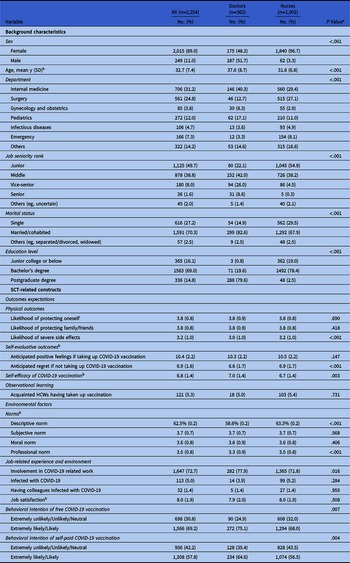
The prevalence of intention of free SARS-CoV-2 vaccination was 75.1% among doctors and 68.0% among nurses, which dropped to 64.6% for doctors and 56.5% for nurses regarding self-paid vaccination intention at a cost of 600 RMB (US$91) (Table 1). Both situations specified 80% effectiveness and rare mild side effects. Doctors had significantly higher SARS-CoV-2 vaccination intentions relative to nurses (all P < .05).
Description of the Study Participants’ Characteristics

Note: Data are tabulated as no. (%) if not specified.
a P-value footnote here.
b Continuous variables are presented with mean (SD).
Background characteristics and description of the independent variables
The background information for and comparisons between doctors and nurses are summarized in Table 1. Moreover, 72.7% of the participants had engaged in COVID-19–related work; 5% and 1.4% had had COVID-19 infection and infected colleagues, respectively. The participants perceived that on average ∼60% of the acquainted non-HCWs, acquainted HCWs, and HCWs in China would take a SARS-CoV-2 vaccination within the first 6 months of its availability. Nurses showed higher levels of perceived side effects, anticipated regret, descriptive norm, and professional norms related to SARS-CoV-2 vaccination than doctors. Doctors demonstrated higher self-efficacy of SARS-CoV-2 vaccination and were more likely to engage in COVID-19 treatment or control work.
SCT factors of SARS-CoV-2 vaccination intention
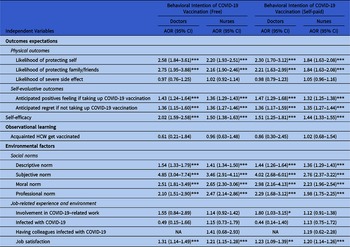
Separate logistic regression analyses adjusted for the background variables were conducted for the 4 vaccination intention scenarios (ie, free and self-paid vaccination intention among doctors and nurses) (Table 2).
Adjusted Associations Between SCT-Related Independent Variables and Behavioral Intention of COVID-19 Vaccination

Note: NA, not applicable; AOR, adjusted odds ratio; CI, confidence interval.
aAdjusted for age, sex, marital status, education level, department, job seniority rank, and hospital.
bBecause only 5 doctors (1.4%) reported having colleagues infected with COVID-19, the odds ratio was not computed.
†.05 < P < .10; *P < .05; **P < .01; ***P < .001.
Outcome expectations
Except for perceived severe side effects, the other outcome expectation variables were significantly and positively associated with both intention of free and self-paid SARS-CoV-2 vaccination among doctors and nurses (all P < .001), including perceived vaccine protectiveness for self (AORs, 1.84–2.58), protectiveness for family and friends (AORs, 1.84–2.75), anticipated positive feelings if taking a SARS-CoV-2 vaccination (AORs, 1.32–1.47), and anticipated regret if not taking a SARS-CoV-2 vaccination (AORs, 1.35–1.36).
Self-efficacy
Self-efficacy was positively associated with all the 4 vaccination intention scenarios (AORs, 1.44–2.20; all P < .001).
Observational learning
No significant association was found between knowing acquainted HCWs that having taken up SARS-CoV-2 vaccination and vaccination intention (AORs, 0.61–1.02; P > .05).
Norms
All 4 norm variables were significantly and positively associated with all the four vaccination intention scenarios at the level of P < .001: the descriptive norm (AORs, 1.36–1.54), the subjective norm (AORs, 2.76–4.85), the moral norm (AORs, 2.23-2.98), and the professional norm (AORs, 1.98–2.47).
Work-related experience and environment
Engagement in COVID-19 treatment and control work was only positively associated with intention of self-paid SARS-CoV-2 vaccination among doctors (AOR, 1.80; P < .05) but not for the other vaccination intention variables. In addition, job satisfaction was positively associated with all the 4 vaccination intention variables (AORs, 1.20–1.31; all P < .001).
Discussion
In the present study, we investigated the intention of free or self-paid SARS-CoV-2 vaccination and the associated factors based on the SCT among HCWs in China. Overall, 68% of the doctors and 75% of the nurses intended to take up free SARS-CoV-2 vaccination. However, the prevalence dropped to 57% and 65% at a fee of 600 RMB ($US91), corroborating previous studies among Chinese university students and general population in Hong Kong. Reference Mo, Luo and Wang16,Reference Yu, Lau, Lau, Wong and Chan17 Cost is an expected barrier, and the concerns about downturns in economy due to the pandemic may have further reduced the willingness to pay. Free and prioritized SARS-CoV-2 vaccination should be provided to these vulnerable occupational groups to avoid nosocomial infections during the pandemic. Although a prior study suggested that a coverage rate of ≥75% would be required to achieve herd immunity with a 80% vaccine effectiveness, Reference Bartsch, O’Shea and Ferguson18 the intention–behavior gap signifies the necessity of continuous efforts to promote vaccination uptake. Corroborating a previous Israel study, Reference Dror, Eisenbach and Taiber5 doctors indicated higher SARS-CoV-2 vaccination intention than nurses. Future studies should investigate the reasons behind the discrepancy in motivation for SARS-CoV-2 vaccination between these 2 groups. Additional efforts and incentives should be given to promote SARS-CoV-2 vaccination among HCWs, especially for nurses.
The SCT is applicable to understanding the intention to take a SARS-CoV-2 vaccination among HCWs. Most of the SCT factors (outcome expectations, self-efficacy, norms, and COVID-19–related work experience) were significantly and consistently associated with both free and self-paid vaccination intentions among the 2 groups. Observational learning was an exception and was not associated with vaccination intentions. This finding is understandable because SARS-CoV-2 vaccination had not been implemented, although a very small number of HCWs might have taken up experimental vaccinations. Reference Zhu, Guan and Li19 Thus, observational learning, which involves information processing and responses, Reference Bandura8 might not have occurred among most participants. The significance of this potential factor of SARS-CoV-2 vaccination would evolve over time.
Supporting the SCT, outcome expectations were significant factors of SARS-CoV-2 vaccination intention among HCWs. Corroborating a previous study, Reference Bandura8 perceived protectiveness of COVID-19 vaccination (oneself and family or friends) was significantly associated with all vaccination intention variables. Thus, SARS-CoV-2 vaccination health promotion may highlight both egoistic and altruistic benefits. Unexpectedly, perceived side effect of vaccines was not associated with vaccination intention in the present study. It was, however, negatively associated with various types of vaccination-related behaviors or intentions (eg, influenza) in previous studies. Reference Sherman, Smith and Sim20,Reference Bish, Yardley, Nicoll and Michie21 It is plausible that side effects were rarely reported during the experimental use of the Chinese SARS-CoV-2 vaccines. In addition, the item about free or self-paid COVID-19 intention specifically referred to vaccines with rare mild side effects. Thus, participants’ responses to such questions did not involve consideration of perceived side effects of SARS-CoV-2 vaccines. Future studies need to confirm and explain this unexpected finding. Furthermore, self-evaluative outcome expectations of positive feelings and anticipated regret about SARS-CoV-2 vaccination were also significantly associated with vaccination intentions. These findings suggest that psychological outcomes such as peace of mind by avoiding regret and positive feelings resulted from SARS-CoV-2 vaccination are potential themes for related health promotion.
As expected, self-efficacy was associated with SARS-CoV-2 vaccination intentions. It is a key construct of a number of behavioral theories (eg, the Health Belief Model and Theory of Planned Behaviors) and has been shown to be a significant determinant of multiple types of behaviors and intentions regarding vaccination, including influenza and COVID-19 vaccination. Reference Ng, Cowling, So, Ip and Liao12,Reference Godin, Vézina-Im and Naccache13,Reference Sherman, Smith and Sim20 Evidence based on workplace vaccination programs suggest that vaccines may be offered on-site and provided free, at multiple locations, on multiple shifts or days, with health education and mobile units for information dissemination to reduce logistics barriers and increase availability and self-efficacy of vaccination for HCWs. 22 Doctors showed higher self-efficacy of SARS-CoV-2 vaccination (eg, confidence in getting the quota and time) than nurses, which might partially explain the higher vaccination intention among doctors than nurses. Our data also supported this speculation (not shown). In general, doctors are more likely than nurses to possess higher positions in the hierarchy of power and decision making. Reference Elsous, Radwan and Mohsen23 Nurses should be assured about their priority to take up SARS-CoV-2 vaccination as a means to increase self-efficacy.
A novel feature of this study is that following the SCT, it has considered various types of descriptive, subjective, moral, and professional norms and work experiences as part of the environmental and contextual factors. All 4 types of norms were consistently and positively associated with vaccination intentions among doctors and nurses, corroborating prior studies about influenza vaccination behaviors of HCWs. Reference Ng, Cowling, So, Ip and Liao12,Reference Godin, Vézina-Im and Naccache13 In general, literature shows that social norms can be fostered to result in behavioral changes, Reference Miller and Prentice24 and such findings could be considered in relevant health promotion campaigns for SARS-CoV-2 vaccination. First, future intervention should consider peer sharing sessions, newsletters, declarations of professional societies through existing online platforms used by HCWs to build up professional and descriptive norms regarding SARS-CoV-2 vaccination among HCWs. Second, our findings indicate that SARS-CoV-2 vaccination might be seen as a moral and prosocial behavior related to others’ health. Such positive framing of SARS-CoV-2 vaccination as a prosocial behavior could be a feasible marketing approach to promote SARS-CoV-2 vaccination. Reference French, Blair-Stevens, McVey and Merritt25 Third, the present study showed that subjective norms perceived from peers, general public, hospital, government, and social media were significantly associated with SARS-CoV-2 vaccination intentions. Thus, health planners should regard SARS-CoV-2 vaccination both as an individual and social behaviors, and social media might be a feasible approach for health promotion.
As another dimension of environmental influence, engagement in the COVID-19 treatment and care was positively correlated with self-paid vaccination intention among doctors, corroborating a previous study. Reference Dror, Eisenbach and Taiber5 Such experiences may be associated with perceived susceptibility, which was usually associated with vaccination behaviors. Reference Wong, Alias, Wong, Lee and AbuBakar26 With regard to free vaccination, it is possible that HCWs who were not involved in COVID-19 work also showed relatively high willingness for SARS-CoV-2 vaccination due to no cost, which might explain the nonsignificant association. Furthermore, no significant associations between COVID-19–related work and vaccination intentions among nurses were observed. A previous study among nurses suggested that COVID-19–related work was positively associated with SARS-CoV-2 vaccination intention via increased work stress. Reference Kwok, Li, Wei, Tang, Wong and Lee27 It is plausible that nurses in mainland China who had not been involved in COVID-19 work were also experiencing greater work stress during the pandemic. Empirical data are needed to substantiate these propositions. Interestingly and importantly, job satisfaction was positively associated with vaccination intentions, corroborating previous studies for influenza vaccination. Reference Naleway, Henkle and Ball28 Job satisfaction has been associated with lower turnover intention and higher organizational commitment among HCWs Reference Delobelle, Rawlinson, Ntuli, Malatsi, Decock and Depoorter29 ; therefore, HCWs with higher levels of job satisfaction may be more likely to conform to expected behaviors for HCWs (eg, vaccination). This finding reinforces the importance of environmental interactions with preventive behaviors, as highlighted by the concept of reciprocal determinism of the SCT. This is particularly crucial because many HCWs are fighting against COVID-19 in risky, stressful, and less rewarding working environments. Reference Liu, Luo and Haase30 The finding sends a reminder to policy makers that HCW vaccination compliance may be based on their job satisfaction and environment.
This study has several limitations. Reporting bias may have occurred due to social desirability associated with SARS-CoV-2 vaccination. The cross-sectional study design cannot allow for making causal inferences; longitudinal studies are warranted. Despite a high response rate, only 5 tertiary-care hospitals in 3 provinces of China were involved. The generalization of these results to hospitals of other levels or provinces should be done with caution. The gender distribution was comparable to the census data for doctors (male: 54.9% vs 51.7%) and nurses in 2018 (male: 2.2% vs 3.3%). 31 However, the sample was overrepresented by HCWs with higher educational levels because we focused on HCWs in tertiary-care hospitals. The prevalence of SARS-CoV-2 vaccination might be overestimated; education was positively associated with vaccination behavior among HCWs. Reference Maltezou, Theodoridou, Ledda, Rapisarda and Theodoridou32 The sample sizes of the 2 groups were uneven and implied lower statistical power in the doctor group, making comparisons of the significance of factors difficult. In the absence of existing tools in the context of SARS-CoV-2 vaccination, some measurements were constructed for this study and referred to previous studies (eg, positive feelings associated with SARS-CoV-2 vaccination). In the present study, we considered the intention to be vaccinated because actual SARS-CoV-2 vaccination had not yet become available, and there is always a discrepancy between intention and action. Future studies are required to compare such differences and validate the present findings. Last, we did not include other types of HCWs because we wanted to keep the sample as homogeneous as possible.
In summary, in the present study, ˜70% of HCWs had behavioral intention to take a free SARS-CoV-2 vaccination with 80% effectiveness and rare mild side effect. This rate dropped to 60% a fee of 600 RMB (US$91) was applied. A number of SCT constructs were associated with SARS-CoV-2 vaccination intention. Prompt theory-driven social marketing is warranted to improve the coverage of SARS-CoV-2 vaccination among HCWs. Future longitudinal studies and randomized controlled trials should be implemented to test the applicability of SCT and whether outcome expectations, norms, self-efficacy, and work environment would increase vaccination uptake. Other evidence-based interventions, such as facilitating vaccination behavior through reminders and prompts and reducing barriers through logistics and healthy defaults (eg, no cost, worksite vaccination, and availability), could also be considered in vaccination health campaigns. Reference Brewer, Chapman, Rothman, Leask and Kempe33
Acknowledgments
We thank Lihui Zhu of Hunan Children’s Hospital, Huifang Tan of the First Affiliated Hospital of Nanhua University, Xiaojun Chen of the First Affiliated Hospital of Shantou University Medical College, Ling Guo of Yunnan Kungang Hospital, Lijun Zhu of Dali Bai Autonomous Prefecture People’s Hospital, and Huixia Lu of the First Affiliated Hospital of Dali University for their assistance in data collection.
Financial support
The study was supported by the internal research funding of the Centre for Health Behaviour Research, the Chinese University of Hong Kong.
Conflicts of interest
The authors declare no conflicts of interest.