Congenital cardiac disease is a common birth defect with an incidence of 1% in all live births.Reference Rosemond, Flegal and Friday1 The number of adolescents with heart disease is increasing following advances in improved overall management. Adolescence is a crucial period for both physical and psychological development. Patients in general, including adolescents, seem to have a poor knowledge of their illness.Reference Veldtman, Matley and Kendall2 That becomes especially important as an accurate knowledge of a chronic disease may be associated with less emotional distress, fewer complications, and improved psychological functioning.Reference Matley3 Adequate comprehension of their illness is likely to reduce the patients’ confusion of themselves and thus improve “healthy” behaviours for coping with their chronic conditions.Reference Eiser, Town and Tripp4 It was found that children and adolescents with chronic diseases such as diabetes mellitus and asthma did not know any more about their illness than normal peers.Reference Eiser, Patterson and Tripp5 Children and adolescents with cardiac disease were also noted to have a limited understanding of their cardiac condition.Reference Veldtman, Matley and Kendall2 These researchers found that only one-third of the patients had a good understanding of their cardiac anomalies and one-fifth knew their medical diagnoses. Adults with congenital cardiac disease had a better understanding about their treatment, prognosis, and physical activity limitations.Reference Chessa, De Rosa and Pardeo6 However, they did not know much about the anatomy of their cardiac problems, the complications, and the impact of smoking and alcohol intake. Of the patients, half did not understand the reasons why they had to take antibiotics before dental intervention.
Visual methodologies are found to be effective in anthropological research. For example, Martin used drawings to explore how adults understood their immune system.Reference Martin7 They are also used for diagnostic or therapeutic purposes in psychology and psychoanalysis.Reference Champion, Noettes, Taboulet and Lemerle8–Reference Williams, Wetton and Moon10 A series of studies were successfully conducted in primary schools to investigate children's beliefs about health and illness by the “draw-and-write” method.Reference Bendelow and Pridmore11–Reference Fury, Carlson and Sroufe14 Guillemin reported that it was effective to use drawings as an adjunct to questionnaires and interviews exploring the understanding of cardiac disease and menopause in middle-aged women.Reference Guillemin15 Drawing analysis as a qualitative method is used in children's health research. It was previously used to assess children and adolescents’ understanding of their small ventricular septal defect in ShuWan and Menahem's study (personal communication) and in children with a urological disorder.Reference Hay16 Children and adolescents may find it easier to illustrate their medical condition by a drawing than verbalising or writing about it. This study uses drawings as a means to assess the anatomical knowledge of the adolescent's cardiac anomaly.
Method and subjects
As part of a wider study, relatively well adolescents aged 12–20 years with a broad spectrum of cardiac abnormalities were consecutively recruited from an ambulatory setting over a 15-month period. Following a semi-structured interview and questionnaire, they were asked to draw a picture of their cardiac abnormality, ideally at the time of attendance, if possible, or at home, and then forward it for review.
Their drawings were assessed by a cardiologist and a paediatrician who scored the drawings by 0, 1, 2, 3 on a scale of 1–4 as follows:
• Subject unable to complete a drawing or drew an incorrect diagram (1)
• A partially correct drawing which highlighted the basic structure of the heart, but did not illustrate the defect(s) (2)
• A reasonably correct diagram that showed a reasonably correct understanding of the heart structure and the cardiac abnormalities (3)
• A correct drawing which demonstrated correct heart anatomy and illustrated the adolescents’ heart defect(s) (4)
Similarly, their descriptions of their cardiac abnormality were also assessed by a cardiologist and a paediatrician who scored the descriptions by 0, 1, 2, 3 on a scale of 1–4 as follows:
• Did not know or gave incorrect descriptions of their cardiac problem (1)
• Partially correct description (2)
• Reasonably correct description (3)
• Completely correct description (4)
Ethics approval for the study was obtained from both the University and the medical centre. Written consent was obtained from both the patients and parents, the latter if the adolescent was younger than 16 years of age.
Data analysis
Analysis of variance was used for comparing the accuracy of the drawings for gender and the severity of the cardiac anomalies. Pearson's correlation was used to assess the relationship between the adolescents’ understandings of their cardiac condition by drawings and in their own language.
Results
A total of 136 patients fulfilled the selection criteria. There were two patients who refused to participate, and 11 who withdrew from the study. Another three had not completed the questionnaire properly and were excluded from the analysis. A total of 120 questionnaires were considered complete for analysis. There were 64 boys and 56 girls in the age range 12 to 20 years with a mean and standard deviation of 16 and 2 years, respectively. All 120 adolescents had conditions varying from an arterial switch for transposition of the great vessels to a small ventricular septal defect. Their cardiac abnormalities included isolated pulmonary/aortic stenosis, atrial septal defects, ventricular septal defects, tetralogy of Fallot, univentricular heart, etc. There were only a minority with non-structural cardiac disease such as arrhythmias, Kawasaki disease, etc. They were excluded from the analysis.
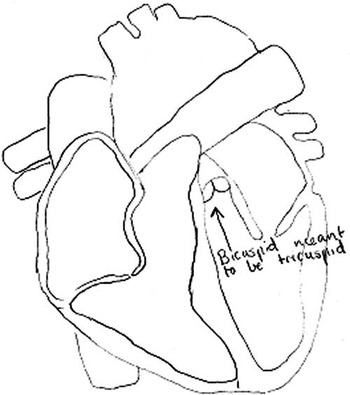
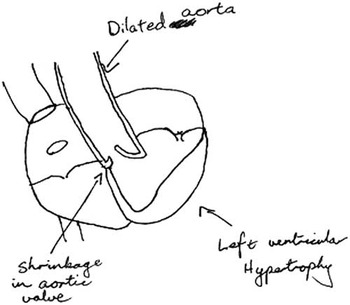
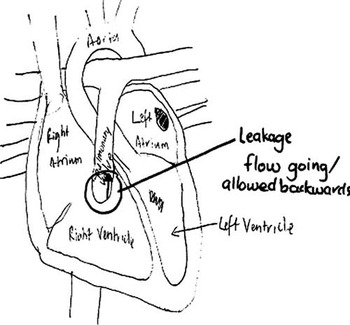
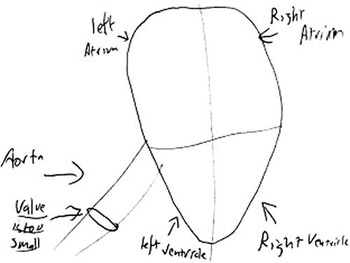
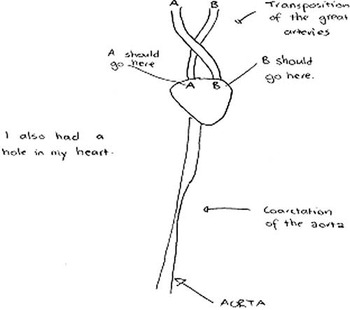
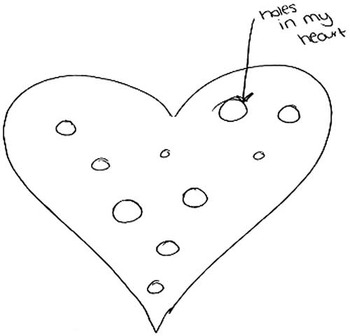
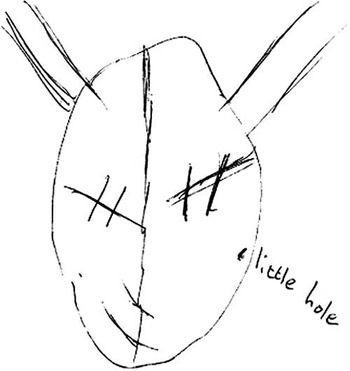
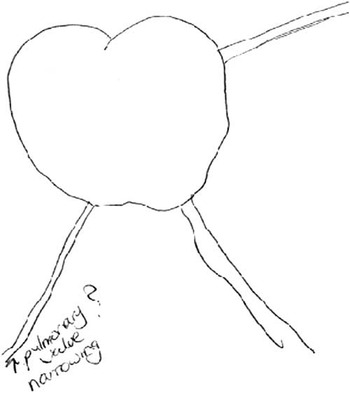
Only 60 (50%) of the patients completed the drawing, of whom one-third did so at the time of attendance. Only three patients, all completed at home, drew an accurate diagram (Figs 1–3). A further nine patients, four completed at home, drew a reasonably correct diagram (Figs 4–6), 13 patients, nine at home, only a partially correct diagram (Figs 7–9), whereas 35 patients, 24 at home, submitted incorrect diagrams (Figs 10–12). There was no significant difference in the accuracy of the adolescents’ drawing between adolescents who completed at home or at the clinic.
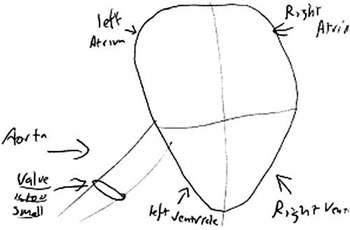
A correct picture drawn by Allan, aged 14 years, diagnosed with bicuspid aortic valve, completed at home.

A correct picture drawn by Emma, aged 17 years, diagnosed with aortic valve stenosis and hypertrophic left ventricle, completed at home.

A correct picture drawn by Ella, aged 17 years, diagnosed with pulmonary valve stenosis, completed at home.

A reasonably correct diagram drawn by Ben, aged 19 years, diagnosed with aortic valve stenosis, completed at the clinic.

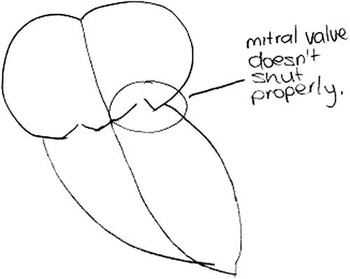
A reasonably correct diagram drawn by Bella, aged 16 years, diagnosed with mitral valve disease who had closure of ventricular septal defect done at 2 years of age, completed at home.

A reasonably correct diagram drawn by John, aged 15 years, diagnosed with ventricular septal defect and aortic valve prolapse, completed at the clinic.

A partly correct picture drawn by Alex, aged 16 years, diagnosed with aortic valve stenosis, completed at clinic.

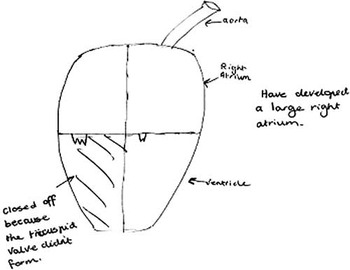
A partly correct picture drawn by Andy, aged 20 years, diagnosed with tricuspid atresia, hypoplastic left ventricle, completed at clinic.

A partly correct picture drawn by Jake, aged 19 years, diagnosed with transposition of the great vessels, ventricular septal defect, and coarctation of the aorta, completed at the clinic.

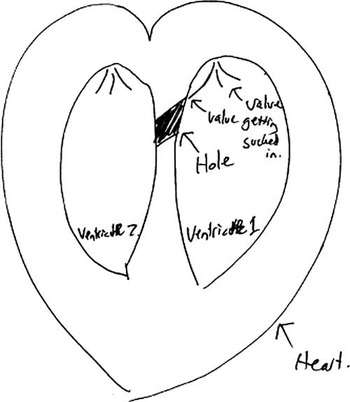
An incorrect picture drawn by Alice, aged 17 years, diagnosed with multiple ventricular septal defects, completed at home.

An incorrect picture drawn by Adam, aged 13 years, diagnosed with ventricular septal defects, completed at home.

An incorrect picture drawn by Bill, aged 14 years, diagnosed with mild pulmonary valve stenosis, completed at home.

There did not appear to be any correlation between the accuracy of the diagrams, the gender of the adolescent, or the severity of their cardiac abnormality.
Only 30% were able to correctly describe in writing their cardiac abnormalities. Out of them, 25% were able to give a partly correct or a reasonably correct description of their cardiac condition, 24 and 39, respectively. There were six patients who gave descriptions that were incorrect and 17 adolescents (14%) who did not know what their cardiac problem was.
• I: Incorrect description
Patient ID 61: There is a sound on my heart which most people don't have.
Comments: This patient misunderstood that murmur was the problem.
• II: Partly correct description
Patient ID 4: Got holes in it, weak.
Comments: This patient knew she had a hole in her heart, but did not mention where it was.
• III: Reasonably correct description
Patient ID 3: I think that the problem with my heart is one of the valves is letting a bit of blood back flow but from what I know it is not too serious at the present.
Comments: This patient identified that the problem was the valve, but did not mention which valve.
• IV: Completely correct description
Patient ID 2: One of the valves of my aortic is too small allowing a little bit of back flow to come through as the valve never finally closes.
Comments: This patient described the problems of his aortic valve
The accuracy of the adolescents’ drawings and their written description in their own language was significantly correlated (Pearson's correlation, r = 0.257; p < 0.01).
Discussion
This study confirmed that the majority of the adolescents had a poor knowledge of their cardiac abnormality as assessed by the illustrations they drew. Other studies also found that the children and adolescents had a poor understanding of their cardiac anomalies, though we have demonstrated this finding in a probably more simple way without the need of the adolescent to describe in so many words what was wrong with his or her heart or in terms which they may have had little understanding of.Reference Veldtman, Matley and Kendall2
The implications of these findings are meaningful. We have shown that a better understanding of their cardiac abnormality may lead to a better quality of life.Reference Wang17 It also has important implications as to how well or otherwise we educate our adolescents about their cardiac condition. Professionals usually believe that parents are able to impart knowledge about their child's cardiac condition to their child.Reference Ley18 That may not be true, as our study has shown. On the one hand, parents may wish to protect their children from the stresses and anxieties of their cardiac disease by limiting what they tell their children about their cardiac abnormality.Reference Cheuk, Wong, Choi, Chau and Cheung19 On the other hand, parents themselves may not have a clear knowledge of their offspring's cardiac condition.Reference Ley18 However, over the years, they may have forgotten what was told to them presumably in detail when their infant or child was younger and first presented, going through the planned treatment, catheter intervention and/or surgery.
One can also suggest that not all adolescents even with a good understanding of their cardiac abnormality are able to draw what may be wrong with their heart. If so, then they were the exceptions as in general the drawings reflected their understanding as confirmed from the review of their answers in the questionnaires.
This study would support the need for the ongoing education of adolescents themselves rather than through their parents taking into account their psychological transaction from that of dependent child to independent adult. A better understanding of their cardiac abnormality may well improve their quality of life and reduce their psychological burden, which will be the focus of an interventional study to try and confirm these outcomes.
Acknowledgements
We thank those cardiologists who allowed their patients to be studied and the patients and parents who agreed to participate in the study.