





Background
Cardiovascular diseases (CVDs), such as coronary heart disease and stroke, rank among the primary causes of mortality from non-communicable diseases globally and in Türkiye (World Health Organization, 2014; Derneği, 2015). The World Health Organization (WHO) indicates that incarceration elevates the risk of cancer and other preventable non-communicable diseases (World Health Organization, 2022). Identifying the risk of cardiovascular mortality is crucial for facilitating early intervention and initiating appropriate follow-up care and treatment for high-risk individuals. In Türkiye, primary healthcare services are delivered by family physicians and nurses working in family health centres located within correctional facilities. When sophisticated diagnostic tests or treatments are necessary, inmates are directed to the prison hospital, if accessible, or to the nearest state or university hospital otherwise.
Stress, insufficient physical exercise, restricted nutritional choices, and smoking or smoke exposure are key contributors to cardiovascular risk (CVR) (Plugge et al., Reference Plugge, Foster, Yudkin and Douglas2009; Esposito, Reference Esposito2010). Studies have shown that individuals with a history of incarceration exhibit an increased risk of cardiovascular illnesses and elevated rates of hospitalisation and mortality from CVDs more than the general population (Ünal et al., Reference Ünal, Ünal, Çetinkaya, İmalı, Gürler and Koç2016; Maruschak et al., Reference Noonan, Rohloff and Ginder2015; Noonan et al., Reference Noonan, Rohloff and Ginder2015).
This study aims to evaluate the cardiovascular disease risk and related factors among incarcerated individuals in a closed prison.
Methods
Study design, location, and duration
This research was designed as a cross-sectional descriptive study and was conducted between January 1st, 2023, and March 31st, 2023, at the Maltepe No. 3 L-Type Closed Prison in Istanbul.
Study population
The study population consisted of all foreign national male inmates aged 40–69 years who were registered with the Family Health Unit located within the prison settlement and volunteered to participate. One of the researchers was the family physician responsible for the healthcare of this prison population. Therefore, this population was selected for the study.
Characteristics of prison
The L-Type prison in which the study was conducted was a high-security closed correctional facility, designed in accordance with international standards, housing exclusively foreign male inmates aged 18 years and older. The facility generally has a high inmate turnover due to short-term sentences, transfers to other correctional facilities and similar reasons. During daytime hours, inmates had access to shared indoor living areas and outdoor exercise yards. The facility included an indoor sports hall, two artificial turf football fields, eight vocational workshops, six classrooms, a library, and a meeting hall. Inmates had the opportunity to participate voluntarily in educational, recreational, vocational, and cultural activities, subject to institutional rules and programme schedules. Meal planning was managed by a dietitian, and psychological and spiritual support services were available for inmates in need (Republic of Türkiye Ministry of Justice).
Exclusion criteria
-
• Individuals with mental, psychological, or physical disabilities that may hinder the interview.
-
• Individuals with a history of cardiovascular disease.
-
• Individuals under the influence of alcohol or drugs, or in withdrawal.
-
• Individuals currently participating in other clinical studies.
-
• Individuals who did not agree to the informed consent and study procedures.
Primary outcomes of the study
Cardiovascular risk level, total cholesterol, blood pressure values, smoking status.
Secondary outcomes of the study
The factors related to the CV risk of the participants such as age, hypertension, smoking, other chronic diseases, anthropometric measures such as weight, body mass index (BMI), and waist circumference (WC) values and laboratory values such as haemoglobin A1c (HbA1c), fasting blood glucose, low-density lipoprotein (LDL), high-density lipoprotein (HDL), triglycerides, total cholesterol, and their dietary habits and exercise behaviours.
Data collection
The data collection tools included a personal information form that captured the participants’ sociodemographic and clinical characteristics. The WHO Cardiovascular Risk Charts were used to estimate cardiovascular risk. These charts are specific to each participant’s country of origin, include separate charts for individuals with and without diabetes, and estimate cardiovascular risk based on age, gender, smoking status, systolic blood pressure, and total cholesterol (The WHO CVD Risk Chart Working Group, 2019). A physical examination form was used to record anthropometric measurements (height [cm], weight [kg], and waist circumference [cm]) and blood pressure (mmHg). The participants’ dietary habits and exercise behaviours were self-reported.
After explaining the study, voluntary participants were provided with the data collection tools through face-to-face interviews. The interviews and anthropometric measurements were conducted by the physician at the Family Health Center where the individuals were registered.
Among the 2,551 inmates, all of them male, 499 were in the age range of 40–69 years. Of these, 133 were excluded as they did not meet the inclusion criteria for the study shown in Figure 1. The anthropometric measurements and laboratory values of the participants were categorised according to accepted standards. Accordingly, obesity was defined using the BMI, calculated from height and weight measurements, and abdominal obesity was determined using waist circumference based on the WHO criteria (World Health Organization, 2023). Blood pressure measurements were conducted according to the European Society of Cardiology (ESC) hypertension guideline, and as only one measurement was taken, the average of the measurements were used in the analysis without grouping (Stergiou et al., Reference Stergiou, Palatini, Parati, O’Brien, Januszewicz, Lurbe, Persu, Mancia and Kreutz2021).
PRISMA flow diagram of participant selection.

Since the prison housed non-Turkish citizens, communication was facilitated by providing translation services in Arabic, Persian, and English.
The routine periodic health examination conducted during the inmates’ prison entry process, or any tests performed at another centre within the last three months (Total Cholesterol, HDL, LDL, Triglycerides, Fasting Blood Sugar, HbA1c), were retrospectively evaluated.
During manuscript preparation, ChatGPT (OpenAI) was used solely to improve the language and readability of the manuscript. No AI tool was used for data collection, data analysis, interpretation of results, or generation of scientific conclusions.
Data analysis
SPSS (version 23.0, SPSS Inc., Chicago, IL, USA) software was used for data analysis. The statistical analysis began with descriptive statistics, where categorical variables were represented as frequencies and percentages. The normality of continuous variables was assessed using the Kolmogorov–Smirnov test, along with evaluations of kurtosis, skewness, and visual inspections of Q-Q plots. Variables following a normal distribution were expressed as mean ± standard deviation, whereas non-parametric data were presented as medians (interquartile range). Continuous variables that do not follow a normal distribution were assessed using the Kruskal–Wallis test for comparisons among multiple groups and the Mann–Whitney U test for comparisons between pairs. Post hoc analyses were conducted to identify specific subgroup differences among categorical variables that demonstrated statistically significant associations.
Ethical approval and necessary permissions
The study received approval from the Clinical Research Ethics Committee of Marmara University Faculty of Medicine on 04.11.22, with protocol code 09.2022.1484. The research was conducted with permission from the General Directorate of Prisons and Detention Houses of the Ministry of Justice of the Republic of Turkey and the Ministry of Health of the Republic of Turkey, with written consent from the Istanbul Provincial Health Directorate and Maltepe District Health Directorate dated 29.12.2022 (E-57292265-204.04-1693/183584). Participants who met the inclusion criteria and agreed to participate were provided with detailed information face-to-face, and their consent was obtained by reading and signing the informed consent form.
Results
Sociodemographic characteristics of the participants
Our study was completed with 366 male participants, with a mean age of 47.4 ± 6.2 years. Participants were of non-Turkish origin, with 74.6% (n = 273) from Asia, 9.8% (n = 36) from Africa, 9.8% (n = 36) from Europe, and 5.7% (n = 21) from South America. The median length of stay in the current correctional facility was 7 months (min 1–max 168), while the median total duration of incarceration (including previous institutions) was 8 months (min 1–max 240 months). Sociodemographic characteristics are summarised in Table 1.
Sociodemographic characteristics of participants

Table 1. Long description
A table summarizing sociodemographic characteristics of participants. The table has 10 rows and 3 columns. The columns are labeled Age groups, Marital status, Educational status, Period of conviction, Continent of the country, and Employment status. The table provides data on the number (n) and percentage (%) of participants in each category. Row 1: Age groups 40-49, n 261, 71.37 percent. Row 2: Age groups 50-59, n 79, 21.6 percent. Row 3: Age groups 60-69, n 26, 7.1 percent. Row 4: Marital status Single, n 49, 13.4 percent. Row 5: Marital status Married, n 317, 86.6 percent. Row 6: Educational status Secondary school and below, n 178, 48.6 percent. Row 7: Educational status High school and above, n 188, 51.4 percent. Row 8: Period of conviction less than or equal to 1 year, n 259, 71 percent. Row 9: Period of conviction greater than 1 year-less than or equal to 5 years, n 75, 20.3 percent. Row 10: Period of conviction greater than 5 years-less than or equal to 10 years, n 17, 4.6 percent. Row 11: Period of conviction greater than or equal to 10 years, n 15, 4.1 percent. Row 12: Continent of the country Asia, n 273, 74.6 percent. Row 13: Continent of the country Europe, n 36, 9.8 percent. Row 14: Continent of the country Africa, n 36, 9.8 percent. Row 15: Continent of the country South America, n 21, 5.7 percent. Row 16: Employment status Unemployed, n 20, 5.5 percent. Row 17: Employment status Employed, n 346, 94.7 percent. Row 18: Total, n 366, 100 percent.
Health-related characteristics of the participants
Upon assessing the health-related attributes of the participants, the prevalence of previously diagnosed conditions was identified as follows: hypertension 5.2% (n = 19), diabetes mellitus 4.4% (n = 16), respiratory diseases 1.4% (n = 5), depression 0.8% (n = 3), and hypothyroidism 0.6% (n = 2).
The prevalence of current tobacco use was 70.5% (n = 258), while the prevalence of individuals who have quit and those who have never used tobacco were both 14.8% (n = 54). The frequency of participants with a history of alcohol and substance use were 31.1% (n = 114) and 21.6% (n = 79), respectively. Additionally, 49.7% (n = 182) of participants reported not exercising, while 25.7% (n = 94) reported engaging in regular exercise. Regarding eating habits, 59.0% (n = 216) reported eating three meals per day, and 36.1% (n = 132) reported eating no more than two meals per day.
Evaluation of participants’ cardiovascular risk
Cardiovascular risk was calculated using the WHO risk assessment charts, with the median risk score was 6% (min 1–max 52). According to the risk distribution, 33.6% (n = 123) were in the very low-risk group, 41.0% (n = 150) were in the low-risk group, 21.0% (n = 77) were in the moderate-risk group, 3.3% (n = 12) were in the high-risk group, and 1.1% (n = 4) were in the very high-risk group. For statistical analysis, these five categories were regrouped into three broader categories: low-risk (very low + low), moderate-risk, and high-risk (high + very high).
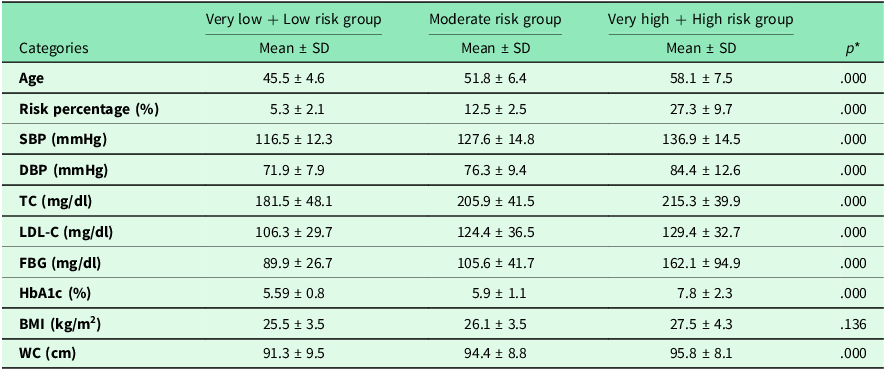
A comparative analysis of the mean values of age, anthropometric measurements, blood pressure, and laboratory parameters across the cardiovascular risk groups is presented in Table 2. Pairwise comparisons revealed statistically significant differences between all cardiovascular risk groups in terms of age and HbA1c.
Comparison of participants’ age, risk percentage, anthropometric measurements, and laboratory values among cardiovascular risk groups

Table 2. Long description
A table comparing cardiovascular risk groups across various health metrics. The table has 10 rows and 5 columns. The columns are labeled as Very low + Low risk group, Moderate risk group, Very high + High risk + group, and p*. The rows are labeled as Age, Risk percentage (percent), SBP (mmHg), DBP (mmHg), TC (mg/dl), LDL-C (mg/dl), FBG (mg/dl), HbA1c (percent), BMI (kg/m^2), and WC (cm). Each cell contains the mean and standard deviation values for each category. Notable trends include increasing values across the risk groups for most metrics, with significant differences indicated by p-values.
* Kruskal–Wallis test, p < 0.05.
SBP: Systolic blood pressure; DBP: Diastolic blood pressure; TC: Total cholesterol; LDL-C: Low-density lipoprotein; FBG: Fasting blood glucose; HbA1c: Glycated haemoglobin; BMI: Body mass index; WC: Waist circumference.
No statistically significant differences were observed between the moderate-risk group and the high-or very high-risk groups for SBP, DBP, TC and FBG. However, the significant differences shown in Table 2 were primarily driven by comparisons between the very low/low-risk group and the high/very high-risk group. The significant differences in LDL and BMI were due to higher means observed in the moderate-risk group compared to the very low and low-risk groups. No statistically significant difference was found in terms of total duration of incarceration or HDL between the groups (p = 0.995 and p = 0.818, respectively).
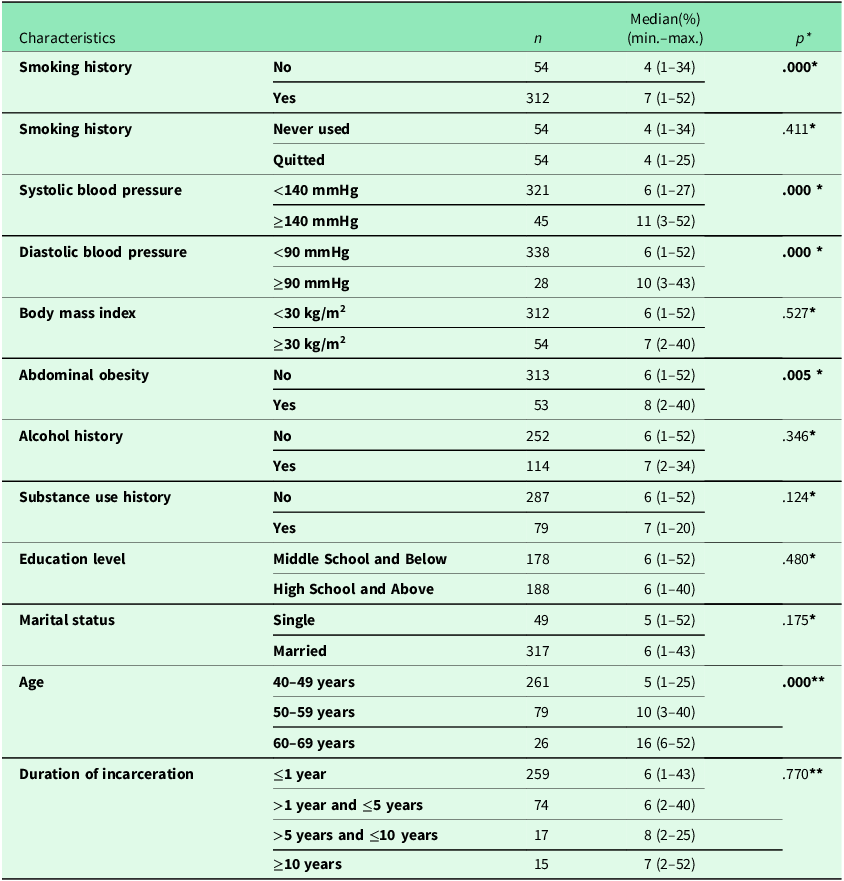
Comparison of the median risk percentage values of sociodemographic and health-related categorical variables is shown in Table 3.
Comparison of the median risk percentage values based on WHO risk assessment data for health and sociodemographic characteristics of participants

Table 3. Long description
A table comparing median risk percentage values for various health and sociodemographic characteristics. The table has 12 rows and 5 columns. Column headers are Characteristics, n, Median(%) (min.–max.), and p*. Row 1: Smoking history, No, 54, 4 (1–34), .000*. Row 2: Smoking history, Yes, 312, 7 (1–52), .000*. Row 3: Smoking history, Never used, 54, 4 (1–34), .411*. Row 4: Smoking history, Quitted, 54, 4 (1–25), .411*. Row 5: Systolic blood pressure, <140 mmHg, 321, 6 (1–27), .000*. Row 6: Systolic blood pressure, ≥140 mmHg, 45, 11 (3–52), .000*. Row 7: Diastolic blood pressure, <90 mmHg, 338, 6 (1–52), .000*. Row 8: Diastolic blood pressure, ≥90 mmHg, 28, 10 (3–43), .000*. Row 9: Body mass index, <30 kg/m2, 312, 6 (1–52), .527*. Row 10: Body mass index, ≥30 kg/m2, 54, 7 (2–40), .527*. Row 11: Abdominal obesity, No, 313, 6 (1–52), .005*. Row 12: Abdominal obesity, Yes, 53, 8 (2–40), .005*.
* Man-Whitney U, p < 0.05.
** Kruskal–Wallis Test, p < 0.05.
Discussion
Cardiovascular risk assessment
In our study, the cardiovascular risk of 366 male inmates in a L-type closed prison housing foreign nationals were calculated using the WHO cardiovascular risk assessment charts. For each participant the CVR assessment chart specialised according to his country region was used (The WHO CVD Risk Chart Working Group, 2019). The median cardiovascular risk score was found 6% (min 1–max 52); 74.6% (n = 273) of participants were in the very low and low-risk groups, 21.0% (n = 77) were in the moderate-risk group, and 4.4% (n = 16) were in the high and very high-risk groups. Comparative analyses of sociodemographic and health-related characteristics are discussed below.
In a study conducted by Packham et al., in six different prisons in the UK with 1207 male inmates, cardiovascular risk was calculated using QRISK2 (Cardiovascular Risk 2), and it was found that 10.2% of the participants had a risk score of 10% or higher (high-risk) (Packham et al., Reference Packham, Butcher, Williams, Miksza, Morriss and Kunti2020). This risk score was higher than our results. This difference may depend on the risk assessment tool used, besides the different conditions of the prisons, the number and the characteristics of the participants. In our study, because of the prison’s characteristics which was offered to prisoners such as access to healthcare, education and cultural programmes and opportunities for social interactions and sports activities could be interpreted as the reason of participants’ healthier lifestyle and their more fit body composition. In a health risk perception study conducted by Saleh et al., in a medium-security closed prison in the United States with 362 male inmates aged 18 and above, cardiovascular risk was calculated using the Framingham Risk Score, and it was reported that the mean risk score was below 10%, which is similar to our findings (Saleh et al., Reference Saleh, Connell, Lennie, Bailey, Elshatarat, Yousef and Moser2019).
Cardiovascular risk and related factors
In our results discussing in more detail below, there were statistically significant difference in the comparison of cardiovascular risk groups in terms of age, HbA1c, SBP, DBP, TC, LDL, FBG, and WC. Moreover, significant statistical differences were found between the cardiovascular risk percentages in terms of smoking status, systolic and diastolic blood pressure, abdominal obesity, and age.
Smoking, one of the major risk factors for cardiovascular disease, is more prevalent among inmates than in the general population (Ritter et al., Reference Ritter, Stöver, Levy, Etter and Elger2011; Herbert et al., Reference Herbert, Plugge, Foster and Doll2012; Donahue, Reference Donahue2014; Wang et al., Reference Wang, Redmond, Dennison Himmelfarb, Pettit, Stern, Chen, Shero, Iturriaga, Sorlie and Diez Roux2017). In our study, the frequency of smokers was 70.8% (n = 258). A review from the United States, which examined whether incarceration is a risk factor or an intervention point for coronary artery disease, reported that the smoking rate among inmates ranges from 70% to 83%, consistent with our findings (Donahue, Reference Donahue2014). Those with a history of smoking (both current and former smokers) had a higher median cardiovascular risk score compared to those who never smoked [7 (1–52) vs. 4 (1–34), p < 0.000]. No statistically significant difference was found in CVD risk score between participants who had quit smoking and those who had never smoked [4% (1–25) vs. 4% (1–34), p = 0.411]. Encouraging structured, sustainable and individualised smoking cessation programmes in prisons may improve both the quality and duration of life by lowering risk among smokers and protecting non-smokers from secondhand smoke as supported by the results of our study.
Cardiovascular risk score was found higher both systolic and diastolic blood pressure with ≥140 mmHg and/or ≥90 mmHg (p < 0.000). High systolic blood pressure is associated with high risk in cardiovascular risk calculation tools such as SCORE and WHO, and SBP is also a parameter in cardiovascular risk assessment (The WHO CVD Risk Chart Working Group, 2019; ESC Cardiovasc Risk Collaboration & SCORE2 Working Group, 2021). Wang et al. reported that incarceration is associated with future left ventricular hypertrophy and hypertension in young adults (Wang et al., Reference Wang, Pletcher, Lin, Vittinghoff, Kertesz, Kiefe and Bibbins-Domingo2009). Based on this, early diagnosis and treatment may help reduce the risk of cardiovascular disease development among inmates.
In our study, the frequency of high and very high cardiovascular risk was significantly higher among participants aged 60–69 years than among those in the other age groups (p < 0.001). Advanced age is one of the most important determinants of cardiovascular risk, particularly because it reflects a longer exposure to cardiovascular risk factors, and it is therefore included as a key parameter in cardiovascular risk prediction tools (The WHO CVD Risk Chart Working Group, 2019; Özdogan, Reference Özdoğan2020; ESC Cardiovascular Risk Collaboration & SCORE2 Working Group, 2021).
The rates of obesity and abdominal obesity were found to be lower than in the general population (15.2% and 15.1%, respectively). The physical characteristics of these individuals, who belong to different races and genetic backgrounds, may have positively influenced their cardiovascular health risk (Tabrizi et al., Reference Tabrizi, Sadeghi-Bazargani, Farahbakhsh, Nikniaz and Nikniaz2018; WHO, 2019, 2023). No statistically significant difference was found between participants with and without obesity regarding cardiovascular risk levels. However, participants with abdominal obesity had a higher CVR score than those without abdominal obesity consistent with literature (p = 0.005) (24–26). While some studies report that inmates are more overweight/obese than the general population (Arries et al., Reference Arries and Maposa2013; Agyapong et al., Reference Agyapong, Annan and Apprey2017; Herrera-Enriquez et al., Reference Herrera-Enriquez and Narvaez-Guerra2017), others suggest that the frequency of obesity is lower (Plugge et al., Reference Plugge, Foster, Yudkin and Douglas2009; Herbert et al., Reference Herbert, Plugge, Foster and Doll2012; Chari et al., Reference Chari, Simon, DeFrances and Maruschak2016; Mohan et al., Reference Mohan, Thomson, Leslie, Dimova, Haw and McKay2018; Bondolfi et al., Reference Bondolfi, Taffe, Augsburger, Jaques, Malebranche, Clair and Bodenmann2020). For example, a study by Mohan et al. suggested that diabetes, hypertension, and body mass index could be controlled and improved highly effective in Japanese prison environment, it is not enable to every country or culture, though (Mohan et al., Reference Mohan, Thomson, Leslie, Dimova, Haw and McKay2018).
In this study, participants with a history of substance use were found to have a higher CVR, which is consistent with the literature. Mongiatti et al. reported that 7.5% (n = 31) of 411 inmates hospitalised for cardiovascular disease in France had a history of substance use, and the frequency of cardiovascular disease increased among those who had used substances in the past decade (Mongiatti et al., Reference Mongiatti, Bayle, Lagarrigue, Fabre, Telmon, Lapeyre-Mestre and Jouanjus2020).
Statistically significant differences were found between the low-, moderate-, and high-risk groups in terms of total cholesterol, low-density lipoprotein, HbA1c, and fasting blood glucose. Accordingly, those with high cardiovascular risk had higher results in the aforementioned biochemical tests. Total cholesterol is a parameter in the WHO risk assessment (The WHO CVD Risk Chart Working Group, 2019), and it is also known that other biochemical tests are associated with high cardiovascular risk (The WHO CVD Risk Chart Working Group, 2019; Williams et al., Reference Williams, Karuranga, Malanda, Saeedi, Basit, Besançon, Bommer, Esteghamati, Ogurtsova, Zhang and Colagiuri2020; Bayram et al., Reference Bayram, Satman, Sabuncu, Sönmez, Cesur, Şahin, Güldiken, Eren, Fenkci, Ezgü, Aslan, Çarlıoğlu, Tamer, Dikbaş, Bozkırlı, Doğruk Ünal, Mete, Örük, Üçler, Haymana, Cander, İzol Torun, Yıldırım Şimşir, Tabur, Özsan Yılmaz, Demirci, Soyaltın and Or Koca2021; American Diabetes Assosication, 2021).
In our study, cardiovascular risk was evaluated in terms of the imprisonment duration by considering the current, previous and total, but no statistically significant differences were found between CVD risk categories and sentence lengths. Additionally, after classifying sentence lengths into groups of one, two, five, and ten years, no statistically significant differences were found in the comparisons of CVR levels between the groups. There are studies reporting that the prison environment or incarceration increases CVR, as well as studies suggesting that this effect is either unclear or underestimated (Donahue, Reference Donahue2014; ESC Cardiovasc Risk Collaboration & SCORE2 Working Group, 2021; World Health Organization, 2022; Howell et al., Reference Howell, Puglisi, Aminawung, Domingo, Elumn, Gallagher, Horton, Kazi, Krumholz, Lin, Roy and Wang2022). The Justice-Involved Individuals Cardiovascular Disease Epidemiology (JUSTICE) study mentions that imprisonment could be one of the factors contributing to the development and progression of CVD, although this has not been sufficiently researched (Howell et al., Reference Howell, Puglisi, Aminawung, Domingo, Elumn, Gallagher, Horton, Kazi, Krumholz, Lin, Roy and Wang2022). In Packham et al.’s study, there was no significant difference between the groups with sentence length shorter and longer than two years in terms of CVR, similar to our results (Saleh et al., Reference Saleh, Connell, Lennie, Bailey, Elshatarat, Yousef and Moser2019). In the Coronary Artery Risk Development in Young Adults (CARDIA) cohort study, 5105 participants, both with and without a history of incarceration, were followed for 30 years to assess CVR. In the initial analyses, those with a history of imprisonment had a higher rate of death due to CVD. However, after multivariable analyses, the statistical significance was no longer present (ESC Cardiovasc Risk Collaboration & SCORE2 Working Group, 2021). WHO-Guideline on Cancer and Cardiovascular Health Inequalities in Prison – Europe stated that CVD may develop later, but they do not specify a time frame for its association (World Health Organization, 2022). The relationship between incarceration duration and cardiovascular risk remains inconclusive. However, the relatively short median duration of incarceration (median 8 months) in our study may partly explain the high proportion of participants classified as having low cardiovascular risk, as this period may not have been sufficient for the prison environment to exert a substantial impact on cardiovascular risk profiles. Moreover, the relatively short duration of incarceration and the high turnover of the prison population may limit the implementation and continuity of long-term individualised preventive interventions, highlighting the need for flexible preventive strategies that can be initiated during incarceration and continued after transfer or release.
The strengths of this study include its conduct in a primary care setting, where cardiovascular risk assessment and preventive care are integral to routine clinical practice. In addition, it is among the few studies to estimate cardiovascular risk in incarcerated individuals using the WHO Cardiovascular Risk Charts tailored to each participant’s country of origin. These findings may contribute to future research and evidence-based cardiovascular prevention strategies in prison populations.
We acknowledge several limitations of our study. The cross-sectional design precludes causal inference between incarceration-related factors and cardiovascular risk. Participation in prison-based activities was voluntary, and lifestyle information, including dietary and exercise behaviours before and during incarceration, was self-reported. Therefore, participants’ engagement could not be standardised or objectively assessed, and recall and social desirability bias may have been introduced, particularly in the prison setting. Furthermore, participants originated from different countries, and differences in genetic background, lifestyle, dietary habits, and cultural characteristics may have influenced the observed cardiovascular risk profiles. The relatively short median duration of incarceration also limited evaluation of its potential long-term impact on cardiovascular risk. Finally, the findings may not be generalisable beyond similar prison settings and populations.
In conclusion, cardiovascular risk assessment based on the WHO guidelines revealed a low frequency of high and very high cardiovascular risk among foreign male inmates in this prison. Given that preventive care has traditionally received less emphasis in prison healthcare than in the general community (Thomas et al., Reference Thomas, Wang, Curry and Chen2016), strengthening preventive services is particularly important. Although the relatively short duration of incarceration may limit the long-term sustainability of lifestyle interventions, prison settings may still offer opportunities to initiate preventive measures and raise awareness of healthier lifestyle behaviours. Strengthening preventive healthcare in prisons may improve inmates’ health while contributing to broader public health and socioeconomic benefits.
Data availability statement
Data is available without revealing personal details after obtaining the necessary institutional permissions. Data requests should be made to the corresponding author.
Acknowledgements
Not applicable.
Author contributions
AU and BC – designed the research study; YDK wrote first draft; reviewed the manuscript. BC – performed the research, YDK and AU analysed the data. YDK and AU – authored the discussion and the conclusion section of the manuscript. BC – contributed to drafting and revising the introduction. All authors contributed to editorial changes in the manuscript, and all authors read and approved the final manuscript.
Funding statement
This research received no specific grant from any funding agency, commercial or not-for-profit sectors.
Competing interests
None.
Ethical standards
The study received approval from the Clinical Research Ethics Committee of Marmara University Faculty of Medicine on 04.11.22, with protocol code 09.2022.1484. The research was conducted with permission from the General Directorate of Prisons and Detention Houses of the Ministry of Justice of the Republic of Turkey and the Ministry of Health of the Republic of Turkey, with written consent from the Istanbul Provincial Health Directorate and Maltepe District Health Directorate dated 29.12.2022 (E-57292265-204.04-1693/183584). Participants who met the inclusion criteria and agreed to participate were provided with detailed information face-to-face, and their consent was obtained by reading and signing the informed consent form.



 Open access

