Introduction
Many studies have found that children of depressed parents are at risk for poor functioning (Goodman & Gotlib, Reference Goodman and Gotlib2002), but few followed children when they reached adulthood. Studies of the impact of parental depression have generally examined cross-sectional or short-term effects on young children or adolescents. Our primary aim was to compare adults who were offspring of depressed parents (ODPs) or offspring of control parents (OCPs) on functioning across life domains. Secondarily, we focused on whether the course of parental depression was associated with adult offspring's functioning.
Comparing ODPs to OCPs
Adult children of depressed or psychiatrically impaired parents report more psychological and social impairment (Williams & Corrigan, Reference Williams and Corrigan1992). A study following children from age 6 to age 32 found that, when their mothers had persistent depression and anxiety, offspring had 2.5 times the risk of lifetime depressive disorder and were more likely to drop out of high school (Ensminger et al. Reference Ensminger, Hanson, Riley and Juon2003). A 4-year study of adolescents and young adults also found that parental major depressive disorder (MDD) increased offspring's risk for depression, anxiety, and substance use disorders (Lieb et al. Reference Lieb, Isensee, Hofler, Pfister and Wittchen2002). In a 25-year follow-up of children of parents hospitalized for depression or a control (medical) condition, ODPs had higher rates of anxiety and substance use disorders, but not of affective disorders or overall psychological morbidity (Peisah et al. Reference Peisah, Brodaty, Luscombe and Anstey2004).
A 10-year follow-up of young adult offspring found that, compared with controls, ODPs had increased rates of MDD, anxiety disorders, alcohol dependence, and social impairment (Weissman et al. Reference Weissman, Warner, Wickramaratne, Moreau and Olfson1997). A 20-year follow-up of the same sample found ODPs to have a higher risk of mood and anxiety disorders and physical health problems, but not substance abuse (Weissman et al. Reference Weissman, Wickramaratne, Nomura, Warner, Pilowsky and Verdeli2006a). In the domain of physical health, cardiovascular disease was somewhat more likely among ODPs. Although there were no differences in marital, parental, nuclear family, or leisure functioning, ODPs were more socially impaired at work and in the extended family. In addition, ODPs used more outpatient mental health treatment.
Course of parental depression
Greater severity and chronicity of parental depression has been linked to greater offspring impairment (Radke-Yarrow, Reference Radke-Yarrow1998). In Peisah and co-workers' (Reference Peisah, Brodaty, Luscombe and Anstey2004) study, among depressed parents, 12.5% recovered and remained well, 83.3% experienced recurrences, and 4.2% experienced an unremitting course of depression over the 25-year follow-up. That study did not link the course of parental depression to children's long-term functioning. At a 10-year follow-up of the sample used here in which offspring were rated by parents, children living with partially remitted and non-remitted parents had more psychological distress, physical problems, and disturbance than did OCPs, and families of partially and non-remitted depressed parents were less cohesive and more conflicted than were control families. Surprisingly, children of stably remitted parents had as much distress and disturbance as children of partially or non-remitted parents (Timko et al. Reference Timko, Cronkite, Berg and Moos2002). Children living with parents treated for depression appeared to be at risk for problems irrespective of the parent's course.
To our knowledge, there have been only two other long-term follow-ups of offspring of parents treated for depression (Peisah et al. Reference Peisah, Brodaty, Luscombe and Anstey2004; Weissman et al. Reference Weissman, Wickramaratne, Nomura, Warner, Pilowsky and Verdeli2006a). In addition to examining the outcome domains of those studies, we also focus on disability and pain, work environment, and stressor severity and coping skills. Pain, disability, and depression often present as a cluster (Arnow et al. Reference Arnow, Hunkeler, Blasey, Lee, Constantino, Fireman, Kraemer, Dea, Robinson and Hayward2006). In the workplace, depression is the most prevalent mental disorder (Sanderson & Andrews, Reference Sanderson and Andrews2006) and is associated with impaired job performance (Adler et al. Reference Adler, McLaughlin, Rogers, Chang, Lapitsky and Lerner2006), as well as with more severe chronic and acute life stressors and impaired coping, for example, diminished problem-solving; more avoidance, emotion-focused coping; cognitive distraction (Ravindran et al. Reference Ravindran, Matheson, Griffiths, Merali and Anisman2002; Matheson & Anisman, Reference Matheson and Anisman2003; Holahan et al. Reference Holahan, Moos, Holahan, Brennan and Schutte2005). To further extend the existing literature, we link the parents' long-term course of depression to the adult children's outcomes. Having found that children living with parents treated for depression (even stably remitted parents) were still impaired at 10 years, we now consider whether these impairments remain at 23 years when the offspring are adults approaching or in middle age.
In summary, this study asked: (1) How do depressed and control parents' offspring compare on domains assessing depressive and other symptoms, physical functioning and disability, social functioning, and utilization of help and coping; and, (2) Is the parent's course of depression (remitted, partially remitted, non-remitted) associated with the adult offspring's functioning?
Method
Sample
The sample consisted of adult children of parents who participated in a larger study of depression. The sample for the larger study was 424 depressed individuals who entered treatment and were diagnosed with a unipolar depressive disorder according to Research Diagnostic Criteria (RDC; Spitzer et al. Reference Spitzer, Endicott and Robins1978; Billings & Moos, Reference Billings and Moos1984). Follow-ups were conducted 1, 4, 10, and 23 years after treatment intake.
Of the 424 patients, 120 (28%) had died by the 23-year follow-up. Of the remaining 304, 248 (82%) were successfully followed at 23 years. The 248 followed patients identified 215 adult offspring (18 years old or older) to whom questionnaires were mailed. (The Institutional Review Board on Human Subjects Research overseeing this study prohibited us from contacting offspring of deceased parents; however, at baseline, depression severity did not differ between subsequently deceased and followed depressed parents.) Of the 215 identified, 143 (67%) returned a completed informed consent form and questionnaire. Analyses comparing baseline sociodemographic and psychiatric characteristics of parents whose adult child did or did not participate revealed no significant differences between groups.
Controls
A matched sample of 368 non-depressed individuals was obtained at baseline as a comparison group. Of these 368, 69 (19%) died by the 23-year follow-up. Of the remaining 299, 236 (79%) were successfully followed at 23 years. The 236 controls identified 261 offspring to whom questionnaires were mailed; 177 (68%) provided informed consent and completed a questionnaire. There were no sociodemographic or psychiatric status differences between parents whose adult child did or did not participate.
Measures
Respondents completed the Health and Daily Living Form (HDL; Moos et al. Reference Moos, Cronkite and Finney1992), pain measures by Von Korff et al. (Reference Von Korff, Ormel, Keefe and Dworkin1992), the Patient Health Questionnaire (PHQ-9; Kroenke et al. Reference Kroenke, Spitzer and Williams2001), the Relationships domain of the Family Environment Scale (FES; Moos & Moos, Reference Moos1994), and the Work Environment Scale (WES; Moos, Reference Moos1994), and an adaption of the Coping Responses Inventory (CRI; Moos, Reference Moos1993). The measures are similar to other commonly used indexes, have strong psychometric properties, have good reliability and convergent and predictive validity, and are relatively stable and predictably associated with other indices of functioning (Holahan & Moos, Reference Holahan and Moos1991; Moos et al. Reference Moos, Cronkite and Moos1998; Holahan et al. Reference Holahan, Moos, Holahan and Cronkite1999). For example, these measures have been shown to discriminate between depressed and non-depressed individuals, and between individuals with remitted or non-remitted depression.
Depression symptoms
Measures of depression symptoms were contained in the HDL. The adult offspring's global depression was based on the Depressive Symptoms Severity Index (DSSI; Moos et al. Reference Moos, Cronkite and Moos1998). The DSSI is composed of a subset of 10 symptoms selected from the RDC (Spitzer et al. Reference Spitzer, Endicott and Robins1978) to form the basis for the DSM-IV criteria for a major depressive episode; items were rated on five-point scales (0=never, 4=often, in the past month) and summed, with Cronbach's α=0.90. The DSSI was also used to classify offspring as depressed based on: reported feeling sad/blue and experiencing a loss of interest and at least three other depression symptoms ‘sometimes’ or more often. Subscales assessed depressed mood and ideation (seven mood-related symptoms were summed; α=0.92) and endogenous depression (sum of eight items; α=0.85). These four indices were used in previous follow-ups. In addition, the depression module of the PHQ-9 yields two indices: major depression (five or more of nine depressive symptom criteria were present at least ‘more than half the days’ in the past 2 weeks, and one of the symptoms was depressed mood or anhedonia), and depression severity (each of the nine items was scored from 0=not at all, to 3=nearly every day, and summed; α=0.89).
Other psychiatric/behavioral problems
Measures of other psychiatric/behavioral problems are contained in the HDL. Symptoms of anxiety was a count of five items the respondent experienced fairly often in the past year (α=0.76). Self-concept was the sum of six items rated from 0 (not at all) to 4 (quite accurately), regarding how well the item described the respondent (α=0.83). In addition to noting whether they smoked tobacco or drank alcohol, participants recorded how much they usually drank on past-month drinking days. Responses were coded as ounces of ethanol and summed to obtain the average amount of ethanol consumed on drinking days. The questionnaire listed nine problems due to drinking in the past year; respondents were classified as to whether or not they experienced at least one drinking-related problem.
Physical functioning, disability, and pain
On the HDL, respondents noted whether they experienced each of 12 physical symptoms fairly often and each of 14 chronic medical conditions diagnosed by a physician during the past year. They were classified as to whether or not they had experienced one or more of these symptoms or of these conditions.
Respondents were classified as to whether or not they were kept in bed by physical health or emotional problems during the past month. For those who were, we report the number of days kept in bed by problems.
On the HDL, respondents reported whether or not they were currently troubled by pain. Van Korff and colleagues' (Reference Von Korff, Ormel, Keefe and Dworkin1992) disability score was computed by averaging three items assessing the extent to which pain interfered with daily activities; recreational, social, and family activities; and ability to work, including housework (0=no interference, 10=unable to carry on activities), and then multiplying by 10. For the PHQ pain index, five items referring to pain problems in the past month were summed (0=not bothered, 2=bothered a lot).
Social, family, and work functioning
On the HDL, respondents reported their number of friends, number of close friends, and number of people from whom real help can be counted on in times of trouble. Respondents also reported how many of 12 activities they had done or attended with friends, and with family, in the past month. Quality of social resources was the sum of six items (0=never, 4=often) regarding feeling supported in one's most important relationship.
Respondents completed the Relationships domain of the FES and the WES with regard to their current family and work environment, respectively. The FES Relationship domain assesses Cohesion (α=0.73), Expressiveness (α=0.67), and Conflict (α=0.76). The Relationship domain of the WES includes Involvement (concerned about and committed to job; α=0.79), Co-Worker Cohesion (supportive and friendly towards employees; α=0.72), and Supervisor Support (management supports employee; α=0.77). The score for each subscale is the sum of nine yes/no items.
Help used
On the HDL, respondents noted whether or not they had been: hospitalized for depression in the past 13 years (since the 10-year follow-up), and hospitalized for any reason during that time period, and if so, the total number of days hospitalized. Mental health help sources used was the count of seven types of professional mental health care providers from whom the respondent had ever obtained help. We calculated whether or not respondents had obtained help from at least one mental health care provider ever, and in the past year. Respondents were asked whether they had ever taken antidepressant medication. Twelve antidepressant brand-name medications were asked about separately, and respondents were advised to check their records and/or medicine cabinet in order to be accurate. Answers were used to create one yes/no item.
Coping
Respondents identified the most stressful situation experienced during the past year, which was coded on stressor severity (0=least severe, 100=most severe; Holmes & Rahe, Reference Holmes and Rahe1967). On the CRI, respondents rated how often they relied on 38 strategies to cope with the stressor (0=never, 3=fairly often). Coping strategies included cognitive approach (sum of 11 items; α=0.64), behavioral approach (13 items; α=0.75), avoidance (eight items; α=0.70), and seeking alternative rewards (six items; α=0.77).
Results
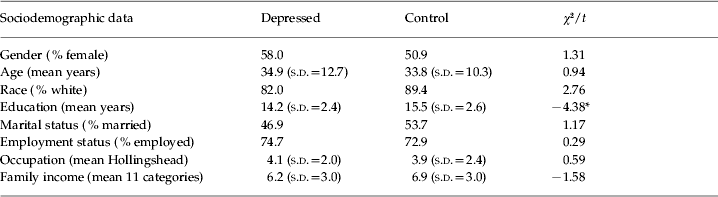
We compared the two groups on sociodemographic characteristics using χ2 and t tests (Table 1). ODPs had fewer years of education than did OCPs. Because women and men differ in the etiology and course of depression and responses to treatment (Kahn et al. Reference Kahn, Brodhead, Schwartz, Kolts and Brown2005; Breslin et al. Reference Breslin, Gnam, Franche, Mustard and Lin2006), and there were more women among the offspring of depressed parents (albeit not significantly), we controlled for gender as well as education in subsequent analyses.
Sociodemographic characteristics of offspring of depressed (n=143) and control (n=177) parents

Hollingshead occupation codes range from 1=highest status to 7=lowest status; family income categories range from 1=less than $10 000 to 11=$150 000 or more.
* p=0.0001.
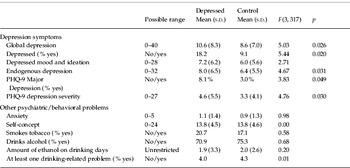
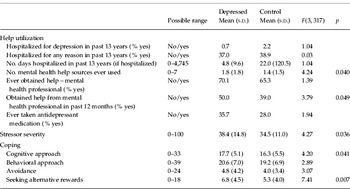
We next conducted analyses of covariance (ANCOVAs) comparing the two groups on depression and other psychiatric/behavioral problems (Table 2), physical functioning, disability, and pain (Table 3), social and work functioning (Table 4), and help utilization, and stressor severity and coping (Table 5). Table 2 shows that ODPs were more likely to be classified as depressed according to self-reported symptoms associated with DSM-IV criteria as measured by the DSSI and PHQ-9, and had more global, endogenous, and severe depression. In contrast, the two groups did not differ on anxiety symptoms, general self-concept, use of tobacco or alcohol, or drinking-related problems.
Analyses of covariance comparing offspring of depressed (n=143) and control (n=177) parents on psychiatric symptoms, controlling for offspring's gender and education

PHQ, Patient Health Questionnaire.
Values shown are adjusted means; for each scale, higher scores represent more of the construct assessed; p values are provided only if p<0.05.
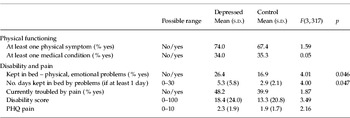
Analyses of covariance comparing offspring of depressed (n=143) and control (n=177) parents on physical functioning, disability, and pain, controlling for offspring's gender and education

PHQ, Patient Health Questionnaire.
Values shown are adjusted means; for each scale, higher scores represent more of the construct assessed; p values are provided only if p<0.05.
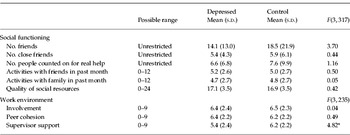
Analyses of covariance comparing offspring of depressed (n=143) and control (n=177) parents on social functioning and work environment, controlling for offspring's gender and education

Values shown are adjusted means; for each scale, higher scores represent more of the construct assessed; for work environment, n=109 employed offspring of depressed parents, and n=129 employed offspring of control parents.
* p=0.028.
Analyses of covariance comparing offspring of depressed (n=143) and control (n=177) parents on help utilization, stressor severity, and coping, controlling for offspring's gender and education

Values shown are adjusted means; for each scale, higher scores represent more of the construct assessed; p values are provided only if p<0.05.
The two groups also did not differ on physical functioning or pain indices (Table 3). ODPs were more likely to have been kept in bed by physical or emotional problems, and those who were kept in bed were in bed for a greater number of days. The two groups did not differ on social functioning (Table 4) or on FES indices (not tabled). ODPs reported less supervisory support at work (Table 4).
Furthermore, the two groups did not differ on hospitalizations, likelihood of having ever obtained help from a mental health professional, or use of antidepressant medications (Table 5). However, ODPs used a greater number of resources for help with mental health problems, and were more likely to have obtained help from a mental health professional in the past year. ODPs reported a more severe stressor than did OCPs (Table 5) and were more likely to rely on cognitive approach coping and seeking alternative rewards (Table 5).
Course of parents' depression
Subsidiary analyses focused on ODPs who, over the 23-year period, were stably remitted (27.0%), partially remitted (46.0%), or non-remitted (27.0%). Briefly, parents were classified as stably remitted if they were remitted for at least three of the four follow-ups and partially remitted at the remaining follow-up; non-remitted if they were non-remitted for at least two follow-ups and partially remitted at the remaining follow-up(s); and partially remitted otherwise (for details, see Cronkite et al. Reference Cronkite, Swindle, Robinson and Moos2006; available by request). We conducted ANCOVAs comparing these three groups to the OCPs (controlling for gender and education) on variables in the domains on which we identified overall group differences, as shown in Tables 2–5.
Offspring of parents with non-remitted depression had significantly more severe symptoms than OCPs did on global depression (F=5.03, p<0.01; means=11.8 v. 8.7, t=2.11, p<0.05) and the PHQ-9 depression severity index (F=4.76, p<0.05; means=5.6 v. 3.4, t=2.31, p<0.05). In addition, offspring of partially remitted parents were more likely to be classified as depressed according to the PHQ-9 than were OCPs (F=3.82, p<0.05; 10.2% v. 3.5%, t=1.97, p<0.05).
Compared with OCPs, offspring of partially remitted parents also were kept in bed a greater number of days by physical or emotional problems in the preceding month (F=6.44, p<0.01; means=8.0 v. 2.9, t=3.24, p<0.01). Unexpectedly, offspring of stably remitted parents were more likely to have been kept in bed at all by such problems (F=4.01, p<0.05; 45.5% v. 17.2%, t=3.50, p<0.001). In reports of the work environment, offspring of both non-remitted (F=4.82, p<0.01; mean=5.0, t=2.00, p<0.05) and stably remitted (mean=4.8, t=2.20, p<0.05) parents experienced less supervisor support than controls (mean=6.2) did. There were no differences between the ODP or OCP groups on whether help was obtained from a mental health professional ever, or in the past year. Finally, groups did not differ on stressor severity ratings, but in the coping domain, offspring of non-remitted parents were more likely than OCPs to rely on cognitive approach coping (F=4.20, p<0.05; means=19.6 v. 16.2, t=3.03, p<0.01).
Subsidiary analyses
In light of Weissman and co-workers' (Reference Weissman, Wickramaratne, Nomura, Warner, Pilowsky and Verdeli2006a) finding on cardiovascular disease, we analyzed the item asking about ‘heart trouble’ in the past year and found that ODPs were more likely than OCPs to report this medical condition when gender and education were controlled (4% v. 0%; F=6.81, p<0.01). In addition, heart trouble was more frequent among offspring of partially remitted (5%) and non-remitted (3%) parents than among offspring of stably remitted (0%) or control (0%) parents (F=3.39, p<0.05).
To obtain the full range of functioning among ODPs and OCPs, our sample included siblings from the same family (Keller et al. Reference Keller, Beardslee, Dorer, Lavori, Samuelson and Klerman1986). Accordingly, we re-ran the analyses using one randomly selected offspring from each family. Results for differences between depressed and control families, and by course of parental depression, retained the same patterns.
Discussion
The greater impairment of adult ODPs than of OCPs was limited mainly to two domains: depression and disability. In keeping with their greater depression and disability, ODPs obtained more help for mental health problems. ODPs also reported recent stressors of greater severity, and relied more on particular strategies to cope with stressors. There were a number of domains in which adult ODPs or OCPs did not differ, including psychiatric and behavioral problems other than depression, physical functioning and pain, social and family functioning, and hospitalizations and medication use for depression. Taken together, the findings suggest that having a parent with depression, although associated with more depression and disability in adulthood, does not have a debilitating influence by pervading other life domains.
Adult offspring of depressed or control parents
Adult ODPs were more likely than controls to be classified as depressed according to self-reported symptoms associated with DSM-IV criteria, and had more severe depression and more endogenous and global depression. ODPs also had greater disability, in that they were more likely to have been kept in bed by physical/emotional problems, and were kept in bed longer. Depression in ODPs is generally conceptualized as due to interactions between genetic factors and stressors in the family and the wider social context (Ensminger et al. Reference Ensminger, Hanson, Riley and Juon2003). About 40–50% of the relationship between mothers' and children's depressive symptoms may be due to genetic linkage (Rende et al. Reference Rende, Plomin, Reiss and Hetherington1993; Kendler, Reference Kendler1995). The non-genetic contribution to the poorer mental health and greater disability of ODPs may be explained by having a depressed parent, or by external influences that affect both parent and child. For example, depression may directly impair parents' ability to support and supervise children, and is associated with more hostile and critical parenting (Downey & Coyne, Reference Downey and Coyne1990; Cummings & Davies, Reference Cummings and Davies1994; Johnson et al. Reference Johnson, Cohen, Kasen, Smailes and Brook2001). In addition, both parents' and offspring's depression may be the consequence of contextual factors such as social disadvantage, marital discord, and adverse family life events (Rutter, Reference Rutter1990; Adrian & Hammen, Reference Adrian and Hammen1993; Forehand et al. Reference Forehand, Biggar and Kotchick1998).
Compared with controls, ODPs used more resources for help with mental health problems in their lifetime and were more likely to have obtained help from a mental health professional in the past year. Weissman and colleagues' (Reference Weissman, Wickramaratne, Nomura, Warner, Pilowsky and Verdeli2006a) 20-year follow-up also found that ODPs were more likely than OCPs to have obtained out-patient treatment for emotional problems. In light of findings from community surveys that people are reluctant to seek help for depression (Barney et al. Reference Barney, Griffiths, Jorm and Christensen2006), it is encouraging that offspring with elevated levels of problems had higher rates of help-seeking.
ODPs, compared with controls, reported experiencing a more severe stressor in the past year. As noted, families of depressed parents are known to have relatively greater numbers of life stressors, but the extent to which offspring are at risk for experiencing more severe stressors as adults has not been studied. ODPs were more likely to rely on cognitive approach coping (logically analyzing or reappraising the stressor in a more positive light) and seeking alternative rewards (behavioral attempts to participate in substitute activities and create new sources of satisfaction). Among adolescents living with depressed parents, secondary control coping, which involves elements related to cognitive approach coping (positive thinking, cognitive restructuring) and seeking alternative rewards (distraction), was associated with fewer depression and anxiety symptoms and mediated between parental stressors and symptoms (Langrock et al. Reference Langrock, Compas, Keller, Merchant and Copeland2002; Jaser et al. Reference Jaser, Langrock, Keller, Merchant, Benson, Reeslund, Champion and Compas2005). Because stressors related to parental depression are likely beyond offspring's control, secondary control coping, which is relatively effective in uncontrollable stressful situations (Weisz et al. Reference Weisz, McCabe and Denning1994), may be more adaptive than primary control coping (taking direct action to change the stressful situation) (Jaser et al. Reference Jaser, Langrock, Keller, Merchant, Benson, Reeslund, Champion and Compas2005).
Offspring of depressed or control parents did not differ on anxiety, self-concept, use of tobacco or alcohol, drinking-related problems, physical functioning, pain, social functioning, family environment, hospitalizations, or medication use. Weissman and colleagues' (Reference Weissman, Wickramaratne, Nomura, Warner, Pilowsky and Verdeli2006a) 20-year follow-up similarly found few significant differences between ODPs and controls on substance abuse, social functioning, or lifetime hospitalizations for emotional problems and use of psychotropic medications.
We found that ODPs, particularly offspring of parents with a non-remitted or partially remitted course, were more likely than controls to report heart trouble. In commenting on similar findings, Weissman et al. (Reference Weissman, Wickramaratne, Nomura, Warner, Pilowsky and Verdeli2006a) noted the increased risk for the development of coronary artery disease conferred by MDD in patients initially free of clinical cardiac disease (Rudisch & Nemeroff, Reference Rudisch and Nemeroff2003) and the need for additional research to confirm and explain suggestions of more coronary-related problems in depressed individuals. Furthermore, similar to Weissman and colleagues' (Reference Weissman, Wickramaratne, Nomura, Warner, Pilowsky and Verdeli2006a) finding on social impairment at work, we found that ODPs reported less support from supervisors at work than did controls.
Course of parental depression
On the whole, adult offspring of parents with a non-remitted course of depression over 23 years were most likely to show impaired functioning compared with controls, including more global depression, and more severe depression. In addition, offspring of non-remitted parents reported experiencing a more severe stressor and using more cognitive approach coping. Offspring of parents with partially remitted depression were also functioning more poorly than controls in that they were more likely to be classified as depressed according to the PHQ-9 and had more disability days. Apart from the work environment, offspring of stably remitted parents differed from controls on only one index: they were more likely to have had at least one disability day.
These results stand in contrast to results of our 10-year follow-up (Timko et al. Reference Timko, Cronkite, Berg and Moos2002). Then, children of stably remitted parents had as much psychological distress and disturbance as children of partially remitted or non-remitted parents, and all three groups scored higher on these indices than did controls. Together, the 10- and 23-year results suggest that the negative impact of parental depression seen when children are living in their childhood home is sustained into adulthood only when the course of parental depression is non-remitting.
Limitations and conclusions
Results of this study must be considered in light of the methods used. First, the measures were self-report, with no external corroboration. However, the DSSI is based on criteria for a DSM-IV diagnosis of depression, and the diagnostic validity of the PHQ is well-established (Kroenke et al. Reference Kroenke, Spitzer and Williams2001). In addition, previous waves of this study showed agreement between self-report and collateral data on participants' life context factors (Billings & Moos, Reference Billings and Moos1984; Swindle et al. Reference Swindle, Cronkite and Moos1989). Nevertheless, future research is needed to extend our findings to include corroborating reports of depression and related functioning from clinical interviews and collaterals. Second, although the 23-year attrition rates were somewhat higher for offspring than of depressed patients and for offspring of controls, they were comparable to the 30% attrition rate of offspring in Weissman and co-workers' (Reference Weissman, Wickramaratne, Nomura, Warner, Pilowsky and Verdeli2006a) 20-year study.
Results suggest that it may be important for ODPs, particularly offspring of parents with a non-remitting or partially remitted course of depression, to obtain help to prevent and treat their own depression and disability (Beardslee, Reference Beardslee2002). In addition to treatment for depression, help might also focus on teaching skills to engage in cognitive and behavioral problem-solving coping with regard to parental depression and its ramifications (Jaser et al. Reference Jaser, Langrock, Keller, Merchant, Benson, Reeslund, Champion and Compas2005). Active coping strategies may serve not only to decrease depression, but also to increase positive affect, which then engenders more life successes (Lyubomirsky et al. Reference Lyubomirsky, King and Diener2005). Obtaining help may benefit not only the adult offspring, but their children as well (Weissman et al. Reference Weissman, Pilowsky, Wickramaratne, Talati, Wisniewski, Fava, Hughes, Garber, Malloy, King, Cerda, Sood, Alpert, Trivedi and Rush2006b). Possibly, future research will find that routine monitoring of ODPs as youths, in order to prevent psychosocial problems and address them promptly and thoroughly if they occur, will alleviate depression and disability in adulthood.
Acknowledgments
This work was supported by Eli Lilly and Company and the Department of Veterans Affairs Office of Research and Development (Health Services Research and Development Service). We thank Genery Booster, Ilana Mabel, Jacob Robson, and Donna Roybal for help with data collection, and Cassandra Sandino for help with this paper. The views expressed here are the authors' and do not necessarily represent the views of the Department of Veterans Affairs.
Declaration of Interest
None.