INTRODUCTION
All linguistic data that are available for analysis have been collected and recorded by someone in some context. Many formalist linguists decontextualize linguistic data and organize them into abstract categories, viewing the empirical study of linguistic performance as merely a means to an end (Gumperz 1982); however, sociolinguists and linguistic anthropologists historically have paid somewhat more attention to the sociocultural context of linguistic performance as well as to the effect that the fieldworker can have on this performance. The most prominent sociolinguistic consideration of fieldworker effect has been the postulation of the “observer's paradox,” in which awareness of observation on the part of speakers causes them to alter their behavior from the “natural” way that they would otherwise speak, thus denying the fieldworker access to the linguistic performance that is the goal of the observation. This article is an attempt to refine the analysis of how the way linguistic data are collected can affect the form that the data take. In lieu of the observer's paradox, I will suggest a way to use the audience design framework (Bell 1984, 2001) to account more systematically for the fieldworker's effect on style shifting in both observed and recorded speech events.
The effect of the fieldworker on linguistic production has been analyzed within both the variationist and ethnography of speaking research paradigms, although in recent work (e.g., Schilling-Estes 1998) the two stances have been combined. Variationists often use sociolinguistic interviews as their main source of linguistic data and thus concentrate specifically on “interviewer” effect – for example, the effect of the interviewer's gender (Walters 1989), the effect of the interviewer's in-group or out-group status (Russell 1982, Rickford 1983), or the effect of the interviewer's race (Rickford & McNair-Knox 1994, Cukor-Avila & Bailey 2001). These studies of interviewer effect usually accept the premise of the observer's paradox, claiming for example that “[d]iffering effects of fieldworkers are a special case of the observer's paradox … characteristics of the fieldworker (i.e. race, gender, etc.) may actually exacerbate the effect of the presence of the fieldworker” (Cukor-Avila & Bailey 2001); such studies also tend to attempt the quantification of fieldworker effect in terms of presence or absence of phonetic, lexical, and (more rarely) syntactic variables.
By contrast, examinations informed by a more anthropological perspective tend to focus more on local norms and ideologies, and to demonstrate a wariness of imposing the fieldworker's ideologies and expectations on the speech events and linguistic practices being recorded. For example, Briggs (1984:22) warns that “most ethnographers seek to impose their own metacommunicative norms on their consultants,” while Bauman & Sherzer (1989:xiv) suggest that “it behooves every ethnographer who gathers data in verbal encounters of any kind to understand first how the getting and giving of information is patterned in the native culture and his or her own, that is, to be a comparative ethnographer of speaking.” From this perspective, the fieldworker can be seen as generating certain effects not only on local linguistic practice but also on the selection of what data or practices are to be considered worthy of study: Both come from the fieldworker's interactions with and interpretation of the community being studied. The selected data, ideologies, and practices often turn out to be an entity valued as “authentic” by the fieldworker – for variationist sociolinguists and early linguistic anthropologists both, a “vernacular” correlating to a “natural” way of speaking. For example, Gal & Irvine (1995:989) note that in ethnographic fieldwork by Boas, Malinowski and their students, “the focus of interest was most often on a single native vernacular and its encoding of cultural categories and concepts”; forms deemed not worthy of study included contact languages and trade languages, seen as “unauthentic accretions to the group's single native language.” The desire of fieldworkers to record and analyze only “authentic” data has led to the variationist tendency to focus on “vernacular” (casual) speech rather than other more “performed” styles, while the early linguistic anthropological focus on monolingual “vernaculars” meant the neglect of mixed languages and contact languages, and thus the erasure of linguistic codes that did not fit the one culture/one language mapping that was a prominent ideology of the time. Although this neglect has been rectified in the past several decades, work on style and style shifting within both of these research paradigms tends to focus on multidialectal but monolingual linguistic repertoires (but cf. Irvine 2001, as well as some work on “crossing,” such as Rampton 1995). However, the ethnic Tatars with whom I interacted during my participant-observation fieldwork, described below, had multilingual linguistic repertoires with Tatar-Russian bilingualism at the core. In addition, while some linguistic fieldworkers (e.g., Baugh 1993, Besnier 1994) have claimed that informants can forget about the recording process and produce “naturalistic” speech,1
Here, “naturalistic” speech appears to mean casual speech styles used with in-group conversation participants.
FIELDWORK IN URBAN TATARSTAN
My twelve months of ethnographic and linguistic fieldwork took place from September 2000 to July 2001, with a follow-up visit in the spring of 2002; I was based in Kazan, the capital of Tatarstan, an autonomous republic in the Russian Federation.2
The Russian Federation is in the process of undergoing major political reorganization, and the level and nature of Tatarstan's autonomy is currently changing.
The other 3 million residents, 2 million of whom are ethnic Russians, speak Russian. Tatar is also spoken by several million ethnic Tatars who live elsewhere in the former Soviet Union, with large populations in Moscow, St. Petersburg, the Samara region, and Central Asia.
These terms are used interchangeably by some Tatars. For others, “literary” Tatar seems to refer to certain intonational patterns and the use of high-register lexical items such as Arabic borrowings, while “pure” Tatar is used to refer to the absence of Russian lexical items in speech in any register.
My fieldwork goals were to find previously undocumented forms of Russian grammatical influence in Tatar and to relate this contact-induced change to the sociocultural and political context. To this end, I had acquired reasonably good grammatical competence in Russian, although I was far from communicatively competent. My Tatar skills were significantly less developed: Though familiar with the intricacies of Tatar grammar, upon my arrival I could barely speak or comprehend spoken Tatar. Improving my competence in both languages was an intensive process that continued for the duration of my fieldwork. The social networks within which I hoped to be a participant-observer were Tatar-speaking university students, both undergraduate and graduate, who had grown into adulthood in the transitional post-Soviet world. However, it was difficult to find young urban adults who spoke Tatar on a regular basis – it was two full weeks before I heard Tatar spoken on the streets of Kazan, and even in the hallways of the university's Tatar philology department almost all conversations took place in Russian. My participant-observation fieldwork then shifted to social networks of the urban Tatar and Tatarphone intellectual elite, many of whom are political and cultural activists promoting a nationalist agenda. One major nexus of these networks of Tatar intelligentsia was a social club with nationalist affiliations (albeit officially politically neutral); I began attending meetings of this club three weeks into my fieldwork, and my continuous attendance gave me a sort of insider status and allowed entrée into other Tatar social networks. In addition to engaging in standard activities for young adults5
Most people in the social club I was documenting were between 18 and 24.
Owing to issues of political sensitivity and trust, I did not begin recording conversations and interviews until my sixth month of fieldwork; until that time, all of my observations were written up in daily field notes. The potential dangers of conversational recordings were highly salient to all, as my fieldwork took place in a society that has been grappling with observation and unratified eavesdroppers for many years: the surveillance of the KGB and its successor, the FSB. The more politically active Tatars with whom I interacted – who see themselves as opposed to the government at both the republic and federal levels – were constantly aware of the possibility of surveillance via recording equipment or otherwise, and they believed several members of the nationalist social networks to be KGB informers. This underlying suspicion of “infiltration” of social networks, along with a wariness of being recorded, was the omnipresent context of my interactions, recorded and otherwise, with members of the urban Tatar intelligentsia.
I have approximately 30 hours of recorded conversations and sociolinguistic interviews, along with 10 hours of radio recordings and approximately 15 hours of television recordings. Despite the fact that I varied the nature of the conversational recordings, recording speech produced in my apartment and elsewhere, both in my presence and in my absence, I found that the recorded speech was almost completely in very “performed” forms of “pure” Tatar. This Tatar performance speech is similar in certain ways to performance as verbal art, where the “act of speaking is put on display, objectified … and opened up to scrutiny by an audience” (Bauman & Sherzer 1989:xix), in that it “involves on the part of the performer assumption of accountability to an audience for the way in which communication is carried out, above and beyond its referential content” (Bauman 1975:293). Audience and audience design are key to understanding this consistent adherence to performance styles in the presence of the fieldworker and recording equipment.
AUDIENCE DESIGN AND THE FIELDWORKER
The first sociolinguistic investigations conceptualized style shifting on a single continuum ranging from careful to casual speech. Labovian sociolinguistic interviews were designed to elicit more and less careful styles, and topics introduced by the interviewer, including questions about childhood experiences and brushes with death, were meant to create contexts for casual speech, where attention paid to content would supersede attention paid to form and lessen the awareness of observation. Although these investigations attempted to use controlled style shifting as a research heuristic, the methodologies used to manipulate speaker styles came under critique for a variety of reasons, and in recent years sociolinguists have been focusing on style shifting as a naturalistic phenomenon. Early criticisms of the attention-to-speech model, which was designed to be applicable only to sociolinguistic interviews (Labov 1972), included an inability to find cues that reliably marked casual speech, problems with categorizing styles that did not fit the model, and difficulty in quantifying how much attention was being paid to speech (Coupland 1980).6
Later criticisms focus on the model's disregard of speaker agency; see, for example, Schilling-Estes 2002:383.
In addition to style shifting within sociolinguistic interviews, the social context of these interviews then came under scrutiny. Milroy 1987a, arguing for the necessity of studying language in context in order to discover the “total linguistic repertoire,” was the first to propose that both the social networks of speakers being studied and the location of the fieldworker within those social networks need to be taken into consideration, warning that it is “unwise to underestimate the importance of a careful choice of fieldwork method; for … this choice has considerable influence both on the kind of language available for analysis, and on the ultimate analytic procedure” (1987a:2). Milroy's sociolinguistic fieldwork in Belfast was conducted from the social position of “a friend of a friend”; she gained entrée to local networks through mutual acquaintances and then expanded her network connections through introductions made by her new acquaintances. Milroy felt that this social position of “friend of a friend” meant that the community simultaneously perceived her as both insider and outsider, and that this ambiguous social perception allowed her to collect data from both perspectives.
Following Brown & Levinson 1979, Bell 1984 dismissed as an “impoverished” view Labov's conception of style as varying according to the amount of attention paid to speech. He proposed an alternate explanation, that of audience design, which holds as a basic tenet that “at all levels of language variability, people are responding primarily to other people. Speakers are designing their style for their audience” (Bell 1984:197). Variation can be found in two dimensions: the social dimension, which is expressed as interspeaker variation, and the stylistic dimension, which is expressed as intraspeaker variation. Bell posits that style is derived from the social dimension, so that “intraspeaker variation is a response to interspeaker variation” (1984:158). Variables such as topic and setting are seen to have less effect on stylistic variation than does audience, which is the “responsive, critical forum before whom the utterances are performed” (1984:161; for empirical testing of this claim cf. Rickford & McNair-Knox 1994 and Lewis 2002, inter alia; for critiques of the claim, cf. Coupland 2001 and Finegan & Biber 2001). The audience design framework is generally held to be superior to the attention-to-speech continuum, which has fallen into disuse,7
Preston 2001 suggests that elements of the attention-to-speech model live on in the style-shifting investigations of Finegan and Biber, reinterpreted as “economy” and “elaboration.”
In the audience design model, audience composition is seen as heterogeneous, and using Goffman's (1981) “participant framework” as a starting point, Bell offers five participant roles for any given speech situation:
Speaker – uses the 1st person.
Addressee – addressed in 2nd person.
Auditor – referred to in 3rd person.
Overhearer – unratified to participate in the speech event, neither addressed nor referred to.
Eavesdropper – both unratified and unknown.
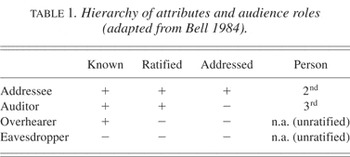
Table 1 summarizes the attributes of audience roles in a speech event. A fieldworker can participate in any of these audience roles. In Bell's framework, these audience roles are defined in relation to the speaker8
Note that these roles are constructed by all the participants in the speech event and are continually negotiated and constructed through the course of the interaction.
Hierarchy of attributes and audience roles (adapted from Bell 1984).

Therefore, one must take into account both the fieldworker's participant role in a speech event and her or his position as a socially located being. Milroy, Li & Moffat (1991:288) suggest that audience design theory calls for “both field methods which reduce the prominence of the investigator, and for analytic procedures which account for his/her interactional role.” When writing about sociolinguistic investigations, linguists seem to have as a prototype an urban, monolingual context with a local, nonstandard dialect, where the fieldworker is a native speaker of the language being investigated,9
This is in contrast to linguistic anthropologists, whose prototypical situation seems to be a rural, isolated monolingual village where the fieldworker must acquire the language being investigated.
As is common with investigators of minority languages, particularly languages undergoing a multigenerational shift, my foreignness, combined with my statement of purpose – that I was in Tatarstan to learn and study Tatar language and culture – was met with surprise and would elicit commentary from everyone. Russians, members of the dominant ethnic group, usually expressed astonishment that anyone would bother to come from thousands of miles away just to study Tatar. Some Tatars, mostly assimilated youth, reacted similarly, but ethnic Tatars over thirty
10This is an approximate boundary.
In fact, people in villages do not speak only Tatar all day every day, as became immediately apparent upon my visits.

, spelling mistakes, calques and mistranslations, and code-switching with Russian. As a native speaker of English, I was able to correctly pronounce phones found in both the Tatar and English phonetic inventories, in particular the highly salient

, mispronunciations of which are seen as representative of the Russification and degeneration of the Tatar language.
12For more on the inability of Tatar speakers to place my accent, and the construal of this accent as “Tatar, but from elsewhere,” see Wertheim 2003b.
As my Tatar competence improved, I found that this high level of language awareness, with its stated ideals of “pure” Tatar and “literary” Tatar, was not provoked merely by the presence of the language learner and investigator. This “discourse of purity” and constant awareness of the Russification of Tatar (mostly on the phonetic and lexical levels) was a constant presence in newspaper articles and opinion pieces, on television, on Internet bulletin boards, and on the radio (Wertheim 2003a). The Tatar discourse of purity, like many others, is based on what Jaffe (1999:61) has called a “logic of oppositional identity,” and it can be seen as part of the postcolonial revalorization of Tatar; an attempt to add value, or symbolic capital, to the subordinate Tatar language. Fear for the assimilation of the Tatar nation is expressed in discourse on linguistic, cultural, and religious issues, but language in particular is seen as a metonymic representative of the nation and the barometer of its health; the impurity and decline of the Tatar language are seen as representative of the impurity and decline of the Tatar nation as a whole (Wertheim 2003b).
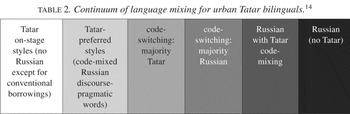
The speakers among whom I was a participant-observer gave me only limited access to their range of speech styles, particularly at the beginning of our acquaintanceship, but over time, as their familiarity with me increased and my positioning within the community became increasingly in-group (and my skills in overhearing and eavesdropping on public conversations improved), I eventually heard a wide range of styles. What I found was that the urban bilingual Tatars with whom I interacted – either balanced or Tatar-dominant bilinguals – had a continuum of linguistic production that was related to language mixing, as shown in Table 2.13
I did not have enough exposure to the speech of rural bilingual Tatars to assess their linguistic repertoires. My Tatar-language interactions with less competent speakers were also somewhat limited, but their linguistic repertoires seem to differ from Table 2 in two major ways: (i) Their production of Tatar on-stage styles in adherence to sociolinguistic conventions was at the expense of fluent and grammatical speech; (ii) they did not produce Tatar-preferred styles.
For more on the various ways of defining “style” and the difficulties in differentiating among style, register, and genre, see the articles in Eckert & Rickford 2001, in particular Yaeger-Dror 2001.
The term mankurt was popularized in a novel by the Kyrgyz author Chingiz Aitmatov, in which mankurts are slaves forced by a foreign conqueror to wear restrictive headgear that causes them to lose their memories. This term is used among the Turkic peoples of the former Soviet Union to refer disparagingly to assimilationists (see Rivers 2002).
Continuum of language mixing for urban Tatar bilinguals.For a similar continuum of language mixing among Spanish-English bilinguals in Texas, see Elías-Olivares 1976.

The set of what I call “Tatar on-stage styles,” found at the extreme Tatar end of the cline, is the realization of speakers' attempts to produce pure and literary Tatar; it is most noticeably characterized by the absence of Russian words. This is the set of styles with the highest level of self-consciousness and what Cameron 1995 calls “verbal hygiene,”17
Here I am using “verbal hygiene” in a more limited sense than Cameron does in her work, referencing in particular the idea of filtering and “cleaning up” linguistic production to meet a desired and extensively discussed norm.
For example, Tatar on-stage styles are most often found in the public sphere in formal registers when the setting, often literally on a stage, requires both a high literary standard and a presentation of Tatarness. Tatar on-stage styles are used by the master of ceremonies and the musicians at a Tatar concert, with the musicians usually speaking less formally. Tatar on-stage styles are also found on radio and television: in the speech of DJs, in speech by both parties in an interview, in all speech produced by newscasters, scripted or off-the-cuff, and in the speech of radio listeners who call in to make requests or comments. The end result is that there is no Russian to be heard in present-day Tatar media, with the exception of conventional borrowings. Off stage, Tatar on-stage styles can be found in announcements, statements, and comments addressed to the general crowd at meetings of Tatar clubs or Tatar cultural events. Private use of Tatar on-stage styles seems to occur only in conversations with or for investigators of Tatar language and culture. This Tatar style set can be seen as part of the construction of an anti-language, one created in opposition to Russian: Anti-languages undergo a “distortion that makes a code more like itself … a self that is most distinctive from its socially dominant counterpart” (Woolard & Schieffelin 1994:70). The filtering out of Russian lexical items can be interpreted as the iconization (Gal & Irvine 1995) of the rejection of Russian influence in other domains (Wertheim 2003a). Even Russian-dominant speakers who are not fully competent in Tatar will attempt to completely de-Russify their speech when this is called for by either setting or audience, which can lead to ungrammatical and sometimes incoherent speech.
Example [1] shows a Tatar on-stage style produced as a single turn in a 35-minute conversation recorded in my kitchen while I was elsewhere in the apartment. The speaker is a 20-year-old Tatar cultural activist, and his conversation partner is a 19-year-old female acquaintance, a nationalist.

Tatar is presented here in standard Turcological notation; vowels have the following IPA correspondences:

.
This is a typical example of an informal production of a Tatar on-stage style. The one Russian lexical item, student ‘student’ (here in the plural, studentlar), is a conventional borrowing for which there is no Tatar equivalent; the same is true for the Arabic borrowing

‘hour’. Conventional borrowings such as these are generally not salient to Tatar speakers (for more on this, and the conventional borrowings that are salient, see Wertheim 2003a).
Tatar-preferred styles are always in informal registers and are found in private conversations where Tatar has been in some way established as the preferred language of communication; for example, this was the main style of intergenerational family communication in the Tatar-speaking homes that I visited, both urban and rural. For the intragenerational family interactions that I observed, the 18 to 24-year-olds who had brought me home tended to interact with their siblings in one of the code-switched styles, or even in Russian with Tatar code-mixing, while their parents, usually in their forties and fifties, generally spoke to each other in a Tatar-preferred style.19
This generational difference in language mixing, where younger people are more likely to code-switch or use Russian with Tatar code-mixing in the home, is a symptom of the contraction of Tatar, much like age-graded asymmetrical bilingual conversations visible on the streets of Kazan.

This conversational turn comes 17 minutes after the conversational turn shown in example (1). In (2), F code-mixes two Russian discourse-pragmatic words, ladno ‘okay, very well’, and nu ‘so, well’, both of which are used for metacommentary. It is not coincidental that this example of a Tatar-preferred style comes from near the end of the recorded conversation; this is true of the recorded conversations in general, in which the (infrequent) code-mixing of Russian discourse-pragmatic words does not begin until at least 15 minutes into the recording, if it occurs at all.
The four remaining types of language mixing are the two kinds of code-switching, Russian with Tatar code-mixing, and pure Russian with no Tatar at all. For the code-switched styles, the majority language into which phrases, clauses, or sentences from the other language are embedded can be either Tatar or Russian. According to both self-reporting and my observations in public spaces, these code-switched styles are used in private conversations by people of all generations. The linguistic identity construction of the members of the Tatar intelligentsia with whom I interacted did not allow them to code-switch in my presence; the requirement to speak “good” Tatar in front of a language investigator meant that for the first six months or so of my fieldwork they presented me only with Tatar on-stage styles, and only later in my fieldwork did some speakers start using Tatar-preferred styles with or near me (many others, however, never used anything but Tatar on-stage styles in my presence for the duration of my fieldwork). The code-mixing of Tatar words into otherwise Russian discourse is deliberate and involves only content words or vocatives. Its purpose is to mark Tatar ethnic identity, and it is used either to invite a shift to the more Tatar end of the cline or to express solidarity. Finally, pure Russian is used with monolingual Russian speakers and for public transactions where sociolinguistic conventions require that Russian be the language of conversation. Speakers would often maintain a side conversation with me in Tatar while they were conducting their business in Russian; transacting business in Russian did not dictate a switch in the style of the private conversation.
The fieldworker's role in style shifting
As my fieldwork progressed, I observed much intraspeaker variation in the speech of Tatar bilinguals. However, it was only later that I realized that by paying careful attention to the placement of the language investigator in the participant role framework of audience design, I could relate patterns in style shifting, in part, to the audience role of the fieldworker participating in a speech event.
I will now briefly present the style shifting of one Tatar bilingual, whom I will call Galimä,21
A pseudonym meaning ‘scholar.’
This use of the formal sez is typical among colleagues and peers.
If we exclude Galimä's professional lectures and look only at her spontaneous speech production, we can see the relationship between her style shifting and my placement within the participant framework, including my salience and ratification in the speech event. Additionally, my presence could cause Galimä to engage in metacommentary on style shifting and her linguistic performance.23
Observations on Galimä's speech production were recorded in field notes; I have no recordings of her actual speech.
In our dyadic conversations in either a professional or a personal context, Galimä was always in a Tatar on-stage style. Like many other Tatars with whom I interacted, she would choose ideology over communication24
Many of the Tatar speakers with whom I worked would privilege ideology and adherence to “good” Tatar over communicative efficacy. This included addressing unknown interlocutors in Tatar (a violation of sociolinguistic etiquette), refusing to switch to Russian to accommodate an uncomprehending interlocutor, and, for less competent speakers, producing disfluent Tatar. For more on this phenomenon, see Wertheim 2005.
Galimä would use a Tatar on-stage style with colleagues, friends, and acquaintances when ratifying them as participants in conversations in which I would be speaker, addressee, or auditor. She would do this even with speakers whom she knew to have limited Tatar competence. This was clearly a self-conscious “performance” of Tatar and an arrangement of performance by others, staged for me. Very often it was only Galimä's participation in the conversation that kept it in a Tatar on-stage style; if she would leave, speakers would frequently ask in Tatar if I knew Russian, and when I answered in the affirmative, they would either switch to Russian with no Tatar in it or code-switch with Russian as the majority language.
If I was an auditor of a conversation with family and friends, Galimä would speak in a Tatar on-stage style, with no Russian. For example, if we were drinking tea in her kitchen and talking, and her son came in and asked a question, she would use only Tatar with him. Additionally, if he used any Russian, she would upbraid him and tell him to speak in Tatar only. However, if I was not an auditor but rather an overhearer, and thus unratified as a conversation participant, Galimä might code-switch with Tatar as the majority language. For example, one time I arrived early for a meeting with Galimä that was going to take place in a lycée classroom and entered the room while she was still consulting with her cousin, advising her on how to teach Tatar periphrastic verbs. Galimä saw me enter the room and nodded in acknowledgment. I sat at the opposite end of a long table, read a newspaper, and surreptitiously listened as the two spoke mostly in Tatar, but with code-switching into Russian of higher-level grammatical constituents and code-mixing of isolated words. As soon as their meeting was over, I became a ratified conversation participant, and when Galimä introduced me to her cousin, she switched into a Tatar on-stage style with no Russian, and her cousin followed suit.
Galimä would speak Russian with those bilingual Tatars for whom Russian was the usual language of interaction (owing both to sociolinguistic conventions and to Tatar's functional domains), but if I was an auditor of one of these interactions, my auditing would often cause linguistic metacommentary. For example, one time we went together to the university post office. Galimä and I were speaking Tatar up to the moment of her transaction, and the postal worker was speaking on the phone in code-switched Tatar and Russian, but the transaction was conducted in Russian, as is typical. I too had business that was conducted in Russian. When the transactions had concluded and we turned away to leave, resuming our Tatar-only conversation, Galimä commented with dissatisfaction. She said to me, “I don't know why I speak Russian with that woman. I've been coming here for years. She knows that I speak Tatar, and I know that she speaks Tatar. So why do we speak in Russian?” Although I do not believe that my presence brought this fact to Galimä's attention for the first time, I suspect that my conversational auditing did trigger the metacommentary, perhaps because of the conflict that it caused in her style shifting. Recall that Galimä's usual behavior when I was going to be a ratified conversation participant was to use Tatar whenever possible with anyone she knew to be a Tatar speaker, regardless of their competence. However, local linguistic norms required her to shift to Tatar-free Russian when transacting post office business, and this requirement seems to have superseded the style-shifting patterns caused by my presence. Perhaps this conflict in linguistic presentation of identity – culturally competent citizen on the one hand, and performer of pure and literary Tatar and the other – is what caused her explicitly stated dissatisfaction with her linguistic performance.
When conversing with monolingual Russians, whether ethnically Russian or Tatar, Galimä would speak Russian only, regardless of my participation role. This would sometimes lead to an interesting phenomenon – a sort of Russian hangover, where Galimä would be “out of phase” in her style shifting, such that after the Russian-language conversation had ended, she would return to our conversation and address me in Russian. However, this would only last for one conversational turn, because regardless of the language of my response, Galimä would become immediately aware of her “inappropriate” style. I could respond in Russian or in Tatar, but her response, always in Tatar, would be the same: “Why am I speaking Russian with you? We don't speak Russian together. Let's speak Tatar.” And we would continue our conversation with her in a Tatar on-stage style.
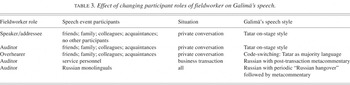
In summary, we can see that although my social role remained constant with Galimä, my various participation roles in speech events seem to have influenced both her style shifting and her awareness of style shifting. This is summarized in Table 3. Instead of labeling any of this behavior as the observer's paradox, or “unnatural” speech due to the presence of the fieldworker, analyzing the speech in question using audience design theory gives a more nuanced account of the various styles produced. Because of my social role as language investigator, I had limited access to Galimä's range of linguistic styles; I was able to observe only three out of the six style sets found in the continuum shown in Table 2. I believe that this is simply a limitation of the fieldwork situation: Galimä's construction of her sociolinguistic identity allowed only three of these styles to be appropriate in my presence; truly “unnatural” behavior would have been inappropriate linguistic performance on her part.
Effect of changing participant roles of fieldworker on Galimä's speech.

The role of the language investigator in recording speech
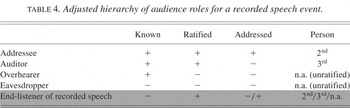
The various styles I have just described were produced in speech events when I was not explicitly in my role of fieldworker and was without any obvious note-taking or recording equipment. Now I will turn to the recorded speech event and briefly examine this too using audience design. A recorded private-domain speech event, regardless of the physical presence or absence of the fieldworker, is an atypical situation that is not classifiable within Bell's ordinary hierarchy of audience roles. And here is why: The recording equipment, previously analyzed by some sociolinguists as itself a participant in the speech event, actually represents an end listener or listeners whose identity is not known at the time of the speech event. This means that the speech event participant represented by the recording equipment is simultaneously ratified (provided that permission to record has been requested and granted) and unknown – a participant role that is not analogous to any found in Bell's framework because, for private conversations, it is unique to the experience of being investigated by a fieldworker of some sort, linguistic or otherwise. In Table 4, I have added the end-listener of recorded speech to the audience role hierarchy so that it can be easily compared with the other standard audience roles. The behavior of recorded speech event participants, sometimes referred to by sociolinguists as “unnatural,” can thus, in part, be interpreted as speakers trying to grapple with a participant role they have never dealt with before, that of the unknown eavesdropper who is nonetheless ratified. This can be attributed to the conflicting audience role attributes of the recording's end listener, for whom speech must be designed but whose social role and identity remain unknown or ambiguous.
Adjusted hierarchy of audience roles for a recorded speech event.

Behavior previously assessed as the result of the observer's paradox can be more appropriately accounted for through this refinement of Bell's audience roles. Recall that, according to Bell, speakers design their speech with audience members in mind, and those participants whose audience roles are higher up on the hierarchy (as seen in Table 1) will have a greater effect on the linguistic performance of the speaker. However, research on some non-Western speech communities has shown that auditor effect can be equal in strength to addressee effect. For example, Jahangiri's (1980, cited in Bell 1984:175) work on Tehranian Persian showed that having high-status auditors would cause speakers to use only formal 2nd person address forms, even for close friends who would have been addressed using the informal pronoun in the absence of such an auditor. I submit that the unusual audience attributes of the end listener of recorded speech, highlighted by the act of recording and the presence of recording equipment, can cause this audience role to be of primary salience and focus, regardless of the fieldworker's actual participant role in the speech event. The fieldworker may be entirely absent and yet still have a greater effect on style than any other speech event participant. Understanding the identity and traditional audience role assigned to this end listener by the speakers being recorded makes it possible to better comprehend her or his effect on recorded speech. The end listener role may be seen as entirely congruent with the fieldworker, and the fieldworker alone; it can be perceived as the fieldworker in combination with other language investigators; or it can be perceived as a person or persons completely unknown to the speaker.
Recall that suspicion or knowledge of political surveillance affected the linguistic production of the nationalists with whom I interacted. Although I managed to convince most members of the social network I was studying that I was not a spy working for the CIA – a question that was put to me point blank in my fourth week on site – there was always the possibility that my recorded materials and notes would be confiscated, either in Russia or after my return home.25
This possibility was thrown into higher relief by the Russian-American “spy wars” of 2000–2001, with “embassy workers” expelled from both Moscow and Washington, DC, and a young American scholar imprisoned on both drug possession and espionage charges (the espionage charges were later dropped).
Some people believed both my apartment and telephone to be bugged and my e-mail to be under surveillance. When speaking with me on the telephone, they would sometimes say, “This is not a phone conversation, I'll tell you about it later.” Or they would pull me out onto my balcony to whisper anything of a sensitive nature.
Some other Tatar speakers presumed the end listener to be the language investigator alone. In this scenario, the end listener took on the attributes of addressee despite physical absence at the speech event. For example, in three separate conversations, all recorded in my absence, conversation participants performed for me in the most standard sense of the word, singing Tatar songs directly into the recording equipment (one performance is even in three-part harmony). Several of the participants – none of whom had access to the recordings – later independently volunteered the information that they had sung for my sake, as a souvenir, so that when I was back home in America and working on the recordings, I would have these nice songs to listen to and think of them fondly. We can extrapolate from this behavior and subsequent metacommentary that the speech events being recorded, into which the singing was embedded, were performed with consciousness of my eventual review of the recorded material. These people were speaking “good Tatar” both for me and for posterity, and their level of filtering remained quite high – their speech was almost completely in Tatar on-stage styles. This parallels the behavior of one of Schilling-Estes's (1998) Ocracoke speakers, whose style shifting into “performance” speech was triggered not by a change in audience but by a change in the perceptual salience of the audience make-up; that is, the language investigator was suddenly made salient through attention to technical details of recording such as changing a tape, flipping it over, or orally marking the tape with the name of the interviewee and date.
CONCLUSIONS
The linguistic data that are collected and recorded by a fieldworker can be affected on every level of linguistic structure by the context in which they are obtained, and in particular by the speakers' interpretation of the fieldworker's role in the speech event. All modes of linguistic data gathering are speech events: both situations created by the investigator, such as lab-based experiments and sociolinguistic interviews, and situations where the investigator is observing and perhaps participating in an event generated by the speakers themselves. For analysis of the speech styles produced by members of the urban Tatar intellectual elite, styles that affected the grammatical forms being produced, it was necessary to pay close attention to the contextualization of the speech event: who was performing, what audience their speech was being designed for, which participant role in the audience composition was most salient or had the greatest effect, and what role the speaker was performing, with an understanding that the identity presented or constructed through language could change over the course of a speech event. The simultaneous insider and outsider status of the fieldworker, whose social status may change over time, may allow access to a wide range of speech styles over the course of extended fieldwork; however, the fieldworker may have access to some styles when participating and observing but be denied access to these styles with the introduction of recording equipment to the scene of the speech event. The “performance” styles that the fieldworker's presence or recording equipment may evoke, while historically underused in sociolinguistic analysis, can be utilized for linguistic analysis in a variety of ways and can also give insights into local linguistic norms and ideologies (cf. Ochs 1978, Dorian 1994, Schilling-Estes 1998, Wertheim 2003b). Rather than viewing speakers' awareness of observation as an undesirable obstacle between the language investigator and a “natural” and “authentic” speech variety, using the fieldworker's social roles and participant roles to explicate styles and style shifting can provide a more nuanced and accurate analysis of fieldworker effect.