The literature studying the behavioral effects of political corruption is rapidly growing. Since many corrupt incumbents do not receive an electoral sanction, the focus of scholarly work in this area has been to identify the individual-level and contextual factors that facilitate (or deter) accountability for political corruption. (For good reviews of this literature see de Sousa and Moriconi Reference De Sousa and Moriconi2013; De Vries and Solaz Reference De Vries and Solaz2017.)
By comparison, we know much less about the impact of corruption on turnout. The conceptual framework developed by Hirschman (Reference Hirschman1970) in his seminal treatise is useful for thinking about the possible consequences of elected officials’ malfeasance on electoral participation. According to Hirschman, members of an organization have two possible responses in the face of unsatisfactory situations or outcomes: they can exit (leave without trying to fix things) or they can use voice (speak up and try to remedy the defects). In the same vein, voters facing a corrupt political environment might lose trust in political institutions and become more apathetic, or they might decide to go to the polls on Election Day in order to “throw the rascals out.”
The few existing studies analyzing the effect of political malfeasance on electoral participation focus on different forms of corruption at different regional levels—municipality, region, and country—and reach divergent conclusions. We therefore need more empirical work to estimate precisely the impact of a corrupt political class on citizens’ propensity to vote. This article uses a vignette experiment embedded in a nationally representative survey in Colombia to better isolate the causal effect of political corruption on electoral participation. The results suggest that receiving credible information about the corrupt behavior of politicians running for office lowers the intention to turn out in future elections. It also shows that corruption demobilizes voters even when corrupt politicians are able to provide public works to their constituencies, a finding that casts doubt on the idea that citizens trade integrity for favorable policy outcomes (Rundquist et al. Reference Rundquist, Strom and Peters1977).
This article proceeds to review the existing literature on the link between corruption and electoral participation and to present arguments and hypotheses. It then describes the vignette experiment conducted in Colombia to test the effect of corrupt politicians on citizens’ propensity to turn out on Election Day. It presents the results of the survey experiment and discusses some of the key implications of the findings.
Corrupt Candidates and Electoral Participation
The literature on electoral participation in Latin America can be divided roughly into two main lines of inquiry. On the one hand, a number of works focus on the institutional determinants of electoral participation, such as compulsory voting, unicameralism, the electoral cycle, and presidential powers (Carreras Reference Carrerasforthcoming; Fornos et al. Reference Fornos, Power and Garand2004; Pérez-Liñán Reference Pérez-Liñán2001). On the other hand, several studies analyze the individual resources (e.g., age and education) and the psychological factors (e.g., political interest, trust in elections, and efficacy) that increase citizens’ propensity to vote (Carlin Reference Carlin2011; Carlin and Love Reference Carlin and Love2015; Carreras and Castañeda-Angarita Reference Carreras and Castañeda-Angarita2014; Carreras and İrepoğlu Reference Carreras and Castañeda-Angarita2013). We know much less about how governance problems (in particular, corruption) affect citizens’ turnout decision in Latin America. It is not clear whether the high level of corruption in many Latin American countries (Blake and Morris Reference Blake and Morris2009; Hagopian and Mainwaring Reference Hagopian and Mainwaring2005) leads to an increase in electoral participation to sanction a corrupt political class or, on the contrary, leads to a more passive citizenry.
Several studies suggest that corruption victimization can lead to unconventional forms of political participation in Latin America, such as joining protest demonstrations (Gingerich Reference Gingerich2009; Kiewiet de Jonge Reference Kiewiet de Jonge2009; Machado et al. Reference Machado, Scartascini and Tommasi2011). These works argue that political corruption can become a powerful grievance that reduces the collective action cost of protests. In fact, many Latin American presidents implicated in corruption scandals were removed from office in the wake of massive street demonstrations (Hochstetler Reference Hochstetler2006; Zamosc Reference Zamosc2012). Should we then expect corrupt politicians to increase citizens’ electoral participation as well? This article contributes to the study of the link between corruption and political participation in Latin America by addressing this important question.
The key argument in this study is that citizens are less likely to go to the polls on Election Day when they receive information about corrupt activities involving a prominent politician running for elected office. This theoretical expectation is informed by several aggregate studies that report that turnout is lower in more corrupt regions or countries (Stockemer et al. Reference Stockemer and Calca2013; Sundström and Stockemer Reference Sundström and Stockemer2015) and individual-level studies showing that citizens who perceive high levels of corruption are less likely to participate in elections (Caillier Reference Caillier2010; Dahlberg and Solevid Reference Dahlberg and Solevid2016; Davis et al. Reference Davis, Ai Camp and Coleman2004).
The “demobilization” argument is predicated on the idea that corruption generates dissatisfaction with political institutions, which, in turn, leads to withdrawal from the political arena. Warren (Reference Warren2004) argues that corruption signals a deficit of democracy, which can lead to a decline in political participation. Several studies in a variety of geographical contexts have indeed shown that citizens who perceive high levels of corruption and citizens living in very corrupt environments are more likely to be disenchanted with political institutions and to report lower levels of regime support (Anderson and Tverdova Reference Anderson and Tverdova2003; Bowler and Karp Reference Bowler and Karp2004; Chang and Chu Reference Chang and Chu2005; Seligson Reference Seligson2002a). Political dissatisfaction associated with perceptions of corruption can result in political apathy (Bauhr and Grimes Reference Bauhr and Grimes2014). For instance, Stockemer et al. (Reference Stockemer and Calca2013) argue that “if local, regional, or national representatives cannot be trusted because they demand bribes and engage in discrimination, then citizens may have little to no incentive to interact with their elected officials” (76). Low levels of political trust are also associated with a decline in political efficacy. Citizens who perceive high levels of malfeasance in public officials are more likely to lose confidence in their government’s willingness and ability to solve problems (Caillier Reference Caillier2010; Inman and Andrews Reference Inman and Andrews2009; Olsson Reference Olsson2014).
Low trust in political institutions and low efficacy may, in turn, lead to lower levels of electoral participation. A series of scholars argue that participation within conventional institutional channels may decline when citizens become disenchanted with political institutions and with democratic performance (Ezrow and Xezonakis Reference Ezrow and Xezonakis2016; Norris Reference Norris2002, 30). Studies from Bolivia (Smith Reference Smith2009), Costa Rica (Seligson Reference Seligson2002b), and Germany (Finkel Reference Finkel1987) have demonstrated that citizens with higher levels of political trust are more likely to vote and to participate in campaign activities.
In the same vein, Grönlund and Setälä (Reference Grönlund and Setälä2007) show that regime legitimacy is positively correlated with electoral participation in 22 European countries examined in the European Social Survey (2002–3). They conclude that “there is a clear and linear relationship between trust in parliament and turnout as well as satisfaction with democracy and turnout” (Grönlund and Setälä Reference Grönlund and Setälä2007, 418). Cox (Reference Cox2003) reaches a similar conclusion in her study of the determinants of voter turnout in European parliamentary elections. In a similar vein, previous research has established that low political efficacy has a negative effect on political participation (Finkel Reference Finkel1985). In particular, citizens who do not feel efficacious are less likely to go to the polls on Election Day (Karp and Banducci Reference Karp and Banducci2008; Norris Reference Norris2002). In sum, if clear evidence of corruption generates political disenchantment and decreases political efficacy, it can lead, by ricochet, to a more passive citizenry.
Whereas we contend that corrupt politicians have a negative effect on citizens’ electoral participation, some scholars argue just the opposite. The “mobilization” argument contends that political corruption should generate “indignation” (Bauhr and Grimes Reference Bauhr and Grimes2014) and boost turnout. This is quite simply an accountability argument, which holds that when citizens face corrupt incumbents they are more likely to go to the polls to “throw the rascals out.” Corruption generates dissatisfaction with incumbent politicians, and citizens go the polls to sanction elected officials involved in corruption scandals (Inman and Andrews Reference Inman and Andrews2009; Kostadinova Reference Kostadinova2009).
There are, however, good reasons to doubt this argument. Previous studies showing a positive relationship between corruption and turnout ascribe this effect not to citizens’ reaction to the corrupt behavior of political incumbents but to the idea that corrupt politicians might value their positions more and therefore spend more money and effort on electioneering (Escaleras et al. Reference Escaleras, Calcagno and Shughart2012; Karahan et al. Reference Karahan, Coats and Shughart2006). These mobilization efforts might, in turn, generate a small boost in turnout, especially if voters are not well informed about the malfeasance of elected officials.
Furthermore, the literature studying the impact of corruption on accountability suggests that corrupt incumbents receive only a small electoral sanction, if they are punished at all (Chang et al. Reference Chang, Golden and Hill2010; Choi and Woo Reference Choi and Woo2010; Dimock and Jacobson Reference Dimock and Jacobson1995; Pattie and Johnston Reference Pattie and Johnston2012; Peters and Welch Reference Peters and Welch1980). These findings are hard to reconcile with the mobilization argument, and they suggest that visible corruption scandals affecting incumbent politicians should “quash the hope” rather than “inspire the fight” (Chong et al. Reference Chong, De La O, Karlan and Wantchekon2015). The main hypothesis of this article follows from this discussion.
Hypothesis 1. Citizens’ likelihood of voting decreases when they receive credible information about the corrupt behavior of prominent politicians running for elected office.
The vignette experiment also tests the effects of the amount of public works that the politician (a hypothetical governor in Colombia) delivers to the region. A subsidiary argument is that the negative effect of corruption on the intention to participate in elections should be less pronounced when political leaders are able to deliver public goods and services to their constituencies. In a seminal article, Rundquist et al. (Reference Rundquist, Strom and Peters1977) postulate that there is an “implicit trading” between voters and politicians. When politicians deliver good policy results in areas that people care about, citizens tend to discount corrupt behavior (Carlin et al. Reference Carlin and Love2015; Fernández-Vázquez et al. Reference Fernández-Vázquez, Barberá and Rivero2016). In fact, previous research using survey data from Latin America and Africa has shown that corruption exerts a more negative effect on executive approval and political trust when economic conditions are bad (Manzetti and Wilson Reference Manzetti and Wilson2006; Zechmeister and Zizumbo-Colunga Reference Zechmeister and Zizumbo-Colunga2013) and when the quality of public services is poor (Lavallée et al. Reference Lavallée, Razafindrakoto and Roubaud2008). If people exposed to corrupt politicians are less likely to lose political trust when these politicians are perceived as good administrators, it follows that the negative effect of the corruption treatment on intention to turn out should be smaller when corrupt political leaders deliver public goods and services to their constituencies. This discussion yields the following hypothesis:
Hypothesis 2. The delivery of public goods to the constituency should reduce the negative effect that a corrupt politician has on citizens’ likelihood of voting.
Research Design: A Survey Experiment in Colombia
Most of what we know about the impact of corruption on electoral participation comes from observational studies at the aggregate (e.g., Stockemer et al. Reference Stockemer and Calca2013; Sundström and Stockemer Reference Sundström and Stockemer2015) and at the individual level (e.g., Dahlberg and Solevid Reference Dahlberg and Solevid2016; Davis et al. Reference Davis, Ai Camp and Coleman2004). These studies have research designs that create considerable challenges for the identification of a causal effect of corruption on electoral participation.
The works analyzing the effect of perception of corruption on citizens’ propensity to vote are problematic for causal inference because perceptions of corruption are correlated with other factors, such as partisanship and trust in institutions (see Anduiza et al. Reference Anduiza, Gallego and Muñoz2013; Morris and Klesner Reference Morris and Klesner2010; Wagner et al. Reference Wagner, Tarlov and Vivyan2014; Wroe et al. Reference Wroe, Allen and Birch2013), which might also be related to the turnout decision. The causal effect of corruption on turnout is also hard to detect in works analyzing the impact of systemic corruption on aggregate turnout. In fact, it is challenging to isolate the impact of systemic political corruption from other factors—e.g., economic development and media freedom—that might also affect turnout (Chowdhury Reference Chowdhury2004; Treisman Reference Treisman2007).
In order to better capture the causal effect of corruption on the likelihood of voting, we use a vignette experiment embedded in a nationally representative survey in Colombia. By using an experimental design that manipulates information about the corruption level of a legislative candidate while holding constant all other aspects of the electoral context, we can evaluate, in a way that eliminates endogeneity concerns, the effect of corrupt politicians on citizens’ propensity to vote in a future election.
The survey was conducted in Colombia between August and October 2016. The experiment was designed by the authors as part of a larger project investigating the impact of corruption on citizens’ political behavior in Latin America. The vignette was placed in the middle section of the questionnaire, which was part of the biannual AmericasBarometer survey in Colombia. The LAPOP team based in Colombia provided valuable input to improve the wording of the candidate vignette. Interviews were conducted face to face, and electronic devices were used for data collection. The vignette experiment analyzed in this study was read to participants by survey enumerators.Footnote 1
We chose to run the experiment in Colombia because it is a country with high levels of corruption, which means that survey respondents would perceive our treatment as realistic. Data from the 2012 AmericasBarometer show that an overwhelming 80 percent of Colombians believe that corruption is “very generalized” or “somewhat generalized” in the country. Also, 62 percent of Colombians believe that corruption in the public sector is “very common,” which largely surpasses the Latin American average of 44 percent. Furthermore, Colombia ranks fourth among 21 countries in the Western Hemisphere in the percentage of people who spontaneously declare that corruption is the most serious problem affecting their country.Footnote 2 The experimental design randomly varied the record of corruption of a hypothetical candidate running for Congress, as well as the candidate’s record of goods provision.Footnote 3
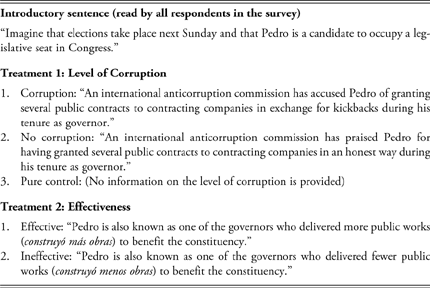
The corruption conditions were three. One group received a vignette that made no mention of the candidate’s record of corruption; another was treated with a vignette in which the congressional candidate was accused by a credible source (an international anticorruption commission) for evidence of bribetaking during a previous tenure as governor; and a third group learned from the same source that the candidate was praised for an honest administration during his tenure as governor. The conditions for the candidate’s level of effectiveness in delivering public works were two: one group was exposed to a “better than average” goods provision candidate, and another group was exposed to a “worse than average” goods provision candidate.Footnote 4 The five different versions of the vignette experiment are described in table 1.Footnote 5
Experimental Vignettes

Our research design differs from previous experimental studies in that it evaluates the effect of corruption involving a legislative candidate instead of a mayoral or gubernatorial candidate. More precisely, our vignette presents a hypothetical legislative candidate who was formerly an honest or corrupt governor. While the typical survey experiment evaluates accountability for subnational authorities running for re-election to the same position (Chong et al. Reference Chong, De La O, Karlan and Wantchekon2015; Fernández-Vázquez et al. Reference Fernández-Vázquez, Barberá and Rivero2016; Winters and Weitz-Shapiro Reference Winters and Weitz-Shapiro2013), this study aims to reproduce the fluidity of political careers in Latin America (Weyland Reference Weyland2002). In this region, many unpopular or unscrupulous politicians change party labels and run for different offices to try to escape the wrath of the voters (Kerevel Reference Kerevel2014; Morgenstern Reference Morgenstern2002). The effects of corruption on accountability and political participation might be muted when politicians run for a different office, so we believe our vignette experiment creates a hypothetical scenario that is realistic and worth analyzing in less institutionalized political systems. We hold the source of the information stable, attributing it to an international organization as a way to guard against less trustworthy national sources (Botero et al. Reference Botero, Cornejo, Gamboa, Pavão and Nickerson2015).
The prior gubernatorial experience serves two additional purposes related to the Colombian political framework. First, it makes the corruption treatment more credible, as governors in Colombia control a sizable amount of public funds, which makes them more vulnerable to accusations of corruption.Footnote 6 Second, it makes the politician a viable candidate for Congress, as deputies in Colombia tend to have strong political connections with subnational politics (Ingall and Crisp Reference Ingall and Crisp2001). Our experimental design is also realistic, given Colombia’s institutional framework. In this South American country, governors are not allowed to run for re-election. Therefore, many governors decide to run for Congress after the end of their term. In other words, the characteristics of this vignette allow us not only to explore corruption effects for a previously understudied type of politician in the experimental literature (i.e., a legislative candidate), but also to ensure the validity of the hypothetical situation in the political context of Colombia.
Immediately after the vignette, we measured a series of attitudinal outcomes, among which we recorded each respondent’s reported likelihood of casting a vote in the following elections. Respondents were asked, “How likely, on a 1–7 scale, are you to vote in the next legislative election?” We used this variable to evaluate the extent to which intention to turn out was affected by our corruption treatment. To facilitate data analysis, we transformed the “intention to turn out” variable to a scale of 0–100, where higher numbers represent greater likelihood of voting.
Results
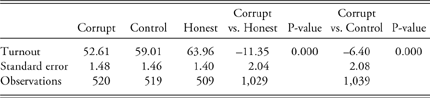
Table 2 presents the average treatment effect of corruption on the likelihood of voting. Using a rescaled 0–100 variable for the likelihood of turnout, we find that the average intention to turn out is 52.61 for respondents who receive the “corrupt candidate” treatment, 59.01 for respondents in the control group, and 63.96 for respondents who receive the “honest candidate” treatment. That is, respondents who randomly received an honest candidate vignette reported the highest likelihood of voting, and respondents who were exposed to a corrupt candidate vignette reported the lowest. When we compare a corrupt candidate to an honest one, intention to turn out declines 11.35 points (p-value < 0.01), and when we compare a corrupt candidate to a candidate in the control vignette, intention to turn out is reduced by 6.40 points (p-value < 0.01). The statistically significant differences in means suggest that citizens who receive credible information about the corrupt behavior of politicians running for elected office are considerably less likely to vote on Election Day.Footnote 7
Average Treatment Effect of Corruption on Turnout: Difference in Means

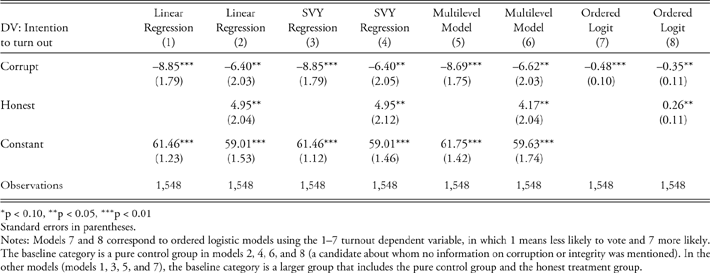
Now we use a series of regressions that take into account the weighting and clustering of the survey design and any additional clustering in the data structure. Table 3 reports the coefficient estimates of corruption for eight model specifications predicting the likelihood of voting. Models 1 and 2 are linear regressions that use a 0–100 scaled dependent variable and clustering standard errors at the municipal level. Models 3 and 4 are linear regressions that take into account the survey weighting and sampling. Models 5 and 6 are multilevel regression models with random effects specified at the district level. Models 7 and 8 are ordered logistic regressions using the original 1–7 scale in the turnout dependent variable.
Regression Analysis

* p < 0.10
** p < 0.05
*** p < 0.01
Standard errors in parentheses.
Notes: Models 7 and 8 correspond to ordered logistic models using the 1–7 turnout dependent variable, in which 1 means less likely to vote and 7 more likely. The baseline category is a pure control group in models 2, 4, 6, and 8 (a candidate about whom no information on corruption or integrity was mentioned). In the other models (models 1, 3, 5, and 7), the baseline category is a larger group that includes the pure control group and the honest treatment group.
In line with the findings reported in table 2, the effect of the corruption treatment is significantly negative and consistent throughout all model specifications. Model 1 shows that the intention to turn out is 8.85 points lower among those respondents who received a corrupt candidate vignette than among those who received an honest or control vignette. And model 2 indicates that the negative effect of corruption is 6.4 points when the baseline is a control candidate. The results are almost identical in models that take into account the clustering and sampling design of the national survey (models 3–4) and in multilevel models (models 5 and 6). Furthermore, the results are robust when we estimate an ordered logistic regression instead of a linear regression (models 7 and 8).
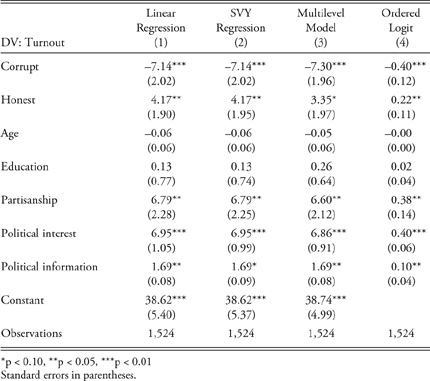
The models in table 3 do not include sociodemographic and attitudinal control variables. Since every respondent has the same probability of receiving the treatment in our vignette experiment, the treatment-control difference without any adjustment is an unbiased estimator of the average treatment effect (Mutz Reference Mutz2011). However, including variables in the regression that are strong predictors of the outcome can improve the precision of the estimation and reduce the size of the standard errors (Gerber and Green Reference Gerber and Green2012). Therefore, we estimated models including several variables—education, age, partisanship, political interest, and political information—that are strongly associated with the turnout decision in Latin America (Carreras and Castañeda-Angarita Reference Carreras and Castañeda-Angarita2014). The results are very similar to the ones reported above. Our main finding concerning the effect of the corruption treatment on the intention to turn out is robust to the inclusion of these covariates. These models are presented in table A2 in the appendix.
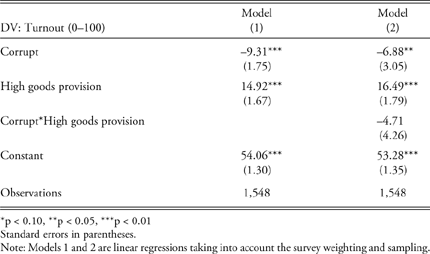
So far we have shown evidence suggesting that corruption has a negative effect on the likelihood of voting, but we have not yet explored whether this effect is contingent on politicians’ effectiveness in providing public goods to their constituents. Table 4 reports the effect of corruption and goods provision on the intention to turn out. Model 1 shows that the “corruption” treatment reduces the likelihood of voting by 9.31 points and that the “goods provision” treatment increases it by 14.92 points. Model 2 tests whether the effect of corruption is conditional on goods provision and shows that corruption decreases the intention to turn out regardless of the level of goods provision. While the effect of corruption is statistically significant, the interaction effect with goods provision is not. This evidence suggests that corrupt politicians demobilize voters irrespective of the level of public goods they are able to provide to their constituencies.Footnote 8
Turnout and Goods Provision

* p < 0.10
** p < 0.05
*** p < 0.01
Standard errors in parentheses.
Note: Models 1 and 2 are linear regressions taking into account the survey weighting and sampling.
Manipulation Checks
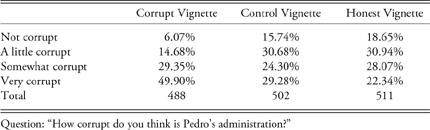
To check whether the experimental manipulation of corruption perceptions was effective, we asked respondents how corrupt they think the candidate described in the vignette was. Table 5 shows the percentage of respondents who answered “very corrupt,” “somewhat corrupt,” “a little corrupt,” and “not corrupt” across the three experimental groups. Among those receiving the corrupt candidate vignette, only 6 percent perceived Pedro’s administration as not corrupt, and among those who received the honest candidate vignette, only 22 percent perceived Pedro’s administration as very corrupt. Those in the corrupt vignette were significantly more likely to perceive Pedro’s administration as corrupt, and those in the honest vignette were much more likely to perceive it as not corrupt. Overall, these responses suggest that the experimental vignette succeeded in moving citizens’ perceptions of corruption.
Manipulation Check

Question: “How corrupt do you think is Pedro’s administration?”
Discussion
Although it is well established in the literature that political corruption decreases trust in political institutions and satisfaction with democracy (Chang and Chu Reference Chang and Chu2005; Seligson Reference Seligson2002a), we know far less about whether citizens’ propensity to participate in elections increases or decreases when they become aware of the corrupt behavior of politicians running for office. This article has used a vignette experiment embedded in a nationally representative survey in Colombia to test hypotheses about the effect of corruption on vote intention, and it also has evaluated whether this effect is contingent on the ability of politicians to deliver public goods to their constituencies.
We find strong support for our first and main hypothesis. Colombian respondents who received the corruption treatment in our survey experiment were significantly less likely to vote in an upcoming election. We argue that visible instances of political corruption demobilize citizens because they lead to political disenchantment and a loss of political efficacy.
Our second hypothesis stated that the negative effect of corruption on electoral participation should be less pronounced when corrupt politicians are able to deliver public goods to their constituencies. This hypothesis is rejected. In fact, the results of the vignette experiment suggest that citizens do not discount corruption when politicians are described as good managers who bring public goods and services to their constituencies. This result is puzzling because there is a longstanding perception that Latin American citizens value politicians who “steal but get things done” (rouba mas faz) (Balán Reference Balán2014). Presumably, then, the negative effects of corruption on citizens’ propensity to go to the polls should be counteracted by the delivery of public works. However, our finding is consistent with the results of several recent studies that show that Latin American citizens do not discount corruption when politicians are seen as effective managers who get things done (Rennó Reference Rennó2008; Rosas and Manzetti Reference Rosas and Manzetti2015; Winters and Weitz-Shapiro Reference Winters and Weitz-Shapiro2013).
One of the criticisms often leveled against survey experiments is that they lack external validity (Barabas and Jerit Reference Barabas and Jerit2010; Morton and Williams Reference Morton and Williams2010). In fact, the unfiltered treatments respondents receive in a vignette experiment are not necessarily similar to the signals citizens pick up in the “real world.” However, corruption scandals receive a lot of media attention at the national and local levels (Camaj Reference Camaj2013; Ferraz and Finan Reference Ferraz and Finan2008). Even minimally informed citizens should be aware of corruption scandals involving high-level politicians (presidents, governors, legislators). In line with Chong et al. (Reference Chong, De La O, Karlan and Wantchekon2015), our results suggest that when citizens receive clear information about the corrupt behavior of politicians running for elected office, they are more likely to become disenchanted and apathetic.
Note, however, that we are not claiming that political corruption always demobilizes voters. Corruption is, almost by fiat, an activity that takes place behind closed doors, and is therefore difficult to observe. If politicians’ corrupt behavior is not exposed by the media or other government watchdogs, it will have little effect on citizens’ political participation. Moreover, previous research suggests that corrupt incumbent politicians might spend more time and effort electioneering and that they are more likely to be challenged by talented political opponents (Escaleras et al. Reference Escaleras, Calcagno and Shughart2012; Hirano and Snyder Reference Hirano and Snyder2012; Karahan et al. Reference Karahan, Coats and Shughart2006). It is possible that these political dynamics will produce a small participation boost in elections that take place in corrupt environments. But what our results reveal is that such a turnout boost—when it exists—should be attributed to these campaign dynamics and not to the corruption scandal itself.
In addition, the effect of information concerning a corrupt incumbent on electoral participation should be contingent on the overall level of corruption in a country. When systemic corruption is high, as is clearly the case in Colombia, a corrupt incumbent might serve as a reminder of how corrupt the political system is and result in the demobilization of voters. A corruption scandal affecting an incumbent politician in a country where systemic corruption is low might, on the contrary, boost electoral participation because voters want to sanction the corrupt politician and expect the other candidates to be less corrupt (Klašnja and Tucker Reference Klašnja and Tucker2013).
Furthermore, the impact of corruption on the likelihood of voting might be particularly strong in countries with voluntary voting laws, such as Colombia. We argue that corruption demobilizes citizens because it leads to a decline in political trust and political efficacy. But these attitudes are weaker predictors of electoral participation in countries that enforce compulsory voting laws (Carlin and Love Reference Carlin and Love2015). In other words, corruption is less likely to demobilize voters when voting is mandatory and enforced.
Our findings also lead us to question the dominant view in the policy community that increased transparency will make citizens more aware of political corruption and thereby help hold corrupt politicians accountable in fledgling democracies. While transparency is necessary to fight corruption, our results suggest that an abundance of information about the malfeasance of elected officials might result in the demobilization of the electorate (for a similar argument see Bauhr and Grimes Reference Bauhr and Grimes2014). Programs aimed at increasing transparency should ideally be accompanied by other reforms that increase horizontal accountability and address the roots of political corruption.
The results presented in this article suggest that corruption can lead to political disengagement. In Colombia, where voting is not mandatory, abstaining does not have a protest connotation and is often interpreted as a sign of political apathy (El Espectador 2015; Correa and Forero Reference Correa and Forero2014). However, our survey experiment does not show (and was not designed to demonstrate) that citizens exposed to corruption become completely apathetic. Electoral participation is just one of the many ways citizens can participate in politics. Previous studies have shown that citizens lose trust in institutions in more corrupt environments (Anderson and Tverdova Reference Anderson and Tverdova2003; Seligson Reference Seligson2002a). Low trust in formal political institutions should discourage conventional political participation, such as voting and contacting politicians. But it is entirely possible that politically disenchanted citizens can resist corruption by engaging in noninstitutionalized political actions, such as joining anticorruption demonstrations.Footnote 9 While some previous works have shown a link between corruption and protest activity (Gingerich Reference Gingerich2009; Machado et al. Reference Machado, Scartascini and Tommasi2011), we lack experimental or cross-national observational research analyzing the impact of corruption on noninstitutionalized political participation. This would be an interesting avenue for further research.
Future studies could also assess the impact of corrupt incumbent politicians on citizens’ political efficacy and political trust. We argue that these are the two attitudes that mediate the effect of corruption on electoral participation. While we show strong evidence for the main hypothesis (i.e., corruption depresses turnout), we rely on previous observational studies to support our causal mechanisms. We believe that survey experiments could also be exploited to assess the impact of corruption on political attitudes (political trust, political efficacy) and emotions (anger, contempt) that, in turn, affect political behaviors such as electoral participation and vote choice.
Appendix
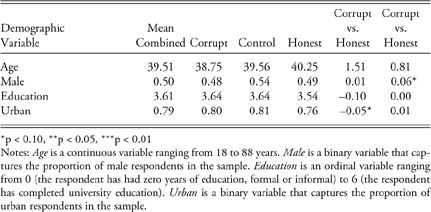
Balance Tests

Models with Controls

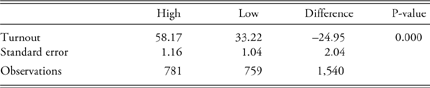
Average Treatment Effect of Public Works on Turnout: Difference in Means