


INTRODUCTION
The Chinese Communist Party (CCP) crafted formal and informal rules to strengthen party institutions in the reform period. The system appeared to work well until Xi Jinping came to power in 2012 and, to the surprise of all, quickly established himself as the most powerful leader China had seen in decades (Shirk Reference Shirk2018). The questions of whether China is returning to one-man rule and whether party institutions can disrupt this process are important and have global implications, given the tragedies of political radicalism under Mao's rule and the vast power and influence that Xi appears to leverage today.
Unfortunately, elite CCP institutions remain extremely secretive. The CCP central committee members, who occupy the most senior positions in China, are electorally approved by the CCP national congress behind closed doors. The government merely informs the public of the list of approved members, but carefully conceals the original vote counts. A noise-filled ranking of the underlying votes is available for academic research—but only for less-prestigious alternate members (Shih, Adolph, and Liu Reference Shih, Adolph and Liu2012; Kung Reference Kung2014; Lu and Ma Reference Lu and Ma2019). Without data on vote counts, there is no feasible way to compare election results over time or across different regions (e.g., we cannot tell whether elections are becoming more or less contentious under Xi).
This research note summarizes an innovative statistical technique that can provide a reliable estimation of secret party congress vote counts and a related metric of voter preference diversity. We apply the technique to analyze national party congress elections from 1945 to 2017 and provincial party congress elections from 2006 to 2017. The revealed dissenting votes at both national and provincial levels demonstrate a change in voting patterns around the time Xi took power. The level of national congress dissenting votes after Xi's first five-year term almost fell to the bottom; most provinces saw their dissenting votes decline too, but a subset of provinces—including Shanxi, a province that was hit hard by the anti-corruption campaign, and most provinces close to Shanghai, the power base of the former top leader Jiang Zemin—saw dissenting votes increase.
The main purpose of this note is to demonstrate that dissenting votes in China's most important political institutions exist, can be reliably measured, and demonstrate variations worthy of investigation. We challenge the widely shared view among students of Chinese elite politics (Shih, Adolph, and Liu Reference Shih, Adolph and Liu2012; Truex Reference Truex2014; Wu Reference Wu2015) that the foremost decision-making institutions in China are entirely top-down and pre-determined by the highest authority.
What exactly do variations in dissenting votes measure? In general, the numbers of dissenting votes in any authoritarian election are difficult to interpret, and they may reflect genuine dissent as well as the degree of electoral suppression. Following Wu (Reference Wu2015), we tentatively suggest that drops in the number of dissenting votes in China reflect tightened electoral suppression or the decay of intra-party democracy. The evidence shows that the decay started well before Xi took power, contrary to popular belief.
There are many alternative explanations, of course, especially at the provincial level. Our new method also opens a range of new questions: Do variations in dissenting votes correlate with important political-economic variables? How can we provide better micro-level evidence of dissenting votes? Can we extend the analysis to prefecture- or even county-level? We hope that future research can shed more light on these and ensuing questions.
REVEALED ELITE DISSENTS IN AUTOCRACIES
If pseudo-democratic elections contribute to authoritarian resiliency through facilitating intra-elite power sharing (Brownlee Reference Brownlee2007; Magaloni Reference Magaloni2008; Svolik Reference Svolik2012), they must allow elites to legally express their dissatisfaction. An election with 100 percent approval rate may corroborate notions of a regime's omnipotence, but it remains undeniably useless for power sharing. Multiparty election—the most common form of authoritarian election today—supplies ample room for elite insubordination (Magaloni Reference Magaloni2008). Elites who control local political machines can work less enthusiastically and deliver fewer votes for the dictator. Furthermore, elites may defect to the oppositional parties in certain extreme cases.
Of course, elite dissents must fall within the boundaries set by the dictator, who maintains ultimate control over the electoral outcome by employing various techniques of electoral suppression (Schedler Reference Schedler2002). The amount of elite dissent revealed in an authoritarian election is a function of both true elite dissent and electoral suppression.
The variations in dissenting votes in communist regimes are probably determined by suppression rather than true dissent. Communist elections are regarded as rituals with strikingly low disapproval rates (Gandhi and Lust-Okar Reference Gandhi and Lust-Okar2009). Because most voters who are genuine dissenters do not dare to cast dissenting votes, what drives dissenting votes on the margin is the level of suppression, not the level of true dissent. Imagine in the past 30 percent of the voters were genuinely dissenting, but the revealed disapproval rate was only 1 percent because of electoral suppression. Now the disapproval rate drops to 0.5 percent. The drop is most likely due to tightened suppression. Whether the percentage of voters who are genuinely dissenting is now above or below 30 percent is hardly relevant.
Why do some voters mange to cast nay votes in China? Casting dissenting votes is relatively safe—not because of secret ballots (the ballot is not absolutely secret, as deputies have to write and cast ballot in an open space, and party leaders eventually have control of the ballot papers on which are deputies’ fingerprints), but because of authoritarian institutions and the need for power-sharing.
The ballots of the national congress contain over 100 names of central committee candidates. Deputies are forbidden from voting against the top leaders, who must be central committee full members, yet voting against most nominees remains legitimate, especially if the deputy herself has a relatively high standing within the party. In fact, lobbying against each other's promotion is common in Chinese government. It is unlikely that top leaders would authorize an investigation to identify the individuals who voted against an ordinary nominee. A single investigation would easily destroy any remaining credibility of the whole system. During the Cultural Revolution, even Chairman Mao's wife failed to obtain Mao's permission to unveil the eight deputies who dared vote against her. With the introduction of a competitive preliminary election in the 13th CCP National Congress in 1987, the norm of dissenting votes has been strengthened.
The CCP delegates vote for full and alternate members of the central committee almost simultaneously. It is reasonable to assume that electoral suppression remains constant for two elections that take place simultaneously at the same location. As voter turnout and enthusiasm are generally higher in more important elections, we expect that dissenting votes are more numerous for full members than for alternate members. Our hypothesis is conservative; even if electoral suppression differs between these two elections, more suppression is expected in the election for full members.
In the long run, we believe that electoral suppression follows a rising trend in the reform era. The 1980s saw a short-lived renaissance of intra-party democracy in China. The Cultural Revolution was just over, and the country opened up to the world. All communist regimes, including China, were experimenting with competitive elections. The third wave of democratization was high and strong. However, the reform wing of the party was purged following the crackdown of the 1989 democratic movement. The worldwide tide of democratization was turned in the twenty-first century. The average rate of global democratic transition slowed. Surviving authoritarian regimes became more resilient. The internal and external driving forces of intra-party democracy have been gradually losing their power in China.
Therefore, we hypothesize that electoral suppression is on the rise and tends to drive down dissenting votes in the long run. Our hypothesis formalizes an argument by Wu (Reference Wu2015), who divided the national congress elections into two stages: the early stage (1980s and 1990s) when unpopular candidates, including princelings and some prominent politicians, were often “accidentally” defeated in the preliminary elections, and the late stage, when tightened political control eliminated these kinds of accidents; however, it should be noted that Wu's (Reference Wu2015) analysis is based on anecdotal evidence only.
Our tentative hypothesis emphasizes the influence of institutions on leaders. It is not Xi Jinping who destroyed intra-party democracy. The seeds of decay were planted early. And it is the long-term decay of intra-party democracy itself that made the rise of a strongman like Xi Jinping inevitable. The decay of intra-party democracy in China and the de-democratization process throughout the globe are deeply related historical phenomena.
ANALYZING NATIONAL CONGRESS VOTES
A NEW STATISTICAL METHOD
For the sake of illustration, suppose the list of winners has three members only: Wang (4), Ding (2) and Xu (6), with the number of strokes of the Chinese characters given in parentheses. Suppose Wang, Ding, and Xu received 5, 2, and 2 nay votes, respectively. According to the official rule, the winner list revealed to the public is Ding, Xu, Wang. Ding and Xu precede Wang because Wang received strictly more disapproval votes. Ding precedes Xu because of the stroke order used in the case of vote ties.
If Wang received fewer nay votes than Xu did, Wang should be listed ahead of Xu. Alternately, if Wang had vote ties with Xu, Wang should still be listed ahead of Xu because of the stroke order. Since in reality Wang follows Xu in the official list, Wang must have received more nay votes than Xu did.
The trickier thing is to determine the vote differences between Ding and Xu, who form a chain of names in increasingly stroke order. Whether they have vote ties or not are both plausible. This said, the vote-tie possibility is more likely. In general if two persons have vote ties, then we must observe a chain of increasing stroke order given the rule of ordering winners. If two persons have different vote tallies, then the one with fewer nay votes must be listed first. There is only a 50 percent chance that their names form a chain of increasingly stroke order.Footnote 1 Therefore, the most straightforward guess is that Ding and Xu have vote ties, and they received fewer disapproval votes than Wang did.
The official alternate member winner list from the 19th Party Congress—which was held in 2017—contains 172 names. When we apply our method to this list, we discover that the list can be partitioned into six chains of increasing stroke order or six levels of vote counts. The six chains, from the first to the sixth, contain 87, 50, 18, 11, 5, and 1 names respectively. The first chain begins with Ma Zhengwu and ends with Dai Houliang. All 87 nominees in this batch tied for the lowest number of disapproval votes, n 1. The second chain begins with Yu Shaoliang and ends with Pan Gongsheng. All 50 nominees in this batch tied for the second lowest number of disapproval votes, n 2, with n 2 > n 1, and so on.
Suppose the 87 nominees in the first batch have different vote counts, we must have extreme luck—86 independent coin tosses all landing on heads—to observe a sequence of 87 names in increasing stroke order. The assumption that they have different vote counts is unrealistic. Unfortunately, the method in the existing literature is based on such an unrealistic assumption. Our method improves over the existing method by removing noise that is due to the stroke order of the names. Our analysis can be generalized, formally presented, and rigorously proved using a Bayesian probability model. The technical details are reported in a separate paper.
Our results of estimated vote ranking with ties pave the way for a sensible estimation of real vote counts n i, with i = 1, 2, 3, 4, 5, 6. We would like to emphasize that the empirical analysis of real election data in the rest of the paper mainly depends on our estimated vote ranking with ties. It does not depend on how reliable the real vote counts are estimated. The estimated vote counts merely make it easy to interpret the empirical findings.
Since 0 ≤ n 1 < n 2 < n 3 < n 4 < n 5 < n 6, we know for sure that n 2 ≥ 1, n 3 ≥ 2, n 4 ≥ 3, n 5 ≥ 4, and n 6 ≥ 5. In other words, we know that those nominees who tied for the second (third, fourth, etc.) lowest number of disapproval votes must have received at least one (two, three, etc.) disapproval votes respectively. Since we estimated the exact number of nominees receiving each distinct level of disapproval votes (e.g., 50 for those who tied for the second lowest number of disapproval votes), we can show that  $\mathop \sum \limits_{i = 1}^6 n_i \ge 144$ (i.e., the aggregated number of disapproval votes is no fewer than 144).Footnote 2
The question remains whether it possible for the aggregated number to be much larger than 144. We do not have rigorous proof, but probabilistic intuition suggests that the real aggregated number should be negligibly close to 144. In the 19th Party Congress, 2280 delegates voted for 172 alternate member nominees. Is it possible that n 1 = 1 (or a larger integer)? Suppose that n 1 = 1 is true, it must also be true that absolutely no nominee received zero nay votes, while a batch of 87 members received exactly one nay vote. This scenario is unlikely. We expect to see some continuity, not such a sharp break: the scenario would be as if 2,280 soldiers fired a shot at an approaching train from a distance, and the second carriage was shot 87 times, but the first carriage was not hit at all. The most likely estimation should be n 1 = 0, namely, that the first batch of 87 members received zero nay votes. Given the same logic, we argue that the vote gap between other neighboring vote ranks should be one as well, though the logic is slightly weak for the difference between n 6 and n 5.
A FREEFALL IN DISSENTING VOTES IN 2017
In total, only twelve central committee election winners are ranked by vote counts and name stroke order: the full- and alternate-member elections of the 7th (1945) and 8th (1956) Party Congresses before the Cultural Revolution and the alternate-member elections of the 12th–19th (1982–2017) Party Congresses in the reform era.
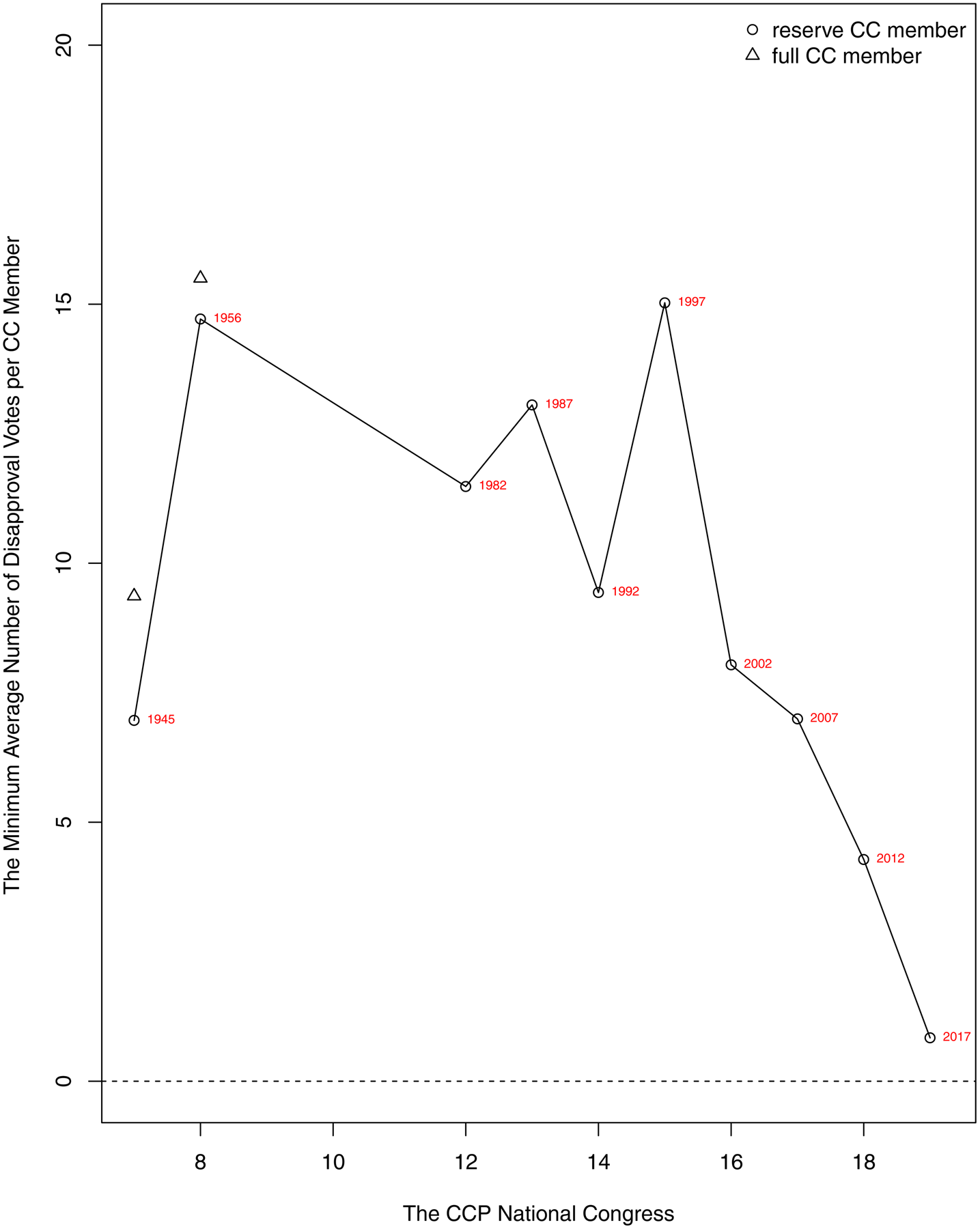
Figure 1 plots the number of (minimum) dissenting votes per committee member. The full members always attracted more dissenting votes than corresponding alternate members. The number of dissenting votes per alternate member first fluctuated within a range from 7 to 15 before the 15th Party Congress in 1997—the year Deng Xiaoping died; it reached its peak in 1997 and has dropped steadily since that year. The death of Deng paved way for real power centralization. Before Deng's death, the top power was always shared between the elders and younger party leaders. There was no significant deviation until the 18th Party Congress in 2012, when the number dropped from 7 to 4.28; in the 19th Party Congress in 2017 the number dropped further to 0.84, a level close to zero. The decline coincides with the rise of Xi's power. Xi had strong influence on the 18th Party Congress, as he was heir-apparent and also the secretary general of the Party Congress. Xi's power greatly increased as a result of the anti-corruption campaign that started soon after Xi took power in 2012.
The Trend of Disapproval Voting in the CCP National Congress
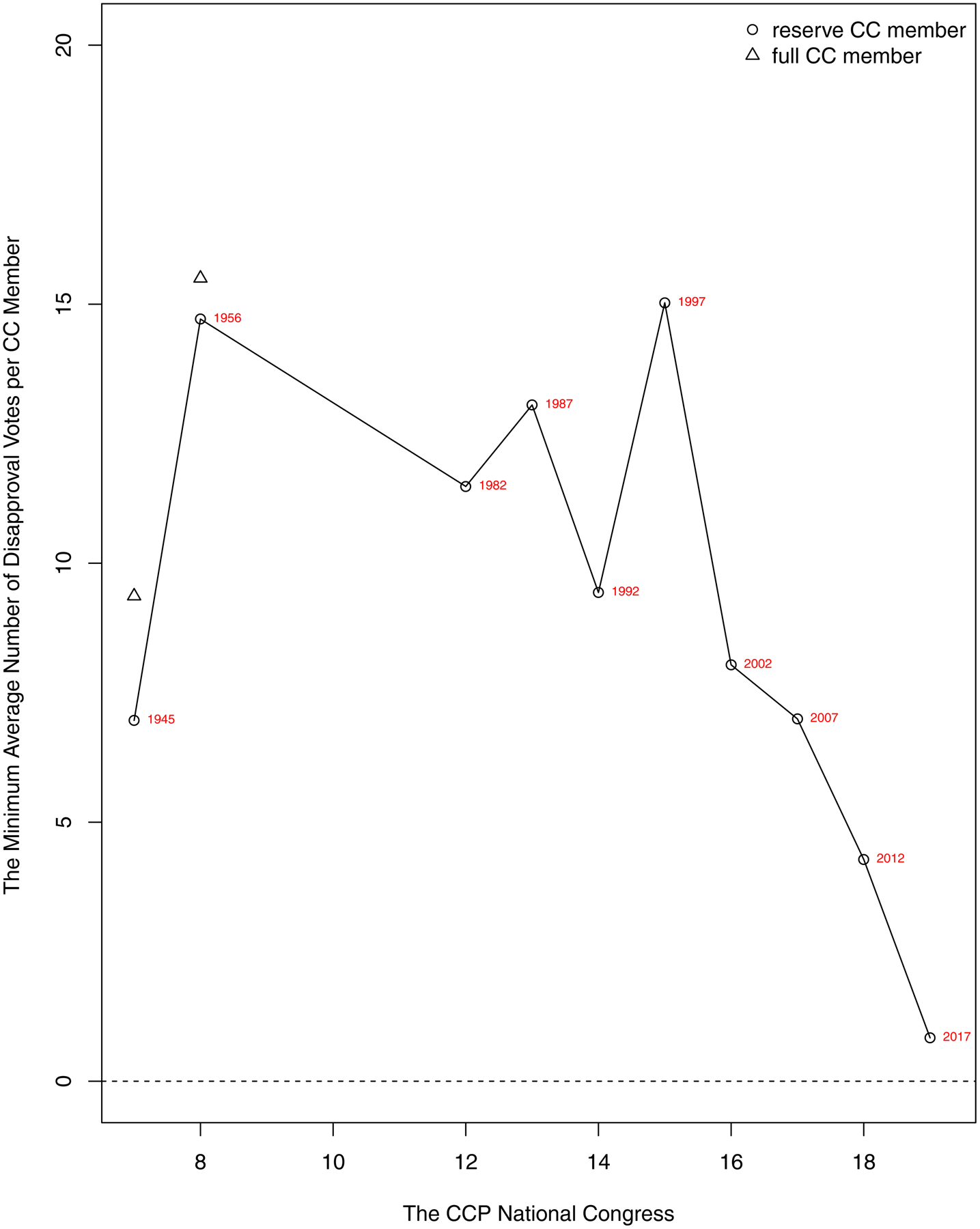
Figure 1 shows evidence that is consistent with our two tentative hypotheses. The plunge of dissenting votes is unlikely to be driven by changes in voter profiles (e.g., younger age) that make casting dissenting votes costlier. The average age of national congress delegates has remained very close to 52 over the past 20 years. Such a plunge to zero had probably never happened in the CCP's history before. Dissenting votes were numerous during the heyday of the Cultural Revolution (Chi Reference Chi2003). It is highly plausible that those voting results disappointed Mao so much that he reported the winner list based on stroke order only, censoring unfavorable information.
THE RAPID CONVERGENCE TO ONE VOICE
The level of dissenting votes is not the only factor that matters; the distribution of these votes is also crucial. Consider two hypothetical central committees. Committee A has three members, with each member receiving exactly one disapproval vote. Committee B also has three members, with one member receiving zero disapproval votes, one receiving exactly one disapproval vote, and one receiving exactly two disapproval votes. The total number of disapproval votes is the same, yet Committee B's election demonstrates greater voter preference diversity and fractionalization than that of Committee A. Adapting the influential index of legislative party fractionalization described by Rae (Reference Rae1967), we define our index of preference fractionalization as
 $$F = 1-\mathop \sum \limits_{i = 1}^m P_i^2 $$
where P i refers to the fraction of central committee members having vote rank i. Our F index equals the probability that two randomly selected central committee members receive different vote numbers. The same index is used as a measure of bio-diversity in ecology. As F increases, the fractionalization or diversity of the Party Congress increases. In our hypothetical example, F for Committee A is 0. F for Committee B is 1 − 3 × (1/3)2 = 2/3.
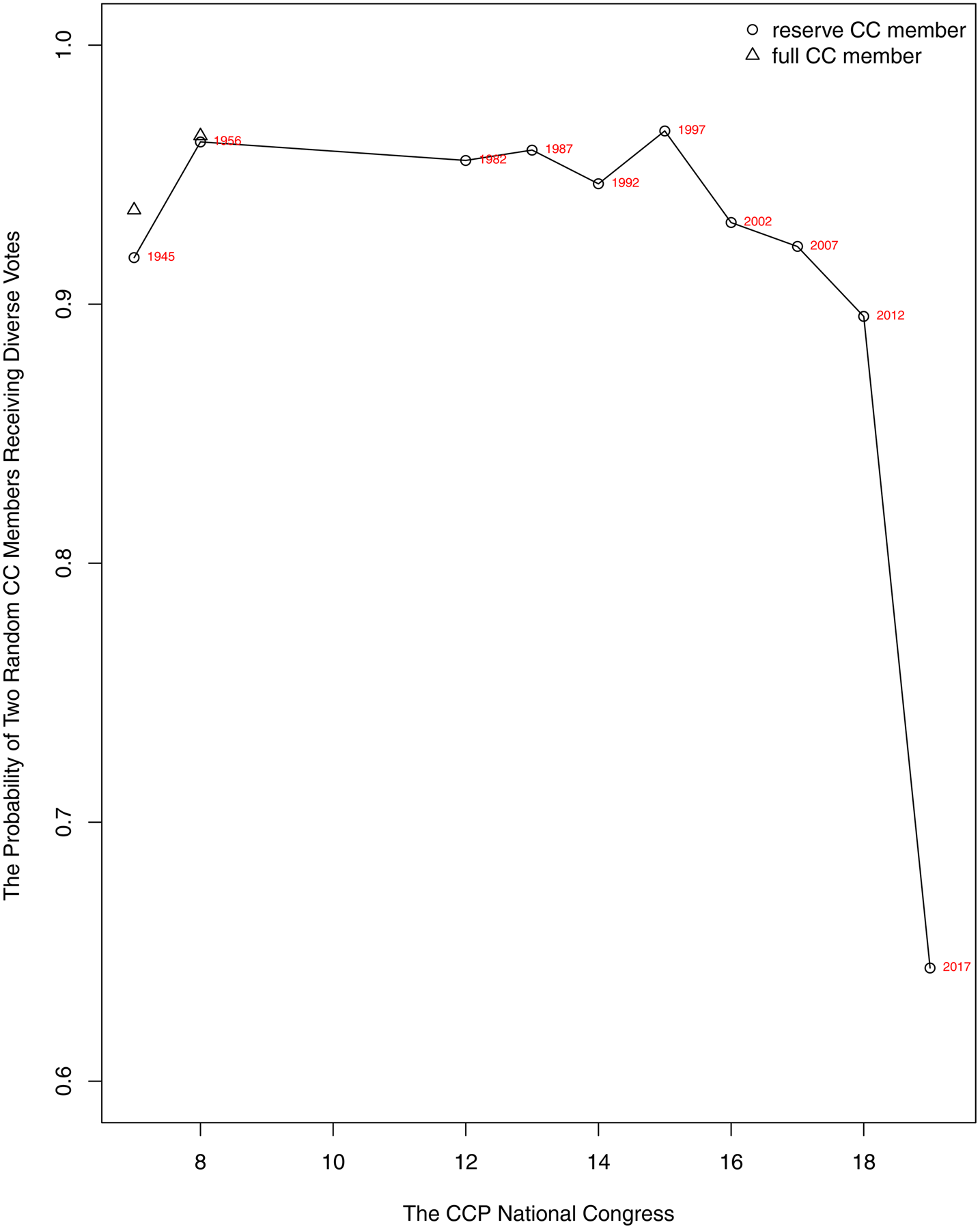
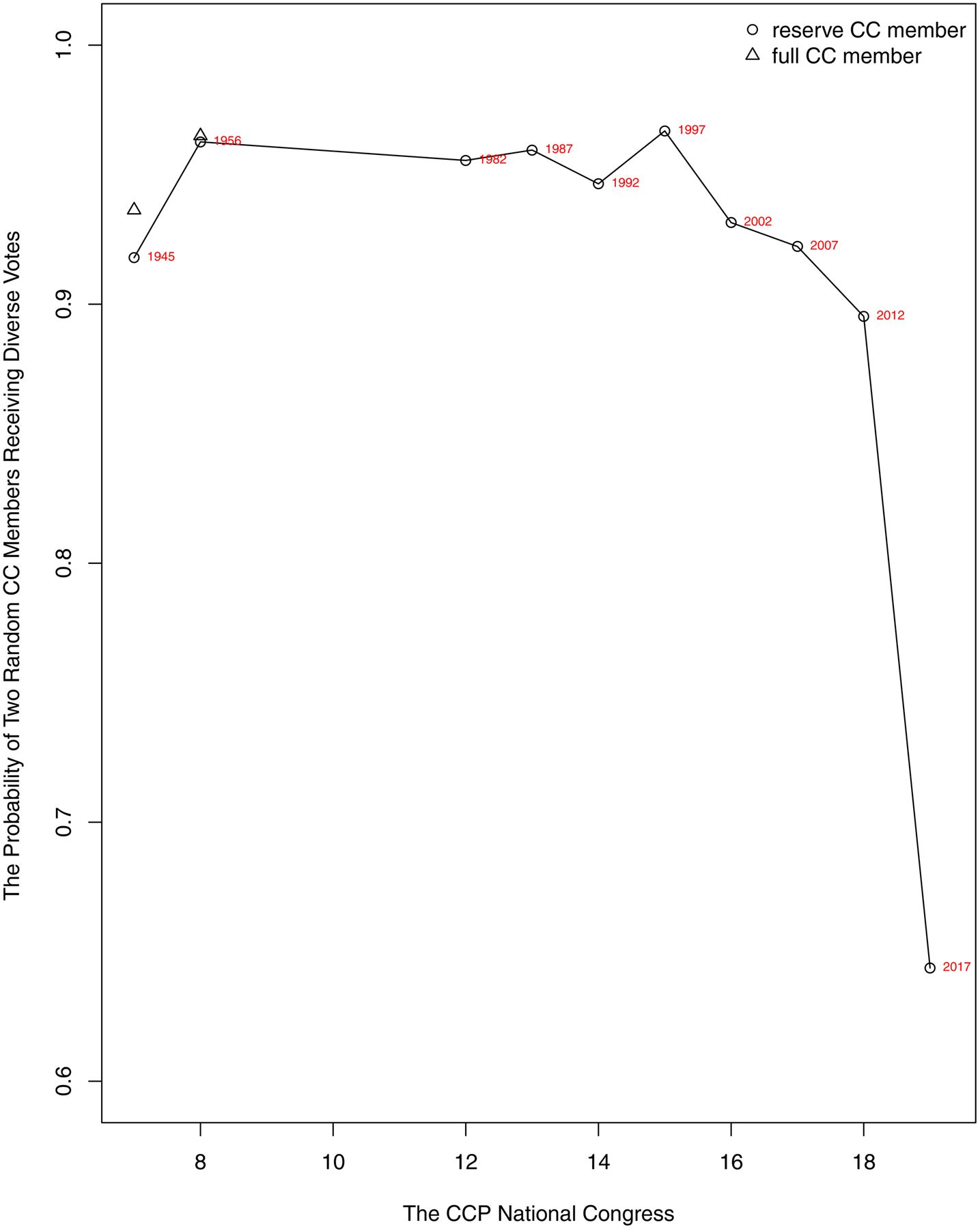
In the 19th Party Congress, P 1 = 87/172, P 2 = 50/172, P 3 = 18/172, P 4 = 11/172, P 5 = 5/172, P 6 = 1/172. The calculated F index is 0.64. However, the calculated F index for all past congresses in our data is at least 0.90. In 2017, the Party Congress F index lost almost one-third of its value. This drop was also unprecedented in recorded party history (Figure 2).
The Trend of Preference Fractionalization in the CCP National Congress
ANALYZING PROVINCIAL CONGRESS VOTES
We also estimated the election tallies of 1383 alternate members from 31 provincial party committees around the 17th (2007), 18th (2012), and 19th (2017) national congresses. We discover that the recent trends of central and provincial elections diverged around the time Xi Jinping took power in 2012. In 2007, central candidates on average received 7 nay votes, which is approximately two times greater than 2.27, the average number of provincial nay votes per candidate in that period. Since the number of voters in the national party congress is approximately two to three times greater than that of provincial party congress, the implied disapproval rate is still similar in both the central and provincial elections around 2007. Around 2012, the year Xi took power, the number of nay votes per candidate dropped in both the central and provincial elections, yet the drop observed in the central elections (from 7 to 4.28) is much steeper than the drop observed in provincial elections (from 2.27 to 2.19). The divergence deepened around 2017, after Xi's first term in office. The number of nay votes per candidates dropped further from 4.28 to 0.84 in the central elections, yet the values of the same variable only dropped from 2.19 to 1.67 in the provincial elections.
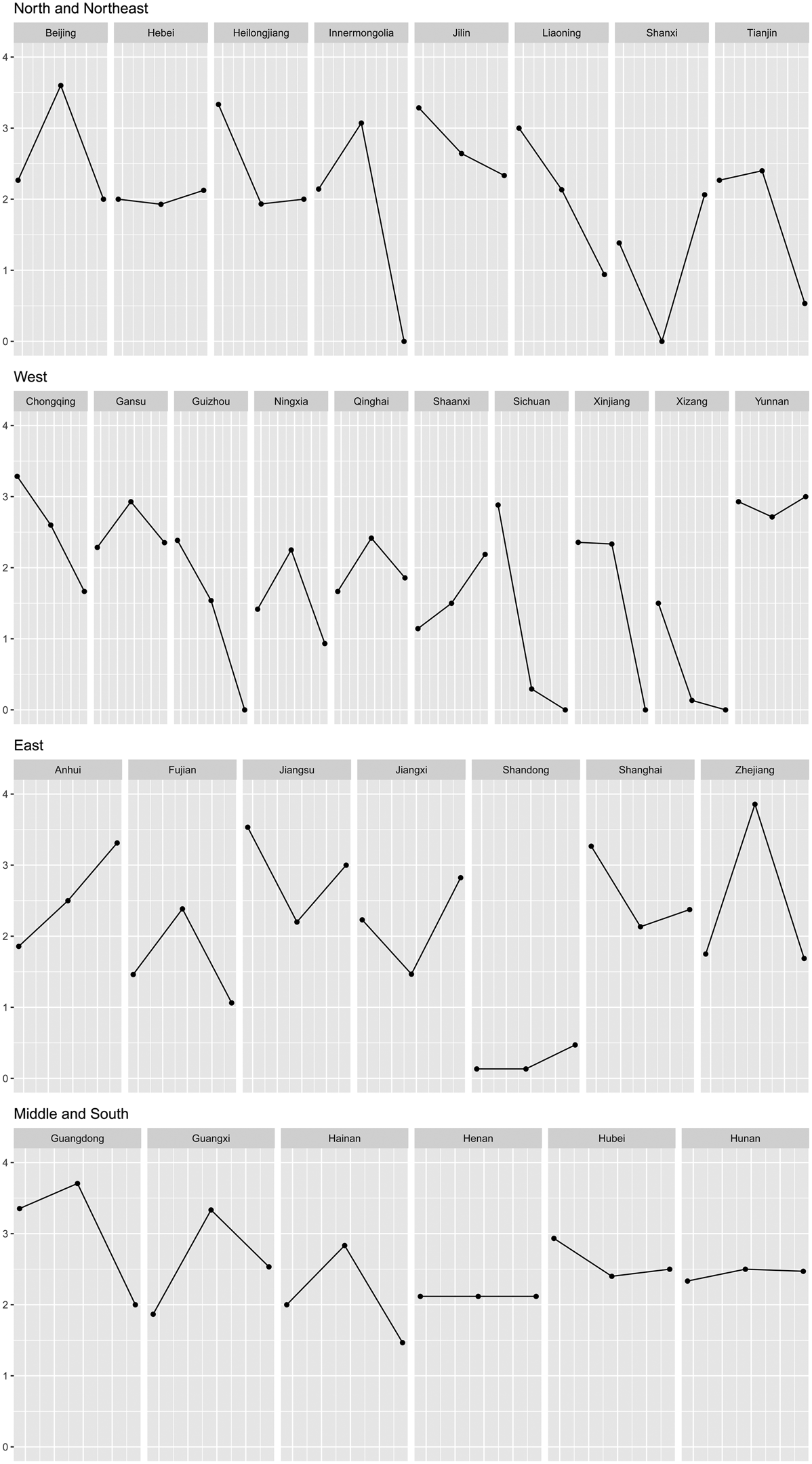
To understand why the aggregated provincial nay votes diverge from the national trend, we plot the estimated number of nay votes per alternate member from 2007–2017 for each province and group them into four regions in Figure 3: the northern and northeastern provinces, the eastern provinces, the middle and the southern provinces, and the western provinces.
The Estimated Nay Votes per Candidate in the CCP Provincial Congress (2007, 2012, 2017)
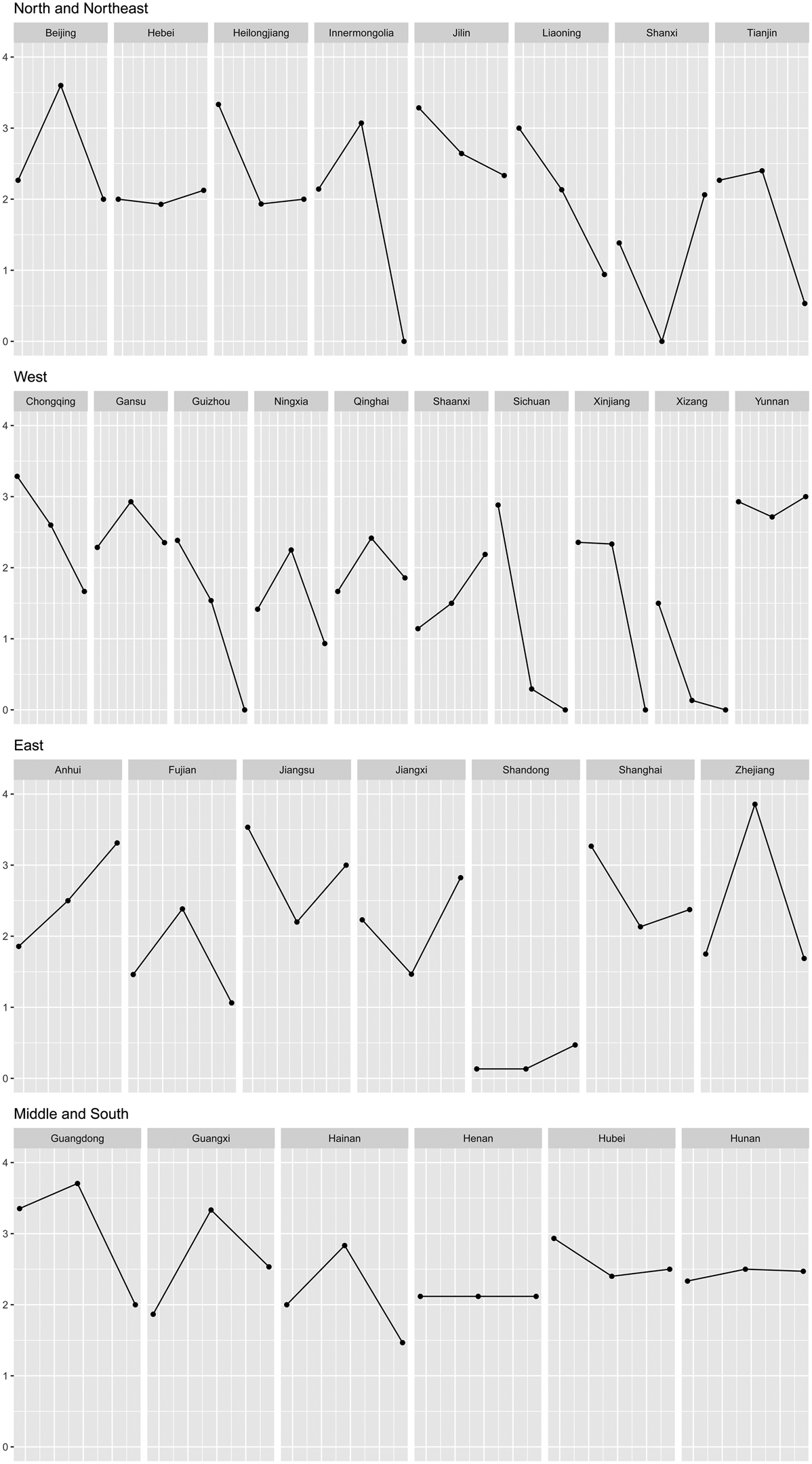
Provinces within the same region tend to have similar trends in dissenting votes over the same period of time. Across these big regions, the variations appear to be substantial and systematic. We can classify the provinces into three groups based on the changes in the votes in 2017: Group DOWN, Group FLAT, and Group UP. Almost all provinces in the north/northeast and the west (including Beijing, the national capital) belong to the Group DOWN. These provinces saw their dissenting votes decline significantly in 2017, following the same trend in the national party congress elections. The dissenting votes even dropped to zero in five provinces (Guizhou, Sichuan, Xinjiang, Xizang, Inner-Mongolia). The last three provinces are ethnic autonomous regions. On the other hand, most provinces in the east belong to the Group UP. These provinces saw their dissenting votes to increase significantly in 2017, opposing the national trend. Provinces in the middle/south belong to the Group FLAT. These provinces saw their dissenting votes remain largely constant or decline slightly.
It is difficult to interpret the variations of revealed dissenting votes across different regions. In provinces where suppression is intensive, provincial congress delegates may refrain from casting any dissenting vote. The variations of suppression may reflect factional infighting: regional party chiefs who are not close to President Xi may encourage dissenting votes to signal the power of regional elites. Alternatively, regional variations of dissenting votes may be driven by variations of genuine disobedience to regional or even top national leadership. Other economic or cultural factors may play a role as well.
While we acknowledge potential alternative explanations, we propose to understand dissenting votes at both national and provincial levels from the suppression perspective. If President Xi wants to centralize more personal power, he has to suppress the political institutions (Shirk Reference Shirk2018). Almost all Chinese empires, including the Chinese communist regime, establish national capitals in the north/west and rely on northern/western provinces to provide political and military support. The richer eastern/southern provinces are coerced to provide economic support. It is natural that President Xi, a northerner, will first take on the central institutions, then the northern/western provinces, and finally the southern/eastern provinces. Xi's suppression of political institutions follows our predicted path, but it is not yet complete. Approximately half of the Chinese provinces—and these are the more economically developed provinces—are not, at least not yet in 2017, under so tight control that provincial elites do not dare or do not bother to cast dissenting votes.
Our interpretation of provincial vote variation appears to be plausible. As eastern provinces are located close to Shanghai, the power base of the former party leader Jiang Zemin and his powerful “Shanghai gang,” it is reasonable to argue that this region is less under Xi's influence. Some exceptions shed more light on our interpretation. Fujian and Zhejiang, two eastern provinces, followed the national trend instead of the regional trend. These are two provinces where Xi had worked for a long time and developed deep connections. It is not surprising that Xi has good control of these two eastern provinces. Among all northern provinces that followed the national trend, Shanxi is the clear outlier that saw its dissenting votes to increase significantly in 2017. As Shanxi is the province hit hardest by Xi's anti-corruption campaign that started around 2012, it looks like an example where genuine dissatisfaction is driving dissenting votes.
CONCLUSION
Using a novel statistical method, we show that the number of dissenting votes and a metric of voter preference diversity both plunged to bottom in the 19th National Congress of the CCP, which was held in 2017. The institution of the National Congress of the CCP—a creation of Mao and his comrades in 1945 and the crown jewel of intra-party democracy in the reform era—appears to be finally suppressed by President Xi after a prolonged institutional decay that paved the way for the sudden rise of a strongman like Xi. Provincial election data that are estimated using the same methodology tell a similar, yet more nuanced story. We identify three sets of provinces that saw dissenting votes to vary in three different ways in 2017. Almost all provinces in the north/northeast and the west saw their dissenting votes decline significantly in 2017, following the same trend in the national party congress elections. On the other hand, most provinces in the east, except those where President Xi worked for a long time, saw their dissenting votes increase significantly in 2017, opposing the national trend. Provinces in the middle/south saw their dissenting votes remain largely constant or decline slightly. In general, our findings suggest that provincial party institutions have remained more resistant and spontaneous than national party institutions since Xi took power.
CONFLICTS OF INTEREST
The author declares none.