

Reflection is required when it comes to a bill drawn on London, say, for the movement of goods from Germany to South America finding itself used as part of the backing for the Norwegian currency. ‘The sterling pool’, Lloyds Bank Review, February 1932, p. 66
1. Introduction
Much as Paul David described the invention of the mechanical typewriter – it was invented 51 times before being patented by Christopher Sholes in 1867, licensed to the Remington Company and successfully commercialized – the connections between the gold-exchange standard and the Great Depression have been discovered repeatedly. They were discovered by Ehsan Choudhri and Levis Kochin in a seminal article in 1980.Footnote 1 They were discovered by Barry Eichengreen and Jeffrey Sachs in articles published in 1985 and 1986.Footnote 2 They were discovered by James Hamilton in an insightful article published in 1988.Footnote 3 They were discovered by Peter Temin in his Robbins Lectures published in 1989.Footnote 4 They were discovered by the now chairman of the Federal Reserve Board in his 1994 Journal of Money Credit and Banking Lecture.Footnote 5 Moreover, these contributors to the contemporary literature had important antecedents, including Robert Triffin in the 1950s, Ragnar Nurkse in the 1940s, and Leo Pasvolsky in the 1930s.Footnote 6
And yet, despite the long lineage of the literature, there remain important unanswered questions about the interwar gold-exchange standard. One such question, on which we focus in this article, is what happened to the currency composition of international reserves. The interwar period was marked by the rise of New York as a financial centre, rivalling London, and of the dollar as an international currency, rivalling sterling. The question is when the dollar overtook sterling as the leading currency in which to hold foreign exchange reserves. This answer is of historical interest. Tracking the positions of sterling and the dollar as reserve currencies opens a window onto international currency status more generally. It sheds light on the competition for financial status between London and New York. Evidence on the liquidation of dollar and sterling reserves by foreign central banks and governments helps to identify the sources of deflationary pressure on the US and British economies and hence helps to explain the propagation of the Great Depression. Finally, it may be possible to mine this episode for information about the circumstances in which, in the not too distant future, the euro might dethrone the dollar as the leading reserve currency.
The challenge of addressing these issues is that the currency composition of foreign exchange reserves in the 1920s and 1930s is a statistical black hole. Central banks published figures for total gold and foreign exchange reserves, information which was then compiled by the Bank for International Settlements and League of Nations, but not on the currency composition of those reserves. Estimates of that currency composition are sparse, undocumented and conflicting. In 1928 the Federal Reserve Board conjectured that ‘perhaps as much as $1,000,000,000 of the operating reserves of foreign central banks’ was held in the form of dollar balances, bills and bonds.Footnote 7 Global foreign exchange reserves being on the order of $2.1 billion (and assuming that a small but non-negligible fraction of foreign exchange reserves was held in third currencies), this implies that the dollar had already overtaken sterling as the leading reserve currency in the second half of the 1920s. Subsequently, Triffin (Reference Triffin1960) offered a sharply contrasting estimate for 1928, namely that sterling's share of global foreign exchange reserves was in the order of 80 per cent. He also estimated sterling's share to be around 70 per cent in 1938. Others like Aliber (Reference Aliber1966) and, more recently, Chinn and Frankel (Reference Chinn and Frankel2008), have built on the work of Triffin and others, suggesting that the dollar only overtook sterling after World War II. This is seen as testifying to the advantages of incumbency and to the power of network effects, which create inertia in the currency composition of foreign exchange holdings and leave room in the market for only one dominant international currency.Footnote 8
These estimates for the 1920s and 1930s are based on fragmentary evidence and conjecture. Triffin's estimates, which are probably the most widely cited, are undocumented and unexplained. For more than 70 years, then, scholars have made the ‘capital mistake’ of theorizing about the currency composition of foreign exchange reserves in advance of the facts.Footnote 9
In this article we partially fill this gap. We report new estimates of the currency composition of foreign exchange reserves in the 1920s and 1930s. These estimates are based on data gleaned in the archives of central banks. Inevitably there are gaps, but our estimates cover some 80 per cent of global foreign exchange reserves.
Our new estimates are at variance with previous pictures. We find that the dollar first overtook sterling as the leading reserve currency not in 1928, 1938 or 1948 but in (wait for it. . .) the mid 1920s, and that it then widened its lead in the second half of the decade. Evidently incumbency and inertia did not delay the transfer of leadership for as long as suggested by Triffin, Chinn and Frankel. Then, however, with the devaluation of the dollar in 1933, sterling regained its place as the leading reserve currency.Footnote 10 Contrary to much of the literature on reserve currency status, it does not appear that dominance, once lost, is gone forever.Footnote 11
Our evidence for the 1920s and 1930s is also inconsistent with the notion that there is only room for one dominant reserve currency, along perhaps with a competitive fringe of minor players, owing to the network externalities thrown off by the dominant currency.Footnote 12 A plausible reading of our evidence is that sterling and the dollar shared reserve currency status, more or less equally depending on year, for much of the interwar period. The prewar oligopoly described by Lindert (Reference Lindert1969), where market share was split between sterling, the French franc and the mark, was displaced by a sterling−US dollar duopoly.
The body of the article is organized as follows. Section 2 provides some background on the evolution, operation and literature on the gold-exchange standard. In Section 3 we describe our data and methods and in Sections 4 and 5 our findings. Section 6 then draws out additional implications for interwar monetary history, focusing on earlier literatures on sterling and the dollar as international currencies more generally.
2. Genoa and beyond
In what remains the single most important scholarly work on the gold standard before 1913, Arthur Bloomfield (Reference Bloomfield1963) described the practice of holding external reserves in convertible foreign assets. Bloomfield classified Russia, Japan, Austria-Hungary, Belgium, the Netherlands, Canada, South Africa, Australia, New Zealand and most of Scandinavia all as on some form of gold-exchange standard – that is, as holding a substantial part or the bulk of their external reserves in foreign exchange. He distinguished the Bank of Finland, the Swedish Riksbank and the National Bank of Belgium, which held the majority of their external assets in the form of foreign bills, balances with foreign correspondents and foreign bonds, from the Russian State Bank, the Bank of Norway, the Bank of Japan and the Austro-Hungarian bank, which held smaller but still substantial shares of their external assets in this form.Footnote 13 He observed that currency boards could also reasonably be placed under this heading, in that they held their currencies rigid not against gold but against an external numéraire currency that was in turn pegged to gold, while the backing for the domestic currency was exclusively in the form of interest-bearing convertible external assets. Economies in this category included Ceylon, India, Kenya, Malaya, the Maldives, Panama, the Philippines, the Seychelles and Singapore.Footnote 14
Bloomfield understood the gold-exchange standard as a progressive development. As he portrayed it, there was a natural progression from the gold coin standard to the gold bullion standard and then to the gold-exchange standard. Each step further economized on the real resource costs of operating the gold standard. Each step further limited the consumption that had to be foregone in order to obtain the yellow metal ultimately providing the basis for the domestic circulation, but without diminishing the credibility of the monetary standard.
The gold-exchange standard, as the final stage in this evolution, piggybacked on the development of international financial centres with strong financial institutions and liquid financial markets, where external reserves could be safely held and conveniently accessed. It was thus not surprising that economies with extensive commercial, financial and political links to those financial centres were disproportionately inclined to adopt the gold-exchange standard. Nor was it surprising that relatively poor countries, for which the opportunity cost of accumulating gold bullion was high, had the greatest tendency to economize on gold by holding their reserves in interest-bearing form.
Bloomfield's intellectual progeny, Peter Lindert (Reference Lindert1969), described the further development of the gold exchange standard in the years leading up to World War I. Basing his work on the publications of central banks, governments and commercial banks, Lindert assigned each institution's foreign reserves to a particular currency.Footnote 15 He thereby constructed estimates of foreign exchange reserves for 1899 and 1913.
Lindert's estimates suggest that foreign exchange reserves accounted for about 20 per cent of the total gold and exchange reserves of central banks and governments on the eve of World War I, up from less than 10 per cent of total reserves in 1880.Footnote 16 They suggest that sterling was far-and-away the dominant reserve currency: 64 per cent of known official foreign exchange assets were held in London, while 15 per cent were held in Paris and 15 per cent were held in Berlin.Footnote 17 Between 1899 and 1913 the mark's share remained unchanged, but the franc's share rose to 31 per cent at the expense of sterling's, which fell to 48 per cent. The rise in the franc's share had a lot to do with events in one country, Russia, which was on the receiving end of French lending and accumulated official balances in Paris in this period.Footnote 18 The only other countries holding significant foreign exchange reserves in Paris, according to Lindert, were Italy and Greece. Canada was probably the only country to hold significant official foreign balances in New York.Footnote 19 More broadly, the growing geographical and currency diversification of foreign reserves reflected the tendency for other countries and financial centres to catch up with Britain and London, respectively. The trend can be viewed as strengthening the foundations of the gold-exchange standard insofar as it relieved countries and central banks of the fears associated with holding all their official foreign-exchange eggs in one basket. Flandreau and Gallice (Reference Flandreau, Gallice, Bussiere and Cassis2005) study the books of one major recipient of Russian funds, the Banque de Paris et des Pays-Bas. They find that the French bank hedged its position by holding large amounts of sterling bills, an illustration of the critical role of the London discount market even when foreign holdings in Paris were increasing.
What this progressive portrayal leaves out is the greater fragility of the gold-exchange standard. The propensity to hold backing for the domestic circulation in the form of interest-bearing assets in the major financial centres hinged on the perceived stability and liquidity of those balances, something that could be undermined by any number of events. War might lead belligerents to embargo gold exports and to seize the balances of an enemy power. Governments and central banks seeking to build up the domestic market as a reserve centre might undermine the position of a competitor by liquidating (converting into gold) external assets held in its currency. Devaluation against gold, either actual or anticipated, by a reserve-centre country would inflict losses on economies holding their external reserves in the form of interest-bearing assets in its market and discourage the practice.
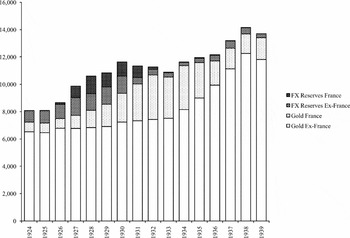
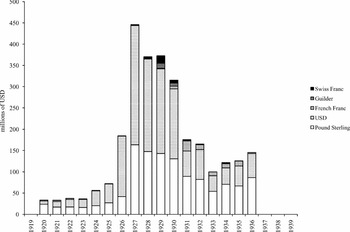
There were examples of each of these disruptions during and after World War I. Gold exports were embargoed. France curtailed its accumulation of foreign exchange reserves after 1928, and some have seen that as a reflection of its campaign to elevate Paris to the status of international financial centre.Footnote 20 The devaluation of sterling in 1931 inflicted losses on holders of sterling reserves, causing many of them to liquidate their foreign currency holdings after the fact.Footnote 21 Thus, the share of foreign exchange in total reserves (as valued by the League of Nations) fell from 36 per cent in 1929–30 to 19 per cent in 1931 and just 8 per cent in 1932. (See Figure 1.) Given still-prevailing rules for backing domestic circulation with either gold or convertible foreign exchange, this collapse of the exchange component of global reserves placed deflationary pressure on the world economy at the worst possible time.
Gold and foreign exchange reserves (24 countries, millions of US dollars)

But in the 1920s, when the interwar system was forged, these were still mostly problems for the future.Footnote 22 Few contemporaries appreciated the intrinsic fragility of a system that pyramided a growing monetary circulation on an increasingly narrow base of gold and whose viability hinged on both economic and political stability and investor confidence.Footnote 23 It was therefore cost efficiencies and not risks that dominated contemporary discussion and motivated the more widespread adoption of gold-exchange-standard practice.
The backdrop to these efforts was the rise in price levels in the period surrounding World War I. The Great War (like most wars) had been inflationary, as governments enlisted seigniorage in the national defence. Money creation and inflation were made possible by the suspension of gold convertibility or at least the temporary imposition of a de jure or de facto embargo on gold exports. Wartime inflation was only partially reversed by deflation in 1920–1. Higher prices, together with higher levels of production as the world economy resumed its growth, implied the need for larger stocks of money and credit.
The perceived problem was that the growth of global gold stocks had not kept pace with this need. Gold production had fallen steadily since 1915. And there was reason to think that this problem was likely to grow more serious if, as widely presumed, gold convertibility was restored on the basis of prewar parities. Prewar parities meant prewar domestic-currency prices of gold. This meant no increase in the nominal value of existing gold balances. And with only the price of gold back at 1913 levels (but other commodity prices remaining higher), the real price of gold and hence mining activity would be depressed.
There were two conceivable solutions to this problem.Footnote 24 One was a generalized deflation to bring price levels back down, thereby raising again the real price of gold until it could back a stock of real balances sufficient to support the prevailing level of economic activity in the short run and stimulate an adequate flow supply of newly mined gold to meet the monetary needs of an expanding world economy in the long run. Absent other steps, the restoration of gold convertibility at prewar parities would be enough to bring this about. Lower gold prices would mean more valuable monetary gold stocks, a smaller domestic circulation, and the credit stringency needed to induce the requisite deflation. The problem with this solution, as contemporaries understood, was that deflation could also mean slow economic growth.Footnote 25
The alternative was to further institutionalize the prewar practice of supplementing gold with foreign exchange. This idea was famously advanced at the Genoa Conference in 1922. Ralph Hawtrey (Director of Financial Enquiries at H. M. Treasury), John Maynard Keynes and Sir Robert Horne (the British Chancellor) drafted on behalf of the conference's financial commission a proposal for central banks to augment gold with foreign-exchange reserves. The commission adopted a resolution authorizing central banks ‘in addition to any gold reserve held at home, [to] maintain in any other participating country [that had previously restored gold convertibility] reserves of approved assets in the form of bank balances, bills, short-term securities or other suitable liquid assets’.Footnote 26 It recommended revising central bank statutes to facilitate this practice. The principal reserve centres, for their part, were encouraged to restore free markets in gold as quickly as possible so that their financial assets, now freely convertible, would constitute an attractive supply of foreign reserves.
The Genoa resolutions, together with the general desire to avoid a more widespread deflation, had the desired effect. With the advice of the League of Nations, Austria, Danzig, Hungary, Bulgaria, Estonia and Greece all adopted new or revised statutes authorizing their central banks to hold the entirety of their external reserves in the form of foreign bills and balances.Footnote 27 A long list of other central banks was authorized to hold a portion of their reserves in this form.Footnote 28 And still other countries that had not yet established central banks held external reserves in the form of bills and balances through other government agencies.Footnote 29
Thus, whereas foreign exchange had accounted for roughly 20 per cent of the total reserves of central banks and governments in 1913, by 1925 this ratio had reached 28 per cent.Footnote 30 (Again, see Figure 1.) By 1926 the ratio was 31 per cent. In 1927–8, the heyday of the interwar gold-exchange standard, it was 42 per cent. The share of reserves accounted for by foreign exchange then collapsed catastrophically.
A few qualifications are needed before proceeding. First, the British were more enthusiastic about the spread of the gold-exchange standard than the French and Americans. Not just Hawtrey, Keynes and Horne at Genoa but Montagu Norman all through the 1920s saw the gold-exchange standard as strengthening Britain's financial position. In contrast, the French and Americans inclined towards an idealized vision of the prewar system and plumped for a more heavily gold-based system.Footnote 31 Insofar as different financial centres had influence with different parts of the world, this difference of opinion influenced which countries were more and less inclined to hold foreign exchange reserves.Footnote 32 Not surprisingly, the practice of holding foreign-exchange reserves was particularly prevalent in the British Commonwealth and Empire and among Britain's other important trading partners.Footnote 33 And, in turn, this played an important role in reserve-currency competition, as we show below.
The reserve-centre countries did not themselves hold much in the way of foreign exchange.Footnote 34 This was as it should be: the whole point of other countries backing their monetary circulations with liquid assets issued by the reserve centres was that the reserve centres backed those same assets (for them, liabilities) with gold into which those assets could be freely converted. Had the reserve centres similarly backed their liabilities with claims on other countries, the arrangement would have simply been one big Ponzi scheme – and it would have been recognized as such.Footnote 35
The principal exception was France, which after 1928 aspired to reserve centre status. In 1926–7 the Bank of France had acquired large amounts of foreign exchange as a result of intervening in the foreign exchange market to prevent the franc from appreciating excessively once the Poincaré stabilization had halted the country's high inflation. (Again, this is evident in Figure 1.) This foreign exchange was in excess of what the Bank of France needed to back its monetary liabilities once gold convertibility was restored in 1928.Footnote 36 Its existence dismayed French officials, and their efforts to liquidate it created serious problems for the reserve centres and the world economy.
In addition, these balances complicate comparisons between the prewar and interwar periods. One can argue that because France was a reserve centre the Bank of France's foreign-exchange balances should be disregarded when one compares the prevalence of the gold-exchange standard before and between the wars, just as one can argue that one should disregard the substantial foreign exchange balances held by Germany and the very much smaller ones held by France before World War I.
But modifying the statistics in this way alters the broader picture only slightly. If we eliminate France from the League of Nations’ figures (the US and the UK already being omitted), the share of foreign exchange in the total external reserves of the remaining 23 countries falls to 38 per cent in 1927–8 (down from 42 per cent for all 24). If we similarly eliminate Britain, France and Germany from Lindert's figures for 1913, the share for the remaining 32 countries rises to 22 per cent (up from 19 per cent for all 35). The contrast between the two periods in the prevalence of the gold-exchange standard is then attenuated somewhat by these adjustments, but far from eliminated. The growth of the foreign exchange share of international reserves was not simply a French phenomenon, in other words; it was global.
Finally, it is worth looking again at the global gold shortage that provided the motivation for the Genoa resolutions.Footnote 37 With benefit of hindsight we now know that this shortage was not as severe as anticipated. Where global output of goods and services was approximately 20 per cent higher in 1925 than it had been in 1913–14, global gold reserves were almost 70 per cent higher.Footnote 38 This meant that commodity prices could remain as much as 50 per cent above prewar levels without creating a gold shortage and credit squeeze. While contemporaries were preoccupied by the fall in gold production during and after the war, the fact was that production was still running at more than double industrial consumption. Central bank gold reserves were further augmented, both during and after the war, by withdrawing gold coin from circulation and concentrating it at central banks. With this move from a gold coin standard to a gold-exchange standard, only a fraction of the domestic circulation had to be fully backed with gold. As a result, the same amount of gold effectively went farther.Footnote 39
The US price level was 40 per cent higher in 1925 than it had been in 1913.Footnote 40 To the extent that reserves flowed towards the US in the second half of the 1920s (the country was in balance of payments surplus), it is fair to think of the dollar as somewhat undervalued relative to other currencies; equivalently, one may think of price levels as having risen a bit more than this (relative to currencies) in other parts of the world.Footnote 41 But even if the dollar was 10 to 15 per cent undervalued – that is, even if the overvaluation attributed to the pound sterling, the most clearly overvalued currency, is generalized to other currencies – there is still an absence of clear evidence of a global gold shortage.Footnote 42 If the US price level had risen by 40 per cent and prices elsewhere had risen by 55 per cent, and if the US was a quarter of the world economy, then price levels worldwide would have been 51 per cent higher than before the war.Footnote 43 Combined with 20 per cent output growth, this means that nominal GDP that was 71 per cent higher. Recall that central bank gold reserves rose by 70 per cent over the period.Footnote 44
Nor was it obvious that this problem would worsen. With gold production outstripping industrial consumption, gold reserves grew at an annual rate of 3.4 per cent per annum in the four years 1926–9, matching the growth of global output.Footnote 45 This in fact exceeded the 3 per cent per annum figure that even gold-shortage advocates like Gustav Cassell argued would be needed to keep prices from falling.Footnote 46 Some authors anticipated faster growth of output and trade (in particular linking the growth of the demand for international reserves to the growth in trade). In the event, this did not come about.
Thus, if there was a problem to be solved by the further spread the gold-exchange standard, it was not a problem of gold shortage but rather a problem of gold distribution. Gold reserves were disproportionately concentrated in the coffers of two central banks: the Federal Reserve and the Bank of France.Footnote 47 With these two central banks holding more gold than needed to back their monetary circulation, less was available to other countries, requiring them to augment their gold reserves with foreign exchange or undergo further deflation. By 1929, these two countries together held more than 50 per cent of the world's monetary gold. This, then, was the nature of the problem to which the gold-exchange standard was a response.
3. Data and methods
The interwar period displays no substantial changes from the prewar period, neither regarding the mechanisms of foreign exchange holdings and transfers, nor in the range of products that were used. Readers are referred to earlier discussions (Lindert Reference Lindert1969; Flandreau and Gallice Reference Flandreau, Gallice, Bussiere and Cassis2005) for details as well as to the Appendix. ‘Foreign exchange’ consisted of three main international financial instruments: foreign bills, foreign deposits and first class government securities.Footnote 48
Several official compilations document the evolution of aggregate gold and aggregate foreign exchange reserves in the interwar years. BIS (1932) covers 1924–32. Its statistics are annual, except for 1931–2, for which it provides quarterly data; 26 European countries and the United States are included, and all data are in Swiss gold francs.Footnote 49 Another widely cited source is Nurkse (Reference Nurkse1944), published under the auspices of the League of Nations. Nurkse's statistics are annual. They cover 24 European countries, the period 1924–32, and are in US dollars.Footnote 50
Nurkse's series appear to have been compiled from contemporary periodical sources. The League of Nations published information on gold and foreign exchange reserves in its annual Statistical Yearbooks and occasional Memoranda.Footnote 51 These sources report data in local currency units. Another useful reference is the Monetary Statistics published by the Federal Reserve Board (1943), which seems to have been the source of, or at least used, a methodology very similar to Nurkse.Footnote 52 It is also possible that the BIS is the source for some of Nurkse's tabulations.Footnote 53
As mentioned, none of these sources provides information on the currency composition of foreign exchange reserves. Central banks never published foreign currency holding breakdowns. We know only one case, Italy, where a central bank has published the currency decomposition of its foreign exchange reserves, but in a later statistical retrospective only.Footnote 54
Foreign exchange reserves data must therefore be elaborated from primary sources. Generally the details of the reserves holdings are contained in handwritten ledgers or typewritten accounting forms. We have therefore attempted to retrieve these documents from the archives of central banks. When we are lucky, archival sources provide both the amounts in foreign currency, the book exchange rate used and the counterpart amount in domestic currency. By definition, the aggregates derived from primary sources are mapped into published domestic sources since the accounting forms were drawn up precisely for that purpose.
Inspection of this material sometimes has revealed questionable accounting practices: book values of exchange rate holdings did not quite line up with actual market prices.Footnote 55 Whenever we could do it, we have sought to value gold and foreign exchange reserves using end-of-year exchange rates.Footnote 56
Readers who wish to compare our output with foreign exchange aggregate holdings published by the BIS and League of Nations will notice a number of discrepancies. Of course, primary sources must be definitive and therefore prevail. On top of the incidence of valuation problems, the differences usually reflect definitional issues. We have sought to identify genuine foreign exchange holdings, by including both foreign exchange held for cover purposes (that required as statutory backing for domestic liabilities) and other types of foreign exchange, but excluding holdings for the account of third parties such as governments for these typically had offsetting positions on the liability side.Footnote 57 More generally the question of liabilities in foreign exchange is a delicate one and was dealt with on a case-by-case basis.
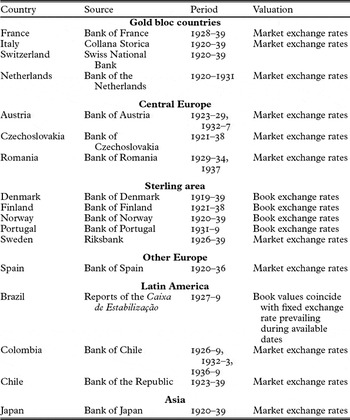
Table 1 below provides a summary of the information that we have succeeded in assembling to date.Footnote 58 At this stage our efforts have produced data for 18 countries, albeit with gaps. In practice, for any given year we are able to include about 15 countries, encompassing Western Europe, Eastern Europe, Asia and Latin America. The central banks in question account for roughly 75 per cent of global foreign exchange reserves (if we are to trust existing estimates for total foreign exchange reserves).
Coverage

Source: See text; Italy counted as member of the Gold Bloc.
4. Global results
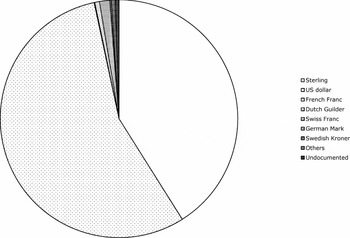
We start in Figure 2 with a snapshot of foreign exchange holdings in 1929, the ‘heyday’ of the interwar gold-exchange standard. The 16 countries included there (France, Italy, Switzerland, Netherlands, Denmark, Finland, Norway, Sweden, Chile, Colombia, Brazil, Spain, Austria, Romania, Czechoslovakia and Japan) held a total of $1.9 billion in exchange reserves. This is 82 per cent of Nurkse's global total for end 1929 and approximately 75 per cent of the global total, (given Nurkse's incomplete country coverage).
Aggregate foreign currency holdings in 1929: a snapshot (16 countries)
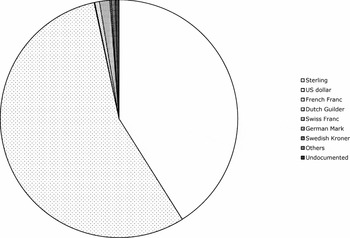
The picture leaves little room for doubt. As of 1929 there were essentially two reserve currencies, the dollar and sterling, which together accounted for some 97 per cent of global foreign exchange reserves. So much for the idea that there is only room in the market for a single reserve currency at any point in time.
Other currencies pale in comparison. The Swiss franc and Dutch guilder, the two next most important currencies in central bank portfolios, totalled about 2 per cent of global exchange reserves. Also notable is the complete absence of the French franc. Although the franc was now credibly stabilized and backed by immensely large excess gold and foreign exchange reserves, it was surpassed even by the Swiss franc, the currency of a very much smaller country, as an instrument of foreign exchange reserves. To be fair, French francs would not be held as foreign exchange reserve by the Bank of France, which held about half of the world's foreign exchange. Even if one adjusts for this, by eliminating France's own reserves from the global total, franc-denominated reserves still account for a mere two-tenths of 1 per cent of the global total. This gives a hollow ring to the literature on the challenge that Paris was mounting to the incumbent reserve-centre countries.
Note also that our new estimates support the Federal Reserve Board conjecture for 1928 of approximately $1 billion of dollar-denominated global exchange reserves (out of a roughly $2.3 billion total), while contradicting the suggestion by Triffin that sterling still accounted at that date for 80 per cent of global foreign exchange reserves. Thus, dollar supremacy so measured did not have to wait until after World War II, as has been repeatedly conjectured.Footnote 59
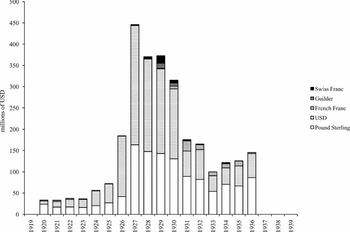
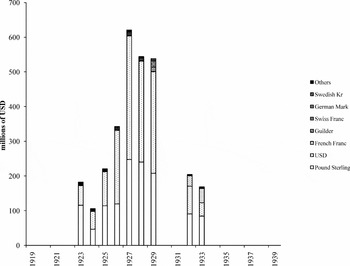
Identifying the precise date at which the dollar overtook sterling is problematic, since information on the currency composition of foreign exchange reserves in the first half of the 1920s is more fragmentary.Footnote 60 For four countries (Italy, Norway, Spain and Switzerland) we have a continuous run of currency-composition figures for the 1920s: as shown in Figure 3, these suggest that the dollar overtook sterling around 1924. The dollar then maintained its leadership through the second half of the 1920s, when sterling was continuously ‘under the harrow’ – when there were persistent doubts about the ability of the Bank of England to maintain its convertibility.Footnote 61
G4 reserves (Italy, Norway, Spain, Switzerland)
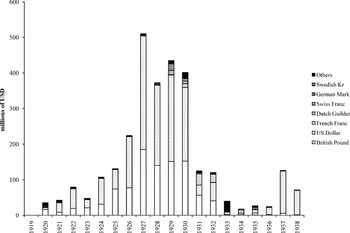
For a somewhat larger group of countries (the previous four plus Austria, Czechoslovakia, Denmark, Finland and Japan), we can do the same thing starting in 1923. The result (Figure 4) suggests that the dollar overtook sterling as the leading reserve currency in 1924–6.
G9 reserves (Austria, Czechoslovakia, Denmark, Finland, Italy, Japan, Norway, Spain, Switzerland)
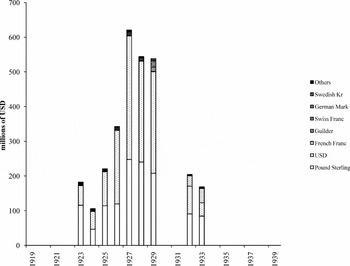
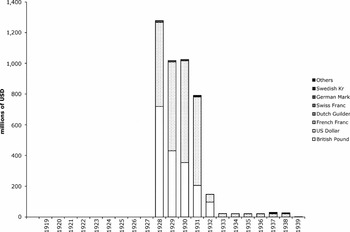
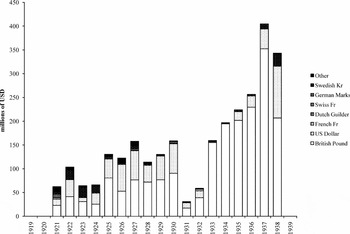
Finally, starting in 1928 we can add the Bank of France, at this time the single largest holder of foreign exchange reserves. Circa 1928 the French central bank still held a slightly larger share of its foreign exchange reserves in sterling than in dollars (Figure 5). The sheer size of France's exchange reserves meant that sterling temporarily regained its reserve-currency leadership as a result of the Bank of France's accumulation of London bills and balances. (‘Regained’ because France accumulated the vast majority of these balances only in late 1926 and 1927, so that whatever the currency composition of its existing reserves might have been earlier, adding them would not change the story.) From 1929 onwards, however, the dollar is again dominant in French – and therefore global – reserves, as the Bank of France liquidates sterling balances in exchange for gold. As always, the historical reality is complex. But the bottom line is unambiguous: the dollar overtook sterling as the leading reserve currency in the 1920s, not in the 1940s or even 1950s.
Bank of France's reserves

What about the 1930s? Another striking result is not just the liquidation of foreign exchange reserves and implosion of the gold-exchange standard, something that is already known on the basis of published aggregate foreign exchange reserves, but also the disproportionate liquidation of dollar reserves and the renewed relative dominance of sterling. At this point the Bank of France no longer figures in the story; by 1932 it has liquidated most of its dollar and sterling claims, and by 1933 it has liquidated these entirely but for a small residual dollar balance. In other countries, however, sterling regains its predominance relative to the dollar, a predominance that appears to be sustained for the remainder of the 1930s. Adding still other countries for which we have data for the 1930s (Ireland, Australia and New Zealand) only reinforces the picture, for these countries held the entirety of their reserves in pounds sterling.
Strikingly, then, the Federal Reserve's estimates of dollar dominance in the late 1920s and Triffin's conjecture of sterling dominance in the late 1930s were both correct. Why the compatibility of their conjectures has not been appreciated previously is also now evident: it is not always the case, it would appear, that the status as leading reserve currency, once lost, is necessarily lost forever.
But is sterling's recovery purely a matter of the sterling area? It is to this question that we now turn.
5. Regional results
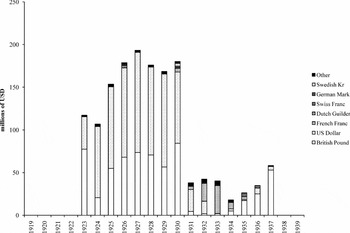
We begin with the members of the gold bloc other than France (Figure 6).Footnote 62 Here too there is evidence of the US dollar establishing its dominance over the pound sterling in the 1920s and of that dominance increasing with time. However, all gold bloc countries began selling sterling in advance of the 1931 sterling crisis. Once that crisis erupted, however, the members of the gold bloc no longer distinguished sterling from the dollar, instead selling both. Thus, conventional accounts (e.g. Friedman and Schwartz Reference Friedman and Schwartz1963) describing how the sterling crisis led to a gold drain from the Federal Reserve and pressure on the dollar are on the mark.
Gold bloc reserves (ex-France)
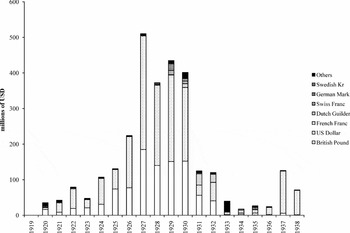
Note the relatively brief and modest increase of the role of the French franc in what became the gold-bloc countries ex-France. In the very early 1930s there was every reason to regard France, with its immense reserves and initially mild downturn, as a strong-currency country par excellence. There being no reason to believe that France would follow Britain in devaluing – in contrast to worries about possible devaluation by the United States – holding reserves in francs had attractions. But the florescence of the franc was brief. By 1934 there were growing questions about France's readiness to defend its existing gold parity. By that time the value of the French-franc-denominated reserves of the gold bloc were already in decline.
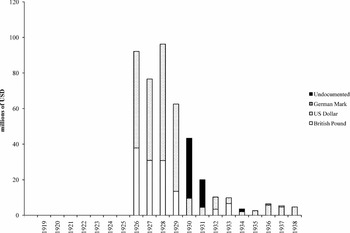
Figure 7 shows a sample of Central European countries. Despite the role of the Bank of England in inflation stabilization in Central Europe, the dollar dominated sterling in the exchange reserves of central banks in the area after 1924. A temporary exception is 1930, when the National Bank of Czechoslovakia apparently took a bet on sterling at what turned out to be the worst possible time. Thereafter the region participated aggressively in the process of foreign exchange liquidation. With the pound's departure from the gold standard, not just sterling but also dollar reserves were liquidated.Footnote 63 We see also a rise in the role of the French franc, which dominated strongly reduced foreign exchange reserves in 1933. Interestingly, when Central European central banks partially rebuilt their foreign exchange reserves, they held sterling rather than dollars. Thus, the resurrection of sterling as the leading reserve currency in the 1930s was not solely a phenomenon of the sterling area.Footnote 64
Central European countries' reserves (Austria, Czecho-slovakia and Romania)
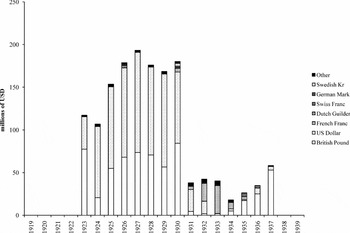
Figure 8 for the non-English-speaking members of the sterling area (here the Scandinavian nations plus Portugal) is predictable. These countries held both sterling and dollars in the 1920s although, in contrast to the situation in other parts of the world, sterling had an edge that showed no signs of eroding. When sterling holdings recovered in the 1930s, they initially drove the dollar out of the portfolios of these countries entirely. But with the approach of World War II, non-Empire-and-Commonwealth sterling area countries increasingly moved their holdings towards dollars. When the war erupted, most reserves were again in dollars. At that date, the US was a neutral country.
Non-English-speaking sterling area reserves (4 Scandinavian)
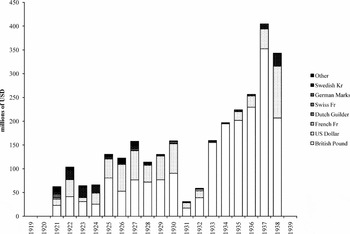
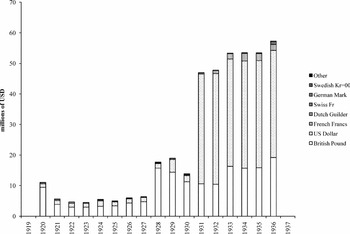
A final European economy is Spain, which never went back on the gold standard and belonged to no currency bloc but nonetheless held more than $50 million of exchange reserves in 1930–1. As for our other countries, it is evident (Figure 9) that the dollar overtook sterling as a reserve currency, but the timing for Spain is different.Footnote 65 The dollar gained ground on sterling later than in other countries, and there is no evidence of it losing ground in the 1930s. The contrast with Portugal, a member of the sterling area, is striking. Again, we only find traces of French francs, despite the fact that the Bank of France was being used as a repository for Spanish gold.Footnote 66
Bank of Spain reserves
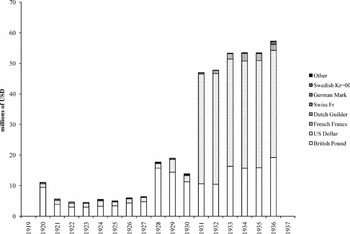
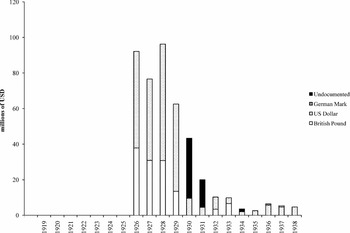
Figure 10 shows Latin America. There too the US dollar had become the dominant reserve currency already in the mid 1920s, inconsistent with the idea that inertia, incumbency and network effects rule the day. There too, however, sterling retained substantial market share, inconsistent with the notion that there is only room for one dominant reserve currency. Come the 1930s, both Chile and Colombia reduced their holdings of foreign exchange relative to gold, and Chile, suffering from a large adverse terms-of-trade shock, experienced a large loss of reserves overall. Colombia for its part continued to hold its foreign exchange reserves primarily in the form of dollars. Alas, at this point we have data for too few Latin American countries in the 1930s to hazard generalizations.
Two Latin American countries (Chile and Colombia)
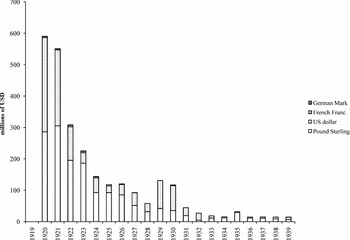
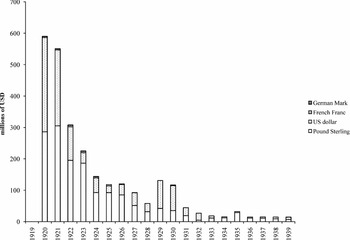
A final country for which we have information is Japan (Figure 11). The Bank of Japan already held large foreign exchange reserves in the 1920s despite only going back onto the gold-exchange standard in 1930. Although the composition of the part it held for its own account, on which we focus, is volatile, certain features are clear. The dollar and sterling were the two dominant forms of exchange reserves, supplemented by some marginal holdings of French francs. The dollar dominated the Bank's portfolio in the immediate aftermath of World War I and in 1929–32. Thereafter the Bank of Japan drastically reduced its exchange reserves; as in other countries, sterling and not the dollar dominated in the 1930s.
Japan's reserves
6. Implications
Our findings have implications for reserve-currency competition, for interwar economic and financial history, and for the future. The conventional wisdom on reserve-currency competition, epitomized by Triffin, is that sterling remained the dominant reserve currency throughout the interwar period despite the fact that the United States had recently overtaken the United Kingdom as the dominant economic, commercial and financial power. This is seen as testifying to the advantages of incumbency, the extent of inertia, the power of network effects, and the fact that there is room for only one dominant unit in the international currency domain. It is also suggested that once the economic and commercial imbalance between the two countries swung decisively towards the United States after World War II, there then occurred an irreversible switch from sterling to the dollar.
Our findings challenge every element of this conventional account. The dollar in fact displaced sterling as the leading reserve currency already in the mid 1920s, not only after World War II. Evidently inertia is less than sometimes supposed. Indeed, the status of dominant currency, once lost, was not lost forever; sterling again surpassed the dollar as the leading reserve currency in the 1930s. This revival helps to explain how authors like Triffin, generalizing from the late 1930s, could think that sterling reigned supreme in the 1920s. It is also a reminder that reserve-currency status depends on more than just economic, commercial and financial size.Footnote 67 It also depends on politics – the politics of the sterling area explaining, in our case, why the pound and not the dollar was the main form in which exchange reserves were held after both the US and UK devalued their currencies.
Indeed, our findings challenge the very notion that there necessarily exists a ‘dominant’ reserve currency. They throw into question the idea that network effects and external scale economies leave room for only one significant international currency. A reasonable reading of the evidence is that sterling and the dollar shared reserve-currency status in the interwar period. Both New York and London were liquid financial markets. Neither the US nor the UK had significant capital controls.Footnote 68 Both were attractive places to hold reserves. As a group, central banks split their reserves between them, not wishing to put all their eggs in one basket. This was not dissimilar to prevailing practice before World War I.
But the fact that there was room in central bank portfolios for more than one reserve currency in the 1920s and 1930s does not mean that there was room for an unlimited number. The third aspirant to reserve-currency status, the French franc, never played more than a minor role. A substantial contemporary literature reports on the efforts of the French government and the Bank of France to build up Paris as a reserve and international financial centre in the 1930s. Authors like Mlynarski (Reference Mlynarski1929), Einzig (Reference Einzig1931), Coste (Reference Coste1932), Nathan (Reference Nathan1938) and Nurkse (Reference Nurkse1944) portray Paris as third behind New York and London as an international reserve centre. They have pointed to the necessary microeconomic improvements that the Paris market needed to achieve in order for the franc to become a leading currency.
Our findings suggest that even this characterization is overly polite and the emphasis on microeconomics (the famous debate on the role of ‘acceptances’), misplaced. Our evidence suggests either that these efforts came to little or that the publicity received by these efforts was somewhat exaggerated. By 1928, until France's stabilization became de jure, the matter was out of question. And by 1933, when both the US and UK were off the gold standard and their currencies were fluctuating, France too had developed serious economic and financial problems. Awareness that France might be forced to follow the US and UK off the gold standard made Paris a less than attractive place to hold reserves. Foreign banks used the Bank of France as a place to store gold, and cashed it in when the weather changed. One is tempted to draw parallels with efforts to make the yen a reserve currency in the 1990s or, perhaps, with talk about whether the Chinese yuan might become a reserve currency in the not-too-distant future. When a country has serious economic and financial problems, like France in the 1930s, Japan in the 1990s and, not inconceivably, China in the future, acquiring reserve-currency status is even more difficult than holding onto it.
Nurkse (Reference Nurkse1944, pp. 46 et seq.) recognized that sterling and the US dollar shared the market in the 1920s and portrayed this situation as unstable. He argued that it encouraged central banks to shift their reserves from one centre to another at the first sign of trouble, adding central banks to his list of destabilizing speculators. He also suggested that the existence of other centres such as Paris created additional tensions.Footnote 69 Our evidence is not inconsistent with the first point in that it shows sharp changes in foreign exchange composition in the portfolios of a variety of central banks after 1929. But it suggests that Nurkse made too much of the ‘French option’, in that the franc never really constituted a meaningful alternative to sterling and the dollar. Conversely, this casts doubts on a large literature that has put much blame on France's ambitions to recover financial clout. One cannot have it both ways: France was small fry and its role should not be overstated.
A final question is what this episode tells us about the future and specifically about the danger of a scramble out of dollar reserves. As we write, foreign central banks are growing anxious that a further decline in the dollar, and US credit problems might result in additional capital losses on their dollar balances. And today, just as in the 1930s, there exists an alternative reserve asset, namely the euro, issued by a large economy possessing deep and liquid financial markets. Interwar history suggests that the possibility of a sharp shift in reserve composition cannot be discounted under such circumstances. If there is a large-scale shift from dollars to euros, it is not inconceivable that the Fed could feel compelled to raise interest rates to support the dollar exchange rate and limit imported inflation. Forcing the central bank into this corner would not be helpful in a period when recession and deflation are in the air. If the dollar falls further, the euro will rise further.Footnote 70 In this case Europe too may feel deflationary pressure. The consequences would not be unlike those in 1931, when Britain's devaluation transmitted deflationary pressure to the United States. And if the parallel is to be extended, we note that sterling problems eventually became serious dollar troubles.
But there are also differences between the two periods. In 1931 the scramble out of sterling was not a scramble into the dollars; rather, it was a scramble into the third reserve asset, gold. The United States saw its currency weaken, forcing the Fed to raise interest rates, rather than strengthening as in the European scenario in the preceding paragraph. But imagine, for the sake of argument, that economic and financial problems comparable to those in the United States also infect Europe, as happened in the 1930s. Asian and Latin American central banks might then wish to scramble out of both dollar and euro securities in a 1931-style scenario. The question is where they would go. Just as there was no viable third option in the 1930s, there is no obvious third option now: there are not enough Swiss francs to go around. Central banks could scramble into gold as a safe haven, mimicking the behaviour of private investors. This would create credit stringency in both the US and Europe, as in the 1930s. Working against this is the observation that gold is already expensive and no longer enjoys its historic status as a reserve asset.Footnote 71
This suggests that if central banks and governments want to shift out of both US and European securities, they are more likely to shift into claims on real assets other than gold, for example purchasing equities through their sovereign wealth funds. The consequences for the US and European economies would not then be so damaging. Of course, this scenario for how central banks will respond assumes their confidence in the fundamental health of the US and European economies. It assumes, in other words, that economic and financial circumstances today, however dire, still do not begin to approach those of the Great Depression.
Acknowledgements
This draft was prepared for the Past, Present and Policy Panel, Genoa, Italy, 28–29 March 2008. For financial support we thank the National Science Foundation, the France−Berkeley Fund, and the Committee on Research of the University of California, Berkeley. For assistance with collecting the data we are tremendously indebted to the following: Austria: Walter Antonowicz and Bernhard Mussak; Brazil: Pedro Carvalho and Rui Pedro Esteves; Chile: David Schindlower; Colombia: David Merchan Cardénas and Mauricio Cardenas; Czechoslovakia: Thomas Holub; Denmark: Hans Kryger Larsen; Finland: Vappu Ikonen; France: Olivier Accominotti; Italy: Filippo Cesarano; Japan: Mariko Hatase; Netherlands: Corry van Renselaar; Norway: Leif Alendal and Øyvind Eitrheim; Portugal: Rui Pedro Esteves; Romania: Mrs Blejan and Virgil Stoenescu; Spain: Pilar Noguès Marco; Sweden: Lars Jonung; Switzerland: Patrick Halbeisen. There is a long list of other people who have helped us in many other capacities and who are gratefully thanked for their support.
Appendix. The microstructure of foreign exchange markets
By conventional accounts, the pioneer of foreign exchange reserve management in the nineteenth century was Belgium (see Conant Reference Conant1910 for the National Monetary Commission and Ugolini Reference Ugolini2008). During those years, and again during the interwar years, ‘Foreign exchange’ consisted of three main international financial instruments: foreign bills (preferably commercial bills, although it was very difficult to tell a commercial bill from a finance one), foreign deposits and first class government securities. Commercial bills and government securities could be purchased or sold in the open, in local or international markets.
Bills denominated in the currency of a given country matured in the financial market of that country where they would be cashed. This required the help of foreign correspondents, commercial banks, central banks, or both, with whom the bills would be parked and who could execute transfers.Footnote 72 Thus, central banks typically kept deposit accounts with their correspondents. In so doing, central banks were by no means different from commercial or merchant banks with international positions. They usually held foreign exchange in accounts, which foreign commercial correspondents recorded on the liability side as lori accounts (‘theirs’ in Italian) which were denominated in domestic currency (i.e. foreign, from the vantage point of the central bank account holder). We understand from sources that there were both current and time accounts. All were interest earning, and we get occasional details on the rate paid. These accounts were fed by maturing bills and drained by new purchases of government or commercial securities. Drafts among accounts were common. The line separating foreign accounts and foreign bills was thin.
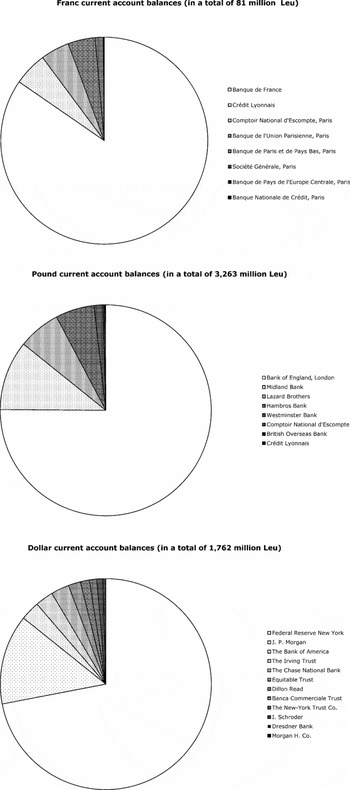
The distribution of the holdings among correspondents and the identity of those correspondents must have reflected a variety of concerns. Balances were kept with institutions that had special relevance given the kind of operations for which foreign exchange was mostly used. Leading merchant banks took care of settling the external trade balance. They were also often in charge of paying the coupons on external debts. Exploring the composition of Scandinavian central bank deposits in London, we often came across the name of Hambro, a London based merchant bank that was prominent in Anglo-Scandinavian trade. There were also substantial balances with such institutions as the London Bank for Northern Commerce or the London House of Rothschild.Footnote 73Figure A1a, b and c shows the decomposition of the current account holdings of the Bank of Romania in Paris, London and New York in 1929. As seen, holdings were mostly with the central bank of the respective market (Bank of France, Bank of England, Federal Reserve). This may have reflected the role of these institutions in the previous stabilization of the Romanian currency and management of Romanian debt. We note the prominence of J. P. Morgan for the New York market.
Sight accounts of the Bank of Romania in 1929: Paris, London and New York

Of note also are forward exchange operations, of which we find occasional evidence through mentions in the records we examined. They existed long before World War I, either through formalized markets and quotation (Flandreau and Komlos Reference Flandreau and Komlos2006) or as over the counter arrangements (Jobst Reference Jobst2009). With the advent of exchange instability in the 1920s, forward markets may not have shrunk. In fact evidence of formalized forward quotations becomes more widespread (Einzig Reference Einzig1931).Footnote 74 Central banks also engaged in substantial foreign exchange ‘repo’ operations, the most egregious being the Bank of Austria's Kostdevisen accounts, whereby the Bank purchased foreign currency from Viennese banks and sold it back to them at a set price. But apart from a few isolated exceptions, it has not been possible to understand the precise way through which such transactions were being recorded. In what follows, foreign exchange holdings are taken to mean just this: the amounts of foreign exchange that central bank accountants recorded at the end of the year.Footnote 75
Another interesting feature that emerged from collecting the data is that the main currencies of the time could be held in different markets. During that period, one does occasionally find dollar deposits in London, or sterling balances in Amsterdam. One location may be hosting a variety of different currencies, implying that there ‘euro-currency’ accounts were common. This represents a transformation compared to the prewar period when such arrangements appear to have been exceptional.Footnote 76 Ideally, one would want to have a complete dataset with a breakdown of foreign deposits according to location and currency in order to get a sense of the reach of foreign currency accounts. At this stage, it is only possible for a subset of the countries in this study. We speculate, however that the phenomenon is only significant for sterling and US dollars.