The Italian “popular science”Footnote 1 literature to which I will be referring, non-specialist science literature written by experts for a lay public and for colleagues from different sectors, was rooted in an ancient tradition as old as publishing itself. It was during the eighteenth century, however, that experts began to popularize natural philosophy in ways that gradually became more complex. Together with educational, religious, or anti-religion objectives, its use increasingly included political aims, both the politics of science and politics tout court. The science narrated in a language and in genres accessible to the non-expert (in an age when communication for specialists was in Latin), through dialogues and almanacs in the time of academies and specialist journals, and through lessons by itinerants in salons or coffeehouses, reached not only the interested and self-taught elites, but also entrepreneurs and state and ecclesiastical officials, who were of vital importance to the natural philosopher and the technologist (Golinski Reference Golinski1992; Stewart Reference Stewart1992). As historians and sociologists of science and technology now realize, thanks to an increasing literature on the subject, the links between experts, politicians, entrepreneurs, and the public intensified with the spread of industrialization until the successful emergence around the mid-nineteenth century of a literature which in various languages celebrated a “science for all,” science pur tous, Wissenschaft für alle, scienza per tutti. It is now accepted that in the construction of the public image of the modern scientist, that literature played a crucial role.Footnote 2
In the decades after political unification (1861) Italy saw several (male) scientists and university professors become well-known as authors of successful literature of scienza popolare. Yet, because of a very high illiteracy rate, Italian readers in the liberal age,Footnote 3 as we shall be seeing, belonged in most cases to a restricted elite of the literate and well off.
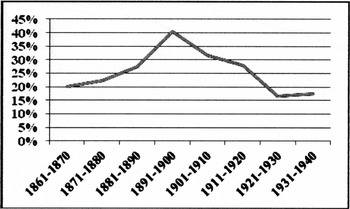
After three more or less idyllic decades, the relationship between Italian scientists and popular science writing started to change when, following the international recession of the 1880s, the Italian publishing sector in general experienced a crisis (Zamagni [1993] Reference Zamagni1997, chap. 1). Science, technology, and medicine book titles published yearly proportionally declined more than other fields (fig. 1). In terms of demand, the fall in the number of scientific publications between the nineteenth and twentieth centuries may be attributed to the public's changes in taste as the age of positivism was superseded by that of neo-idealism (Boringhieri Reference Boringhieri2010). One first question to be answered is: what changed here on the side of production? Since the figure of professional science journalist or writer was lacking in Italy up until the 1920s, what altered in the commitment of scientists as popularizers?

In the meantime, the success of scienza per tutti from the 1860s to the 1900s had made a concrete impression on various categories of readers, in the first place, the scientists themselves. In statements of their aims, the popularizing scientists of a positivist orientation showed they were trying to reach the poorer social classes, to help them emancipate themselves financially, and to free them from centuries of “obscurantism,” that is to say the influence of the Catholic Church. Vice-versa, the Catholic popularizing scientists aimed to “defend” that same public from the attacks of the so-called “priests of science,” politically close to those liberal elites who, in power in the early decades after unification, raised significant barriers to the ambitions of the Vatican (on the Italian history of the period, see Davis Reference Davis2000). However, the reality could be sometimes more interesting than that. The public activities of scientists of various shades of opinion (naturally including less crystal clear positions as well as those outlined above), were also directed at defending common interests.
In Nuova Antologia, a non specialist magazine read by every good Italian bourgeois, reviewing the volume by the geologist and abbot Antonio Stoppani (1824˗1891), Paolo Mantegazza (1831–1910) managed to praise both the enemy and himself by stating that “rationalists and Catholics alike may shake the hand of the author [Stoppani], forgetting he is an abbot; because in him, above the priest of the God of Nazareth stands the priest of that eternal divinity whose name is science” (Mantegazza Reference Mantegazza1872, 204–205). Mantegazza was a physiologist, anthropologist, and a freemason who held anticlerical views; he argued for evolution, popularized the precepts of birth control, and was throughout the liberal era a bestselling author. Stoppani, who in 1876 published one of the most famous Italian books, Il Bel Paese (The Beautiful Country), a long term success on natural science, was an anti-evolutionist geologist and the author of ferocious attacks on “positive science” (Stoppani Reference Stoppani1876, [1884] 1886; Vaccari Reference Vaccari and Kölbl-Ebert2009; Redondi Reference Redondi2012).
The (few) Italian scientists after unification,Footnote 4 scattered in a number of quite peripheral centers, seeing themselves in their publications for the public, which often presented them as heroes or priests of “modernity,” learnt to think of themselves as belonging to a real community. They held a wide variety of political, religious, and scientific positions, even at opposite extremes in the case of Stoppani and Mantegazza, but they also had common interests, at least with regard to those politicians and administrators in charge of the institutes where they worked and on whom their funds for research depended.
Of course, the entrepreneurial bourgeoisie and the middle classes also benefited from the success of science for all, a literature spreading the idea of science and technology as engines of economic “progress,” as well as social progress, just as the self-taught workers, technicians, and artisans did in the limited number of areas being industrialized (Lacaita Reference Lacaita1973, Reference Lacaita1990).
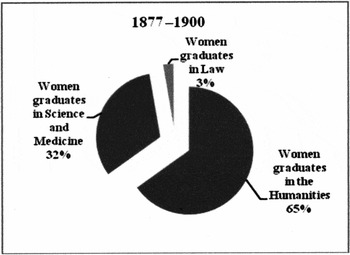
However, the benefits of the success of scienza per tutti were also enjoyed by another protagonist, who like the “scientist” and the “entrepreneur,” was emerging on to the Italian economic and social scene: the “new woman” of the lower-middle and middle classes determined to graduate in order to gain access to the professions (De Giorgio Reference De Giorgio1992, chaps. 5 and 6; idem 1996; Malatesta Reference Malatesta2006, chap. 6). In Italy this was a limited public of a few hundred women who were not a priority target for writers and publishers of popular science. Yet a quantitative study of the first period of access for women to Italian science higher education demonstrates that that science literature had had more influence on those women in the orientation of their choices of profession than the contemporary well known extraordinary national and international success of books by authors who argued for the intellectual inferiority of women, such as Cesare Lombroso (1835–1909), Gugliemo Ferrero (1871–1942), or Mantegazza (Lombroso and Ferrero [1893] Reference Lombroso and Ferrero2004; Mantegazza [1893] Reference Mantegazza1932; Babini et al. [1986] Reference Babini, Minuz and Tagliavini1989; Gibson Reference Gibson2002, chap. 2; Govoni [2002] Reference Govoni, Cassata and Pogliano2011, chap. 5; Wanrooij Reference Wanrooij and Willson2004). As we shall see, 32 per cent of the first wave of women graduates between 1877 and 1900 chose to study sciences or medicine.
Yet, judging from the data and the case studies available, it seems that in the period examined here, Italian academics’ behavior toward women in science changed from a relatively welcoming attitude during the age of the scienza per tutti, to a rejection between the two World Wars. The exclusion women came up against in professional science between the wars in Italy cannot be explained simply by fascism. It was, rather, a situation that Italian women would have been subjected to anyway, like women working in universities in other, more democratic western countries, such as the United States and United Kingdom, after the advances made in the early years of the century (Rossiter Reference Rossiter1982, 190–193, 269–270; Dyhouse Reference Dyhouse1995, 138). It was in the last decades of the nineteenth century that the behavior of academics toward women in science in Italy therefore shows an anomalous trend, and the second question I need to answer here is: why were women in Italy not kept out of universities and professional societies or associations, as was happening elsewhere?
In what follows I will suggest that at the root of scientists’ change in attitude toward women in science between the 1870s and the 1930s we find the same reasons that led scientists to carefully adjust their distance from so-called popular science. It was in the course of that half century that the consolidation of a national community of science practitioners came to an end, a process that experienced a final episode in the participation of the scientists in research for the war effort during War World I (Maiocchi Reference Maiocchi and Micheli1980, Reference Maiocchi, Calì, Corli and Ferrandi2000; Pancaldi Reference Pancaldi1993, Reference Pancaldi2006; Tomassini Reference Tomassini, Cassata and Pogliano2011). Those professional practitioners, born between the 1880s and the beginning of the twentieth century, no longer involved themselves in the business of publications at a layman's level of language as the scientists after unification had. The new scientists continued to popularize, but concentrated on drafting university manuals and popularizing books of a medium-high level (Evangelisti Reference Evangelisti1999; Govoni Reference Govoni, Cassata and Pogliano2011b). It was this new scientist, in the years of the postwar economic crisis, who understood that women, already increasing in numbers in science faculties during the war, were dangerous competitors.
The lives and works of Evangelina Bottero and Carolina Magistrelli provide suitable examples to follow the evolution from dialogue to clash between men and women in the culture of science in the age of Italian national community building. They were the first women science graduates in Italy in 1881, and in 1890 they became full professors of science in an institute of higher education. Yet after four decades of success, in 1923 their careers ended in disaster.
I shall try here to make sense of this history, a case study in itself quite marginal, involving a limited number of protagonists, by placing it in the context of two macro phenomena I have been examining in-depth (Pomata Reference Pomata, Medick and Trepp1998): the relationships between professional scientists and non-specialist science literature, and between men and women in higher science education in Italy from the 1870s to the 1930s. Since the English speaking science market, as we shall see, was a model that was taken as an ideal by some important Italian authors and publishers, a brief comparison with the British situation – the best known and studied – will help us to understand what happened in Italy.
The success and (relative) decline of scienza popolare in Italy
Readers of popular science in post-unification Italy were primarily men and women of the rich bourgeoisie and the new lower-middle and middle classes; though only in the few industrial zones, there were also a very few people from the lower classes. In 1861 at the national level the truly literate were no more than 10 to12 per cent of the adult population. In 1901 the illiterate were still 48 per cent and in 1931, 20.9 per cent of the population overall (De Mauro [1963] Reference De Mauro2011; Cipolla Reference Cipolla1969; De Fort Reference De Fort1995). In 1881, the year of the greatest success of scienza per tutti (fig. 1), those belonging to the upper middle class – borghesia – were around 11 per cent of the population (Barbagli and Pisati Reference Barbagli and Pisati2012, 295; on the Italian bourgeoisie, see Meriggi Reference Meriggi, Kocka and Mitchell1993). It is likely that this 11 per cent of the population corresponded to non-occasional readers, and thus, arguably, readers also of science literature.Footnote 5 With the spread of education the situation improved a little but, compared to other European countries, Italians’ low propensity to read, especially scientific material, would seem to be an endemic phenomenon (Eurostat 2011; Govoni Reference Govoni, Cassata and Pogliano2011b).
Nineteenth-century Italian popular science, like that of other countries, was nevertheless practiced by scientists not only for educational reasons and economic advantage, but also to facilitate dialogue with colleagues in different sectors. The study of that literature thus helps in understanding individuals’ scientific ambitions and those of categories of scientists, a mixture of idealism and ambiguities in a role that was taking decisive steps away from that of “natural philosopher” towards that of “scientist.” In that evolution, foreign models, in particular British models, played a part.
Recent historical research has deconstructed the image of a two-dimensional “Victorian science” produced by a growing and cohesive community of experts (among others, see Sheets-Pyenson Reference Sheets-Pyenson1985; MacLeod Reference MacLeod1996, Reference MacLeod2000; Shteir Reference Shteir1996; Butler Reference Butler1998a, Reference Butler1998b; Lightman Reference Lightman1997; Desmond Reference Desmond1997; Gates Reference Gates1998; White Reference White2003; Morrell Reference Morrell2005). It is now clear that each place and institution saw the individual expert as well as groups of collaborators act differently according to the personal, scientific, career, political, and religious interests involved. It remains true, however, that it was initially in the United Kingdom that scientific practitioners became engaged in popular science and educational policies often acting as a national community sharing a few important goals. The image the public had of British men of science and which survived for a long time through popular publications was typically an image of a new kind of “enlightened” professional, tending towards the heroic, whose intellectual efforts found an immediate application in terms of industrial, medical, social, and political “progress” (Meadows Reference Meadows2004; MacLeod Reference MacLeod2007).
This was the sweetened and simplified image which was circulating among the British public, and abroad, an image that reached Italy thanks to the alliance of some scientists and publishers who had lived abroad in their youth as students or else in exile for political reasons during the Risorgimento (on so-called Risorgimento Anglophilia, see Isabella Reference Isabella2009, chap. 6).
If at the level of the reorganization of the universities and launch of new research institutions the model, in Italy and elsewhere, was the German research university, the model adopted by social reformers and popularizers of science to communicate with the public was a different one. In this case the model was more often the United Kingdom with its extraordinary personalities, like Michael Faraday, in both experimental and popularizing fields; its experts, politicians, reformers, and popularizers, like Thomas Huxley; its science market that produced scores of journals; its institutions, like the Royal Institution; and its British Association for the Advancement of Science (BAAS). Britain was also home to the Crystal Palace, whose mythical status internationally established a new way of seeing the role of science and technology in “modern” societies (among others, see White Reference White2003; Cantor et al. Reference Cantor, Gooday, Dawson, Noakes, Shuttleworth and Topham2004; Cantor and Shuttleworth Reference Cantor and Shuttleworth2004; Henson et al. Reference Henson, Cantor, Dawson, Noakes, Shuttleworth and Topham2004; SciPer Project web site; James Reference James2007; Fyfe and Lightman Reference Lightman2007).
In 1873, again in the pages of the Nuova Antologia, commenting upon the decision of a scientist colleague to publish his work exclusively in English, Mantegazza endorsed his choice with enthusiasm, saying that English was the language “which today is read by the majority of people of the educated world in both hemispheres” (Mantegazza Reference Mantegazza1873, 238–239). French remained the international language par excellence, German was increasingly influential, but to read English was by that time indispensable for scholars of nature and had been at least since 1859, with the publication of On the Origin of Species.
In fact, the importance that the reformist and pragmatic culture emerging from Scotland and England had for some of the protagonists of the history of the relations between science and society in Italy is well known, starting from Francesco Algarotti (1712–1764), one of the original Italian expert popularizers, author of the internationally well-known Il Newtonianismo per le Dame, ovvero Dialoghi sopra la Luce e i Colori (Newtonianism for the Ladies, or Dialogues on Light and Colours, 1737). The first edition of the book was placed on the Index by the Catholic Church, not for the heliocentric arguments put forward, but for the political positions of its young anglophile author, openly a freemason, accused of suffering from a “slow fever of Lockeism” (Francesco Maria Zanotti to Eustachio Manfredi, February 7, 1733, quoted in De Zan Reference De Zan, Cremante and Tega1984, 136–7; Graf Reference Graf1911; Govoni [2002] Reference Govoni, Cassata and Pogliano2011, chap. 2; Mazzotti Reference Mazzotti2004). Carlo Cattaneo (1801–1869), politician and philosopher, a crucial figure in spreading an idea of “progress” as the fruit of the interaction between the circulation of scientific and technical culture, and social and economic development, was an enthusiastic supporter of Bentham. He was respected by a variety of famous science and technology popularizers, from the mathematician Francesco Brioschi (1824–1897) to the technologist Giuseppe Colombo (1836–1921), from Mantegazza to the moderate catholic naturalist and popularizer Paolo Lioy (1834–1911), the first to support Darwin's theories in Italy (Colombo Reference Colombo and Giordano1934; Brioschi Reference Brioschi and Lacaita2003; Vitale Reference Vitale and Vitale2003; Thom Reference Thom, Colombo, Peruta and Lacaita2004; Govoni Reference Govoni and Bandini2011c). Indeed, the British context was taken as a model in politics, culture and even at the level of scientific and educational institutions (Graf Reference Graf1911; Are Reference Are1965; Spini Reference Spini1988; Lacaita Reference Lacaita, Ceschi and Vigo1995; Romano Reference Romano1998). Carlo Luciano Bonaparte (1803–1857), a zoologist born in France, but educated also in the U.S.A., looked to the BAAS when promoting the Congresses of Italian scientists (1839) (Pancaldi Reference Pancaldi, MacLeod and Collins1981, Reference Pancaldi1982, Reference Pancaldi1983; Ausejo Reference Ausejo1994; Casalena Reference Casalena2007). The physicist Carlo Matteucci (1811–1868), in his role as Italy's first minister of education after unification, looked to Germany as his source of inspiration for the reform of the university system (Porciani Reference Porciani and Porciani1994). Yet when seeking to promote the diffusion of science and technology among non-experts, including perhaps the lower class, he supported the spread of Letture scientifiche libere (Free Science Lectures), lessons for all that were organized by private individuals, which were “a very good import from Great Britain and America” (Sulle Condizioni della Pubblica Istruzione [. . .] 1865, 217–218; Matteucci Reference Matteucci1867, 8). The education systems of the United Kingdom or United States were often cited as positive models by Pasquale Villari (1827–1917), positivist historian, friend and correspondent of John Stuart Mill, a powerful politician who promoted science in public education; Michele Lessona (1823–1894), naturalist, university professor, and famous popularizer; Angelo Mosso (1846–1910), a physiologist with an international reputation and a popularizer; Lioy himself, and others too (Villari Reference Villari1864; Lessona [1869] Reference Lessona1873, chap. 1; Mosso Reference Mosso1903, chap. 8; Laboulaye [1862] Reference Laboulaye and Lioy1866; Lioy Reference Lioy1868). When an Italian Society for the Advancement of Science (Società Italiana per il Progresso delle Scienze, SIPS) was actually set up at the beginning of the twentieth century, the BAAS would once again provide its founder, the mathematician Vito Volterra (1860–1940), with a model to follow. Volterra, among other things, when he visited the United States was so impressed by its universities he toyed with the idea of staying there (Goodstein Reference Goodstein2007, 154, chap. 14).
The British science market was an important model also for publishers, although obviously it was not the only one to influence them. Emilio Treves, who like Cattaneo and Villari had married a learned Englishwoman,Footnote 6 was one of the most important publishers of the so-called scienza per tutti, and the most successful Italian publisher before World War I. In 1883, at the height of his reputation, Treves brought together some of the most famous popularizing scientists and engineers to publish a weekly which he hoped would become the “Italian Nature.” Treves believed that ‟only the English Nature . . . an admirable model, the French . . . considerably lighter [because] it includes everything as long as it has pictures and is entertaining.” As for the German edition Treves claimed “it was worth very little in all aspects” (Treves to Mantegazza, June 13, 1884, Mantegazza Papers). Like the case of the “Italian Nature,” another interesting episode attesting popularizing's transnational character saw the Turin publishers, the brothers Dumolard, launch in 1875 the Biblioteca Scientifica Internazionale. The series started as an Italian offshoot of the International Scientific Series, brainchild of the American Edward L. Youmans and involving collaboration between publishers and scientists to spread Darwin's evolutionary theories (MacLeod Reference MacLeod and Meadows1980; Howsam Reference Howsam2000; Lightman Reference Lightman2007, chaps. 2 and 7; Govoni, [2002] Reference Govoni and Bandini2011, chap. 3). One could continue with many other examples.
Italy shared with other European countries some of the economic and social reasons for the success of popular science between the 1860s and 1900. Other circumstances supporting this success, however, were undoubtedly linked to its specific national context, in particular the politics and rhetoric of unification. The elites in power supported an idea of science regarded as the driving force behind “progress,” persuaded it would rapidly help give the country an economic and social structure comparable to that of other leading European countries. In these circumstances, popularizer scientists enjoyed great success. There were a few women among them, such as Bottero and especially Magistrelli, as well as Adele Masi Lessona (1824–1904), science writer and ghost translator of some of Darwin's works into Italian published under her husband's name, the aforementioned Lessona (Govoni [2002] Reference Govoni2011, chap. 4).
Although the evidence indicates that Italian social realities were among the worst in Europe in the period 1870–1900, a generation of scientists and publishers, many of whom had taken part in the Risorgimento, ensured that the percentage of scientific books among all books published in Italy reached a peak at the turn of the century that was not to be surpassed in subsequent decades (fig. 1).
At the individual level therefore, the writers’ situation in Italy, taking into account the diverse contexts, may be compared to that of British writers. The same cannot be said of the behavior of popularizer scientists as members of a national community of professionals. The community in Italy was very fragile, as attested by a large number of indicators, including one of the first international rankings devoted to evaluating the scientific success of several European nations (Candolle Reference Candolle1873, tab. 9, 176–177). South of the Alps, as is well known, there were no institutions comparable to the Royal Institution or the BAAS; both the attempts made with the aforementioned Congresses of Italian Scientists failed, as did the attempt in 1862 to establish the SIPS. For reasons briefly referred to here, the success of popular science literature assumed a different character from Britain: in Italy individual scientists were unable to cooperate for middle- or long-term collective goals. While the production of book titles confirms the success of individual authors, in 1871 only 69 of the 765 officially registered journals were scientific, about 9 per cent of the total (from the data in Ottino Reference Ottino1875, 11). The “Italian Nature” failed after only two years, and not through a lack of support from the publisher, but instead because of the relative lack of collaboration by the project's scientists (Govoni Reference Govoni, Bensaude-Vincent and Rasmussen1997; idem [2002] 2011, chap. 6).
In the medium term, that intense political and publishing commitment of the scientists had negative repercussions on their work in the laboratory. Hence for the scientists of a later generation it became a matter of urgency to bring “national” scientific production back to acceptable qualitative levels. To do this, a new generation of scientists born roughly between the 1860s and the 1870s, as was Volterra, invested in new challenging institutions to raise the quality of research. Thus in 1906 they supported the re-launching of the SIPS, an initiative that provided good results during World War I and between the two world wars, and which may be linked to the birth of the National Research Council (Consiglio Nazionale delle Ricerche, CNR) in 1923. Between these two events, the complex operation that led to the creation of a national community of scientists in Italy was completed during World War I, when scientists were committed to new kinds of collaboration with the government and with industry (Casella et al. Reference Casella, Ferraresi and Giuliani2000; Simili and Paoloni Reference Simili and Paoloni2001; Cassata and Pogliano Reference Cassata and Pogliano2011). The operation was thus completed by young scientists born between the 1880s and the early years of the new century. Since the figure of professional science writer and journalist was lacking in Italy up until the 1920s, the reduced commitment of scientists in the popularizing field in the first three decades of the twentieth century quickly had repercussions for the publishing market. It is true that in Italy, as in Britain, scientists’ lack of interest in scientific popularizing in the twentieth century was more myth than reality (Bowler Reference Bowler2009; Govoni Reference Govoni, Cassata and Pogliano2011a). However, it is also true that their commitment to popularizing changed: the production of lower level literature fell, while that of manuals and of generally higher level work increased, as can be seen, for instance, with the popularizing activities of the young Enrico Fermi (1901–1954) (Fermi Reference Fermi and Barone2009). As testimony to the cohesion reached by the scientific community, the number of journals increased: in 1939 there were 637 scientific titles of various levels (data source: CNR, 3 vols., 1939). It was this new scientist, aware of belonging to a community with shared objectives and of growing prestige and power after World War I, who realized that women in science could be competitors to be feared.
Women in higher science education south of the Alps
In the last decades of the nineteenth century scientists rose to positions of economic, institutional, and political prominence at the same time that women entered higher science education and the professions (Rossiter Reference Rossiter1982; Abir-Am and Outram [1987] Reference Abir-Am and Outram1989; Seymour Eschbach Reference Eschbach1993; Dyhouse Reference Dyhouse1995; Berti Logan Reference Berti Logan1998, Reference Berti Logan2004, and Reference Berti Logan2005; Tullberg Reference Tullberg1998; “Histoires de pionnièrs” 2000; Mazón Reference Mazón2003; Rowold Reference Rowold2010).
Let's briefly return to a comparison with the situation in the United Kingdom. Although it is well known that in institutions like the BAAS the presence of women was always important and encouraged by the men of science, the determination with which sometimes those same scholars kept women out of most scientific societies and universities for so long was also remarkable. In opposing women's admission to membership of the Ethnological and Geological Society, in his view “a place of discussion for adepts,” in a famous passage Huxley declared he was convinced that notwithstanding a hoped for improvement in education “five-sixths of women will stop in the doll stage of evolution to be the stronghold of parsondom, the drag on civilisation, the degradation of every important pursuit with which they mix themselves – ‘intrigues’ in politics, and ‘friponnes’ in science” (Huxley to Lyll, March 17, 1860, in Huxley Reference Huxley and Huxley1901, 228). It is true that among Darwinians, men and women, we know they held kaleidoscopic positions regarding women's place in nature and society (among others, see Russett 1989; Desmond Reference Desmond1997; Richards Reference Richards, Oldroyd and Langham1983, Reference Richards and Lightman1997, Reference Richards and Moore1998; Kohlstedt and Jorgensen Reference Kohlstedt, Jorgensen, Numbers and Stenhouse1999; Desmond Reference Desmond2001; White Reference White2003, chap. 1). Nonetheless, it is also true that the choices of institutions have enormous power, and those made by universities and professional associations and societies of the Victorian age legitimated de facto the image of women as stuck at the “doll stage of evolution.” If in 1829 women had been admitted to the Zoological Society of London and in 1839 to the Entomological Society, the Linnaean Society only admitted them in 1905, the Royal Microscopical Society in 1909, the Royal Geographical Society in 1913, the Geological Society in 1919, and the Royal Society in 1945; Oxford and Cambridge only granted degrees to women in 1920 and 1946 respectively. This was the behavior of a community with an ancient monastic and hence misogynist tradition behind it, but that was not all there was to it (Noble Reference Noble1993; Perrone Reference Perrone1993; McWilliams Tullberg Reference Tullberg1998; Schiebinger Reference Schiebinger2004, chaps. 4, 5; Higgitt and Withers Reference Higgitt and Withers2008).
If on the one hand denying women access to universities and societies was the defense of privileges acquired, on the other hand it was an idealistic battle in the name of high standards reached in science and technology. To put it more simply, we may say that if the scientist and inventor were by now “heroes,” the popular press did not hesitate to cover women in ridicule when they assumed the role of students or intellectuals. It is clear that the two upstarts, the scientist (man of science) and the “new woman,” had to remain separate, in the public sphere as well as in the new temples of knowledge, universities, and professional societies, places for “adepts” (“Ladies not admitted,” Punch, March 21, 1896, 134).
Briefly recalling the well known British example helps us to understand why in those same decades Italian scientists, though often sharing Huxley's ideas on the position of women in human evolutionary history, did not close the doors of the university and professional societies on them.
In the decades after the unification in Italy, the eighteenth-century male natural philosopher, usually financially independent because of noble, ecclesiastical, or upper bourgeois extraction, was gradually being replaced by a middle class or lower middle class male scientist. Also the first women graduates in science in the 1880s who emerged on to the intellectual market often belonged to the lower middle class. They enrolled in the university for the same reasons that men did: accession to a profession to enable them to rise in the social order. However, the experiences of the first women graduates demonstrate that the scientists they had to do with encouraged their studies and professional activities (Govoni Reference Govoni and Govoni2006, Reference Govoni2007, and Reference Govoni2009a). I believe the reason for this collaboration did not simply lie in the tiny number of women science graduates and in the liberal mentality of several post-unification scientists.
When in 1876 new university regulations were introduced, the law stated that ‟Women may be enrolled in the register of students and auditors, where they present the required documentation,” without needing to abrogate previous legislation (“Nuovi regolamenti Universitari” 1876, 12). Important politicians and intellectuals demonstrated some by no means banal involvement in the issue, yet nevertheless, the women who embarked on the adventure were few (Howard Reference Howard1977; Moretti Reference Moretti and Soldani1989; Raicich Reference Raicich and Soldani1989; Cammelli and Di Francia 1996; Berti Logan Reference Berti Logan1998). The reasons had to do with the economic conditions of the country and the lack of a tradition of girls’ grammar schools, for Catholic opinion was firmly opposed to adolescent co-education (Soldani Reference Soldani1989; Ghizzoni and Polenghi Reference Ghizzoni and Polenghi2008). According to the data of the ministry of education, between 1877 and 1900 there were 224 women graduates, in a context of female illiteracy of around 80 per cent in 1870 and around 60 per cent in the early years of the twentieth century. At any rate, as already anticipated, seventy-two of those first women graduates chose to graduate in sciences or in medicine (fig. 2)
The choices of the first 224 women graduates in Italy (1877–1900) (source: Ravà Reference Ravà1902, 634–654).

If science was proclaimed to be “for all,” if indeed science was being preached as the main tool needed to free people and nations from poverty and “obscurantism,” why should that not apply to women? It was a public sphere context – national and international – favorable to the sciences that contributed to women's choosing to enroll in increasing numbers for science or medicine degrees. And in fact, the scientific results of Italian women researchers were highly thought of internationally.
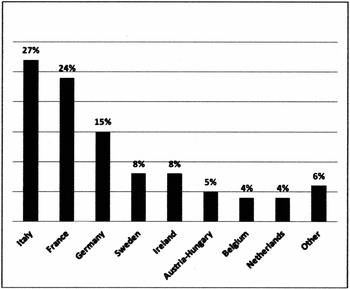
If we exclude American and British women, who on their own account for around two thirds of the scientific articles published by women and registered in the Catalogue of Scientific Papers, 1800–1900, Italian women were the most productive among the hundred and seventeen women scientists of other countries (fig. 3). The scientific production of Italian women increased especially from the 1880s, which was clearly when they began to frequent university laboratories. And in fact, most of the first women graduates in the sciences had successful careers (Govoni Reference Govoni and Govoni2006; Scienza a due Voci . . . web site).
Percentage of scientific publications of women by nation (except American and British women) registered in the Catalogue of Scientific Papers, 1800–1900, of the Royal Society of London (source: Creese Reference Creese and Creese2004, 209).

The brilliant professional beginnings of women in science, however, would not continue proportionally after World War I, when there was the first important, general increase in the number of women science graduates. In the academic year 1923–24 there were 330 women science graduates, and in 1926–1927 the percentage of women graduates in sciences out of the total number of graduates in the sciences, male and female, was 37 per cent. Four of the first seventy-two women who graduated in science between 1881 and 1900 became full professors in an institute of higher education: Bottero and Magistrelli, Rina Monti (1871–1937) (Dröscher Reference Dröscher, Babini and Simili2007), and Maria Bakunin (1863–1960). By 1931 the number of female graduates in medicine, pharmacy, and science had numbered over 200 a year for the previous fifteen years. Yet in 1931 only fourteen women enjoyed stable employment at various levels in the medical and scientific sectors out of a total of 1,614 university teachers (ISTAT 1936, 74–75).
Relationships between men and women in science had changed during the liberal era, as events in the careers of Evangelina Bottero and Carolina Magistrelli testify.
The Bottero and Magistrelli case
Evangelina Bottero and Carolina Magistrelli were two middle-class women from the provinces, Bottero from Aqui in Piedmont, and Magistrelli from Mantua in Lombardy (Bottero, ACS; Bottero Pagano, ASS; Magistrelli, ACS; Magistrelli Sprega, ASS). In their teens, they met in Florence, where between 1875 and 1878 they attended the complementary course at the Normal School. The Normal Schools were high schools devoted to the training of primary school teachers, and the diploma did not grant admission to the university (Soldani Reference Soldani2004). So when in 1878 Bottero and Magistrelli moved to Rome to attend university lectures in the natural sciences faculty, they gained admission as regular students after a complex bureaucratic process. In those years in the Science Faculty there were interesting scientists such as Pietro Blaserna (1836–1918), professor of physics, one of the most politically powerful scholars of his age, and Stanislao Cannizzaro (1826–1910), a chemist, and like Blaserna, a powerful politician. There were several occasions when Blaserna, Cannizzaro, and their colleagues gave their support to Bottero, Magistrelli, and other women students, such as Margarete Traube (1856–1912) (Registro dei verbali della Facoltà . . ., ASS; on Traube, see Nebrig Reference Nebrig2012). Having embarked on some laboratory work in physics and chemistry, Bottero and Magistrelli obtained prizes and grants, and on June 15, 1881, they were the first women in Italy to graduate in the natural sciences (Registro della Carriera Scolastica, ASS; for a first attempt at reconstructing this case and further reference on the Italian bibliography, see Govoni Reference Govoni2007).
In 1883 they published a book on the telephone, and the same year, certainly with the help of Blaserna, their mentor who wrote a preface to the book, they were employed in the Royal Institutes of Female Higher Education, called Magistero (Bottero and Magistrelli Reference Bottero and Magistrelli1883).
In 1882, after a decade-long debate, two institutes of the Magistero were established in Rome and Florence to train teachers for the female Normal Schools. The diploma issued at the end of a four-year course did not have the legal value of a degree, but Magistero professors enjoyed a status fully equivalent to that of university professors. While Bottero and Magistrelli were working in the Roman institute, among the staff were Giuseppe Dalla Vedova (1834–1919), a noted geographer; Luigi Capuana (1839–1915), a successful writer; Fanny Salazar Zampini (1853–1914), writer and feminist of international experience; Luigi Pirandello (1867–1936), playwright, essayist and Nobel prize winner for literature in 1936; and Maria Montessori (1870–1952), the internationally known anthropologist and educationist (Pesci Reference Pesci1994; Babini and Lama [2000] Reference Babini and Lama2010). In addition, an interesting feature of the Magistero was the important place it reserved for the teaching of the natural sciences, and the few documents that have survived show that Bottero and Magistrelli's teaching included experimental work (Bottero Pagano, ASS).
While Bottero abandoned writing, in 1886 Magistrelli published a pamphlet on Conoscere e Amare nell'Emancipazione della Donna (Knowing and Loving in the Emancipation of Woman) (Magistrelli Reference Magistrelli1886). In this she supported the idea that women's education must be devoted to their duties as wives but, above all, as mothers. When Magistrelli published the booklet on the “emancipated woman,” she was a professional and an established science writer; she was a woman who when she graduated with Bottero saw herself many times mentioned in the international press (among several others, see London Daily News, Wednesday June 29, 1881, 3; Royal Cornwall Gazette, Friday 8 July 1881, 2; [The] Englishwoman's Review 1881, 380; Hanson Robinson 1881, 251; The Annual Register of World Events, 1882, 48). Moreover, we know that in 1908 she would attend the First National Women's Congress in Rome (Atti del I Congresso . . . 1912, 713). Why did she publish that pamphlet?
Her taking that public position was perhaps done with a precise career strategy in mind. Magistrelli was the daughter of a cobbler, and her mother who had been widowed had remarried, but had later divorced her second husband (Ruolo di Popolazione FF 1626; Atto Notarile n. 11922/1995, 1 Novembre 1873, ASM). Quite possibly Magistrelli did not wish to see doubts voiced about her “morality”: between 1885 and 1886 she was unmarried and in the process of obtaining tenure in a female institute of higher education in a country which was overwhelmingly Catholic. But other possible reasons which help us understand that booklet are offered by Magistrelli's zoology book.
Between 1888 and 1891 Magistrelli published four science books with Paravia, an important Turin publisher (Magistrelli Reference Magistrelli1888, Reference Magistrelli1890, Reference Magistrelli1891, [1888] Reference Magistrelli1897). Intended as textbooks for female high schools, they were lavishly illustrated, and their structure and language made them at the same time science books for a wider public. Written in a sober but lively style, Magistrelli's zoology book is perhaps her most interesting. Prudently, from its very first pages Magistrelli wrote that nature should be understood from an evolutionary perspective, quoting first Huxley and later Lessona, the evolutionist zoologist we have already mentioned (Magistrelli Reference Magistrelli1888, iv, 27). Magistrelli opened the book with a description of the gorilla, comparing it to human beings, and then described the animal world from the vertebrates down to the protozoa, closing the book with a description of the human being.
A comparison between parental care in nature and in human society was a frequent topic in Magistrelli's zoology book; she paid special attention to maternal behavior in several species, often comparing it to human mothers’ behavior. Clearly, her evolutionary perspective was consistent with her view of women's emancipation which she had presented in the booklet published two years earlier. In the name of an evolutionist interpretation of the role of the female, human and animal, Magistrelli turned upside down the reasoning of those evolutionist scientists who, like the celebrated Mantegazza, asserted the dominant role of the male, in line with a natural selection resembling the “progress” of society (Minuz [1986] Reference Minuz, Babini, Minuz and Tagliavini1989; Landucci Reference Landucci and Tort1996a, Reference Landucci and Tort1996b; Rossi-Doria Reference Rossi-Doria and Burgio1999). Both in the pages on female emancipation and in those on zoology, Magistrelli simply ignored the male and emphasized the role of the female: in nature, a role functional to the survival of the species; in human society a role functional to the education of the individual, to “the family's happiness,” and “to the glory, the power and the future of the country” (Magistrelli Reference Magistrelli1886, 35).
Magistrelli's writings confirm the importance that the diffusion of Darwinism had had in relation to a positive role for women in society in Italy too; a positive role which, theorized over in the name of the “nature” of women in a confused mixture of social and biological arguments, would later on turn against Magistrelli herself.
Bottero and Magistrelli's careers were rapid and brilliant: in 1890 they became full professors with tenure: Bottero, then thirty-one, of physics, although she always taught chemistry as well; Magistrelli, then thirty-two, of the natural sciences. In the 1890s both married, adopting double surnames, Bottero Pagano and Magistrelli Sprega (Bottero, ACS; Magistrelli, ibid.; Atti di Matrimonio, CM). After World War I they were approaching retirement. In the meanwhile, Magistrelli Sprega had had the satisfaction of becoming the dean of the Magistero several times. She was dean in 1920, when the ministry of education appointed Giovanni Gentile (1875–1944), the idealist philosopher who was among the fiercest opponents of positivist culture, inspector of the Roman Magistero. It was on that occasion that Gentile saw the well-equipped science laboratory and understood the importance of experimental science in the Magistero (Bottero Pagano, ASS) that had been established by the two women.
In October 1922 Mussolini took over as prime minister and Gentile was appointed minister for education. After two months, he wrote a letter to Bottero Pagano announcing that the chair of physics in the Magistero would soon be suppressed (Gentile to Bottero Pagano, December 3, 1922, Bottero Pagano file, ASS). On January 11, 1923, a decree ad personam eliminated the chair of physics that Bottero Pagano had held for forty years (Ministero dell'Istruzione Pubblica 1923, I (8), 535). On March 13, Gentile signed another decree transforming the Magistero into a co-educational institute at full university level, and in the meantime he changed the rules for the recruitment of professors, making the new rules retroactive; the new arrangement allowed him to suppress Magistrelli Sprega's professorship, too (Ministero dell'Istruzione Pubblica 1923, I (17), 1385–1390). At that point, he offered Bottero Pagano a job in a secondary school; he also ordered the science lab to be dismantled. In July, Bottero Pagano retired (Gentile to Bottero Pagano, March 5, 1923, in Bottero, ASS; Enrico Pagano to Gentile, July 28, 1923, ibid.).
Only in November Gentile wrote a long and embarrassed letter to Magistrelli Sprega: he was offering a job in a school for teenagers to the sixty-five year old professor, author, and dean of the Magistero. This was her answer:
I thank Your Excellency for the kind words, but my dignity as [a] woman and teacher after forty years of conscientious work as full tenured professor of an Institute of Higher Education, of which on three occasions I held the post of Director with the esteem and respect of my colleagues, as is well known to Your Excellency, does not allow me to accept the post Your Excellency would have in mind for me. I would like to add that it is highly deplorable that a government carries out reforms, in the public administration, which expose a teacher in my position to suffer a humiliation such as the one, with the best of intentions, that Your Excellency has inflicted on me with the letter to which this replies (Magistrelli Sprega to Gentile, November 6, 1923, in Magistrelli Sprega, ACS).
Writing back, Gentile tried to find a compromise arrangement, but on Christmas Day 1923 Magistrelli Sprega closed the affair with a short note: “I enclose my application for retirement in which I indicate simply the reasons that prevent me from accepting the post offered to me, so that they may remain officially on record.” In the long document attached she mentioned again the “insult to [her] dignity as a woman” besides the scientific reasons that made it ridiculous for her to teach disciplines unknown to her such as computisteria (business math) in a school for adolescents (Magistrelli Sprega to Gentile, December 25, 1923 and enclosure, in Magistrelli, ACS).
We have no evidence that any colleague intervened in defense of Bottero Pagano and Magistrelli Sprega, and this despite the fact that Bottero Pagano had been a member of the Italian Physical Society since its foundation (1897), and Magistrelli Sprega a member of the Society of Italian Naturalists, as well as a member of the SIPS from its founding statute (Anon. 1897, v; Società Italiana di Scienze Naturali 1907, 15; SIPS 1908, 309).
Over the four decades spanning the careers of Bottero Pagano and Magistrelli Sprega, the generation of post unification scientists who in previous decades had been involved both in political unification and/or in the so-called scienza per tutti movement, had retired. Some of those scientists had given their concrete support to the first women science students and graduates, as had been the case with Blaserna, Lessona,Footnote 7 Lioy, and Camillo Golgi (1843–1926), in 1906 co-winner of the Nobel prize (Mazzarello Reference Mazzarello2009, chap. 14). These and other scientists had worked at a time when a national community of experts did not yet exist. This absence of a national community can be seen in the low number of scientific practitioners, the relative poverty of scientific achievements at the international level, with the possible exception of mathematics (Bottazzini Reference Bottazzini1994), the inability to lobby effectively once in Parliament (Montaldo Reference Montaldo, Cassata and Pogliano2011), and, as has been mentioned, the inability of individually successful writers in the popularizing fields to work together to produce journals and book series over lengthy periods.
Their weakness was also shown by their inability to perceive the threat from women graduates in science as possible competitors, which scientists had already realized in other countries such as the United Kingdom, the United States, and Germany. Things changed when Italian scientists’ participation in wartime research resulted in the construction of a community of professionals, which significantly increased in numbers from 1915. New posts in the universities for natural scientists were arriving (Dröscher Reference Dröscher2013), while the number of women graduates in science also increased considerably.
At the end of the war, Gentile noted that the universities had been “invaded by women, who have now flooded into our universities” (Gentile Reference Gentile1919, 8). He was the spokesman for an academic community which felt it was under threat from women graduates firmly determined to enter professional markets. What happened to women in science in Italy during and after World War I was the result of different actions. On the one hand, there was a silent exclusion by the relevant academics of women who wished to make a career in the university. On the other hand, there was a political and media campaign where the old positivist myths, insisting on women's inferiority in the name of evolutionary theory, found common ground with the attempts to overturn that interpretation by scholars like Magistrelli and others of the next generation, like Gina Lombroso (1872–1944). Physician, popularizer, and well known writer, author of a book on women which was translated into twelve languages, Gina Lombroso was the wife of Ferrero, who was co-author with her father, Cesare, of the well known 1893 book Criminal Woman, the Prostitute, and the Normal Woman (Lombroso and Ferrero [1893] Reference Lombroso and Ferrero2003; Lombroso Reference Lombroso1920; Dolza Reference Dolza1990; Babini Reference Babini, Babini and Simili2007). The feminism aiming at emancipation and equality of writers like Gina Lombroso was considered to be woman's worst enemy, in that it distanced her from her main task, maternity (Bock and Thane Reference Bock and Thane1991; Allen Reference Allen2005; Klein et al. Reference Klein, Jo Plant, Sanders and Weintrob2012; on the long term reflections of parents and children's relationships on Italian society, see Barbagli et al. Reference Barbagli, Castiglioni and Zuanna2003). Emphasizing the maternal role as the only emancipatory one for women was a position shared by many feminists well into the twentieth century. The international diffusion of this view coincided in Italy with the fragmentation into various associations, often in conflict with each other, of the women committed to the feminist movement; then came fascism (Key Reference Key1911; Pieroni Bortolotti [1963] Reference Pieroni Bortolotti1975; Gaiotti De Biase [1963] Reference Gaiotti De Biase2002; Buttafuoco Reference Buttafuoco, Bock and Thane1991; Offen Reference Offen2000; Pironi Reference Pironi2010; Vezzosi Reference Vezzosi, van der Klein, Jo Plant, Sanders and Weintrob2012).
The positions taken by women like Magistrelli and Gina Lombroso have been labeled “antiemancipationist” or “contradictory” (Buttafuoco Reference Buttafuoco1988, 110; Dolza Reference Dolza1990, chap. 3). Yet, interpreted in the historical context of the first time women gained access to higher education in the age of the success of scienza per tutti, those positions appear on the contrary to be tragically coherent. Having grown up with the myth of science as a culture capable of explaining all phenomena, even those of society, their attempt to justify and valorize the maternal role of women in fact left basic prejudices unaltered, confirming the image of women as not suited to intellectual endeavor. While Gina Lombroso paid for the conflict between her intelligence and her successful career, on the one hand, and her loyalty to Darwinian science, her father, and her husband, on the other, by suffering depression and existential problems,Footnote 8 Magistrelli paid with her profession and in concrete terms.
According to expert opinion, Gentile was opposed to racism on the grounds that it was the result of that conception of mankind of the natural sciences to which he was hostile (Turi Reference Turi1995, 475). It is clear that he acted differently towards women. Ironically for one of the fiercest enemies of positivist culture, he was the person who completed the task begun by the materialist scientists, men and women, of whom he was so contemptuous.
The evolutionist science popularizer best known in the liberal age, Mantegazza, in a very successful book, republished during fascism, wrote:
Woman always was and always will be less intelligent than men . . . . In the long history of evolution she has always remained not far from her point of departure. Of course with a better education she will in the future be able to give more to science; but I believe that the distance that separates her from us [men] will always remain the same: because men will progress at the same time as women do . . . . The oppression, which women have suffered from until now, is not sufficient to explain her inferiority. (Mantegazza [1893] Reference Mantegazza1932, 269)
At the end of World War I Gentile, who was contemptuous of writers like Mantegazza for their epistemological crudeness, wrote that women were not suitable as teachers because, “it has to be said, [they] do not possess and never will possess that lively originality of thought, nor that iron spiritual vigor, which are the highest strengths, intellectual and moral, of humanity, and must be the pillars of the education to form the higher spirit of the country” (Gentile Reference Gentile1919, 8). Gina Lombroso, the founder, among other things, of the Associazione Divulgatrice Donne Italiane (Italian Woman's Popularizing Association), held that if the objective of male “passion” is an abstract and intellectual object, for women “this passion depends on the maternal nature that pervades the entire spirit of the woman even when she is not yet a mother . . . the first consequence of this special passion is that the woman does not base her actions on reason but on instinct” (Lombroso Reference Lombroso1918, 7).
The rhetoric used by two contemporaries Gentile and Gina Lombroso was different, but the substance was the same. During the postwar years of economic crisis this interpretation of woman's role was useful in discouraging women's professional ambitions, not to mention its use during fascism, when women were explicitly “invited” to go back to the home (Le donne a casa) (Saraceno Reference Saraceno, Bock and Thane1991, 200; on Italian working and professional women between the wars, see De Grazia Reference De Grazia1992; Curli Reference Curli1998; Galbani Reference Galbani2001; Vicarelli Reference Vicarelli2007; Wilsson Reference Willson2009; on the contradictory relationships between fascism and women in Europe, see Durham Reference Durham1998).
Between Magistrelli Sprega and Gentile the clash was between two representatives of different generations and of irreconcilable ideals concerning the role of science in society and in education but, incredibly enough, not concerning the place of women in nature and society.
Neither Gentile nor other fascist ministers introduced laws to prevent women from working in universities, as they did in secondary schools and in other professional sectors (Ballestrero Reference Ballestrero and Groppi1996). And yet the cases of Bottero Pagano and Magistrelli Sprega and others being studied at present illustrate that other ways could be similarly effective in removing women from the professions; in this case, institutional reforms were used. The reform of the Magistero, which aimed at the elimination of the teaching of scientific experimentation, enabled Gentile to get rid of two unwanted women, very much in the way. One other effective system was to assign women scholars to posts in poor quality universities that were hard to reach, such as the University of Cagliari in Sardinia; this was the case for botanist Eva Mameli Calvino (1886–1978), who worked there for a few years after 1926. In those same years the mathematician Pia Nalli (1886–1942) also worked there as director of the Institute of Mathematics; of the four researchers who worked there, two were women. Giulia Degli Innocenti and Fanny Fontana worked in the Institute of Geology, where there were three to four teachers during this period. Two scholars worked in the Institute of Mineralogy: the director and Giulia Martinez. In 1928–29 at the Institute of Physics Rita Brunetti (1890–1942) was the director, Teresa Mundula her deputy, and Zaira Ollano assistant lecturer; the only two men in the institute were a technician and the caretaker or porter. A situation where the men were discriminated against is naturally somewhat suspect: with the exception of Nalli and Brunetti,Footnote 9 who had significant careers, all the other women left the university, including Eva Mameli Calvino (Govoni Reference Govoni2012). In the meantime with the increase in the number of women graduates the figure of the female “collaborator” or “voluntary assistant” took root. Studies of Volterra and Giuseppe Peano (1858–1932) show how numerous the women graduates in mathematics were who, in the first two decades of the twentieth century, were thinking about a career in research. From the list of offprints preserved in Volterra's library it turns out that of 135 women who sent him science offprints, ninety-four were Italian women (Linguerri Reference Linguerri2010, 28; on Peano and women mathematicians, see Roero Reference Roero, Babini and Simili2007). And yet, although both Volterra and Peano seem to have been helpful equally towards male and female students, only four of those women mathematicians had the chance to pursue a university career.
The efficacy of the male academic community's strategies for excluding women is proved by the data. Between World War I and the early 1920s the number of women became really significant in Italian universities, and in 1921 they made up 10.4 per cent of university students. The number of women graduates in the sciences in the academic year 1923–24 reached its highest point of the first half of the twentieth century: 330 graduates. In 1931 the percentage of women graduates in science out of a total of graduates in science, male and female, was 34 per cent. Yet that same year women made up 0.87 per cent of science and medicine university teachers (data from ISTAT 1936, 49, 74–75).
The disproportion between the number of women graduates and that of women researchers in science, technology, and medicine, was the result of a struggle between competitors, men and women, which would continue throughout the twentieth century, and even today has still not been properly resolved, in Italy, as well as elsewhere (AAUW 2010; Rossiter Reference Rossiter1995, Reference Rossiter2012; Abir-Am Reference Abir-Am2010; European Commission 2013; MIUR 2013).
Conclusion
The history of Italian so-called popular science has been useful in helping us to understand some of the neglected features of the relationships between the production, circulation, and consumption of science between the nineteenth and twentieth centuries. These studies of Italian popular science have provided the medium-term context that allows us to grasp the choices made by the earliest women graduates, as well as the process of professionalization of the figure of the scientist, with the consequent quantitative growth of universities, as phenomena that to some extent interacted with each other.
In the last decades of the nineteenth century in Italy women who wished to study in universities were not excluded, and, indeed, the first women science graduates could relatively easily acquire professional status. In the contemporary United Kingdom, by contrast, the typical warlike reaction of experts was sending women out of professional roles and back to “curiosity,” in the name of a community aware of the privileges it wished to defend, as well as the high standards achieved in science. This was a science which, at the same time, was providing “proof” of the intellectual inferiority of women. Here I have argued that in Italy too, where those positions concerning the place of women in nature were significantly successful, it was because of the late formation of a national community that scientists were late to realize that women in science could be competitors. Things changed after World War I, when women “flooded” into the universities and applied pressure to enter the professions at precisely the time when scientists were completing the process of forming a national community with a growing, strong relationship to the state and to industry. At that point, and with the coming of fascism, the old positivist theses on the maternity mission of women came back, unwittingly supported by several women science writers and emancipationists.
In 1919 in the United Kingdom, Parliament approved the Sex Disqualification (removal) Act, and in 1920 the Nineteenth Amendment prohibited any United States citizen from being denied the right to vote because of their sex. But those landmark moments did not save women in the 1920s from a reaction, which some have called a backlash, which was the result of the advances made by women in the first decades of the century (Rossiter Reference Rossiter1982, 122).
Likewise, I suggest that the tragic political events in Italy from the 1920s onward, when laws were introduced to hinder or block the entry of women into state employment but not into the university, can explain only in part the worsening relationship between men and women in science higher education between the wars compared with the relative highs of an earlier period. Otherwise, the continuation throughout the second half of the twentieth century of the marked discrepancy between the number of women graduates, the scientific results of the women researchers and their career opportunities would be inexplicable (ISTAT 2001).
That negatively evolving relationship between men and women in science in Italy after World War I coincided with the decreasing interest of scientists in low-level science literature, and both phenomena had a lot to do with the definitive building of a national scientific community. The Bottero and Magistrelli case, and others now being studied show that effective ways could be found by academics to push women out of higher education.
The internationally recognized results in recent years achieved by the history of “popular science” confirm it is a useful instrument to test the strategies – whether pursued or contingent – of scientists and their communities. Following scientists, men and women, in action in those sectors on the border between the lab, the markets of science, politics, and various social and institutional actors, is extremely useful for our understanding of what scientists do to construct their personal careers, their public image, and their professional communities (Latour Reference Latour1987): their commitment to popularizing is clearly part of this complex network of relations and actions. The building of a scientific community and the entry of women into higher education were contemporary and interrelated phenomena that should in my opinion be regarded by historians as one of the possible “natural experiments” in the culture of science that we are in need of, if we want to understand the relationship between science and society, as well as between men and women in science in the nineteenth century.
Acknowledgments
It is a pleasure to thank Arne Schirrmacher and the colleagues of the project Twentieth-Century Science Communication in Europe for the discussions we shared during a workshop held at the Max Planck Institute for the History of Science of Berlin in May 2010, when I presented an earlier version of this paper. I would also like to thank Alexandre Métraux, for some important and generous suggestions, two anonymous referees for their useful comments, and Brian Brege (Stanford University, History Department), for his valuable editing of my English. I am especially grateful for the conversations I have had with Marta Cavazza, Paula Findlen, Giuliano Pancaldi, and Gianna Pomata over the years about men and women in science and its history.