Introduction
Helminth parasites of wild rodents are common and have been studied over many years throughout Europe. Although the spirurian nematode Mastophorus muris has been studied previously in other rodents (Vukićević-Radić et al., Reference Vukićević-Radić, Kataranovski and Kataranovski2007; Lafferty et al., Reference Lafferty2010; Smith and Kinsella, Reference Smith and Kinsella2011; Grzybek et al., Reference Grzybek2014), to our knowledge, there have been no previous studies on this parasite in the water vole (Arvicola amphibius).
The genus Mastophorus, which is one of the categories of stomach nematodes within the order Spirurida, family Spirocercidae, has a worldwide distribution in a wide range of rodents (Wertheim, Reference Wertheim1962). The life cycle is indirect, with various insects (e.g. beetles, locusts, earwigs, cockroaches) acting as intermediate hosts (Quentin, Reference Quentin1970). After being ingested by rats (Rattus rattus), it takes c. 28 days for infective stage larvae to develop into breeding adults (Quentin, Reference Quentin1970). The adult nematodes shed their eggs inside the vole's stomach, and these are released into the open environment along with the vole's faeces. The intermediate hosts (insects) ingest the eggs, and then the larvae are developed, thus continuing the life cycle of the nematode.
Water voles of the genus Arvicola are small mammals of the rodent family and are one of the most important prey species of the red fox in Europe (Raoul et al., Reference Raoul2010). Adult voles weigh 200–300 g and prefer riparian habitats (Stoddart, Reference Stoddart1970; Melis et al., Reference Melis2013). Adults are territorial during the breeding season and produce up to five litters annually, with a life span of up to 2 years (Isakova et al., Reference Isakova, Nazarova and Evsikov2012). Reproduction occurs between the end of March and September (Stoddart, Reference Stoddart1970), with a short gestation period of 20–22 days. During the winter the voles are less active, with a high mortality (up to 70%) (Forder, Reference Forder2006; Korslund and Steen, Reference Korslund and Steen2006). There are two main species of water voles, separated by their habitat use: A. amphibius and A. scherman (Taberlet et al., Reference Taberlet1998).
Although there have been many studies on the effects of season on abundance of various helminths in wild rodents (e.g. Charleston and Innes, Reference Charleston and Innes1980; Langley and Fairley, Reference Langley and Fairley1982; Abu-Madi et al., Reference Abu-Madi2000), only a few have reported seasonal variation in the prevalence of M. muris in rodents. To our knowledge, there have been no studies on the seasonal influences on numbers of M. muris in water voles. Regarding the influence of habitat or regions on the prevalence of helminths, Roberts et al. (Reference Roberts1992) concluded that habitat utilization was the most important factor shaping the prevalence of helminth parasites, including M. muris, in populations of rats (Rattus rattus). Local variations in prevalence and intensity of endoparasites, including six nematodes (one being M. muris), were observed in bank voles (Myodes glareolus) within ecologically similar sites (Barnard et al., Reference Barnard2002). Nevertheless, the habitat in Sweden is different from that in those studies (tropical and eastern European, respectively), and we have no knowledge of what factors affect levels of infection of M. muris in Sweden.
This paper focuses on M. muris in the water vole to assess the abundance of infection in relation to intrinsic factors (host sex and functional group) and extrinsic factors (season and region) that could explain variation in worm burdens in water voles in Sweden.
Materials and methods
Collection and examination of water voles
Field methods
Water vole trapping was done as part of a larger project studying Echinococcus multilocularis in rodents (EMIRO). Study areas and trapping methods are described in detail by Miller et al. (Reference Miller2016a, Reference Millerb, Reference Miller2017). Briefly, rodent collections were performed in three municipalities of southern Sweden: Uddevalla, Katrineholm and Gnesta/Nyköping. The study sites of Uddevalla (10 × 10 km) and Katrineholm (10 × 10 km) were chosen because they were the sites of the original E. multiocularis findings (Wahlström et al., Reference Wahlström2012). Two additional areas (c. 20 × 20 km) in the municipalities of Gnesta/Nyköping and Vetlanda/Växjö were chosen as comparison sites, as E. multilocularis had not yet been found there. Those areas were part of a national environmental/wildlife-monitoring programme (FoMA, www.slu.se/en/environment). Vetlanda/Växjö was excluded from this study because no water voles were caught there in 2013. Each region consisted of forests, fields, pastures and areas with human settlement. Topcat traps (Andermatt Biocontrol AG) were used for trapping water voles in this study. The topcat traps were placed in water vole tunnels to catch the voles as they moved through their tunnel systems. Trapping sites were selected after identifying typical water vole signs (tunnels and mounds) in the fields in each of the three regions. Traps were set for a minimum of 2 hours, and checked frequently. Unlike small rodent trapping (e.g. Theuerkauf et al., Reference Theuerkauf2011), the trapping method for water voles using topcat traps is not standardized. The number of traps set depended on the size of the colony (based on observed signs). The duration of trapping at a particular site depended on the activity level of the voles and the timing of the trapping, varying from 2 hours to overnight. The voles were collected and frozen (−20°C) during 4–6 weeks in the spring (April/May) and fall (September/October) of 2013.
Laboratory methods
All water voles were thawed and dissected in the parasitology laboratory at the Swedish University of Agricultural Sciences (SLU), Uppsala, Sweden. Morphologic characteristics (e.g. body length), sex and weight were recorded upon dissection. For the purposes of this study, voles were categorized into three functional groups based on their reproductive status: adult (breeding), subadult/juvenile (non-breeding) and non-determined or unknown. The adult voles were those with signs of active breeding. In females this was based mostly on the presence of embryos or placental scars in the uterus, evidence of lactation, and an open vagina, and in males it was based mostly on size of testicles. For voles classified as non-determined or unknown, these signs could not be clearly classified as breeding or not breeding. Subadults are voles that have reached mature size but are not yet breeding, whereas juveniles are young, sexually immature voles (Myllymäki, Reference Myllymäki1977). The focus of the dissections was to examine the livers for metacestodes of the tapeworm E. multilocularis. However, other organs, including the gastrointestinal (GI) tract, were saved from each water vole and stored at −20°C for further analysis in other studies. After thawing, the GI-tract was weighed. The stomach was separated from the intestines and cut open to wash the contents into a Petri dish. The stomach contents were then sieved through a tea strainer (mesh size c. 510–610 μm) to eliminate coarse food material, and washed into a counting tray. The counting tray with stomach contents and water was examined under a dissecting microscope. Immature and mature M. muris were counted and preserved in 70% alcohol for each vole.
Data analysis
Prevalence, mean intensity and abundance of infection of M. muris were calculated in MS Excel using the formulas defined by Margolis et al. (Reference Margolis1982) and Rózsa et al. (Reference Rózsa, Reiczigel and Majoros2000), and the confidence intervals (95% CI, lower limit–upper limit) were calculated for each level of infection. To determine the effect of certain intrinsic (sex, functional group) and extrinsic factors (season, region) on the number of worms found (abundance of infection), a generalized linear model (GLM) was run using R × 64 3.0.1 (http://cran.r-project.org/) with R Studio. The number of M. muris was the dependent response variable, whereas sex, functional group, season and region were included as factors or independent predictor variables. Checking the Poisson distribution model, data were found to be overdispersed, and the dispersion parameter even for the quasi-Poisson family was found to be 35. Also, when looking at the distribution of nematode counts and checking the fit of the GLM with negative binomial error, we found that the best error variance for abundance was a negative binomial (with a log link), which is implemented in our data analysis using the MASS package and the function ‘glm.nb’. After checking all assumptions and addressing the overdispersion, the analysis was followed by a backwards selection method (stepwise removal of non-significant variables or factors). The final model was developed with significant predictor variables for which the likelihood ratio of χ 2 was significant (i.e. P ≤ 0.05) using negative binomial with log-link function. The significance was set at 5%.
Results and discussion
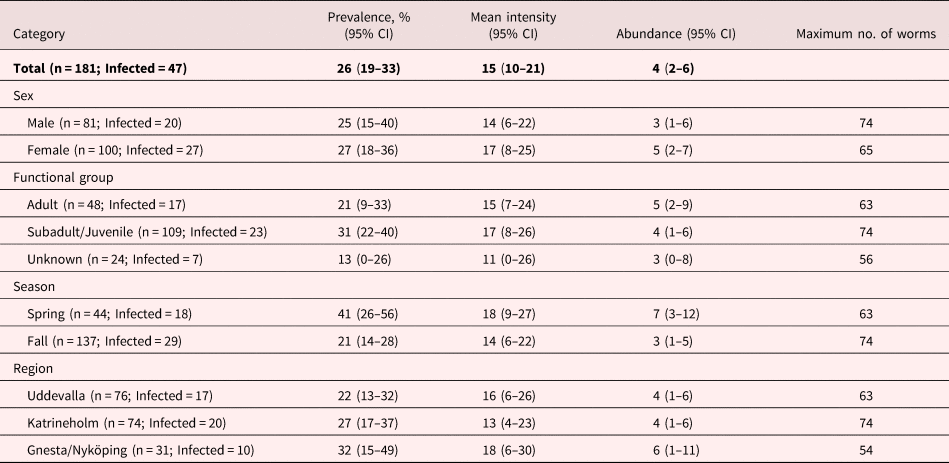
In total, 181 water voles were collected: 76 in Uddevalla (31 spring, 45 fall), 74 in Katrineholm (12 spring, 62 fall) and 31 in Gnesta/Nyköping (1 spring, 30 fall). Table 1 reports the distribution of the sexes, functional groups and the total number of voles and infected voles collected by season and region. The mean (95% CI) body length (mm) of the investigated voles was 156 (154–159).
The prevalence (%), mean intensity and abundance of Mastophorus muris infection in water voles, relative to sex, functional group, season, and region of Sweden.

Overall, 47 of 181 voles (26%) were infected with M. muris (table 1). There were no noticeable differences in prevalence of infection (%) between the sexes, functional groups, seasons or regions due to their overlapping confidence intervals (CI). The total mean intensity and abundance of infection (95% CI) were 15 (10–21) and 4 (2–6), respectively. Besides, there was no evident variation of infection within different categories of sex and region, whereas there seems to have been variation of infection with respect to season and functional group (table 1), with higher infection in spring than fall, and in adults compared to other age groups. The majority of voles had fewer than 10 worms, with only a few voles having up to 74 worms.
Prevalence of M. muris in other rodent species is varied. A study conducted by Lafferty et al. (Reference Lafferty2010) found overall prevalence of M. muris was 59% in a sample of 165 rats from the Line Islands of the central Pacific Ocean, which is greater than that found in this study. Their findings suggested that the higher prevalence of M. muris was associated with the dominance of the coconut Cocos nucifera in the habitat, which provided suitable habitat conditions for the insects that acted as intermediate hosts of M. muris. The prevalence of M. muris in this study is closer to that reported by Charleston and Innes (Reference Charleston and Innes1980) and Grzybek et al. (Reference Grzybek2014). Charleston and Innes (Reference Charleston and Innes1980) found a lower prevalence of infection (20%) in 191 samples of R. rattus in New Zealand and suggested that this could be due to lack of suitable intermediate hosts (insects), changes in feeding habits and variation of host resistivity with season. Similarly, Grzybek et al. (Reference Grzybek2014) reported lower prevalence of M. muris infection (14% of 922 samples) in a study of bank voles (M. glareolus) conducted in the north-eastern region of Poland. Although they did not mention the reason for the lower prevalence of M. muris, they found that both prevalence and abundance of infection were higher in lactating adult females than males due to higher demands for protein and energy, mostly fulfilled by insects (intermediate host of M. muris).
Results of the GLM indicated no significant differences in the abundance of infection with regard to sex and functional group categories. There was, however, a significant seasonal effect on abundance of infection of M. muris (χ21,179 = 109.944; P < 0.001), with a higher prevalence of infection in spring than in fall (table 1). Although few other studies have been published regarding seasonal changes in infection of M. muris in rodents, a higher prevalence of M. muris has been noted in the late winter and spring months in rats in New Zealand (Charleston and Innes, Reference Charleston and Innes1980) and in bank voles (M. glareolus) in the northern boreal zone of Finland (Haukisalmi et al., Reference Haukisalmi, Henttonen and Tenora1988). The seasonal differences of food availability and age structure in water voles, as demonstrated by Potapov et al. (Reference Potapov2004) and Nazarova and Evsikov (Reference Nazarova and Evsikov2010), could influence the level of infection in these animals. In addition, breeding in the spring could add stress to the water voles, resulting in higher infection. Montgomery and Montgomery (Reference Montgomery and Montgomery1988) found that low food availability in the wood mouse (Apodemus sylvaticus) in Northern Ireland in spring resulted in poor nutritional status, and suggested this as one cause of higher infection of nematodes. Similarly, Grzybek et al. (Reference Grzybek2014) found that higher infection of M. muris in female bank voles (M. glareolus) in Poland was potentially related to pregnancy and the lactating period of females. During lactation a higher protein diet is required. As a result, female voles in general consume more insects, which increases their chances of being exposed to infection. Despite the name, water voles are based mostly on land. In Sweden, it has been shown that some water voles spend a good proportion (if not all) of their time in the grassland/field environment where insects occur, whereas others migrate between the marsh and grassland/fields (Jeppsson, Reference Jeppsson and Tamarin1990).
There was a significant regional effect on abundance of infection (χ22,177 = 107.929; P < 0.01), with the highest infection in Gnesta/Nyköping among the three regions (table 1). Although very few water voles were captured in Gnesta/Nyköping compared to Uddevalla and Katrineholm, the number of M. muris per infected vole was found to be highest in Gnesta/Nyköping. This may reflect the relative abundance of both the intermediate and final hosts for M. muris, and other spatial factors such as temperature and precipitation. For instance, Burlet et al. (Reference Burlet, Deplazes and Hegglin2011) found that a significant contributing factor to the risk of water voles in Switzerland becoming infected with E. multilocularis was colder temperatures, which facilitate the survival of this nematode's eggs in the environment (Burlet et al., Reference Burlet, Deplazes and Hegglin2011). Similarly, Roberts et al. (Reference Roberts1992) reported a strong effect of habitat on the prevalence of helminth parasites, including Brachylaima apoplania, Capillaria hepatica and M. muris, in Polynesian rats (Rattus exulans) from three habitats (forest, grassland and lighthouse-farm) in New Zealand. Among these three habitat types, the infection levels (prevalence and abundance) of M. muris were found to be highest in forest habitat due to higher abundance of arthropods (intermediate hosts of M. muris). Physical attributes of the microhabitat could also explain the observed differences in host population dynamics and diet.
This is the first paper that has reported quantitative worm burden data for M. muris infection in A. amphibius captured from different locations in Sweden. There were significant seasonal and regional variations in abundance of M. muris. However, how these parasites affect host fitness and life history remains unknown. Also, analysis of the water vole's seasonal diet would be useful, to ascertain the time period when the insects (intermediate hosts) that transmit M. muris infection are ingested by water voles. Therefore, more research and comprehensive studies are essential to understand the diet of the water vole, variation of M. muris and the ecological consequences of M. muris infection in water voles.
Author ORCIDs
Bijaya Neupane https://orcid.org/0000-0003-1215-689X
Acknowledgements
Advice on statistical data analysis was obtained from the statistics professors of Inland Norway University of Applied Sciences, Campus Evenstad, Norway. We thank the landowners who allowed us to access water vole populations.
Financial support
This work was funded through an EU Formas grant (EMIDA-ERA NET) for a project entitled “Echinococcus multilocularis in Rodents (EMIRO)” (221-2011-2212) and the Environmental and Monitoring and Assessment at the Swedish University of Agricultural Sciences (FoMA, http:// www.slu.se/en/environment). Inland Norway University of Applied Sciences, Norway arranged an Erasmus Travel Fund for this study.
Conflict of interest
None.
Ethical standards
Fieldwork was performed with ethical permits from the Swedish Environmental Protection Agency (NV-02939-11) and the Swedish Board of Agriculture (A-135-12).