




No CrossRef data available.
Institutions, Expectations, and Currency Crises
Published online by Cambridge University Press: 04 January 2006
Abstract
Currency crises are costly phenomena that have been exceptionally difficult to explain and predict. We comprehensively examine the relationship between political institutions and currency crises and emphasize the causal linkage between institutions, expectations, and crises. Specifically, we argue that institutional variables—particularly divided government and government turnover—increase the variance of expectations held by speculators thereby increasing the likelihood of currency crises. We test these hypotheses using three existing economic models of currency crises and find that institutional variables are not only statistically significant, but also substantially improve the ability of these models to forecast crises.We are grateful to Helen Milner, Charles Cameron, William Bernhard, and seminar participants at the University of Wisconsin and the University of Southern California for helpful comments. Lisa Martin and our referees provided feedback that helped dramatically improve our arguments and exposition. Andy Rose, Steve Kamin, Mathieu Bussiere, and Marcel Fratzscher generously provided data and advice that helped us replicate their findings. David Leblang acknowledges financial support from the National Science Foundation (SES-0136866).
Information
- Type
- RESEARCH NOTES
- Information
- Copyright
- © 2006 The IO Foundation and Cambridge University Press
Academic interest in the causes of currency crises has exploded in the past decade as speculative attacks have toppled the currencies of countries as diverse as the United Kingdom, Mexico, Russia, Argentina, Thailand, and South Africa. While many scholars have contributed to understanding which underlying economic fundamentals lead speculators to attack a country's currency, we know less about precisely how and when political institutions contribute to currency crises. Filling this gap is both of theoretical and empirical importance. From a theoretical perspective, it makes little sense to consider economic variables in isolation from political variables, given that it is widely acknowledged that both influence the probability of currency crises. From an empirical perspective, the extreme difficulty of accounting for currency crises on the basis of economic variables alone justifies explicitly considering the role of political institutions. We demonstrate in this article that a theoretically driven analysis of the effects of political institutions not only offers a significant payoff from the point of view of explaining crises but also helps substantially improve one's ability to forecast crises.
In addition to showing that political institutions matter, we expand our understanding of how political institutions may be associated with crises. Hitherto the case study and large N literature in political science has yielded several plausible causal mechanisms. In the case study literature, Haggard and MacIntyre have individually argued that the presence of multiple veto players contributed substantially to the Asian financial crisis of mid-1997, by obstructing efforts to improve economic fundamentals.1
See Haggard 2000; MacIntyre 2003.
We explore the links between institutions, expectations, and currency crises by developing the political implications of a state of the art game theoretic model by Morris and Shin.3
We focus on this model both because its informational assumptions are more realistic than previous models, and because the model yields an important comparative static result that relates the variance in speculators' beliefs to the probability of currency crises.4Morris and Shin's model is theoretically important not only because it focuses on the variance of expectations but also because it generates a unique equilibrium. This is in contrast to the multiple equilibrium models arising from so-called second-generation–crisis-payments models popularized by Obstfeld 1996.
We present our argument and evidence in the following sections. In the next section we discuss theoretical models of currency crises and emphasize the importance of the variance of speculators' expectations. In the second section we derive the political implications of crisis models and develop three testable hypotheses. The third section describes our methodology and our empirical results. We discuss the implications of our findings and offer suggestions for future research in the fourth section. The final section concludes.
Theories of Currency Crises
Academic thinking about the causes of currency (or balance-of-payments) crises has evolved in the past twenty-five years. Krugman's seminal first-generation model focuses exclusively on crises caused by an incompatibility between economic fundamentals and an exchange rate peg.5
As politicians (conceived of as the monetary authority) continue to monetize a fiscal deficit, an incompatibility between money creation and exchange rate stability becomes apparent and the government runs short of the very reserves required to defend the exchange rate peg. While informative in theory, the crisis in the European Monetary System in 1992 demonstrated that even countries with strong fundamentals—including low fiscal deficits—could be vulnerable to devastating speculative attacks. This experience inspired a second generation of crisis models emphasizing the self-fulfilling nature of speculative attacks.6 These models, however, generate multiple equilibria rendering them of limited use from the perspective of generating unique testable hypotheses.There is an obvious way in which political institutions can be brought into the analysis of currency crises, as per the conventional economic fundamentals-based approach. There is a wealth of evidence suggesting that political institutions influence fiscal and monetary policy. Alesina and Drazen and Roubini and Sachs show that the presence of divided government and the lack of government stability contribute to wars of attrition that delay fiscal adjustments and lead to macroeconomic imbalances.7
Consistent with these arguments case studies of the Asian financial crisis developed within the veto-player framework explicitly draw a link between government instability, divided government, and weak fundamentals.8See Haggard 2000; MacIntyre 2003.
Note that arguments based exclusively on the above causal chain imply that the relationship between institutional variables and currency crises should become statistically insignificant once economic fundamentals are included as controls in regressions accounting for crises. The recently developed Morris and Shin model, however, implies that political institutions will continue to affect the probability of crises even after fundamentals are taken into account.9
This model is of special interest to political scientists because the greater realism of one of its key assumptions allows one to draw unique testable political hypotheses from a formal model, rather than on the basis of ad hoc conjecture. How does the Morris and Shin model improve on previous generations of crisis models? Both first- and second-generation approaches invoke the assumption of common knowledge and assume that speculators are always fully and commonly aware of the state of fundamentals; an assumption that is implausible in practice. As Calvo and Mendoza have pointed out speculators are often rationally ignorant of the true state of fundamentals because “trading emerging market securities … requires collecting detailed information about the countries involved. This information is costly and ‘depreciates’ quickly. Moreover, fixed information costs are large because assessing country risk requires gathering and processing information about all key macroeconomic and political variables on a recurrent basis, independently of investment size.”10Relaxing the common knowledge assumption involves formidable technical difficulties that have only recently been overcome in the theory of “global games.” Global games are incomplete information games that allow for the incorporation of a small amount of noise in an actor's assessment of the underlying state of fundamentals.11
Using the theory of global games, Morris and Shin develop a currency crisis model that generates a unique equilibrium as well as comparative statics on speculators' beliefs about how other speculators perceive the state of fundamentals. As Morris and Shin describe this comparative static, “what is important is not the amount of information per se, but rather how public and transparent this information is. If market participants are well informed about the fundamentals, but they are unsure of the information received by other participants, and hence unsure of the beliefs held by others, speculative attacks may be triggered even though everyone knows that the fundamentals are sound.”12Morris and Shin 1998, 588.
Heinemann and Illing 2002 give an elegant explanation of the intuition underlying this result.
Political Institutions and Speculative Attacks
The Morris and Shin framework implies that speculators will be relatively certain about the beliefs of other speculators regarding the state of fundamentals when a common focal point for fundamentals is present.14
Even when a focal point is present, one still needs a grain of doubt to be present for the unique equilibrium result to hold.
A speculator's assessment of the overall strength of fundamentals incorporates assessments of the likely future values of key economic variables. The most widely used focal point for speculators' forecasts of key economic variables is the government's forecast, but this is only the case when government announcements are credible. (When they are not, speculators tend to rely largely on their own private forecasts.) In the developing world, a new government needs time to develop a reputation for accurate forecasts. (Note that we are considering a typical developing country environment where government forecasters are not independent of politicians.) In the interim, speculators are deprived of a common focal point. This means that the period immediately following government turnover is a period in which speculators are likely to be relatively uncertain of each others' beliefs. The implication is that the presence of a government that has just taken office is likely to be associated with higher uncertainty on the part of speculators about other speculators' beliefs and a higher probability of a currency crisis even if the true state of fundamentals remains unchanged.
The argument above is that the coordination of forecasts by speculators is improved when all speculators can believe government pronouncements/forecasts. Credibility, and thus coordination, is greatly facilitated when the government offers forecasts that are verifiable by multiple actors with differing preferences; that is, in highly transparent environments. Under such conditions the government's forecasts can serve as a plausible focal point for speculators' expectations. It has been argued that democracies offer relatively transparent institutions for policymaking because “decisions are made openly, in the context of competing interests and demands.”15
Broz 2002, 867.
See, for theoretical statements relating democracy to the revelation of information, Fearon 1994; Wittman 1989.
The effect of democratic institutions on speculators' uncertainty about other speculators' beliefs can, however, be rendered ambiguous by the following consideration. If there are multiple actors involved in the policymaking process—as exists, for example, under divided government—then multiple focal points may emerge. This is the case because an important part of the forecast of fundamentals is an assessment of whether policy proposals that have a bearing on the values of economic variables will be implemented. Consider the case where the status quo value of a fundamental variable is not known with certainty by speculators, a common enough circumstance in the developing world, while the ideal points of the chief executive and the median legislator with respect to the outcome value of this variable are known. Assume without loss of generality that the chief executive's ideal point is to the left of the median legislator. Speculators who place the status quo to the left of the chief executive will forecast an outcome at the chief executive's ideal point. Speculators who place the status quo to the right of the median legislator will forecast an outcome at the median legislator's ideal point. Speculators who place the status quo between the politicians' ideal points will forecast an outcome between these ideal points. While the existence of opposition parties can provide a check against the dissemination of information by the chief executive that may be incorrect, this latter type of uncertainty may mitigate against the emergence of a single focal point under divided democratic government.
When it comes to the latter type of uncertainty, authoritarian regimes may in fact even have an advantage over divided democratic governments. This is the case because in authoritarian regimes there is rarely a legislative body capable of opposing policies initiated by the chief executive. As long as ideal point of the chief executive is known, even if the status quo is unknown speculators can use the ideal point of the chief executive as a focal point for forecasts. Thus, overall, while authoritarian regimes may have a transparency disadvantage with respect to democratic regimes, they may have an offsetting advantage over divided democratic regimes under certain plausible conditions when it comes to ease of forecasting bargaining outcomes. Which effect dominates is, of course an empirical question that we seek to answer in the following sections.
These arguments then suggest that in addition to institutional variables that have been previously studied in the literature, we empirically examine the relationship between government turnover, democracy, and unified-divided government on the probability of a currency crisis, controlling for the state of economic fundamentals. That is the task of the next section.
Empirical Analysis
Sample, Data, and Methods
An obvious way to proceed with our analysis would be to select a set of observations (countries and time periods) and control variables that provide the highest probability that we will find empirical support for our hypotheses. This strategy, however, would not allow us to distinguish between the importance of our hypotheses of interest and the likelihood that our findings are a result of the empirical strategy. To guard against biasing the empirical work in favor of our hypotheses, we take three established and diverse crisis models and use their lists of fundamentals as controls for our political variables. The three models we use also provide an excellent laboratory within which to explore hypotheses as they (1) provide different operational definitions of the dependent variable—currency crises; (2) include different countries; (3) cover different temporal periods; and (4) employ different econometric methodologies. The benchmarks we use are well-known models developed by Frankel and Rose (FR), Kamin, Schindler and Samuel (KSS), and Bussiere and Fratzscher (BF).18
We describe these models in turn.19We cannot overemphasize the fact that the publicly available nature of replication datasets for these models played a significant role in our decision to use them. We are grateful to the authors for their willingness to share their data.
Frankel and Rose use a probit model to examine the role that domestic and international variables play in developing country currency crises from 1971–92.20
The Frankel-Rose sample includes Algeria, Argentina, Bangladesh, Belize, Benin, Bhutan, Bolivia, Botswana, Brazil, Burkina Faso, Burundi, Cameroon, Cape Verde, Central African Republic, Chile, China, Colombia, Comoros, Congo, Costa Rica, Cote d'Ivoire, Dominican Republic, Ecuador, Egypt, El Salvador, Ethiopia, Fiji, Gabon, Gambia, Ghana, Guatemala, Guinea-Bissau, Guyana, Haiti, Honduras, Hungary, India, Indonesia, Iran, Jamaica, Jordan, Kenya, Korea, Lesotho, Liberia, Madagascar, Malawi, Malaysia, Mali, Malta, Mauritania, Mauritius, Mexico, Morocco, Nepal, Nicaragua, Niger, Nigeria, Pakistan, Panama, Paraguay, Peru, Philippines, Portugal, Romania, Rwanda, Senegal, Sierra Leone, Solomon Islands, Somalia, Sri Lanka, Sudan, Swaziland, Syrian Arab Republic, Tanzania, Thailand, Togo, Trinidad & Tobago, Tunisia, Turkey, Uganda, Uruguay, Vanuatu, Venezuela, Zambia, and Zimbabwe.
This second criterion avoids identifying countries with crawling pegs as experiencing currency crashes.
Kamin, Schindler, and Samuel's interest is similar to that of Frankel and Rose in that both studies attempt to isolate the impact of domestic and international variables on currency crises. Rather than focusing on currency crashes, however, Kamin, Schindler, and Samuel examine the factors that lead to speculative attacks. They define a speculative attack as occurring when the index of exchange market pressure (a weighted average of changes in the real exchange rate and reserve holdings) exceeds its average value by 1.75 standard deviations. Using monthly data they identify a crisis as occurring during a year when any month experiences a crisis. KSS employ a sample of twenty-six emerging countries from 1980–2000.23
Their sample includes Argentina, Brazil, Chile, China, Colombia, Ecuador, Egypt, Hungary, India, Indonesia, Israel, Korea, Malaysia, Mexico, Morocco, Pakistan, Peru, Philippines, Poland, Saudi Arabia, South Africa, Taiwan, Thailand, Turkey, Uruguay, and Venezuela.
Bussiere and Fratzscher code a crisis as occurring when the weighted average of the change in the real effective exchange rate, the change in the interest rate, and the change in reserves is more than two standard deviations away from each country's average. BF also differs from both FR and KSS by distinguishing between normal and postcrisis periods.
To these three models we first add variables that measure government turnover, political democracy, and divided government; the three variables suggested by our hypotheses. We draw on the Database of Political Institutions (DPI) for these variables that we describe in turn.24
Subsequently, we add other variables that have been previously highlighted in the literature.To capture recent turnover in government we use a variable—stabs—measuring government stability from the DPI.25
Ibid.
Ibid.
Democracy can, of course, be measured in a variety of ways using a variety of data sources. Our argument is that democracy influences the forecasts of speculators because it is highly transparent. We operationally measure transparency as the degree to which political environments have competitive elections as these processes give rise to increased access to information by voters. We measure the competitiveness of electoral systems using a variable from the DPI called Legislative Index of Electoral Competition.27
We also used a dichotomous measure of political democracy from Przeworski et al. 2000 and obtained almost identical results.
We measure unified/divided government using a dummy variable—the variable allhouse—also obtained from the DPI.28
Beck et al. 2001. The Database of Political Indicators includes a number of institutional variables that measure the degree of separation of powers and existence of veto players across governments. We check for the robustness of our results against alternative indicators in the results section.
We create two variables: unified democracy and divided democracy by combining the allhouse and liec variables. Coding democracy as existing when liec is greater than or equal to six (on a seven-point scale), we identify divided (unified) democracies as occurring when a democracy has a divided (unified) government. In our empirical models below, authoritarian governments are the omitted and comparison category.
While unified government and government turnover measure institutional characteristics of government, they do so on different dimensions. The correlation between these two measures ranges from −0.014 in the FR data set to −0.21 in the KSS data set (−0.14 in BF).
Results
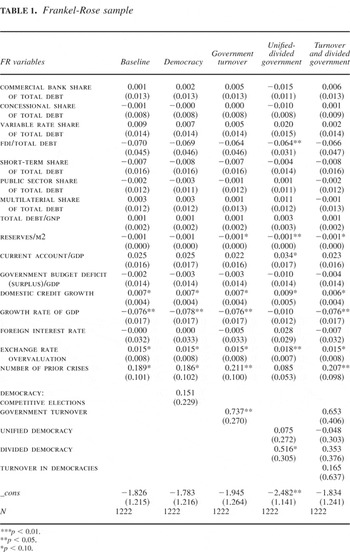
We begin by presenting our core regression results in Tables 1, 2, and 3. Table 1 contains our replication of Frankel and Rose's model. The first column is our replication of the original—baseline—specification. Adding a variable for competitive democratic elections to this specification (column 2) does not provide support for the hypothesis that democracies are associated with fewer speculative attacks. While the coefficient on competitive elections is positive, it is far from statistically significant. In column three we include the measure of government turnover. This variable is statistically significant and positive. Note that the coefficients in the tables are standard coefficients and not marginal coefficients. When we calculate marginal effects, we find that an increase in government turnover from 0 to 1, which is the change observed in over 80 percent of the observations when turnover is not equal to zero, increases the probability of a currency crisis by 7.9 percent. (A shift of one standard deviation from the mean increases the probability of a currency crisis by 1.3 percent.)
Frankel-Rose sample

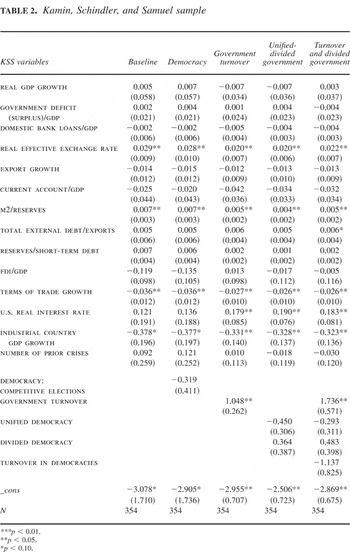
Kamin, Schindler, and Samuel sample

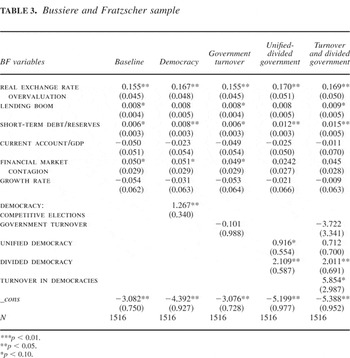
Bussiere and Fratzscher sample

The effect of unified and divided democracies on currency crises is explored in column 4. Although there is no statistically significant difference between unified democracies and authoritarian regimes, there is between divided democracies and authoritarian regimes. This latter difference is not only statistically significant, but it is also substantively interesting as well: changing from an authoritarian regime to a divided democracy increases the likelihood of a currency crisis by 4.9 percent.
Can our results be explained by differences in the costs and benefits of a defense across political environments? It is plausible that a divided government will find it relatively costly to organize a currency defense, given the need to gain the approval of multiple veto players. However, it is also plausible that divided governments, often being unstable coalition governments, have most to lose from not successfully defending the peg from the perspective of political survival. Accounting for the divided government result on the basis of costs and benefits thus hinges on an assumption that the former consideration outweighs the latter. As for our result for recent government turnover, new governments may well find it less costly to undertake economically contractionary measures to defend the peg thanks to “honeymoon” effects, making it difficult to unambiguously account for our result via the costs and benefits channel.
In column 5 in Table 1, we examine both government turnover and divided government and explore whether there are differences in the effect of government turnover between democratic and authoritarian regimes. It is readily apparent that we are asking the data to do quite a bit of work for us here. In spite of considerably collinearity, the variables government turnover and turnover in democracies are jointly significant (p-value = 0.03). The marginal effect of government turnover in authoritarian and democratic states indicates an increase in the likelihood of a currency crisis of 9 percent, which is statistically significant at the 0.05 level. An increase in government turnover in authoritarian regimes (that is, holding turnover in democracies constant) is also statistically significant at the 0.10 level, resulting in an increase in the likelihood of a crisis of 6.7 percent. Divided democracy and unified democracy are not jointly significant.
Table 2, which replicates the results of KSS, shows largely similar results. This is reassuring, as the dependent variable used by KSS measures speculative attacks while that employed by FR is really a measure of large devaluations. The results in Table 2 confirm that democracy does not have an independently significant effect on the likelihood of a speculative attack. Recent government turnover, however, does have a statistically and substantively robust influence: increasing government turnover from 0 to 1 increases the likelihood of a speculative attack by 20 percent. While the regular probit coefficient for divided government is not significant, the marginal effect of divided government is statistically significant (0.10 level) and moving from an authoritarian to a divided democratic regime increases the likelihood of a speculative attack by approximately 6 percent.
The message from column 5 in Table 2 using the KSS sample is similar to that from using the FR sample. Both government turnover and turnover in democracies are individually insignificant but jointly significant (p-value = 0.0002). Holding constant turnover in democracies (as well as unified and divided government), increasing turnover in authoritarian regimes increases the likelihood of speculative attack by 37 percent. Turnover in democracies does not, however, have a statistically significant marginal effect. While unified and divided democracies are jointly significant (p-value = 0.0155), their marginal effect is not.
We examine the BF sample in Table 3. First, note that the democracy variable is statistically significant unlike in the other samples. The coefficient is, however, opposite from our expectations and indicates that democracies are 5 percent more likely than authoritarian regimes to experience speculative attacks. The second interesting difference between the BF, FR, and KSS samples is that the coefficient on government turnover is negative and is far from statistically significant. Closer investigation of the data reveals that there are few (only eight) instances of government turnover during pre or postcrises periods. The consequence is that it is difficult to get a precise estimate of the relationship between government turnover and currency crises using the BF sample and specification.
Both divided and unified democracies are, as is consistent with the coefficient on the democracy variable, more likely to experience speculative attacks as compared to authoritarian regimes. Although it is puzzling, given our theory, why unified democratic governments should be more prone to attacks than authoritarian regimes, it is interesting that divided democratic governments are more prone to speculative attacks than unified democratic governments.29
A test of the null hypothesis that these two coefficients are equal to one another is rejected with a p-value of 0.097.
We next conduct a comprehensive examination of the effect of political institutions on crises, by adding variables that have been identified elsewhere in the literature as being associated with crises. For reasons of space, we do not present tables for these results, but rather describe our main findings below. We first explore the importance of elections and the electoral cycle. Frieden, Ghezzi, and Stein and Leblang find that the likelihood of speculative attacks increases in the periods surrounding political elections.30
We create three variables to capture the electoral cycle: the year before an election, the year of an election, and the year after an election.31Here we used the dates of an election from the DPI and combined that information with the dichotomous democracy variable so that we are capturing “democratic” elections.
We also explore the importance of government partisanship. Leblang and Simmons find that governments of the left are often more committed to exchange rate stability as compared to government of the right.32
See Leblang 2002, and Leblang 2003; Simmons 1992.
Recall that we use the change in veto players as our indicator of government instability. The number of veto players, rather than its change, has been the focus of recent work on international economic policy.33
See Tsebelis 2002; and Keefer and Stasavage 2003.
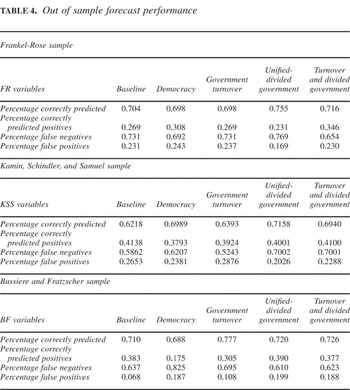
Finally, Table 4 shows the contributions of our favored political variables to out of sample forecasts of currency crises. The top row in each of the panels unambiguously reveals what is gained from adding political variables to forecasting models. When a political variable relating to unified/divided government is added to the FR specification, the percentage of correct predictions goes up from 70 percent to 76 percent (Table 4). When the same variable is added to the KSS specification, the percentage of correct predictions goes up from 62 percent to 72 percent. In the BF sample when a variable capturing recent turnover is added, the percentage of correct predictions goes up from 71 percent to 78 percent.
Out of sample forecast performance

The second row in each panel shows that a specification that takes account of divided government and government turnover raises the percentage of crises correctly predicted from 27 percent to 35 percent in the FR sample. Political models match, but do not improve on, the KSS and BF specifications in this regard. When it comes to false negatives the specification with divided government and recent turnover reduces the percentage from 73 percent to 65 percent in the FR sample (row 3 of panel 1). The specification with recent turnover reduces false negatives from 59 percent to 52 percent in the KSS sample (row 3 of panel 2), while the specification with divided government reduces false negatives from 64 percent to 61 percent in the BF sample (row 3 of panel 3). Furthermore, the specification with divided government reduces false positives from 23 percent to 17 percent in FR, and from 26 percent to 20 percent in KSS (row 4 of panels 1 and 2). However, political models raise false positives relative to the BF base specification.
Conclusion
The most important conclusion of our analysis is that political institutions significantly help us explain and forecast currency crises. Furthermore, in addition to the mechanism operating via poor fundamentals, government turnover and divided government may also contribute to crises by affecting speculators' expectations. Our finding that political institutions can influence speculative attacks by conditioning the expectations of currency speculators has significant policy implications. It implies that countries with divided government and those that have experienced recent turnover in government have an exceptional need for producing transparent forecasts. This may require special institutional solutions, such as the delegation of forecasting to bureaucracies that are not only independent of politicians, but are also subject to intense public scrutiny.
Our findings also give rise to a substantial research agenda. First, it is conceivable that institutional variables mask underlying differences in political interests and incentives to maintain different values of fundamentals or to devalue the currency. Our research agenda thus includes an effort to operationalize such considerations across a global sample in a systematic manner. Second, while adding political variables increases the ability of early warning system models to predict outcomes, a large proportion of outcomes still remain predicted. This article therefore only constitutes the starting point for a research agenda focused on using political variables to improve currency crisis forecasts. One aspect of our agenda includes the application of nonparametric switching models to define political phenomena as well as currency crises. This effort is especially called for in the latter realm given the variety of definitions of currency crises that are prevalent in the literature, and the fact that these definitions share the feature that they are fairly arbitrarily chosen by scholars of crises, rather than generated directly from the data. Another aspect of this agenda consists of developing more precise measures of political variables associated with currency crises. The fact that political variables emerge with substantial coefficients despite the likely prevalence of measurement error suggests that such efforts will result in a greater appreciation of the impact of politics on the likelihood of currency crises.
References
REFERENCES
Alesina, Alberto, and
Allan Drazen.
1991.
Why Are Stabilizations Delayed?
American Economic Review
81 (5):1170–88.Google Scholar
Beck, Thorsten,
George Clarke,
Alberto Groff,
Philip Keefer, and
Patrick Walsh,
2001.
“New Tools in Comparative Political Economy: The Database of
Political Institutions.”
World Bank Economic Review
15 (1):165–76.Google Scholar
Berg, Andrew, and
Catherine Pattillo.
1999.
Are Currency Crises Predictable? A Test.
IMF Staff Papers
46 (2):107–38.Google Scholar
Broz, J. Lawrence.
2002.
Political System Transparency and Monetary Commitment
Regimes.
International Organization
56 (4):863–89.Google Scholar
Bussiere, Matthieu, and
Marcel Fratzscher.
2002.
Towards a New Early Warning System of Financial Crises.
ECB Working Paper 145.
Frankfurt:
European Central Bank. Available at 〈http://www.ecb.int/pub/pdf/scpwps/ecbwp145.pdf〉.
Accessed 1 September 2005.
Calvo, Guillermo, and
Enrique Mendoza.
2000a.
Rational Contagion and the Globalization of Securities
Markets.
Journal of International Economics
51 (1):79–113.Google Scholar
Calvo, Guillermo, and
Enrique Mendoza.
2000b.
Capital-Markets Crises and Economic Collapse in Emerging Markets: An
Information-Frictions Approach.
American Economic Review
90 (2):59–64.Google Scholar
Carlsson, Hans, and
Eric van Damme.
1993.
Global Games and Equilibrium Selection.
Econometrica
61 (5):989–1018.Google Scholar
Fearon, James.
1994.
Domestic Political Audiences and the Escalation of International
Disputes.
American Political Science Review
88 (3):577–92.Google Scholar
Frankel, Jeffrey A., and
Andrew K. Rose.
1996.
Currency Crashes in Emerging Markets: An Empirical Treatment.
Journal of International Economics
41 (3):351–66.Google Scholar
Frieden, Jeffry A.,
Piero Ghezzi, and
Ernesto Stein.
2001.
Politics and Exchange Rates: A Cross Country Approach. In
The Currency Game: Exchange Rate Politics in Latin America,
edited by
Jeffrey A. Frieden and
Ernesto Stein,
21–64.
Washington, D.C.:
Inter-American Development Bank.
Haggard, Stephan.
2000.
The Political Economy of the Asian Financial Crisis.
Washington, D.C.:
Institute for International Economics.
Heinemann, Frank, and
Gerhard Illing.
2002.
Speculative Attacks: Unique Equilibrium and Transparency.
Journal of International Economics
58 (2):429–50.Google Scholar
Kamin, Steven B.,
John Schindler, and
Shawna Samuel.
2001.
The Contribution of Domestic and External Factors to Emerging Market
Devaluation Crises.
International Finance Discussion Papers 711.
Washington, D.C.:
Federal Reserve. Available at 〈http://www.federalreserve.gov/pubs/ifdp/2001/711/ifdp711.pdf〉.
Accessed 1 September 2005.
Keefer, Philip, and
David Stasavage.
2003.
The Limits of Delegation: Veto Players, Central Bank Independence,
and the Credibility of Monetary Policy.
American Political Science Review
97 (3):407–23.Google Scholar
Krugman, Paul.
1979.
A Model of Balance of Payments Crises.
Journal of Money, Credit, and Banking
11 (3):311–25.Google Scholar
Leblang, David.
2002.
The Political Economy of Speculative Attacks in the Developing
World.
International Studies Quarterly
46 (1):69–91.Google Scholar
Leblang, David.
2003.
To Devalue or to Defend? The Political Economy of Exchange Rate
Policy.
International Studies Quarterly
47 (4):533–59.Google Scholar
Leblang, David, and
William Bernhard.
2000.
The Politics of Speculative Attacks in Industrial
Democracies.
International Organization
54 (2):291–324.Google Scholar
MacIntyre, Andrew.
2003.
The Power of Institutions: Political Architecture and
Governance.
Ithaca, N.Y.:
Cornell University Press.
Morris, Stephen, and
Hyun Song Shin.
1998.
Unique Equilibrium in a Model of Self-Fulfilling Currency
Attacks.
American Economic Review
88 (3):587–97.Google Scholar
Obstfeld, Maurice.
1996.
Models of Currency Crisis with Self Fulfilling Features.
European Economic Review
40 (3–5):1037–47.Google Scholar
Persson, Torsten,
Gerard Roland, and
Guido Tabellini.
1997.
Separation of Powers and Political Accountability.
Quarterly Journal of Economics
112 (4):1163–202.Google Scholar
Przeworski, Adam,
Michael E. Alvarez,
José Antonio Cheibub, and
Fernando Limongi.
2000.
Democracy and Development: Political Institutions and Well-Being in
the World, 1950–1990.
Cambridge:
Cambridge University Press.
Roubini, Nouriel, and
Jeffrey Sachs.
1989.
Political and Economic Determinants of Budget Deficits in the
Industrial Democracies.
European Economic Review
33 (5):903–33.Google Scholar
Simmons, Beth.
1992.
Who Adjusts.
Princeton, N.J.:
Princeton University Press.
Tsebelis, George.
2002.
Veto Players: How Political Institutions Work.
New York:
Russell Sage Foundation Press.
Wittman, Donald.
1989.
Why Democracies Produce Efficient Results.
Journal of Political Economy
97 (6):1395–424.Google Scholar
Frankel-Rose sample
Kamin, Schindler, and Samuel sample
Bussiere and Fratzscher sample
Out of sample forecast performance
 You have
Access
- 50
- Cited by