Introduction
Cancer patients receiving radiotherapy often experience various psychosocial issues caused by the disease itself and the side effects caused by the treatment.
Depression, anxiety and other aspects of psychological distress can precede cancer, as can a lack of financial means for therapy or transportation, interruptions in career and family life and existential dilemmas about life’s meaning. If these issues are not adequately managed, they can significantly impact the patient’s quality of life (QoL), treatment compliance and satisfaction with the care provided. Reference Ng, Verkooijen, Ooi and Koh1–Reference Anderson, Slade, McDonagh, Burton and Fields5 Studies have shown that psychosocial interventions such as cognitive behavioural therapy, psycho-education, group and individual supportive therapy can improve the QoL of life of cancer patients. Reference Carlson and Bultz6
Therapeutic radiographers are the first point of contact for patients undergoing radiotherapy treatment. They, therefore, have an important role in ensuring the physical and psychosocial wellbeing of the patients throughout the radiotherapy pathway. 7–9 In essence, cancer patients want health care professionals to attend to both their physical and psychosocial needs. Reference Mikkelsen, Søndergaard, Jensen and Olesen10 However, the fast-paced and highly technological nature of the job often makes it difficult for therapeutic radiographers to provide adequate support.
Nonetheless, there seems to be limited research investigating the role of therapeutic radiographers in providing psychosocial support to cancer patients. Furthermore, there is a need to evaluate possible barriers that may prevent therapeutic radiographers from fulfilling such a role. Reference Elsner, Naehrig, Halkett and Dhillon11,Reference Elsner, Naehrig, Halkett and Dhillon12 It is in this context that this research aimed to evaluate the therapeutic radiographers’ perception about their role in providing psychosocial support to cancer patients attending radiotherapy at a local oncology centre in Malta. The study also aimed to evaluate possible challenges or barriers experienced by therapeutic radiographers which hinders them from fulfilling this role. Furthermore, the study aimed to collect data that would help inform and improve future practice.
Methods
This study adopted a quantitative, prospective, cross-sectional and non-experimental research design. All therapeutic radiographers (n = 26) working at the radiotherapy department at an oncology centre in Malta were invited to participate in the study.
Ethical considerations
All required institutional permissions and research ethics committee approvals were sought and obtained, including those from the local oncology hospital and the University of Malta Faculty Research Ethics Committee (Ref No: 5863 300620). The participants were informed via an information letter that participation in this study was voluntary and that the completion of the questionnaire constitutes consent to participate in this study.
Research tool
The questionnaire was self-designed but contained elements from the literature. Reference Elsner, Naehrig, Halkett and Dhillon12,Reference Maamoun, Fitch and Barker13 The final questionnaire was divided into four sections and consisted of a mix of multiple-choice questions, 5-point Likert scales and free-text responses. The first part of the questionnaire collected demographic data including age, gender, years of experience working as a therapeutic radiographer and social/caring responsibilities. The latter question was included since published literature has suggested that previous or existing caring responsibilities can influence one’s ability in providing psychosocial support. Reference Elsner, Naehrig, Halkett and Dhillon12,Reference Lavergne, Taylor, Gillies and Barisic14 The second section consisted of 8 questions aimed at evaluating participants’ attitudes and confidence in providing psychosocial support. The third part of the questionnaire evaluated the existing referral process for psychosocial support at a local oncology centre. The final section analysed the barriers experienced by therapeutic radiographers that may hinder them from providing existing psychosocial support.
Reliability and validity
The questionnaire was tested for reliability and validity.
The reliability of the questionnaire was assessed by distributing the questionnaire twice to three therapeutic radiographers with a 4-week time interval. The pre-test and post-test mean scores for each individual were analysed to assess for any statistically significant difference, but this was not the case since the resultant p values (0·183, 0·577 and 0·493) exceeded the 0·05 level of significance. In addition, the Pearson coefficient (1·000, 0·994 and 1·000) indicated that there was a strong positive relationship between the pre-test and post-test scores, with these being 1 or close to 1 confirming a high degree of reliability. Additionally, no changes were made to the questionnaire between the pilot and full research study, as from the feedback given by the therapeutic radiographers, the questions were all deemed to be relevant and clear and in line with the research objectives.
For validity, three ‘experts’ having at least 10 years of experience in radiotherapy practice, academia and research rated each item of the questionnaire for their relevance in relation to the research aims of the study. The experts were instructed to give a rating of 1 if they deemed the question not being relevant to the research aims, with a rating of 4 indicating that the question was extremely relevant. All items were rated with a 3 or 4, indicating that they were all considered as either relevant or extremely relevant. Consequently, the average Item Content Validity Index of all rates was that of 0·78, which is extremely near to the recommended 0·80 value. Therefore, in line with methods suggested by Polit and Beck the tool was considered as having satisfactory content validity. Reference Yusoff15
Data collection
The questionnaire, together with an information letter, was distributed to all therapeutic radiographers (n = 26) working at a local radiotherapy department by intermediaries to ensure the anonymity of the participants. Participants were given a 4-week time frame to complete the questionnaire and deposit this in a designated collection box. No personal identifying information was collected in the questionnaire.
Data analysis
The data were transcribed from paper to SPSS by the primary author with the aid of an experienced statistician. The statistician also assisted and advised about statistical data analysis. The Friedman test was used to compare mean ratings supplied to a number of linked statements, whereby a p-value of less than 0·05 was considered as a statistically significant result.
The primary author performed the content analysis for the open-ended responses, a process that was discussed and verified by the other authors who are experienced in such analysis. This method of analysis provided a quantitative method of summarising any form of content by counting various characteristics of it. Reference Mihailescu16 In effect, the free-text responses to the open-ended questions were initially analysed so as to apply relevant coding units. Upon further reading and review, the researchers grouped data with similar codes and content, which then allowed for specific themes to be quantified and counted. In addition, therapeutic radiographers’ actual qualitative replies were included as quotes so as to represent therapeutic radiographers’ voice and provide some insight into their perceptions and views about this aspect of their practice and role.
Results
Twenty-one (n = 21) responses were received, resulting in a response rate of 81%. The results according to the questionnaire sections are as follows.
Demographics
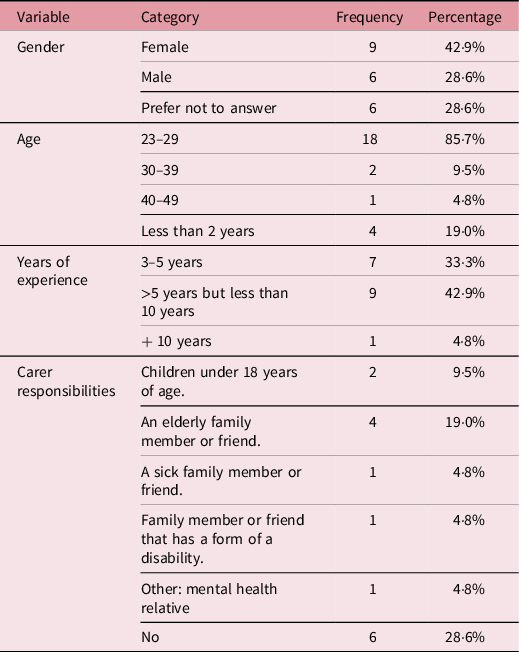
A summary of the participants’ demographic data is presented in Table 1. The largest group of responses were from females (42·9%). Most were aged between 23 and 29 years (85·7%), with nearly half the respondents having more than 5 years of work experience (47·7%). Nine therapeutic radiographers (42·9%) indicated that they had carer responsibilities for either children, family and/or friends.
Demographics of therapeutic radiographers who completed the questionnaire

Therapeutic radiographers’ perception on their role in psychosocial care
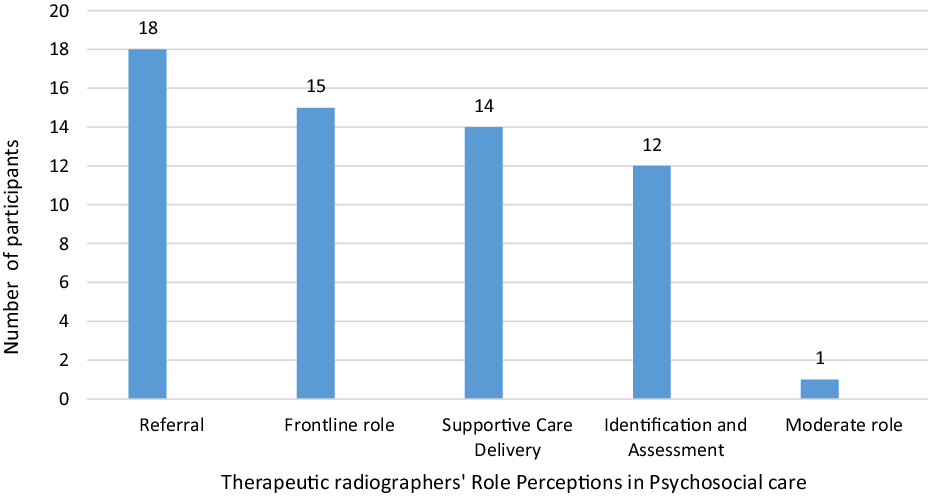
Figure 1 summarises the therapeutic radiographers’ perception of their role in providing psychosocial support. The majority (85·71%, n = 18) of the participating therapeutic radiographers perceived their role as the primary coordinators of care by means of referring patients for psychosocial interventions. On the other hand, 71·42%, (n = 15) of therapeutic radiographers also perceived themselves as being front liners since they had daily direct patient contact with the patients during treatment. 66·67% therapeutic radiographers stated that they have an important role in the provision of supportive care while 57·14% (n = 12) stated that they have an important role in the patients’ assessment.
Frequency of coding units as mentioned by participants when commenting about their perception of the therapeutic radiographers’ role in providing psychosocial care.

Therapeutic radiographers’ confidence level in providing advice in support care issues
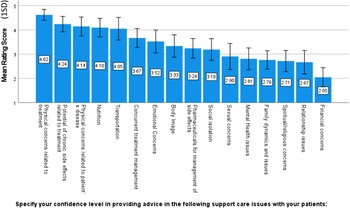
Figure 2 summarises the confidence of the therapeutic radiographers in providing physical and psychosocial support to patients receiving radiotherapy treatment using a rating score of 1 (not confident) to 5 (highly confident). The therapeutic radiographers were most confident in providing advice related to physical and treatment-related issues such as transportation (Score >4). On the other hand, an intermediate confidence level (score 3 to 4) was reported for advising on concurrent treatment management, emotional concerns, body image, pharmaceuticals management of treatment-related side effects and social isolation. Therapeutic radiographers felt the least confident in giving advice on mental health, family dynamics, spiritual and religious concerns, relationship issues and financial concerns. The Friedman test showed a statistically significant difference in the mean rating scores reflecting therapeutic radiographers’ confidence, as illustrated graphically in Figure 2.
The confidence levels of therapeutic radiographers in providing advice in support care issues.

Referrals for psychological support
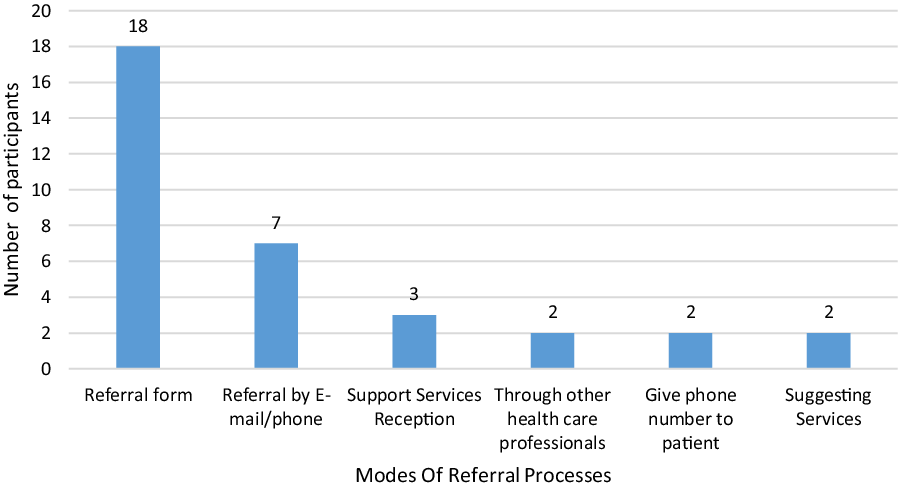
Eleven (52·4%) therapeutic radiographers indicated that they had referred between 1 and 4 patients for psychosocial support in the past year, with the remaining 10 (47·6%) stating that they had not referred any patient in this period. The content analysis of the open-ended question about the process used to refer patients for psychosocial support showed that various methods were used by therapeutic radiographers (Figure 3). Most therapeutic radiographers (85·7%, n = 18) indicated that they mostly used a referral form to refer patients to such services, followed by e-mail or telephone.
Thematically categorised responses detailing the methods’ therapeutic radiographers used to refer patients for psychosocial support.

Perceived barriers to the provision of psychosocial support
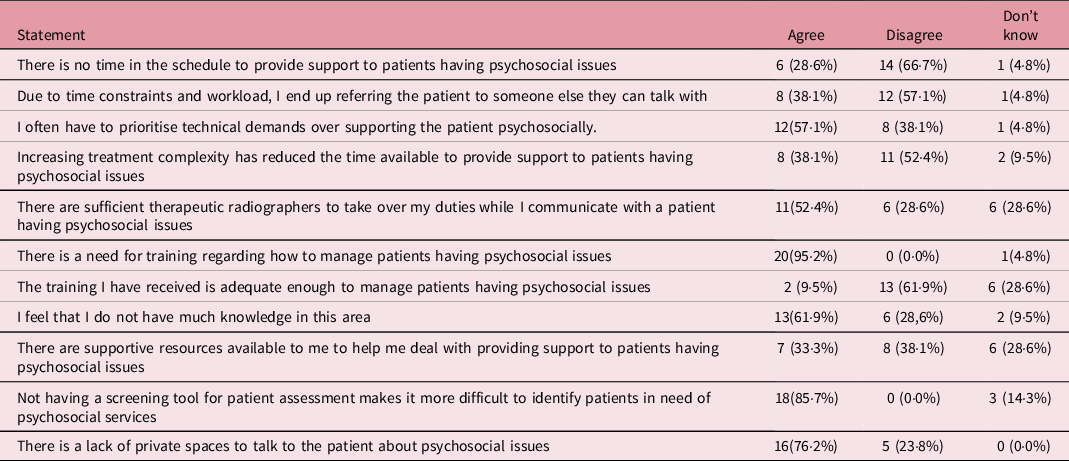
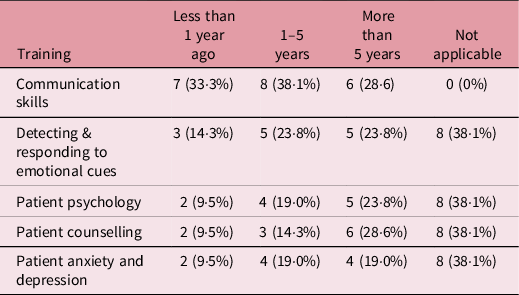
Lack of training and knowledge on psychosocial support was identified as the key barriers to the provision of psychosocial support (Table 2). In fact, only half of the therapeutic radiographers indicated that they had attended training on areas related to psychosocial support. Furthermore, those who had received training had their training for more than 5 years (Table 3). Another identified barrier prevalent among therapeutic radiographers’ responses was the lack of a screening tool in the department as well as the lack of a private space to engage with patients in the radiotherapy department. Conversely, it was noted that therapeutic radiographers did not consider time or lack of staff to be barriers in the provision of adequate psychosocial support.
Barriers in the provision of psychosocial support

Training in areas of patient care by timeframe

Open-ended responses and comments
Further insights relating to these results were provided by the open-ended responses provided. Several therapeutic radiographers expressed similar views to therapeutic radiographer 8 who commented that ‘referral forms for other services are not easily accessible, while the long waiting times often discourage patients from taking up these services’. Similarly, the participants pointed out that while there were multiple ways that patients can be referred to the appropriate services by therapeutic radiographers, the lack of a standard procedure may sometimes hinder such referrals. This suggests that therapeutic radiographers feel that there are no standard referral processes or that they are unaware of any standard departmental procedures that may guide such a process. In fact, the lack of available resources was not cited by all therapeutic radiographers as a barrier to providing psychosocial support. These results show that, despite the availability of services for psychosocial support, not all therapeutic radiographers may be aware of them.
Therapeutic radiographers’ recommendations to overcome the identified barriers
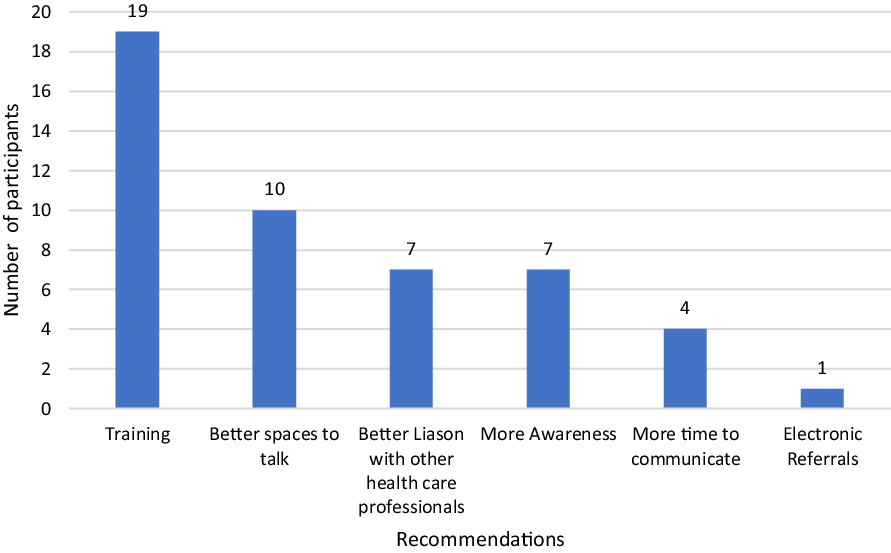
Most of the therapeutic radiographers 90·5% (n = 19) indicated that they need additional training to further develop their skills in providing psychosocial support. Therapeutic radiographers recommended the need to allocate a private space within the department to engage with patients and hence facilitate psychosocial discussions with patients. Better liaison with other support services was also recommended. One therapeutic radiographer suggested the use of electronic referrals to facilitate the process (Figure 4).
Showing recommendations to overcome the identified barriers.

Discussion
Although several studies have been conducted evaluating the perceptions of healthcare professionals on the provision of psychosocial support to cancer patients, there is currently limited research evaluating the perception of therapeutic radiographers. Reference Elsner, Naehrig, Halkett and Dhillon12,Reference Moore, Rivera Mercado, Grez Artigues and Lawrie17,Reference Oultram, Findlay, Clover, Cross, Ponman and Adams18 To our knowledge, this is the first study evaluating the perceptions of therapeutic radiographers on their role in providing psychosocial support to cancer patients at a cancer centre in Malta.
Our findings indicate that therapeutic radiographers strongly believe that the provision of psychosocial support is an important part of their role, irrespective of their gender and clinical experience. Consistent with other research findings, Reference Elsner, Naehrig, Halkett and Dhillon11–Reference Maamoun, Fitch and Barker13 the therapeutic radiographers felt that they had a key role as refers even though therapeutic radiographers eventually performed very limited referrals to other psychosocial support services (Table 2). The local undergraduate radiography course emphasises the need to provide psychosocial support via a multidisciplinary team. This could potentially explain why most therapeutic radiographers felt this as an important part of their role. However, although psychosocial support was perceived as important various organisational barriers may have hindered the therapeutic radiographers from fulfilling this role, including the lack of standardised referral processes, poor awareness of the psychosocial services available and lack of a suitable physical space to talk to patients. Conversely to other studies, time and workload were not considered as a barrier to the provision of psychosocial support, indicating that the department is adequately staffed to address this need. Reference Maamoun, Fitch and Barker13,Reference Botti, Endacott, Watts, Cairns, Lewis and Kenny19–Reference Chen, Chan, Chan, Yap, Wang and Kowitlawakul21 The majority (85·7%) of the participant agreed that having a screening tool could facilitate the referral process.
In their qualitative study, Merchant et al. Reference Merchant, O’Connor and Halkett20 found that the RT department lacks enough room to communicate with patients, both for addressing clinical concerns and giving psychosocial support. This was also consistent with the finding of this study. Therapeutic radiographers advised that additional space be set up for this purpose.
Another interesting finding was that despite the local undergraduate course offering training on the provision of psychosocial support, most therapeutic radiographers state that they do not have sufficient training in this area. Limited knowledge in therapeutic radiographers was also highlighted as a barrier in providing psychosocial support by Maamoun et al., Reference Elsner, Naehrig, Halkett and Dhillon11 Larsen et al. Reference Larsen, Fineberg, Rinaldo, Menon and Jones22 and Lavergne. Reference Lavergne, Taylor, Gillies and Barisic14 In our study, therapeutic radiographers were mostly confident in giving advice on the physical aspect of treatment rather than psychosocial issues, which may reflect the highly technical aspect of the job. These findings suggest that hospital management needs to organise additional continuous professional development courses to address this need. In fact, this research can be important in raising awareness about improving therapeutic radiographers’ skills in detecting and managing psychosocial issues. Consequently, this will make it easier for patients to gain access to specialised services and receive timely care, while also reducing the burden of anxiety and any unmet psychosocial patients’ needs. Incorporating such skills into standard practice will therefore aid in addressing patients’ psychosocial needs during radiation oncology visits and/or treatments.
Patients consider conversations about interests and relationships as critical to enhanced comfort, rapport and involvement, as well as allowing them to feel like an ‘individual’ rather than a ‘patient’. As a result, these connections foster a sense of belonging, as well as motivation and incentive to continue and finish treatment. Reference Merchant, O’Connor and Halkett20,Reference Bolderston, Lewis and Chai23,Reference Halkett and Kristjanson24 As noted in the literature, while various professional organisations have recognised the significance of therapeutic radiographers in providing psychosocial support, Reference Elsner, Naehrig, Halkett and Dhillon11–Reference Lavergne, Taylor, Gillies and Barisic14,Reference Larsen, Fineberg, Rinaldo, Menon and Jones22,Reference Bolderston, Lewis and Chai23 however, research on radiographers as essential providers of psychosocial support is still quite lacking. This emphasises the need for more research exploring radiographers’ perceptions, confidence and/or competence of their role in providing psychosocial support.
This study has some limitations that have to be acknowledged. Although achieving a relatively high response rate from the accessible population, the small sample size may have influenced the statistical significance of this study’s research findings. Moreover, the study was conducted in a single centre in a small Mediterranean island over a short time period, which may further limit the generalisability of the results obtained. Although questionnaires provide a fast tool to collect data in this study, they cannot fully capture respondents’ emotional responses or feelings, highlighting the need for a qualitative research approach for future studies. Finally, this study did not capture the point of view of the patients about the psychosocial support received from therapeutic radiographers. Therefore, it is strongly recommended that any future work should also evaluate the perceptions of cancer patients about the psychosocial support they receive and/or wish for when attending radiotherapy.
In conclusion, this study’s findings reveal that, while local therapeutic radiographers recognise the critical role they play in providing psychosocial support to cancer patients, they encounter multiple barriers. This emphasises the need for improved collaboration between hospital management and therapeutic radiographers to overcome the highlighted barriers, allowing therapeutic radiographers to provide more effective psychosocial support, resulting in improved patient care and quality of life.
Supplementary Material
To view supplementary material for this article, please visit https://doi.org/10.1017/S1460396922000218.
Acknowledgements
We would like to express our sincere gratitude to Dr Jose Guilherme Couto and Mr Kyle Muscat for their expertise in the validation of the research tool and the intermediaries for their assistance in distributing and collecting the questionnaires on our behalf. Additionally, we thank Prof. Liberato Camilleri and Ms Nakita Grima for their assistance in the analysis of the data. Finally, we are grateful to all the radiographers who participated and made this contribution possible.
Conflicts of Interest
The authors declare none.