


Introduction
In the last 50 years, numerous studies have focused on the relationship between Eating Disorders (ED) and Obsessive Compulsive Disorder (OCD) (Dubois, Reference Dubois1949; Palmer and Jones, Reference Palmer and Jones1939), providing evidence both for and against this relationship. The evidence for the existence of a connection stems from different arguments, including a syndromic perspective, common personality features, and biological factors. The majority of studies have focused on comorbidity, demonstrating that the presence of OCD among ED patients is significantly high (e.g. Kaye et al., Reference Kaye, Bulik, Thornton, Barbarich and Masters2004; Matsunaga et al., Reference Matsunaga, Miyata, Iwasaki, Matsui, Fujimoto and Lirijke1999; Milos, Spindler, Ruggiero, Klaghofer and Schnyder, Reference Milos, Spindler, Ruggiero, Klaghofer and Schnyder2002; Speranza et al., Reference Speranza, Corcos, Godart, Loas, Guilbaud and Jeammet2001).
In 1991 Rachman pointed out the need for studies addressing the nature of the relationship between ED and obsessive compulsive disorder. Since then, there has been a large amount of research in this area; however, there is still a lack of studies addressing this relationship at a psychopathological level. Recently, Shafran (Reference Shafran, Frost and Steketee2002) proposed that studying the beliefs hypothetically related to OCD in ED patients could be a way to investigate the link between the two disorders. These OCD-Beliefs have been emphasized in cognitive OCD models as an important factor in the genesis and/or maintenance of the disorder (Clark, Reference Clark2004; Rachman, Reference Rachman1997; Salkovskis, Reference Salkovskis1999). In this vein, the Obsessive Compulsive Cognitions Working Group (OCCWG, 1997, 2001, 2003) proposed the existence of six core OCD belief domains: (1) Inflated responsibility; (2) Over-importance of thoughts (which also includes thought-action fusion beliefs); (3) Importance of controlling one's thoughts; (4) Overestimation of threat; (5) Intolerance of uncertainty; and (6) Perfectionism.
As far as we know, three studies have specifically examined obsessive compulsive belief domains in ED. Humphreys, Clopton and Reich (Reference Humphreys, Clopton and Reich2007) observed a significant relationship between ED symptoms and OCD related beliefs (Obsessional Beliefs Questionnaire, OBQ) in 160 female students. Moreover, the Perfectionism domain accounted for 5% of the variance in ED symptomatology, and it was responsible for the relationship between ED and OCD symptoms. Lavender, Shubert, de Silva and Treasure (Reference Lavender, Shubert, de Silva and Treasure2006) analyzed the adherence of ED patients to OC beliefs (OBQ), finding no differences between anorexic, bulimic and Eating Disorder Non Specified (EDNOS) groups on most of the subscales. Current ED participants had significantly higher scores than recovered ED participants on every OBQ-domain except Responsibility; and ED patients scored higher than anxious and OCD patients on almost all the subscales. One important limitation of the study was the impossibility of controlling variables such as the severity of psychopathology, age or gender, and the fact that OCD comorbidity was not specifically explored within the ED sample of the study. Therefore, without controlling obsessionality, the results (i.e. the high levels of OCD-relevant beliefs) could be due to the high comorbidity between ED and OCD. Finally, another approach to the study of OCD beliefs was used by Freid (Reference Freid2007), who developed a measure that adapted the OBQ to the ED context (i.e. related to food, eating, shape and weight).
From a different perspective, some of the beliefs related to OCD, or aspects associated with them, have been studied in EDs, with Perfectionism being the most studied construct (Shafran, Reference Shafran, Frost and Steketee2002). ED subtypes show higher scores on perfectionism than the general population (Bastiani, Rao, Weltzin and Kaye, Reference Bastiani, Rao, Weltzin and Kaye1995; Halmi et al., Reference Halmi, Sunday, Strober, Kaplan, Woodside and Fichter2000), and perfectionism, in turn, seems especially related to AN (Bardone-Cone et al., Reference Bardone-Cone, Wonderlich, Frost, Bulik, Mitchell and Uppala2007; Shafran, Cooper and Fairburn, Reference Shafran, Frost and Steketee2002). The Thought-Action Fusion (TAF) belief, the belief that having morally unacceptable thoughts is as bad as actually carrying them out (TAF-Moral), and the belief that certain thoughts increase the probability of particular events occurring (TAF-Probability), has been adapted to ED by Shafran and colleagues (Rachman and Shafran, Reference Rachman and Shafran1999; Shafran, Teachman, Kerry and Rachman, Reference Rachman and Shafran1999). This bias has been labelled Thought Shape Fusion (TSF) (e.g. thinking about forbidden food is as morally wrong as eating it), and it has been related to ED psychopathology in ED patients and to ED symptoms in community individuals (e.g. Coelho, Carter, McFarlane and Polivy, Reference Coelho, Carter, McFarlane and Polivy2008; Radomsky, de Silva, Todd, Treasure and Murphy, Reference Radomsky, de Silva, Todd, Treasure and Murphy2002; Shafran and Robinson, Reference Shafran and Robinson2004). Finally, although the belief about the importance of controlling one's thoughts as formulated by the OCCWG (1997, 2001, 2003) has not been directly addressed in ED patients, several studies demonstrate the tendency of ED patients and dieters to employ various control strategies, such as suppressing thoughts about weight, eating, and shape (Harnden, McNally and Jimerson, Reference Harnden, McNally and Jimerson1997; O'Connell, Larkin, Mizes and Fremouw, Reference O'Connell, Larkin, Mizes and Fremouw2005), rumination, distraction or avoidance (Woolrich, Cooper and Turner, Reference Woolrich, Cooper and Turner2008). From these data, the speculation could be made that controlling thoughts is relevant for dieters and ED patients.
To summarize, few studies have examined the relationship between OCD and ED at a cognitive level. Although the results have been inconclusive, they suggest the importance of OCD beliefs in ED psychopathology and the need to clarify this relationship with specifically designed studies. Furthermore, given the present debate about the validity of traditional classification systems for ED, due to ambiguity about limits among subtypes (Grilo, Reference Grilo2006) and diagnostic migration within patients (Fairburn and Harrison, Reference Fairburn and Harrison2003), a further step in the study of OCD beliefs in ED could be to analyze differences among more specific ED symptomatology: restrictive, purgative and non-purgative subtypes.
To respond to these literature limitations, the present study has been developed with two aims: first, to analyze the differences among ED subtypes and community participants in the content and degree to which they present OCD beliefs, after controlling for age, Body Mass Index and obsessionality; and second, to explore which OCD beliefs explain ED symptomatology in a sample of ED patients.
Method
Participants
Two groups of subjects participated in the study. The first group consisted of 79 patients with eating disorder diagnosed according to DSM-IV-TR criteria (APA, 2002) and recruited from the Eating Disorder Unit at San Juan Hospital (Alicante, Spain) (initially 84 patients were recruited but 5 were excluded because they presented comorbid OCD). Clinical participants were divided into the following groups: the Anorexia Nervosa Restrictive group (ANR) was composed of 21 women; 8 (38.09%) had a comorbid diagnosis (major depression, borderline personality disorder, obsessive-compulsive personality disorder, generalized anxiety disorder, panic disorder with agoraphobia, and attention deficit hyperactivity disorder); 12 (57.1%) were in-patients, and 9 were receiving out-patient treatment at the time of the study. The Anorexia Nervosa Purgative group (ANP) included 18 women. At the time of the study, 61.1% were in-patients. Moreover, 38.9% of the ANP group had a comorbid diagnosis (major depression, panic disorder, and borderline, schizotypal, and non-specified personality disorders).
It is important to mention that in the AN group (Restrictive and Purgative), 12 patients (6 from each subtype) were actually EDNOS at the time of this study since, due to the effect of the treatment, these patients did not meet the DSM-IV weight criteria, although they met all the diagnostic criteria for AN when they were explored in the first intake. However, in order to avoid fragmenting the groups further, we decided to keep these patients in their original groups, as has been done in previous studies (Cooper, Grocutt, Deepak and Bailey, Reference Cooper, Grocutt, Deepak and Bailey2007). Moreover, since the difference in weight could affect our first aim, a preliminary analysis was performed that showed no differences in OCD beliefs between AN patients with and without weight recovery.
The Bulimia Nervosa Purgative group (BNP) included 18 women patients. Seventeen received out-patient treatment (88.9%), whereas only two were in-patients (11.1%). Furthermore, 38.9% had a comorbid diagnosis (panic disorder with agoraphobia (in two patients), major depression, and cyclothymic disorder). The Binge Eating Group (BEG) was composed of 22 women patients: 6 participants with Bulimia Nervosa Non Purgative and 16 patients with Binge Eating Disorder, all women. These groups were joined on the basis of two criteria: first, due to the similarities between the two groups on personality features and clinical characteristics; and second, for statistical analysis purposes. Six patients (27%) had a comorbid diagnosis (major depression, dysthymic disorder, adaptive disorder, non-specified personality disorder, compulsive buying, and fibromyalgic syndrome). Twenty-one (95.5%) were receiving out-patient treatment.
The healthy control group was composed of 50 women selected from a sample of 557 community members who were relatives and friends of university students (see procedure section). In order to balance gender and sample size with the clinical group, 50 women were randomly selected, excluding those with subclinical symptoms of OCD (Clark-Beck Obsessive-Compulsive Scale) and/or eating disorders (Restraint Scale).
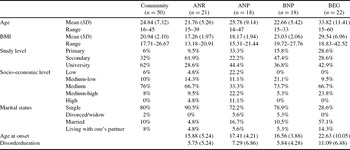
In summary, four groups of ED patients and a group of healthy controls participated in this study. Table 1 shows the socio-demographic variables and Body Mass Index (BMI) for each group.
Participants, body mass index, socio-demographic and clinical variables

Notes: Age, Body Mass Index (BMI), age at onset, and disorder duration are expressed in Mean (Standard Deviation). Community: Community group, ANR: Anorexia Nervosa Restrictive subtype; ANP: Anorexia Nervosa Purgative subtype; BNP: Bulimia Nervosa Purgative subtype; BEG: Binge Eating Group
Instruments
Obsessive Beliefs Spanish Inventory-Revised (OBSI-R; Belloch, Cabedo, Morillo, Lucero and Carrió, Reference Belloch, Cabedo, Morillo, Lucero and Carrió2003; Belloch et al., Reference Belloch, Morillo, Luciano, García-Soriano, Cabedo and Carrió2010; Cabedo, Belloch, Morillo, Giménez and Carrió, Reference Cabedo, Belloch, Morillo, Giménez and Carrió2004; Gimenez, Morillo, Belloch, Carrió and Cabedo, Reference Cabedo, Belloch, Morillo, Giménez and Carrió2004). This is a self-report questionnaire designed to evaluate dysfunctional beliefs related to the maintenance and/or development of OCD. It is composed of 50 items with a 7-point Likert scale from 1 (absolutely disagree) to 7 (absolutely agree), and participants are asked about their level of agreement with different sentences corresponding to general dysfunctional beliefs. The OBSI-R contains eight empirically derived subscales: a) inflated responsibility; b) over-importance of thoughts; c) thought-action fusion-probability; d) thought-action fusion-moral; e) importance of thought control; f) overestimation of threat; g) intolerance to uncertainty; and h) perfectionism. The OBSI-R has demonstrated excellent psychometric properties in OCD and community individuals (Belloch et al., Reference Belloch, Morillo, Luciano, García-Soriano, Cabedo and Carrió2010). In the present sample, the instrument showed a satisfactory internal consistency (α = values ranging from 0.71 to 0.82 for the sub-scales).
Clark-Beck Obsessive Compulsive Inventory (CBOCI; Clark and Beck, Reference Clark and Beck2002). This is a self-report instrument that appraises obsessive-compulsive symptoms across 25 items grouped in two scales (obsessions and compulsions) with a 4-point scale from 0 (never/totally disagree) to 3 (always/totally agree). The Spanish version of this instrument (Belloch, Reina, García-Soriano and Clark, Reference Belloch, Reina, García-Soriano and Clark2009) has shown good internal consistency in the present study (Total score α = 0.88; obsessions scale α = 0.82; compulsions scale α = 0.76). This instrument was used in this study to extract subclinical OCD with a score of 25, which is a reliable cut-off point between OCD and non-OCD subjects (Belloch et al., Reference Belloch, Reina, García-Soriano and Clark2009).
The Eating Attitudes Test (EAT-26; Garner and Garfinkel, Reference Garner and Garfinkel1979; Garner, Olmsted, Bohr and Garfinkel, Reference Garfinkel and Garner1982). This is a self-report that assesses attitudes and behaviours related to ED, mainly to AN. It has 3 subscales: Dieting; Bulimia and Food Preoccupation; and Oral Control; and the total score measures symptom severity. Each item is scored with a 6-point Likert scale (never–always). The Spanish version was prepared by Castro, Toro, Salamero and Guimerá (Reference Castro, Toro, Salamero and Guimerá1991). Internal consistency for our sample ranged from .89 to .60 for each subscale.
The Restraint Scale (RS; Herman and Polivy, Reference Herman and Polivy1975) is a self-report instrument that includes 10 items on a 4 or 5 point scale. The internal consistency in the present study for the total score was 0.79. Regarding the subscales for Weight fluctuation and Concern about dieting, the internal consistency scores were 0.75 and 0.65, respectively. Following Heartheton, Herman, Polivy, King and McGree (Reference Heartherton, Herman, Polivy, King and McGree1988), in this study the subclinical ED group has been extracted with a score of 16, which is a widely used and reliable cut-off point between restrainers and non-restrainers.
Procedure
The recruitment of community participants was carried out by advanced psychology students who received course credit for their recruitment efforts. In the seminar they received training about how to present the instruments to prospective subjects. Each of the students administered the assessment instruments individually to at least three friends and/or family members who did not receive any compensation for their participation in the study. Subjects reporting current mental health problems and/or taking psychotropic medication were not included in the study.
Clinical participants attended the Eating Disorders Unit at San Juan Hospital, a clinic included in the public Spanish National Health network. Their diagnosis was made by their current psychiatrist, following the Structured Clinical Interview for DSM-IV (First, Spitzer, Gibbon and Williams, Reference First, Spitzer, Gibbon and Williams1999), and all of them were receiving cognitive-behavioural therapy. The questionnaires were completed in the presence of one of the authors of this study.
Prior to filling out the questionnaire protocol, participants received a brief explanation of the study. Participants who agreed to participate signed an informed consent. Following the completion of the questionnaires, all the participants were weighed and measured to calculate their BMI. This study received the ethical approval of the Hospital and the University of Valencia Ethics Committees.
Analyses were carried out with SPSS v.15 (SPSS, Inc., Chicago, IL). In order to analyze differences among groups in the relevant variables, ANOVAs were computed using F or Brown-Forsythe (BF), depending on the homogeneity of group variances. Tukey or Games-Howell (when variances were different) post-hoc statistics were applied to examine the source of between-groups differences, and ANCOVAs with Bonferroni correction were used, controlling the influence of age, BMI and OC symptoms. For the second objective, multiple regression analysis with a stepwise statistical procedure to enter predictors was used, given the large number of predictors and the sample size available (Tabachnik and Fidell, 2007). The stepwise procedure only enters predictors in the equation that statistically add explained variance. The analyses were carried out separately for each EAT subscale, with age, BMI, OC beliefs and symptom measures as independent variables. Associations and differences were considered significant when p values were ≤.05.
Results
Differences between ED groups and community group in OCD beliefs
Analyses of variance (ANOVA) among groups indicated that there were no differences among the clinical ED subtypes in their OCD beliefs; however, Tukey and Games-Howell post-hoc analyses showed that the ANR, ANP and BNP obtained significantly higher scores than the community participants on almost every OBSI-R subscale (Responsibility: F (4,124) = 5.34, p < .001. Over-Importance of Thoughts: F (4,124) = 7.55, p < .001; TAF-Likelihood: BF (4,124) = 9.99, p < .000; TAF-Moral: F (4,124) = 4.27, p < .01; Importance of Thought Control: F (4,124) = 6.90, p < .000; Overestimation of Threat: F (4,124) = 16.08, p < .000; Intolerance to Uncertainty: F (4,124) = 8.45, p < .000; Perfectionism: F (4,124) = 10.34, p < .000; effect size range = .34 -12). ANR patients showed the greatest differences in beliefs in comparison with the community sample, as they scored significantly higher on every subscale, except TAF-Moral and Overestimation of Threat; in contrast, the BEG were the most similar to the community participants.
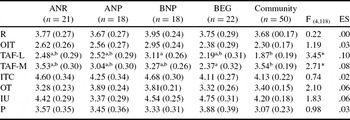
Later, as there were significant differences among groups in age (BF (4,68.62) = 7.74; p < .001; effect size = .21), BMI (BF (4,35.61) = 38.57; p < .001; effect size = .58) and obsessionality (BF (4,75.21) = 27.11; p < .001; effect size = .54), which is a comorbid condition in ED patients, an ANCOVA controlling for these variables was conducted (Table 2). Bonferroni correction revealed differences only between the BNP and the community group on TAF-likelihood, and between the BEG and the community group on TAF-moral. The other ED groups did not differ from the BNP/BEG or from the community sample (see Table 2).
Differences in the OBSI-R subscales between ED subtypes and community group (ANCOVAs controlling obsessionality, BMI and age). Data expressed in Mean (Standard Error) controlled by covariates

Notes: * = p < .05. Bonferroni correction. ES: effect size (partial eta squared). Superscripts a and b represent Bonferroni corrections. ANR: Anorexia Nervosa Restrictive subtype; ANP: Anorexia Nervosa Purgative subtype; BNP: Bulimia Nervosa Purgative subtype; BEG: Binge Eating Group; Community: Community group. R: Responsibility; OIT: Over-Importance of Thoughts; TAF-L: Thought-Action Fusion-Likelihood; TAF-M: Thought-Action Fusion-Moral; ITC: Importance of Thought Control; OT: Overestimation of Threat; IU: Intolerance to Uncertainty; P: Perfectionism
Analysis of the degree to which OCD-Beliefs explain ED symptomatology
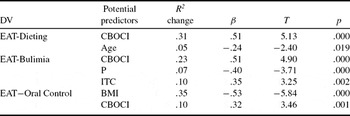
For the following analyses, as there were no differences between the ED groups on beliefs, they were collapsed into one group (N = 79). Several regression analyses were computed for the clinical participants, separately for each EAT subscale (dependent variables), with age, CBOCI, BMI and the OBSI-R subscales as predictors (see Table 3). Results indicated that the CBOCI total score predicted a high percentage of the EAT subscales’ variance: 31% of EAT-Diet (F (2,68) = 19.17; p = .0001); 23% of EAT-Bulimia (F (3,67) = 14.36; p = .0001); and 10% of EAT-Oral control (F (2,68) = 27.98; p = .0001). Perfectionism and Importance of Thought Control explained an additional 7% and 10% of EAT-Bulimia, respectively, the BMI predicted 35% of EAT-Oral Control, and age predicted 5% of EAT-Dieting.
Stepwise regression analysis, with clinical ED sample (N = 79), on EAT subscales with age, BMI, OBSI-R subscales and CBOCI total score as potential predictors

Notes: DV: Dependent Variable; EAT: The Eating Attitudes Test; Potential predictors: CBOCI: Clark-Beck Obsessive Compulsive Inventory Total Score, BMI: Body Mass Index, Age, OBSI-R: Obsessive Beliefs Spanish Inventory-Revised. OBSI-R subscales: P: Perfectionism; ITC: Importance of Thought Control; OT: Overestimation of Threat; TAF-M: Thought-Action Fusion-Moral
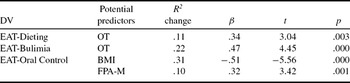
Given that obsessive symptoms are an important predictor of ED symptomatology (the CBOCI score appears in all the regression analysis models), and that we were especially interested in examining the relevance of OCD beliefs, new stepwise regression analyses were conducted, but without the CBOCI measure (see Table 4). Regression analyses performed separately for each EAT subscale show that Overestimation of Threat makes a unique contribution to EAT-Diet and EAT-Bulimia, explaining 11% (F (1,71) = 9.22; p = .0001) and 22% (F (1,71) = 19.77; p = .0001) of the variance, respectively, while BMI and FPA-Moral explained 31% and 10% of the EAT-Oral Control variance (F (2,70) = 24.27; p = .0001).
Stepwise regression analysis, with clinical ED sample (N = 79), on EAT subscales with age, BMI, and OBSI-R subscales as potential predictors

Notes: DV: Dependent Variable; EAT: The Eating Attitudes Test. Potential predictors: BMI: Body Mass Index, Age, OBSI-R: Obsessive Beliefs Spanish Inventory-Revised. OBSI-R subscales: P: Perfectionism; ITC: Importance of Thought Control; OT: Overestimation of Threat; TAF-M: Thought-Action Fusion-Moral
Discussion
The present paper is an attempt to answer two specific questions: First, are there differences in OCD-related beliefs between ED and community individuals and among ED subtypes? Second, do OCD-related beliefs predict ED symptomatology? The first objective of this study was to analyze the differences in OCD-beliefs among ED patients, taking into account the different diagnostic subtypes, compared with healthy controls. No differences were found between the beliefs held by the AN subtypes (restrictive and purgative), the BN, and the binge eating group. In the same vein, Lavender et al. (Reference Lavender, Shubert, de Silva and Treasure2006) did not report differences in the majority of the beliefs assessed by the OBQ among AN, BN and patients with a non-specified eating disorder. These findings could be interpreted within the perspective of the Transdiagnostic Theory (Fairburn, Cooper and Shafran, Reference Fairburn, Cooper and Shafran2003; Fairburn et al., Reference Fairburn, Cooper, Doll, O'Connor, Bohn and Hawker2009), which points out the commonalities in the psychopathology and course of migration among subtypes, possibly explained by common maintenance mechanisms. According to our results, one of these mechanisms could be the obsessive-compulsive related beliefs underlying ED. Comparing the ED subtypes with the Community group, the AN restrictive patients scored higher than community participants on all of the OBSI-R scales, while the binge eating group appeared as the group most similar to the healthy controls. These results are especially important because, as far as we know, this is the first study to include a binge eating group in the OCD-beliefs analyses, and to compare restrictive and purgative eating disorder dimensions. These data are coherent with general findings about the relationship between ED and OCD, with AN being closer to OCD than BN (Blinder, Cumella and Sanathara, Reference Blinder, Cumella and Sanathara2006; Godart et al., Reference Godart, Flament, Curt, Perereau, Lang and Venisse2003, Reference Godart, Berthoz, Rein, Perereau, Lang and Venisse2006; Thornton and Russell, Reference Thornton and Russell1997). However, when comparisons were made, controlling age, body mass index and obsessionality, only two differences emerged: BN purgative patients showed higher TAF-likelihood than healthy controls; and binge eating patients showed lower scores on TAF-moral. These results show that beliefs that having certain thoughts increases the probability of particular events occurring, and having morally unacceptable thoughts is as bad as actually carrying them out, have relevance in ED, as indicated by Shafran and colleagues (Rachman and Shafran, Reference Rachman and Shafran1999; Shafran et al, Reference Shafran, Teachman, Kerry and Rachman1999). Moreover, there is a well-known overvaluation made by ED patients about the consequences of their thoughts related to body and food, and their high adherence to moral values (Toro, 1996; Vitousek and Manke, Reference Vitousek and Manke1994). The differences in OC related beliefs found between the healthy group, on the one hand, and the BN purgative and binge eating group (patients in which impulsivity is a common characteristic) on the other, requires further study.
The second objective was to examine the explanatory power of specific OCD-beliefs on ED symptomatology in ED patients. Obsessive-compulsive symptomatology explained between 31% and 10% of the variance in ED symptomatology. Other significant predictors were age, body mass index, Perfectionism and Importance of Thought Control. Perfectionism has been postulated in the literature as a risk and maintenance factor for both ED (Bastiani et al., Reference Bastiani, Rao, Weltzin and Kaye1995; Fairburn, Reference Fairburn, Clark and Fairburn1997; Lilenfeld, Wonderlich, Riso, Crosby and Mitchel, Reference Lilenfeld, Wonderlich, Riso, Crosby and Mitchel2006), and OCD (OCCWG, 1997), and some authors have posited that perfectionism could be the link between ED and OCD (Humphreys et al., Reference Humphreys, Clopton and Reich2007; Shafran, Reference Shafran, Frost and Steketee2002). Despite the fact that the importance of thought control (OBSI-R) has not been directly studied in ED patients, the need of these patients to control their thoughts has been reported in different studies (O'Connell et al., Reference O'Connell, Larkin, Mizes and Fremouw2005; Woolrich et al., Reference Woolrich, Cooper and Turner2008). Moreover, ED patients’ need for control in their lives or every day functioning was first proposed by Slade (Reference Slade1982), and later included in a number of ED theories and studies that emphasize ED patients’ low perception of control (Dalgleish et al., Reference Dalgleish, Tchanturia, Serpell, Hems, De Silva and Treasure2001; Fairburn, Shafran and Cooper, Reference Fairburn, Shafran and Cooper1998; Sassaroli, Gallucci and Ruggiero, Reference Sassaroli, Galluci and Ruggiero2008).
When the regression analysis was carried out again without introducing obsessionality as a predictor, the belief of Overestimation of Threat was the only significant predictor of the Dieting and Bulimia EAT subscale, thus suggesting that the belief that Thoughts are threatening has an influence on performing diet and purgative behaviours. This belief has not been studied in ED patients; however, an excessive threat of gaining weight and its effects (on their weight, body shape and in their lives) has been observed, as well as the overestimation of the threat of eating certain foods. In the Cognitive Theory of Bulimia Nervosa by Cooper, Wells and Todd (Reference Cooper, Wells and Todd2004), negative beliefs about eating include this catastrophizing cognitive distortion (“If I get fat no one will ever speak to me again”; Cooper, Todd and Wells, Reference Cooper, Todd and Wells2009). Finally, as in the previous regression analysis, EAT-Oral Control maintained a negative relationship with body mass index that accounted for a quarter of the variance, suggesting the important role played by weight in the ED symptomatology, and particularly in the Oral Control dimension. Moreover, TAF-moral also explained part of the Oral Control subscale.
There are several limitations to this study, such as the small ED subtype samples, and the fact that some of the participants in the ANR and ANP groups were eating disorder non-specified at the time of the study, due to the effect of the treatment on weight recovery. However, as previously mentioned, there were no significant differences between patients with and without weight recovery on any OBSI-R subscale. This result suggests the presence of these beliefs, regardless of the level of emaciation. However, further investigation is needed to better clarify these data, given that other studies have suggested that low BMI is associated with obsessionality (Garfinkel and Garner, Reference Garfinkel and Garner1982; Serpell, Livingstone, Neiderman and Lask, Reference Serpell, Livingstone, Neiderman and Lask2002). Another limitation was that the information about the non-clinical sample was collected entirely through self-report measures, although many other studies have used this same method. Moreover, the absence of an OCD control group made it impossible to compare ED and OCD patients and better analyze OCD-belief specificity.
These results have implications at psychopathological and clinical levels. This study represents a further step in creating a better psychopathological definition of ED, which in turn implies the possibility of more specific and effective treatments. Specifically, our study points out that it would be relevant to assess cognitive variables as OC-related beliefs in ED patients, mainly Overestimation of Threat and TAF-Moral, which could be maintaining factors of ED subtypes, as pointed out by other authors (e.g. Shafran, Reference Shafran, Frost and Steketee2002). More studies are needed to investigate whether ED patients could benefit from cognitive therapies more focused on these types of dysfunctional beliefs.
Acknowledgements
This study was, in part, supported by the Ministerio de Ciencia e Innovación (PSI2009–10957), and in part by AEPCP (Asociación Española de Psicología Clínica y Psicopatología) Funding for Research. CIBER Fisiopatología de la Obesidad y Nutrición is an initiative of ISCIII.



Comments
No Comments have been published for this article.