Introduction
Loneliness affects people of all ages, but is often associated with older age (Shute and Howitt Reference Shute and Howitt1990). Age-related losses and decreasing health are implicated in the loss of social contacts, which in turn are expected to increase the risk of loneliness. Many studies have shown that this common view of the relationships between old age, social losses and loneliness is not straightforward (e.g. Dykstra Reference Dykstra2009; Fees, Martin and Poon Reference Fees, Martin and Poon1999; Shute and Howitt Reference Shute and Howitt1990), but few have disentangled the complex inter-relationships. This is important for the design and delivery of ameliorative interventions, for it is essential to decompose the interactions between age, other background features, social relationships and feelings of loneliness in order to understand who is vulnerable for loneliness and why (Victor et al. Reference Victor, Scambler, Bowling and Bond2005). ‘Empirical demonstrations of independent effects would provide a rationale for attempting to increase the social contacts of isolated individuals who claim to be satisfied with their low level of social contact’ (Rook Reference Rook1984: 257).
This study examines the relationship between social relationships and feelings of emotional and social loneliness in old age, and seeks to detect the risk factors for deficits in social relationships that result in the feeling of loneliness. Emotional loneliness manifests in the lack of an attachment figure – an intimate or confidant – while social loneliness is caused by deficits in the broader circle of social contacts (Weiss Reference Weiss1973). Rather than focusing on the general emotional state of feeling lonely, the distinction takes into account the source and type of loneliness. While limited research has been done on the distinction between emotional and social loneliness, recent research has emphasised its importance (DiTommaso and Spinner Reference DiTommaso and Spinner1997; Drennan et al. Reference Drennan, Treacy, Butler, Byrne, Feally, Frazer and Irving2008; Dugan and Kivett Reference Dugan and Kivett1994; Dykstra and de Jong-Gierveld Reference Dykstra and de Jong-Gierveld2004; Dykstra and Fokkema Reference Dykstra and Fokkema2007; Gupta and Korte Reference Gupta and Korte1994; Stroebe et al. Reference Stroebe, Stroebe, Schut and Abakoumkin1996; van Baarsen et al. Reference van Baarsen and Broese van Groenou2001). Distinguishing between social and emotional loneliness enables a fuller understanding of the development of loneliness in old age. Social and emotional loneliness not only have different causes but require different ameliorations, and only social loneliness can be addressed by broadening the social network (Weiss Reference Weiss1973). As our aim is to unravel the relationship between old age and loneliness through the age-related social losses, this study explicitly focuses on social loneliness.
The approach is twofold: first to disentangle the direct effects of the attributes of social relationships that associate with social loneliness; and second to gain a better understanding of the groups at risk of social loneliness by identifying which personal characteristics correspond with which social relational features and therefore indirectly affect social loneliness. By decomposing the direct causes of social loneliness, i.e. deficits in the social relational features, and the indirect risk factors, i.e. personal features correlating with specific deficits in the broader circle of social relations, the aim is to specify who is vulnerable to social loneliness and why.
Theoretical framework
Loneliness and social relations
Loneliness is generally understood as the negative subjective feeling that results from a lack of or the poor quality of social relationships (de Jong-Gierveld, van Tilburg and Dykstra Reference de Jong-Gierveld and Hagestad2006; Perlman Reference Perlman2004). Although social isolation is not equivalent to loneliness (Victor et al. Reference Victor, Scambler, Bowling and Bond2005), there are different theoretical views about their association (Dykstra and Fokkema Reference Dykstra and Fokkema2007). Deficit and cognitive explanations have been proposed. With regard to the first, Weiss focused on the situational factors that cause loneliness: ‘Anyone, regardless of his or her personality, is liable to suffer loneliness in situations that are appropriately defective’ (1973: 71–2). According to this deficit approach, people need social contacts to avoid loneliness (Marangoni and Ickes Reference Marangoni and Ickes1989), and the lack of such contacts directly results in feelings of social loneliness (Dykstra and Fokkema Reference Dykstra and Fokkema2007), but situational factors do not entirely explain the differences between lonely and not lonely individuals (Marangoni and Ickes Reference Marangoni and Ickes1989). Loneliness is a subjective experience and cannot be fully understood without taking people's aspirations for their social contacts into account. In this cognitive view, loneliness arises when actual social relationships do not match those that are desired (Perlman and Peplau Reference Perlman, Peplau, Duck and Gilmour1981; de Jong-Gierveld, van Tilburg and Dykstra Reference de Jong-Gierveld and Hagestad2006). Johnson and Mullins (Reference Johnson and Mullins1987) argued that it is when this discrepancy exceeds a threshold that feelings of social loneliness emerge, and suggested that people need a certain level of social contact whether or not their desired social relationships are satisfied, the implication being that both the deficit and the cognitive interpretations apply.
In actual social relations, several specific relational features are expected to affect social loneliness. A general distinction can be made between the quantitative and qualitative facets of social relationships as predictors of (social) loneliness (Gupta and Korte Reference Gupta and Korte1994; Russell et al. Reference Russell, Cutrona, Rose and Yurko1984). Many analysts have focused on the direct independent effects of the quality and quantity of social contacts (e.g. Drageset Reference Drageset2004; Dykstra and de Jong-Gierveld Reference Dykstra and de Jong-Gierveld2004; van Baarsen et al. Reference van Baarsen and Broese van Groenou2001). Knowledge about the interplay between quality and quantity is limited, but as the two features are expected to interact, it is important to take into account this underlying mechanism in studying the net effects on (social) loneliness (Dykstra Reference Dykstra1990). Estimating only the direct independent effects could lead to misidentifications of the groups that are at risk of social loneliness. In this respect, we expect the quantity of social relationships to have a strong positive effect of the assessed quality (House Reference House1987) (see Figure 1).
The conceptual path model.

The perceived quality of social relationships can be understood as a summary evaluation of all their aspects, and arises from a cognitive process that precedes the arousal of a sense of social loneliness (Dykstra and Fokkema Reference Dykstra and Fokkema2007). It is a broader measure than social loneliness, however, because poor perceived quality does not necessarily result in social loneliness. Only when the poor quality creates a discrepancy from expectations that exceeds the ‘loneliness threshold’ is the risk of social loneliness high. As this paper seeks to compare the deficit and the cognitive views, the relationship standards are taken into account. According to the cognitive view, the level of social loneliness not only depends on the actual social relationships but also on the person's preferences or aspirations with respect to social relations: where there is a discrepancy between the actual and desired social relations, feelings of social loneliness emerge (Dykstra and Fokkema Reference Dykstra and Fokkema2007). People tend to modify their expectations according to their actual situation to minimise the felt discrepancy (van Baarsen et al. Reference van Baarsen, Smit, Snijders and Knipscheer1999), so it is hypothesised that there is a strong correlation between the actual relationships and the relationship standards (see Figure 1). A specific measure of the experienced discrepancy has been developed to test the cognitive hypotheses.
Indirect risk factors on social loneliness: background features
The second aim of this contribution is to detect the groups of older people most at risk of social loneliness (Figure 1). Several gerontological theories focus on the social relationships of older people and try to explain the impact on them of ageing. Changes in the individual's social relationships are generally attributed to either the proactive behaviour or agency of older people themselves, or to age-associated changes like decreasing health (Aartsen et al. Reference Aartsen, van Tilburg, Smits and Knipscheer2004). Both perspectives share the idea that ageing brings changes in the individual's social life, whether positive or negative (Adams Reference Adams2004). These theories relate to social loneliness outcomes, for not only do they refer to actual social relationships but also to individual's preferences.
One of the first theoretical perspectives on the social ageing process was disengagement theory, which related the shrinking social network in old age to consciousness of approaching death (Carstensen Reference Carstensen1995; Cumming et al. Reference Cumming, Dean, Newell and McCaffrey1960; Fung, Carstensen and Lang Reference Fung, Carstensen and Lang2001). This consciousness raises self-awareness and leads to disengagement from society, and consequently decreasing social interaction. As a person ages, she or he experiences a decrease in actual and desired social contacts, so ageing does not lead to social loneliness. A criticism of disengagement theory is its assumption that the withdrawal is voluntary which, among other things, suggests that policies do not have to pursue the social integration of older people (Adams Reference Adams2004).
Another relevant perspective on the ageing process is activity theory, which can be considered as the counter to disengagement theory. Its basic assumption is that the more active the individual, the higher is their life satisfaction (Moody Reference Moody and Moody2002), which leads to a focus on the physical and social obstacles which impede people's social interactions (Fung, Carstensen and Lang Reference Fung, Carstensen and Lang2001). The continuity theory of ageing is quite similar; it assumes that people carry on the same roles and habits that they have developed earlier in life (Moody Reference Moody and Moody2002). Both theories underline the importance of social participation and interaction as predictors of wellbeing. These perspectives suggest that a shrinking network as one ages results in lower wellbeing and thus a higher risk of social loneliness.
Recent theories about the impact of ageing on social networks include those of socio-emotional selectivity, of selective optimisation with compensation, and of gerotranscendence. The theory of socio-emotional selectivity starts with the assumption that as people age, they become more and more aware of their finitude. This awareness encourages a shift in favour of close emotional bonds and less interest in casual or less-close contacts (Carstensen Reference Carstensen1995). This means that as one ages, the social network shrinks, but this does not necessarily lead to more loneliness, for expectations change as well as the social network. The theory of selective optimisation with compensation closely resembles that of socio-emotional selectivity. Its basic assumption is that decreasing cognitive and physical capacities force older people to select their contacts and optimise them for the receipt of social support, rather than trying to maintain all their contacts (Aartsen et al. Reference Aartsen, van Tilburg, Smits and Knipscheer2004). This theory links declining health with a shrinking network, but it is uncertain how the process affects the desired social network. The theory defines ‘successful ageing’ as the minimisation of losses and the maximisation of gains (Baltes and Carstensen Reference Baltes and Carstensen1996). It seems plausible that the discrepancy between expectations and actual social relationships does not necessarily increase with a decline in the size of the social network.
Finally, the theory of gerotranscendence can be considered a variant of disengagement theory that focuses on the potentially positive aspects of the cognitive changes one experiences during the final years (Adams Reference Adams2004). Tornstam (Reference Tornstam1997: 143) described ‘gerotranscendence’ as ‘a shift in meta-perspective, from a materialistic and pragmatic view of the world to a more cosmic and transcendent one, normally accompanied by an increase in life satisfaction’. Gerotranscendence is seen as a normal, natural accompaniment of maturity and wisdom, and may imply a decreasing need for social contacts (Hauge Reference Hauge1998). This would mean that if social contacts in old age decrease, this might reflect decreasing need and not necessarily imply more loneliness. To summarise, these various constructions of the ageing process predict many indirect effects of age and declining health on social loneliness as they operate through the number of social relationships and contacts, the relationship standards (or expectations) and their perceived quality.
The other background features that are expected to affect social relationships in old age are: partner status, having children, level of education and gender. Partner status strongly affects an individual's social contacts. Many partners or spouses provide access to a broader social network through their own family and friends. On the other hand, in the long term, a marriage or partnership can lead to denser and smaller networks and the neglect of friendships (Kalmijn and Broese van Groenou Reference Kalmijn and Broese van Groenou2005). Generally, we expect a strong differentiation in social loneliness according to the presence of a partner and the associated differences in realised and desired social relationships.
Children have an integrative function because contacts with relatives lower the risk of social loneliness. On the other hand, recent studies have shown that the social engagement of those with children and childless people differs little. In addition, childless women have more friendships than other women (Dykstra and Hagestad Reference Dykstra and Hagestad2007; Wenger Reference Wenger2009). Educational level, as a measure of socio-economic status, is expected to influence both the quantity and the quality of social relationships. A high socio-economic status promotes social integration (de Jong-Gierveld and Hagestad Reference de Jong-Gierveld and Hagestad2006). With regard to gender, women are expected to have both more and higher quality social contacts because they maintain a greater number of emotionally-close relationships (Korporaal, Broese van Groenou and van Tilburg Reference Korporaal, Broese van Groenou and van Tilburg2008; van Baarsen and Broese van Groenou Reference van Baarsen and Broese van Groenou2001). The described background characteristics generate interaction effects, particularly with age and gender. Educational level and having children are expected to differ by age as a result of cohort and ageing effects. At the population level, the ‘young old’ in Belgium had a higher educational level and more children than their predecessors (Rowland Reference Rowland2007). Living alone is most prevalent among the ‘oldest old’ as a result of partner bereavement, and women are greatly over-represented in the oldest age groups.
Methods
For the analyses, the data were drawn from Wave 9 of the Panel Study of Belgian Households conducted in 2000. This asked several questions about actual social relations and relationship standards, and administered the de Jong-Gierveld loneliness scale (de Jong-Gierveld and Kamphuis Reference de Jong-Gierveld and Kamphuis1985). The dataset has an extensive set of variables concerning social relationships, several of which derived from questions about the respondent's preferences and experienced discrepancy between the desired and actual number of social relationships. Six such variables were included in the analyses. The quantity of social relationships was measured by two variables: contact frequency with friends, family and acquaintances living outside the household, and the number of good friends. Satisfaction with each of the personal social contacts was used as an indicator of the quality of social relationships (seeKraus et al. Reference Kraus, Bazzini, Davis, Church and Kirchman1993). On the basis of an exploratory factor analysis, a composite indicator was constructed from three variables: satisfaction with the relationship with (1) family, (2) friends and (3) acquaintances. The score ranges from ‘3’, indicating complete dissatisfaction with one's social relationships, to ‘18’, indicating the highest satisfaction. This ‘satisfaction measure’ can be considered as an overall evaluation of the social relationships of the individual.
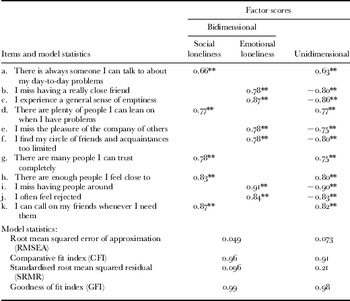
Concerning relationship standards, the respondents were asked to indicate whether they agreed or not with the following items: ‘I find it important to have many friends and acquaintances in my life’, and ‘I find it important to have good, qualitative relationships with others’. The experienced discrepancy in the quantity of the social relationships was measured by the responses to a question whether or not the respondents believed that the number of their good friends was low or high compared to others. Responses were categorised on a five-point Likert scale. To measure social loneliness, the de Jong-Gierveld loneliness scale was used. It enables both uni-dimensional and bi-dimensional measures of loneliness. Confirmatory factor analyses were executed to compare both approaches, and they were found valid and reliable. Consistent with others' findings, the first item of the scale was the weakest (Moorer and Suurmeijer Reference Moorer and Suurmeijer1993). The other items had standardised loadings of at least 0.77 in both the uni- and bi-dimensional measures (Table 1). The social loneliness score was constructed (as stipulated in the manual) by the count of the numbers of items on which the respondents answered ‘no’ or ‘more or less’ (de Jong-Gierveld and van Tilburg Reference de Jong-Gierveld and van Tilburg2006b). The score ranges from ‘0’, indicating no feelings of social loneliness, to ‘5’.
Standardised factor loadings for the bidimensional and unidimensional approach

Significance levels: * p<0.05, ** p<0.01.
Results
Descriptive analysis
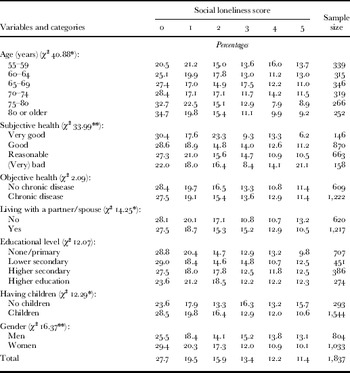
Table 2 presents the distribution of social loneliness scores by the respondents' background characteristics. Overall, 28 per cent reported no feelings of social loneliness, whereas nearly one-quarter suffered severe social loneliness (scores of 4 or 5). The mean score was ‘2’. The reported level of social loneliness differed by age, with the oldest having significantly lower scores than the younger. More than 50 per cent of those aged 75 or more years had a score of less than ‘2’, whereas one-quarter of those aged 55–59 years had scores of ‘4’ or ‘5’. Subjective health positively correlated with social loneliness, but having a chronic disease made no significant difference, and nor was educational level influential. On the other hand, not living with a partner/spouse and having children lowered the risk of social loneliness. On average, women were less socially lonely than men.
Relative distribution of background characteristics and social loneliness

Significance levels: * p<0.05, ** p<0.01.
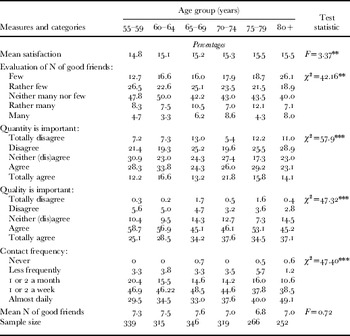
The variations in the actual and preferred social relationships by age are presented in Table 3. Overall the level of satisfaction with social relationships was very high, with the oldest age groups having the greatest satisfaction. Those aged 65 or more years were generally more positive about their number of good friends than the younger age groups but, on the other hand and excepting those aged 70–74 years, they attached less importance to the overall number of social relationships. While the majority believed it important to have good quality relations with others, significant age differences were found, with the older age groups significantly more in agreement with this item. In addition, the oldest age groups more frequently met family, friends or acquaintances not belonging to their household. On the other hand, the mean number of good friends did not differ by age.
Actual and preferred social relationships by age group

Notes: N: number. Neither (dis)agree: neither agree nor disagree.
Significance levels: * p<0.05, ** p<0.01, *** p<0.001.
Multivariate analysis
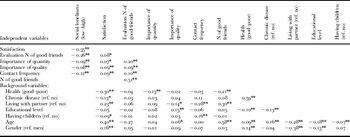
As the aim of the analysis was to test the empirical validity of the conceptual model summarised in Figure 1, path analysis was an appropriate approach (Mueller Reference Mueller1996). Since the variables had different levels of measurement and ordinal variables were used, the weighted least-squares method was applied (Bollen Reference Bollen1989; Byrne Reference Byrne1998).Footnote 1 The results from the path analysis are shown in Table 4. The columns represent the dependent variables in the model, and the rows display the independent variables. The column headed ‘social loneliness’, for example, shows the standard path coefficients that explain the level of social loneliness. In this model, the intermediate effects of the actual and preferred social relationships between the background characteristics, on the one hand, and the level of social loneliness, on the other hand, are tested. Furthermore, the effects of the quantity of the social relationships and the preferred social relationships on the quality of the social relationships are taken into account. Generally, the model has a good fit (root mean squared error of approximation 0.017).
Standardised path coefficients of social relational features and background characteristics on social loneliness and social relational features

Notes: N: number. Neither (dis)agree: neither agree nor disagree. Measures of fit: χ2=12.73, p=0.18; root mean square error of approximation (RMSEA)=0.017; comparative fit index (CFI)=1.00; standardised root mean square residual (SRMR)=0.055; goodness of fit index (GFI)=1.00.
Significance levels: * p<0.05, ** p<0.01.
The figures show that the quantity of the social relationships, the experienced discrepancy in their number, the relationship standards, and the quality of the relationships directly and significantly affected social loneliness (R 2=0.31). With regard to the quality of the relations, the results point to a strong negative association between satisfaction with relationships and social loneliness. The appraisal of the number of good friends relative to others, as an indicator of the experienced discrepancy in the quantity of social relations, had a significant direct effect: a more positive assessment decreased the risk of social loneliness. With regard to the relationship standards, the figures indicate that those who attached great importance to the quantity and quality of social relationships were less inclined to feel socially lonely. Besides these indicators of the cognitive process that precedes the sense of social loneliness, the quantity of relationships had a direct effect, and higher contact frequency with non-household members associated with less social loneliness. Furthermore, there were strong correlations between the indicators of the quantity of social relationships and the relationship standards. A high number of friends significantly correlated with the importance attached to the quantity of social relationships (r=0.23, p<0.01). The same held for contact frequency (r=0.13, p<0.01), which also correlated with the significance of qualitative contacts (r=0.11, p<0.01).
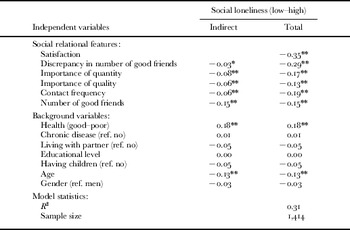
In addition, the path analysis enables the indirect and overall effects to be detected. The upper group of figures in Table 5 shows the indirect and overall effects of the social relationships attributes on social loneliness, while the lower group show the indirect effects of the background variables. The latter equal the overall effects as no direct effects were estimated (Figure 1). All the social relational features had significant indirect effects on social loneliness (Table 5). People who attached much significance to the quality and the quantity of their social relationships were generally more satisfied with their social relationships and evaluated their number of good friends more positively (Table 4). The same held for a high contact frequency with family, friends and neighbours. The number of good friends lowered the risk of social loneliness as it went hand-in-hand with comparatively positive appraisals of the number of good friends (Table 4).Footnote 2
Decomposition of effects of social relational features and background features on social loneliness

Significance levels: * p<0.05, ** p<0.01.
The at-risk groups
To identify the groups most at risk of social loneliness, this section identifies the attributes of social relationships and the background characteristics that associated with the malaise. Only subjective health status and age indirectly affected social loneliness (Table 5). Poor subjective health increased the risk of social loneliness. Those who reported good subjective health were more satisfied with their social relationships and had a high number of good friends (Table 4). People with good subjective health also attached more importance to having a lot of friends and acquaintances. The overall indirect effect of age on social loneliness was a negative relationship: greater age went hand-in-hand with a lower risk of social loneliness (Table 5).Footnote 3 The older respondents attached more importance to the quality of social relationships (Table 4), and reported a higher number of good friends and were more satisfied with their social relationships. On the other hand, the results show that greater age meant poorer subjective health which led to a higher risk of social loneliness (Table 4). The indirect effect of age on social loneliness thus runs in two directions, depending on other background characteristics, but overall was negative (Table 5).
Living with a partner, educational level, having children, a chronic disease and gender had no overall significant indirect effect on social loneliness (Table 5), but did associate with other attributes of the respondents' social relationships (Table 4). People with a chronic disease were generally less satisfied with their social relations. Respondents who lived with their spouse/partner had a lower contact frequency and attached less importance to the quality of social relations, but had a high number of good friends and were more satisfied with their social relationships. A higher educational level associated with more importance being attached to the quality of social relationships and with better health. Respondents with children were generally less satisfied with their social relations, but had more frequent contacts. Women were more satisfied with their social relationships than men, but the overall indirect effects of all these background characteristics on social loneliness was not significant because the opposite effects of the different attributes tended to cancel each other out.
Discussion
The findings have confirmed the validity of both the deficit and the cognitive explanations of the causes of social loneliness. The number of a respondent's social relationships directly affected their sense of social loneliness, independent of the perceived deficiencies and people's preferences, and had indirect effects through the level of satisfaction with social relationships and the appraisal of the number of good friends (House Reference House1987). The latter had strong predictive power: the higher the satisfaction with social relationships and the better the appraisal of the number of good friends, the lower the risk of social loneliness. This confirms the cognitive perspective on social loneliness, i.e. that loneliness is a subjective experience that results from a comparative evaluation of actual and desired social relationships. Moreover, contact frequency, an indicator of the quantity of the social relationships, directly affected social loneliness irrespective of the perceived quality of the relationships, which is in line with the deficit hypothesis that a lack of social contacts directly results in feelings of social loneliness (Weiss Reference Weiss1973).
The findings suggest that the respondents who attached great importance to both the quantity and the quality of social relationships were less inclined to feel socially lonely. Moreover, attaching much importance to the quantity went hand-in-hand with a higher number of good friends and higher contact frequency. The latter also positively correlated with the importance attached to the quality of social relations. These findings on the effect of relationship standards on social loneliness may at first appear counter-intuitive. According to the cognitive approach, expectations would affect social loneliness in the opposite direction to actual relationships, because people with high standards would be more at risk of experiencing a negative discrepancy than people with low standards (Dykstra and Fokkema Reference Dykstra and Fokkema2007). A possible reason for the contradictory finding is that the quantitative and qualitative indicators did not completely capture the variations. As people tend to tune their expectations to their actual situation (van Baarsen and Broese van Groenou Reference van Baarsen and Broese van Groenou2001), the importance attached to the quantity and quality of social contacts can reflect the actual quantity and quality of social contacts. The findings support this explanation because both the number of friends and contact frequency positively correlated with the number of preferred social relations. Loneliness occurred when these expectations did not match reality. An additional explanation for the positive effect of the preferences can be found in the individual's management of feelings of loneliness. Lowering expectations is one way to combat feelings of loneliness (Fokkema and van Tilburg Reference Fokkema and van Tilburg2005). It seems reasonable to assume, therefore, that people with low expectations not only tended to have a lower quantity or quality of social relations, but were also more inclined to feel lonely because they were likely to have lowered their expectations to combat feelings of loneliness. The cross-sectional nature of the dataset does not allow this hypothesis to be tested.
Overall, as Dykstra and Fokkema (Reference Dykstra and Fokkema2007) concluded, both the deficit and cognitive theories contribute to explaining social loneliness. With regard to loneliness interventions, this implies that people who suffer from social loneliness would benefit from an increase in both the quality and the quantity of their social relations, even if they claim to be satisfied with their social relationships (Rook Reference Rook1984). Attention can also be given to the indirect risk factors on social loneliness. We specifically focused on the indirect effect of age on social loneliness through actual and preferred social relations. Health status, living with a partner, having children, educational level and gender were also included in the analyses. A remarkable bivariate finding was that greater age lowered the risk of social loneliness (it was confirmed by the multivariate analyses). This contradicts previous studies of social loneliness, which generally have shown no significant correlation between age and social loneliness (Drageset Reference Drageset2004; Dykstra and Fokkema Reference Dykstra and Fokkema2007; van Tilburg, Havens and de Jong-Gierveld Reference van Tilburg, Havens and de Jong-Gierveld2004), but these studies did not take into account the indirect effect of age through the attributes of social relationships. The path model revealed that this overall effect can be attributed to both actual and preferred social relationships. The oldest-old attached more importance to the quality of contacts, which implies a lower risk of social loneliness, and moreover irrespective of health status, educational level and other background features, they were more satisfied with their social relationships and reported a higher number of good friends. So the oldest-old both had and preferred good quality social contacts.
These results accord with the predictions derived from the theory of socio-emotional selectivity, that with increasing age more importance is attached to the quality of relationships (Carstensen Reference Carstensen1995), as was reflected in both the actual and preferred social relationships of the respondents. On the other hand, age exerted an opposite indirect effect on social loneliness through subjective health. Older people with poor self-assessed health attached less importance to the number of their social contacts, and seemed to adjust their standards (or expectations) to their restricted opportunities to meet people (van Baarsen and Broese van Groenou Reference van Baarsen and Broese van Groenou2001). People with poor subjective health had relatively few good friends and were apt to feel socially lonely. These results are in line with the prediction from activity theory, that physical obstacles restrain people from social interaction (Fung, Carstensen and Lang Reference Fung, Carstensen and Lang2001), and that reduced activity in turn indirectly increases the risk of social loneliness. It is important to note, however, that the degree to which one feels healthy is more important than actual or objective health status. Of course objective health strongly affects subjective health, but it is the latter that exerts a significant indirect effect on social loneliness. The presented findings provide little support for the predictions derived from disengagement theory or the theory of gerotranscendence. The oldest-old did not seem to disengage from society as they did not attach less importance to the quantity of social contacts.
It should be remembered that the data were drawn from the ninth wave of a panel survey, so selective attrition and a bias in the analysis sample towards more socially-engaged respondents may have influenced the results. Research on attrition in the Panel Study of Belgian Households has shown that respondents aged 65 or more years were three times less likely to participate as a result of incapability than younger age groups (De Keulenaer Reference De Keulenaer2007). This problem was countered in the model by controlling for objective and subjective health.
With regard to the other background features, no overall indirect effects on social loneliness were found. The bivariate results showed a lower risk of social loneliness among those not living with a partner or spouse, among those with children and among women. The multivariate analyses did not confirm this finding when the other background characteristics were controlled, although the findings for gender were ambiguous. The bivariate result showed that women were significantly less prone to social loneliness than men, but gender was not significant in the path model. Additional analyses of the direct effects of the background features on social loneliness showed, however, that gender significantly affected social loneliness (beta=−0.09, p<0.01) and indicated a higher level of social loneliness for men.Footnote 4 There are several possible explanations. Differences by gender may stem from relational features that were not included in the model, and the social loneliness scale may have a gender bias – men may be less inclined to agree with items of the social loneliness scale because they believe that they represent ‘typically female aspects of personal relationships’ (Dykstra and Fokkema Reference Dykstra and Fokkema2007: 11; see also van Baarsen and Broese van Groenou Reference van Baarsen and Broese van Groenou2001).
As detailed in the introduction, relatively little research has previously been done on social and emotional loneliness. The presented findings have confirmed the value of such research, however, particularly for detecting the groups of older people most at risk of loneliness (Fokkema and van Tilburg Reference Fokkema and van Tilburg2005; van Baarsen et al. Reference van Baarsen, Smit, Snijders and Knipscheer1999). The findings have shown that to understand the overall risk factors for social loneliness, it is important to disentangle the interactions among the influential factors because several attributes of social relationships that affect social loneliness inter-correlate (de Jong-Gierveld and van Tilburg Reference de Jong-Gierveld and van Tilburg2006a). This study has decomposed the indirect effects of the background characteristics on social loneliness through their effects on social relationships (cf. Victor et al. Reference Victor, Scambler, Bowling and Bond2005). By detecting the underlying mechanisms, it has been possible not only to show that age and subjective health indirectly affected social loneliness, but also to understand in which direction and through which social relational features. Understanding the causal pathways is crucial for establishing the importance of the various background influences and for correct specifications of the risk groups.