Introduction
Suitable ovarian function (OF) is critical for the maintenance of the physiological activities of organisms, particularly the reproductive system (Yu et al., Reference Yu, Zhai, Wang, Geng, Chen, Wen, Tang, Yu, Zhang and Liu2021). Ovarian function depends on various paracrine, autocrine, and endocrine agents. These factors can modulate follicular development and steroidogenesis and influence ovarian cells such as granulosa cells, theca cells, and oocytes (Nikanfar et al., Reference Nikanfar, Oghbaei, Rastgar Rezaei, Zarezadeh, Jafari-Gharabaghlou, Nejabati, Bahrami, Bleisinger, Samadi, Fattahi, Nouri and Dittrich2021). Also, it has been highlighted that the balance of primordial follicle triggering and follicle arrest has a substantial role in the preservation of ovarian performance by which primordial follicle selection from the reserve pool into the pool of growing follicle occurs. This process enables ovulation and oocyte growth (Liu et al., Reference Liu, He, Xu, Xu, Zhao, Luo, Sun, Qi and Wang2021). However, OF is decreased in some conditions such as polycystic ovarian syndrome (PCOS) (Cho et al., Reference Cho, Kim, Seok, Jun, Park, Kweon, Lim and Kim2021), premature ovarian failure (POF) (Zhou et al., Reference Zhou, Song, Liu, Zhang, Li, Hu, Huang, Ma, Song and Zhang2021), and ovarian cancer (OCa) (Rezaei-Tazangi et al., Reference Rezaei-Tazangi, Roghani-Shahraki, Khorsand Ghaffari, Abolhasani Zadeh and Boostan2021). PCOS and POF can be the main causes of infertility (Fan et al., Reference Fan, Cieri-Hutcherson and Hutcherson2021; Shareghi-Oskoue et al., Reference Shareghi-Oskoue, Aghebati-Maleki and Yousefi2021); plus, OCa is considered a main factor responsible for women’s deaths globally. Therefore, finding suitable approaches with high effectiveness and low side effects to elevate OF is an urgent need, and unfortunately, the present therapeutic options have no clear remedy for ovarian function-related disorders (Xu et al., Reference Xu, Fan, Geng, Gao, Yu and Xia2021). Recently, mesenchymal stem cell (MSC)-based therapy, using several sources such as adipose tissue (AD), bone marrow, and umbilical cord, has been proposed as a novel candidate to improve OCa, OF, or treatment of female infertility (Touboul et al., Reference Touboul, Lis, Al Farsi, Raynaud, Warfa, Althawadi, Mery, Mirshahi and Rafii2013; Yoon, Reference Yoon2019; ArefNezhad et al., Reference ArefNezhad, Motedayyen and Mohammadi2021). MSCs can decrease stromal cell and germ cell apoptosis, potentiate folliculogenesis through secretion of some cytokines and growth factors, including insulin-like growth factor-1 (IGF-1), hepatocyte growth factor (HGF), and vascular endothelial growth factor (VEGF), and microenvironment improvement (Fu et al., Reference Fu, He, Xie and Liu2008; Elfayomy et al., Reference Elfayomy, Almasry, El-Tarhouny and Eldomiaty2016). Furthermore, MSCs may suppress fibroblast proliferation and reduce extracellular matrix deposition. These stem cells stimulate neovascularization and enhance blood perfusion of injured ovarian tissues (He et al., Reference He, Chen, Yang, Hou, Ma and Xu2018; Yoon, Reference Yoon2019). Among different sources of MSCs, AD-derived MSCs have noticeable benefits, for example, easy isolation, accessibility, and the capability to differentiate into different cell lines (ArefNezhad et al., Reference ArefNezhad, Motedayyen and Mohammadi2021). Conversely, it has been stated that MSC-conditioned medium (CM) can have therapeutic effects on ovarian damage (He et al., Reference He, Chen, Yang, Hou, Ma and Xu2018; Gunawardena et al., Reference Gunawardena, Rahman, Abdullah and Abu Kasim2019). MSC-CM, as a source of diverse growth factors, promotes the recovery of damaged tissues and its main advantage is immunocompatibility for the recipient patients (Javanmard et al., Reference Javanmard, Karimipour and Pasdar2018). Therefore, in this mini-review, the current efforts regarding the possible curative influences of MSCs and CM derived from AD on ovarian functions and related disorders will be summarized.
Mesenchymal stem cells derived from human adipose tissue and their conditioned medium: Useful tools for improving ovarian function?
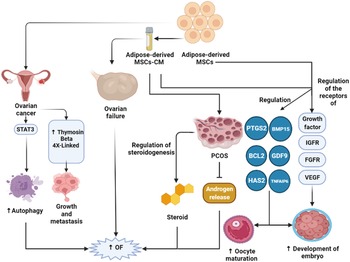
Adipose-originated stem cells improve chemotherapy-induced ovarian malfunction in animal models; also, they induce angiogenesis and restore the corpus luteum and ovarian follicle number in damaged ovaries (Zhao et al., Reference Zhao, Chen, Su, Huang, Shi, Shi and Lin2019). Human omental adipose-derived MSCs can increase autophagy in OCa through the STAT3 signalling pathway (Chu et al., Reference Chu, Wang, Li, Liu, Zhang, Li, Hu, Liu, Zhou, Zuo and Peng2020). However, some reports have addressed the protumour impacts of these MSCs (Zhang et al., Reference Zhang, Torres-Rojas, Yue and Zhu2021). It has been reported that adipose-derived MSCs increase the growth and metastasis of OCa by increasing the expression of Thymosin Beta 4X-Linked (Chu et al., Reference Chu, You, Zhang, Gao, Han, Luo, Liu, Zuo and Wang2019). In addition, one study implicated an increase in OCa progression through the administration of human omental adipose-derived MSC-CM as a result of the proteomic changes of cancer cells (Zhang et al., Reference Zhang, Dong, Wang, Cai and Wang2017). In another work, Takehara and colleagues revealed the positive effects of AD-derived MSCs and their CM on cyclophosphamide-induced ovarian failure. They also observed no serious side effects and no tumour formation in animal models of POF (Takehara et al., Reference Takehara, Yabuuchi, Ezoe, Kuroda, Yamadera, Sano, Murata, Aida, Nakama, Aono, Aoyama, Kato and Kato2013). Based on the work of Chugh and colleagues, MSC-CM suppresses androgen release and regulates steroidogenesis in a cellular model of PCOS (Chugh et al., Reference Chugh, Park, Esfandyari, Elsharoud, Ulin and Al-Hendy2021). Human adipose-derived MSCs and their CM can also promote embryo development and oocyte maturation through the regulation of the receptors of growth factors IGFR, FGFR, and VEGF, and the genes associated with oocyte maturation, cumulus expansion, and apoptosis, such as BMP15, GDF9, TNFAIP6, HAS2, PTGS2, and BCL2, in animal studies (Figure 1; Lee, Reference Lee2021). The enhancement of OF is related to the increase in oocyte numbers, higher oocyte quality, and an increase in Bmp15 and Gdf 9 levels (Yin et al., Reference Yin, Chang, Li and Leung2021). Therefore, it seems that AD-derived MSCs and their CM can be effective in boosting OF in some conditions such as PCOS and POF; however, regarding ovarian cancer, more investigations are required to demonstrate their exact effects.
Adipose tissue-derived mesenchymal stem cells (MSCs) and their conditioned medium (CM): their potential for ovarian functions and some ovarian diseases such as ovarian cancer, polycystic ovarian syndrome (PCOS), and premature ovarian failure (POF).

Conclusion
Ovarian function, which is affected by paracrine, autocrine, and endocrine factors, has a substantial role in reproductive system stability. Defects in OF can influence the fertility and life span of women by causing some diseases such as POF, PCOS, and OCa. At this time, an effective therapeutic tool against these disorders has not been suggested. Recently, some studies have investigated the effectiveness of AD-derived MSCs and their CM against these illnesses. It seems that AD-derived MSCs and their CM can potentiate angiogenesis, folliculogenesis, and corpus luteum recovery, regulate steroidogenesis, and inhibit androgen secretion probably through the secretion of various cytokines and growth factors, and therefore may be effective in OF-associated conditions such as POF and PCOS. These sources can also increase embryo development and oocyte maturation through mechanisms such as regulating growth factor receptors, e.g. IGFR, FGFR, and VEGF, oocyte maturation-related genes, cumulus expansion genes, and apoptosis-associated genes, e.g. BMP15, GDF9, TNFAIP6, HAS2, PTGS2, and BCL2. Therefore, they may be therapeutic candidates for infertility in women. However, more research is needed to show their capacity to remedy disorders related to OF, particularly OCa. Regarding OCa, there is conflicting evidence. Some papers have highlighted the negative effects of AD-derived MSCs and their CM on OCa treatment through the proteomic changes of OCa cells and increment of Thymosin Beta 4X-Linked expression. In contrast, some reports have indicated the positive impact of these mesenchymal sources on disease improvement by involving the STAT3 signalling pathway.
Data availability
All data searched in this study are included in this publication.
Acknowledgements
This work was performed in a personal capacity. The figure was created using the web-based software BioRender.
Financial support
This research received no specific grant from any funding agency, commercial or not-for-profit sectors.
Conflict of interest
The authors declare that they have no competing interests.
Ethical standards
This is a mini-review article that examines past studies and the references used in the text.
Consent for publication
Not applicable.