Introduction
An important question within the language sciences is how production, comprehension, learning, and memory of language can be modulated by extra-linguistic factors such as emotion. The relationship between first language (L1) processing and emotion has been a focus of psycholinguistics for the past decade (Altarriba & Bauer, Reference Altarriba and Bauer2004; Bayer, Sommer & Schacht, Reference Bayer, Sommer and Schacht2011; Briesemeister, Kuchinke & Jacobs, Reference Briesemeister, Kuchinke and Jacobs2011; Citron, Weekes & Ferstl, Reference Citron, Weekes and Ferstl2013; Kousta, Vinson & Vigliocco, Reference Kousta, Vinson and Vigliocco2009; Kuperman, Estes, Brysbaert & Warriner, Reference Kuperman, Estes, Brysbaert and Warriner2014; Long & Titone, Reference Long and Titone2007; Mackay, Shafto, Taylor, Marian, Abrams & Dyer, Reference Mackay, Shafto, Taylor, Marian, Abrams and Dyer2004; Recio, Conrad, Hansen & Jacobs, Reference Recio, Conrad, Hansen and Jacobs2014; Scott, O'Donnell, Leuthold & Sereno, Reference Scott, O'Donnell, Leuthold and Sereno2009; Sheikh & Titone, Reference Sheikh and Titone2013; Vinson, Ponari & Vigliocco, Reference Vinson, Ponari and Vigliocco2014). An equally intriguing question, which forms the topic of this paper, is whether word emotionality encountered in one's first language (L1) has a different impact on cognitive and linguistic processing compared to one's second language (L2), and if so, why. Here, the literature is somewhat less developed, though an emerging consensus is that emotional word processing is less intense for L2 compared to L1 language (reviewed in Itzhak, Vingron, Baum & Titone, Reference Itzhak, Vingron, Baum and Titone2017).
Despite the emerging consensus about L1 and L2 word emotionality effects, many questions remain unanswered, given that the findings across studies do not always perfectly cohere with each other and the consensus view. Thus, in this paper, we have two interrelated goals with respect to advancing our understanding of how word emotionality impacts L1 and L2 processing. Our first goal is to amass a large corpus of L2 readers’ emotionality judgements of English words similar to our past work for L1 emotional words (Warriner, Kuperman & Brysbaert, Reference Warriner, Kuperman and Brysbaert2013). Our second goal is to analyze these ratings to evaluate different mechanisms of when and why L2 readers show reduced emotionality effects in word processing compared to L1 readers. Here we focus specifically on the impact of bilinguals’ behavioural ecology with respect to L1 and L2 emotional word use. In building to these goals, we first selectively review what is known about L1 and L2 emotion processing and different theoretical accounts of these effects.
Turning first to L1 language processing, the available literature generally suggests that the magnitude and direction of L1 (or monolingual) emotionality effects on word processing depends on several factors. One factor is the nature of the task. For instance, in tasks where word emotionality is irrelevant (e.g., emotional Stroop tasks where word meanings interfere with colour naming task), emotionality is distracting and results in slower processing (e.g., Eilola, Havelka & Sharma, Reference Eilola, Havelka and Sharma2007; Sutton, Altarriba, Gianico & Basnight-Brown, Reference Sutton, Altarriba, Gianico and Basnight-Brown2007). However, in tasks where word emotionality is relevant (e.g., lexical decision responses, natural reading for comprehension), word emotionality is thought to be facilitative. Tasks can also differ in terms of whether they focus attention on word meaning, and thus emotionality, in an implicit or explicit manner (e.g., Long & Titone, Reference Long and Titone2007, who used both an implicit lexical decision task and explicit emotion judgement tasks for the same words and participants).
Another source of conflict across L1 studies pertains to effects of a word's emotional valence (i.e., whether it is positive or negative), whether a word refers to an emotionally laden concept (e.g., the word “death”) or an emotional label directly (e.g., the word “happy”). Many studies obtain consistent advantages in word recognition speed for both positively and negatively valenced words (Kousta et al., Reference Kousta, Vinson and Vigliocco2009; Kuchinke, Võ, Hofmann & Jacobs, Reference Kuchinke, Võ, Hofmann and Jacobs2007; Méndez-Bértolo, Pozo & Hinojosa, Reference Méndez-Bértolo, Pozo and Hinojosa2011; Scott et al., Reference Scott, O'Donnell, Leuthold and Sereno2009; Scott, O'Donnell & Sereno, Reference Scott, O'Donnell and Sereno2012), whereas others find that only positivity generates a processing boost (Kuperman et al., Reference Kuperman, Estes, Brysbaert and Warriner2014; Vinson et al., Reference Vinson, Ponari and Vigliocco2014). Finally, all these effects can interact with other linguistic factors, such as word abstractness, concreteness, or familiarity (e.g., Sheikh & Titone, Reference Sheikh and Titone2015).
Turning to the L2 literature, a general consensus has also emerged that when a bilingual person hears or reads emotionally charged words, such as “death,” in their L2, they are less affected in terms of language processing compared to when the same person hears or reads the translation equivalent of this word in their L1, French, (i.e., “mort”), despite the person's high familiarity with the word and concept across both languages (reviewed in Itzhak et al., Reference Itzhak, Vingron, Baum and Titone2017). That is, L2 readers are more likely to neutralize emotionally charged words compared to L1 readers. For example, a classic study examining reprimands and taboo phrases showed that L2 (English) phrases elicited smaller skin conductance responses (SCRs) than L1 (Turkish) phrases (Harris, Ayçiçeǧi & Gleason, Reference Harris, Ayçiçeǧi and Gleason2003). Interestingly, emotional word neutralization can potentially scale up to more global aspects of subjective experience, reflected by reports that even highly proficient bilinguals report feeling more emotional and natural in their first language than their second language, regardless of their L2 proficiency (Dewaele & Nakano, Reference Dewaele and Nakano2013; Santiago-Rivera & Altarriba, Reference Santiago-Rivera and Altarriba2002).
Similar to L1 studies, however, work on L2 emotional word neutralization often suggests a variable pattern, which again likely arises from differences across studies in task demands, the other ways in which words can differ, and, of great relevance here, differences in bilingual language experience among the people tested (Anooshian & Hertel, Reference Anooshian and Hertel1994; Ayçiçeǧi-Dinn & Caldwell-Harris, Reference Ayçiçeǧi-Dinn and Caldwell-Harris2009; Brase & Mani, Reference Brase and Mani2017; Caldwell-Harris, Reference Caldwell-Harris2015; De Grauwe, Willems, Rueschemeyer, Lemhöfer & Schriefers, Reference De Grauwe, Willems, Rueschemeyer, Lemhöfer and Schriefers2014; Foroni, Reference Foroni2015; Ponari, Rodriguez-Cuadrado, Vinson, Fox, Costa & Vigliocco, Reference Ponari, Rodriguez-Cuadrado, Vinson, Fox, Costa and Vigliocco2014). To give an example of this variability, in a memory task where emotional words typically experience an advantage, Ferré, García, Fraga, Sánchez-Casas and Molero (Reference Ferré, García, Fraga, Sánchez-Casas and Molero2010) did not find a difference in the number of emotional words recalled in L1 or L2 of early Spanish–Catalan (and Catalan–Spanish) bilinguals and late Spanish–English bilinguals. This lack of a difference between L1 and L2 recall suggests intact emotional processing regardless of when the experiencer learned the language (for similar results in Turkish–English bilinguals, see Ayçiçeǧi-Dinn & Caldwell-Harris, Reference Ayçiçeǧi-Dinn and Caldwell-Harris2009). Similarly, Harris (Reference Harris2004) found that early bilinguals (who used English, their L2 language, dominantly) showed no difference in SCRs between English and Spanish, despite other studies finding increased SCRs in a participant's native language (Harris et al., Reference Harris, Ayçiçeǧi and Gleason2003). Other studies show mixed findings depending on the particular measure, or in combination with other linguistic factors. For example, Caldwell-Harris, Tong, Lung, and Poo (Reference Caldwell-Harris, Tong, Lung and Poo2011) found that Chinese–English bilinguals rated Chinese (L1) phrases as more emotional than English (L2) phrases, but found similar skin conductance responses to emotional words in both languages. With respect to the impact of other variables, Sheikh and Titone (Reference Sheikh and Titone2015) found that emotional word processing was comparable during L1 and L2 reading for positive words (both showed positive word facilitation in combination with other factors such as abstractness and frequency): however, only L1 readers showed negative word facilitation in combination with such factors. Thus, L2 readers were more likely to neutralize negative but not positive words compared to L1 readers.
Some of the differences across L2 studies most certainly arise from the fact that different papers include bilingual samples that vary in L2 background and ability. Accordingly, studies directly examining individual differences in bilingual experience have led to the conclusion that L2 emotional word neutralization is most profound when L2 experience is low (and, conversely, the lack of an L1 and L2 difference when L2 experience is high). For example, Degner, Doycheva, and Wentura (Reference Degner, Doycheva and Wentura2012) found that only sequential German–French bilinguals with high levels of L2 immersion experienced affective priming in their L2 compared to individuals with lower levels of L2 immersion. Similarly, Ponari et al. (Reference Ponari, Rodriguez-Cuadrado, Vinson, Fox, Costa and Vigliocco2014) found that highly proficient L2 speakers of English showed similar emotional facilitation in a lexical decision task as L1 speakers. In an emotional Stroop task, Spanish–English bilinguals (who were likely reverse dominant) experienced interference in both languages, with the effect being larger in their second (but more dominant) language, English (Sutton et al., Reference Sutton, Altarriba, Gianico and Basnight-Brown2007). A similar finding was shown in Eilola et al. (Reference Eilola, Havelka and Sharma2007). As well, there may also be differences across emotional words: for example, Kazanas and Altarriba (Reference Kazanas and Altarriba2016) found processing differences between emotion (e.g., happiness) and emotion-laden (e.g., vacation) words in one's dominant language, but not necessarily in their first language. Thus, while there is a general consensus that responses to emotional words in L2 are weaker than to those in L1, there are many factors that modulate or even cancel these effects: such as the nature of the task; other ways in which words can differ; and, crucially, individual differences in L2 experience with emotional words and the context in which they are learned.
We now turn our attention toward theoretical accounts of why L2 language processing may be less affected by emotionality than L1 language processing, in an attempt to get a better handle on the overall empirical record. Two general classes of theories offer important insights. One class emphasizes lexical-representational differences across the L1 and L2 for emotional vs. neutral words, and another emphasizes the experiential or embodied contextual differences across the L1 and L2 in which emotional vs. neutral words are encountered. Critically, these theories are not mutually exclusive and may, in fact, operate simultaneously to greater or lesser degrees.
The first class of theory is exemplified by Perfetti's (Reference Perfetti2007) Lexical Quality Hypothesis, which posits that one's level of language proficiency and word knowledge can impact natural reading. Within this view, differences between L1 and L2 readers emerge when L2 speakers do not know some words, and so they may functionally treat these words as less emotional. This generates a prediction that less frequent words should result in a larger neutralization of emotional responses for L2 speakers of English, because less frequent words are less likely to be encountered by an L2 speaker. Additionally, less proficient L2 speakers of English should also demonstrate greater emotional neutralization than more proficient L2 speakers of English. This prediction finds support in some studies showing that more proficient L2 speakers behaved like L1 speakers in emotional Stroop tasks (Eilola et al., Reference Eilola, Havelka and Sharma2007; Sutton et al., Reference Sutton, Altarriba, Gianico and Basnight-Brown2007). However, it conflicts with Degner et al. (Reference Degner, Doycheva and Wentura2012) and Segalowitz, Trofimovich, Gatbonton and Sokolovskaya (Reference Segalowitz, Trofimovich, Gatbonton and Sokolovskaya2008), who did not find any interaction between L2 neutralization and proficiency.
The second class of theory, exemplified by Barsalou's (Reference Barsalou1999) Embodied Theoretical Approach to Language, Dual Coding Theory (Clark & Paivio, Reference Clark and Paivio1991) and other work (e.g., Kousta, Vigliocco, Vinson, Andrews & Del Campo, Reference Kousta, Vigliocco, Vinson, Andrews and Del Campo2011; Sheikh & Titone, Reference Sheikh and Titone2015) suggests that learning the emotional connotation of a word is not only based on learning its definition (i.e., denotation), but also on use of those words in real-life environments, which includes its affective and sensorimotor aspects. Accordingly, for L2 readers to fully acquire the emotional connotations of foreign-language words, they would need to be exposed to the ecologically valid, affective and sensorimotor experiences that normally come with that word. Thus, simply knowing the denotation of a word (say, through book reading or classroom education) is not sufficient.
The link between the embodied experience with a word and its meaning acquisition is made explicit in Dual Coding Theory (Clark & Paivio, Reference Clark and Paivio1991), among others. Dual Coding Theory proposes that abstract concepts are only stored as verbal representations, but concrete concepts are stored as both verbal and image-based representations. Thus, concrete words are more readily available than abstract words because they are represented by two systems, whereas abstract words are only represented by one. This theory suggests that L2 speakers of a language should have intact emotion processing for concrete words (which they have experienced and have two levels of representation) but not abstract words. However, Kousta et al. (Reference Kousta, Vigliocco, Vinson, Andrews and Del Campo2011) propose that Dual Coding Theory cannot fully account for the processing of abstract concepts. They state that abstract concepts are often more emotional than concrete concepts and that emotion plays a role in how abstract words are processed. They suggest that sensorimotor information is most important for the representation of concrete words, whereas affective information is most important for abstract words (see also Sheikh & Titone, Reference Sheikh and Titone2015).
In another kind of embodied view, Harris, Gleason, and Ayçiçeǧi (Reference Harris, Gleason and Ayçiçeǧi2006) argue that the learning context in which a word is acquired has a strong effect on how emotional that word is to the experiencer. They proposed the Emotional Contexts of Learning Theory, which theorizes that it is not the order of language learning that matters for emotional processing, but rather how emotional the learning context is. For example, for most bilinguals, the L1 is more emotional because it is learned in an emotional environment (such as with family). On the other hand, an L2 can have variable levels of emotionality in its learning context. Some bilinguals may learn their second language in an equally emotional environment to their L1, while others may learn an L2 a less emotional (or personal) environment such as school or work. Such differences should impact the ways in which word emotionality impacts processing for L1 and L2 readers.
Taken together, the family of embodied accounts predicts that the environment in which a word is learned should affect the valence rating of that word for L2 readers. Crucially, we can methodologically proxy this environment by using the semantic category of a word, as will be seen below (e.g., “homework” as a work-related word vs. “butt” as a swear word; see, Pennebaker, Booth & Francis, Reference Pennebaker, Booth and Francis2007). Accordingly, if a word falls into a semantic category that aligns with how L2 readers typically use English (e.g., at school or work, but potentially not at home with their family and friends), then the word will have as much emotionality as it would for L1 readers. In contrast, if a word falls into a semantic category that does not align with how L2 readers typically use English, it will have less emotional impact on L2 readers, even if they know the word denotatively to the same degree. Thus, how an L2 speaker learned English should interact with how native-like is their L2 experience of emotion. Specifically, after controlling for proficiency, L2 speakers who have lived in an English-speaking country for more years should have more native-like English emotion than those who recently moved to an English-speaking country.
The present study
As noted at the beginning of this paper, our overarching goal is to fill a gap in the literature arising from the variety of mixed results and theoretical predictions. We aim to accomplish this overarching goal in two interdependent ways that involved a large-scale data collection of affective ratings to English words from L2 readers of English, combined with novel sophisticated analyses of these data. Of note, the present study is not the first to compare L1 and L2 affective ratings. Velez-Uribe and Rosselli (Reference Velez-Uribe and Rosselli2019) collected affective ratings in English and Spanish from 101 Spanish–English bilinguals for 120 words, consisting of 40 positive, 40 negative, and 40 taboo/swear words. They found that these bilinguals rated positive and negative words as more emotional in their second language (English), but rated taboo/swear words as more emotional in their first language (Spanish). Winskel (Reference Winskel2013) collected affective ratings to Thai and English words from 57 Thai–English bilinguals. These participants rated the valence of 20 neutral and 20 negative words (comprised of negative emotion and negative emotional words), and language had no effect on the bilinguals’ valence rating of the word. Both of these studies have small sample sizes and a relatively homogeneous linguistic makeup, but provide an interesting insight into the difference in explicit affective ratings between a bilingual's L1 and L2.
To overcome limitations in the empirical record described above, the present study uses a large stimulus list to tease apart which linguistic factors affect the emotional processing of a word in L2, using more participants than any other study mentioned, to understand which individual difference variables affect how a speaker processes emotion – given the constraint that all participants are undergraduate students with similar age and educational backgrounds. Crucially, we explicitly ask participants to rate the emotion of a word, rather than having them interact with emotional words in an unrelated task, to pinpoint the emotional differences between words. Thus, we specifically examine the emotional connotation of English words by directly asking participants to rate the valence and arousal of each word on a 9-point ratings scale (see Warriner et al., Reference Warriner, Kuperman and Brysbaert2013). Consequently, we will assess the degree to which L2 readers neutralize emotional words based on their explicit ratings. While large datasets exist for L1 affective norms in a variety of languages (Bonin, Aubert, Malardier & Niedenthal, Reference Bonin, Aubert, Malardier and Niedenthal2016; Soares, Comesaña, Pinheiro, Simões & Frade, Reference Soares, Comesaña, Pinheiro, Simões and Frade2012; Stadthagen-Gonzalez, Imbault, Pérez Sánchez & Brysbaert, Reference Stadthagen-Gonzalez, Imbault, Pérez Sánchez and Brysbaert2017; Warriner et al., Reference Warriner, Kuperman and Brysbaert2013, among many others), the data amassed in this study is the largest set of valence and arousal ratings given by L2 speakers of English.
Method
Participants
Valence
420 undergraduate students, enrolled in linguistic courses at McMaster University, participated in the collection of valence norms for course credit. Of these, 14 participants identified their first language as English and were excluded from further analyses. We removed an additional 9 participants who provided “I don't know this word” responses to more than 50% of stimuli, as well as 137 participants who provided the same numeric response to 50% or more of stimuli.
Among the remaining 260 participants, 203 participants were female and 234 were right-handers (5 participants did not provide handedness information). The mean age of participants was 20.13 (sd = 3.67), and 94% of participants were between the ages of 18 and 24. The distribution of native languages (L1s) in the cohort was as follows: 99 (38%) participants reported Mandarin, Cantonese or an unspecified Chinese dialect as their L1; 25 (10%) reported Arabic; 20 (8%) Urdu; 19 (7%) Korean, and the remaining participants reported other single or multiple L1s.
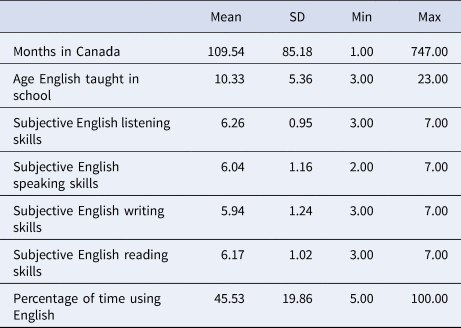
See Table 1 in the Appendix for further demographic variables relating to participants who rated word valence.
Descriptive statistics of participants’ English proficiency, including self-reported months spent in Canada, age English began in school, subjective English skills (1-low, 7-high), and percentage of time spent using English

Arousal
644 undergraduate students, enrolled in linguistic courses at McMaster University, participated in the collection of arousal norms for course credit. Of these, 24 participants identified their first language as English and were excluded from further analyses. We removed an additional 134 participants who provided “I don't know” responses to more than 50% of stimuli, as well as 195 participants who provided the same numeric response to 50% or more of stimuli.
Among the remaining 291 participants, 216 participants were female and 258 were right-handers (7 participants did not provide handedness information). The mean age of participants was 20.25 (sd = 3.6), and 92% of participants were between the ages of 18 and 24. The distribution of native languages (L1s) in the cohort was as follows: 129 (44%) participants reported Mandarin, Cantonese or an unspecified Chinese dialect as their L1; 26 (9%) reported Arabic; 17 (6%) Urdu; 18 (6%) Korean, and the remaining participants reported other single or multiple L1s.
Materials and design
The words included in our stimulus set were selected from the set of about 14,000 English words which Warriner, Kuperman, and Brysbaert (Reference Warriner, Kuperman and Brysbaert2013) made available, of affective norms collected amongst L1 speakers. In this study, valence ratings were collected for 2688 (2692 for arousal) unique words on a 9-point scale (for a definition of the scale, see below). The stimuli for the present study were distributed over 8 lists (one per semester) containing between 325 to 360 words each. The words were presented in a random order and were randomly selected from Warriner et al.'s ratings to uniformly represent the range of valence or arousal. Specifically, we binned all words in Warriner et al. into 25 bins (5 bins of valence by 5 bins of arousal) and randomly drew 13 words from each bin without replacement, totalling approximately 325 words per session. Some bins depleted in subsequent lists. Once a bin was depleted, we randomly drew 15 words from each of the remaining bins without replacement. Six out of eight lists started with the same set of 10 anchor words which represented extremes and mid-points of valence and arousal and were used to situate a rater within each scale: the benefits of using anchor words are discussed in Warriner et al. (Reference Warriner, Kuperman and Brysbaert2013) and Warriner, Shore, Schmidt, Imbault, and Kuperman (Reference Warriner, Shore, Schmidt, Imbault and Kuperman2017). These 10 words were the only ones shared between the six lists. Due to a programmatic error, two lists did not begin with anchor words and so they shared no words with any other list.
Procedure
Participants were recruited via the departmental online subject pool over 8 semesters from 2012–2017. Since a different (single) stimulus list was offered in each semester, participants were allowed to complete more than one experimental list in different semesters, and some participants completed the task for both valence and arousal. In the first two semesters, each word was simultaneously rated both for valence and arousal; in following sessions, words were separately rated for valence and arousal. The instructions to all stimuli lists were as follows, with wording for arousal in square brackets:
You are going to be asked to rate how happy [excited] or sad [calm] a series of words make you feel. There will be approximately 360 words. The scale ranges from 1 (happy [excited]) to 9 (unhappy [calm]). At one extreme of this scale, you are happy, pleased, satisfied, contented, hopeful [stimulated, excited, frenzied, jittery, wide-awake, or aroused]. When you feel completely happy [aroused] you should indicate this by choosing rating 1. The other end of this scale is when you feel completely unhappy, annoyed, unsatisfied, melancholic, despaired, or bored [relaxed, calm, sluggish, dull, sleepy, or unaroused]. You can indicate feeling completely unhappy [calm] by selecting 9. The numbers also allow you to describe intermediate feelings of pleasure [calmness/arousal], by selecting any of the other feelings. If you feel completely neutral, neither happy nor sad [not excited nor at all calm], select the middle of the scale [rating 5]. If you do not know a word well enough to rate it, please check the button for “Unknown Word”.
Anchoring happy and calm responses at the low end of the scale (1) instead of the upper end (9) were done for comparability with the scales used in prior large data collections of affective ratings (Bradley & Lang, Reference Bradley and Lang1999; Warriner et al., Reference Warriner, Kuperman and Brysbaert2013). Prior to completing valence or arousal ratings, participants were asked to supply basic demographic information (age, gender, handedness). They also completed an extensive bilingualism questionnaire (LEAP-Q), which queried one's language education and immigration background, one's proficiency in their first language, English and other non-native languages. They also indicated the situations and environments of each language use (Marian, Blumenfeld & Kaushanskaya, Reference Marian, Blumenfeld and Kaushanskaya2007). Completion of the entire task did not exceed 45 minutes.
Results and discussion
Data trimming
A total of 91658 valence (104058 for arousal) ratings were collected; the number was reduced to 88224 (97315 for arousal) after we removed ratings that were outside the 1–9 scale (including the 3125 responses signifying an unknown word; 3364 for arousal). We further removed all words that received 12 or fewer ratings (15.03% of valence ratings, 0% of arousal ratings). We reversed the valence [arousal] scale from the one presented to participants; 1 represents unhappy [calm] and 9 represents happy [excited] for more intuitive interpretation.
The resulting pool contained 83590 valence (93451 arousal) ratings to 2284 English words submitted by 260 (289 for arousal) L2 speakers of English. Experimental sessions varied in the number of recruited participants. Each word that was not in the set of anchor words received between 13 and 87 valence ratings with a median of 27, and a mean of 35.6 (SD = 23.9). This variability in the number of ratings for each word is due to our L2 speakers’ knowledge of English. Participants were able to click “I don't know this word” if an unfamiliar word appeared during the experiment. This leads to many words, specifically low frequency words, to having far fewer ratings than higher frequency words. In addition, the 10 anchor words that were reused in multiple lists received many more ratings: range 101–198, median 174 and mean 159.6 (SD = 32.9). It is possible that anchor words received more than one rating from a given person over multiple semesters: for privacy reasons, we cannot explore this possibility further. We include all words in further analyses. We provide a spreadsheet reporting each word, its average valence and arousal rating, the standard deviation of both ratings, and the number of ratings per word (outlined in the Availability section). We further supplement this information by the average, standard deviation and number of valence and arousal ratings given to those words by all L1 speakers of English in Warriner et al.'s (Reference Warriner, Kuperman and Brysbaert2013) study, as well as by the subgroup of younger (less than 30) participants in that study: this subgroup is age-compatible with the present cohort. Finally, we supply the word's frequency of occurrence in the 51-million token corpus of subtitles to English films and media (Brysbaert & New, Reference Brysbaert and New2009).
We estimated the split-half reliability of L2 valence ratings using a bootstrapping procedure. At each of 1000 iterations, we randomly selected two sets of 6 ratings to each word without replacement (half of the minimum number of ratings to a word: 13) and calculated the mean rating in each group. This provided us with two sets of 2627 mean ratings: the correlation coefficient between every two sets is a point-wise estimate of split-half reliability, and the distribution of coefficients over 1000 iterations enabled an estimation of the confidence interval. L2 valence ratings showed a relatively high split-half reliability: the average correlation was r = 0.73 [CI 95% 0.72–0.75]. This reliability was lower than one reported in Warriner et al. (Reference Warriner, Kuperman and Brysbaert2013), r = 0.91. This is likely to lead to greater heterogeneity in the level of English proficiency, as well as linguistic, cultural and social backgrounds amongst the current study's L2 raters, compared to the L1 English speakers from the US that were recruited in Warriner et al. (Reference Warriner, Kuperman and Brysbaert2013).
We performed the split-half reliability of L2 arousal ratings using the same method as described above. L2 arousal ratings showed a weak split-half reliability: the average correlation was r = 0.35 [CI 95% 0.32–0.38]. In line with Warriner et al. (Reference Warriner, Kuperman and Brysbaert2013), split-half reliability of arousal ratings is substantially lower than the reliability of valence ratings (r = 0.689 in Warriner et al. Reference Warriner, Kuperman and Brysbaert2013). Due to the low reliability of the arousal ratings, we will not report any analyses henceforth. The norms, however, are reported in the Supplementary Materials (Supplementary Materials).
Comparison of first and second language ratings
We first conduct comparisons of overall distributions of valence ratings given to 2627 English words by L2 and L1 speakers of English, as documented in the present study and in Warriner et al. (Reference Warriner, Kuperman and Brysbaert2013), respectively. We then consider valence ratings of both groups to specific semantic categories that are hypothesized to bring forward differences in the behavioural ecology of L1 and L2 speakers of a language: e.g., work-related versus swear words. Finally, we consider the moderating influence of one's L1, one's proficiency in L1 and L2, and other pertinent factors. Given the age distribution of the L2 participants, we chose to compare their judgments to those of the young (under 30) subset of L1 raters from Warriner et al.'s (Reference Warriner, Kuperman and Brysbaert2013) data set: in what follows, all references to L1 ratings relate to this subset. We note that comparisons with ratings based on the entire L1 population in Warriner et al. yielded nearly identical results.
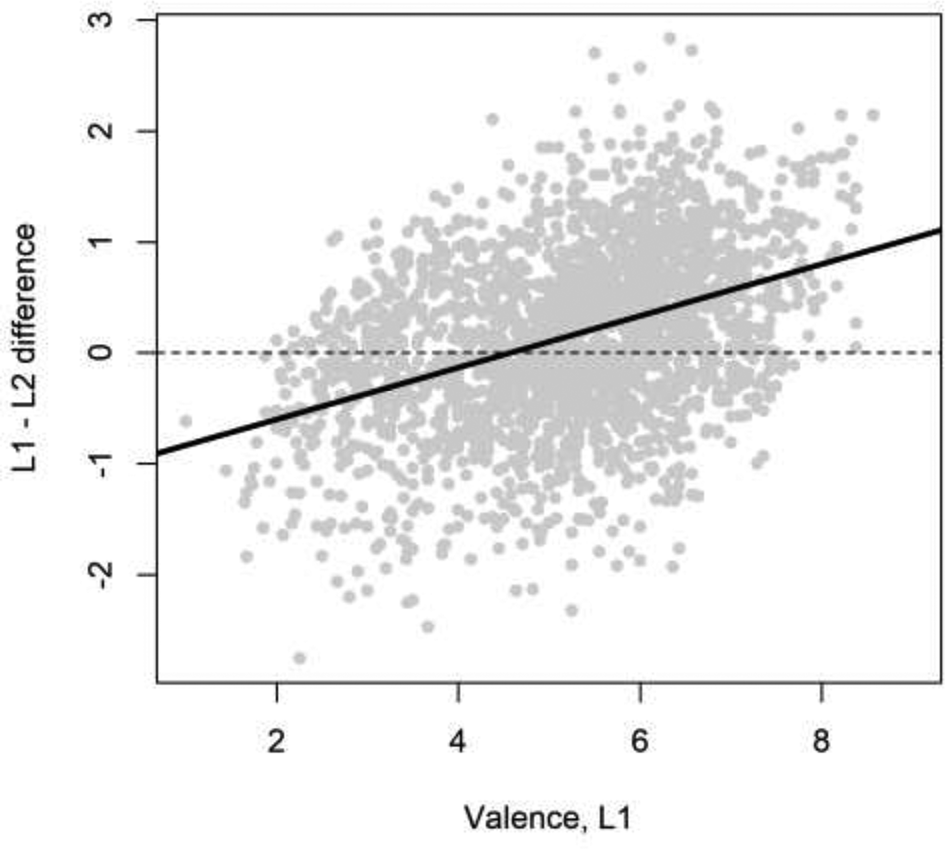
To zoom in on differences in valence judgments, we calculated the difference between the mean L1 and L2 valence ratings (L1–L2). A negative difference signifies a word that received a more positive response from L2 speakers of English; a positive difference means that the L1 valence rating was more positive (higher) than the L2 rating. Figure 1 plots the difference score against L1 valence ratings. The dotted line in this figure marks the hypothetical position of identical ratings from L1 and L2 speakers of English. The best-fit regression line demonstrated a linear effect of L1 valence on difference scores (y = −1.06 + 0.23x, R2 = 16%). Most words in the middle of the valence range are close to this equality line, yet, the further a word is from being neutral, the more L2 valence ratings deviate from L1 ratings. L2 responses were consistently more moderate than L1 responses at the ends of the scale (less positive for positive words and less negative for negative ones). The more extreme the L1 judgments were, the more attenuated the L2 response was. Thus, for words with L1 ratings below 2 (very negative) or above 8 (very positive) on a 9-point scale, L2 speakers provided judgments that were about 1 point higher (for negative) or 1 point lower (for positive) respectively. Apparent exceptions to this pattern are words at the very extremes of the valence distribution: the most negative words in our stimulus list (e.g., betrayal, bankrupt, L1 valence 1.00 and 1.44) and the most positive ones (e.g., happy, relaxing, L1 valence 8.38 and 8.38) elicited L2 valence judgments that were closer to L1 valence judgments than words slightly further from the extremes. The correlation between L1 valence judgements and the L1-L2 difference was 0.40, df = 2282, p < 0.001.
Scatterplot of the difference between L1 and L2 valence ratings plotted against L1 ratings, with a lowess trend line (solid).

L2 Proficiency and word frequency as moderators of emotionality
A straightforward prediction for the proficiency-driven discrepancy in L1 and L2 emotionality is that the discrepancy would be stronger in lower-frequency words and/or in bilinguals with a lower level of L2 proficiency. We tested this hypothesis by examining how the difference between L1 and L2 ratings of valence is influenced by a word's frequency of occurrence in language and estimates of English proficiency of the current study's raters.
From the pool of valid responses to 2008 words, we selected 73576 ratings given by 223 participants who specified all aspects of their English proficiency in our bilingualism questionnaire. We selected the participant's subjective estimate of English reading mastery as an index of their English proficiency. We fitted a linear mixed-effects multiple regression model to the difference between L1 and L2 ratings as a dependent variable. The model contained a critical interaction of two fixed effects: L1 rating of valence and English reading proficiency and a main effect of word frequency. We centred the estimates of L1 valence and log-transformed word frequency for improved interpretability of the model. Random effects included random intercepts by word and by participant. Library lmerTest (Kuznetsova, Brockhoff & Christensen, Reference Kuznetsova, Brockhoff and Christensen2016) in the statistical software language R (R Core Team, 2018) was used in all regression analyses.
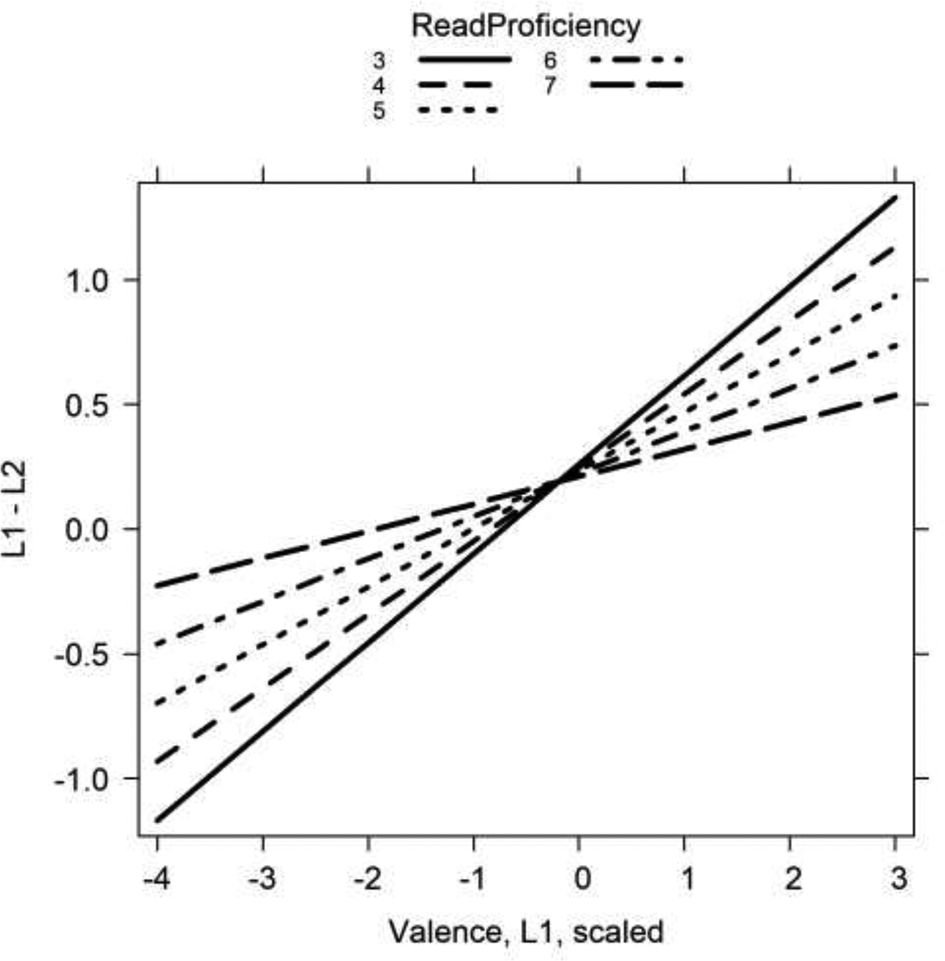
Subjective measures of English proficiency showed a statistically reliable interaction. The greater a participant's self-reported reading proficiency, the more native-like their ratings were (see Figure 2 for the interaction plot and Table 2 in the appendix for specification of the model). Furthermore, we found a significant effect of word frequency – more frequent words were rated more native-like than less frequent words. In sum, the attenuated magnitude of emotional responses in L2 speakers is observed in participants with low subjective English proficiency and less frequent words, but less so in highly proficient L2 English speakers.
Effect of L1 valence ratings on the L1-L2 difference in valence ratings, broken down by 5 levels of subjective English reading proficiency.

Fixed effects of a regression model fitted to the L1-L2 difference in valence ratings, with a critical interaction of valence by subjective English reading proficiency (EngReadN) and a main effect of log transformed word frequency (lFreq). cValence stands for centred L1 valence. Number of observations: 69342, by-item SD = 0.66, by-participant SD = 0.49, residual SD = 1.63.

Embodied emotion
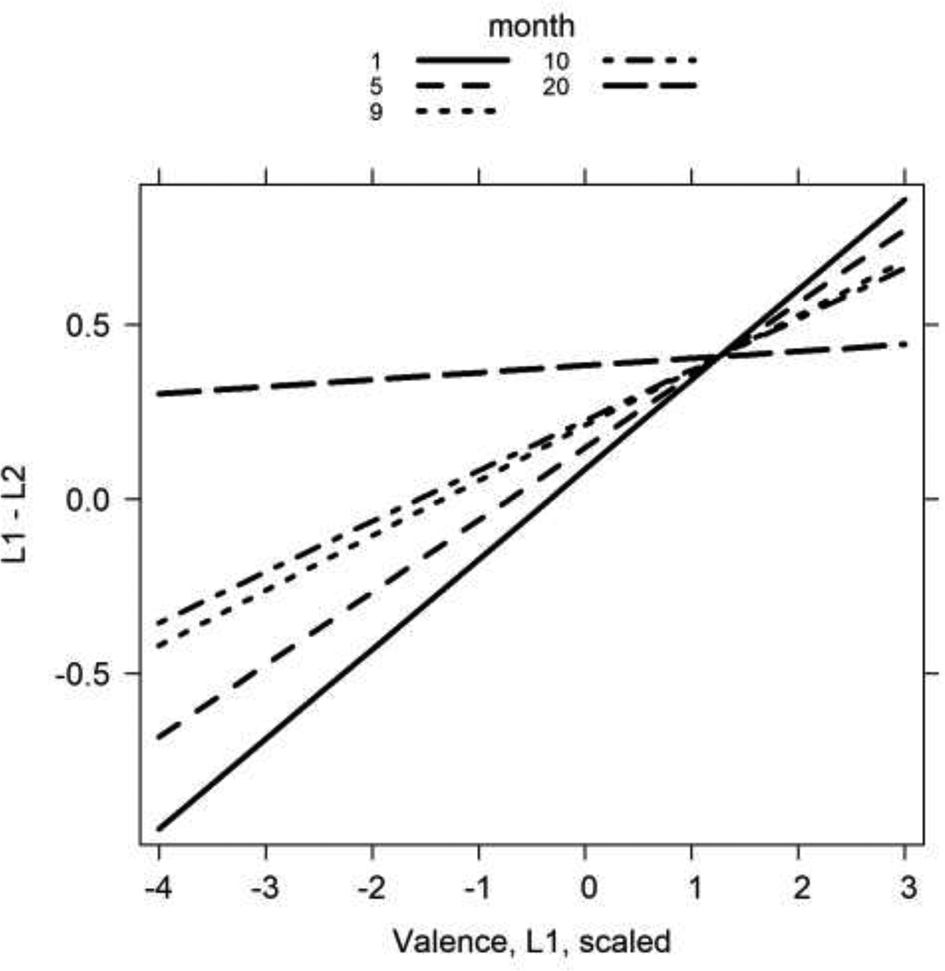
We fit a separate linear mixed-effects multiple regression model to the difference between L1 and L2 ratings as a dependent variable and time spent in Canada as an independent variable. We centred the estimates of L1 valence and square-root transformed months in Canada for improved interpretability of the model. Random effects included random intercepts by word and by participant. Time lived in Canada, used as a proxy for the amount of English embodiment, demonstrated a reliable modulating effect on the relationship between L1 valence ratings and the L1-L2 difference, see Figure 3 for the interaction plot and Table 3 in the Appendix for specification of the model. L2 speakers with a longer time lived in Canada showed emotional responses that were more similar to those by L1 speakers of English, see Figure 3.
Effect of L1 valence ratings on the L1-L2 difference in valence ratings broken down by five levels of the time lived in Canada (in square-root transformed months).

Fixed effects of a regression model fitted to the L1-L2 difference in valence ratings, with a critical interaction of valence by square-root transformed time lived in Canada (sqrtmonth). cValence stands for centred L1 valence. Number of observations: 69333, by-item SD = 0.66, by-participant SD = 0.49, residual SD = 1.63.

We cannot test both the proficiency account and the embodiment account into a single model. Subjective English proficiency and length of time in Canada are strongly correlated (0.54, df = 70347, p < 0.001). It is therefore statistically infeasible to tease apart the effects of these two crucial predictors. It is likely that both English proficiency and English embodiment play overlapping and separate roles in the processing of English emotionality. Furthermore, our estimate of the length of residence in Canada is likely a more accurate measure than subjective English proficiency rating. This could further lead to variability within our results and increase our inability to compare two theoretical accounts.
To further investigate the effects of embodiment on emotionality, it is possible that an L2 speaker primarily uses their L1 rather than L2 to discuss topics related to swear or taboo words, but predominantly uses L2 rather than L1 to communicate in a professional setting. In this case, the emotionality of swear or taboo words in their L2 will deviate more from that in their L1, whereas their work-related lexicon might elicit similarly strong or even stronger emotional responses in their L2 than in their L1. This approach predicts a substantial variability in how similar L1 and L2 emotional responses to words are, depending on the semantic domains of the lexicon.
We tested this account by examining whether the discrepancy between L1 and L2 ratings varied by topic. To this end, we selected several topics from the LIWC, a dictionary of over 5 thousand words distributed over semantic categories (Pennebaker, Booth & Francis, Reference Pennebaker, Booth and Francis2007). For each topic, we sought to establish whether the difference between L1 and L2 judgments of valence was stronger than that observed across the entire word set.
We cannot fully account for circumstances in which participants in our study tend to use English or their L1. For this reason, we selected for examination the topics that the prior literature found to elicit much weaker emotional responses in L2 speakers than in L1 speakers: e.g., swear, taboo and sex-related words, and words denoting positive and negative emotions. Additionally, given that the present study's cohort consisted of bilingual students in a Canadian university, we assumed that topics related to occupation and achievement would correspond to the experiences in which participants in our study use English equally or more often than their L1. Furthermore, these professional contexts where our bilingual students use English are less conducive to using words we expect to be less emotional (swear, taboo and sex-related words). If a group of words are less emotional in our bilingual's L2, we expect a weak-to-no correlation between the difference in L1 and L2 ratings and the L1 rating of each word. If a group of words are more emotional in our bilingual's L2, we expect a stronger correlation between L1-L2 and L1 rating.
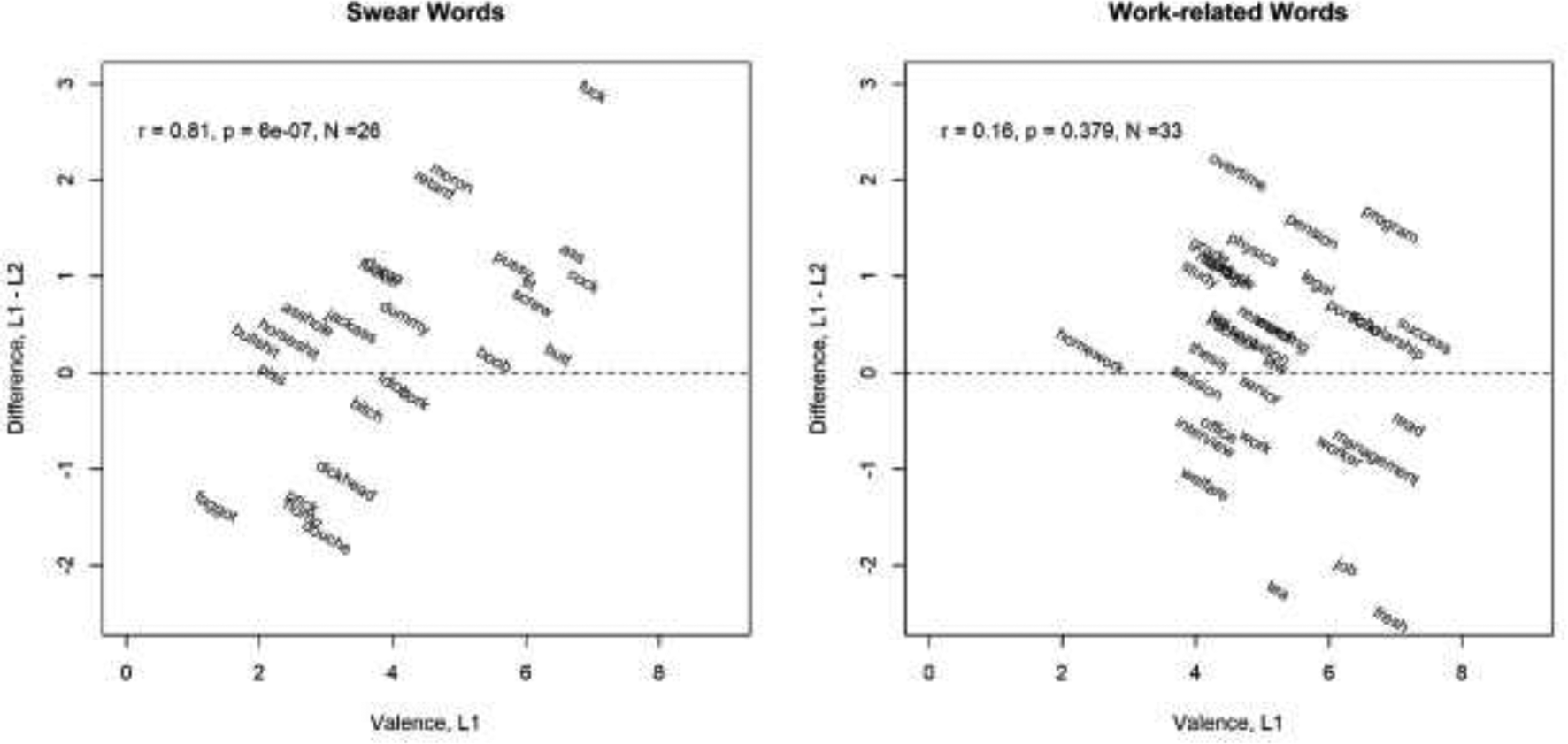
Data fully supported predictions of the embodied approach and were in agreement with prior literature demonstrating that swear and taboo words become less emotional with each subsequently learned language among multilinguals (Dewaele, Reference Dewaele2004). Twenty-six swear, taboo and sex-related words overlapped across the LIWC category “swear” and our word list. These words showed the strongest difference between L1 and L2 judgments. Figure 4a plots the L1–L2 difference in valence ratings against L1 valence ratings for these words, with jitter between words added for legibility. The plot shows that taboo words judged as positive by L1 speakers (e.g., cock, screw, butt) were consistently judged as much less positive by L2 speakers; while very negative L1 judgments (e.g., douche, faggot, prick) rendered a much less negative response from L2 speakers of English. The correlation between the L1 valence ratings and the L1-L2 difference in ratings was 0.81 (df = 24, p < 0.001). As indicated by the Fisher r-to-z transformation, this correlation was significantly stronger (p < 0.001) than the one observed in the entire dataset (0.40, df = 2282, p < 0.001).
Difference between L1 and L2 valence ratings to a. swear, taboo and sex-related words and b. work-related words plotted against L1 valence ratings to those words. Jitter added for legibility.

A similar tendency was observed in the comparison of L1 and L2 ratings to words from the “negative emotion” and “positive emotion” categories in the LIWC dictionary. A set of 104 LIWC words associated with negative emotions showed a correlation of 0.52 (df = 116, p < 0.001) between the L1-L2 valence difference and L1 ratings, indicating again a significantly stronger (the Fisher r-to-z transformation p < 0.001) tendency for L2 speakers of English to elicit less extreme emotional responses to words with extremely unpleasant meanings. In a somewhat weaker way, L2 speakers showed a less positive response to 66 words associated with positive emotions, as compared to L1 speakers of English: the critical correlation was 0.45 (df = 74, p < 0.001), which is significantly stronger than the baseline correlation observed in the entire dataset.
In agreement with our predictions about the preferred use of English in the professional life of our bilinguals, we found an unreliable correlation (0.16, df = 31, p = 0.379) between the L1-L2 difference in valence ratings and L1 valence ratings in 33 words from the LIWC “work” category, see Figure 4b. This trend was not significantly different from the baseline correlation that we observed in the entire dataset (0.40, df = 2282, p < 0.001). Furthermore, differences between L1 and L2 valence ratings to work-related words were less disperse than those to swear words (IQR 1.03 vs IQR 1.23) and were centred around the zero difference (median 0.02). This contrasts with a clear tendency for L2 speakers to respond less emotionally to swear words compared to L1 speakers of English (median L1-L2 valence difference was 0.31), In general, the L1-L2 differences were much less consistent in work-related words. For some of them, L2 raters showed less positive ratings and for some equally emotional. We believe that the difference between two groups of words originates in the different sources of experience that L2 readers have with using work-related and swear words. We conclude that L2 speakers showed relatively little emotional attenuation in the professional lexical domain, but showed a substantial attenuation in responses to swear words.
It could be possible that one of the reasons we find a difference in swear and taboo words, but not work-related words, is that swear words have a larger range of available emotions, and work-related words have a limited range of emotions available. We found the opposite case; our work-related words had a larger L1 valence range than swear words (work: range = 3.00–7.49, mean = 5.30, SD = 1.20; swear: range = 2.33–5.76, mean = 4.44, SD = 1.20). The differences in L1 and L2 ratings are not due to the limited range of work-related words, but seemingly the contexts in which these words arise. We speculated that the topic of achievements would also be one that participants in our study would discuss more often in English than in their L1. There was no reliable correlation (0.06, df = 28, p = 0.77) between the L1-L2 valence difference and L1 valence ratings in the 31 words from the LIWC “achievement” category.
General discussion
Here, we report the largest available dataset of English affective norms (valence and arousal) collected from L2 speakers of English, available in the Supplementary Materials (Supplementary Materials). Overall, we found a general tendency for L2 speakers to have attenuated valence judgements compared to L1 speakers. With a possible exception of well-anchored extremely emotional words, L2 speakers appear to be less emotionally engaged when judging words in a foreign language. In contrast to many earlier studies that concentrated on only negative words in their comparison of L1 and L2 emotionality (but see Sheikh & Titone, Reference Sheikh and Titone2015), we examined the differences across the entire valence range and observed that the pattern of attenuating emotionally extreme responses is present at both ends of the valence scale, but is more salient in the negative subrange of valence, consistent with the findings of Sheikh and Titone (Reference Sheikh and Titone2015).
These findings contrast with two previously collected datasets comparing explicit affective ratings to words in a bilingual's L1 and L2 (Velez-Uribe & Rosselli, Reference Velez-Uribe and Rosselli2019; Winskel, Reference Winskel2013). Velez-Uribe and Rosselli (Reference Velez-Uribe and Rosselli2019) found that bilinguals rated positive and negative words as more emotional in English (L1), and rated taboo words more emotional in Spanish (L2). Winskel (Reference Winskel2013), on the other hand, found no difference between Thai–English bilinguals’ ratings of neutral and negative English and Thai words. These differences can be accounted for by two reasons. Firstly, both of these studies had small, linguistically homogeneous samples. Secondly, both studies compared a small sample of words. Furthermore, both studies had their bilinguals rate both languages, which could affect how semantically linked the L1 and L2 translations of each word were in the study.
We investigated two interdependent classes of theories regarding these differences in emotional language between L1 and L2 speakers. The first class of theory, exemplified by Perfetti's (Reference Perfetti2007) Lexical Quality Hypothesis, proposed that the difference between L1 and L2 readers of English is simply due to a degraded mental representation of the word. Due to their less extensive and diverse experience with words in L2, bilinguals may be expected to demonstrate a less precise and entrenched knowledge of both the denotations and emotional connotations of those words than their L1 counterparts (Hellman, Reference Hellman2011; Wolter, Reference Wolter2001). This semantic knowledge would be particularly incomplete in situations that do not provide sufficient learning opportunities: either words only occurring rarely in language use, or bilinguals not having substantial exposure to L2, or both. In order to support this theory, our data would have to suggest that the word's frequency should play a vital role in the difference in L1 and L2 readers. Additionally, L2 proficiency should play a role in how L2 raters respond to the word – if the word is well represented in an L2 rater's mind (higher proficiency), more proficient L2 readers should rate words similarly to L1 raters.
Our data supported these claims – we found a significant effect of the frequency of a word impacted the way L2 raters responded to the emotion of that word. More frequent words resulted in more native-like affective responses. Furthermore, self-rated L2 reading proficiency significantly interacted with the difference between L1 and L2 raters – more proficient raters gave responses that resembled L1 raters.
The second class of theories is exemplified by Barsalou's (Reference Barsalou1999) Embodied Theoretical Approach to Language. It is also evident in other theories such as Dual Coding Theory (Clark & Paivio, Reference Clark and Paivio1991), the Emotional Contexts of Learning theory (Harris et al., Reference Harris, Gleason and Ayçiçeǧi2006), and recent work by Kousta et al. (Reference Kousta, Vigliocco, Vinson, Andrews and Del Campo2011). Collectively, these approaches propose that word representation is encoded not only by meaning, but also by our sensorimotor and emotional interactions with that word. That is, traces of episodic memory that encode a word's orthography, phonology and semantics during exposure to a word also encode the bodily and emotional states of the person during that exposure (Kousta et al., Reference Kousta, Vigliocco, Vinson, Andrews and Del Campo2011; Clark & Paivio, Reference Clark and Paivio1991). This general approach highlights the role of behavioural ecology, i.e., the differential use of one's native and non-native languages in a spectrum of communication settings. To support this class of theories, we would need to find evidence that L2 reader's use of English affects their emotional responses to specific words.
Here again, our data show that may be the case – words which were used by the L2 readers (language used in a university setting) showed less difference between L1 and L2 ratings than words that were seldom used by the L2 readers (words which they would use at home with their friends and family, such as swear or taboo words). This supports the hypothesis that a word's emotionality is not only encoded by knowing the meaning of the word but interacting with that word in a second language. These findings are not conclusive due to the fact that we are only comparing two semantic categories, but they shed some evidence that differences between L1 and L2 speakers are due to embodiment and real-world, ecologically valid use of the English language.
Furthermore, we found that the length of time spent in an English-speaking country significantly affected how L2 raters responded to words. We found that the longer L2 readers spent in Canada, and consequently, the more sensorimotor interaction they have had with English, the more similar they were to L1 speakers of English. More specifically, an increase in real-world L2 exposure appears to gradually offset the attenuation of emotional responses characteristic of non-native use of L2 and engenders a more intensive, native-like emotional engagement with L2 lexical material. Thus, we conclude that word meaning and emotionality is created and stored as complex mental representations built by a wide variety of encodings, including verbal and sensorimotor encodings.
The present dataset does not allow for disentangling contributions of English proficiency and immersion in the English-speaking environment to the mastery of emotional connotations of English words. A future investigation of this question might require a fairly specific population: a) people who vary in their English proficiency but have not lived in an English-speaking country and thus had no immediate experience with the ecology of using emotional words, or b) individuals who are matched on their level of English proficiency but have different durations of residence in an English speaking country. Population (a) may be found among international students arriving for their studies in an English-speaking country; population (b) may be found among recent and non-recent immigrants enrolled in a language course of a given level.
Our findings are in agreement with other studies that have found that the more everyday interactions a bilingual has with a given word or concept, the more emotional that word becomes. Puntoni, de Langhe, and van Osselaer (Reference Puntoni, de Langhe and van Osselaer2009) found the more a concept is used in an L2 environment (rather than L1), the more emotional it becomes in a bilingual's second language.
It is important to note that, with the current dataset, we cannot fully disentangle the differences in emotional strength between concepts and words. In this paper, we have treated concepts and words as a single unit, but this is not necessarily the case in a bilingual's mental lexica. When we learn a word in our first language, we learn the word and concept from the environment around us. On the other hand, a bilingual may learn the word in a second language inside a classroom (with little to no interaction), while having the concept from their first language. It could be that the embodied accounts are looking at the strength of this connection – from the concept to the word in a second language. As we become more proficient in a second language, this connection is strengthened, and therefore the emotion of the word/concept is felt more strongly. As MacWhinney (Reference MacWhinney2008) argued, when first learning a first (or second) language, we rely more on our “inner speech” before producing language, and build a mental concept of what is being discussed. This could be the case in second-language learners – they may be building their L2 speech by mentally translating from the L1 into their L2. This could lead to a less direct route from concept to the second-language word that would go away with increased proficiency (and a more direct route from concept to L2 word). Kroll and Tokowicz (Reference Kroll and Tokowicz2005) argued that when we want to utter a word, the concept must first be activated, and then the word becomes active in both the L1 and L2. If we consider a low proficiency bilingual and take both of the ideas into account, it is quite possible that L2 words are more disconnected from their concepts, and this may be why we see less embodiment in low proficiency bilinguals.
Furthermore, another limitation of this paper is the large variance in the number of ratings each word received. This variability is due to the vocabulary size of our participants. When a participant encountered a word that was unfamiliar, participants were able to select “I don't know this word” instead of providing a false rating. This directly impacts the number of ratings each word received. Some words, specifically low frequency words, are less likely to be encountered by our L2 speakers, and therefore receive fewer ratings than higher frequency words. Researchers who use this dataset can choose an appropriate cut-off for the number of ratings a word has received to be used in their studies.
These findings shed light on classic questions in bilingual research which have been previously difficult to disentangle. Although we were unable to determine whether proficiency or embodiment impacted L2 ratings, we hope that researchers can make use of the norms we are presenting, both in experimental work and for further data mining.
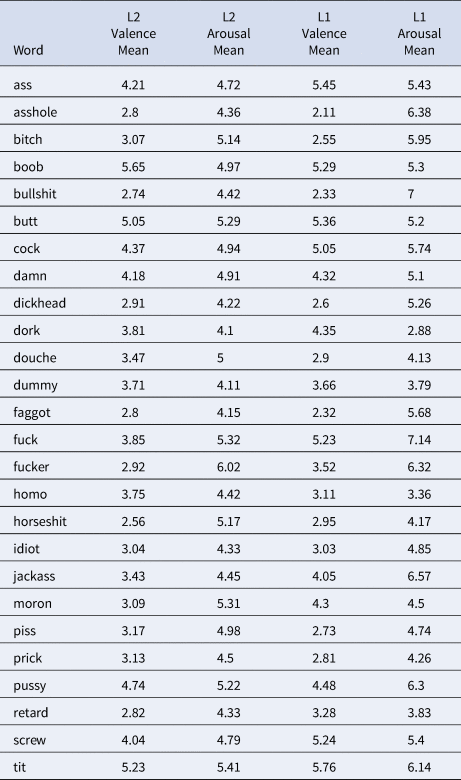
A list of the swear words used in Figure 4, and their corresponding L1 and L2 valence and arousal norms (L1 norms come from Warriner et al., Reference Warriner, Kuperman and Brysbaert2013)

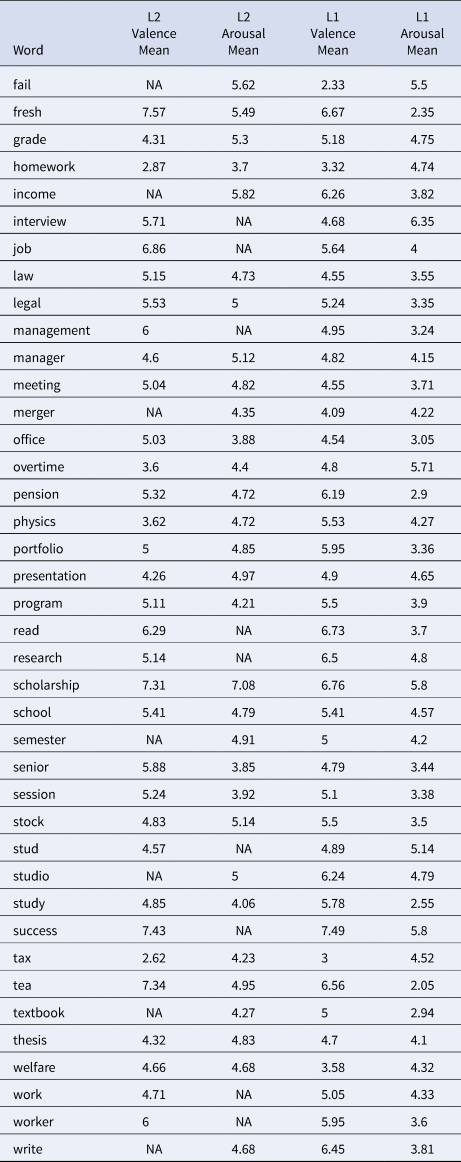
A list of the work-related words used in Figure 4, and their corresponding L1 and L2 valence and arousal norms (L1 norms come from Warriner et al., Reference Warriner, Kuperman and Brysbaert2013).

Supplementary Material
For supplementary material accompanying this paper, visit https://doi.org/10.1017/S1366728920000474
Appendix
Availability
Ratings of valence and arousal are available at https://osf.io/nr9wj/?view_only=d731c1111f7048a492e6a5cdb88c081b in .csv format. Every value is reported two times, prefixed with “L1” (Native English Speakers, as reported in Warriner et al., Reference Warriner, Kuperman and Brysbaert2013) or “L2″ (Non-native English Speakers), followed by either “Val” (valence) or “Aro” (arousal). For each word, we report the overall mean (L2.Val.Mean), standard deviation (L2.Val.SD), and the number of contributing ratings (L2.Val.N). Additionally, we suffixed some columns with “Young” to indicate ratings from a similarly aged L1 population reported in Warriner et al. (Reference Warriner, Kuperman and Brysbaert2013). Some ratings may appear with an “NA”. This indicates that there were not enough L2 raters to rate that dimension of that particular word.