Oxadiazon is a protoporphyrinogen oxidase (PPO)-inhibiting herbicide in the oxadiazole chemical family (Duke et al. Reference Duke, Lee, Duke, Reddy, Sherman, Becerril, Nandihalli, Matsumoto, Jacobs and Jacobs1997; Senseman Reference Senseman2007). Oxadiazon is utilized for control of annual grasses such as goosegrass and crabgrass (Digitaria), and also broadleaves such as carpetweed (Mollugo verticillata L.) and Florida pusley (Richardia scabra L.) (Derr Reference Derr1994; Johnson Reference Johnson1976). Due to the possibility of oxadiazon-induced turfgrass phytotoxicity, oxadiazon is typically applied either on a granular carrier to dry green turfgrass or as a liquid foliar application to dormant turfgrass (Kelly and Coates Reference Kelly and Coats1999). As a PPO-inhibiting herbicide, oxadiazon does not inhibit turfgrass root development as do mitotic-inhibiting dinitroaniline herbicides and dithiopyr (McCarty et al. Reference McCarty, Porter and Colvin1995). Oxadiazon can even be utilized during establishment of bermudagrass (various Cynodon dactylon or Cynodon dactylon×Cynodon tranvaalensis) by sprigging or stolonizing because it is safe for developing roots (Bingham and Hall Reference Bingham and Hall1985; Bingham and Shaver Reference Bingham and Shaver1981). Oxadiazon is generally perceived to be more effective in controlling goosegrass than the dinitroaniline herbicides, a difference in control that is exacerbated by populations with resistance to mitotic inhibitors (Bingham and Shaver Reference Bingham and Shaver1981; Dernoeden et al. Reference Dernoeden, Watschke and Mathias1984; Johnson Reference Johnson1976; Mudge et al. Reference Mudge, Gossett and Murphy1984).
Goosegrass has C4 carboxylation and is typically considered to be an annual, but can perennialize in tropical environments (Buker et al. Reference Buker, Steed and Stall2002). Goosegrass has a white to almost silver appearance at the center of the plant, giving rise to the alternative common name “silver crabgrass” (Holm et al. Reference Holm, Plucknett, Pancho and Herberger1977). Goosegrass is considered one of the five worst weeds in the world and is commonly found growing in areas of high traffic with soil compaction or in areas of poor drainage (Holm et al. Reference Holm, Plucknett, Pancho and Herberger1977; McCarty Reference McCarty1991). On athletic fields, sidelines, goal mouths, and areas between hash marks are commonly infested by goosegrass. On golf courses, areas around cart paths, tee boxes, and putting greens are places goosegrass infestations commonly occur. Not only is goosegrass unsightly, but it can compete with the desirable turf stand and cause a putting green to be uneven. Furthermore, goosegrass presents a problem because of herbicide resistance and a lack of control options. Goosegrass ranks fourth out of all herbicide-resistant weeds, with a total of 45 reported cases of resistance to seven sites of action (Heap Reference Heap2017).
Herbicides that provide selective goosegrass control are limited, especially for use in bermudagrass turf. For example, dinitroanilines, dithiopyr, indaziflam, foramsulfuron, metribuzin, and oxadiazon can be used to control goosegrass in bermudagrass turf, however, each presents specific limitations. Dinitroanilines and dithiopyr are generally viewed as inferior for goosegrass control compared to oxadiazon and indaziflam (McCullough et al. Reference McCullough, Yu and de Barreda2013; Mudge et al. Reference Mudge, Gossett and Murphy1984). Indaziflam, however, can injure bermudagrass on high-sand soils such as constructed root zones, and can hamper bermudagrass development (Brosnan et al. Reference Brosnan, Breeden, Thoms and Sorochan2014; Jones et al. Reference Jones, Brosnan, Kopsell and Breeden2013). Foramsulfuron can control goosegrass with acceptable bermudagrass safety, however, multiple applications are normally required (Busey Reference Busey2004). Metribuzin can control goosegrass postemergence but unacceptable bermudagrass injury can occur and resistance has been reported (Brosnan et al. Reference Brosnan, Nishimoto and DeFrank2008).
As of early 2017, The International Survey of Herbicide Resistant Weeds reports 22 cases of resistance to PPO inhibitors (Heap Reference Heap2017). Further, despite almost three decades of PPO-inhibiting herbicide usage (beginning in the late 1980s), the first report of resistance did not occur until 2001, and 13 of the 22 cases occurring since 2011 (Heap Reference Heap2017). (Not all cases presented in scientific literature have been reported to the International Survey of Herbicide Resistant Weeds). A biotype of common waterhemp (Amaranthus rudis Sauer) in Kansas treated for consecutive years with acifluorfen was found to be 4 to 34 times more resistant to acifluorfen, lactofen, fomesafen, and sulfentrazone than were nonresistant biotypes (Shoup et al. Reference Shoup, Al-Katib and Peterson2003). Researchers in Brazil have identified cross-resistance to PPO- and acetolactate synthase (ALS)-inhibiting herbicides in populations of wild poinsettia (Euphorbia heterophylla L.) (Trezzi et al. Reference Trezzi, Felippi, Mattei, Silva, Nunes, Debastiani, Vidal and Marques2005). In a separate population of common waterhemp collected in Illinois, resistance to PPO-, ALS-, and photosystem II–inhibiting herbicides was determined to be caused by a third encoded protox encoding gene, PP2XL, that contained a glycine deletion at position 210 (Patzoldt et al. Reference Patzoldt, Hager, McCormick and Tranel2006). Normally, PPO is encoded by two separate nuclear genes in plants, PPX1 and PPX2 (Lee et al. Reference Lee, Hager and Tranel2008; Patzoldt et al. Reference Patzoldt, Hager, McCormick and Tranel2006). PPX1 is a nuclear-encoded plastid utilized form, whereas PPX2 is nuclear encoded and utilized by mitochondria (Lee et al. Reference Lee, Hager and Tranel2008). It was predicted that common waterhemp plastid and mitochondrial PPO is encoded by a single gene: PPX2L (Patzoldt et al. Reference Patzoldt, Hager, McCormick and Tranel2006). To date, no weed species in any turfgrass management system has evolved resistance to PPO-inhibiting herbicides such as oxadiazon, nor has any weed species evolved resistance to oxadiazon.
Goosegrass plants that were not controlled by oxadiazon treatment were collected in 2014 from golf course fairways in Virginia and North Carolina. Both facilities had greater than 10 years of continuous oxadiazon use. The objectives of this study were to 1) determine if the suspected-resistant goosegrass biotypes are resistant to oxadiazon, and 2) evaluate oxadiazon rate response to develop rate response models.
Materials and Methods
Greenhouse experiments were conducted from January 2015 to June 2015 to determine the effectiveness of oxadiazon applied preemergence on suspected oxadiazon-resistant goosegrass biotypes. Research was conducted at Auburn University Weed Science Greenhouse in Auburn, Alabama. Suspected resistant goosegrass plants were collected from golf course fairways at the Country Club of Virginia, Richmond, Virginia (biotype CCV) and River Bend Golf and Country Club, New Bern, North Carolina (biotype RB). A biotype collected from Alabama Agricultural Experiment Station, Plant Breeding Unit, Tallassee, Alabama (biotype PBU) was included as a susceptible standard with no known history of exposure to PPO-inhibiting herbicides. All the biotypes were propagated separately in a greenhouse environment to increase seed lots for experiments. Seeds were air dried and stored at 4 C until needed. Plastic pots (10-cm diameter) were filled with the surface horizon of a Marvyn sandy loam (fine-loamy, kaolinitic, thermic Typic Kanhapludults) with a pH of 6.5 and 1.1% organic matter. Twenty seeds were planted in each pot at a 0.5-cm depth. Plants were overhead-irrigated three times daily (approximately 0.2 cm each irrigation).
Treatments included oxadiazon (Ronstar FLO, Bayer Environmental Sciences, Research Triangle Park, NC 27709) applied at rates of 0.035, 0.07, 0.14, 0.28, 0.56, 1.12, and 2.24 kg ha−1. Additional comparison treatments included indaziflam (Specticle FLO, Bayer Environmental Sciences) at 0.03 kg ha−1; prodiamine (Barricade, Syngenta Crop Protection LLC, Greensboro, NC 27419-8300) at 0.56 kg ha−1; and a nontreated check. Treatments were applied at 280 L ha−1 using an enclosed spray chamber with a single 8002E nozzle at 32 psi (TeeJet Spray Systems Co, Wheaton, IL 60189). Treatments were applied preemergence approximately one hour after seeding each pot. Pots were lightly mist-irrigated prior to and immediately after herbicide applications. Normal irrigation was resumed 24 h after application. Experiments were conducted as a completely random design, replicated three times, and were repeated in time. Pots were randomized weekly to account for unexplained discrepancies in the greenhouse environment. Data collected were number of emerged seedlings per pot at 42 d after treatment (DAT) and aboveground biomass collected 42 DAT. To determine aboveground biomass, shoots were clipped at the soil surface, dried for 72 h at 60 C, and weighed. At the time of harvest, no plants were observed to be producing seedheads, thus the weights can be considered to be foliar weight only.
Data were subjected to ANOVA using the PROC GLM procedure using SAS 9.4 (SAS Institute Inc, Cary, NC). Fisher’s protected LSD (P=0.05) was used to compare the labeled rate of oxadiazon (1.12 kg ha−1) to industry standard treated and nontreated checks. To facilitate regression analysis, oxadiazon rates were log transformed to create equal spacing between treatments. The nontreated treatment (0 kg ha−1) was transformed to −1.76 to maintain equal spacing among log treatment rates. Seedling emergence counts were converted to percent reduction relative to counts in nontreated pots, and aboveground biomass weight was converted to percent aboveground biomass reduction relative to the weight in nontreated pots. The nontreated mean for seedling emergence and aboveground biomass was used for conversion calculations to determine relative measures. Percent reduction relative to nontreated was used for regression model fitting rather than count or biomass data, because of differences between biotypes with respect to germination in the nontreated check. Data were fitted to an exponential decay model using SigmaPlot 10.2 (Systat Software Inc, London, UK) using an exponential decay function:
 $$y\,{\equals}\,a{\asterisk}{\rm exp}^{{{\minus}b{\asterisk}x}} $$
where y represents goosegrass seedling biotype reduction (%), x represents log-transformed oxadiazon rate (kg ha−1), and b represents the y intercept. Regression equations were used to calculate inhibition values at 50% and 90% relative to that of the nontreated check for each biotype, commonly referred to as I50 and I90 values, respectively, and 95% confidence intervals (α=0.05) were calculated for regression model parameters. Using parameter confidence intervals, confidence intervals were calculated for each I50 and I90 value as a means of comparison among biotypes.
Results and Discussion
The effect of experimental run by herbicide treatment was not significant (P>0.05) for either seedling emergence or aboveground biomass; thus, the data were pooled over experimental run. An herbicide treatment by goosegrass ecotype interaction was observed for seedling emergence and aboveground biomass (P < 0.05).
Comparison of Registered Control Options
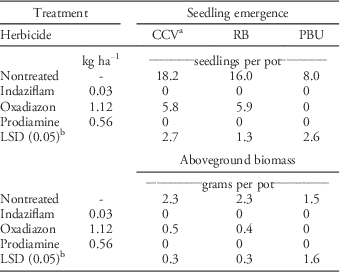
Results presented will focus on comparison of the response of different ecotypes to the labeled rates of oxadiazon, prodiamine, and indaziflam, as well as regression analysis of oxadiazon rates. Indaziflam at 0.03 kg ha−1, prodiamine at 0.56 kg ha−1, and oxadiazon at 1.12 kg ha−1 completely prevented seedling emergence of the susceptible goosegrass biotype PBU (Table 1), resulting in no biomass accumulation. Indaziflam and prodiamine applied at 0.03 kg ha−1 and 0.56 kg ha−1, respectively, completely prevented seedling emergence of suspected resistant biotypes CCV and RB, resulting in no aboveground biomass accumulation 42 DAT. Oxadiazon at 1.12 kg ha−1 allowed six to nine suspected resistant seedlings of CCV and RB to emerge, resulting in 0.5 and 0.4 g biomass accumulation per pot, respectively, 42 DAT. While this is the first report of oxadiazon-resistant goosegrass in the peer-reviewed literature, it is not the first report in non–peer reviewed sources (Askew et al. Reference Askew, Cox and Spak2013; Cox Reference Cox2014). Cox (Reference Cox2014) and Askew et al. (Reference Askew, Cox and Spak2013) reported reduced control of a goosegrass biotype treated with labeled rates of oxadiazon, but found that indaziflam (0.035 or 0.062 kg ha−1), prodiamine (0.84 kg ha−1), and dithiopyr (0.56 kg ha−1) resulted in acceptable control.
Goosegrass seedling emergence (top) and aboveground biomass (bottom) in response to registered-rate, preemergence-applied treatments with different modes of action. Greenhouse experiment; data collected 42 days after treatment.

a Goosegrass biotype abbreviations: CCV, Country Club of Virginia, Richmond, VA, suspected resistant; RB, River Bend Golf Course, New Bern, NC, suspected resistant; PBU, Plant Breeding Unit, Tallassee, AL, known susceptible.
b LSD (P<0.05) value for comparison of means within a common biotype.
Response to Oxadiazon Rate Progression
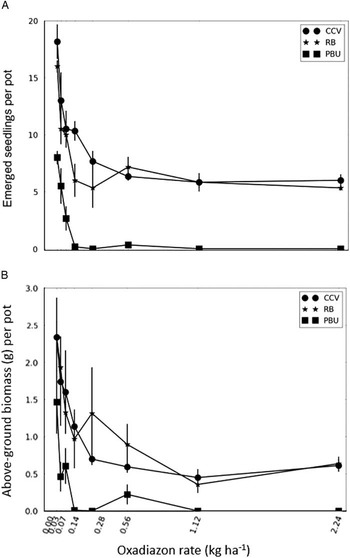
Oxadiazon at rates ≥ 0.14 kg ha−1 completely prevented seedling emergence of PBU seedlings, resulting in no aboveground biomass except for unexplainable minor emergence that occurred at 0.56 kg ha−1 (Figure 1). No oxadiazon rate completely prevented either emergence or biomass of CCV or RB, the two suspected resistant biotypes. Increasing rates of oxadiazon decreased emergence and biomass, but little to no difference was observed for rates from 0.28 to 2.24 kg ha−1. In nontreated pots, susceptible goosegrass PBU had a lower emergence of approximately 8 seedlings per pot, compared to 16 to 18 seedlings per pot in the nontreated pots for suspected resistant CCV and RB goosegrass. To account for this discrepancy in nontreated germination, data were adjusted to percent relative to the nontreated within each biotype prior to regression analysis.
Seedling emergence (A) and aboveground biomass (B) response of four goosegrass biotypes to oxadiazon at increasing rates. Oxadiazon rates have not been log transformed to create equal spacing among treatments. Vertical bars represent standard errors (P=0.05). Goosegrass biotype abbreviations: CCV, Country Club of Virginia, Richmond, VA, suspected resistant; RB, River Bend Golf Course, New Bern, NC, suspected resistant; PBU, Plant Breeding Unit, Tallassee, AL, known susceptible.

Percent emergence relative to the nontreated and percent aboveground biomass response to oxadiazon rate were modeled for all biotypes using exponential decay functions to allow for calculation of I50 and I90 values (Table 2). Prior to regression analysis, oxadiazon rates were converted to log scale to create equal spacing among oxadiazon rates (Figure 2). R2 values for all models were from 0.81 to 0.97. Oxadiazon I50 and I90 values for PBU based on seedling emergence relative to the nontreated were 0.04 and 0.19, respectively (Table 3). Oxadiazon I50 and I90 values for PBU based on aboveground biomass relative to the nontreated were 0.03 and 0.12 kg ha−1, respectively. Across emergence rate and biomass for both biotypes, suspected resistant CCV and RB were calculated to have similar I50 values of 0.12 to 0.18 compared to PBU, with overlapping 95% confidence interval comparison and higher I90 values 10.83 to 85.57 kg ha−1. Seedling emergence data predicted 7.9 and 3.0 times greater I90 values for CCV and RB, respectively, compared to biomass data. Regardless of differences among models, predicted I90 values for CCV and RB were greater than the standard labeled rate of 1.12 kg ha−1.
Percent seedling emergence response (A) and percent aboveground biomass response (B) relative to the nontreated control of three goosegrass biotypes 42 days after treatment with increasing rates of oxadiazon. Response was modeled based on the log rate of oxadiazon to create equal spacing between rates using exponential decay regression of percent emergence number or percent weight (g) per pot relative to the nontreated check. Non–log transformed oxadiazon rates are presented for reference. Means are represented by differing symbols for each biotype and regression equation model are represented by differing line type for each biotype. Vertical bars represent standard errors (P=0.05). Goosegrass biotype abbreviations: CCV, Country Club of Virginia, Richmond, VA, suspected resistant; RB, River Bend Golf Course, New Bern, NC, suspected resistant; PBU, Plant Breeding Unit, Tallassee, AL, known susceptible.

Predictive model with exponential decay equations for percent emerged seedlings and fresh weight in response to increasing oxadiazon rate relative to the nontreated control. Parameter estimate and parameter estimate 95% confidence intervals (CI) are presented as means of model comparison.

a Goosegrass biotype abbreviations: CCV, Country Club of Virginia, Richmond, VA, suspected resistant; RB, River Bend Golf Course, New Bern, NC, suspected resistant; PBU, Plant Breeding Unit, Tallassee, AL, known susceptible.
b In the exponential decay equation, x is oxadiazon rate and y is the response variable of emerged seedlings or aboveground biomass relative to the nontreated check.
Estimated oxadiazon rate required to reduce goosegrass biotype by 50% (I50) and 90% (I90) based on number of emerged seedlings and aboveground biomass harvested 42 days after treatment. 95% confidence intervals (CI) at I50 and I90 values are provided as means of comparison.

a Goosegrass biotype abbreviations: CCV, Country Club of Virginia, Richmond, VA, suspected resistant; RB, River Bend Golf Course, New Bern, NC, suspected resistant; PBU, Plant Breeding Unit, Tallassee, AL, known susceptible.
b I50 and I90 values were calculated based on exponential decay functions.
Research Implications
Resistance to PPO-inhibiting herbicides is relatively rare. The International Survey of Herbicide Resistant Weeds currently reports 10 species resistant to PPO-inhibiting herbicides, compared to 48 species resistant to acetyl-CoA carboxylase–inhibiting herbicides, 159 species resistant to ALS-inhibiting herbicides, and 74 species resistant to photosystem II–inhibiting herbicides (Heap Reference Heap2017). Further, 9 of the species reported resistant to PPO-inhibiting herbicides are eudicots, and only one is a monocot: wild oat (Avena fatua L.). The lack of development of weeds resistant to PPO-inhibiting herbicides is theorized to be the result of a polygenic site of action compared to a monogenic site of action for acetyl-CoA carboxylase–, ALS-, and photosystem II– inhibiting herbicides (Patzoldt et al. Reference Patzoldt, Hager, McCormick and Tranel2006). Herbicides that target monogenic sites of action often result in target site resistance caused by single nucleotide changes (Powles and Yu Reference Powles and Yu2010). Polygenic target site of action resistance, or resistance to herbicides that act on more than one enzyme, would conceivably require changes in all target sites (Patzoldt et al. Reference Patzoldt, Hager, McCormick and Tranel2006). Common waterhemp has avoided the necessity of dual mutation through duplication of the PPX2 to PPX2L, which contains a codon deletion and is also utilized in both mitochondria and plastids following translation (Patzoldt et al. Reference Patzoldt, Hager, McCormick and Tranel2006). PPO-resistant common ragweed (Ambrosia artemisiifolia L.) was found to contain a single nucleotide polymorphism in only one of the two PPO target sites, PPX2 (Rousonelos et al. Reference Rousonelos, Lee, Moreira, VanGessel and Tranel2012).
We have yet to decipher the resistance mechanism evolved by CCV and RB goosegrass. The observed resistance of RB and CCV goosegrass could be described as incomplete resistance, because it does not completely eliminate herbicidal activity and results in the death of some seedlings within a population. Similar incomplete PPO-inhibiting herbicide resistance response has been observed with tall waterhamp (Amaranthus tuberculatus (Moq.) Sauer) (Shoup et al. Reference Shoup, Al-Katib and Peterson2003).